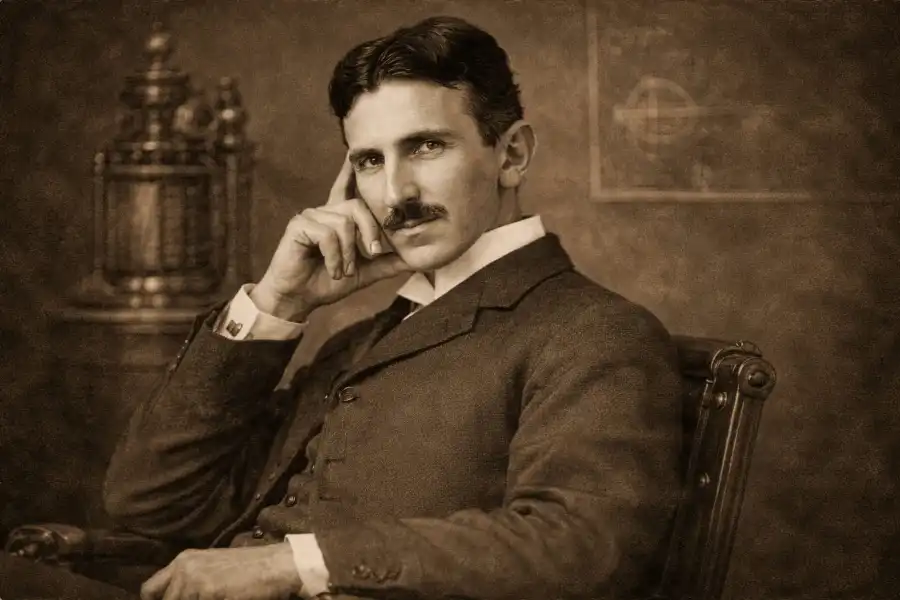
Nikola Tesla was a Serbian-American inventor and electrical engineer whose revolutionary work on alternating current (AC), wireless communication, and electromagnetic fields transformed modern civilization. Despite inventing technologies that power our world today—from AC electricity systems to radio, X-rays, and remote control—Tesla died penniless and largely forgotten while his rival Thomas Edison received widespread acclaim. This is the untold story of how Tesla's genius shaped the 20th century, why his groundbreaking inventions were stolen or suppressed, and how this visionary scientist predicted Wi-Fi, smartphones, and renewable energy decades before they became reality.
Table of Contents
Who Was Nikola Tesla?
When we think about great inventors, the first name that comes to mind is Thomas Edison. We have all learned about his inventions which light up our world today. But there is someone who was far more talented and contributed more to these discoveries than Edison—a visionary whose innovations truly shaped the modern world.
What if I told you that the real hero was a Serbian-American scientist called Nikola Tesla and that Edison was more of a business person than a scientist? Tesla's groundbreaking work on alternating current and wireless power transmission revolutionized how we generate and use electricity today.
Early Life of Nikola Tesla
Nikola Tesla was a Serbian-American inventor, electrical engineer, and physicist born on July 10, 1856, in Smiljan, the Austrian Empire (present-day Croatia). From an early age, he showed exceptional talent in mathematics and physics. In school, he became fascinated by electricity demonstrations from his physics professor, sparking a lifelong passion for electrical innovation.
Tesla possessed an extraordinary intellect—he could perform integral calculus in his head and earned the highest grades at the Austrian Polytechnic. However, personal struggles including gambling problems derailed his education after his father's death. Despite his genius, he never completed his university degree and suffered a nervous breakdown in March 1879. Undeterred, in 1881 he moved to Budapest to work for a telegraph company, beginning his journey toward revolutionizing electrical power.
Nikola Tesla vs. Edison
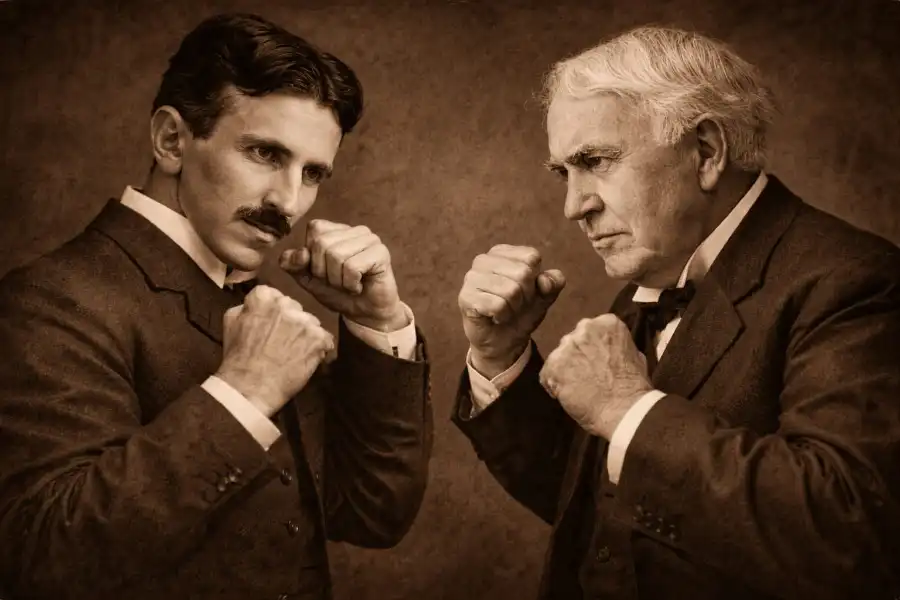
In 1884, Tesla moved to the United States after being invited by Charles Batchelor, manager of the Edison Machine Works, to work in Edison's New York facility. Initially, Tesla impressed Edison with his diligence and deep understanding of electrical systems. The two brilliant minds worked together briefly on Edison's direct current technology.
However, the partnership was short-lived. Edison challenged Tesla to improve his DC dynamos, offering $50,000 as a reward—a fortune at the time. After months of intensive work, Tesla delivered an improved design. Yet when he asked for his reward, Edison refused, dismissing it as a joke: "Tesla, you don't understand our American humor." This betrayal would fuel Tesla's determination to prove the superiority of alternating current over Edison's direct current systems.
The Battle of the Currents
After leaving Edison, Tesla founded the Tesla Electric Light Company to pursue his vision of alternating current technology. He patented his improved arc lighting system using AC. However, investors showed little interest in his ideas for AC motors and long-distance power transmission. Facing financial abandonment and loss of patents, Tesla was left destitute.
To survive, he worked manual labor jobs, even as a ditch digger for $2 a day. During this dark period in 1886, he wrote in despair, "My high education in various branches of science, mechanics, and literature seemed to me like a mockery." However, fate intervened when Tesla met Alfred S. Brown and attorney Charles F. Peck in late 1886. These experienced entrepreneurs recognized his genius and agreed to fund his research.
In 1887, Tesla developed the AC induction motor—a revolutionary invention that would transform global electricity distribution. While Edison promoted Direct Current systems as safer, alternating current was gaining popularity for its ability to transmit power over vast distances. Edison's DC generators could only transfer power within a one-mile radius, while Tesla's AC system could transmit electricity over hundreds of miles, making it ideal for powering entire regions efficiently.
"If he had a needle to find in a haystack he would not stop to reason where it was most likely to be, but would proceed at once, with the feverish diligence of a bee, to examine straw after straw until he found the object of his search. ... I was almost a sorry witness of such doings, knowing that a little theory and calculation would have saved him ninety per cent of his labor."
George Westinghouse recognized Tesla's genius and hired him, licensing the patents for his AC motor and providing his own laboratory. Thus began the legendary "Battle of the Currents"—a struggle between Tesla's alternating current system and Edison's direct current for dominance in electricity infrastructure. Although AC was superior for long-distance transmission, Edison was a masterful marketer who knew how to manipulate public opinion.
To discredit AC, Edison launched a propaganda campaign. He even orchestrated the public execution of a convicted murderer using an electric chair powered by alternating current to frighten the public into believing AC was lethal. During the financial panic of 1890, cash shortages affected all companies, and the Tesla motor struggled to gain commercial traction despite its technological superiority.
Tesla's Many Achievements
While Edison won the marketing battle, it was Tesla and his alternating current system that ultimately won the war. AC fundamentally changed how humanity generates and distributes electrical power, and we continue to use it as the worldwide standard today. Beyond AC power, Tesla created numerous groundbreaking innovations.
Tesla developed fluorescent lighting decades before it became commercially available. While Guglielmo Marconi typically receives credit for inventing the radio, it was actually Tesla who developed the technology years earlier. Tesla publicly demonstrated wireless radio transmission in 1893—well before Marconi's work. The U.S. patent office reversed Tesla's radio patents in 1904 and awarded them to Marconi to avoid paying royalties.
Modern radar technology originated from Tesla's pioneering work. Although the first radar unit was built in 1934, it was based on electromagnetic principles that Tesla had conceptualized in 1917. Tesla also invented the remote control—revolutionary in 1898 when he demonstrated the first wireless remote-controlled model boat, using radio signals to control its propeller, rudder, and running lights.
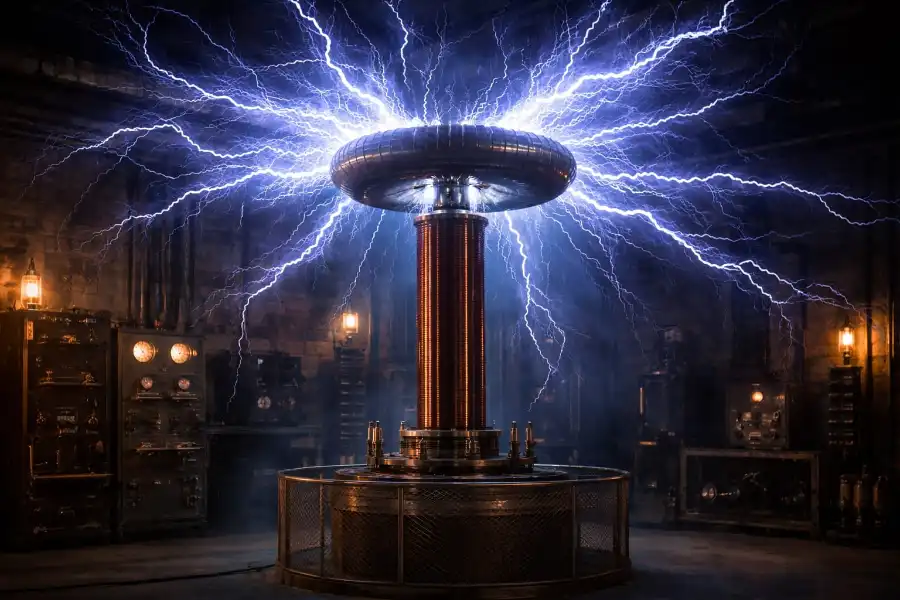
In 1895, Tesla designed the first AC hydroelectric power plant at Niagara Falls—a landmark achievement demonstrating the superiority of alternating current for renewable energy. He also invented the Tesla coil, an electrical resonant transformer circuit developed in 1891 that revolutionized high-voltage, high-frequency current generation. In 1930, Tesla developed an improved electric motor design, though the economic depression and World War II limited its adoption.
Around 1900, Tesla embarked on his most audacious project—wireless power transmission. His plan involved constructing electrical towers for wireless energy distribution, aiming to provide free electricity to the entire world. This concept was decades ahead of its time. However, competition from Marconi (funded by Edison) in radio technology, combined with investor skepticism, doomed the project. As funding evaporated, Tesla faced bankruptcy and the project was abandoned.
Nikola Tesla's Rewards
Although Tesla was extraordinarily talented and made revolutionary breakthroughs, he struggled to commercialize his innovations. He was a pure scientist, not an entrepreneur. Many of his inventions were so far ahead of their time that the world lacked the infrastructure to implement them. Compounding his misfortune, competitors systematically stole his patents. However, some recognition eventually came: In 1943, the U.S. Supreme Court posthumously overturned Marconi's patent on the radio, acknowledging Tesla as the original inventor.
"I don't care that they stole my idea. I care that they don't have any of their own"
Throughout his career, Tesla battled against Edison, who possessed far greater financial resources and marketing savvy. While Edison excelled at promoting inventions, Tesla couldn't compete with his showmanship and corporate backing. Although Tesla's innovations led to revolutionary breakthroughs, many seemed impractical at the time.
Tesla's life was marked by tragedy. In 1895, his laboratory burned down, destroying years of research. He never married, dedicating his life to his work until his health deteriorated. He suffered mental breakdowns and hallucinations in his later years. On January 7, 1943, Tesla died alone, bankrupt and penniless—a tragic end for the inventor whose discoveries power the modern world. His achievements were never fully appreciated during his lifetime.