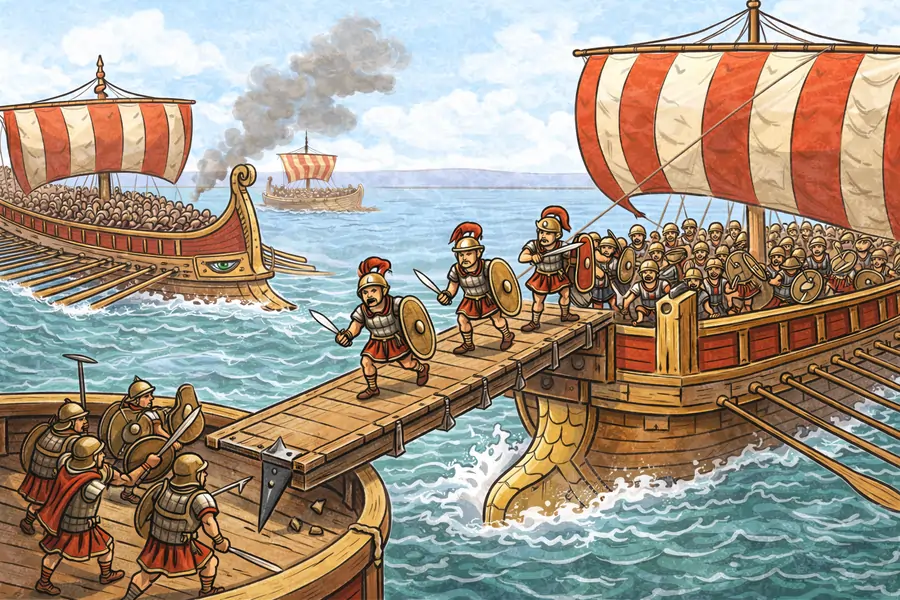
The Roman Corvus was a revolutionary boarding bridge that transformed inexperienced Roman sailors into formidable naval warriors. Introduced during the First Punic War, it allowed Roman legionaries to board enemy ships and fight hand-to-hand, neutralizing Carthage's centuries of naval superiority. This simple yet ingenious invention helped Rome win decisive victories at the Battles of Mylae and Ecnomus, laying the foundation for its emergence as the dominant power of the Mediterranean.
Table of Contents
- Introduction to the Corvus
- The Roman Republic in the 3rd Century BC
- The Carthaginian Empire
- Causes of the First Punic War
- Roman and Carthaginian Military Strength
- Rome's Decision to Build a Navy
- The Corvus: Design and Engineering
- Tactical Purpose of the Corvus
- How the Corvus Changed Naval Warfare
- The Battle of Mylae
- The Battle of Ecnomus
- Psychological Impact of the Corvus
- Limitations and Structural Problems
- Why the Corvus Was Abandoned
- The End of the First Punic War
- Historical Significance
- Aftermath of the Corvus
Introduction to the Corvus
The rise of Rome as the dominant power of the Mediterranean was a challenge that they overcame through struggle. In the early third century BC, Rome was a formidable land power, but it lacked the naval experience required to challenge the greatest maritime empire of the western Mediterranean-the Carthaginian Empire. Yet, within a single generation, Rome was capable of building a huge navy and defeating Carthage in a prolonged naval war. Rome had now emerged as the leading naval power of the ancient world. (Polybius, Histories 1.20-1.23; Goldsworthy, The Fall of Carthage)
At the center of this transformation stood a simple yet revolutionary invention: the Roman Corvus. This boarding device attached to Roman ships allowed Roman soldiers to fight at sea as they fought on land, neutralizing Carthaginian naval superiority and redefining ancient naval warfare. (Polybius, Histories 1.22; Lazenby, The First Punic War)
This article explores in depth:
- The Roman Republic and Carthaginian Empire in the 3rd century BC
- The causes and outbreak of the First Punic War
- The imbalance between Roman and Carthaginian naval power
- Rome's rapid and unprecedented naval reconstruction
- The design, mechanics, and tactical use of the Corvus
- How the Corvus won decisive Roman victories
- The limitations and eventual abandonment of the Corvus
- The end of the First Punic War and its historical consequences
The Roman Republic in the 3rd Century BC
By the early third century BC, the Roman Republic had completed its domination of the Italian peninsula. Through a combination of conquest, alliances, and colonization, Rome had subdued rival peoples such as the Samnites, Etruscans, and Greek city-states of southern Italy. By now, Rome was considered to be a regional power, but it was yet to be a global power. (Livy, Periochae; Polybius, Histories 1.6; Goldsworthy)
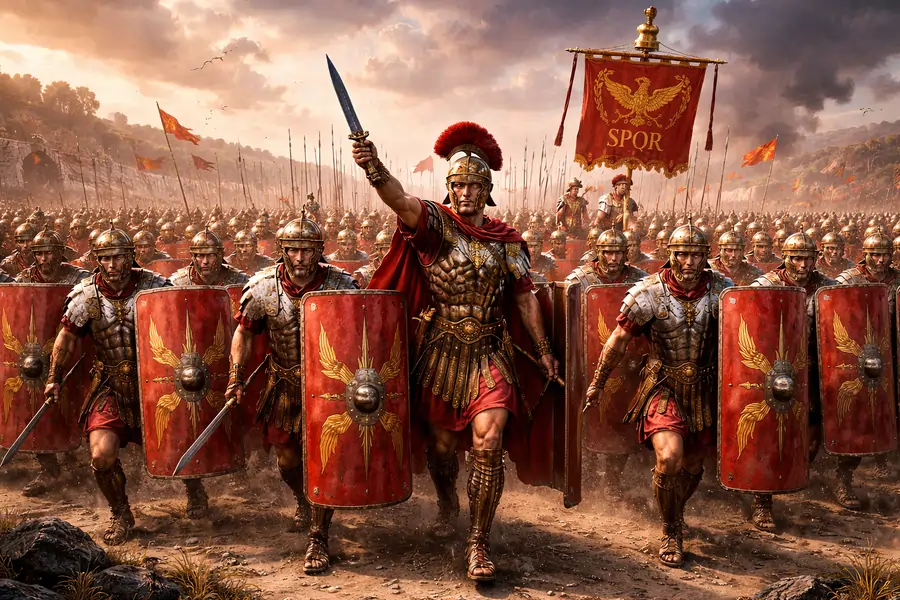
Roman Military Culture
Rome's strength rested almost entirely on its legionary system:
- Heavy infantry armed with a sword (gladius) and a shield (scutum)
- Flexible manipular formations
- Emphasis on discipline, endurance, and close combat
- Citizen-soldiers motivated by land ownership and civic duty
- Superior training and a standing military force.
Roman warfare was decisive and brutal, designed to break enemy resistance through sustained infantry engagement. Cavalry and naval forces played only a supporting role. (Polybius, Histories Book 6; Goldsworthy, The Complete Roman Army)
Roman Naval Weakness
Despite its land dominance, Rome possessed:
- No tradition of blue-water sailing
- No experienced sailor class
- Only small coastal vessels for transport and patrol
- No experience in building military vessels like the Trireme or Quinquereme.
This weakness would become dangerously apparent when Rome's interests collided with those of Carthage in the Mediterranean. (Polybius, Histories 1.20; Lazenby)
The Carthaginian Empire in the 3rd Century BC
Carthage, founded by Phoenician settlers, was fundamentally different from Rome in culture, economy, and military doctrine. (Warmington, Carthage)
Carthaginian Power Base
Carthage was a commercial and naval empire:
- Controlled trade routes across North Africa, Sicily, Sardinia, and Spain
- Possessed immense wealth from trade, farming, and mining
- Maintained permanent shipyards and dockyards
- Fielded the most advanced warships of the era
- Used mercenaries to fight their wars
(Warmington; Hoyos, Mastering the West)
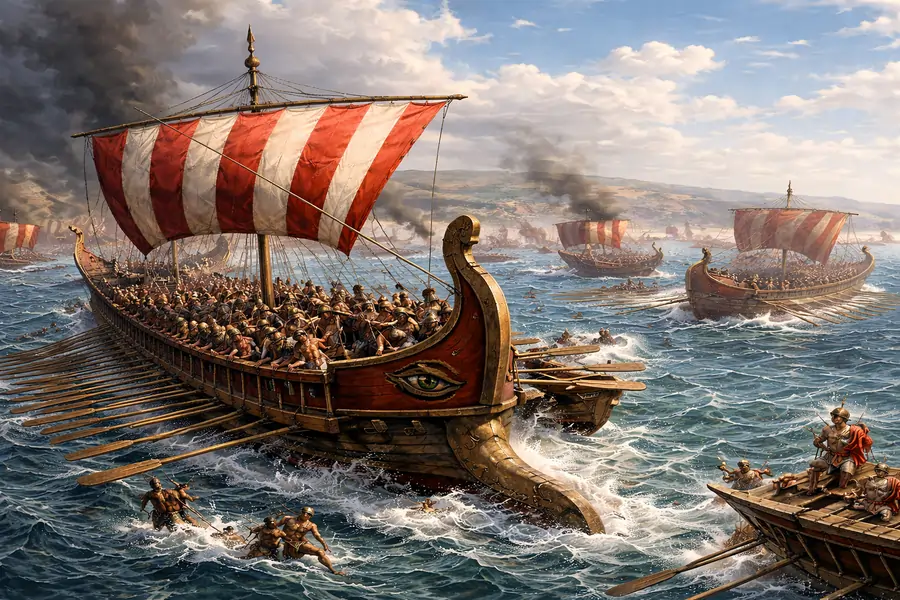
Naval Supremacy
The Carthaginian navy:
- Employed professional sailors and rowers
- Used advanced ramming tactics
- Excelled in ship maneuverability and coordination
- Dominated naval warfare for centuries
Unlike Rome, Carthage viewed naval power not as a supplement but as the foundation of its empire. (Polybius, Histories 1.20; Warmington)
Causes and Outbreak of the First Punic War
The First Punic War erupted in 264 BC, rooted in competition over Sicily, the largest island in the Mediterranean and a critical strategic crossroads. (Polybius, Histories 1.10-1.11)
The Messana Crisis
The immediate spark came from the Mamertines, mercenaries who seized the city of Messana. Threatened by Carthaginian intervention, they appealed to Rome for protection. Rome now faced a dilemma as intervening risked war with Carthage, for which they were not fully prepared. However, inaction risked Carthaginian domination of Sicily and the whole of the Mediterranean. The Roman Senate ultimately chose intervention, marking Rome's first major overseas war. (Polybius, Histories 1.10-1.12; Lazenby)
Roman and Carthaginian Military Strength Compared
Land Warfare
Rome excelled in land based warfare:
| Rome | Carthage |
|---|---|
| Large citizen armies | Skilled but often disloyal mercenaries |
| Unified command structure | Less cohesive than Roman legions |
| Strong discipline and morale | Prone to mutiny if unpaid |
(Polybius, Histories Book 6; Goldsworthy)
Naval Warfare
At sea, the situation was reversed:
| Rome | Carthage |
|---|---|
| Rome had almost no naval experience | Carthage possessed centuries of naval experience |
| Roman crews were inexperienced and poorly trained | Carthaginian fleets dominated maneuver-based combat |
| No naval presence | Hundreds of warships |
This imbalance forced Rome to seek a radical solution. (Polybius, Histories 1.20-1.21)
Rome's Decision to Build a Navy
Recognizing that victory in Sicily required naval control, Rome undertook one of the most extraordinary military projects in ancient history. (Polybius, Histories 1.20; Lazenby)
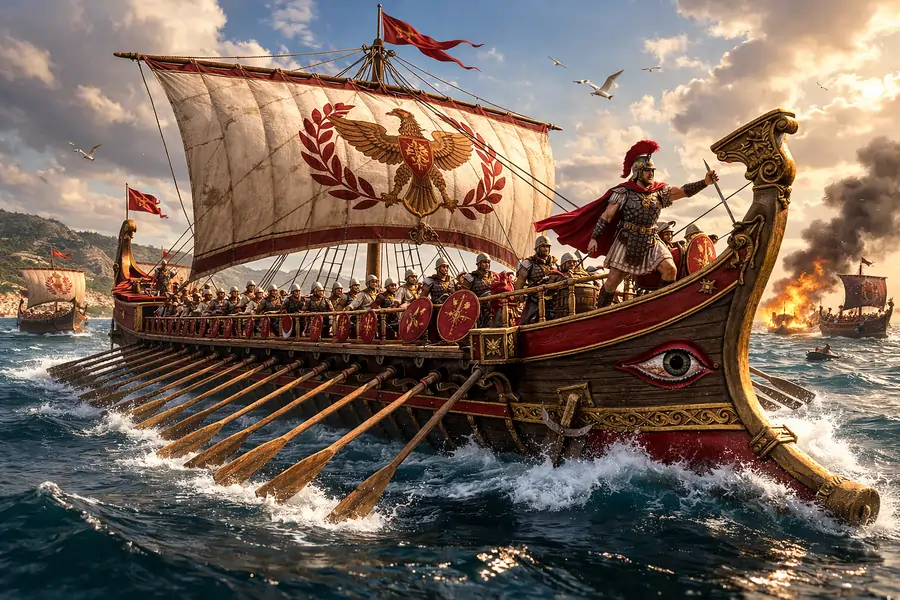
Reverse Engineering Carthaginian Ships
According to Polybius, the Romans captured a Carthaginian quinquereme and used it as a blueprint for their own fleet. Roman shipbuilders copied its design and mass-produced warships using standardized construction methods. Over 100 quinqueremes were reportedly built in a remarkably short period. (Polybius, Histories 1.20; Goldsworthy; Lazenby)
Training an Inexperienced Navy
Rome still lacked the sailors for manning the ships and expertise in naval warfare. They recruited rowers from their citizen population and trained crews on land using rowing benches. They then focused on infantry marines boarding enemy ships rather than seamanship, which they could not master. Rome accepted that it could not out-sail Carthage-but it could outfight it. (Polybius, Histories 1.21-1.22; Goldsworthy)
The Roman Corvus: Design and Engineering
What Was the Corvus?
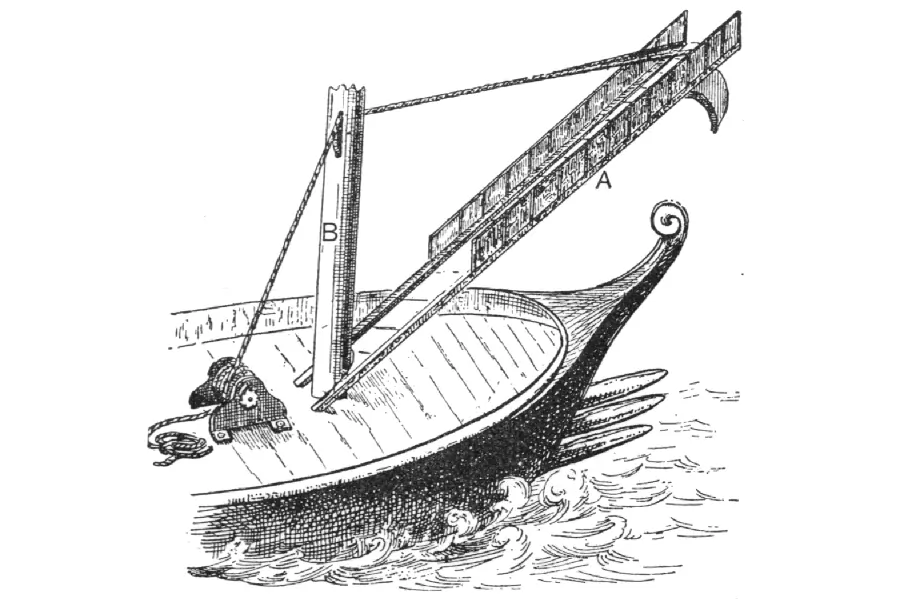
The Corvus (Latin for "raven") was a movable boarding bridge mounted on the prow of Roman warships. It transformed naval combat into a form of land battle conducted at sea, allowing Roman legionaries to exploit their superiority in close-quarters fighting instead of competing with the Carthaginians in maneuver warfare. (Polybius, Histories 1.22; Lazenby, The First Punic War; Goldsworthy, The Fall of Carthage)
Physical Description
- Length: Approximately 10-11 meters (36 Roman feet according to Polybius)
- Width: Roughly 1.2 meters
- Constructed of heavy timber
- Mounted on a vertical pole with pivoting capability
- Fitted with a large iron spike at the end
Polybius describes the Corvus as a long wooden gangway with an iron spike resembling a bird's beak, from which it derived its name. When lowered, the spike embedded itself into the enemy's deck, locking the vessels together and allowing Roman marines to storm aboard. (Polybius, Histories 1.22; Coates, The Age of the Galley)
Mechanical Function of the Corvus
The Corvus could be raised and lowered rapidly and rotated to face approaching enemy ships. Once the enemy vessel came alongside, the bridge was released, causing its iron spike to bite into the opposing deck. This secured the ships together despite the movement of the sea and created a stable crossing for Roman infantry. Although mechanically simple, the device fundamentally altered the nature of naval combat. (Polybius, Histories 1.22; Lazenby)
Tactical Purpose of the Corvus
Roman naval doctrine using the Corvus was straightforward:
- Absorb or evade the initial enemy approach
- Drop the Corvus onto the enemy deck
- Board with legionaries
- Overpower the enemy ship's crew and capture the vessel
Rather than attempting to outmaneuver experienced Carthaginian sailors, Rome deliberately converted naval engagements into infantry battles where its disciplined legionaries held a decisive advantage. (Polybius, Histories 1.22-1.23; Goldsworthy)
The Corvus therefore eliminated much of the importance of maneuver warfare, reducing the effectiveness of Carthage's superior seamanship. (Lazenby; Hoyos, Mastering the West)
How the Corvus Changed Naval Warfare
Neutralizing Ramming Tactics
Carthaginian warships relied on speed, maneuverability, and bronze rams to disable enemy vessels before withdrawing safely. The Corvus fundamentally disrupted this style of warfare by:
- Preventing ships from disengaging after contact
- Forcing prolonged close-quarters combat
- Reducing the importance of superior navigation and seamanship
As a result, Rome largely neutralized the tactical advantages that had made Carthage the dominant naval power in the western Mediterranean. (Polybius, Histories 1.22-1.23; Goldsworthy)
Turning Sea Battles into Infantry Battles
Roman soldiers:
- Fought in disciplined formations
- Used shields and swords effectively in close combat
- Overwhelmed enemy crews who were trained primarily as sailors rather than heavy infantry
- Often enjoyed numerical superiority in boarding actions due to the larger complement of Roman marines
Instead of winning battles through superior seamanship, Rome increasingly relied upon its traditional military strengths-discipline, organization, and heavy infantry combat. (Polybius, Histories 1.23; Goldsworthy, The Complete Roman Army)
This was not naval warfare as Carthage understood it-it was legionary warfare afloat.
The Battle of Mylae (260 BC)
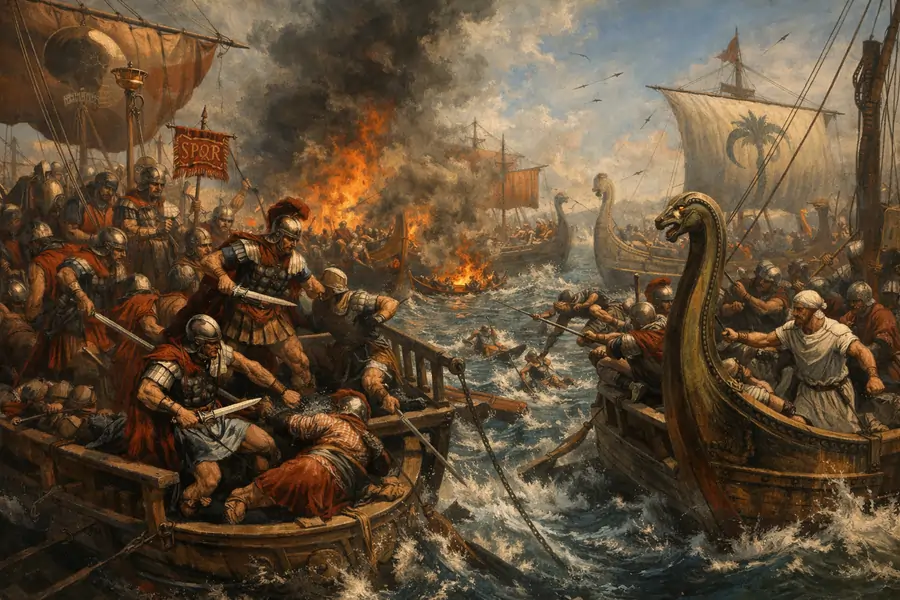
Rome's first great naval victory came at Mylae, where the Corvus proved decisive. The battle marked a turning point in the First Punic War by demonstrating that Rome could defeat the greatest naval power of the age. (Polybius, Histories 1.23; Lazenby)
Battle Overview
The Roman fleet was commanded by Gaius Duilius. Confident in their naval superiority, the Carthaginians advanced aggressively toward the inexperienced Roman fleet. As enemy ships closed, Roman crews lowered the Corvus, locking the vessels together and allowing legionaries to board. The Carthaginian crews, surprised by this unfamiliar tactic, were defeated ship after ship. (Polybius, Histories 1.22-1.23; Diodorus Siculus, Bibliotheca Historica)
Significance
- Rome's first major naval victory
- Demonstrated the effectiveness of the Corvus
- Shattered Carthaginian confidence in their uncontested naval superiority
- Proved that innovation could compensate for Rome's lack of maritime experience
The victory at Mylae significantly boosted Roman morale and established Gaius Duilius as one of the Republic's earliest naval heroes. To commemorate his achievement, the Romans erected the famous Columna Rostrata, decorated with the captured bronze rams of enemy ships. (Polybius, Histories 1.23; Livy, Periochae; Goldsworthy)
The Battle of Ecnomus (256 BC)
One of the largest naval battles in ancient history, the Battle of Ecnomus showcased the Corvus on a massive scale. Many modern historians regard it as one of the largest naval engagements ever fought in terms of the number of ships involved. (Polybius, Histories 1.26-1.28; Goldsworthy; Lazenby)
Strategic Context
- Rome planned a full-scale invasion of North Africa to carry the war into Carthaginian territory.
- The Roman fleet escorted a large invasion force across the Mediterranean.
- Ancient sources estimate that more than 600 warships participated in the battle, although modern historians debate the precise numbers.
- Carthage sought to outmaneuver and divide the Roman formations before they could reach Africa.
(Polybius, Histories 1.26-1.27; Lazenby)
Role of the Corvus
- Allowed Roman formations to maintain cohesion during combat
- Neutralized Carthaginian attempts to exploit superior maneuverability
- Enabled repeated boarding actions against enemy vessels
- Converted another major naval battle into a contest of infantry rather than seamanship
Although the exact extent of the Corvus' use at Ecnomus is debated by some modern historians, Polybius credits Roman boarding tactics with playing a major role in the victory. (Polybius, Histories 1.27-1.28; Lazenby; Goldsworthy)
The Roman victory cleared the way for the invasion of North Africa and confirmed that Rome had evolved from a purely continental power into a formidable naval opponent. (Polybius, Histories 1.29; Goldsworthy)
Psychological Impact of the Corvus
Beyond its physical utility, the Corvus had a profound psychological effect. Carthaginian sailors, who were accustomed to defeating opponents through superior seamanship and maneuverability, suddenly faced heavily armed Roman legionaries boarding their ships. Roman crews, meanwhile, gained confidence knowing they could fight using tactics that closely resembled land warfare. The long-held belief that Carthage was invincible at sea was decisively challenged. Naval battles increasingly became contests of morale and discipline as much as technical sailing skill. (Polybius, Histories 1.23; Goldsworthy, The Fall of Carthage; Lazenby, The First Punic War)
Limitations and Structural Problems of the Corvus
Despite its success, the Corvus was far from perfect. While it delivered important victories early in the First Punic War, it also introduced significant engineering and operational challenges that reduced the effectiveness of Roman warships. (Lazenby; Coates, The Age of the Galley)
Stability Issues
The Corvus added considerable weight high above the deck because of its large timber construction and supporting mast. This raised the ship's center of gravity, making Roman quinqueremes less stable and more difficult to handle in rough seas. Their maneuverability suffered, and they became increasingly vulnerable during storms. (Polybius, Histories 1.37; Coates; Lazenby)
Storm Losses
During the First Punic War, Rome lost several fleets to violent storms, resulting in enormous casualties. Ancient historians recorded these disasters, while many modern scholars have suggested that the additional top weight of the Corvus may have contributed to the ships' instability. However, the exact extent of the Corvus' responsibility remains debated, as poor weather, inexperienced crews, and overloaded vessels also likely played significant roles. (Polybius, Histories 1.37, 1.54; Goldsworthy; Lazenby)
Why the Corvus Was Abandoned
- Roman crews gradually developed genuine naval experience and no longer depended upon boarding devices.
- Improved seamanship and conventional naval tactics became more effective than relying on the Corvus.
- The risks associated with operating the heavy boarding bridge during rough weather became increasingly apparent.
- Rome favored faster, lighter, and more maneuverable warships that were better suited for conventional naval combat.
Although no ancient source explicitly records the formal abandonment of the Corvus, it disappears from historical accounts after the middle of the First Punic War. Most historians conclude that Rome quietly phased it out as its sailors became more experienced and its fleet evolved. (Polybius, Histories; Lazenby; Goldsworthy)
Rome no longer needed the Corvus-it had mastered naval warfare through experience and adaptation, laying the foundations for centuries of Roman dominance in the Mediterranean. (Goldsworthy; Hoyos, Mastering the West)
The End of the First Punic War
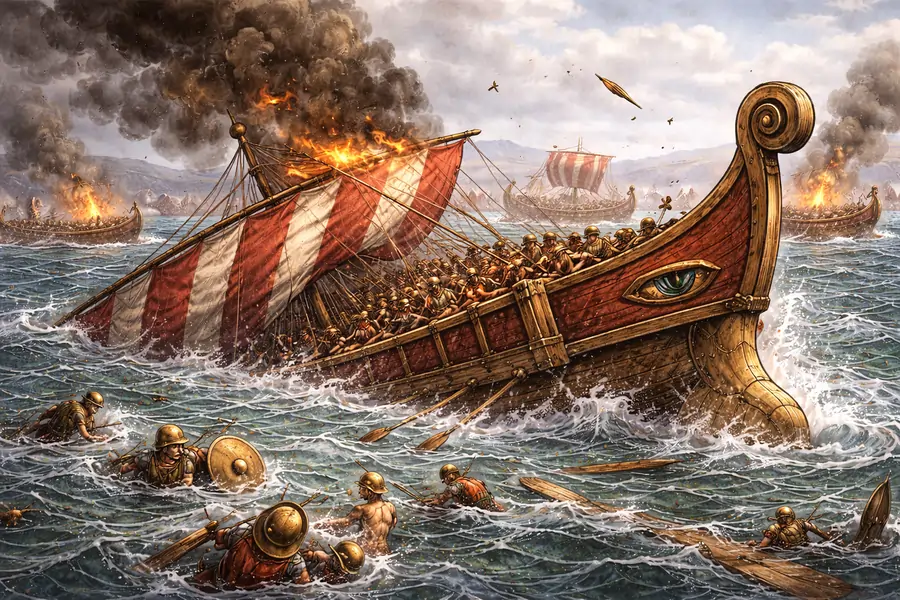
The war concluded in 241 BC after the Battle of the Aegates Islands. By this stage of the war, Rome had greatly improved its seamanship and ship design, allowing it to fight effectively without relying on the Corvus. The Roman fleet intercepted the Carthaginian relief force attempting to resupply its army in Sicily. Laden with provisions, the Carthaginian ships were slower and less maneuverable, allowing the Romans to seize the initiative. (Polybius, Histories 1.60-1.61; Goldsworthy)
The Romans secured victory through several important advantages:
- The reduced maneuverability of Carthaginian ships due to heavy cargo.
- Carthage's reliance on hastily assembled and less experienced crews.
- Superior Roman training and preparation after more than two decades of naval warfare.
- Favorable weather conditions that allowed the lighter Roman fleet to maneuver more effectively.
(Polybius, Histories 1.60-1.61; Lazenby)
The battle ended in a decisive Roman victory. According to Polybius, approximately fifty Carthaginian ships were sunk and around seventy captured. Carthage was forced to sue for peace, surrender Sicily, pay a substantial indemnity, and acknowledge Rome as the dominant naval power in the western Mediterranean. (Polybius, Histories 1.61-1.63; Goldsworthy)
Historical Significance of the Roman Corvus
The Corvus was a temporary innovation, but its impact on history was lasting. It provided Rome with an effective solution during a period when the Republic lacked experienced sailors and professional fleets. More importantly, it demonstrated Rome's greatest strategic strength-the ability to identify weaknesses, innovate rapidly, and adapt faster than its enemies. (Goldsworthy; Hoyos; Lazenby)
The boarding bridge enabled Rome to survive the critical early years of the First Punic War, establish itself as a naval power, and lay the foundations for later victories in the Punic Wars. Although eventually abandoned, the Corvus fundamentally altered the balance of power in the Mediterranean and proved that technological innovation could overcome centuries of accumulated naval experience. (Polybius, Histories Book 1; Goldsworthy)
Aftermath of the Corvus
The Roman Corvus was more than a boarding bridge-it represented one of antiquity's most influential military innovations. By transforming naval battles into infantry engagements, it allowed Rome to exploit its greatest military strength while neutralizing Carthage's greatest advantage. Although later rendered unnecessary by Rome's growing naval expertise, the Corvus fulfilled its strategic purpose. It helped transform Rome from a regional Italian power into the dominant maritime empire of the western Mediterranean, changing the course of ancient history. (Polybius, Histories 1.20-1.63; Goldsworthy, The Fall of Carthage; Lazenby, The First Punic War)
References & Further Reading
- Polybius - The Histories (University of Chicago)
- Perseus Digital Library - Classical Greek and Roman Sources
- Encyclopaedia Britannica - First Punic War
- Encyclopaedia Britannica - Battle of Mylae
- Livius.org - Ancient History Articles and Sources
Books and Memorables
This article may contain affiliate links. If you purchase through these links, I may earn a small commission at no extra cost to you.


Related Articles
Frequently Asked Questions
What was the Roman Corvus and how did it work?
The Corvus was a movable boarding bridge mounted on Roman warships. When dropped onto an enemy deck its iron spike would lock the two vessels together, enabling Roman legionaries to board and fight as infantry at sea.
Why was the Corvus important in the First Punic War?
The Corvus neutralized Carthaginian naval maneuvering and allowed Rome to leverage its superior infantry tactics at sea, leading to decisive victories such as the Battle of Mylae and the Battle of Ecnomus.
Who commanded the Roman fleet at the Battle of Mylae?
Gaius Duilius commanded the Roman fleet at Mylae in 260 BC and achieved Rome's first major naval victory using the Corvus.
What was the role of quinquereme warfare in the First Punic War?
Quinqueremes were the primary warships used during the First Punic War. Rome copied Carthaginian designs to mass-produce quinqueremes, which became the backbone of Roman naval power.
How did Rome overcome the Carthaginian navy?
Rome combined rapid shipbuilding, tactical innovations like the Corvus, and by training large crews and marines to board enemy ships, eventually outmatching Carthage despite initial naval inexperience.
Add Comment