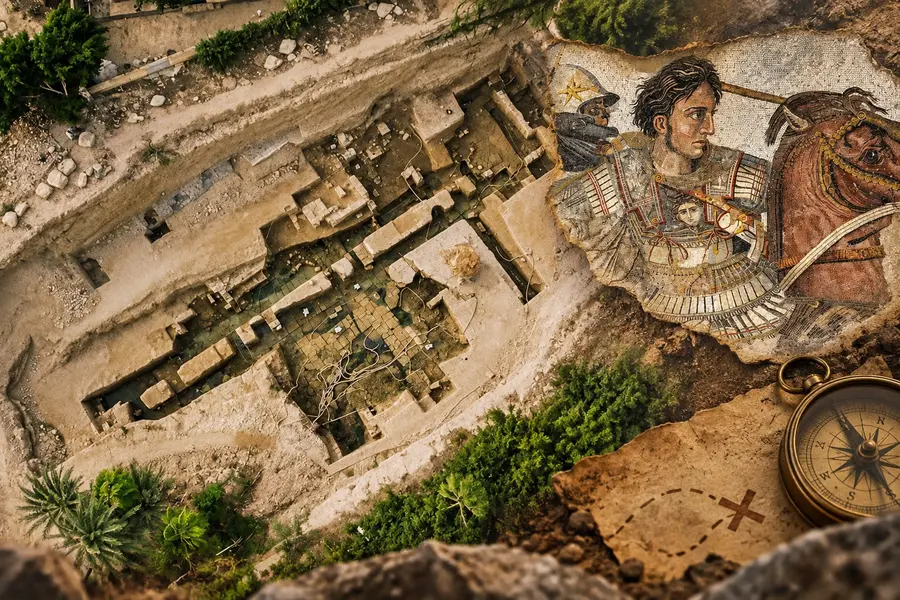
Alexander the Great conquered an empire stretching from Greece to India, but his greatest struggle may have begun after his death. When Alexander died in Babylon in 323 BC, his empire immediately began to fracture, and his corpse became a prize worth fighting over. A magnificent funeral procession was prepared, his embalmed body was placed in a golden coffin, and an enormous hearse was built to carry him west toward Macedonia. It never reached its intended destination. Ptolemy, Alexander's former companion and the ruler of Egypt, intercepted the procession and took possession of the body. Alexander was eventually buried in Egypt, first at Memphis and later in Alexandria, where his tomb became one of the most famous monuments of the ancient Mediterranean. Roman emperors would visit it centuries later. Then, sometime in late antiquity, the tomb disappeared. Today, nobody can say with certainty where Alexander's body lies.
Table of Contents
- How Did Alexander the Great Die?
- What Happened to Alexander's Body After His Death?
- The Struggle Over Alexander's Corpse
- Ptolemy Seizes the Body
- The Spectacular Funeral Procession
- Alexander's Body Is Taken to Egypt
- The Tomb of Alexander in Alexandria
- Famous Ancient Visitors to Alexander's Tomb
- How Did Alexander's Tomb Disappear?
- Theories About the Lost Tomb
- The Modern Archaeological Hunt
- The Legacy of Alexander's Lost Body
- References and Sources
How Did Alexander the Great Die?
Alexander died in Babylon in June 323 BC, at the age of 32. The ancient sources agree on the broad outline of his final illness, although they differ on some details. He had returned to Babylon after the exhausting campaigns that had taken him across Persia and into the Indian subcontinent. Ancient sources report that he was preparing for an expedition to Arabia, with further plans for expansion sometimes attributed to him.
Instead, he developed a severe illness after a series of banquets. According to Plutarch and other ancient writers, Alexander gradually became weaker over a period of roughly eleven days. He developed a high fever and eventually lost the ability to speak and move normally. The ancient tradition sometimes describes him remaining conscious enough to recognize his soldiers as they passed before him for a final farewell. The exact medical cause remains uncertain. Malaria, typhoid fever, West Nile virus and other infectious diseases have all been proposed, while the ancient poisoning story has attracted considerable attention but is not supported by the strongest contemporary evidence.
The surviving Babylonian astronomical records also place Alexander's death in this period. Diodorus gives 28 Daesius as the date, corresponding to June 323 BC in the conventional chronology. For a fuller examination of the competing explanations, see How Did Alexander the Great Die?. His death brought an extraordinary military career to an abrupt end. Alexander had defeated the Persian Empire, crossed Central Asia, and pushed his army as far as the Punjab. His campaigns are examined in greater detail in Alexander the Great: Biography, Battles and Strategy Guide.
What Happened to Alexander's Body After His Death?
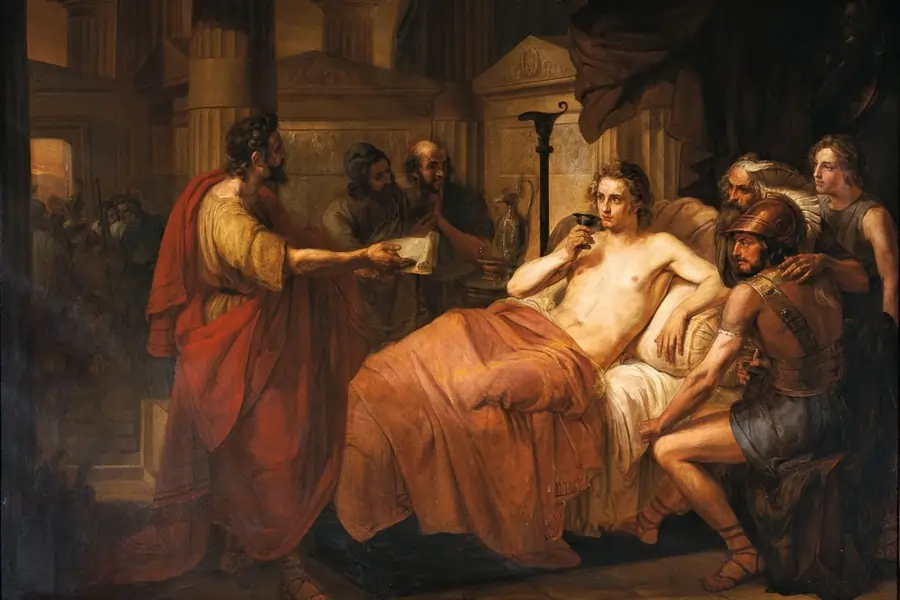
Alexander's body did not simply disappear into a royal grave. His corpse became an object of enormous political importance almost immediately after his death. Possessing Alexander's body could help legitimize whoever claimed to represent his empire. Alexander had conquered an enormous territory but had left behind no clear adult successor. His wife Roxana was pregnant, and the future Alexander IV had not yet been born. His half-brother Philip Arrhidaeus was regarded as incapable of exercising independent political authority. Alexander's generals therefore began competing for power.
In this unstable environment, the burial of Alexander became much more than a funeral. Where Alexander was buried could determine which political faction could claim his memory, his royal authority and his connection with the Macedonian dynasty. Alexander's body was embalmed according to elite ancient practices. Ancient accounts describe the corpse being treated with aromatic substances so that it could survive the long journey from Babylon. Diodorus later recorded that the body was placed inside a golden coffin surrounded by spices intended to preserve and perfume it.
The Struggle Over Alexander's Corpse
The first intended destination appears to have been Macedonia. Aegae, the ancient Macedonian royal burial centre at modern Vergina, was the traditional destination expected for a Macedonian king. That plan, however, created a problem for Ptolemy. Ptolemy, son of Lagos, had been one of Alexander's trusted generals and had received control of Egypt during the initial division of the empire. He understood that Alexander's corpse could be turned into a powerful political symbol. A king buried in Macedonia strengthened the Macedonian royal house and potentially the authority of Alexander's central successors. A king buried in Egypt could transform Alexandria into a major center of Alexander's cult and give Ptolemy an extraordinary connection with the dead conqueror.
Ancient sources therefore preserve the striking story of Ptolemy diverting Alexander's funeral procession. Strabo explicitly states that Ptolemy took the body from Perdiccas while it was being transported from Babylon toward Egypt. There is some disagreement among the sources over exactly how the seizure occurred. Pausanias presents Ptolemy as persuading the Macedonians transporting the body to hand it over, while other traditions make the episode sound much more like a deliberate interception. Whatever the precise circumstances, gaining possession of Alexander's body gave Ptolemy an important political and symbolic asset.
Ptolemy Seizes the Body
The episode became part of the larger conflict between Ptolemy and Perdiccas, who had emerged as the most powerful figure among Alexander's successors. The struggle eventually became one of the opening conflicts of the Wars of the Diadochi, the long series of wars fought by Alexander's generals for control of his empire. Ptolemy's decision was strategically brilliant. He did not need to control Alexander's entire empire if he could control one of its most potent symbols.
Alexander's body could be displayed, honored, and incorporated into the religious and political identity of Egypt. Ptolemy could present himself not as an ordinary provincial governor who had seized power, but as the legitimate custodian of Alexander's legacy. That symbolism became even more important when Ptolemy eventually established himself as king of Egypt. The Ptolemaic dynasty would rule Egypt for nearly three centuries, until the death of Cleopatra VII in 30 BC.
The Spectacular Funeral Procession
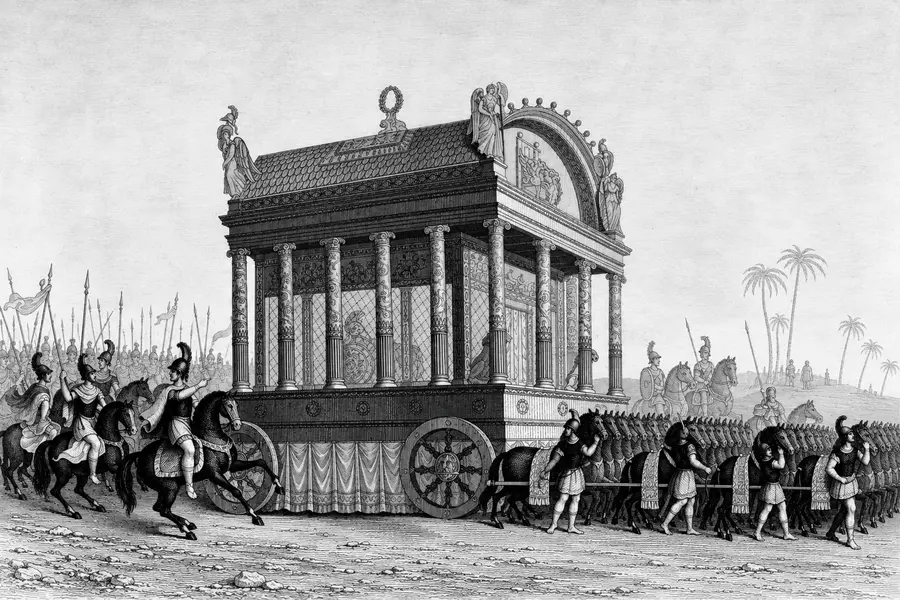
The funeral procession prepared for Alexander was one of the most extraordinary spectacles described in the ancient world. Ancient tradition places the preparation of the funeral procession and vehicle over an extended period of roughly two years. Diodorus Siculus provides a remarkably detailed description of the enormous structure built to transport Alexander's body. It was essentially a mobile royal monument rather than an ordinary funeral wagon.
| Feature | Description |
|---|---|
| Funeral vehicle | Huge, richly decorated ceremonial carriage |
| Coffin | Hammered gold |
| Body | Embalmed and surrounded by aromatic spices |
| Decoration | Gold, purple fabric, precious materials and sculptural imagery |
| Wheels | Four large Persian-style wheels |
| Draft animals | 64 exceptionally large mules |
| Military imagery | Scenes representing Macedonians, Persians, elephants, cavalry and ships |
The coffin itself was made of gold. Above and around it was an elaborate architectural structure decorated with columns, sculptures, precious materials and purple textiles. Images celebrated the elements of Alexander's empire that included Macedonian soldiers, Persian troops, Indian elephants, cavalry and naval forces. Golden bells reportedly hung from the structure and rang as the enormous vehicle moved. Diodorus describes sixty-four exceptionally large mules pulling the carriage.
The procession was so impressive that crowds reportedly gathered whenever it entered a city. Road workers and mechanics accompanied it, repairing roads and dealing with obstacles along the route. This was not merely a funeral but a demonstration of imperial power. There is something deeply ironic about the spectacle. Alexander had spent his life moving armies across continents. In death, he made one final journey, but his destination was determined by the political ambitions of the men who survived him.
Alexander's Body Is Taken to Egypt
According to Diodorus, Ptolemy went north to meet the funeral procession as far as Syria. Once he received Alexander's body, he decided that it should remain in Egypt rather than continue toward the original destination. He ultimately established a monumental precinct worthy, in Diodorus's words, of Alexander's fame. Pausanias gives a slightly different version of the sequence. He says that Ptolemy buried Alexander at Memphis using Macedonian rites. Strabo also preserves traditions concerning Memphis before the body reached its final resting place in Alexandria.
This distinction matters because Alexander appears to have had more than one burial location in Egypt. The evidence points to a sequence. An initial Egyptian burial at Memphis followed by a later transfer to Alexandria. The move to Alexandria was especially significant. Alexander himself had founded the city in 331 BC, and it rapidly developed into one of the great urban centers of the Hellenistic world. For Ptolemy, placing Alexander there was politically perfect. The conqueror would rest inside the city that carried his name.
The Tomb of Alexander in Alexandria
Alexander's final known resting place in Alexandria was called the Soma or Sema in ancient sources. The Greek word soma means "body," while sema can mean a tomb or monument. Strabo, who visited Alexandria during the Roman period, described the Soma as part of the royal quarter. It contained the tombs of the Ptolemaic kings as well as Alexander's burial place. By Strabo's time, Alexander had therefore become physically incorporated into the dynasty that had seized control of Egypt after his death.
The tomb was not simply a private burial chamber. Alexander was increasingly treated as a divine or semi-divine figure, and his burial place became a center of royal ideology. The Ptolemies could present themselves as successors and guardians of the conqueror whose name still carried enormous prestige across the Mediterranean. The original golden coffin did not survive intact. Strabo states that it was eventually plundered and replaced by another coffin described as being made of translucent material, commonly interpreted as glass or alabaster. This change probably reflected the enormous value of the original coffin. The replacement may reflect the extraordinary value of the original golden coffin, although the precise reason for the change is unknown.
Famous Ancient Visitors to Alexander's Tomb
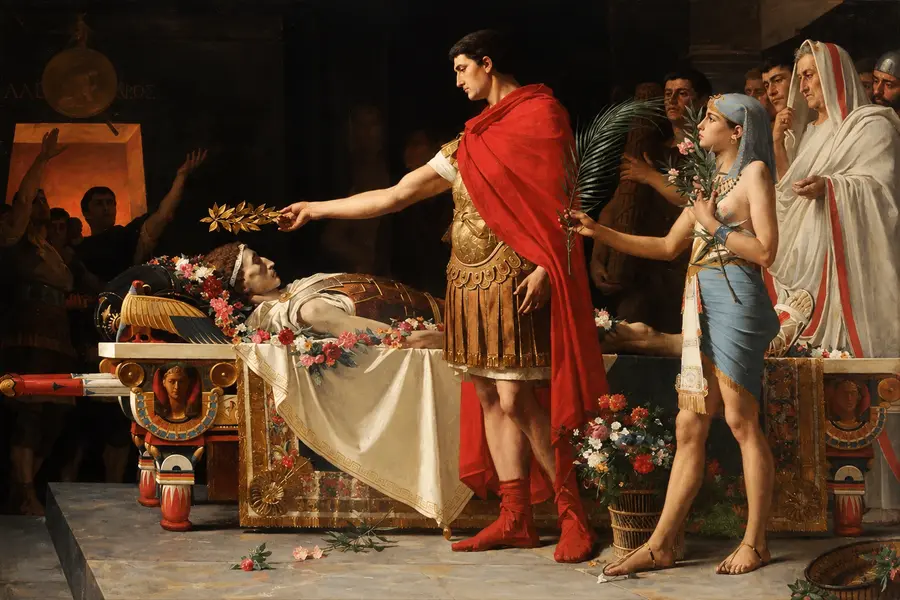
For centuries, Alexander's tomb remained sufficiently famous that powerful visitors sought it out. One of the most famous was Octavian Augustus, who entered Alexandria after defeating Mark Antony and Cleopatra in 30 BC. According to Suetonius, Augustus ordered Alexander's sarcophagus and body to be brought out of the inner part of the shrine. He gazed upon the dead conqueror, placed a golden crown on him, and scattered flowers over the body.
Dio Cassius preserves the famous story that Augustus accidentally damaged Alexander's nose when he touched the body. Whether the incident really happened is impossible to establish, but the story illustrates how unusually accessible Alexander's remains could be to exceptionally powerful visitors. Julius Caesar is also traditionally associated with a visit to Alexander's tomb during his time in Alexandria. The story fits Caesar's well-known admiration for Alexander, although the surviving literary evidence is later than the event itself and should therefore be treated with appropriate caution.
Later Roman emperors continued the tradition of associating themselves with Alexander. Caracalla is particularly well documented. The historian Herodian describes his visit to Alexandria in AD 215. Caracalla went to Alexander's tomb, removed his purple robe, rings, belts and other valuables, and deposited them there as offerings. The succession of famous visitors reveals something important. Alexander's tomb had become a monument of political memory. Roman rulers did not visit merely to look at an ancient corpse. They were confronting the image of the greatest conqueror of the Greek and eastern worlds.
How Did Alexander's Tomb Disappear?
This is where the historical trail becomes frustratingly thin. For hundreds of years, ancient writers could identify Alexander's tomb. By late antiquity, however, references become increasingly uncertain. The disappearance was probably not the result of one dramatic event in which someone simply carried the body away. Alexandria suffered repeated wars, civil disturbances, religious conflicts, earthquakes, subsidence and changes to its urban landscape.
The ancient royal quarter was gradually transformed. Buildings were abandoned, destroyed or reused, while parts of ancient Alexandria eventually disappeared beneath later construction and, in some areas, beneath the sea. One particularly important piece of evidence comes from the Christian preacher John Chrysostom, who visited Alexandria around AD 400. A late-antique passage attributed to John Chrysostom has often been interpreted as evidence that knowledge of Alexander's tomb had become uncertain by around AD 400. Archaeologists therefore generally place the loss of reliable knowledge about the Soma sometime during late antiquity. There is no secure archaeological evidence proving exactly when the tomb vanished or what happened to Alexander's body.
Where Could Alexander's Tomb Be?
The mystery has generated an extraordinary number of theories. Numerous searches have been undertaken, documented or officially recognized, and the possibilities range from plausible archaeological hypotheses to highly speculative claims.
1. Somewhere beneath central Alexandria
This remains one of the most sensible possibilities. Ancient descriptions place the Soma within the royal quarter of Alexandria, and researchers have attempted to reconstruct the ancient street grid to identify its approximate location. The nineteenth-century scholar Mahmoud el-Falaki proposed an area around the intersection of major ancient streets in the center of Alexandria. Later archaeological work around Kom el-Dikka revealed important Roman and Hellenistic remains, although no tomb identifiable as Alexander's has been found.
2. The Nabi Daniel Mosque area
The Nabi Daniel Mosque became one of the most famous locations associated with the lost tomb. Nineteenth-century stories claimed that a subterranean chamber beneath the mosque contained Alexander's remains. The problem is that archaeological investigations have failed to establish such a connection. The legend was also amplified by later stories that claimed mysterious underground chambers contained Alexander's body. Modern scholarship generally treats the Nabi Daniel identification as unproven.
3. The Attarine area
Another possibility involves the area around the historic Attarine Mosque. A large ancient Egyptian sarcophagus discovered there was once thought by some to be Alexander's. It was eventually identified as belonging to the Egyptian pharaoh Nectanebo II. That discovery nevertheless created an intriguing possibility. Because Nectanebo's sarcophagus was apparently unused, some researchers have wondered whether Ptolemy could have reused it for Alexander. There is no conclusive evidence that he did so.
4. The submerged royal quarter
Ancient Alexandria was not identical to modern Alexandria. Earthquakes, subsidence and coastal changes caused sections of the ancient city to sink beneath the Mediterranean. Archaeological discoveries beneath the water have demonstrated how much of the ancient royal and harbor landscape has been lost. This raises the possibility that portions of the Soma complex may now lie beneath modern buildings, buried archaeological layers or even submerged ground. That does not prove Alexander's tomb is underwater, but it makes the search considerably more difficult.
5. Siwa Oasis
Alexander had visited the oracle of Amun at Siwa during his lifetime, and some ancient traditions connect his desired burial with the sanctuary. This has encouraged modern claims that Alexander was ultimately buried there. The most famous modern attempt came in the 1990s, when Greek archaeologist Liana Souvaltzi argued that a monument at Siwa represented Alexander's tomb. The claim was strongly disputed, and the archaeological evidence has not established the identification. Alexandria remains the much stronger location according to the mainstream ancient literary tradition.
The Modern Archaeological Hunt
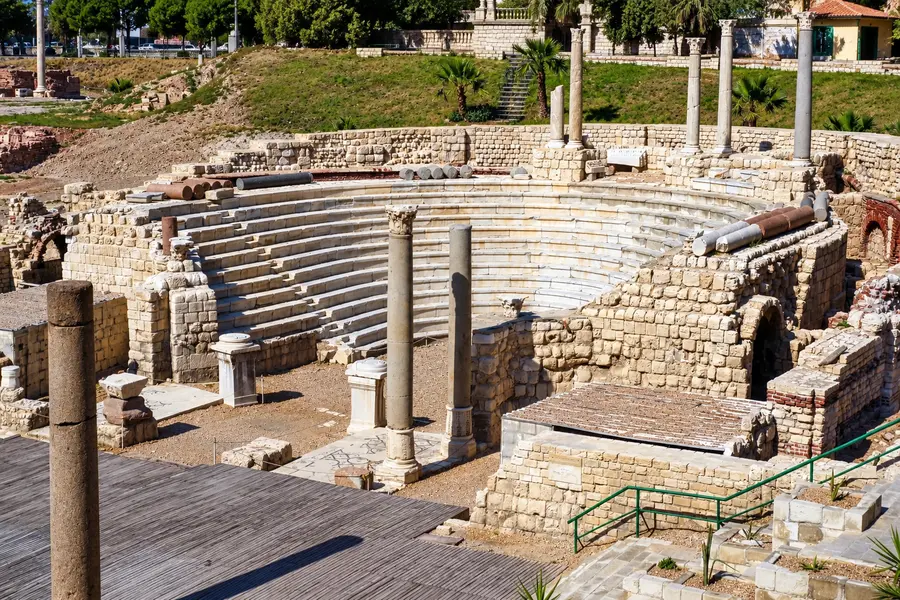
The search for Alexander's tomb is unusual because historians are not looking for a completely mythical monument. We know the tomb existed. Ancient writers saw it. Its location was known for centuries. Roman emperors visited it. The mystery is how a monument so famous could disappear so thoroughly. Modern archaeology has gradually narrowed the problem. Excavations at Kom el-Dikka have revealed major portions of ancient Alexandria, including streets, public buildings, and Roman-period structures. Yet the Soma itself has not been securely identified. Archaeologists also face a unique practical problem. Modern Alexandria sits directly over ancient Alexandria. Excavating the most promising areas can mean working beneath roads, buildings, mosques, cemeteries and densely occupied neighborhoods.
Recent archaeological work has also demonstrated how much of Alexandria's ancient landscape has disappeared or shifted. Excavations in the Shallalat Gardens area, for example, have produced significant remains and a marble statue proposed by its excavator as a representation of Alexander. The statue is intriguing, but neither it nor the excavation has proved the location of the Soma. Underwater archaeology offers another avenue. Parts of the ancient coastline and royal quarter are now submerged, and marine archaeologists have mapped substantial remains of ancient Alexandria. Yet no discovery has conclusively connected a submerged monument with Alexander's tomb.
The Legacy of Alexander's Lost Body
Alexander's missing tomb is more than an archaeological puzzle. It is the final chapter of a story that began with one of history's most ambitious conquerors. In life, Alexander created an empire that his generals could not hold together. In death, however, his body became one of the few possessions that could still unite political ambition, royal legitimacy and religious symbolism. Ptolemy understood this better than almost anyone. The irony is striking. Alexander wanted to be remembered as a conqueror whose achievements would outlive ordinary human limits. His tomb did survive for centuries. Kings, generals, and emperors came to stand before his remains. His body became a political relic of the Hellenistic and Roman worlds.
And then the physical monument vanished. Today, there is no authenticated tomb, no securely identified sarcophagus, and no scientifically confirmed remains of Alexander the Great. We know from multiple ancient sources that his body reached Egypt and was eventually placed in Alexandria. We know that later visitors saw the tomb. We know that it stood somewhere within the ancient city. But the final location of the body remains one of antiquity's greatest archaeological mysteries. The mystery also gives Alexander's story an unusual ending. The man who crossed deserts, mountains and rivers could be followed across half the ancient world. His final journey can be reconstructed in remarkable detail. Yet the last few meters of that journey, from the known monument of antiquity to its eventual disappearance, remain hidden.
That is why the search continues. Finding Alexander's tomb would not merely produce another ancient monument. It could provide the first direct archaeological encounter with the physical remains of one of history's most consequential rulers. Alexander conquered an empire in thirteen years. His body has now been missing for roughly two thousand years.
References and Sources
The account above draws primarily on ancient literary evidence and modern archaeological scholarship. Because the ancient sources sometimes disagree, details such as the exact route of the funeral procession, the circumstances of Ptolemy's seizure of the body, and the sequence of Alexander's Egyptian burials should be treated as historical reconstructions rather than absolute certainties.
- Strabo, Geography, Book XVII. One of the most important ancient descriptions of Alexandria and the Soma, including the account of Ptolemy taking Alexander's body and the later replacement of the golden coffin.
- Diodorus Siculus, Library of History, Books XVII-XVIII. Especially valuable for the circumstances of Alexander's death and the extraordinary funeral vehicle constructed for his body.
- Pausanias, Description of Greece, Book I. Provides an important alternative account of Ptolemy taking Alexander's body and burying it at Memphis.
- Plutarch, Life of Alexander. A major ancient biography containing the narrative of Alexander's final illness and death.
- Suetonius, Life of Augustus, 18. Records Augustus's visit to Alexander's tomb and his viewing of the body.
- Herodian, History of the Roman Empire, 4.8. Describes Caracalla's visit to Alexander's tomb in AD 215.
Books and Memorables
This article may contain affiliate links. If you purchase through these links, I may earn a small commission at no extra cost to you.


Related Articles
Frequently Asked Questions
What happened to Alexander the Great's body after he died?
After Alexander the Great died in Babylon in 323 BC, his body was embalmed and prepared for an elaborate funeral procession intended to carry him to Macedonia. Ptolemy, one of Alexander's generals and the ruler of Egypt, intercepted the procession and took the body to Egypt. Alexander was initially buried at Memphis and was later transferred to a monumental tomb in Alexandria, where his remains were visited by famous rulers for centuries.
Why did Ptolemy take Alexander the Great's body to Egypt?
Ptolemy took Alexander's body to Egypt because possessing the conqueror's remains carried enormous political and symbolic importance. Alexander was the founder of Alexandria and the former ruler of the empire that Ptolemy now controlled in Egypt. By securing Alexander's body and eventually placing it in Alexandria, Ptolemy could associate his new dynasty with Alexander's royal legacy and strengthen his claim to legitimacy.
Where was Alexander the Great buried after he died?
Alexander the Great appears to have been buried in Egypt in more than one location. Ancient sources indicate that Ptolemy initially buried him at Memphis before his remains were later transferred to Alexandria. His final known resting place was the Soma, or Sema, a royal tomb complex in Alexandria that also became associated with the Ptolemaic rulers.
What did Alexander the Great's funeral procession look like?
Alexander's funeral procession was an enormous royal spectacle. Ancient historian Diodorus Siculus describes a gigantic funeral carriage decorated with gold, purple textiles, columns and military imagery. Alexander's golden coffin was placed inside the structure, while 64 large mules reportedly pulled the vehicle. The decorations represented elements of Alexander's empire, including Macedonian soldiers, Persian forces, cavalry, elephants and ships.
Which famous people visited Alexander the Great's tomb?
Several famous ancient rulers are associated with visits to Alexander's tomb in Alexandria. Julius Caesar is traditionally said to have visited the tomb, while Augustus certainly visited it after capturing Alexandria in 30 BC. The Roman emperor Caracalla also visited Alexander's tomb in AD 215 and left offerings there. These visits show how Alexander's burial place remained an important symbol of power long after his death.
Why can't archaeologists find Alexander the Great's tomb today?
Alexander the Great's tomb disappeared from reliable historical knowledge during late antiquity. Alexandria experienced earthquakes, subsidence, rebuilding, wars and major changes to its urban landscape, while parts of the ancient city eventually became buried or submerged. The tomb may still lie beneath modern Alexandria, may have been destroyed or may have been relocated in antiquity. Despite numerous searches, no archaeological discovery has conclusively identified Alexander's final resting place.
Add Comment