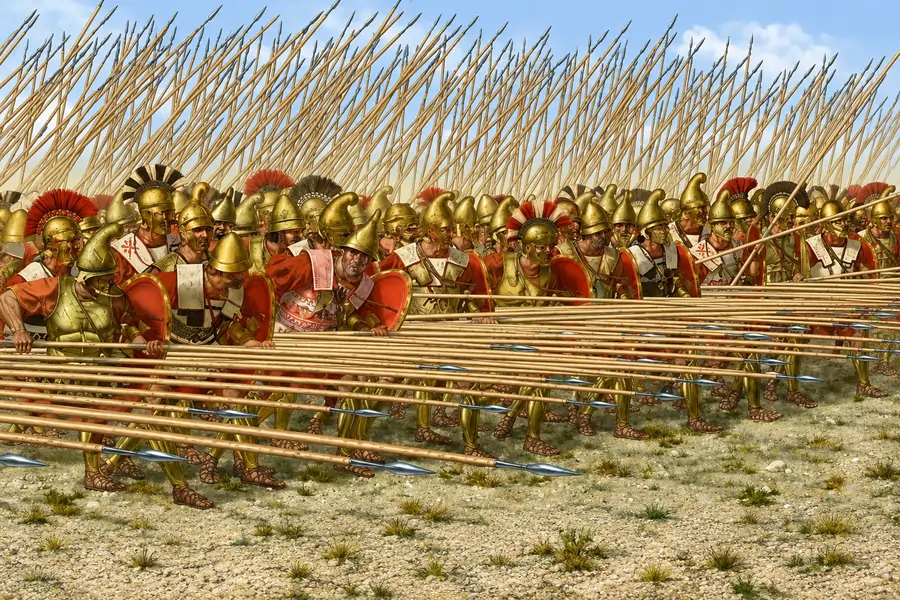
The Macedonian phalanx was one of the most feared military formations in ancient warfare. Developed and perfected under King Philip II of Macedon and later used by Alexander the Great, the Macedonian phalanx transformed Macedonia into the dominant military power of the ancient Mediterranean world. The Macedonian phalanx was armed with the massive sarissa pike and drilled with relentless discipline. The phalanx became the core of Alexander's army that shattered the Persian Empire and carried Macedonian power from Greece to India. Ancient historians such as Arrian, Diodorus Siculus, and Polybius repeatedly praised the effectiveness of the formation, while modern historians continue to regard it as one of the greatest military innovations in history.
Table of Contents
- What Was the Macedonian Phalanx?
- Origins of the Macedonian Phalanx
- Greek Phalanx vs Macedonian Phalanx
- Weapons and Armour of the Macedonian Phalanx
- Organization and Command Structure
- Training and Discipline
- Battlefield Tactics
- Why the Macedonian Phalanx Was So Effective
- Major Battles of the Macedonian Phalanx
- Weaknesses of the Macedonian Phalanx
- Decline of the Macedonian Phalanx
- Legacy of the Macedonian Phalanx
- References and Further Reading
What Was the Macedonian Phalanx?
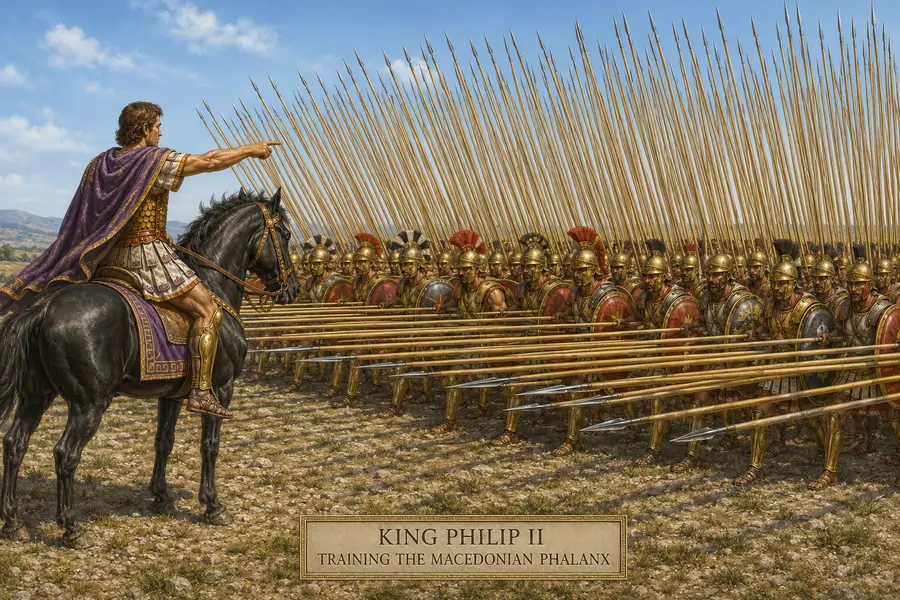
The Macedonian phalanx was a dense infantry formation composed primarily of heavily trained pikemen known as the pezhetairoi, or "Foot Companions." Unlike the Greek hoplite formations of the era, Macedonian infantry carried the enormous sarissa, a two-handed pike capable of projecting several rows of spear points that could engage the enemy before they could engage them. Ancient historian Polybius described the formation as nearly impossible to break from the front when properly deployed (Histories, Book XVIII).
The phalanx formation was the backbone of the Macedonian army. It was created and trained under Philip II while Alexander the Great perfected its role. Unlike the purely defensive role performed by heavy infantry, Alexander used his phalanx in both defensive and offensive maneuvers. The steady formation fixed enemy forces in place while cavalry and elite troops exploited weaknesses in the opposing lines. Historian Robin Lane Fox argues that the Macedonian phalanx represented "the disciplined anchor of Alexander's battlefield system" (Alexander the Great, 1973).
The use of the sarissa in the tight Macedonian phalanx formation took skill and intensive training. Unlike many Greek city-state armies, the Macedonian military was a permanent professional force. Soldiers trained continuously throughout the year, allowing them to maneuver with exceptional cohesion even during large-scale engagements. This professional military setup ensured that the Macedonian army was highly trained, skilled, and motivated.
Origins of the Macedonian Phalanx
The origins of the Macedonian phalanx date to the reforms of King Philip II of Macedon. When Philip became king in 359 BC, Macedon faced threats from Illyrians, Thracians, and rival Greek states. During this period, Macedonia was not renowned for its military strength and was not sufficiently strong to withstand potential stronger enemies.
Philip spent part of his youth as a hostage in Thebes, where he observed the military tactics of the Theban general Epaminondas. According to historian N.G.L. Hammond, Philip absorbed critical lessons regarding battlefield coordination, discipline, and tactical flexibility during this period (Philip of Macedon, 1994).
After returning to Macedon, Philip introduced many military reforms based on his learnings in Thebes. He standardized military equipment, established permanent training systems, and reorganized the army into professional units. Most importantly, he introduced the use of the sarissa pike, which fundamentally transformed infantry warfare. Historian J.F.C. Fuller described Philip's military reforms as "one of the greatest revolutions in military history" (The Generalship of Alexander the Great, 1958). These reforms eventually enabled Macedon to dominate Greece following the victory in the Battle of Chaeronea in 338 BC.
Greek Phalanx vs Macedonian Phalanx
The Greek and Macedonian phalanxes both used disciplined heavy infantry units arrayed in close formation, fighting together. However, they differed significantly in equipment, tactical doctrine, and their role on the battlefield. The traditional Greek hoplite phalanx comprised heavily armored citizen-soldiers carrying large round shields called aspis and shorter spears known as doru. These formations were highly effective in frontal combat as seen in the Battle of Thermopylae, but lacked flexibility and mobility.
The Macedonian phalanx, by contrast, sacrificed some armor protection in favor of reach and maneuverability. Macedonian soldiers wielded the famous sarissa, which was a long pike usually estimated between 18 and 22 feet long. Arrian noted that the extended reach of the sarissa allowed several ranks to engage enemies simultaneously (Anabasis of Alexander, Book I).
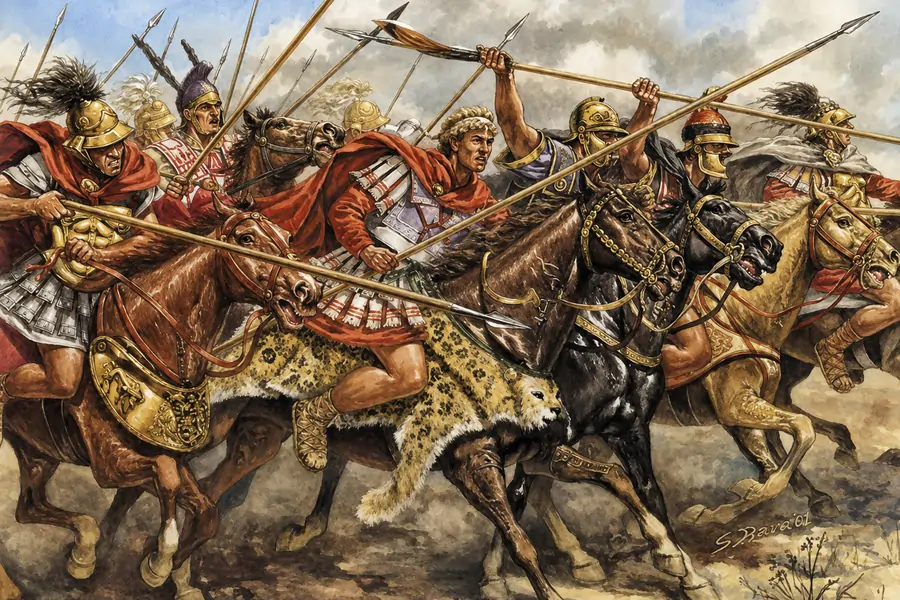
The Greek phalanx generally operated alone and was the primary decisive formation of their army. The battle was won or lost based on the performance of their phalanx alone. The Macedonian phalanx, however, worked closely with the other troops on the battlefield, including cavalry, in a broader combined arms system. This coordination became one of Alexander's greatest battlefield advantages and negated the weaknesses of the phalanx. The tactical partnership between the phalanx and cavalry is especially evident in campaigns such as the Battle of Gaugamela, where the phalanx pinned Persian forces while the Companion Cavalry delivered decisive attacks.
Weapons and Armour of the Macedonian Phalanx
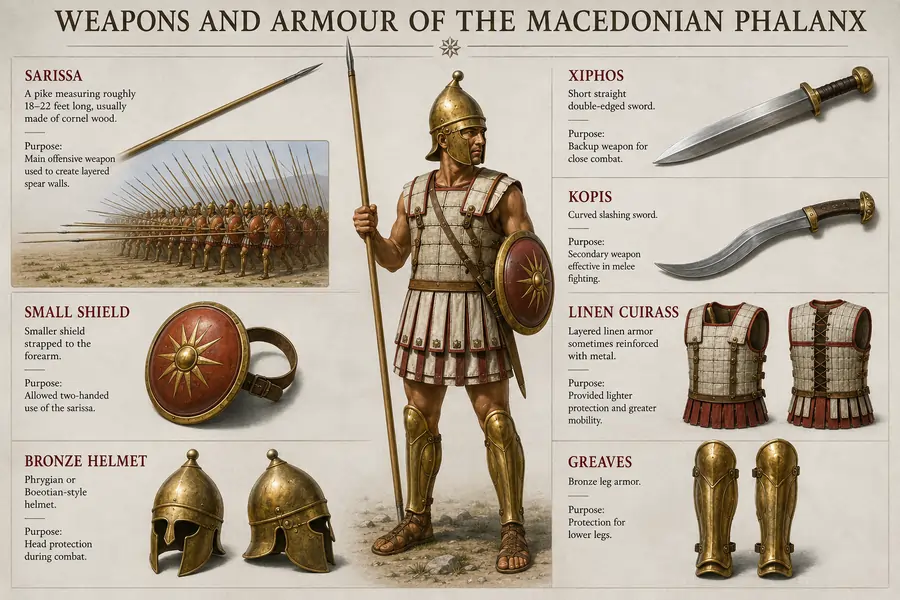
The effectiveness of the Macedonian phalanx depended heavily on its specialized weapons and equipment. Philip II's reforms created a more standardized military system that outperformed most earlier Greek armies.
| Weapon / Armour | Description | Purpose |
|---|---|---|
| Sarissa | A pike measuring roughly 18-22 feet long, usually made of cornel wood | Main offensive weapon used to create layered spear walls |
| Xiphos | Short straight double-edged sword | Backup weapon for close combat |
| Kopis | Curved slashing sword | Secondary weapon effective in melee fighting |
| Small Shield | Smaller shield strapped to the forearm | Allowed two-handed use of the sarissa |
| Linen Cuirass | Layered linen armor sometimes reinforced with metal | Provided lighter protection and greater mobility |
| Bronze Helmet | Phrygian or Boeotian-style helmet | Head protection during combat |
| Greaves | Bronze leg armor | Protection for lower legs |
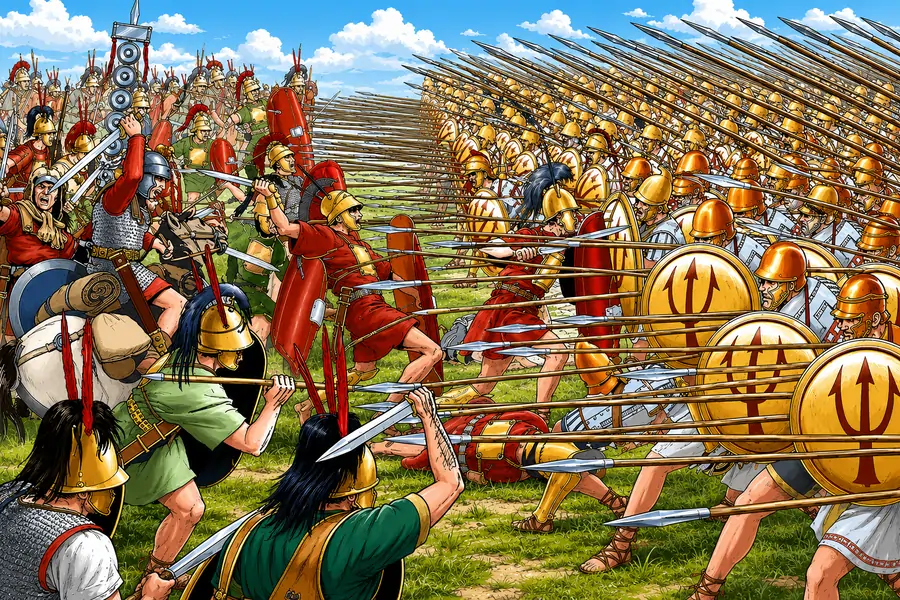
The sarissa was the defining weapon of the Macedonian phalanx. According to Polybius, the sheer density of projecting spear points made direct assaults extraordinarily dangerous (Histories, Book XVIII). Historians believe the first five ranks could present their pikes simultaneously toward the enemy.
The sarissa was a two-handed weapon that limited the use of heavy shields. Therefore, the Macedonian infantry used smaller shields than traditional Greek hoplites. This reduced their defense and personal protection but significantly increased offensive reach and formation density.
Organization and Command Structure
The Macedonian phalanx was organized into syntagma, which was the basic tactical unit usually consisting of 256 men arranged in a 16-by-16 formation. Several syntagmata formed larger tactical divisions under experienced commanders. This structure gave greater tactical flexibility even during complex operations. Individual commanders could take tactical decisions based on the progress of the battle without waiting for instructions. Notable Macedonian commanders associated with the phalanx included:
- Parmenion
- Coenus
- Craterus
- Perdiccas
- Seleucus
Alexander himself frequently took direct command of battlefield operations, which included the phalanx. Arrian repeatedly emphasized Alexander's ability to coordinate infantry and cavalry movements with exceptional precision (Anabasis of Alexander, Book III). At the beginning of the Persian campaign in 334 BC, Alexander commanded approximately 12,000 phalangites within an army of roughly 40,000 men. Historian Donald Engels notes that maintaining such a force required advanced logistical planning and disciplined supply systems (Alexander the Great and the Logistics of the Macedonian Army, 1978).
Training and Discipline
The success of the Macedonian phalanx depended entirely on discipline and cohesion. Unlike temporary citizen militias in many Greek states, Macedon had a professional army that trained continuously throughout the year. Philip II enforced rigorous military drills focused on synchronized movement, endurance marching, formation integrity, and coordinated spear handling. Ancient accounts consistently emphasize the remarkable discipline of Macedonian troops.
Historian Peter Green argues that Macedonian battlefield success can be attributed not only to superior weapons but also to the army's ability to maneuver cohesively under extreme battlefield pressure (Alexander of Macedon, 1991). Maintaining formation was essential as any weaknesses in the phalanx could cause the entire formation to collapse. Even small gaps in the pike wall could expose the formation to enemy attack. Soldiers, therefore trained to move as a single unified body rather than as independent soldiers.
Battlefield Tactics
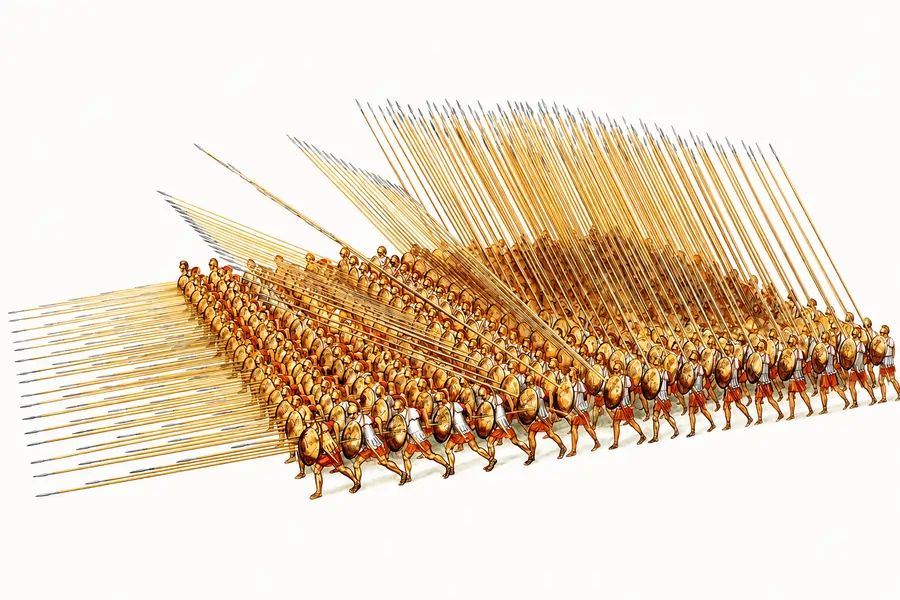
The Macedonian phalanx rarely operated independently. Instead, it was the central component of a combined arms system that integrated infantry, cavalry, missile troops, and siege units. The phalanx usually occupied the center of the battlefield, where its role was to pin enemy formations in place. The projecting sarissas created a formidable barrier that opponents struggled to penetrate when facing them head-on.
Once enemy forces became fixed in decisive fighting against the phalanx, Alexander often launched cavalry assaults against exposed flanks or weak points. This tactical coordination became one of the defining features of Macedonian warfare. The strategy proved devastating during battles such as the Battle of Granicus and the Battle of Issus. Ancient historian Diodorus Siculus described the psychological impact of the advancing phalanx as terrifying due to the "dense forest of spear points" confronting enemy infantry (Bibliotheca Historica, Book XVII).
Why the Macedonian Phalanx Was So Effective
The effectiveness of the Macedonian phalanx is due to multiple interconnected factors rather than a single innovation or tactic.
- First, the sarissa gave Macedonian infantry a massive reach advantage over most opponents. Enemy soldiers often faced multiple spear points before they could strike back effectively.
- Second, the formation's density created extraordinary frontal strength. Historian Adrian Goldsworthy notes that a properly deployed phalanx generated immense pressure against opposing infantry lines (Philip and Alexander, 2004).
- Third, Macedonian professionalism distinguished the army from many Greek militias. Soldiers trained continuously and could execute complicated maneuvers under battlefield conditions.
- Finally, the phalanx succeeded because it operated within a broader combined arms doctrine. Although the Macedonian phalanx was very strong in frontal attacks, it was weak when attacked from the wings or rear. Coordination with the cavalry made the Macedonian army exceptionally deadly.
This military system allowed Alexander the Great to achieve victories that permanently altered world history. For a broader overview of history's greatest commanders, see our guide to the greatest military generals in history.
Major Battles of the Macedonian Phalanx
The Macedonian phalanx was the backbone of Alexander's army and had demonstrated its effectiveness across numerous campaigns and battlefields. At the Battle of Chaeronea in 338 BC, Philip II defeated a coalition of Greek city-states, including Athens and Thebes. Historians widely consider this battle the moment Macedon became the dominant power in Greece.
During the Battle of Granicus, the phalanx stabilized Alexander's line while cavalry attacks shattered Persian resistance. The Battle of Issus demonstrated the formation's ability to fight effectively even in restricted terrain against larger Persian forces. The greatest test of the Macedonian military system came during the Battle of Gaugamela. Despite facing a massive Persian army under Darius III, the Macedonian phalanx held the center long enough for Alexander to exploit openings with cavalry attacks. Arrian described the battle as the decisive collapse of Persian imperial power (Anabasis of Alexander, Book III).
At the Battle of the Hydaspes, the phalanx encountered Indian war elephants under King Porus. The difficult terrain and elephant charges caused severe strain on Macedonian formations, yet discipline and coordination ultimately secured victory. The Macedonians were able to innovate and adapt to overcome the new threat.
Weaknesses of the Macedonian Phalanx
Despite its strengths, the Macedonian phalanx also possessed several vulnerabilities. The formation was strongest from the front but vulnerable on the flanks and rear. If enemy forces bypassed the spear wall and attacked them from the sides or rear, phalangites struggled in close combat due to the awkward length of the sarissa. The troops also needed to be extensively trained in order to maintain proper discipline and cohesion.
Rough terrain posed another major challenge. As with any infantry, maintaining formation cohesion on uneven ground was extremely difficult. Polybius specifically argued that terrain disruption reduced the effectiveness of the phalanx considerably (Histories, Book XVIII). The system also depended heavily on combined arms coordination. Without cavalry and supporting troops protecting its sides, the phalanx became increasingly vulnerable.
Decline of the Macedonian Phalanx
Following Alexander's death in 323 BC, his empire fragmented into competing Hellenistic kingdoms. These kingdoms continued using the phalanx for generations, but military conditions gradually changed. The rise of Rome exposed the limitations of the rigid pike formation. Roman legions operated in smaller, more flexible units capable of adapting to uneven terrain and changing battlefield conditions. The Macedonian phalanx formation had by now become obsolete.
At battles such as Cynoscephalae in 197 BC and Pydna in 168 BC, Roman forces exploited gaps and disorder within the phalanx. Polybius famously concluded that the Roman legion possessed superior tactical flexibility compared to the Macedonian system. By the late second century BC, the Macedonian phalanx had largely disappeared as the dominant infantry formation of the Mediterranean world.
Legacy of the Macedonian Phalanx
The Macedonian phalanx remains one of the most influential military systems in ancient history. Philip II's reforms created a disciplined professional army that changed the power dynamics of the Mediterranean. Alexander's campaigns demonstrated how combined arms tactics, professional infantry, and aggressive leadership could defeat much larger empires. Historian Victor Davis Hanson describes the Macedonian army as "the first fully integrated military machine of the ancient world" (Warfare in the Classical World, 1989). The phalanx influenced warfare for centuries and remains a central subject in the study of military history, tactical innovation, and ancient state power.
References and Sources
- Arrian, Anabasis of Alexander
- Plutarch, Life of Alexander
- Green, Peter, Alexander of Macedon
- Fuller, J.F.C. The Generalship of Alexander the Great
- Quintus Curtius Rufus (History of Alexander)
- Diodorus Siculus, Bibliotheca Historica
- Waldemar Heckel. Alexander the Great: Historical Sources in Translation. Blackwell Publishing, 2004.
- Robin Lane Fox. Alexander the Great. Penguin Books, 1973.
- Adrian Goldsworthy. The Complete Roman Army. Thames & Hudson, 2003.
- Perseus Digital Library
- Victor Davis Hanson - Warfare in the Classical World
Recommended Books
This article may contain affiliate links. If you purchase through these links, I may earn a small commission at no extra cost to you.
Related Articles

Frequently Asked Questions
Why did the Macedonian phalanx use the sarissa instead of shorter spears?
The Macedonian phalanx used the sarissa because its extreme length allowed multiple ranks of soldiers to project spear points toward the enemy at the same time. This gave Macedonian infantry a major reach advantage over traditional Greek hoplites armed with shorter spears.
How were Macedonian phalanx soldiers trained for battle?
Macedonian phalanx soldiers trained continuously as part of a professional standing army. They practiced formation movement, sarissa handling, endurance marching, and coordinated battlefield maneuvers under King Philip II and Alexander the Great.
What role did the Macedonian phalanx play in Alexander the Great's victories?
The Macedonian phalanx usually held the center of the battlefield and pinned enemy forces in place. This allowed Alexander the Great and his Companion Cavalry to attack exposed enemy flanks and break opposing armies apart.
How heavy was the armour of the Macedonian phalanx?
The armour of the Macedonian phalanx was generally lighter than that of traditional Greek hoplites. Many soldiers wore linen cuirasses, bronze helmets, and smaller shields to improve mobility while carrying the long sarissa pike.
Why was the Macedonian phalanx vulnerable on rough terrain?
The Macedonian phalanx relied on tight formation spacing and coordinated spear alignment. Rough or uneven terrain could create gaps between soldiers, reducing the effectiveness of the sarissa wall and exposing weak points to enemy attacks.
Which battles proved the strength of the Macedonian phalanx?
The Macedonian phalanx proved highly effective in major battles such as Chaeronea, Granicus, Issus, Gaugamela, and Hydaspes. These victories helped Alexander the Great conquer the Persian Empire and expand Macedonian power across Asia.
Add Comment