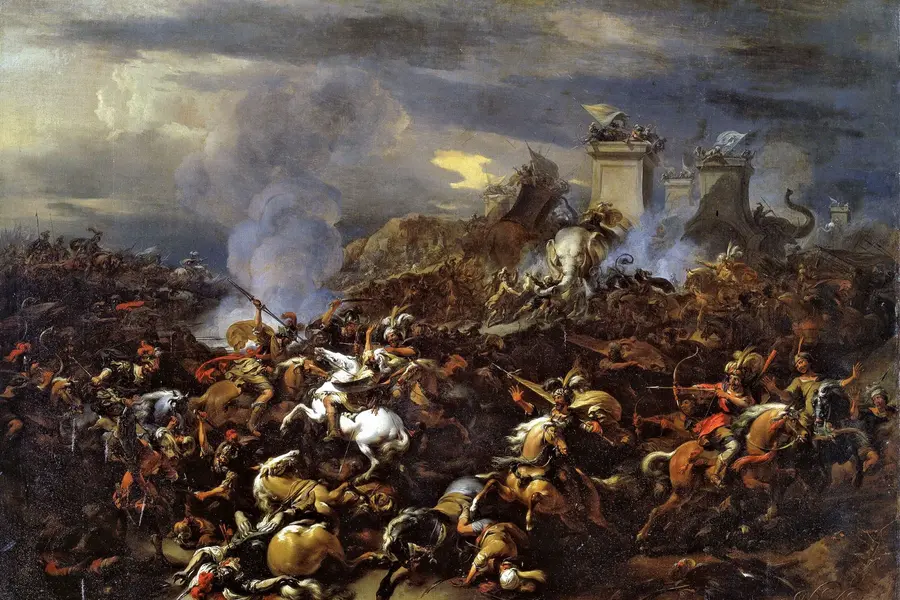
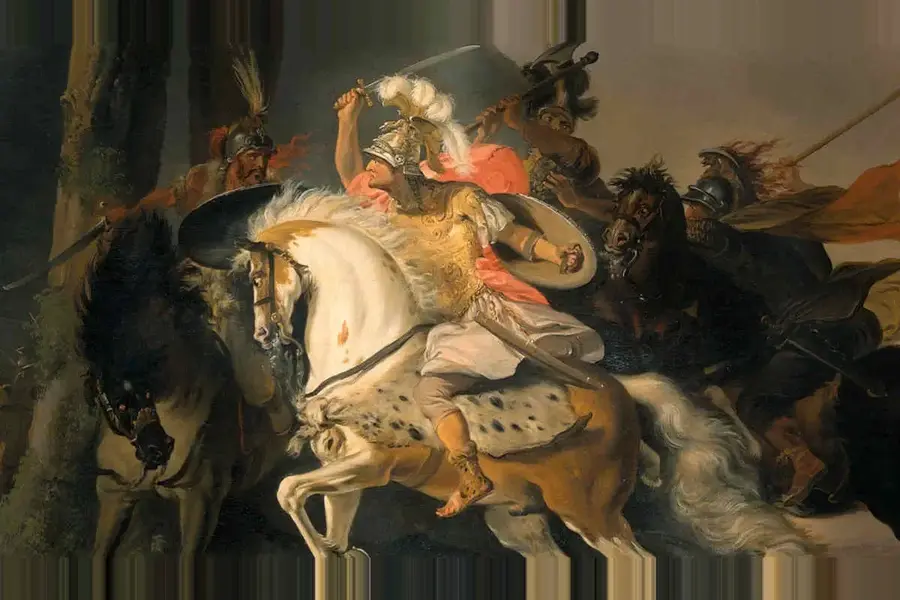
The Battle of the Hydaspes, fought in 326 BC against the Pauravas under King Porus, was the last major battle for Alexander the Great. Fought on the banks of the Hydaspes River (modern Jhelum River in Pakistan), this was one of the most challenging battles for Alexander. Unlike the Persians, the Pauravas were more disciplined, motivated, and led by a brave King. The Macedonians had to deal with treacherous monsoon weather, disease, and war elephants. Ancient historians such as Arrian and Plutarch portray the battle as one of Alexander's greatest tactical achievements, while modern historians often describe it as the campaign that revealed the limits of Macedonian expansion.
This battle tested Alexander's ability to its limits. He was forced to adapt under pressure and exploit enemy weaknesses under unfamiliar conditions. Although Alexander emerged victorious, the hard-fought battle against Porus was a significant contributing factor to the Macedonian army's decision not to march further into India. The Battle of the Hydaspes, marked both the height of Alexander's eastern conquests and the beginning of the end of his expansion.
- Background and Prelude to the Battle
- Who Was King Porus?
- The Geography of the Hydaspes River
- The Armies at Hydaspes
- Alexander's Strategic Problem
- The Secret River Crossing
- Detailed Progress of the Battle
- The Role of War Elephants
- How Alexander Won the Battle
- Casualties and Losses
- Consequences and Aftermath
- Why the Macedonians Refused to Continue
- Historical Importance of Hydaspes
- References and Sources
Background and Prelude to the Battle
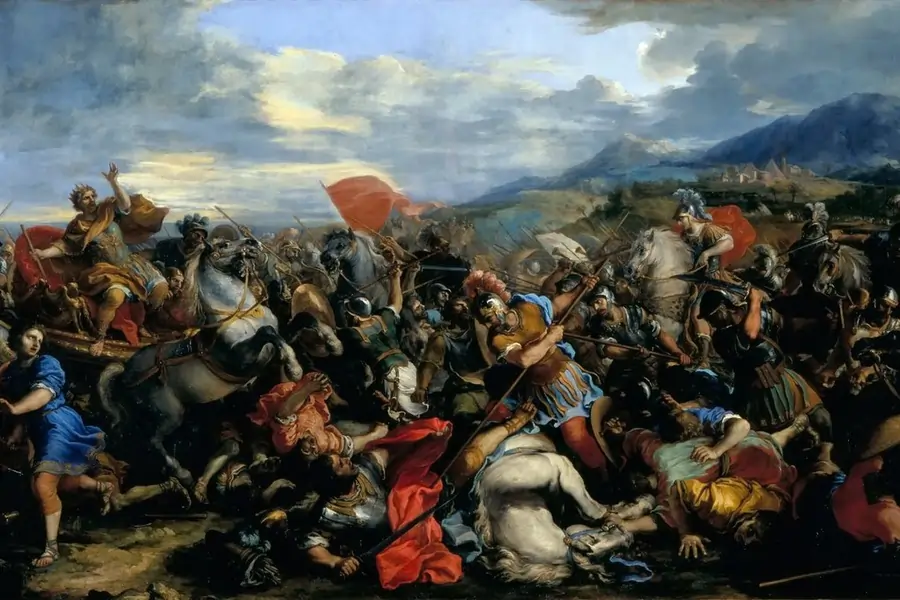
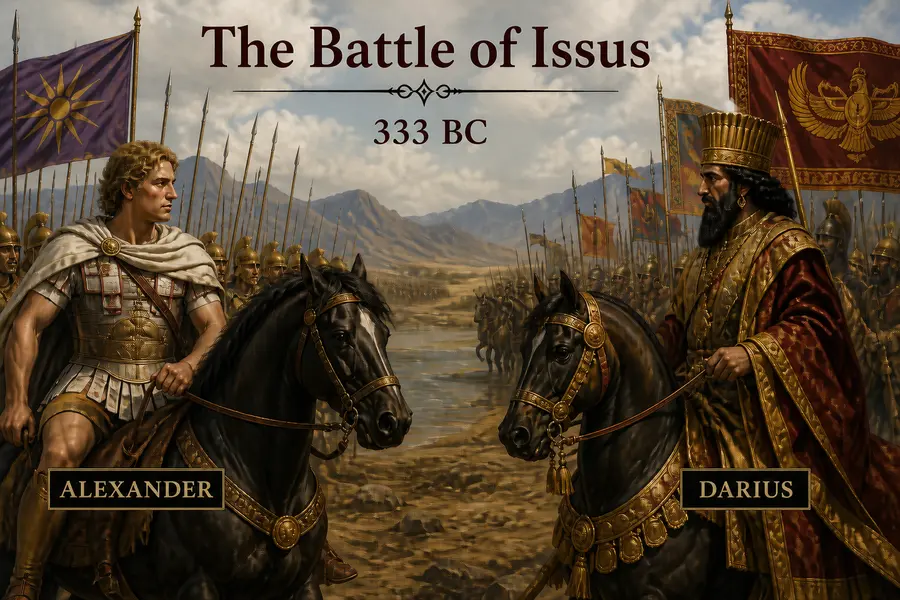
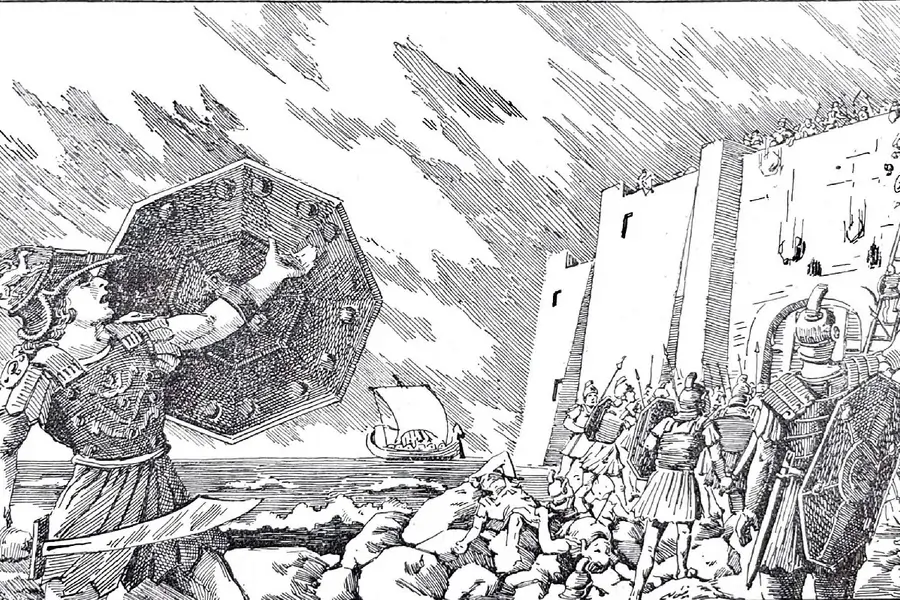
By 326 BC, Alexander the Great had already conquered the Persian Empire and established himself as the ruler of Asia. His victories at the Battle of the Granicus, the Battle of Issus, the Siege of Tyre, and the decisive Battle of Gaugamela had shattered Achaemenid power and made Alexander into the master of one of the largest empires in history. After the death of Darius III in July of 330 BC, Alexander continued eastward into Bactria and Sogdiana. These campaigns proved difficult and brutal. Arrian notes in Anabasis of Alexander that the Macedonians faced constant resistance, difficult mountain terrain, and guerrilla warfare that exhausted both men and supplies.
When Alexander approached the Indian subcontinent, he faced fragmented states constantly fighting with each other rather than a unified empire. Several of these rulers submitted peacefully, hoping to curry favour with the Macedonian King. One of the most important of these collaborators was Ambhi of Taxila, whom Greek writers referred to as Taxiles. According to Arrian, Ambhi welcomed Alexander with gifts, supplies, and military assistance because he sought support against Porus.
Unlike the other leaders, Porus, however, refused submission. The king controlled territory between the Hydaspes (Jhelum) and Acesines (Chenab) Rivers in the Punjab region. Ancient historians consistently describe him as courageous, proud, and determined to resist the foreign invasion. Curtius Rufus writes that Porus believed surrender would dishonor both himself and his kingdom (Curtius Rufus, Histories of Alexander, Book VIII). The confrontation between Alexander and Porus became inevitable.
Who Was King Porus?
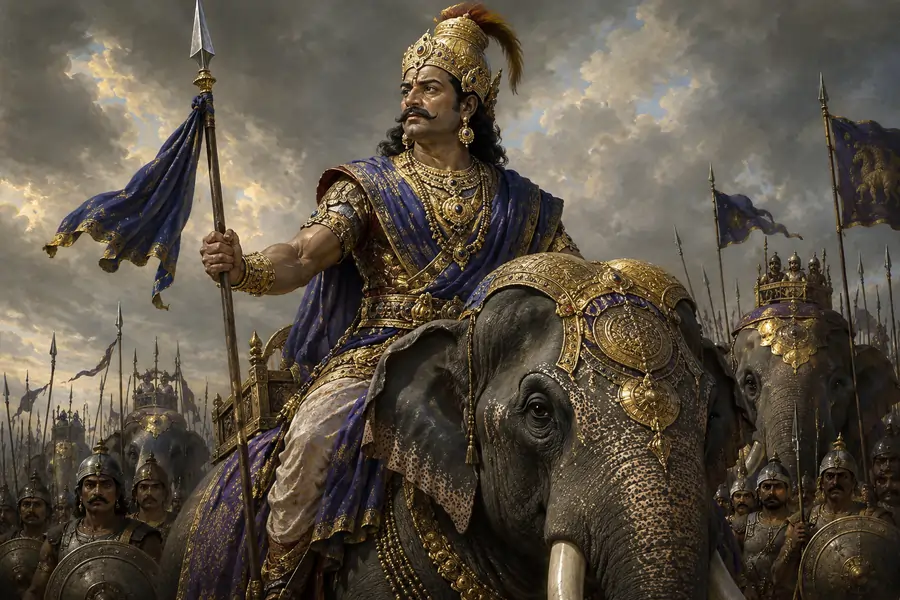
King Porus, known in Greek sources as Poros, ruled a regional kingdom in the Punjab that belonged to the Paurava dynasty. Although surviving Indian sources are limited, Greek historians present him as one of the most capable opponents Alexander faced during his eastern campaigns. Arrian describes Porus as a man of impressive physical stature and exceptional bravery who personally fought in battle atop an elephant even after suffering wounds. Plutarch similarly praises Porus's determination and dignity during the campaign (Plutarch, Life of Alexander, Chapter 60).
Porus's kingdom occupied the fertile lands of the Punjab and supported large populations. It was a key strategic location where the river systems created natural defensive barriers against invading armies. Apart from the geographical location, the greatest military advantage available to Porus was his use of war elephants. Indian armies had perfected the use of war elephants for centuries. However, for the Macedonians, Hydaspes would be the first time they would have to face a large elephant force. The elephants were shock troops capable of breaking infantry formations, terrifying horses, and creating panic in tightly packed ranks.
Modern historian Adrian Goldsworthy notes that the psychological effect of elephants was often as important as their physical impact because many soldiers and horses had never encountered such animals in combat before.
The Geography of the Hydaspes River
The geography of the battlefield played a decisive role in the Indian campaign. The Hydaspes River was swollen by heavy monsoon rains, making it dangerous and difficult to cross. Ancient accounts repeatedly emphasize the strength of the current and the unstable muddy banks. Porus cautiously positioned his army along the opposite bank specifically to block Alexander's crossing attempts. According to Arrian, Porus carefully shadowed Macedonian movements and prepared to attack any force attempting to cross openly.
This created a severe problem for Alexander, who was eager to engage the enemy. Unlike the Battle of Granicus, where he decisively crossed the river and faced the Persian satraps head-on, it was not possible to execute the same maneuver here. King Porus was shadowing Alexander's movement, and a direct crossing under enemy observation would expose his troops while they were disorganized and vulnerable in the water. The weather further complicated operations. Rainstorms reduced visibility, flooded parts of the terrain, and limited maneuverability for both sides.
The Armies at Hydaspes
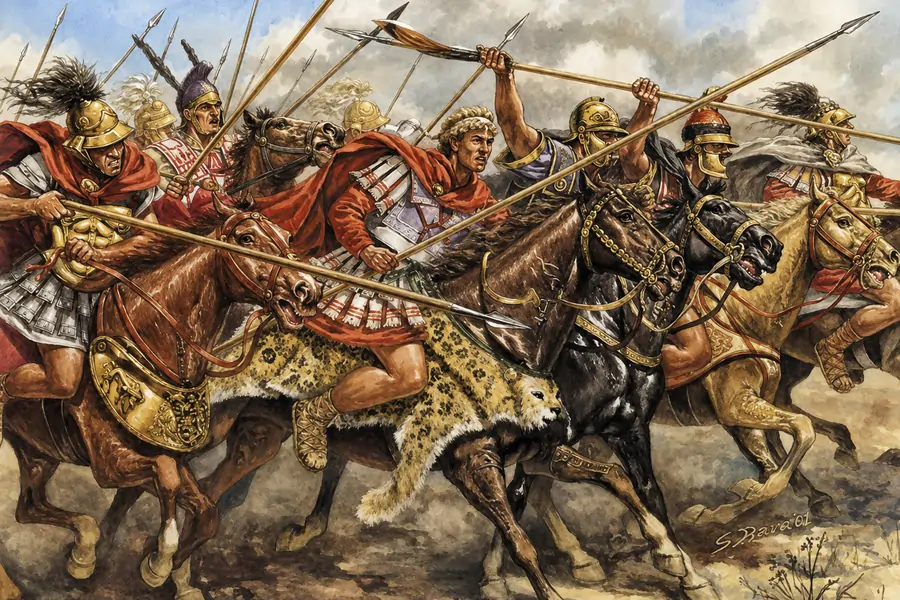
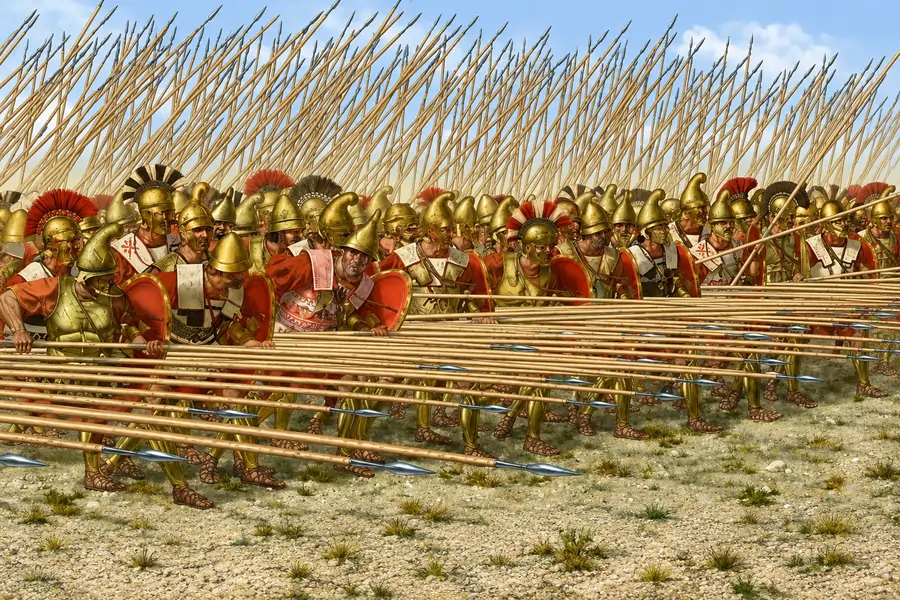
Exact troop numbers remain debated because ancient historians often exaggerated battlefield figures. Most modern historians estimate that Alexander commanded somewhere between 35,000 and 45,000 troops. The Macedonian army comprised the elite Companion Cavalry, the Macedonian phalanx, hypaspists, mounted archers, light infantry, and allied Greek contingents.
Porus's army likely consisted of about 20,000 - 50,000 infantry supported by cavalry, chariots, and approximately 200 war elephants. Diodorus Siculus reports that Porus deployed elephants across the front line to disrupt Macedonian formations before close combat began (Diodorus Siculus, Bibliotheca Historica, Book XVII).
The elephants represented the greatest unknown factor in the battle and Alexander's greatest threat. Macedonian tactics had repeatedly succeeded against Persian cavalry and infantry. However, Hydaspes introduced a battlefield environment unlike anything Alexander or his army had previously faced.
Alexander's Strategic Problem
Alexander immediately recognized that forcing a direct crossing in front of Porus's army would be extremely dangerous. Instead, he adopted a cunning strategy of deception and psychological manipulation. For days, Alexander ordered his troops to repeatedly march up and down the riverbank while conducting false preparations for crossing the river. Arrian states that these constant movements gradually convinced Porus that Alexander was merely attempting to confuse him rather than preparing an actual assault.
Meanwhile, Alexander secretly identified a crossing point upstream that included wooded terrain that helped hide his troops. He divided his army carefully and left a body double, dressed in his bright clothes, to confuse the enemy. Craterus remained behind with a substantial force opposite Porus's main camp to maintain pressure and prevent the Indian king from shifting all his troops upstream. Alexander personally led the elite strike force toward the hidden crossing point.
This operation reflected several important characteristics of Alexander's generalship. Instead of being rash and trying to cross the river in front of Porus, he demonstrated remarkable patience during difficult operations, relying on deception and misdirection to confuse Porus about his true intentions. At the same time, Alexander showed considerable operational flexibility in the whole operation. He had split his forces into two, but these two forces needed to coordinate with each other perfectly, or the entire crossing would result in failure. He exploited the enemy confusion with rapid and decisive action once the crossing succeeded.
These qualities had already contributed to Alexander's reputation as one of the greatest military generals in history.
The Secret River Crossing
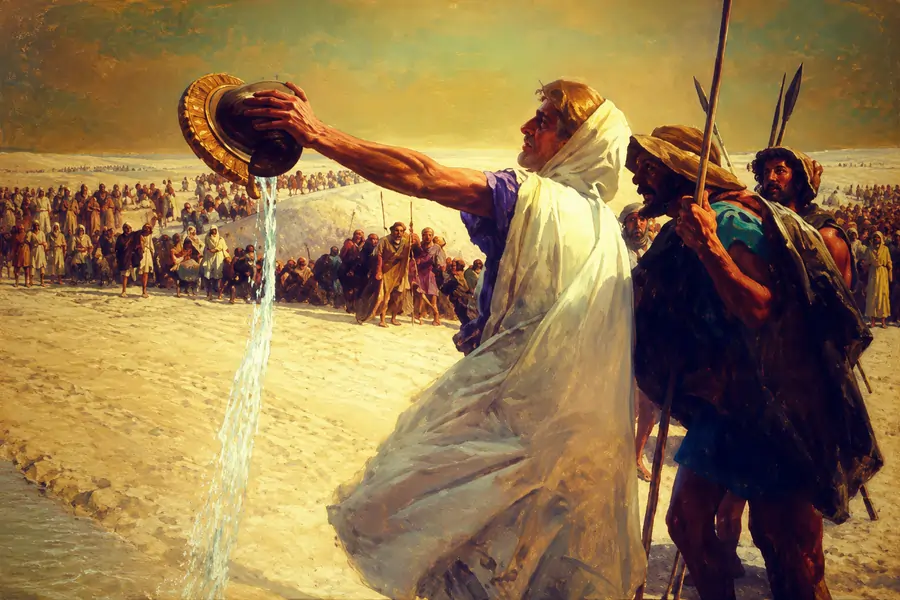
The decisive stage of the campaign began during a violent nighttime storm. Alexander had chosen an elite squad and moved upstream to the pre-determined crossing point. Here, using boats, rafts, and improvised flotation devices, Alexander's special troops crossed the river under cover of darkness and thunder. Plutarch writes that the storm concealed the sound of Macedonian movement and helped prevent early detection (Life of Alexander, Chapter 60).
Initially, Porus believed the crossing was another diversionary maneuver. This hesitation proved costly and can be attributed to Alexander the Great's brilliant psychological tactics and deception. When Indian scouts confirmed that Alexander himself had crossed with a major force, Porus immediately dispatched troops under his son to delay the Macedonians. According to Arrian, this advance force was defeated quickly by Macedonian cavalry attacks. Porus then advanced with his main army to confront Alexander before the Macedonians could fully consolidate their position.
Detailed Progress of the Battle
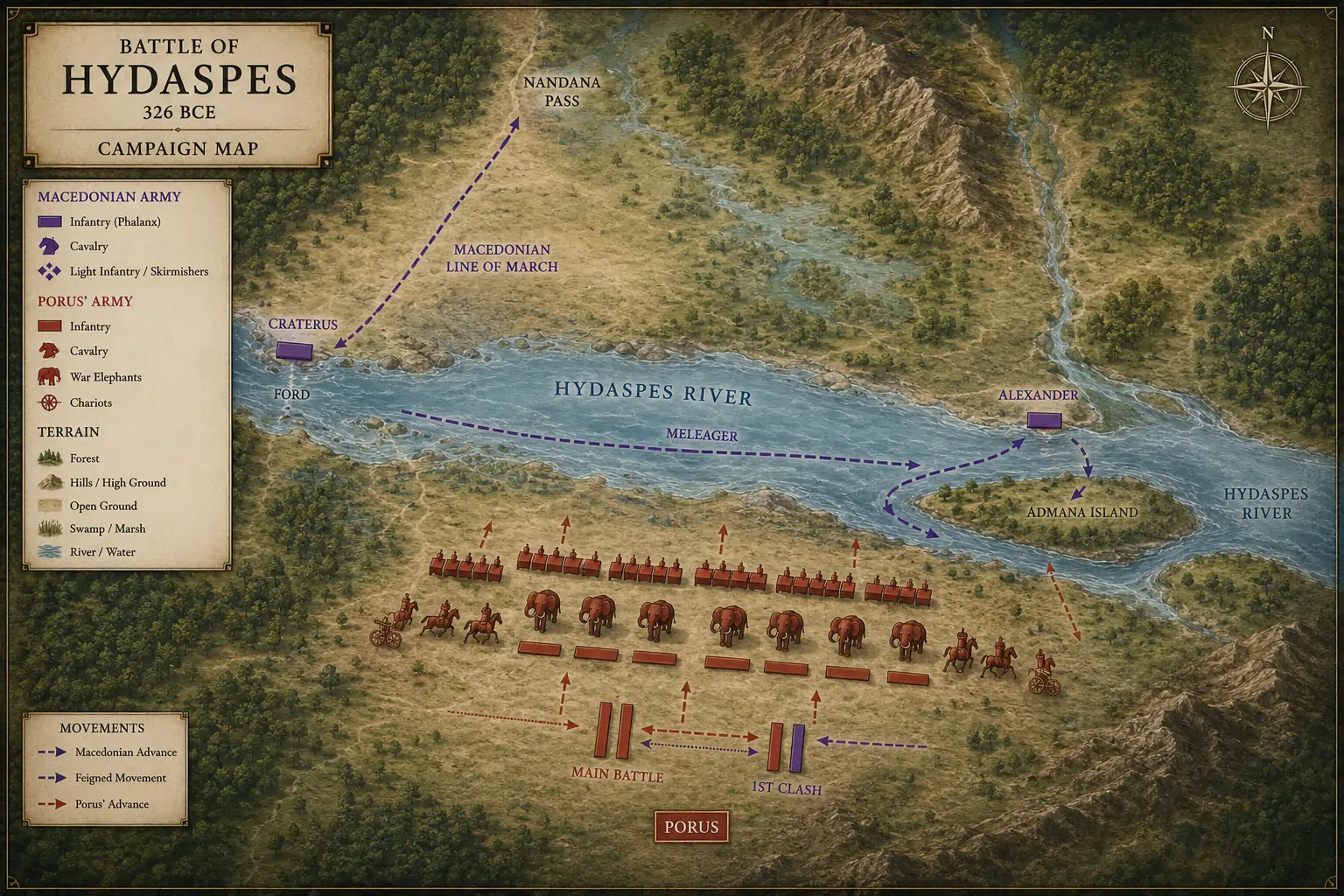
The Battle of the Hydaspes turned into one of the longest and bloodiest engagements fought by Alexander. Porus deployed his war elephants in front of his infantry in the center. Cavalry forces occupied the wings, while chariots supported sections of the formation where terrain permitted movement. Although the monsoon rains had severely impacted their movement.
Alexander tried to avoid any attacks in the Indian center against the deadly war elephants. Instead, he targeted the Indian cavalry on the flanks. Arrian explains that Alexander intended to weaken Porus's mobility and force him into reactive movements before fully committing the phalanx (Arrian, Anabasis, Book V).
The Macedonian cavalry repeatedly struck the Indian left flank while mounted archers and light infantry harassed enemy formations from a distance. The muddy terrain severely reduced the effectiveness of Indian chariots. Curtius Rufus notes that the wet ground made maneuvering difficult and diminished their battlefield value (Curtius Rufus, Histories, Book VIII).
As the battle intensified, the Macedonian phalanx finally advanced into the elephant line. This phase of the fighting became chaotic and brutal. Ancient writers describe elephants trampling soldiers, disrupting formations, and causing panic among horses. Curtius Rufus vividly describes wounded soldiers being crushed beneath elephants or seized by their trunks during close combat.
Despite these losses, the Macedonians gradually adapted to dealing with the elephants. Javelin throwers and archers targeted elephant drivers (Mahouts) and vulnerable animals. Over time, wounded elephants became increasingly difficult to control. Once panicked, many elephants turned against their own troops and caused chaos and confusion among the Indian soldiers.
Meanwhile, Coenus, commanding a cavalry brigade, conducted a flanking maneuver that threatened the Indian rear. This maneuver placed additional pressure on Porus's cavalry and prevented effective coordination between different sections of the Indian army. The battle eventually devolved into close-quarter fighting. Unlike Darius III, Porus continued fighting courageously from atop his elephant till the bitter end. Macedonian discipline and tactical coordination slowly shifted momentum in Alexander's favor.
The Role of War Elephants
The Battle of the Hydaspes is remembered primarily for its use of war elephants. To the average Macedonian soldier, the presence of war elephants on such a large scale would have been intimidating. Needless to say, the presence of the majestic beasts had an enormous psychological impact. Horses often panicked at the sight and smell of these unfamiliar animals, while infantry formations struggled to maintain cohesion when elephants charged.
However, elephants also created serious problems for the army deploying them. Once injured or frightened, they became unpredictable and caused significant damage to their own troops. Arrian specifically notes that wounded elephants eventually destroyed Porus's own forces as they rampaged through crowded infantry formations.
The battle demonstrated both the strengths and weaknesses of elephant warfare. Against inexperienced opponents without proper discipline or morale, elephants could create a devastating impact. But disciplined infantry supported by missile troops could gradually neutralize them. They are also a double-edged sword that could potentially harm their own troops.
How Alexander Won the Battle
The victory at Hydaspes was one of Alexander's hardest fought battles and resulted from a combination of patience, deception, and impressive battlefield coordination. His battlefield success began with his use of deception, as he conducted false drills along the riverbank. Repeated feints convinced Porus that the Macedonians did not plan to cross the river, which made him lower his guard.
Second, Alexander made sure not to engage the Indian troops at the river crossing, as this would have proved disastrous. He deceived Porus and managed to cross the river upstream with a contingent of elite troops, and chose the battlefield on his own terms. The upstream crossing forced Porus to react rather than maintain complete control of the defensive situation.
Third, Alexander used the mobility of his cavalry effectively throughout the battle. Rather than attacking the elephants directly at the start, he concentrated on disrupting Indian cavalry support and isolating different portions of Porus's army. Fourth, Macedonian troops were far more trained and disciplined. Infantry, cavalry, archers, and light troops worked together continuously throughout the engagement.
Finally, the Macedonians were able to adapt during the course of the battle. The initial shock caused by the Indian elephants was followed by the Macedonian troops' efforts to adapt and counter them. Modern historian J.F.C. Fuller argues that Hydaspes represented one of Alexander's greatest demonstrations of battlefield adaptability, as it required him to solve problems unlike those encountered in Persia. The battle remains one of the most decisive battles in military history because it demonstrated both the power and limitations of Alexander's military system.
Casualties and Losses
Ancient casualty figures differ considerably. Arrian claims that Porus lost approximately 20,000 infantry and 3,000 cavalry during the battle. Most of the elephants were also killed or captured. Macedonian losses were lower than the Indian losses, but still significantly higher compared to other battles in Alexander's campaigns. Ancient estimates vary, though modern historians generally believe the Macedonians suffered heavier casualties than official accounts admitted because the elephant attacks inflicted severe damage on the Macedonian troops. Hydaspes was therefore not a swift or easy victory. It was one of the costliest battles Alexander ever fought.
Consequences and Aftermath
After the battle, Porus was captured and brought before Alexander. According to the famous story recorded by both Arrian and Plutarch, Alexander asked Porus how he wished to be treated. Porus answered, "Treat me like a king." When Alexander asked if he desired anything more, Porus reportedly replied, "Everything is contained in those words: like a king." (Plutarch, Life of Alexander, Chapter 60).
Impressed by Porus's bravery and dignity, Alexander restored him to power and expanded his territory. This decision reflected Alexander's broader political strategy of governing through loyal local rulers whenever possible. Following the victory, Alexander founded two cities:
- Nicaea, meaning "Victory," commemorated the success at Hydaspes
- Bucephala honored Alexander's beloved horse Bucephalus, who reportedly died around this time.
The battle also extended Macedonian influence farther into northwestern India and increased contact between Greek and Indian cultures. The stage was now set for Alexander to expand further into India.
Why the Macedonians Refused to Continue
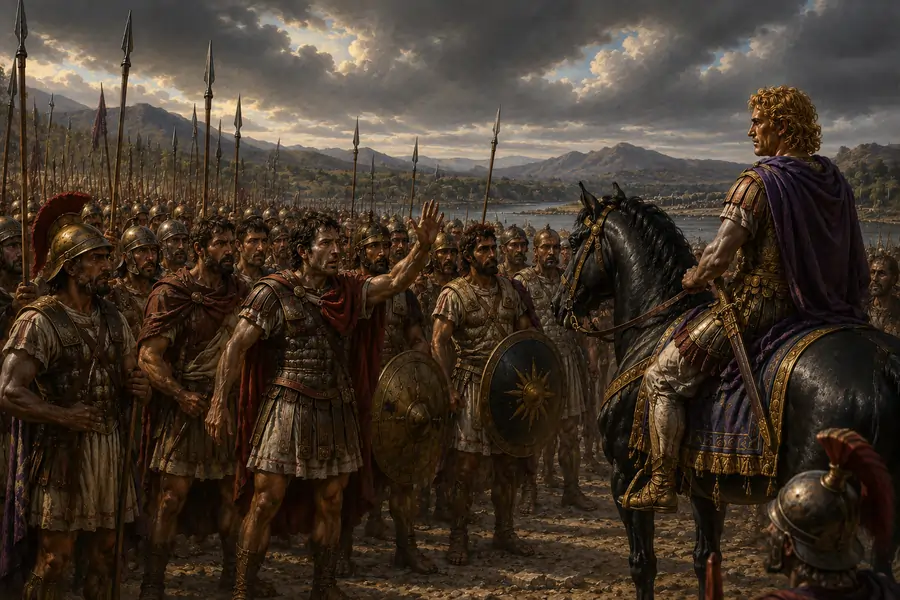
However, Alexander's journey of conquest would end abruptly after this iconic battle. Despite achieving victory, the Macedonian army had reached its psychological and physical limits. Years of continuous campaigning and constant battles had exhausted the troops. The soldiers were feeling homesick and wanted to return to their families. The harsh climate, unfamiliar geography, and diseases also impacted the morale of the troops.
Having just faced a hard-fought battle, reports of even larger Indian Kingdoms shattered the morale of the troops. Ancient sources indicate that the Macedonians heard stories about powerful states beyond the Hyphasis River with armies far larger than anything encountered so far, including thousands of additional war elephants.
When Alexander attempted to persuade his army to continue the march eastward, they refused. Arrian records that Coenus spoke on behalf of the soldiers, urging Alexander to return home because the men were exhausted and longed to see their families again (Arrian, Anabasis, Book V).
This was a very rare moment when Alexander failed to achieve his intended objective. Eventually, he was forced to turn his army back. The return journey proved disastrous for the Macedonians, particularly during the crossing of the Gedrosian Desert, where thousands of soldiers died from starvation, dehydration, and exhaustion.
Historical Importance of the Battle
The Battle of the Hydaspes was one of Alexander's final major victories and arguably one of his hardest fought. Unlike Gaugamela, where Macedonian tactical superiority rapidly overwhelmed Persian resistance, Hydaspes became a prolonged struggle that tested Macedonian endurance, adaptability, and battlefield discipline. The Indian King's courage and perseverance also helped maintain the morale of the Indian troops and prevented an early collapse.
The battle also marked an important moment in cultural and military interaction between the Hellenistic world and India. Greek historians gained greater knowledge of Indian warfare, geography, politics, and philosophy following the campaign. Most importantly, the Hydaspes was the boundary that demonstrated the limit of conquest. Alexander remained undefeated in battle, but even his extraordinary leadership could not overcome the exhaustion and resistance of his own army indefinitely. The battle, therefore, stands as both a remarkable military achievement and the turning point that effectively ended Alexander's eastern expansion.
References and Sources
- Arrian, Anabasis of Alexander
- Plutarch, Life of Alexander
- Green, Peter, Alexander of Macedon
- Fuller, J.F.C. The Generalship of Alexander the Great
- Quintus Curtius Rufus (History of Alexander)
- Diodorus Siculus, Bibliotheca Historica
- Waldemar Heckel. Alexander the Great: Historical Sources in Translation. Blackwell Publishing, 2004.
- Robin Lane Fox. Alexander the Great. Penguin Books, 1973.
- Adrian Goldsworthy. The Complete Roman Army. Thames & Hudson, 2003.
- Perseus Digital Library
- Encyclopaedia Britannica - Battle of Gaugamela
Recommended Books
This article may contain affiliate links. If you purchase through these links, I may earn a small commission at no extra cost to you.
Related Articles
Frequently Asked Questions
Why did Alexander choose to cross the Hydaspes River at night?
Alexander crossed the Hydaspes River at night to avoid a direct confrontation while his army was vulnerable in the water. Using darkness, heavy rain, and thunder to conceal his movements, he successfully surprised King Porus and secured a safer landing point for his troops.
How did war elephants affect the Battle of the Hydaspes?
War elephants initially caused serious problems for the Macedonian army by disrupting infantry formations and frightening horses. However, as the battle continued, Macedonian soldiers targeted the elephant drivers and wounded the animals, causing many elephants to panic and trample their own troops.
Why was the Battle of the Hydaspes considered Alexander's hardest battle?
The Battle of the Hydaspes was one of Alexander's hardest battles because he had to deal with monsoon weather, a dangerous river crossing, unfamiliar war elephants, and a determined enemy led by King Porus. The battle was longer and more physically exhausting than many of his earlier victories.
What happened to King Porus after the Battle of the Hydaspes?
After the battle, King Porus was captured and brought before Alexander. Impressed by his bravery and leadership, Alexander restored Porus to his throne and allowed him to continue ruling his kingdom as a loyal ally of the Macedonian Empire.
Why did Alexander's army refuse to continue deeper into India?
Alexander's army refused to continue farther into India because the soldiers were exhausted after years of campaigning. They also feared reports of larger Indian kingdoms with massive armies and thousands of war elephants waiting farther east beyond the Hyphasis River.
What rivers were connected to the Battle of the Hydaspes?
The Battle of the Hydaspes was fought near the Hydaspes River, known today as the Jhelum River in Pakistan. The campaign also involved nearby rivers in the Punjab region, including the Acesines River, modern-day Chenab.
Add Comment