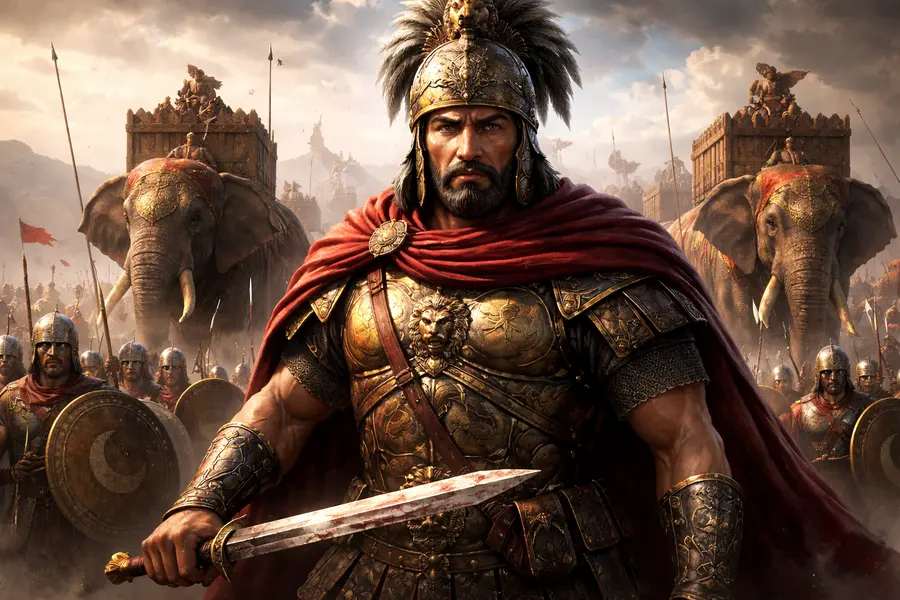
Hannibal Barca remains one of the most brilliant and daring military commanders in history. Hannibal was made legendary for his audacious plan to cross the frozen Alps with war elephants. He kept his oath and remained an enemy of Rome till his death. Hannibal reshaped the art of warfare and nearly brought the Roman Republic to its knees. Let us explore his early life, rise to power, the causes of the Second Punic War, his battlefield triumphs, political struggles, exile, and dramatic final days. We will discover why Hannibal is still studied by generals and historians alike to this day.
Table of Contents
- Early Life and Family Background
- Rise to Power in Carthage
- How the Second Punic War Began
- The Legendary Crossing of the Alps
- Major Battles and Military Genius
- Rome's Response: The Fabian Strategy
- Defeat at the Battle of Zama
- Hannibal's Political Career After Zama
- Exile and Continued Military Achievements
- Rome's Pursuit and Hannibal's Suicide
- Why Hannibal Was One of the Greatest Generals
- Legacy and Historical Impact
Early Life and Family Background
Hannibal Barca was born in 247 BC in Carthage, one of the most powerful maritime empires of the ancient Mediterranean. He was the son of Hamilcar Barca, a prominent Carthaginian general who played a crucial role in the later stages of the First Punic War. Hamilcar was not just a military leader but a visionary who sought to rebuild Carthaginian strength after its defeat by Rome. He was deeply devoted to Carthage and knew that conflict with Rome was inevitable.
He expanded Carthage's influence into Iberia (modern Spain), creating a new power base rich in silver mines and manpower. These silver mines were essential for Carthage's development, as they were severely crippled by Rome's harsh conditions imposed at the end of the First Punic War. Hamilcar wanted to strengthen the Carthaginian military and start a new campaign against Rome.
This environment of military ambition and political rivalry shaped Hannibal's upbringing. According to the Greek historian Polybius (Histories 3.11-13), before leaving for Spain, Hamilcar made his young son swear an oath of eternal hatred toward Rome. The Roman historian Livy also preserves this tradition (History of Rome 21.1), making it one of the defining episodes of Hannibal's early life. This was a defining moment in Hannibal's childhood, and this oath would become the guiding force of his life. Hannibal was not spoiled with riches and grew up in a military camp rather than a sheltered environment. He was exposed to warfare, logistics, and leadership at an early age. He learned multiple languages, understood diverse cultures, and developed the charisma that would later allow him to command a multi-ethnic army.
Rise to Power in Carthage
After Hamilcar's death, leadership in Iberia passed first to Hasdrubal the Fair, Hannibal's brother-in-law. Hasdrubal expanded Carthaginian influence through diplomacy rather than war, establishing alliances and founding the city of New Carthage (Cartagena). He demanded hostages from the territories conquered by Carthage to dissuade them from breaking treaties. In 221 BC, seven years after Hamilcar's death, Hasdrubal was assassinated by a Celtic slave seeking revenge, an event recorded by Polybius (Histories 2.36). Following his death, the Carthaginian army in Iberia unanimously elected Hannibal as their commander. After his death, the Carthaginian army in Iberia unanimously elected Hannibal as their commander. At just 26 years old, Hannibal took control of Carthage's most important military territory.
Hannibal earned the trust of his troops by leading from the front. His early campaigns in Spain demonstrated his tactical brilliance. He subdued hostile tribes, consolidated Carthaginian power, and prepared for a larger conflict that he knew was inevitable: war with Rome. Hannibal had not forgotten his oath. He was merely biding his time and waiting for the best moment to strike.
How the Second Punic War Began
According to the treaty signed at the end of the First Punic War, all territories south of the Ebro River were under Carthage's sphere of influence. Meanwhile, the territories north of the river were under Roman influence. Saguntum was a city allied to Rome, which was south of the Ebro River and under Carthage's sphere of influence. However, when Hannibal laid siege to Saguntum, they reached out to Rome for help. Rome treated this as a violation of the treaty even though it was not true.
After an eight-month siege, Hannibal captured Saguntum, an event described in detail by both Polybius (Histories 3.17-18) and Livy (History of Rome 21.5-15), who viewed it as the immediate trigger for the Second Punic War. In response, Rome demanded that they surrender Hannibal to them for trial. Carthage refused. In 218 BC, Rome declared war, marking the beginning of the Second Punic War.
The Legendary Crossing of the Alps
Carthage did not have a strong navy to challenge Rome, so the only option left was to wait for Rome to attack them. Hannibal, however, decided to march his entire army from Spain to Italy across the Alps in what remains one of the most daring maneuvers in military history. According to Polybius (Histories 3.50-56), Hannibal began his Alpine expedition with roughly 50,000 infantry, 9,000 cavalry, and several war elephants, undertaking one of the most daring marches in military history.
The crossing was full of unknown dangers - hostile tribes, treacherous terrain, and freezing conditions. By the time he descended into Italy, Hannibal had lost a significant portion of his army. Yet, what remained was a hardened and loyal force ready to confront Rome. Rome, on the other hand, was completely taken off guard. This extraordinary feat cemented Hannibal's reputation as a master strategist and is often cited as one of the greatest military achievements of all time.
Major Battles and Military Genius
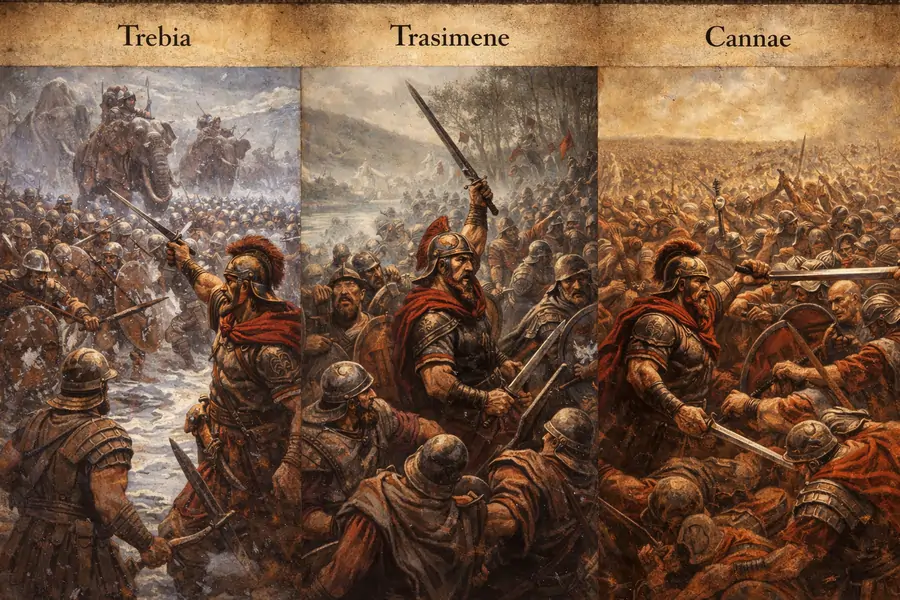
Once in Italy, Hannibal dealt at series of devastating defeats against Rome, winning some of the most famous battles in history.
Battle of Trebia (218 BC)
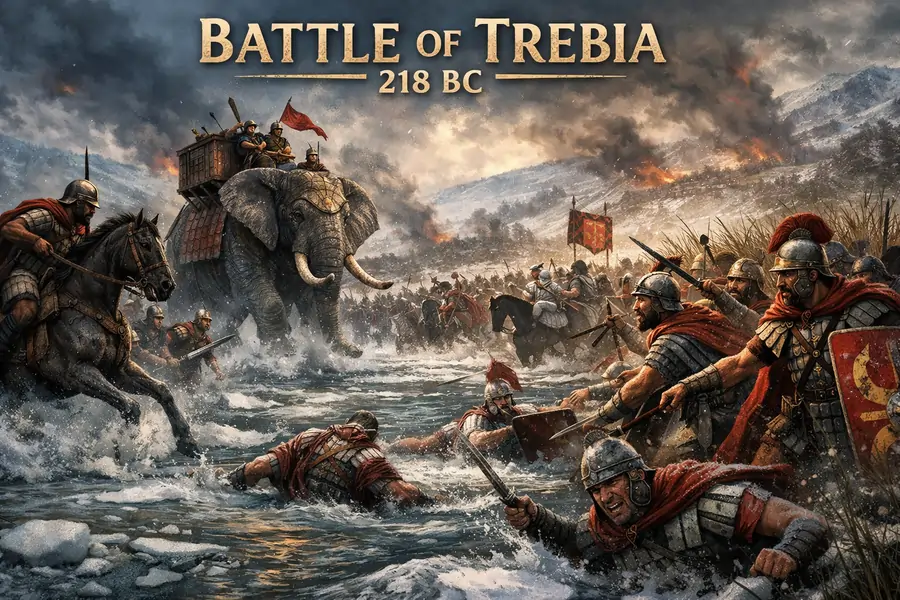
The Battle of Trebia was the first major victory for Hannibal on Italian soil. As described by Polybius (Histories 3.72-75) and later by Livy (History of Rome 21.54-56), Hannibal lured the Romans across the freezing Trebia River before springing a carefully prepared ambush using concealed troops under Mago Barca and superior cavalry tactics. This helped bolster the morale of his troops and helped him recruit new allies in the north.
Battle of Lake Trasimene (217 BC)
Polybius (Histories 3.82-85) describes Lake Trasimene as one of antiquity's greatest military ambushes, where Hannibal trapped a Roman army between the hills and the lake. Livy likewise emphasizes the confusion and devastation suffered by the Roman forces (History of Rome 22.4-7). The Battle of Lake Trasimene was a rude shock for the Romans, who believed in Roman superiority and acted rashly. This battle forced Rome to use a more cautious approach and adapted the Fabian strategy to avoid confrontation with Hannibal.
Battle of Cannae (216 BC)
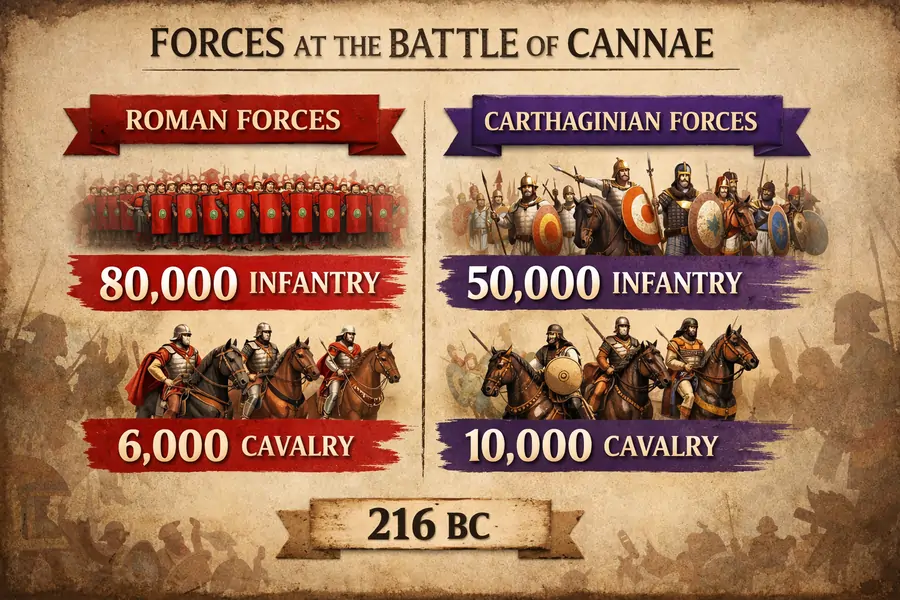
Rome had amassed the largest army in its history to tackle the Hannibal problem. However, at the Battle of Cannae, Hannibal proved his tactical innovation. According to Polybius (Histories 3.113-117), Hannibal deliberately allowed the center of his line to bend before enveloping the massive Roman army from both flanks, a tactical masterpiece now known as the double envelopment. Livy also regarded Cannae as Rome's greatest military disaster (History of Rome 22.44-51). This was the pinnacle of his military career and his greatest achievement.
Military historian Theodore Ayrault Dodge described Cannae as one of history's finest examples of battlefield tactics, while Adrian Goldsworthy notes that it remains a benchmark for operational encirclement in modern military studies. It is often included among the top 10 decisive battles in history. Rome had lost twenty percent of its military-age population on that fateful day.
Rome's Response: The Fabian Strategy
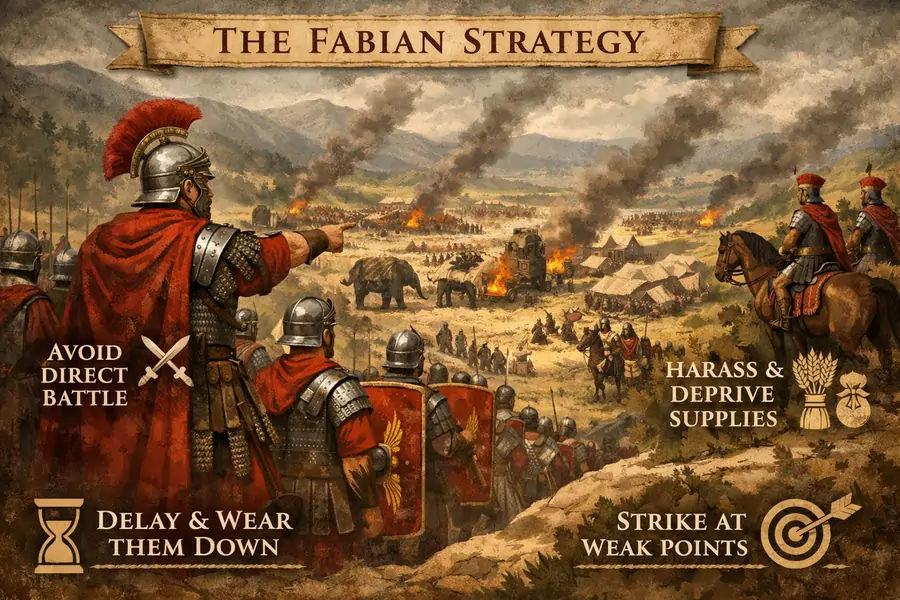
After facing defeat at the Battle of Cannae, Rome went back to using the Fabian strategy. The Fabian Strategy, associated with Quintus Fabius Maximus, relied on avoiding pitched battles and gradually exhausting Hannibal's army. Plutarch praises this cautious approach in his Life of Fabius Maximus, while Livy records the political criticism Fabius initially faced for refusing open battle. Instead of confronting Hannibal directly, the Romans used delay tactics, avoided major battles, and targeted supply lines. Although criticized at the time, this strategy ultimately helped Rome survive and recover. Rome did not want to risk facing another defeat at the hands of Hannibal.
Defeat at the Battle of Zama
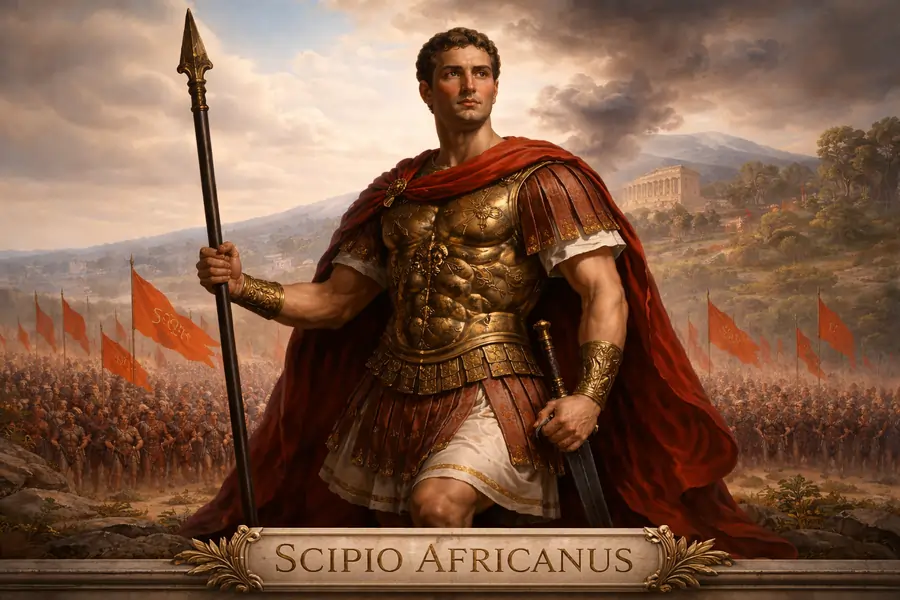
Although Rome was unable to defeat Hannibal in Italy, they were busy dealing decisive defeats to the Carthaginians in Spain and Iberia. With no hope of reinforcements and Carthage at risk from Scipio's army, Hannibal was recalled to North Africa. His campaign in Italy lasted over a decade, but he was unable to win the war against Rome. He now faced Scipio Africanus to defend the city of Carthage.
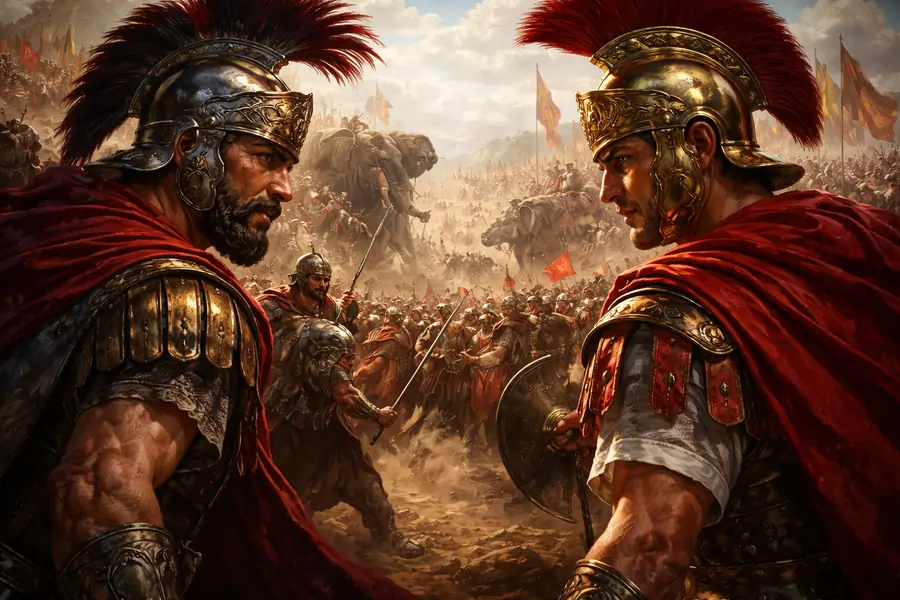
Polybius (Histories 15.9-16), whose account is generally regarded as the most reliable surviving description of the battle, records that Scipio carefully adapted his tactics to counter Hannibal's strengths. Modern historian Adrian Goldsworthy similarly argues that Zama was a contest between two exceptional commanders rather than a simple Roman victory. He was therefore wary of his tactics. In 202 BC, the two great commanders faced each other at the Battle of Zama. Scipio had even adapted Hannibal's own tactics against him, using flexible formations and superior cavalry to defeat the Carthaginian army. This marked the end of the Second Punic War and Hannibal's first and only major defeat. The defeat at Zama was not due to Hannibal's decline, but rather, it highlighted the brilliance of both commanders.
Hannibal's Political Career After Zama
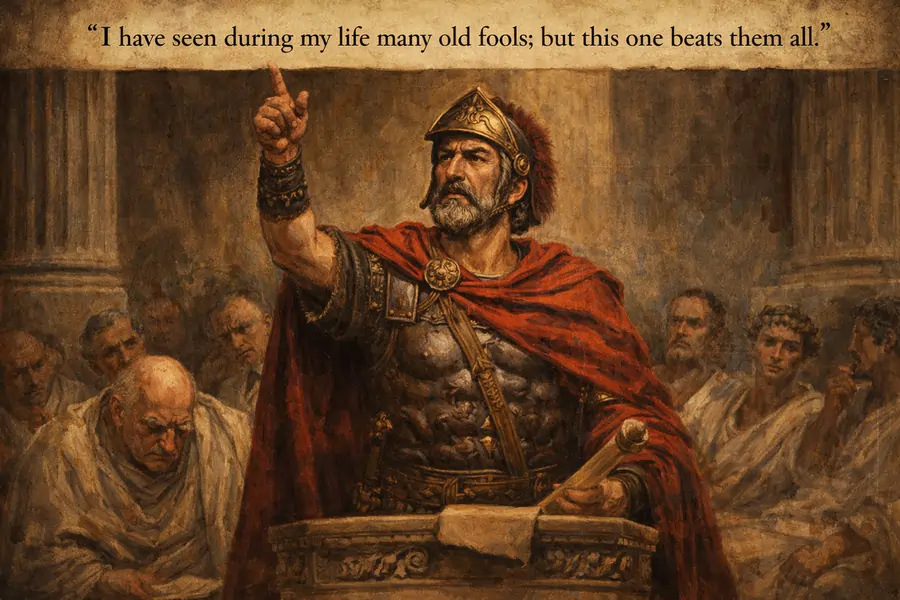
After the war, Hannibal retired from military service and returned to Carthage. According to Livy (History of Rome 33.46-49) and Cornelius Nepos (Life of Hannibal 7), Hannibal was elected suffete and introduced financial reforms that reduced corruption and enabled Carthage to pay its Roman indemnities more efficiently. He restructured Carthage's finances, reduced corruption, and ensured that war indemnities to Rome were paid efficiently. His reforms strengthened Carthage economically, but also made him enemies among the elite.
Rome was still wary of Hannibal's influence and pressured Carthage to surrender him. Facing political opposition and Roman demands, Hannibal chose exile.
Exile and Continued Military Achievements
After leaving Carthage, Hannibal sought refuge with Antiochus III of the Seleucid Empire. His years in exile are described by Cornelius Nepos (Life of Hannibal 7-9) and Livy, both of whom portray Rome as continuing to regard him as a dangerous adversary. There, he offered his expertise in military strategy and contributed to some naval operations against Rome. However, Antiochus did not fully utilize Hannibal's capabilities. In one instance, Antiochus displayed his mighty army to Hannibal and asked him if they were enough for the Romans. Hannibal is said to have responded, "Quite enough for the Romans, however greedy they are," suggesting that Hannibal did not believe that his army was large enough to defeat the Romans but enough to satisfy their thirst for conquest. Antiochus was defeated by the Romans in the Battle of Magnesia, following which he had to flee again.
Cornelius Nepos (Life of Hannibal 10) recounts one of Hannibal's most unusual stratagems: ordering clay pots filled with venomous snakes to be hurled onto enemy ships, causing panic that helped secure victory. In 184 BC, Hannibal helped Prusias I defeat Eumenes two more times before the Romans forced Bithynia to give up Hannibal.
Rome's Pursuit and Hannibal's Suicide
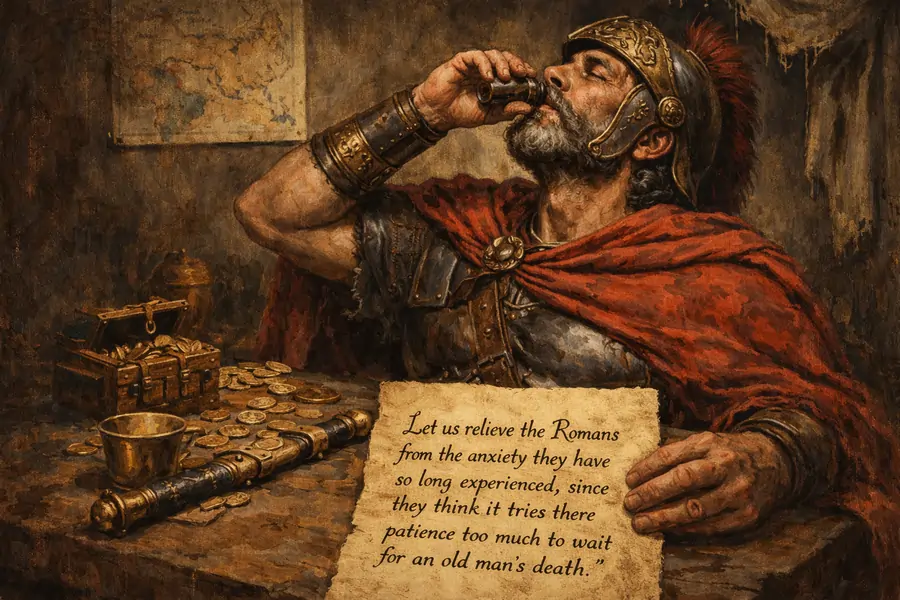
Rome never forgot Hannibal. Even years after the war, they viewed him as a threat. The defeats he dealt to the Romans on their soil were ingrained in their minds. As Roman influence expanded, they demanded his surrender from various kingdoms that sheltered him. Eventually, around 183 BC, when Hannibal was in Bithynia (modern-day Turkey), he was surrounded by enemy soldiers.
According to Cornelius Nepos (Life of Hannibal 12) and Livy (History of Rome 39.51), Hannibal chose to take poison rather than surrender to Rome, bringing to an end one of antiquity's greatest military careers. According to tradition, he carried poison with him for this very purpose. His final act was a defiant letter that he left behind before taking his own life.
"Let us relieve the Romans from the anxiety they have so long experienced, since they think it tries their patience too much to wait for an old man's death"
Why Hannibal Was One of the Greatest Generals
Hannibal Barca is widely regarded as one of history's greatest military commanders. Modern historians such as Adrian Goldsworthy, J. F. Lazenby, and Dexter Hoyos consistently rank him among antiquity's finest strategists because of his tactical innovation, operational brilliance, and ability to sustain a multinational army deep inside enemy territory.
Mastery of Battlefield Tactics
Hannibal demonstrated exceptional tactical skill in multiple battles. At the Battle of Trebia, he used terrain, weather, and hidden troops to ambush the Romans. At Lake Trasimene, he executed one of the largest ambushes in ancient history by trapping a Roman army between hills and a lake. His greatest achievement came at Cannae, where he performed a double envelopment that surrounded and destroyed a much larger Roman force. These victories showed his ability to adapt tactics to different situations.
Leadership of a Multi-Ethnic Army
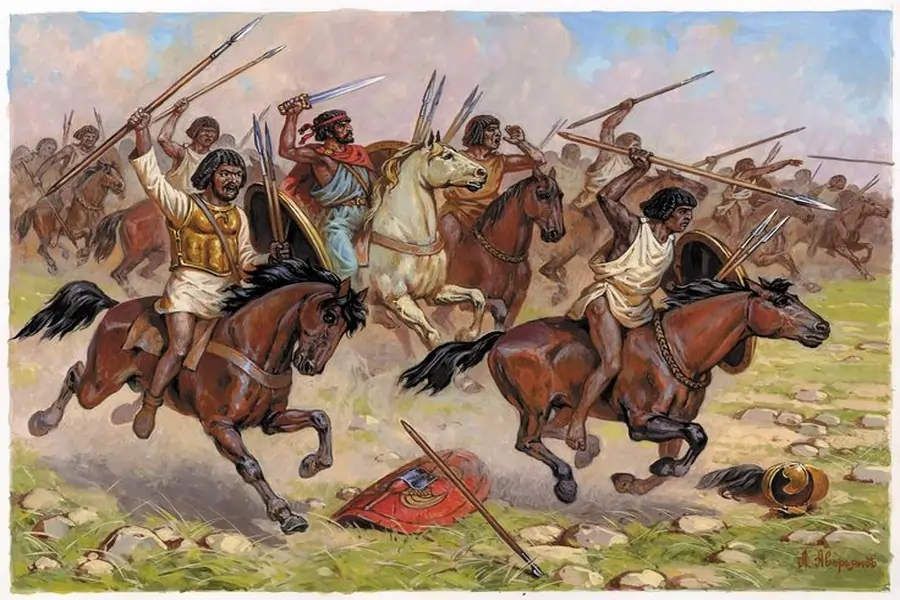
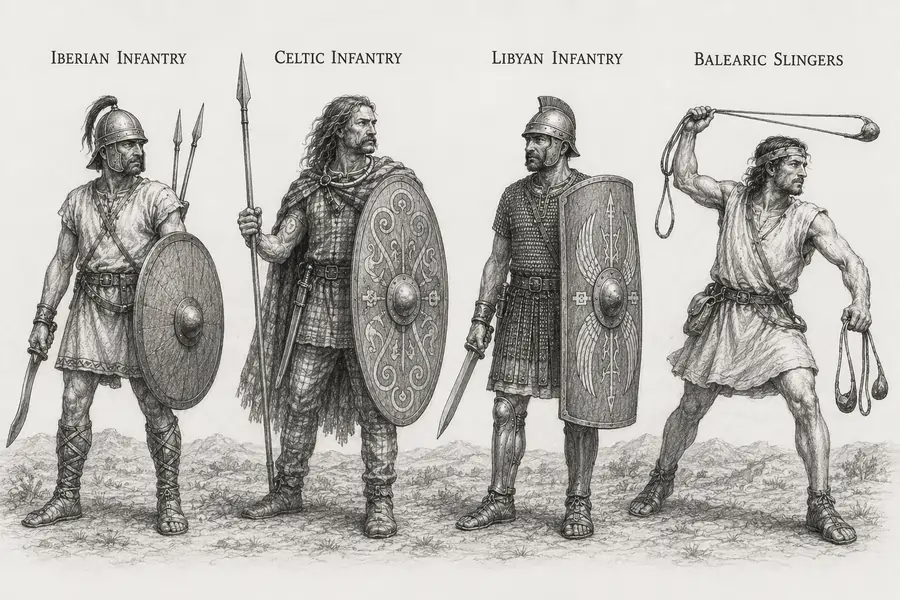
Hannibal commanded a diverse army composed of Iberians, Gauls, Numidians, Africans, and other allied troops. These forces differed in language, culture, and fighting styles. Despite these challenges, Hannibal maintained discipline and cohesion for more than a decade in hostile territory. His ability to integrate cavalry, light infantry, and heavy troops into coordinated maneuvers was a major strength.
Strategic Boldness and Innovation
The decision to cross the Alps into Italy remains one of the boldest strategic moves in military history. By bringing the war directly to Roman territory, Hannibal forced Rome onto the defensive and encouraged revolts among Rome's Italian allies. This maneuver demonstrated his willingness to take calculated risks to achieve strategic surprise.
Adaptability in Adverse Conditions
Hannibal operated without consistent reinforcements from Carthage and relied heavily on local alliances and captured supplies. Despite these limitations, he remained undefeated in Italy for many years. He adjusted his tactics depending on terrain, enemy strength, and available forces, showing remarkable flexibility.
Long-Term Psychological Impact on Rome
Hannibal's victories created panic in Rome and forced the Republic to abandon its traditional aggressive strategy. The Romans adopted the Fabian Strategy to avoid direct confrontation, a clear sign of Hannibal's influence. Even after the war ended, Roman leaders remained wary of him, demonstrating the lasting psychological impact of his campaign.
Through tactical brilliance, bold strategy, and effective leadership, Hannibal challenged the most powerful state of his time and came close to defeating it. His campaigns, especially the Battle of Cannae, continue to be studied as classic examples of military genius.
Legacy and Historical Impact
Hannibal Barca is widely regarded as one of the greatest military generals in history. His tactics, particularly at Cannae, continue to influence military strategy to this day. Despite ultimately losing the war, Hannibal was able to bring Rome to its knees by inflicting devastating defeats on its own soil. He was so close to his ultimate goal of defeating Rome.
His story also foreshadows the eventual destruction of Carthage during the Third Punic War, when Rome finally eliminated its greatest rival. Hannibal's life is a testament to ambition, resilience, and strategic brilliance. From his childhood oath to his final moments, he remained a symbol of resistance against overwhelming odds. Even today, his name evokes admiration, curiosity, and respect-ensuring that Hannibal Barca's legacy endures across centuries.
Sources and Further Reading
- Polybius. The Histories, Books 3 and 15. Available at: https://penelope.uchicago.edu/Thayer/E/Roman/Texts/Polybius/home.html
- Livy. Ab Urbe Condita, Books XXI-XXIII.
- Cornelius Nepos. Life of Hannibal. Available at: https://topostext.org/work/520
- Plutarch. Life of Fabius Maximus. Available at: https://penelope.uchicago.edu/Thayer/E/Roman/Texts/Plutarch/Lives/Fabius_Maximus*.html
- Goldsworthy, Adrian. The Fall of Carthage: The Punic Wars 265-146 BC. Yale University Press, 2006.
- Lazenby, J. F. Hannibal's War. University of Oklahoma Press, 1998.
- Hoyos, Dexter. Mastering the West: Rome and Carthage at War. Oxford University Press, 2015.
- Dodge, Theodore Ayrault. Hannibal. Da Capo Press (reprint).
- Hoyos, Dexter. Hannibal's Dynasty: Power and Politics in the Western Mediterranean. Routledge.
- Hoyos, Dexter (ed.). A Companion to the Punic Wars. Wiley-Blackwell, 2011.
Related Articles
Frequently Asked Questions
Who was Hannibal Barca and why is he famous?
Hannibal Barca was a Carthaginian general and one of the greatest military commanders in history. He is most famous for leading Carthaginian forces against Rome during the Second Punic War and for his daring crossing of the Alps with war elephants, as well as his major victories at battles like Cannae and Lake Trasimene.
Why did Hannibal cross the Alps?
Hannibal crossed the Alps to invade Italy from the north and catch the Romans off guard. Instead of fighting Rome on his own territory, he aimed to bring the war directly into Italy, weaken Roman alliances, and force a decisive victory on Roman soil.
What was Hannibal's greatest victory?
Hannibal's greatest victory is widely considered to be the Battle of Cannae in 216 BC. In this battle, he used a double envelopment tactic to surround and destroy a much larger Roman army, resulting in one of the most devastating defeats in Roman history.
How did Hannibal lose the Second Punic War?
Hannibal ultimately lost the Second Punic War after being defeated by Scipio Africanus at the Battle of Zama in 202 BC. Scipio adapted Hannibal's own tactics and used superior cavalry to break the Carthaginian army, forcing Carthage to surrender.
What happened to Hannibal after the Battle of Zama?
After the Battle of Zama, Hannibal returned to Carthage and became a political leader, implementing financial and administrative reforms. However, due to pressure from Rome and political enemies at home, he was forced into exile and continued to serve as a military advisor in foreign courts.
How did Hannibal die?
Hannibal died around 183 BC in Bithynia when Roman forces closed in on him. Refusing to be captured by his lifelong enemies, he took poison that he reportedly carried with him, ending his life on his own terms.
Add Comment