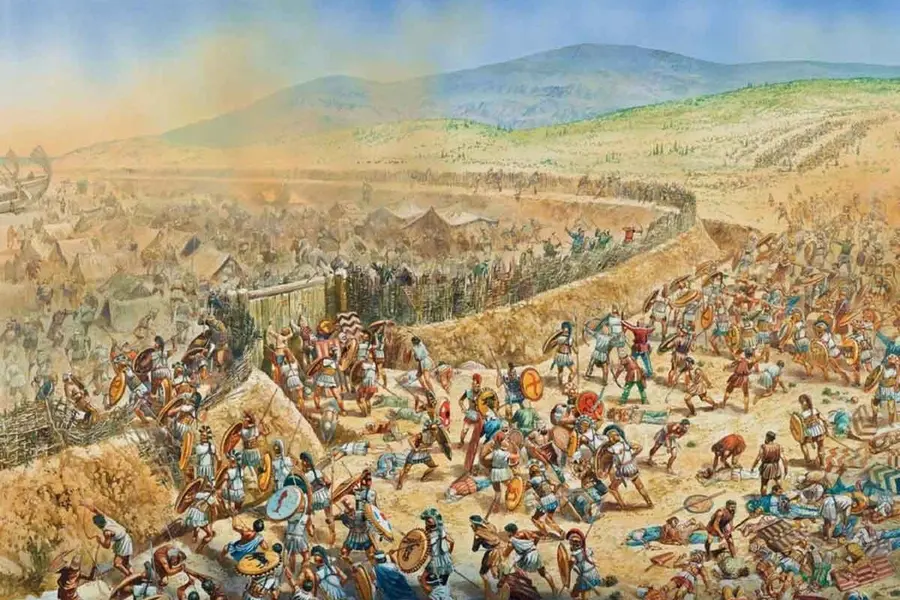
On a single day in 479 BC, according to the ancient historian Herodotus, Greek forces defeated the Persian army at Plataea and shattered the Persian position on the coast of Ionia at Mycale. One victory helped drive the invaders from mainland Greece while the other carried the war across the Aegean, where Persian ships lay protected behind a fortified camp. The Battle of Mycale was more than a forgotten clash at the end of Xerxes' invasion. It exposed the limits of Persian military power, encouraged resistance among the Greek cities of Asia Minor, and opened the way for Athens to become the dominant naval power in the eastern Mediterranean.
While the battles of Thermopylae and Salamis have become famous symbols of the Greco-Persian Wars, Mycale deserves a place in the same story. Its outcome depended on more than the courage of Greek hoplites. Geography, military decisions, local loyalties, and the destruction of a vulnerable fleet all shaped the result. Understanding the Battle of Mycale also helps explain why the Greek victory over Persia did not end the conflict immediately, but instead began a new struggle for control of the Aegean.
Table of Contents
- The Persian Wars Before Mycale
- Why the Greeks Sailed to Ionia
- The Persian Fleet at Mount Mycale
- The Commanders and Armies at Mycale
- The Battle of Mycale: How the Greeks Won
- The Role of the Ionian Greeks
- The Aftermath: Burning the Persian Fleet
- Why the Battle of Mycale Mattered
- Was Mycale Really Fought on the Same Day as Plataea?
- Conclusion
- References and Further Reading
1. The Persian Wars Before Mycale
To understand why the Battle of Mycale mattered, it is necessary to look beyond the battlefield itself. The clash took place during the final phase of the second Persian invasion of Greece, an expedition launched by King Xerxes I to bring the independent Greek city-states under Persian authority.
The conflict had begun decades earlier. In 499 BC, several Greek cities in Ionia, on the western coast of Asia Minor, rebelled against Persian rule. Athens and Eretria provided limited assistance to the rebels, helping to turn a regional revolt into a wider confrontation with the Persian Empire. Although the Ionian Revolt was eventually crushed, it contributed to the chain of events that brought Persia into conflict with mainland Greece.
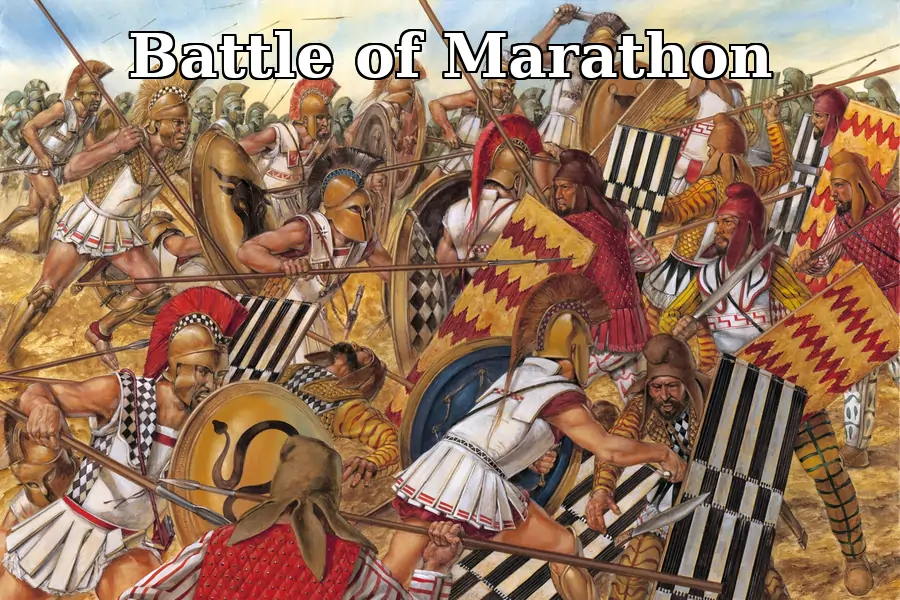
King Darius I subsequently sent an expedition against Greece. In 490 BC, the Athenians defeated the Persian landing force at the Battle of Marathon. The defeat did not end Persian ambitions. Xerxes, Darius's successor, assembled a much larger expedition to subdue Greece and avenge earlier setbacks.
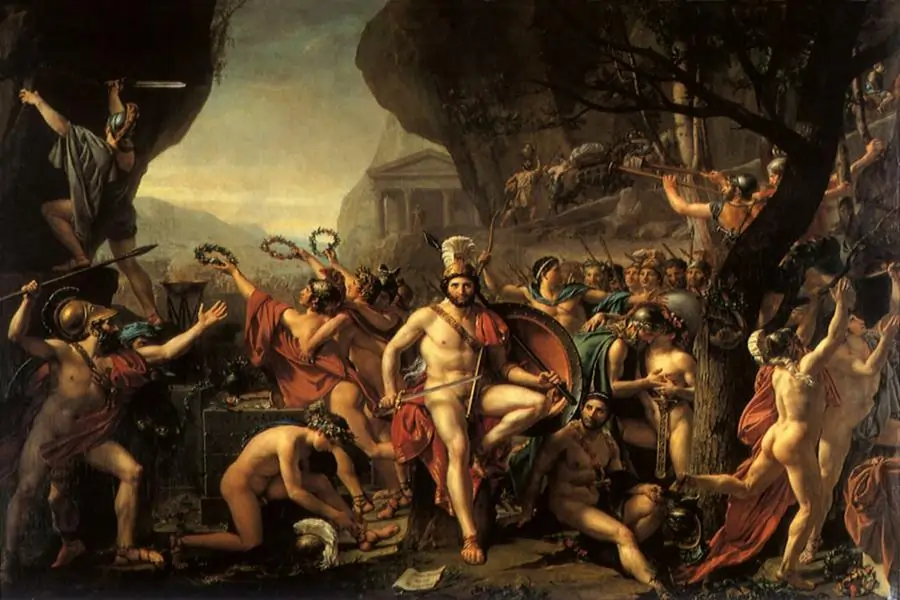
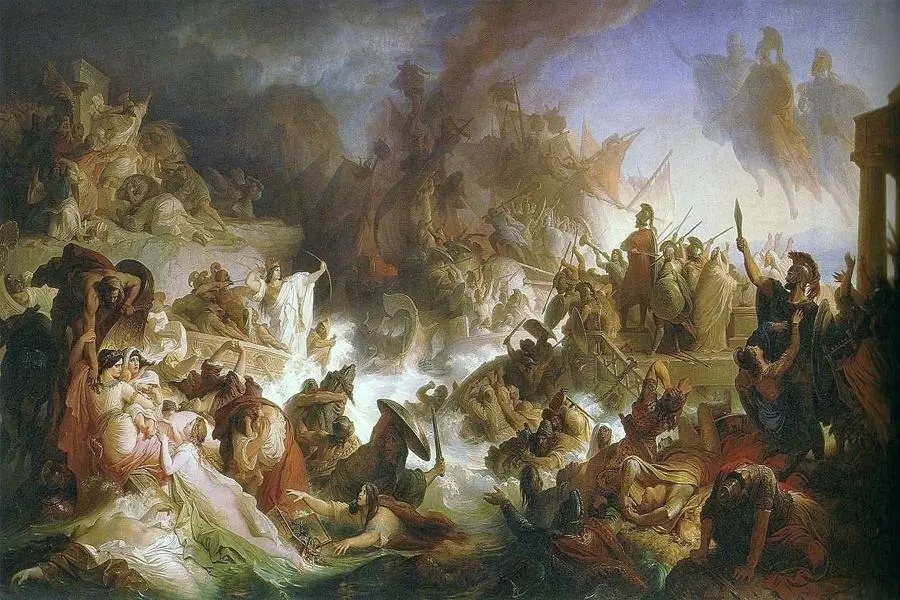
The campaign of 480 BC initially brought spectacular Persian successes. The Greek defenders at Thermopylae were defeated, and Athens was eventually occupied and burned. Yet the Persian advance encountered a serious obstacle at sea. At the Battle of Salamis, the Greek fleet defeated the Persian navy in the confined waters near the island of Salamis. The loss weakened Persia's ability to support its land campaign and complicated the supply of its forces in Greece.
Xerxes returned to Asia, leaving the commander Mardonius to continue the campaign in Greece during 479 BC. Mardonius still possessed a formidable army and hoped to secure Greek submission through a combination of military pressure and diplomacy. The Athenians and their allies, however, refused to abandon the struggle.
The decisive land battle came at Plataea, where a Greek coalition under the Spartan regent Pausanias defeated Mardonius's army. The Persian commander was killed, and the surviving Persian forces withdrew from the battlefield. The victory severely damaged Persia's campaign on the Greek mainland. Yet the war was not confined to mainland Greece. Across the Aegean, a Greek fleet was preparing to challenge the Persian position in Ionia. Its confrontation with the Persian forces near Mount Mycale would become the other major victory associated with the final campaign of 479 BC.
2. Why the Greeks Sailed to Ionia
The Greek expedition to Ionia began with uncertainty. The allied fleet, commanded by the Spartan king Leotychidas, had assembled at Delos in the Aegean. The Greeks had to decide whether to pursue an offensive operation against Persia or remain closer to their own territory.
While the fleet was at Delos, envoys from Samos approached the Greek commanders. According to Herodotus, they argued that the arrival of a Greek fleet could encourage the Ionian Greeks to revolt against Persian rule. They also suggested that the Persian ships were inferior to the Greek vessels and that a successful campaign might bring substantial rewards.
The appeal was both strategic and political. The Ionian cities had cultural and historical ties to the Greek mainland, but many had spent decades under Persian rule. Their participation in a revolt could weaken Persian control along the coast and provide the Greeks with potential allies in enemy territory.
The Greek commanders therefore moved towards Samos, an island lying close to the Ionian coastline. Their objective was not simply to destroy enemy ships. They also hoped to exploit local discontent and prevent Persia from using its remaining naval strength to dominate the eastern Aegean.
This was a significant change in the direction of the war. At the Battle of Thermopylae, the Greeks had attempted to block a Persian advance through a narrow land passage. At Salamis, they had lured the Persian fleet into difficult waters. At Mycale, they would take the initiative and carry the conflict to the Asian shore.
The expedition also exposed the different interests within the Greek alliance. Sparta remained a major land power, while Athens had invested heavily in its navy. Their cooperation had been essential to the victories of 480 and 479 BC, but the question of who would lead future operations in the Aegean was becoming increasingly important.
3. The Persian Fleet at Mount Mycale
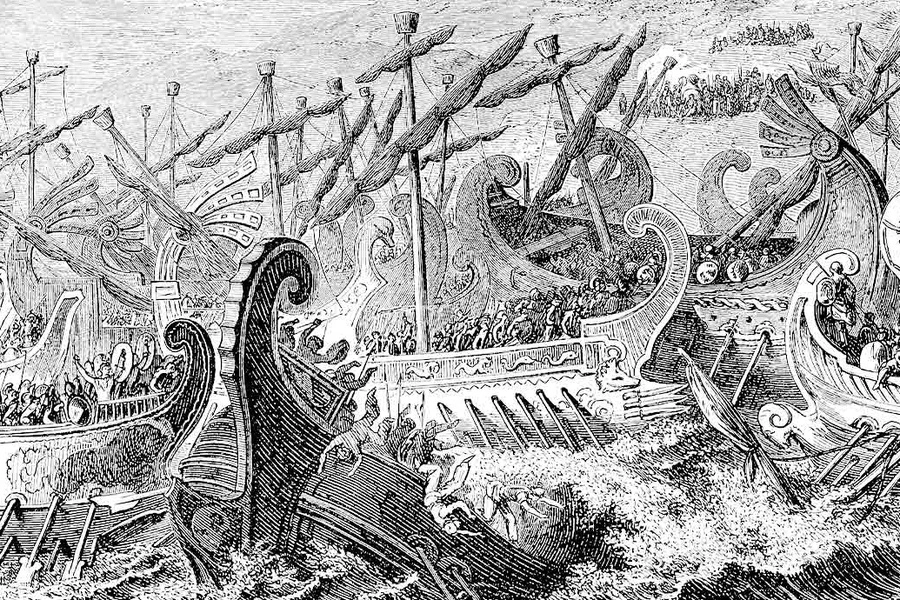
When the Greek fleet approached Samos, the Persian commanders chose not to risk another major naval engagement. Herodotus reports that they dismissed their Phoenician ships and moved the remaining fleet towards the mainland, seeking the protection of the Persian land forces stationed in Ionia.
The Persian army in the region was commanded by Tigranes. Its presence gave the Persian fleet a defensive option after the defeat at Salamis. Rather than expose their ships to a Greek attack at sea, the Persians could bring them ashore and establish a fortified position protected by troops.
The fleet withdrew to the coast near Mount Mycale, opposite Samos. The location placed the Persian ships close to the Asian mainland and within reach of their supporting army. The Persians then hauled their vessels ashore and constructed a defensive enclosure using timber, stones and other available materials.
This was not necessarily an irrational decision. A fleet that had suffered a major defeat could be difficult to employ effectively against an opponent with strong naval momentum. By moving ashore, the Persians reduced their immediate exposure to a surprise attack from Greek ships and created a position that could be defended by infantry.
However, the decision also created a vulnerability. Ships on land could not manoeuvre, withdraw quickly or respond independently to changing conditions. Their protection depended on the security of the fortified camp and the troops defending it.
The Persian position was therefore a compromise between preserving the fleet and avoiding another naval disaster. If the Greeks refused to attack the camp, the ships might survive. If the Greeks landed in strength and broke through the defences, the entire fleet could be destroyed without a conventional sea battle.
Herodotus describes the Persians as preparing for either a siege or a successful defence. The enclosure was designed to protect both the ships and the men who would fight around them. Yet the Greeks had little incentive to leave the enemy undisturbed. They decided to land and confront the Persian force directly.
The strategic contest had changed. The Persian fleet was no longer the principal instrument of the battle. The decisive question was whether the Greek forces could overcome the Persian infantry and reach the ships behind the defences.
4. The Commanders and Armies at Mycale
The Greek expedition was led by Leotychidas, the Spartan king who commanded the allied fleet. The Athenian contingent was led by Xanthippus, one of the leading Athenian commanders of the period. Their forces included troops from several Greek communities, reflecting the coalition that had resisted Xerxes's invasion.
On the Persian side, Tigranes commanded the land force protecting the fleet. The Persian naval commanders included Artayntes and Ithamitres. Herodotus also names Mardontes among the senior Persian commanders killed during the fighting.
The precise number of people engaged at Mycale remains uncertain. Herodotus gives the Persian force a figure of 60,000 men, but ancient army totals should not automatically be treated as reliable measurements. The surviving narrative does not provide enough independent evidence to establish the exact strength of either side.
| Category | Greek forces | Persian forces |
|---|---|---|
| Commanders | Leotychidas and Xanthippus | Tigranes, Artayntes and Ithamitres |
| Strategic objective | Defeat the Persian position and weaken Persian control of the Aegean | Protect the fleet and maintain the Persian position in Ionia |
| Military situation | An attacking force approaching from the sea | A fleet protected by a fortified camp and supporting infantry |
| Major tactical challenge | Crossing the difficult coastal terrain and breaching the defences | Holding the enclosure against an organised assault |
| Outcome | Victory and destruction of the Persian ships | Defeat and severe losses |
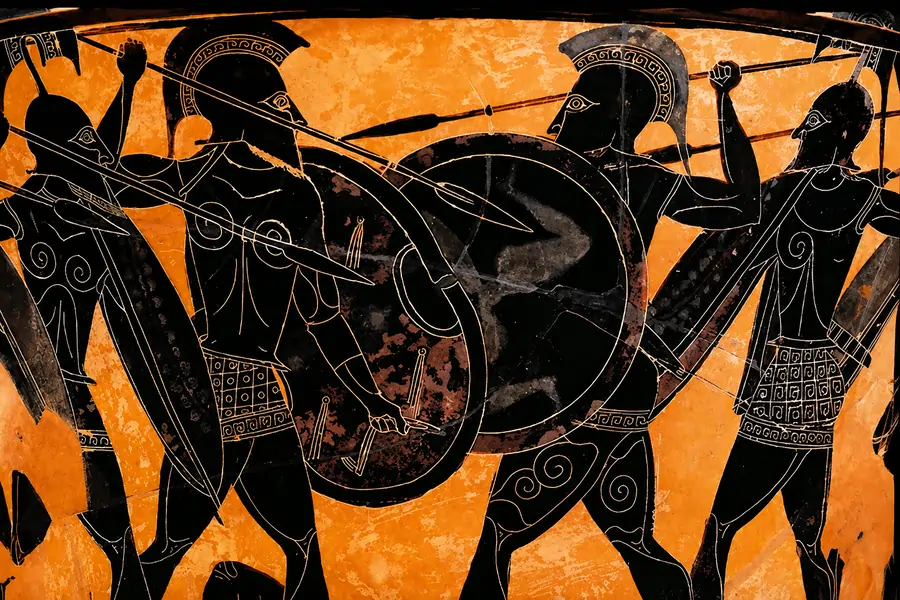
The armies also differed in how they approached the fighting. Greek hoplites relied on heavy armour, large shields, spears and close-order formations. Persian forces drew on a wider range of military traditions, including archery, infantry and cavalry, although the usefulness of each element depended on the terrain and circumstances.
It would be misleading to reduce the outcome to a simple contest between Greek heavy infantry and Persian soldiers. The Persians were defending a fortified position, while the Greeks had to advance against prepared resistance. The battle was shaped by the ability of each side to use its position and maintain cohesion under pressure.
5. The Battle of Mycale: How the Greeks Won
The Greek landing and advance
Once the Greeks learned that the Persian fleet had withdrawn to the mainland, they faced a choice. They could return home, sail towards the Hellespont, or land and attack the Persian position. The allied commanders chose the third option.
The decision carried considerable risk. The Greek fleet could no longer rely on the advantages of a naval engagement, and its troops would have to fight an enemy protected by a fortified camp. Yet withdrawing would leave the Persian position intact and squander the opportunity to strike at the fleet.
The Greeks landed near Mycale and prepared to advance against the Persian defences. The terrain complicated their approach. The coastal landscape and the slopes of the surrounding heights meant that the different sections of the Greek force did not necessarily advance at the same pace.
Herodotus describes the Athenians and their allies advancing on one side, while the Spartans and their allies followed a different route. The Athenians reached the Persian position first. The separation mattered because the assault began before all the Greek contingents could arrive together.
Before the attack, the Greek commander Leotychidas had also attempted to encourage the Ionian Greeks serving with the Persians to consider their freedom. This was a political appeal intended to weaken Persian cohesion before the fighting began.
The Persian defensive line
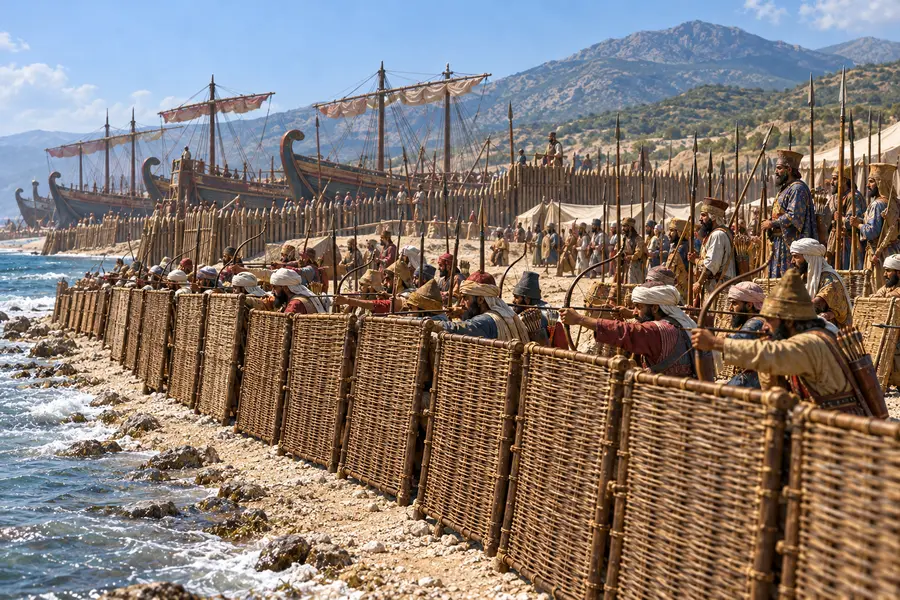
The Persians had prepared a barrier of shields and fortified the camp around their ships. Such a position could protect defenders from an advancing enemy, restrict access to the ships and force attackers to fight through a narrow area rather than exploit their full numbers.
The defenders were not simply waiting helplessly behind the enclosure. Herodotus describes them resisting the Greek attack with determination. Their position offered protection, and their ability to hold the line could have prevented the Greeks from reaching the ships.
For the attackers, the challenge was to maintain formation while moving towards the defences and then force a breach. A failure at this stage could have left the Greek troops exposed in front of the Persian line, potentially allowing the defenders to inflict heavy casualties.
The Greeks had experience fighting Persian forces, most notably at Marathon and Plataea. But Mycale presented a different problem. At the Battle of Marathon, the Athenians had attacked a Persian force deployed on open ground. At the Battle of Plataea, the Greeks had fought a major land battle against Mardonius's army. At Mycale, they had to storm a fortified position whose main purpose was to protect a fleet.
The Athenian assault breaks through
According to Herodotus, the Athenians and their allies were the first to engage the Persian defenders. They fought their way towards the enclosure, where the Persians initially held their ground. The fighting was intense enough to delay the Greek advance, but the Persian line eventually gave way.
The breach transformed the battle. Once the attackers penetrated the defensive position, the Persians could no longer rely on the enclosure to prevent access to the camp. Greek troops were able to enter the position and press their advantage at close quarters.
Herodotus singles out the Athenians for their performance in the fighting. His account reflects the perspective of a Greek historian writing in a world where the achievements of individual city-states mattered greatly. Nevertheless, his description identifies the Athenian attack as a decisive stage in the battle.
The Persian defenders continued to resist. Herodotus says that, after the wider force began to flee, the Persians gathered into smaller groups and fought on. Their resistance demonstrates that the collapse of the defensive line did not immediately turn every Persian soldier into a fleeing combatant.
The difference between an organised defensive position and a disintegrating one was crucial. While the enclosure remained intact, the Persians could concentrate their strength at the point of attack. Once the Greeks entered the camp, the defenders faced a more difficult fight, with fewer opportunities to control the engagement.
The Spartans arrive, and the Persian position collapses
The Spartan contingent and its allies approached by a different route. The difficult terrain slowed their advance, so they did not take part in the initial assault in the same way as the Athenians. By the time they reached the fighting, the Persian defensive position was already under severe pressure.
The arrival of additional Greek forces helped complete the Persian defeat. The defenders could no longer contain the assault, and the fighting developed into a rout in which many of the Persian troops were killed or fled. Herodotus names Tigranes and Mardontes among those killed.
The battle illustrates how quickly a defensive position could become vulnerable once attackers broke through its perimeter. While the enclosure held, the Persian defenders could concentrate their resistance; once the Greeks entered the camp, maintaining an organised defence became more difficult. The precise sequence of events is known chiefly through Herodotus, so the battle is best reconstructed as a hard-fought assault whose outcome reflected the collapse of the Persian position, rather than as a perfectly coordinated operation planned in every detail by the Greek commanders.
It is important, however, not to imagine a perfectly coordinated Greek operation in which every movement unfolded according to a master plan. The surviving account describes separate advances, difficult terrain and the Athenian contingent taking the initiative. The Greek victory emerged from the interaction of their assault, the Persian defensive failure and the arrival of further allied troops.
By the end of the engagement, the Persian position at Mycale had been overwhelmed. The Greeks had won a land battle on the Asian coast and placed the Persian fleet within their reach.
6. The Role of the Ionian Greeks
The Battle of Mycale was not simply a confrontation between Greeks from the mainland and an army serving the Persian king. It also involved Greek communities that had lived under Persian rule for decades.
The Ionians occupied an ambiguous position. They shared linguistic, religious and cultural connections with other Greek communities, but their cities had political relationships with the Persian Empire. Some Ionians served within Persian forces, and their actions could be influenced by local political circumstances, personal interests and the risks of opposing imperial authority.
Before the battle, Leotychidas appealed to the Ionians to consider their freedom. The Persian commanders, meanwhile, were suspicious of the loyalty of their Ionian contingents. According to Herodotus, they disarmed the Samians and assigned the Milesians to guard mountain passes, separating them from the main force.
These measures reveal the importance of trust within a multinational army. The Persian Empire drew military resources from many peoples, and such diversity was a source of strength. Yet an army assembled from communities with different political interests could face difficulties when its commanders doubted the loyalty of some of its own troops.
Herodotus describes the Samians as assisting the Greek side and the Milesians as acting against Persian troops who were fleeing the battle. These actions suggest that at least some Ionian contingents turned against the forces they had been serving. The account does not establish that every Ionian community shared the same aims, however. Their choices took place within a complicated political situation in which local interests, Persian authority and the prospect of Greek support all mattered.
The account should not be taken to mean that all Ionian Greeks shared the same aims or acted from a single sense of national identity. Their decisions were made within a complex political landscape. Nevertheless, their role at Mycale demonstrates how local cooperation and defections could influence the outcome of a military campaign.
The battle also exposed the limits of Persian control in western Anatolia. Holding territory required more than deploying troops and ships; it required maintaining the cooperation, or at least the compliance, of local communities. When that relationship became unstable, the military position could weaken rapidly.
7. The Aftermath: Burning the Persian Fleet
After defeating the Persian force, the Greeks turned their attention to the ships. The fleet had been hauled ashore and protected by the fortified enclosure, but that defensive arrangement had failed. The Greeks looted the camp and burned the ships and the surrounding fortifications.
This was the strategic climax of Mycale. The Greeks had not merely defeated the troops protecting the Persian fleet; they had destroyed the ships that the Persian commanders had brought ashore to protect them from another naval engagement. The loss seriously weakened the Persian position in the eastern Aegean, although it did not eliminate the empire's wider naval resources or its capacity to rebuild its forces.
Ships were expensive military assets. They required skilled crews, maintenance, supplies, and the coordination of naval bases. Losing a large concentration of vessels could therefore have consequences beyond the immediate battlefield, especially when the surviving fleet had already suffered a setback at Salamis.
Mycale did not mean that the Persian Empire had lost all its naval capabilities. Persia remained a powerful state with extensive resources and the ability to rebuild forces. Nor did the victory immediately free every Greek city in Asia Minor from Persian rule. Its significance lay in the weakening of the Persian position and the new opportunities available to the Greek coalition.
After the battle, the Greek commanders gathered at Samos to discuss the future of the Ionian Greeks. Herodotus describes a debate over whether the Greek populations of Asia Minor should be relocated to safer areas under Greek control. The Spartans favoured resettlement, while the Athenians opposed the proposal.
The disagreement revealed a growing difference between Spartan and Athenian priorities. Sparta was primarily concerned with the security of mainland Greece, whereas Athens had strong interests in the Aegean islands and the Greek settlements of Asia Minor. These interests would become increasingly important in the years following the Persian invasion.
The Greeks subsequently moved towards the Hellespont, the narrow waterway connecting the Aegean with the Sea of Marmara. Control of this passage was important for movement between the Aegean and the Black Sea. According to Herodotus, the Athenians continued the offensive and later besieged Sestus, a Persian stronghold near the straits.
The campaign thus continued beyond Mycale. The battle was a major turning point, but its consequences developed through further operations, political negotiations and the gradual reorganisation of power in the Aegean.
8. Why the Battle of Mycale Mattered
The weakening of Persian power in the Aegean
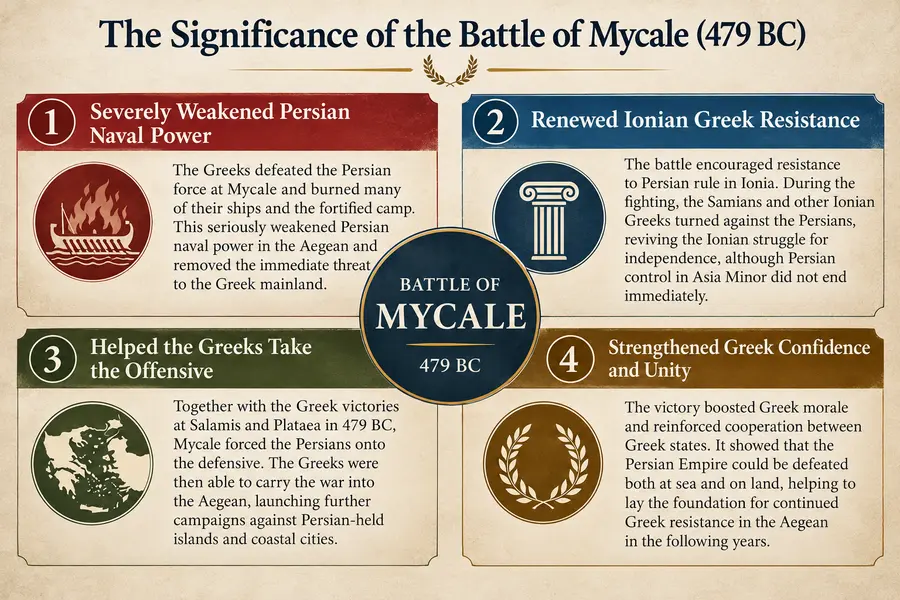
The immediate result of Mycale was the destruction of the Persian fleet at the battlefield and the defeat of the troops protecting it. Coming after Salamis and Plataea, the loss further undermined Persia's ability to sustain its campaign against the Greek city-states.
Yet the outcome should be understood in regional terms. The Persian Empire remained intact, and its power extended across a vast area of western and central Asia. Mycale did not overthrow the Achaemenid monarchy or end the empire's influence in the eastern Mediterranean. It instead weakened one part of its military position at a critical moment.
A renewed challenge to Persian control of Ionia
The battle encouraged the Greek cities of the eastern Aegean to challenge Persian authority. The participation of the Samians and the actions attributed to the Milesians highlighted the difficulties Persia faced in keeping the region secure after a major military defeat.
However, political independence did not follow automatically from the Greek victory. The Ionian cities remained exposed to Persian power, and their future depended on the willingness and ability of the Greek allies to support them. Mycale created an opportunity rather than providing a permanent solution.
The rise of Athenian naval power
Mycale also helped shape the future relationship between Athens and the other Greek states. Athens had played a leading role in the naval war against Persia, and its interests increasingly centred on the Aegean and the eastern Mediterranean.
In the years that followed, Athens became the leading power in the Delian League, an alliance originally formed to continue the war against Persia and protect Greek communities. Over time, the alliance developed into an Athenian-dominated system of power.
This transformation was not caused by Mycale alone. It resulted from a series of military campaigns, political choices, and disagreements between Athens and its allies. Nevertheless, the destruction of the Persian fleet and the renewed campaign in the eastern Aegean helped create the conditions in which Athenian influence could expand.
The long-term story also offers a useful contrast with Athens's later decline. The maritime power that emerged from the Persian Wars eventually became embroiled in the Peloponnesian War, a conflict that exposed the limits of Athenian resources and its ability to maintain an empire against determined opposition.
Mycale in the wider history of ancient warfare
The battle provides a valuable example of how ancient armies and fleets depended on each other. The Persians attempted to protect their ships by placing them under the cover of a land army. The Greeks responded by landing troops and attacking the defensive position directly.
The outcome shows that a fleet could remain vulnerable even when its commanders avoided a naval engagement. Ships required secure anchorages, protected bases, and ground forces capable of preventing an enemy landing. Once the defensive perimeter failed, the fleet became exposed to destruction.
The battle also demonstrates the importance of cohesion and local support. The Greek assault did not succeed through equipment alone. The defenders' loss of control, the pressure exerted by the attacking forces and the uncertain loyalties within the Persian position all contributed to the result.
These themes recur throughout military history. Later conflicts between Greek and Macedonian armies, for example, reveal how formations, terrain and command decisions could determine the outcome of a battle. Our articles on why the Macedonian phalanx was so effective and how the Roman legion defeated the Macedonian phalanx explore similar questions about the relationship between tactics, organisation and battlefield conditions.
Mycale belongs in this wider discussion because it illustrates a fundamental military truth: the strength of an army or fleet depends not only on its numbers and equipment, but also on how effectively it can respond when the conditions of battle change.
9. Was Mycale Really Fought on the Same Day as Plataea?
The claim that the Battle of Mycale took place on the same day as the Battle of Plataea is one of the most memorable features of the ancient account. Herodotus explicitly links the two victories and describes a report of the Greek success at Plataea reaching the forces at Mycale as they prepared to fight.
In his narrative, the report strengthened the morale of the Greek troops. Herodotus also draws attention to religious parallels between the two battlefields, presenting their coincidence as a remarkable example of divine favour. The connection gives his account a dramatic structure: while the Greeks were defeating the Persian army on the mainland, another Greek force was striking at Persian power across the Aegean.
However, the precise synchronisation of the two battles is disputed. Herodotus wrote his account decades after the events, and modern historians have questioned whether the engagements occurred on exactly the same day. The possibility that the battles took place close together remains distinct from certainty about their exact timing.
There is another important limitation. The surviving account of Mycale depends heavily on Herodotus. We do not possess a detailed Persian narrative of the battle that independently confirms his description of the commanders, troop movements and events. Historians must therefore examine his account critically while recognising that it remains the principal source for reconstructing the engagement.
These uncertainties do not diminish the importance of the battle. The Greek victories at Plataea and Mycale occurred during the same broad campaign and together marked a serious setback for Xerxes's invasion. The historical significance of Mycale rests on the military and political consequences of the engagement, not solely on whether it coincided with Plataea to the day.
For readers interested in the broader pattern of decisive engagements, the most decisive battles in history provide further examples of how individual victories can reshape a conflict without immediately resolving every political question behind it.
10. Conclusion
The Battle of Mycale in 479 BC was one of the defining engagements of the final phase of the Greco-Persian Wars. By landing on the Ionian coast, defeating the Persian defenders, and burning the fleet at Mount Mycale, the Greeks turned a defensive struggle into an offensive campaign against Persian power in the Aegean.
Its significance becomes clearer when viewed alongside Plataea. One victory shattered Mardonius's campaign in mainland Greece; the other struck at Persia's maritime position and encouraged renewed resistance among the Ionian Greeks. Whether or not both battles occurred on precisely the same day, their combined impact marked a major turning point in the war.
Mycale did not destroy the Persian Empire or secure lasting independence for every Greek city in Asia Minor. Instead, it opened a new phase of conflict in which the Greeks, particularly the Athenians, sought to extend their influence across the Aegean.
The battle is therefore remembered not only for the destruction of a Persian fleet but also for what followed. The defeat of Xerxes's invasion helped preserve the independence of the Greek city-states, while the campaigns that came afterward transformed the balance of power in the eastern Mediterranean. Mycale stands as a reminder that the consequences of a battle are often measured not just in the territory won or the enemies defeated, but in the political opportunities it creates.
References and Further Reading
- Herodotus, Histories, Book 9, chapters 90-107. The principal ancient account of the Battle of Mycale, covering the Greek expedition, the Persian defensive position, the fighting, the role of the Ionians, and the destruction of the fleet. Read Herodotus, Book 9, through the Perseus Digital Library.
- Rollinger, Robert. "Herodotus IX. Tigranes and the Battle of Mycale." Encyclopaedia Iranica. A scholarly overview of the events described in Herodotus, including the Persian position, the Greek assault, and the significance of the Ionian contingents. Read the article.
- "The Battle of Mycale (479 BCE)." Achaemenica. A modern overview discussing the battle's context, the surviving evidence, and the debate surrounding the traditional synchronisation with Plataea. Read the overview.
- "Herodotus X. Artayctes and the Finale." Encyclopaedia Iranica. Provides context for the Greek campaign towards the Hellespont and the subsequent siege of Sestus. Read the article.
- McDougall, Iain. "The Persian Ships at Mycale." In 'Owls to Athens': Essays on Classical Subjects Presented to Sir Kenneth Dover (1990), pp. 143-149. A scholarly study of the Persian ships and their role in the battle. View the chapter record at Oxford Academic.
Historical note: The narrative of the battle relies primarily on Herodotus. Ancient troop totals, the precise sequence of events, and the claim that Mycale and Plataea occurred on the same day should be treated with appropriate caution.
Related Articles

Frequently Asked Questions
What was the Battle of Mycale in 479 BC?
The Battle of Mycale was fought in 479 BC between a Greek force led by the Spartan king Leotychidas and an army protecting a Persian fleet near Mount Mycale on the coast of Ionia in Asia Minor. The Greeks defeated the Persian defenders and burned their ships, weakening Persian military power in the Aegean during the Greco-Persian Wars.
Why was the Battle of Mycale important in the Greco-Persian Wars?
The Battle of Mycale was important because it weakened Persia's naval position in the Aegean and encouraged resistance among the Greek cities of Ionia. Together with the Greek victory at Plataea, it marked a major turning point in the Persian invasion of Greece and helped create opportunities for further Greek campaigns against Persian-controlled territories.
Who won the Battle of Mycale and who commanded the Greek forces?
The Greeks won the Battle of Mycale in 479 BC. The allied Greek fleet was commanded by the Spartan king Leotychidas, while the Athenian contingent was led by Xanthippus. They defeated the Persian forces protecting the fleet near Mount Mycale and destroyed the ships after the battle.
How did the Greeks defeat the Persians at the Battle of Mycale?
The Greeks defeated the Persians by landing on the Ionian coast and assaulting the fortified camp where the Persian fleet had been hauled ashore. According to Herodotus, the Athenians and their allies reached the defences first and broke through the Persian line. The arrival of other Greek forces helped complete the victory, after which the Greeks burned the Persian ships and fortifications.
Why did the Persian fleet withdraw to the coast before the Battle of Mycale?
The Persian commanders withdrew their fleet towards the coast near Mount Mycale rather than risk another naval engagement with the Greeks. They brought their ships ashore and protected them behind fortifications supported by Persian infantry. This defensive strategy reduced the fleet's exposure at sea but left the ships vulnerable when the Greeks landed and captured the camp.
Was the Battle of Mycale fought on the same day as the Battle of Plataea?
According to the ancient Greek historian Herodotus, the Battle of Mycale and the Battle of Plataea took place on the same day in 479 BC. Plataea was a Greek victory against the Persian army in mainland Greece, while Mycale was fought against Persian forces protecting a fleet in Ionia. Some historians question whether the two battles occurred on precisely the same day, so the traditional account should be treated with caution.
Add Comment