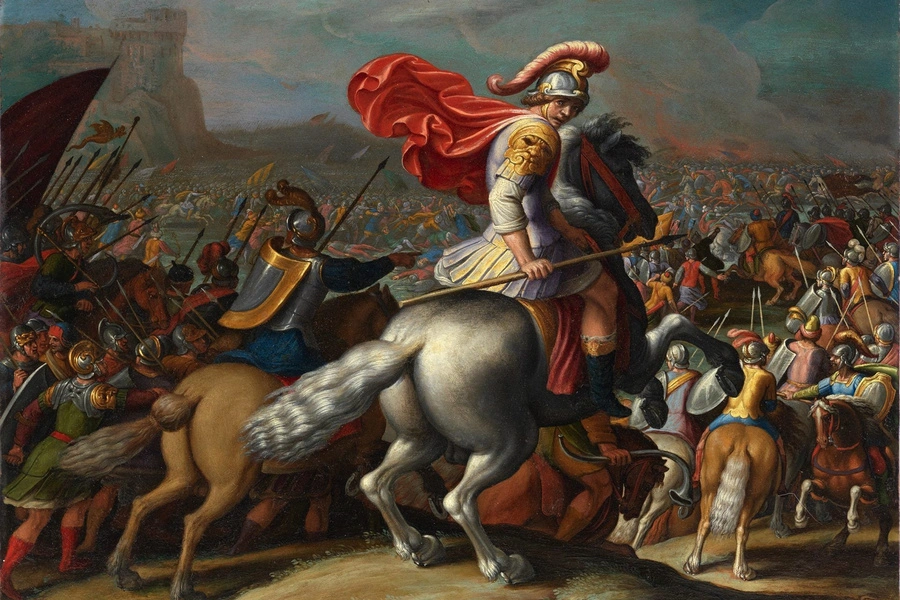
Bucephalus was more than the horse of Alexander the Great. He was a companion who shared the dangers of one of history's most extraordinary military campaigns. From the famous moment when a young Alexander tamed an apparently uncontrollable stallion to the horse's final days in India, the story of Bucephalus reveals a more personal side of the Macedonian conqueror. Ancient writers preserved his memory, Alexander reportedly named a city after him, and later traditions even connected his ancestry to the legendary man-eating horses of Greek mythology. Yet how much of this is the truth and how much of it is just legend? What do we actually know about the horse that accompanied Alexander on his journey of conquest?
Table of Contents
- Who Was Bucephalus?
- How Alexander Tamed Bucephalus
- What Did Bucephalus Look Like?
- Was Bucephalus Descended from the Mares of Diomedes?
- Bucephalus and Alexander's Military Campaigns
- Bucephalus at the Battle of the Hydaspes
- How Did Bucephalus Die?
- Bucephala: The City Named After Alexander's Horse
- The Legacy of Bucephalus
- References
Who Was Bucephalus?
Bucephalus was the famous horse of Alexander III of Macedon, better known as Alexander the Great. Their association began when Alexander was still a young prince, long before he crossed into Asia and defeated the Persian Empire. According to the Greek biographer Plutarch, a Thessalian horse dealer named Philonicus brought Bucephalus to Alexander's father, King Philip II, offering the animal for thirteen talents. The horse's behaviour made an immediate impression, but not the kind the seller had hoped for. Bucephalus refused to accept riders and resisted the attempts of the king's attendants to control him.[1]
The horse was eventually judged too difficult to handle. Alexander, however, believed the problem lay not in the animal's temperament alone but in the way people approached him. His decision to demonstrate this would become one of the best-known stories from his childhood. Alexander was born in 356 BC and became king of Macedon in 336 BC. His subsequent campaigns carried him from Greece through the Persian Empire and into parts of Central and South Asia. Bucephalus became closely associated with this extraordinary military career, although the surviving sources do not provide a reliable record of every battle in which Alexander rode him.
How Alexander Tamed Bucephalus
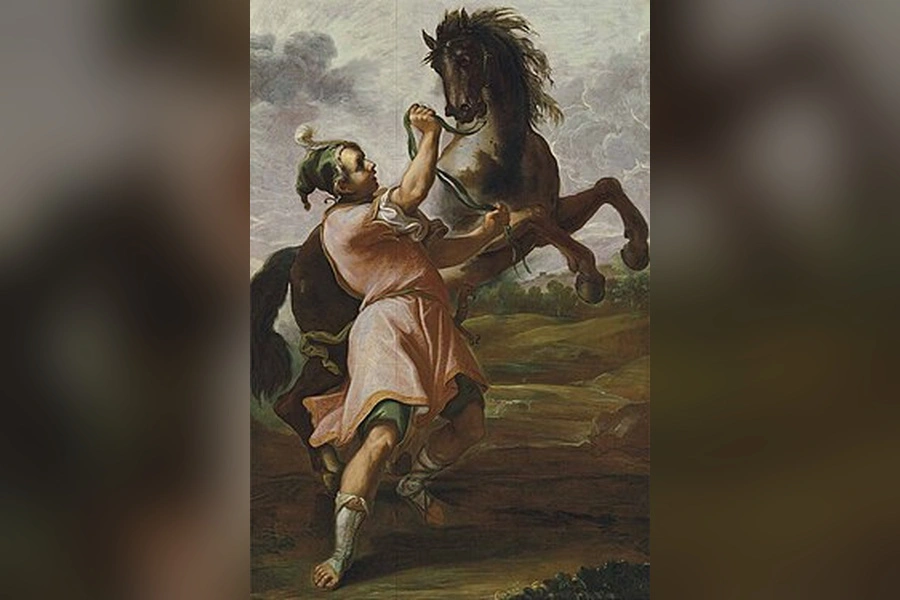
The taming of Bucephalus is one of the most memorable anecdotes in ancient biography because it presents Alexander as a young man capable of understanding a problem that experienced adults had failed to solve. Plutarch recounts that the horse reared up when anyone attempted to mount him. Philip II ordered the animal to be taken away, believing him to be wild and unmanageable. Alexander objected, remarking that the king's attendants were losing an excellent horse because they lacked the skill and courage to handle him. When Philip challenged his son to prove his claim, Alexander agreed to pay the full price of the horse if he failed.[1]
Rather than immediately forcing himself onto the stallion, Alexander watched the animal closely. He noticed that Bucephalus appeared frightened by the movement of his own shadow. Alexander turned the horse towards the sun, preventing the shadow from falling in front of him, and gradually calmed him. Only when Bucephalus was more settled did Alexander mount him and guide him into a gallop.
The spectators, who had initially watched with anxiety, responded with astonishment when Alexander returned successfully. Plutarch adds that Philip embraced his son and declared that Macedon was too small a kingdom for him.[1]
The episode is often interpreted as an early demonstration of Alexander's powers of observation, confidence and leadership. Instead of relying entirely on force, he identified the source of the horse's distress and changed his approach. This makes the story more interesting than a simple tale of a brave boy conquering a difficult animal.
Nevertheless, Plutarch wrote centuries after Alexander's lifetime. His account is an important ancient tradition, but the exact dialogue and dramatic details cannot be independently verified. The story should therefore be read as both a portrait of Alexander and a historical anecdote preserved by a later biographer.
What Did Bucephalus Look Like?
Ancient descriptions portray Bucephalus as a large, powerful, and spirited horse. Arrian, writing about Alexander's campaigns, describes him as unusually large and noble in character. He also notes that the horse would accept Alexander as his rider while rejecting other riders.[2]
The name Bucephalus comes from the Greek words associated with an ox or bull and a head. Ancient writers offered explanations for the unusual name, although they did not agree on the precise reason.
- An ox-head marking: One explanation held that Bucephalus had a white mark on his head resembling the head of an ox.
- An identifying brand: Another tradition suggested that the horse had an ox-head mark engraved or branded on him.
These explanations survive in Arrian's account, but the horse's exact appearance remains uncertain. Modern paintings frequently portray Bucephalus as a magnificent black stallion, reflecting the ancient description of a dark horse with a white marking. Such depictions are artistic interpretations rather than independently established physical details.[2]
His reputation for strength and spirit also fits the practical demands placed on an ancient cavalry horse. A warhorse needed to tolerate noise, movement, unfamiliar terrain and the presence of other animals. However, the sources do not provide enough information to reconstruct Bucephalus's training, equipment or precise role in every engagement.
Was Bucephalus Descended from the Mares of Diomedes?
One of the more intriguing traditions about Bucephalus connects the horse to the Mares of Diomedes, the terrifying horses from Greek mythology. According to this legend, Bucephalus belonged to a bloodline descended from the mythical mares associated with the eighth labour of Heracles.
In Greek mythology, Diomedes of Thrace possessed a herd of savage, man-eating horses. Heracles was ordered to capture them as one of his Twelve Labours. The story appears in ancient mythographic traditions, including the account preserved by Diodorus Siculus, although versions of the episode differ in their details.[3]
The Mares of Diomedes were the opposite of ordinary domesticated horses. Their ferocity made them symbols of dangerous power that had to be overcome. Connecting Bucephalus to their lineage, therefore, gave Alexander's horse a suitably extraordinary origin: his exceptional strength and difficult temperament could be explained by a mythical ancestry.
However, this connection must be treated carefully. The ancestry of Bucephalus is not established historical fact, and the familiar accounts of his life by Plutarch and Arrian do not verify a descent from the Mares of Diomedes. The connection belongs to the broader world of Greek myth and later legendary traditions, rather than to a demonstrable pedigree.
The story nevertheless creates a fascinating link between Alexander's history and the heroic mythology of the Greek world. Alexander himself was often associated with Heracles and Achilles, figures whose exploits helped shape the ideals of Greek kingship and heroism. A legendary horse descended from the mares captured by Heracles would fit naturally into this imaginative world. For the full mythological background, read our account of Heracles and the Twelve Labours, including the capture of the Mares of Diomedes.
Bucephalus and Alexander's Military Campaigns
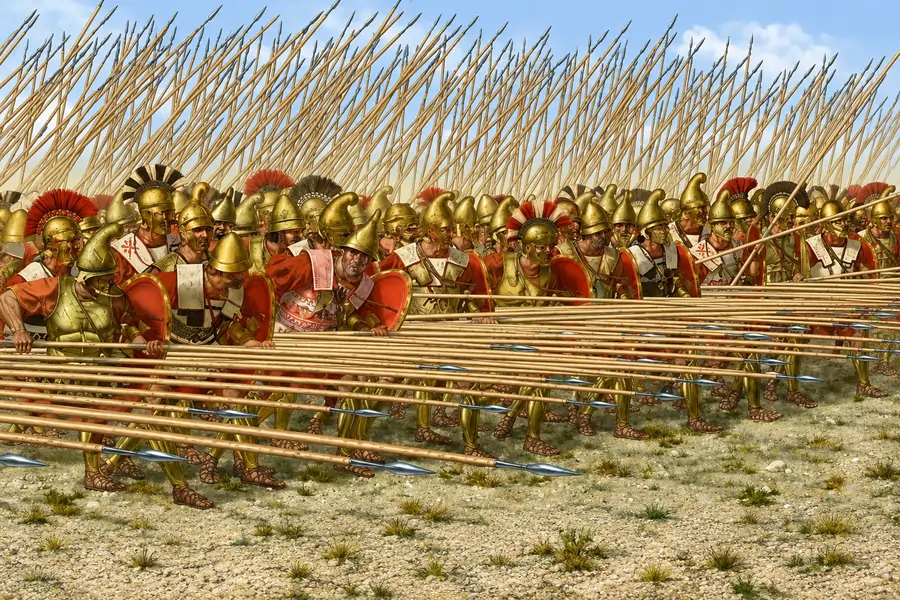
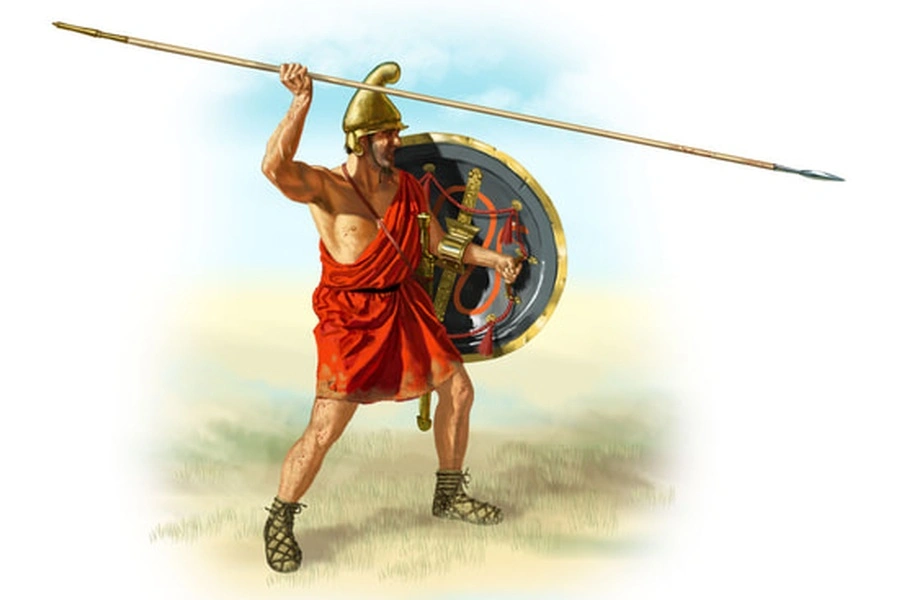
Alexander's conquest of the Persian Empire depended on more than the courage of an individual commander. His army combined the Macedonian phalanx, lighter infantry, missile troops, and a powerful cavalry arm. Among its most important units was the Companion cavalry, an elite force that Alexander frequently used to deliver decisive attacks against enemy formations.
Horses were essential to this system. They allowed commanders to move rapidly across the battlefield, exploit gaps in enemy lines and pursue retreating troops. A trusted mount could also provide a commander with a degree of familiarity and control in the confusion of combat. Alexander's personal association with Bucephalus illustrates the importance a horse could assume in the life of a mounted warrior.
Alexander's early victories established the reputation of his cavalry. At the Battle of the Granicus River in 334 BC, he led his army against Persian forces in Asia Minor. He later defeated Darius III at the Battle of Issus in 333 BC and at Gaugamela in 331 BC. These victories opened the way for the collapse of Persian imperial power, although Bucephalus's precise involvement in each battle cannot be confirmed from the surviving evidence.
Alexander and the Companion cavalry were at the center of the battle. The unit was a formation of trained horsemen, directly led by Alexander. Alexander's success depended on the coordination of cavalry, infantry, reconnaissance, and battlefield decisions. Bucephalus became a symbol of the king's personal military identity.
Bucephalus at the Battle of the Hydaspes
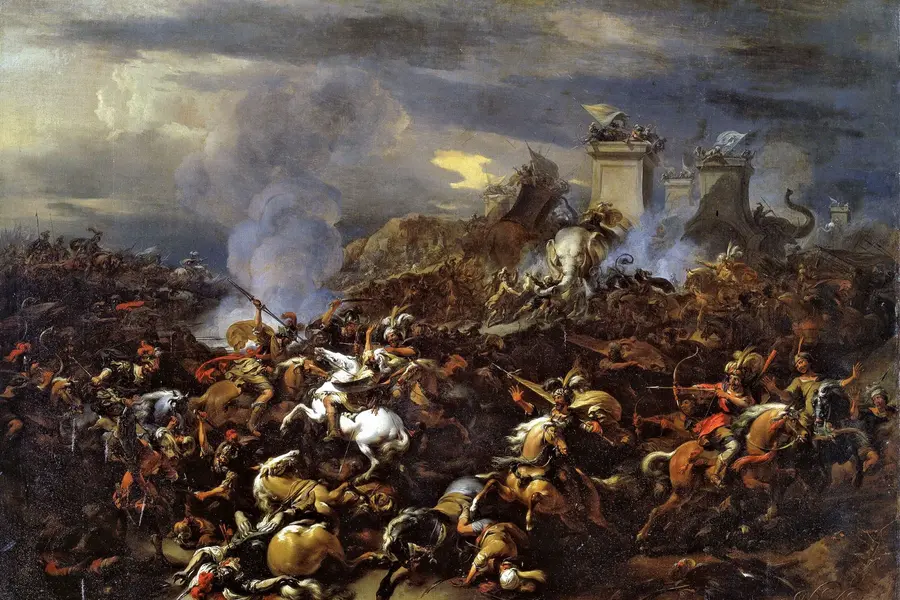
By 326 BC, Alexander had advanced into the Indian subcontinent. His campaign brought him into conflict with King Porus, who ruled territory east of the Hydaspes River, generally identified with the modern Jhelum River in present-day Pakistan. The resulting Battle of the Hydaspes became one of the most demanding engagements of Alexander's eastern campaign.
Porus possessed infantry, cavalry, chariots and war elephants. Alexander had to cross a major river while confronting an opponent who could use the terrain and the elephants to disrupt his formations. He eventually manoeuvred his forces across the river and defeated Porus after a hard-fought battle.[2]
The battle is especially relevant to Bucephalus because ancient writers place the horse's death in the aftermath of Alexander's Indian campaign. The precise circumstances remain disputed, but both Plutarch and Arrian associate the horse's final days with the events surrounding the Hydaspes.[1][2]
The Battle of the Hydaspes also illustrates the limits of Alexander's advance. Although he defeated Porus, his army later refused to continue farther east, forcing Alexander to begin the return journey. The campaign involved further hardships, including dangerous river journeys and the devastating crossing of the Gedrosian Desert.
Read our detailed account of the Battle of the Hydaspes and Alexander's encounter with Porus for a closer examination of the tactics and challenges involved.
How Did Bucephalus Die?
The death of Bucephalus is one of the most revealing examples of how ancient historical accounts can differ. Although the horse's death is associated with Alexander's Indian campaign, the surviving writers disagree about its immediate cause.
In his Life of Alexander, Plutarch states that most writers attributed the death to wounds for which Bucephalus had received treatment. He also records an alternative explanation from Onesicritus, who believed that the horse died from old age and exhaustion. Plutarch gives Bucephalus's age as thirty years.[1]
Arrian presents a different emphasis. He says that Bucephalus was not killed by an enemy but died from the effects of toil and old age. He likewise reports that the horse was about thirty years old.[2]
| Ancient source | Account of Bucephalus's death |
|---|---|
| Plutarch | Reports that most writers attributed the death to battle wounds, while Onesicritus blamed old age and exhaustion. |
| Arrian | Attributes the death to toil and old age rather than wounds inflicted by an enemy. |
The disagreement means that it is misleading to state categorically that Bucephalus was killed during the Battle of the Hydaspes. He may have suffered wounds during the campaign, but the available evidence does not settle the question. What the accounts do agree on is that he had endured many hardships alongside Alexander and was remembered as an unusually valuable animal.
The reported age of thirty should also be understood as an ancient claim, not a modern veterinary determination. The sources do not provide a reliable birth date for Bucephalus, making it impossible to independently calculate his age at death.
Bucephala: The City Named After Alexander's Horse
Alexander's response to Bucephalus's death demonstrates how deeply the horse had become associated with the king's life. According to both Plutarch and Arrian, Alexander founded a city in the horse's memory near the Hydaspes River and named it Bucephala, also rendered Bucephalia.[1][2]
Alexander founded settlements during his campaigns for several reasons, including military control, administration and the consolidation of conquered territory. Naming a city after Bucephalus gave the settlement a more personal significance. It commemorated an animal that had reportedly accompanied Alexander through years of hardship and danger.
Arrian also describes another city founded in the region, Nicaea, whose name commemorated victory. One settlement celebrated military success, while the other preserved the memory of Alexander's horse.[2]
The exact location of ancient Bucephala remains uncertain. It is commonly associated with the region around the modern Jhelum River, but identifying the precise site is difficult. The ancient sources establish the commemorative tradition more securely than they establish the settlement's exact modern location.
For Alexander, the foundation of Bucephala represented more than a gesture of affection. Like monuments and commemorative settlements elsewhere in the ancient world, it helped preserve a memory beyond the lifetime of the person or animal being honoured.
The Legacy of Bucephalus
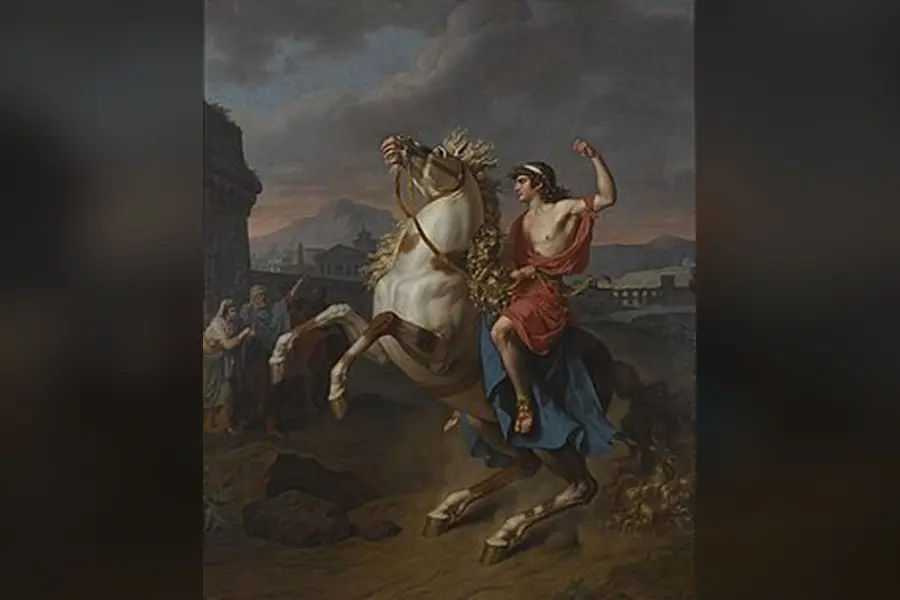
Bucephalus remains one of the best-known animals associated with an ancient ruler. His fame rests partly on the story of his taming, partly on his association with Alexander's conquests, and partly on the account of the city named in his memory. The horse occupies a rare position between recorded history and heroic legend.
The taming story presents Alexander as a young man who could observe a problem, understand its cause and act decisively. His later career would make him one of antiquity's most celebrated commanders, and the episode became a natural part of the story told about his early promise. Yet the anecdote should not be treated as proof that every later success was predetermined. It is better understood as an illustration of how ancient writers constructed narratives about exceptional leaders.
Bucephalus's place in the history of warfare also deserves a balanced assessment. A warhorse could provide speed, mobility and a dependable mount for a commander, but cavalry victories depended on the training of riders, the coordination of units and the decisions made across an entire battlefield. Alexander's military achievements were products of a sophisticated army, not the work of one horse alone.
His story also reveals the personal dimensions of ancient warfare. Kings and soldiers relied on animals for transport, communication, supply and combat. A horse that served for years could become familiar to its rider and acquire a significance extending far beyond its practical function. The ancient accounts portray Bucephalus as a trusted companion whose death mattered enough to be remembered through the naming of a city.
Alexander's reputation has endured through accounts of his campaigns, his treatment of defeated rulers and the scale of his conquests. His place among the great military commanders is explored in our guide to the greatest military generals in history. The battles that shaped his reputation are also examined in our overview of the most decisive battles in history.
Bucephalus adds another dimension to that legacy. He reminds us that history is not made only by kings, armies and victories. Sometimes, the enduring story is also about the bond between a person and an animal that shared the risks of an extraordinary journey. Whether viewed through the historical accounts or the later myths surrounding his ancestry, Bucephalus remains a powerful symbol of Alexander the Great's world.
References
-
Plutarch. Life of Alexander, chapters 6 and 61. Translated by Bernadotte Perrin, Loeb Classical Library. The principal ancient account of the taming of Bucephalus and the differing traditions about his death.
Read Plutarch's account of Alexander taming Bucephalus.
Read Plutarch's account of Bucephalus's death. -
Arrian. Anabasis of Alexander, Book 5, chapter 19. Translated by E. J. Chinnock. The account describes Bucephalus's character, the traditions surrounding his name, his death, and the foundation of Bucephala.
Read Arrian's Anabasis of Alexander. -
Diodorus Siculus. Library of History, Book 4, chapter 15. An ancient account of the labours of Heracles, including the capture of the Mares of Diomedes. The mythical connection to Bucephalus should not be treated as verified historical ancestry.
Consult Diodorus Siculus, Book 4.
Historical note: Plutarch and Arrian wrote centuries after Alexander's lifetime. Their accounts preserve important traditions, but some details remain disputed. This article distinguishes their reports from mythological interpretations and modern historical conclusions.
Books and Memorables
This article may contain affiliate links. If you purchase through these links, I may earn a small commission at no extra cost to you.


Related Articles
Frequently Asked Questions
How did Alexander the Great tame Bucephalus?
According to the ancient Greek biographer Plutarch, Alexander tamed Bucephalus by noticing that the horse was frightened by his own shadow. Alexander turned the horse towards the sun so that its shadow fell behind it, then calmed the animal before mounting it. The episode became one of the most famous stories about Alexander's youth and is often cited as an example of his powers of observation.
How did Bucephalus die during Alexander the Great's campaign in India?
Bucephalus died during Alexander the Great's Indian campaign, around the time of the Battle of the Hydaspes in 326 BC. Ancient sources disagree about the cause. Plutarch reports that many writers attributed his death to battle wounds, while others blamed old age and exhaustion. Arrian also states that Bucephalus died from old age and the hardships of the campaign rather than enemy wounds.
Was Bucephalus descended from the Mares of Diomedes in Greek mythology?
Some legendary traditions connect Bucephalus to the Mares of Diomedes, the man-eating horses captured by Heracles during his Twelve Labours. This proposed ancestry gives Alexander's famous horse a mythological origin associated with strength and ferocity. However, the connection is not established historical fact, and the surviving accounts by Plutarch and Arrian do not verify that Bucephalus descended from these mythical horses.
Why did Alexander the Great name a city Bucephala after his horse?
Ancient writers report that Alexander founded a city called Bucephala, or Bucephalia, near the Hydaspes River in memory of Bucephalus. The horse had accompanied Alexander during his campaigns and held a special place in his life. Naming a settlement after him preserved his memory beyond his death. The city's exact modern location remains uncertain, although it is associated with the region of the Jhelum River in present-day Pakistan.
Did Bucephalus carry Alexander the Great in the Battle of the Hydaspes?
Bucephalus is closely associated with Alexander's Indian campaign and the events surrounding the Battle of the Hydaspes against King Porus in 326 BC. Ancient sources connect the horse's death with this stage of the campaign, but they do not establish with certainty whether Alexander rode Bucephalus throughout the battle or whether the horse died from wounds sustained during the engagement. It is therefore more accurate to describe the association without claiming a confirmed battlefield death.
What does the name Bucephalus mean, and why was Alexander's horse given that name?
Bucephalus comes from Greek words meaning 'ox-headed' or 'bull-headed'. Ancient historian Arrian records traditions explaining the name through a marking resembling an ox's head on the horse. Other versions describe a brand or identifying mark. Although the exact origin of the name is uncertain, it became inseparable from the identity of Alexander the Great's famous warhorse.
Add Comment