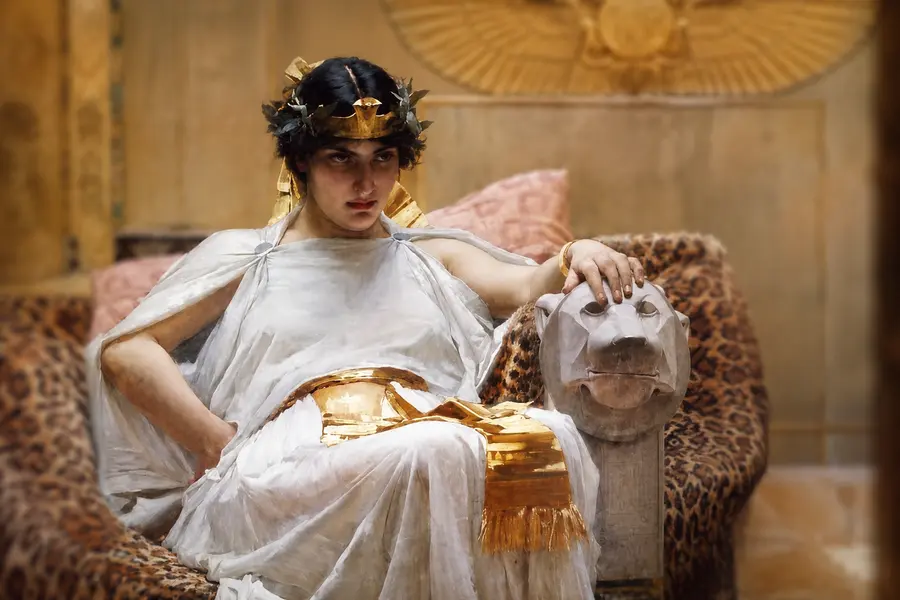
Cleopatra VII has been celebrated as the most beautiful woman in history for over two thousand years. But was she really as beautiful as the legends claim? Ancient writers praised her irresistible charm, Renaissance artists transformed her into an icon of beauty, and Hollywood immortalized her as the ultimate femme fatale. Yet surviving coins and historical evidence tell a more complex story. Rather than relying solely on physical appearance, Cleopatra captivated some of history's most powerful men through intelligence, charisma, political skill, education, and carefully crafted royal imagery. Understanding the truth behind Cleopatra's beauty reveals why she remains one of history's most fascinating rulers and why her legend has endured long after the fall of ancient Egypt.
Table of Contents
- Who Was Cleopatra?
- Was Cleopatra Really Beautiful?
- How Tall Was Cleopatra?
- What Languages Did Cleopatra Speak?
- Why Was Cleopatra Famous for Her Beauty?
- Cleopatra's Beauty Routine and Beauty Secrets
- How the Cleopatra Beauty Myth Was Created
- Cleopatra's Lovers: Politics Before Romance
- How Did Cleopatra Die?
- Why Cleopatra's Beauty Became an Eternal Legend
Who Was Cleopatra?
Cleopatra VII Philopator (69-30 BC) was the final active ruler of the Ptolemaic Kingdom of Egypt. Although remembered as an Egyptian queen, she belonged to the Macedonian Greek dynasty founded by Ptolemy I Soter, one of Alexander the Great's greatest generals. The Ptolemies ruled Egypt for nearly three centuries following Alexander's conquest of the region.
Unlike many of her predecessors, Cleopatra embraced Egyptian traditions. Ancient historian Plutarch notes that she was the first member of her dynasty known to have learned the Egyptian language, while also speaking several others, including Greek, Ethiopian, Hebrew, Aramaic, and possibly Latin (Plutarch, Life of Antony, 27).
Her reign was marked by political instability as Rome expanded across the Mediterranean. Cleopatra's survival depended on diplomacy, strategic alliances, and extraordinary political judgment. Her famous relationships with Julius Caesar and Mark Antony were not merely romantic affairs but calculated partnerships designed to preserve Egypt's independence. Following the defeat of Antony and Cleopatra by Octavian at the Battle of Actium in 31 BC, Egypt became a Roman province. Her death the following year ended both the Ptolemaic dynasty and the Hellenistic Age.
Was Cleopatra Really Beautiful?
The simple answer is probably not in the conventional sense, but that is precisely what makes her story remarkable. Contrary to popular belief, no contemporary description claims Cleopatra possessed extraordinary physical beauty. In fact, the surviving evidence suggests that her legendary reputation rested on qualities far more compelling than facial features alone.
Ancient Coins Paint a Different Picture
The most reliable surviving images of Cleopatra appear on coins minted during her reign. These official portraits show a queen with:
- A prominent hooked nose
- A strong jawline
- Thin lips
- A pronounced chin
- A high forehead
These features differ significantly from the idealized depictions popularized by modern films and artwork. Historians generally believe these coins intentionally emphasized authority and legitimacy rather than youthful attractiveness. Some scholars also argue that royal portraits on ancient coinage often adopted masculine characteristics associated with strength and leadership. Therefore, while coins provide valuable evidence, they should not be interpreted as photographic representations.
What Did Ancient Historians Say?
The most revealing account comes from Plutarch, writing about a century after Cleopatra's death:
"Her actual beauty... was not in itself altogether incomparable, nor such as to strike those who saw her."
Instead, Plutarch immediately explains what truly captivated those around her:
"The attraction of her person lay in her conversation... her voice was like an instrument of many strings."
This passage suggests Cleopatra's greatest asset was not extraordinary physical beauty but an irresistible combination of intelligence, wit, confidence, eloquence, and personal magnetism.
Beauty Standards Were Different in Antiquity
Modern beauty standards cannot easily be applied to the ancient Mediterranean world. Royal women were judged not only by appearance but also by dignity, poise, fertility, education, and divine symbolism.
As queen, Cleopatra deliberately modeled herself after the goddess Isis, presenting herself as both a political ruler and a divine protector of Egypt. Her appearance was carefully designed to communicate legitimacy and power rather than youthful glamour. This royal image proved remarkably successful. Even after Rome conquered Egypt, Cleopatra's reputation overshadowed countless rulers whose military victories have long been forgotten.
How Tall Was Cleopatra?
Despite Cleopatra VII being one of history's most famous women, her exact height is completely unknown. No contemporary source records her physical measurements, and her tomb has never been conclusively identified. As a result, historians cannot determine how tall she was with any certainty.
Some modern estimates suggest Cleopatra may have stood between about 5 feet (152 cm) and 5 feet 5 inches (165 cm), based on the average height of elite women living in the eastern Mediterranean during the Hellenistic period. However, these figures are educated approximations rather than evidence drawn directly from Cleopatra herself.
The surviving portraits of Cleopatra provide little help. Coins minted during her reign emphasize distinctive facial features such as a prominent nose and strong jawline but reveal nothing about her height or overall physique. Likewise, statues and busts follow artistic conventions that idealized or symbolized royal authority rather than accurately portraying physical appearance.
Ultimately, Cleopatra's height remains one of the many unanswered questions about her life. What ancient sources consistently emphasize is not how tall she stood, but how commanding her presence was. Whether addressing Roman statesmen, negotiating with foreign ambassadors, or presenting herself as the living embodiment of the goddess Isis, Cleopatra's influence came from her confidence, intellect, and political brilliance rather than any recorded physical measurement.
What Languages Did Cleopatra Speak?
Cleopatra VII was renowned not only for her political skill but also for her remarkable linguistic ability. Ancient historian Plutarch described her as an exceptionally gifted speaker who could converse with people from many different cultures without relying on interpreters. At a time when most Hellenistic rulers communicated almost exclusively in Greek, Cleopatra's command of multiple languages set her apart and became one of her greatest diplomatic strengths.
Greek was Cleopatra's native language. As a member of the Ptolemaic dynasty, which descended from one of Alexander the Great's Macedonian generals, she was educated in Greek literature, philosophy, rhetoric, mathematics, and science at the royal court in Alexandria. Greek remained the language of government and administration throughout her reign.
According to Plutarch (Life of Antony, 27), Cleopatra was also the first known ruler of the Ptolemaic dynasty to learn the Egyptian language. Earlier Ptolemaic kings had ruled Egypt for nearly three centuries while relying primarily on Greek, often communicating with their Egyptian subjects through translators. By speaking Egyptian herself, Cleopatra strengthened her image as the legitimate pharaoh of Egypt rather than merely a foreign Greek monarch.
Plutarch further states that Cleopatra could communicate with numerous other peoples without interpreters. Ancient sources and modern historians suggest she likely spoke or understood several languages, including:
- Greek (her native language)
- Egyptian
- Aramaic
- Hebrew or a closely related Semitic language
- Ethiopian (likely referring to a language spoken in Nubia or the Kingdom of Kush)
- Possibly Arabic, Median, Parthian, or other regional languages used by neighboring states
- Possibly Latin, although there is no firm evidence that she spoke it fluently. Since many educated Romans, including Julius Caesar and Mark Antony, spoke Greek, there was little practical need for her to do so.
Cleopatra's multilingual ability was far more than an intellectual accomplishment. It allowed her to negotiate directly with ambassadors, merchants, military commanders, and foreign rulers from across the eastern Mediterranean and Near East without depending on translators. This ability reduced the risk of misunderstandings, demonstrated respect for foreign cultures, and enhanced her reputation as one of antiquity's most capable diplomats. Combined with her intelligence and charisma, her command of languages became one of the key reasons she remained one of the most formidable rulers of the late Hellenistic world.
Why Was Cleopatra Famous for Her Beauty?
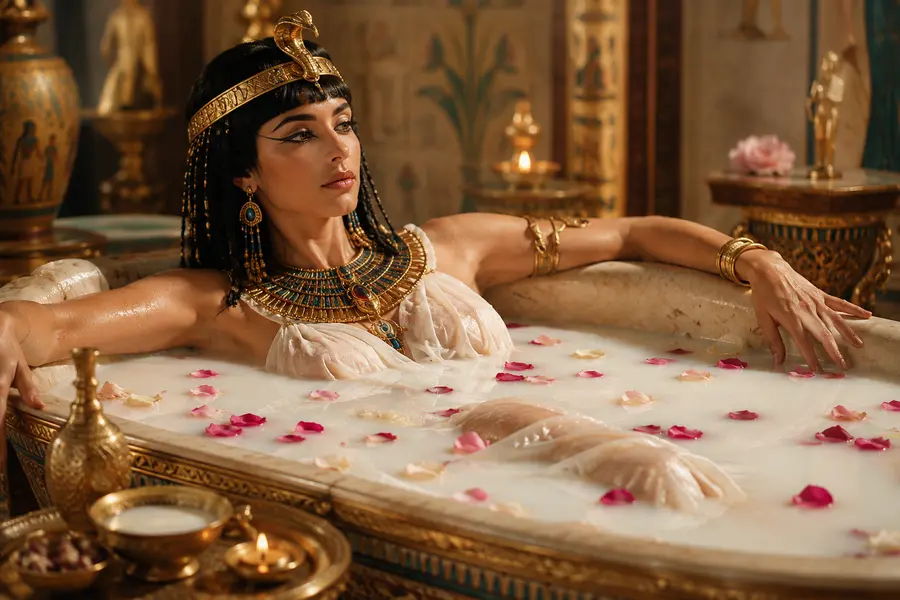
If ancient sources never described Cleopatra as the most beautiful woman in the world, why has that belief persisted for over two millennia? The answer lies in the combination of Roman propaganda, literature, Renaissance art, and modern popular culture.
1. Her Intelligence Was Often Mistaken for Beauty
Cleopatra possessed one of the finest educations in the ancient world. She studied philosophy, mathematics, astronomy, rhetoric, economics, diplomacy, and medicine at Alexandria, home to the famous Library of Alexandria.
Unlike many monarchs of her era, she actively negotiated with foreign leaders, commanded naval expeditions, managed Egypt's economy, and personally directed diplomatic strategy. Her conversations reportedly impressed Julius Caesar, Mark Antony, scholars, ambassadors, and foreign rulers alike. Ancient authors repeatedly emphasize that people remembered meeting Cleopatra because of her intellect rather than merely her appearance.
2. Her Charisma Was Extraordinary
Ancient writers consistently describe Cleopatra's charisma as unforgettable. She reportedly adapted her speech, humor, and behavior depending on her audience. She could discuss philosophy with scholars, politics with generals, economics with merchants, and religion with Egyptian priests. Her voice, according to Plutarch, was especially captivating. Combined with elegance and confidence, it created an impression that physical appearance alone could never explain.
3. Roman Propaganda Enhanced Her Legend
After defeating Antony and Cleopatra, Octavian, later Emperor Augustus, needed to justify a civil war fought against fellow Romans. Rather than portraying Antony as a rival Roman general, Roman propaganda blamed Cleopatra. She became the seductive foreign queen who had supposedly bewitched Antony through irresistible beauty.
This narrative transformed a political conflict into a moral lesson about Roman virtue overcoming eastern luxury. Poets such as Horace and Virgil reinforced this image, while later historians repeated many of these themes, helping establish Cleopatra's reputation as history's ultimate temptress.
4. Shakespeare and Hollywood Reinvented Cleopatra
William Shakespeare's Antony and Cleopatra presented her as passionate, intelligent, mysterious, and captivating. Centuries later, cinema further amplified this image. Perhaps no portrayal proved more influential than Elizabeth Taylor's performance in the 1963 film Cleopatra, which permanently associated the queen with extraordinary physical beauty. Although visually striking, these portrayals reflect artistic interpretation rather than historical evidence.
Cleopatra's Beauty Routine and Beauty Secrets
Many beauty treatments attributed to Cleopatra appear across modern skincare products and wellness blogs. While ancient sources support some, others are legends that developed centuries later. Nevertheless, Egypt possessed one of the ancient world's most advanced cosmetic traditions, and Cleopatra almost certainly benefited from its sophisticated beauty practices.
Milk Baths
The most famous Cleopatra beauty secret is bathing in milk. Although direct contemporary evidence is limited, later Roman writers associated wealthy women with milk baths because lactic acid gently exfoliates dead skin cells. Modern dermatology confirms that lactic acid remains an effective ingredient in many skincare products. Whether Cleopatra routinely bathed in donkey's milk cannot be proven, but the practice was technically plausible given the resources available to Egypt's royal court.
Honey as a Natural Moisturizer
Honey was widely used throughout ancient Egypt for both cosmetic and medicinal purposes. Egyptian medical papyri describe honey as an ingredient for treating wounds and protecting skin because of its natural antibacterial properties. Modern research similarly recognizes honey's moisturizing and antimicrobial qualities. It is therefore likely that Cleopatra used honey-based skin treatments common among Egyptian elites.
Olive Oil and Almond Oil
Natural oils played an important role in Egyptian skincare. Olive oil softened the skin, protected against the dry climate, and served as a base for perfumes. Almond oil was valued for conditioning both skin and hair, while moringa oil, produced in Egypt, was especially prized among the wealthy. These oils also carried fragrant botanical extracts, allowing queens and nobles to wear luxurious perfumes throughout the day.
Kohl Eye Makeup
Perhaps Cleopatra's most historically accurate beauty practice involved kohl eyeliner. Egyptians applied black and green pigments around their eyes using finely ground minerals such as galena and malachite.
The purpose extended beyond fashion. Modern studies suggest certain mineral compounds used in Egyptian cosmetics may have stimulated immune responses that reduced eye infections in the Nile Valley's dusty environment. The dramatic eye makeup also enhanced Cleopatra's association with the gods Horus and Ra, reinforcing her divine royal image.
Perfumes and Fragrant Oils
Egypt was internationally renowned for luxury perfumes. Cleopatra almost certainly wore complex fragrances made from frankincense, myrrh, cinnamon, rose, lotus flowers, and other imported botanicals. Ancient writers even describe the scented sails of her royal barge during her famous meeting with Mark Antony on the River Cydnus (Plutarch, Life of Antony, 26).
Diet and Physical Health
While no detailed record survives of Cleopatra's daily meals, the royal court enjoyed access to fresh fruits, vegetables, fish, figs, dates, wine, and Mediterranean olive oil. As with many elite societies, appearance was closely linked to overall health, hygiene, and status. Maintaining good health was as important to royal image as cosmetics themselves.
How the Cleopatra Beauty Myth Was Created
Cleopatra's transformation into history's greatest beauty did not happen during her lifetime. Instead, it evolved gradually over centuries. Roman authors emphasized her seductive influence over Caesar and Antony. Medieval storytellers embellished these accounts, while Renaissance painters increasingly portrayed her according to contemporary European beauty ideals. During the nineteenth century, Orientalist art further romanticized Cleopatra as the exotic queen of the East.
Twentieth-century films cemented this image for modern audiences. As each generation retold her story, historical evidence became intertwined with legend, making it difficult to separate fact from fiction. Ironically, this evolution mirrors Cleopatra's own mastery of image-making. She understood that symbols, ceremony, and public perception could shape political reality. In that sense, the enduring myth of Cleopatra's beauty may be the greatest testament to her success as a ruler and strategist.
Cleopatra's Lovers: Politics Before Romance
Few historical figures have had their romantic life scrutinized as closely as Cleopatra's. Popular culture often portrays her as a queen who seduced powerful men through beauty alone. Historical evidence, however, paints a different picture. Cleopatra had only two well-documented romantic relationships, both of which were deeply intertwined with Egypt's survival against the growing power of Rome.
These relationships were political alliances as much as personal partnerships. By aligning herself with Rome's most influential leaders, Cleopatra secured military protection, financial stability, and legitimacy for her reign.
1. Julius Caesar (48-44 BC)
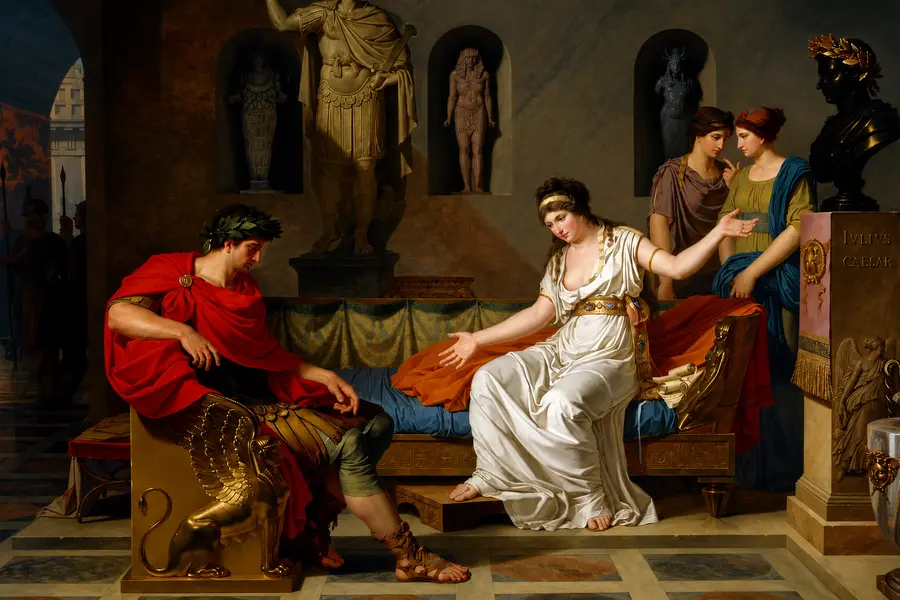
Cleopatra first met Julius Caesar in 48 BC during the Alexandrian War. At the time, Egypt was engulfed in a civil conflict between Cleopatra and her younger brother, Ptolemy XIII. According to Plutarch, Cleopatra famously arranged to be secretly brought into Caesar's palace wrapped inside a carpet, or more likely a linen sack, to avoid detection by her rivals. The dramatic meeting has become one of history's most famous political encounters.
Caesar supported Cleopatra's claim to the Egyptian throne after defeating Ptolemy XIII. Their alliance soon developed into a romantic relationship, resulting in the birth of a son, Ptolemy XV Philopator Philometor Caesar, commonly known as Caesarion. Although Caesar never officially recognized Caesarion as his legal heir, Cleopatra promoted him as the son of Julius Caesar, strengthening the legitimacy of her dynasty.
2. Mark Antony (41-30 BC)
After Caesar's assassination in 44 BC, Cleopatra returned to Egypt and cautiously observed Rome's new power struggle. In 41 BC, she met Mark Antony at Tarsus in Asia Minor. Ancient writers describe Cleopatra arriving aboard a magnificent royal barge adorned with purple sails, golden decorations, and luxurious perfumes. While later accounts undoubtedly embellish the event, the meeting demonstrated Cleopatra's understanding of political theatre and diplomacy. The relationship between Antony and Cleopatra lasted over a decade. Together they had three children:
- Alexander Helios
- Cleopatra Selene II
- Ptolemy Philadelphus
Their partnership allowed Antony access to Egypt's enormous wealth while providing Cleopatra with Roman military support. However, the alliance alarmed Octavian, Caesar's adopted heir, who portrayed Antony as a Roman leader corrupted by a foreign queen. This propaganda campaign culminated in the naval Battle of Actium in 31 BC, where Octavian defeated Antony and Cleopatra.
Were There Any Other Lovers?
Modern historians overwhelmingly agree that there is no reliable evidence that Cleopatra had numerous lovers. Ancient Roman propaganda often exaggerated or invented stories about her personal life to discredit both Cleopatra and Mark Antony. Unlike later legends, contemporary historical sources identify only Julius Caesar and Mark Antony as Cleopatra's confirmed romantic partners. The enduring image of Cleopatra as a woman who seduced countless men reflects centuries of literary embellishment rather than historical fact.
How Did Cleopatra Die?
Following the defeat at Actium, Antony and Cleopatra retreated to Alexandria as Octavian's forces advanced into Egypt. Believing Cleopatra had died, Antony reportedly took his own life by falling upon his sword. Mortally wounded, he was carried to Cleopatra's mausoleum, where he died in her arms (Plutarch, Life of Antony, 76-77).
Days later, Octavian captured Cleopatra. Knowing she would almost certainly be displayed as a prisoner during Octavian's triumphal procession in Rome, Cleopatra chose death over humiliation.
Did Cleopatra Really Die from an Asp Bite?
The traditional story claims Cleopatra committed suicide by allowing an Egyptian cobra (asp) to bite her. However, modern historians debate this account. Ancient sources provide several conflicting explanations:
- A venomous cobra concealed inside a basket of figs.
- A poisoned hairpin.
- A fast-acting poisonous ointment.
Roman historian Cassius Dio acknowledged uncertainty regarding the exact method of her death, while Plutarch himself admitted that no definitive evidence existed. Today, many scholars believe poisoning may have been more practical than handling a live cobra, though the famous snake story remains the most enduring tradition. Cleopatra died on 10 or 12 August 30 BC at approximately 39 years of age. After her death, Octavian annexed Egypt into the Roman Republic, effectively ending nearly three centuries of Ptolemaic rule and transforming Rome into the Mediterranean's dominant power.
Legacy of Cleopatra
Cleopatra's legacy extends far beyond the enduring question of whether she was truly beautiful. While surviving coins and ancient accounts suggest she may not have possessed extraordinary physical beauty by either ancient or modern standards, nearly every historical source agrees that she possessed qualities far more influential. Her intelligence, political acumen, multilingual education, charisma, and mastery of diplomacy enabled her to preserve Egypt's independence for over two decades during one of the most turbulent periods in Mediterranean history.
Much of Cleopatra's reputation as history's most beautiful woman was shaped after her death. Roman propaganda portrayed her as the seductive foreign queen who had bewitched Julius Caesar and Mark Antony, while later Renaissance artists, playwrights, and Hollywood films transformed her into an icon of timeless beauty. Over the centuries, this carefully constructed image gradually overshadowed the historical ruler herself.
In reality, Cleopatra's greatest achievement was her ability to combine intellect with image. She understood that perception could be as powerful as military strength, presenting herself as both the rightful ruler of Egypt and the living embodiment of the goddess Isis. Her alliances with Caesar and Antony were not simply romantic relationships but calculated political partnerships intended to safeguard her kingdom against Rome's growing dominance.
More than two thousand years after her death, Cleopatra remains one of history's most recognizable figures not because historians can agree on her appearance, but because of the extraordinary impact she had on the ancient world. Her story demonstrates that lasting influence is rarely built on beauty alone. Instead, it is intelligence, leadership, confidence, and the ability to shape history that have ensured Cleopatra's name continues to captivate scholars and readers alike.
References and Further Reading
- Plutarch. Life of Antony
- Plutarch. Life of Caesar. Loeb Classical Library. Perseus Digital Library.
- Cassius Dio. Roman History, Books 42-51.
- Stacy Schiff. Cleopatra: A Life. Little, Brown and Company, 2010.
- Duane W. Roller. Cleopatra: A Biography. Oxford University Press, 2010.
- Joyce Tyldesley. Cleopatra: Last Queen of Egypt. Profile Books, 2008.
- Adrian Goldsworthy. Antony and Cleopatra. Yale University Press, 2010.
- Encyclopaedia Britannica. "Cleopatra VII."
Books and Memorables
This article may contain affiliate links. If you purchase through these links, I may earn a small commission at no extra cost to you.


Related Articles

Frequently Asked Questions
Was Cleopatra really considered beautiful by ancient historians?
Most ancient historians did not describe Cleopatra as exceptionally beautiful. Plutarch, writing about a century after her death, stated that her physical beauty was not unmatched. Instead, he emphasized that her intelligence, charisma, eloquence, and captivating voice made her unforgettable. Modern historians generally believe these qualities, rather than extraordinary physical appearance, explain her lasting reputation.
What did Cleopatra really look like according to historical evidence?
The best evidence comes from coins minted during Cleopatra's reign, which depict her with a prominent nose, strong jawline, and defined facial features. While ancient coins were often designed to project royal authority rather than realistic beauty, they suggest Cleopatra looked quite different from the idealized portrayals seen in modern films and artwork.
Did Cleopatra actually use milk baths and other beauty treatments?
Historical evidence suggests Cleopatra likely used many of the skincare practices common among Egypt's royal elite, including natural oils, perfumes, honey, and kohl eye makeup. The famous donkey's milk bath is part of later historical tradition rather than a practice directly confirmed by contemporary sources, although milk was known to have skin-softening properties.
How many lovers did Cleopatra really have?
Reliable historical sources identify only two confirmed romantic partners: Julius Caesar and Mark Antony. Claims that Cleopatra had numerous lovers largely originate from later Roman propaganda and popular legends rather than contemporary historical evidence. Both relationships were also important political alliances that helped protect Egypt's independence.
Why is Cleopatra remembered as one of history's most beautiful women?
Cleopatra's reputation for beauty developed over centuries through Roman propaganda, medieval literature, Renaissance art, Shakespeare's plays, and Hollywood films. Historians generally agree that her intelligence, political skill, charisma, and carefully cultivated royal image played a much greater role in her influence than physical beauty alone.
What made Cleopatra such an influential ruler despite Rome's growing power?
Cleopatra combined diplomacy, multilingual communication, economic leadership, and strategic alliances to keep Egypt independent for more than two decades during Rome's expansion. Her ability to negotiate with powerful Roman leaders while presenting herself as both a Hellenistic monarch and the living goddess Isis made her one of the most effective political leaders of the ancient Mediterranean.
Add Comment