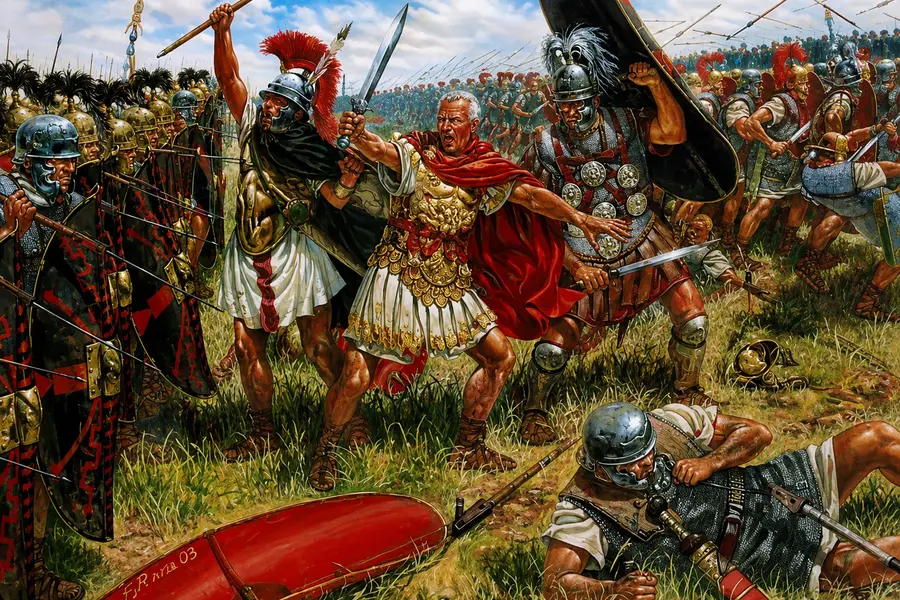
The Battle of Pharsalus, fought on 9 August 48 BC, was the decisive clash between Julius Caesar and Pompey the Great during the Roman Civil War. Caesar entered the battle badly outnumbered, facing a larger Roman army with a huge cavalry advantage. Yet within a single day, his veteran legions shattered Pompey's army through superior battlefield discipline, careful deployment, tactical surprise, and Caesar's decision to create a fourth line of infantry specifically to defeat the enemy cavalry. Pharsalus was not just another spectacular military victory for Caesar. It destroyed the main army defending the Roman senatorial cause. It made Caesar the dominant military and political power in the Roman world, shifting the course of history.
Table of Contents
- The Roman Civil War: Why Caesar and Pompey Went to War
- The Prelude to Pharsalus
- Caesar and Pompey: The Opposing Commanders
- The Armies at Pharsalus
- The Battlefield and Pompey's Plan
- The Battle of Pharsalus
- How Caesar Won Despite Being Outnumbered
- The Aftermath of Pharsalus
- Why the Battle of Pharsalus Was Significant
- The Military Legacy of Pharsalus
- Sources and References
The Roman Civil War: Why Caesar and Pompey Went to War
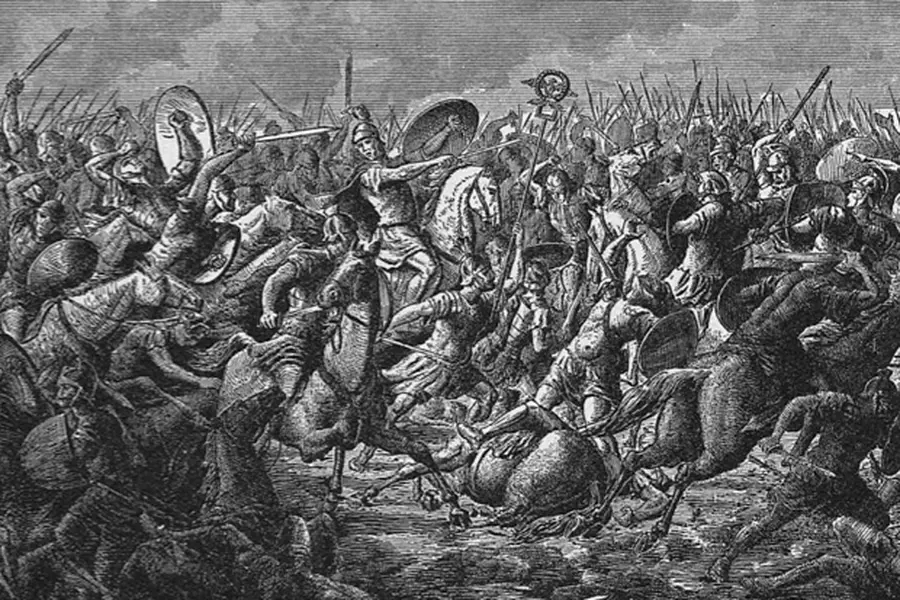
The Battle of Pharsalus cannot be understood without the political crisis that produced it. The conflict was not simply a struggle between two Roman generals. It was the culmination of years of competition between powerful individuals and the increasingly unstable political institutions of the late Roman Republic. Julius Caesar, Pompey the Great, and Marcus Licinius Crassus had once formed the informal political alliance known as the First Triumvirate. Their cooperation helped Caesar secure the consulship in 59 BC and subsequently obtain command in Gaul, where he spent almost a decade building one of the most experienced armies in the Roman world.
The death of Crassus at Carrhae in 53 BC removed the third major figure from the political balance. Pompey and Caesar increasingly became rivals. Pompey aligned himself more closely with the senatorial elite, while Caesar's military victories, wealth, and political following made him increasingly difficult for his opponents to control. The immediate crisis came when Caesar's command in Gaul was nearing its end. His enemies wanted him to surrender his army and return to Rome as a private citizen. Caesar feared prosecution and political destruction if he did so without retaining his power. The Senate ordered him to disband his army, while Caesar argued that Pompey and his supporters were acting against his rights.
In January 49 BC, Caesar crossed the Rubicon with his army. His famous decision transformed a political confrontation into civil war. Caesar rapidly occupied much of Italy, but Pompey avoided a decisive confrontation. Pompey and many senators withdrew across the Adriatic to Greece, where they could exploit their considerable military resources and naval strength. Caesar followed, but first had to deal with Pompeian forces in Spain and other areas of the Mediterranean. The struggle therefore became a war across the Roman world rather than a single campaign. Caesar's eventual victory at Pharsalus was the culmination of a conflict that had already demonstrated how much Roman military power had become tied to the loyalty of individual commanders.
The Prelude to Pharsalus
Pompey initially had important advantages. He controlled a powerful army in the eastern Mediterranean and possessed a substantial fleet. Caesar, meanwhile, had to move his veteran army across the Adriatic while operating at considerable distance from his main bases. Caesar crossed into Greece in early 48 BC. His army eventually confronted Pompey's much larger force around Dyrrhachium, in modern Albania. The campaign became a prolonged contest of fortifications, supply, and maneuver.
Caesar's position became increasingly dangerous. Pompey's larger army and control of the surrounding region placed pressure on Caesar's supplies. Caesar constructed extensive lines of fortifications, but Pompey's forces eventually broke through them. Caesar suffered a serious defeat at the Battle of Dyrrhachium. Instead of allowing the defeat to destroy his army, Caesar withdrew inland. Pompey followed, and the two armies eventually moved into Thessaly.
Caesar's army had suffered from hunger, disease, exhaustion and the psychological effects of the defeat at Dyrrhachium. Yet Caesar possessed a core of veteran soldiers who had campaigned together for years. Many of Caesar's veterans had fought throughout the Gallic Wars and understood their commander's methods intimately. Ancient sources emphasize the contrast between the two armies. Caesar's soldiers were hardened veterans accustomed to rapid marches, fortification work, and violent close combat. Their experience was especially valuable because Roman legionary warfare depended not merely on individual courage but on maintaining formation under extreme pressure.
Caesar and Pompey: The Opposing Commanders
The Battle of Pharsalus brought together two of the most famous Roman commanders of the first century BC.
| Commander | Side | Strengths | Position at Pharsalus |
|---|---|---|---|
| Julius Caesar | Caesarian | Experienced commander, veteran army, aggressive tactical leadership | Personally directed the right wing |
| Pompey the Great | Pompeian/Senatorial | Large army, overwhelming cavalry, extensive eastern resources | Directed the battle from the rear of his line |
| Mark Antony | Caesarian | Experienced subordinate and veteran commander | Commanded Caesar's left wing |
| Gnaeus Domitius Calvinus | Caesarian | Senior Roman commander | Commanded the centre |
| Titus Labienus | Pompeian | Experienced cavalry commander and former Caesarian lieutenant | Directed Pompey's massed cavalry |
Caesar's greatest advantage was not simply personal brilliance. His army had developed a close relationship with its commander through years of campaigning. He knew how his soldiers would respond under pressure, while they knew what he expected of them. Pompey was hardly an inexperienced general. He had achieved extraordinary victories before his confrontation with Caesar and had commanded Roman armies across the Mediterranean. His problem at Pharsalus was not lack of military ability but the combination of a complicated political coalition, a much larger army, and a command structure in which confidence in numerical superiority encouraged an overly cautious plan.
The Armies at Pharsalus
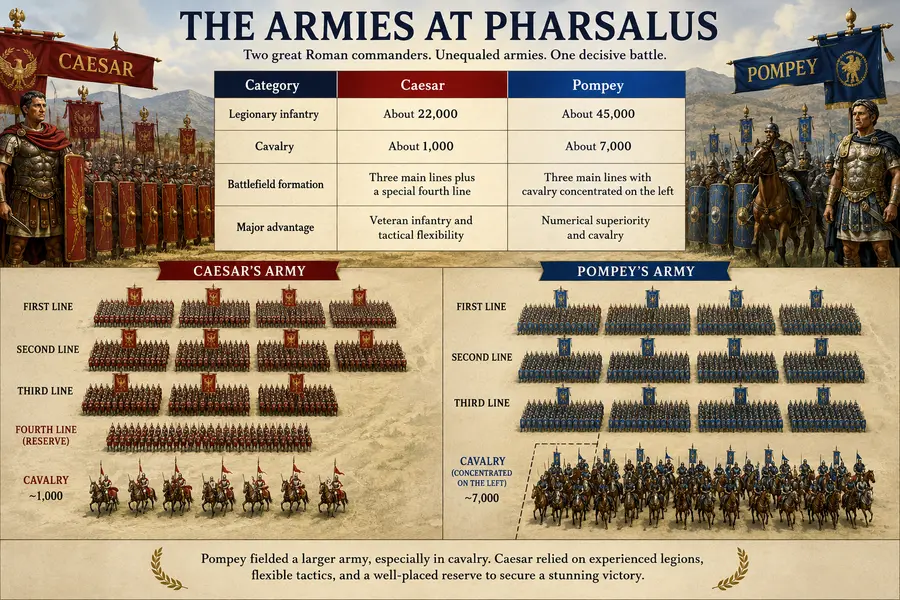
The exact size of the armies remains uncertain because ancient sources provide different figures and because Roman armies were frequently understrength. Caesar stated that he had approximately 22,000 legionaries in 80 cohorts available for the battle, while Pompey's force contained approximately 45,000 legionaries in 110 cohorts. Caesar also estimated Pompey's cavalry at around 7,000 compared with only about 1,000 cavalry on his own side.
| Category | Caesar | Pompey |
|---|---|---|
| Legionary infantry | About 22,000 | About 45,000 |
| Cavalry | About 1,000 | About 7,000 |
| Battlefield formation | Three main lines plus a special fourth line | Three main lines with cavalry concentrated on the left |
| Major advantage | Veteran infantry and tactical flexibility | Numerical superiority and cavalry |
These figures should not be treated as perfectly precise. Ancient authors had reasons to exaggerate battlefield numbers, and Caesar's own account naturally presents the battle in a way favorable to his leadership. Modern historians therefore debate the exact strength of both armies. Nevertheless, the broad picture is clear. Caesar was substantially outnumbered, especially in cavalry. This numerical disadvantage shaped the entire battle.
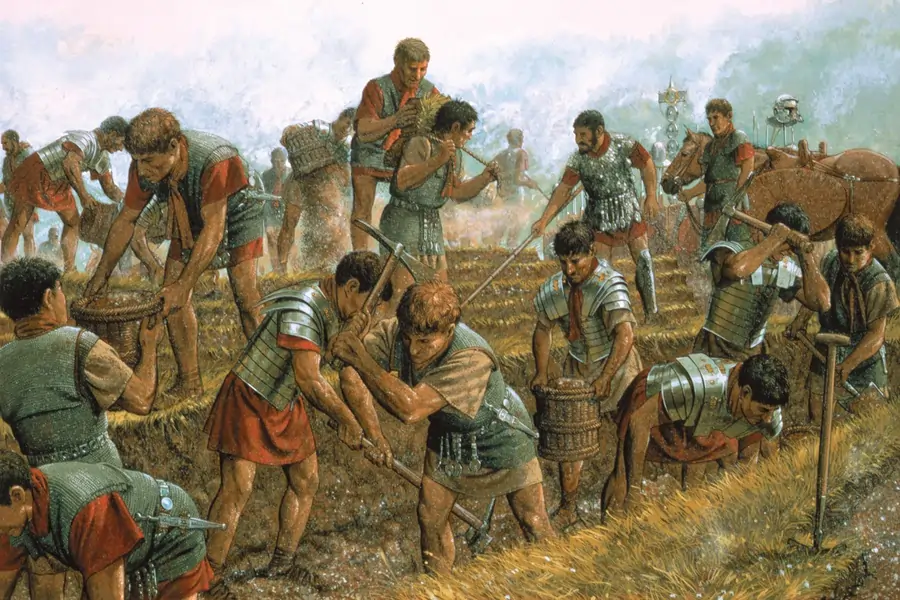
Roman legionaries were highly trained heavy infantry, equipped primarily with the pilum and sword and protected by shields, helmets and body armour of varying types. The army's effectiveness depended on formation discipline as much as individual fighting ability. The daily life, training and endurance of these soldiers are important to understanding how they could continue fighting after long campaigns; see Daily Life of a Roman Soldier: Food, Salary and Routine.
The Battlefield and Pompey's Plan
The armies met on the plain near Pharsalus in Thessaly. The terrain offered Caesar an important defensive advantage on his left, where the Enipeus River helped protect his flank. Pompey therefore concentrated his enormous cavalry force on his left wing. Pompey's plan was strategically straightforward but potentially devastating if his cavalry superiority could be converted into a flank attack. His infantry would engage Caesar's legions while his cavalry swept around Caesar's exposed right flank. Once the cavalry reached Caesar's rear, the Caesarian army could be attacked from two directions.
On paper, this was a logical plan. Using Caesar's reported figures, Pompey had roughly seven times as much cavalry as Caesar. If his horsemen could break the smaller Caesarian cavalry force, Caesar's right flank would be exposed. Caesar recognized the danger immediately. Instead of simply placing his own cavalry in front of Pompey's cavalry and hoping it could hold, Caesar created an entirely new tactical formation.
The Battle of Pharsalus
1. Caesar's army advances
Caesar's soldiers initially advanced toward Pompey's line. Pompey had ordered his infantry not to rush forward but to remain in position and allow Caesar's men to approach. Pompey calculated that Caesar's infantry would become exhausted during the advance. His soldiers would then meet a fresh and stationary enemy.
Caesar's veterans, however, recognized the danger. As they approached the Pompeian line, Caesar reports that his soldiers stopped briefly to regain their breath before continuing their advance. This small detail illustrates the experience of Caesar's soldiers. Rather than blindly following momentum, they understood how to manage their physical strength during a battlefield advance. The two infantry lines eventually collided.
2. Pompey's cavalry attacks Caesar's right
The decisive moment came on Caesar's right flank. Pompey's cavalry surged forward under the direction of Labienus. Caesar's much smaller cavalry force could not withstand the sheer weight of the attack and began giving ground. From Pompey's perspective, everything appeared to be going according to plan. The Caesarian cavalry was retreating, and the enormous Pompeian cavalry force was beginning to turn Caesar's exposed flank. But Caesar had anticipated precisely this movement.
3. Caesar's concealed fourth line strikes
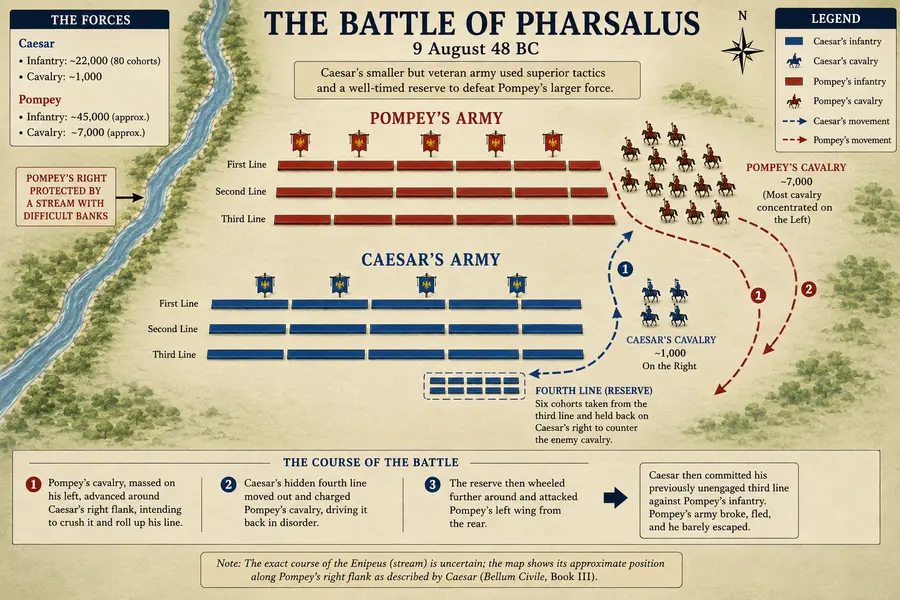
According to Caesar's own account, he detached six cohorts from his third line and formed them into a fourth line. Ancient sources describe this force as six cohorts. These troops were placed behind and to the side of Caesar's right wing, concealed from the main Pompeian attack. Caesar instructed them specifically to counter the enemy cavalry. When Pompey's horsemen advanced far enough to begin turning Caesar's flank, Caesar gave the order. The hidden infantry suddenly charged.
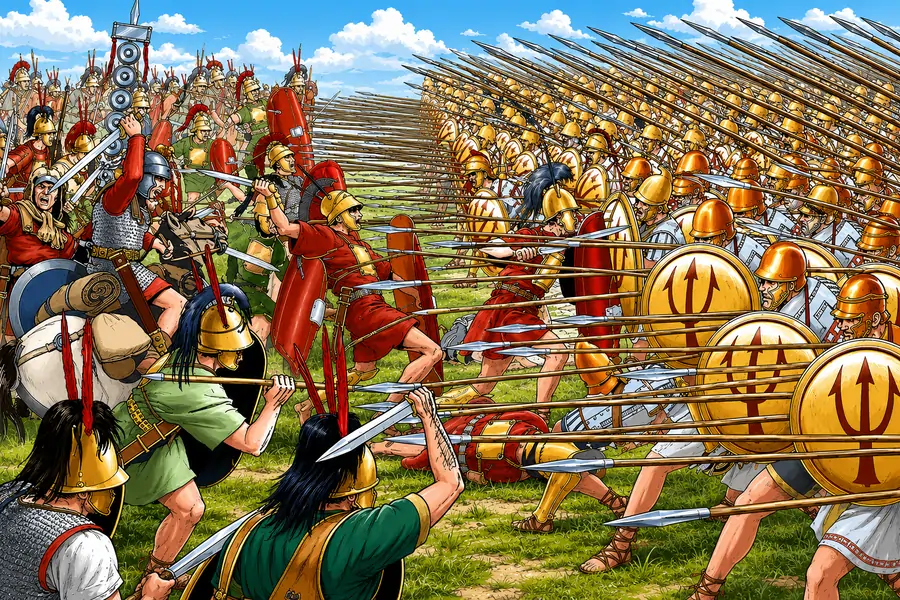
This was the tactical turning point of the Battle of Pharsalus. Instead of confronting the cavalry as conventional infantry might, Caesar's soldiers attacked aggressively and disrupted the mounted formation. Pompey's cavalry, expecting to find a collapsing flank, suddenly encountered disciplined infantry moving toward them. The shock was enormous. The Pompeian cavalry broke and fled toward the nearby hills. Their retreat left Pompey's archers and slingers exposed, and Caesar's fourth line attacked them as well. Caesar had transformed his greatest weakness, his lack of cavalry, into a battlefield problem that could be solved by infantry.
4. Caesar turns Pompey's flank
The fourth line did not simply defend Caesar's right wing and stop. Having driven away the Pompeian cavalry, the infantry turned inward and attacked Pompey's left wing from the rear. At almost the same time, Caesar ordered his third line, which had been held back in reserve, into the battle. This created a devastating combination. Pompey's infantry was now attacked from the front by Caesar's main force, from the rear by the fourth line, and under pressure from fresh Caesarian reserves.
The numerical superiority of Pompey's army suddenly became less useful. Large numbers of soldiers are difficult to employ effectively once their formation begins to collapse. Units cannot easily support one another when their flanks and rear are threatened. Pompey's left wing broke.
5. Pompey's army collapses
When Pompey saw his cavalry destroyed and his left wing collapsing, the battle was effectively lost. He withdrew toward his camp. Caesar, however, did not allow Pompey's army time to reorganize. His troops pursued the fleeing Pompeians and eventually attacked the camp itself. The camp's defenders attempted to resist, but the collapse of the field army made organized resistance increasingly difficult. Caesar's soldiers broke into the camp, turning a battlefield defeat into a complete military disaster for Pompey's forces. Pompey escaped the battlefield and fled toward the coast. He eventually sailed to Egypt, where he was murdered on the orders of advisers to the young king Ptolemy XIII.
How Caesar Won Despite Being Outnumbered
The Battle of Pharsalus is frequently remembered as a classic example of a smaller army defeating a larger force. But Caesar did not win simply because he was a better general. Several interconnected factors produced the result.
1. Caesar correctly identified the decisive threat
Pompey's infantry superiority was intimidating, but Caesar understood that the immediate tactical danger was the cavalry on his own right flank. Instead of distributing his limited reserves evenly, Caesar concentrated them against the point where Pompey was strongest.
2. The fourth line neutralized Pompey's greatest advantage
The special fourth line was arguably the most important tactical innovation of the battle. Caesar could not match approximately 7,000 cavalry with approximately 1,000 cavalry, so he changed the nature of the engagement. His infantry became the weapon that defeated Pompey's cavalry. Caesar himself later emphasized the importance of these cohorts in his account of the battle, describing them as the force that routed the cavalry, destroyed the exposed light troops, and turned the Pompeian flank.
3. Caesar kept fresh troops in reserve
Caesar did not commit every available soldier at the beginning of the battle. His third line remained out of the fighting until the decisive moment. This gave him a reserve capable of reinforcing exhausted troops after the initial clash. Pompey's army, despite being larger, had fewer opportunities to exploit its numerical advantage once Caesar's reserves entered the battle.
4. Veteran soldiers handled pressure better
Caesar's army had spent years campaigning together. The men had experienced sieges, marches, ambushes, pitched battles and logistical crises. Their cohesion mattered enormously when the battle became confused. Morale is often overlooked in discussions of ancient warfare, but it could determine whether an army continued fighting after its formation was disrupted. Caesar's soldiers had a strong record of surviving battlefield crises and recovering from setbacks.
5. Pompey's plan depended too heavily on cavalry
Pompey's strategy was built around an overwhelming cavalry attack. Once that attack failed, the entire plan began to unravel. His infantry was still numerically superior, but the loss of the cavalry meant that Caesar's army could no longer be enveloped as intended. Worse, the cavalry's retreat exposed Pompey's left flank and eventually allowed Caesar's infantry to attack from the rear.
6. Caesar exploited success immediately
Caesar did not stop after defeating the cavalry. He immediately converted the local success into a wider attack against Pompey's flank and then committed his third line. This is one of the most important lessons of Pharsalus. Winning a tactical engagement is not enough. A commander must exploit the enemy's loss of cohesion before it can recover.
The Aftermath of Pharsalus
The scale of the Pompeian defeat was enormous. Caesar reported approximately 15,000 Pompeian dead and more than 24,000 prisoners, while claiming that his own losses were remarkably low, around 200 legionaries and 30 centurions. Other ancient sources provide considerably lower estimates for Pompey's casualties, with Appian citing the testimony of Asinius Pollio, one of Caesar's officers, who reported approximately 6,000 Pompeian dead.
These conflicting numbers demonstrate why ancient casualty figures must be treated cautiously. Caesar had an obvious interest in portraying the victory as extraordinary, while later writers relied on different traditions. What is beyond serious doubt is the scale of the strategic defeat. Pompey's main field army had ceased to exist as an effective fighting force.
Caesar also demonstrated one of the political weapons that would become characteristic of his rule: clemency. Many captured Roman senators and soldiers were pardoned. Pompey himself escaped. His attempt to seek refuge in Egypt ended disastrously when he was murdered shortly after landing. Caesar followed him to Alexandria, where the next phase of the civil war unfolded.
Why the Battle of Pharsalus Was Significant
Pharsalus was not technically the final battle of the Roman Civil War. Pompeian resistance continued in Africa and Spain, and Caesar still had several campaigns ahead of him. Nevertheless, it was the decisive turning point.
The destruction of Pompey's main army
Before Pharsalus, Caesar and Pompey represented competing centres of Roman power. After Pharsalus, Pompey's military position was shattered. Caesar had effectively destroyed the only major army capable of immediately challenging his dominance in the eastern Mediterranean.
The collapse of the senatorial military cause
Pompey's army represented much of the political establishment that opposed Caesar. Its destruction severely weakened the traditional republican faction. The Roman Republic did not disappear overnight, but Pharsalus made the political transformation underway increasingly difficult to reverse. For this reason, the battle is considered to be one of the most decisive battles in ancient history.
Caesar became the dominant Roman leader
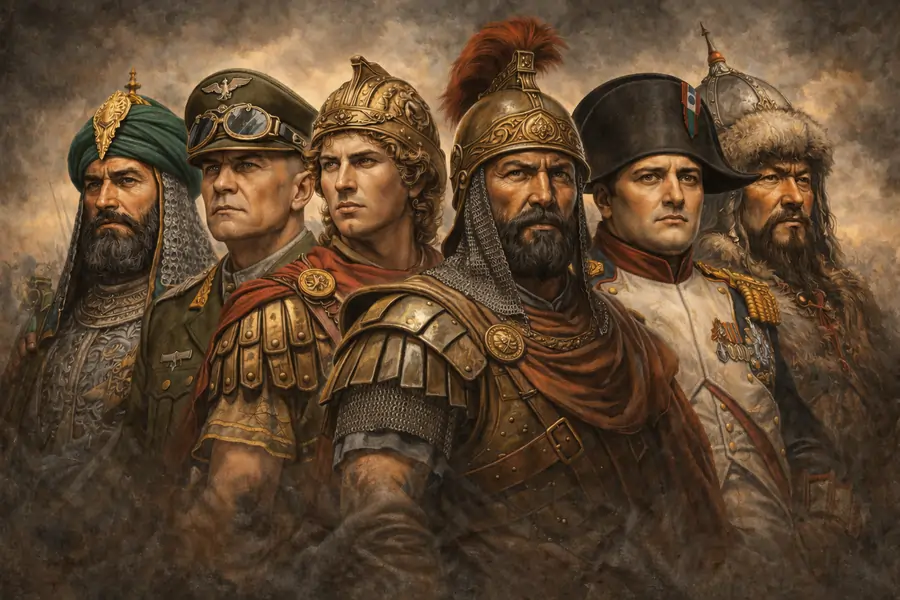
Caesar's victory transformed his position. He was no longer simply one powerful Roman competing with another. He had defeated the most important military rival in the Republic. His extraordinary rise illustrates why ancient historians and later military writers have placed him among history's greatest commanders. His ability to combine political calculation, rapid movement, engineering, logistics, and battlefield tactics made him an unusually versatile commander. See 10 Greatest Military Generals in History.
The Military Legacy and Significance of Pharsalus
The Battle of Pharsalus mattered because it demonstrated how Roman civil wars had transformed the nature of political power. The Republic's institutions could still appoint magistrates and pass laws, but the decisive force increasingly belonged to commanders who controlled experienced armies personally loyal to them. Caesar's victory showed that political legitimacy backed by a large senatorial coalition was not enough to defeat a commander who could maintain the loyalty and cohesion of his troops. Pharsalus therefore marked an important stage in the transition from a competitive republican system toward a political order dominated by individual military leaders.
Its military significance was equally important. Pharsalus showed that a Roman army did not have to win by applying greater mass against greater mass. Caesar's success came from making his smaller force function as a more responsive instrument, with different parts of the army assigned different battlefield roles. The episode became an enduring example of combined tactical thinking: infantry, reserves, terrain, timing and aggressive exploitation could compensate for an opponent's numerical advantages. This helps explain why Caesar's reputation as a commander rests not only on famous victories, but on his ability to adapt Roman military methods to the specific problem confronting him.
Yet Pharsalus was ultimately more consequential as a political victory than as a purely military one. The destruction of Pompey's principal field army removed the strongest organized resistance to Caesar's claim to dominate Roman politics, setting in motion the final phase of the Republic's collapse. Caesar would continue fighting for several years, but after Pharsalus the central question was no longer whether he could survive the civil war; it was what kind of political system would emerge from his victory. His assassination in 44 BC prevented him from determining that future himself, but the concentration of power created by his victories survived him. In that sense, Pharsalus was not the end of the Roman Republic, but one of the battles that made its eventual transformation into the Roman imperial system increasingly difficult to reverse.
Sources and References
- Julius Caesar, The Civil War, Book III, chapters 82-112. Caesar's own account contains the most detailed surviving narrative of the battle, including his order of battle, the creation of the fourth line and the aftermath.
- Plutarch, Life of Caesar. Plutarch provides an independent narrative tradition and useful information about Caesar, Pompey and the political circumstances surrounding the battle.
- Appian, The Civil Wars, Book II. Appian offers another account of the battle and discusses the conflicting casualty figures.
- Cassius Dio, Roman History, Book 41. Dio provides a later Roman historical account of the campaign and the battle.
- Primary-source reading: The University of Chicago's LacusCurtius provides an accessible online edition of Caesar's Civil Wars, including Book III and the Pharsalus campaign.
Ancient casualty evidence: Appian preserves both the low Caesarian casualty tradition and a substantially lower Pompeian death toll attributed to Asinius Pollio, illustrating the uncertainty surrounding ancient battlefield statistics.
Modern overview: The surviving evidence is broadly consistent on the central tactical sequence: Pompey's cavalry drove back Caesar's cavalry, Caesar's concealed infantry reserve counterattacked, the cavalry fled, Caesar's fourth line turned against Pompey's infantry, and Caesar then committed his third line.
Books and Memorables
This article may contain affiliate links. If you purchase through these links, I may earn a small commission at no extra cost to you.


Related Articles
Frequently Asked Questions
How did Caesar defeat Pompey despite having fewer soldiers at Pharsalus?
Caesar defeated Pompey despite being heavily outnumbered by using a specially designed fourth line of infantry to counter Pompey's much larger cavalry force. Caesar also held his veteran third line in reserve and committed it at the decisive moment. Once Pompey's cavalry was driven away, Caesar's fourth line attacked the exposed flank of Pompey's infantry, turning Pompey's numerical advantage into a disadvantage.
What was Caesar's fourth line at the Battle of Pharsalus?
Caesar's fourth line was a special reserve of six cohorts taken from his third line and positioned behind his right wing. Caesar created it specifically to deal with Pompey's large cavalry force. When Pompey's cavalry advanced around Caesar's flank, the fourth line attacked them unexpectedly, driving them away and then turning against Pompey's infantry. It was one of the most important tactical decisions of the Battle of Pharsalus.
Why did Pompey's cavalry fail at the Battle of Pharsalus?
Pompey's cavalry failed because Caesar anticipated their attack and prepared a dedicated infantry reserve against them. Pompey had roughly 7,000 cavalry compared with about 1,000 on Caesar's side, but this numerical superiority became ineffective when the cavalry encountered Caesar's fourth line. After being driven from the battlefield, Pompey's cavalry could no longer envelop Caesar's army, leaving Pompey's left flank exposed.
What was Pompey's strategy at the Battle of Pharsalus?
Pompey's strategy was to use his much larger cavalry force to overwhelm Caesar's cavalry on the right wing, sweep around Caesar's flank and attack his army from the rear. Pompey also ordered his infantry to remain in position rather than immediately advancing, hoping that Caesar's soldiers would become exhausted as they crossed the battlefield. The plan depended heavily on Pompey's cavalry superiority, but Caesar's fourth line disrupted the cavalry attack.
How many soldiers did Caesar have compared with Pompey at Pharsalus?
According to Caesar's own account, he had approximately 22,000 legionaries organized into 80 cohorts, while Pompey had about 45,000 legionaries in 110 cohorts. Caesar also estimated that Pompey had approximately 7,000 cavalry compared with only about 1,000 cavalry on his side. The exact figures are debated by historians because ancient sources provide different numbers, but Caesar was clearly outnumbered at Pharsalus.
Why was the Battle of Pharsalus important to the Roman Civil War?
The Battle of Pharsalus was important because Caesar destroyed the main field army supporting Pompey and the senatorial opposition. Pompey was forced to flee to Egypt, where he was later murdered. Although the Roman Civil War continued after Pharsalus, the battle fundamentally changed the balance of power and left Caesar as the dominant military and political figure in the Roman world. It was a major step in the collapse of the Roman Republic.
Add Comment