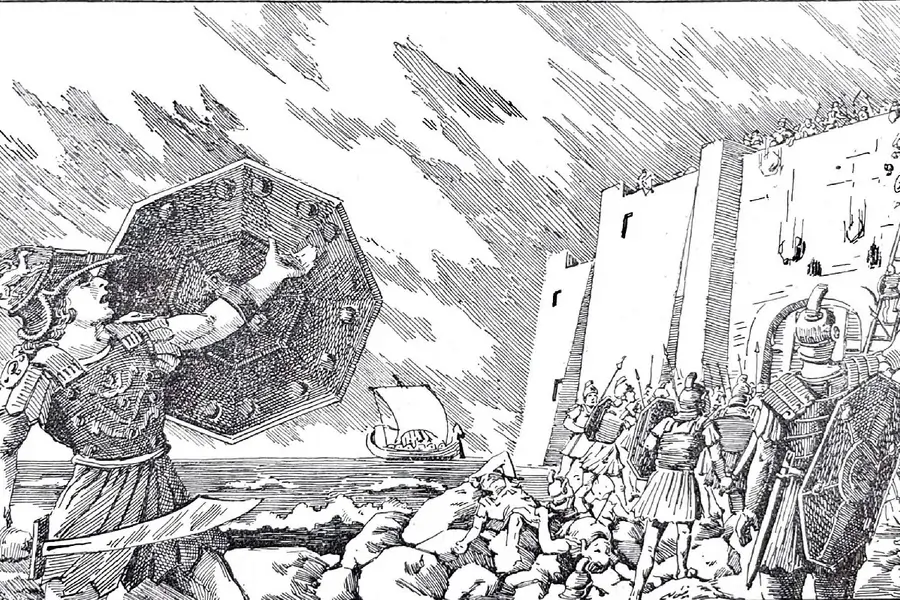
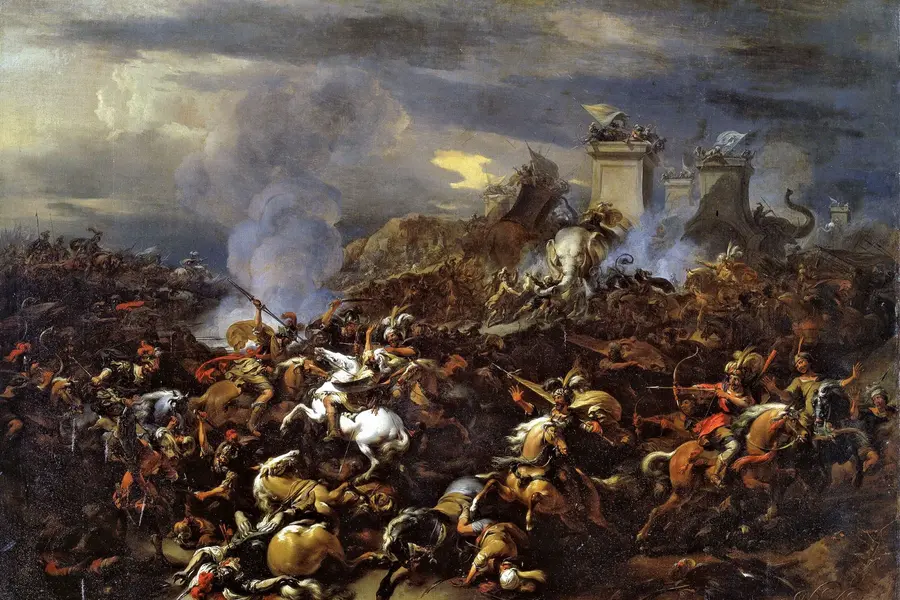
The Siege of Tyre in 332 BC is considered to be one of the most brilliant examples of siege warfare in the ancient world. Unlike conventional battles on the open field, Alexander the Great now faced a different challenge. The island fortress of Tyre stood between the Macedonians and the dominance of the eastern Mediterranean. Protected by massive walls, powerful naval defenses, and the Mediterranean Sea itself, the fortress city of Tyre was formidable. What followed was a brutal seven-month siege that showcased Alexander's determination, engineering innovation, strategic adaptability, and ability to overcome seemingly impossible obstacles. Ancient historians such as Arrian and Diodorus describe the siege as one of the defining episodes of Alexander's conquest of the Persian Empire (Arrian, Anabasis 2.15-24; Diodorus Siculus, Bibliotheca Historica 17.40-46).
- Prelude to the Siege of Tyre
- Why Tyre Was Important
- The Defenses of the Island Fortress
- Alexander's Demand and Tyre's Refusal
- The Progress of the Siege
- Alexander's Engineering and Tactical Innovations
- The Final Assault on Tyre
- Analysis of Alexander's Military Genius
- Consequences of the Fall of Tyre
- The Legacy of the Siege
- Frequently Asked Questions
- References and Sources
Prelude to the Siege of Tyre
Long before Alexander had reached Tyre, he had already shifted the balance of power in the eastern Mediterranean. After crossing into Asia Minor in 334 BC, his first major victory came at the Battle of the Granicus River where he defeated Persian satrapal forces securing his foothold in Anatolia and encouraging Greek cities under Persian control to shift their allegiance to Alexander(Arrian, 1.16; Peter Green, Alexander of Macedon, 1992).
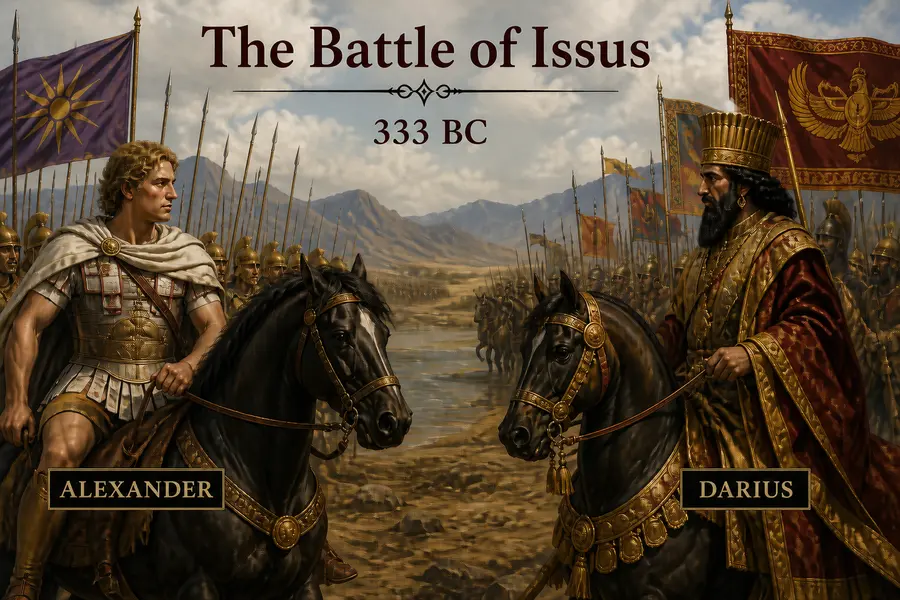
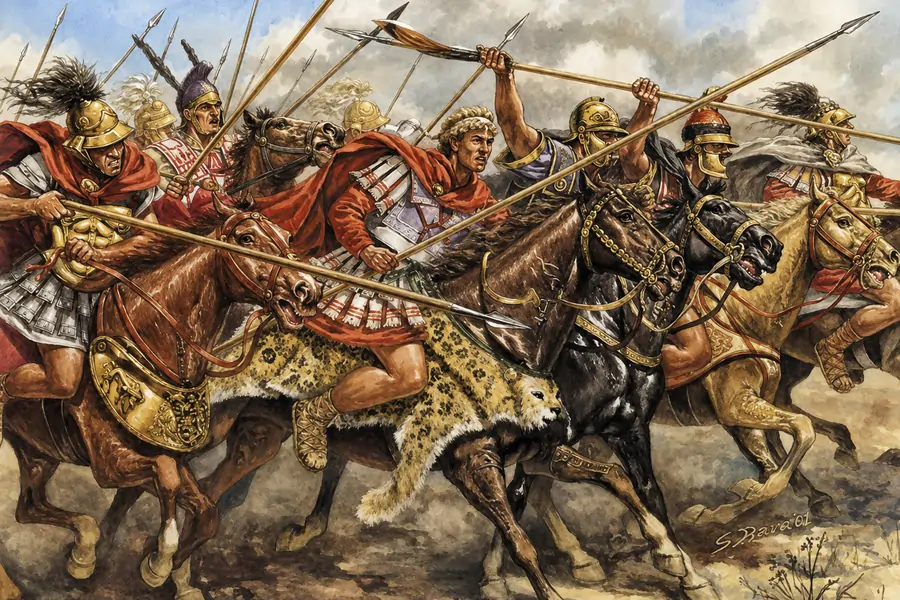
The following year, in 333 BC, Alexander achieved an even greater victory at the Battle of Issus. This was the first time King Darius III faced off against the Macedonian King in battle. Alexander led his Companion Cavalry on a decisive charge that broke the Persian left wing. Alexander used the confusion to charge straight at Darius, who fled the battlefield, leading to a rout in the Persian army. Curtius Rufus notes that the defeat severely damaged Persian prestige throughout the empire (Curtius Rufus, 3.11).
Alexander chose not to chase Darius into Mesopotamia. This was a strategic move to improve logistics for his army and consolidate his gains. Persia's navy was still strong, and to negate its influence, he moved south along the Phoenician coast to eliminate Persian naval bases, denying them ports in the Mediterranean. Historian Robin Lane Fox argues that this campaign demonstrated Alexander's understanding that naval logistics and coastal security were essential for sustaining deeper operations against Persia (Fox, Alexander the Great, 1973).
Recognizing the strength of the Macedonians, most Phoenician cities submitted peacefully. Sidon welcomed Alexander, while Byblos surrendered without major resistance. The people of Tyre, however, refused to submit. Unlike the other Persian cities, Tyre's island position and naval power gave its inhabitants confidence that they could withstand any siege.
Why Tyre Was Important
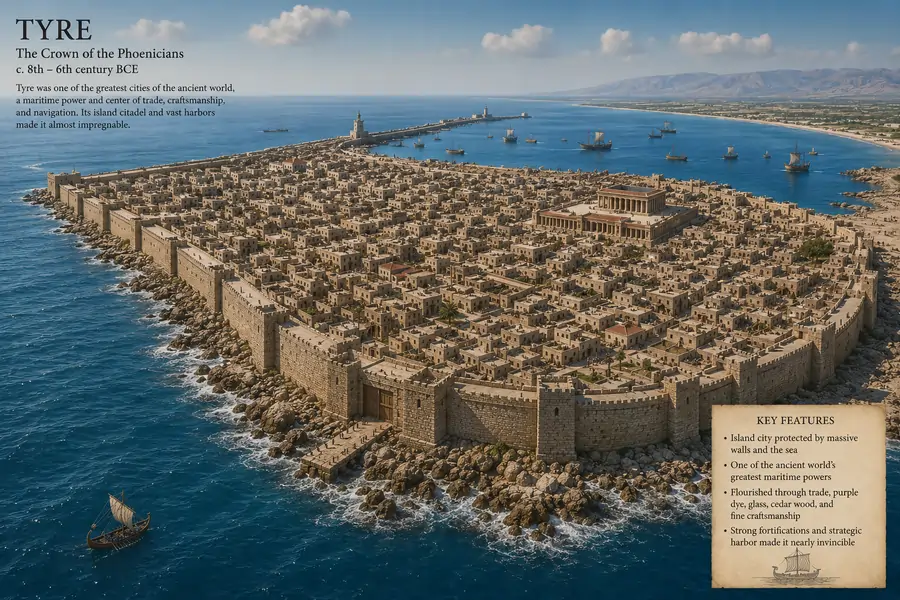
Tyre was not just another coastal city. It was the wealthiest and most influential Phoenician port in the eastern Mediterranean. The city was a naval hub that controlled important maritime trade routes and possessed a strong navy that supported Persian operations. According to historian J.F.C. Fuller, Tyre represented "the key to the eastern Mediterranean" during Alexander's campaign (The Generalship of Alexander the Great, 1960).
Alexander could not leave Tyre unconquered, as it created a dangerous strategic problem. The Persian navy could use the city's harbors to threaten Macedonian communications and supply routes. Alexander could potentially be cut off if he chose to campaign deeper into Persian territory. As long as Tyre remained independent, Persian naval resistance in the Mediterranean could continue.
The defiance of the city also carried symbolic importance. After his victory in the Battle of Issus, Alexander considered himself the rightful ruler of Asia. The defiance of Tyre threatened the image of complete Macedonian dominance in the region and instigated Persian resistance to Macedonian rule.
The city of Tyre was a Phoenician center for the deity Melqart, often equated with the Greek Heracles. Alexander requested permission to enter the city of Tyre to offer a sacrifice at the temple of Melqart. Arrian explains that the Tyrians understood the political implications of this request and refused him entry into the city itself (Arrian, 2.15). The rejection enraged Alexander, resulting in one of the most famous sieges in ancient military history.
The Defenses of the Island Fortress
Tyre's defenses were among the strongest in the ancient world. The island city was located roughly half a mile from the mainland, surrounded by the sea on all sides. Massive stone walls surrounded the city, with some sections of the wall as high as 150 feet. Diodorus Siculus emphasizes the intimidating scale of these fortifications and the confidence they inspired among the defenders (Diodorus, 17.40).
Being surrounded by sea on all sides, the city of Tyre had a natural defensive barrier. Alexander could not employ traditional siege warfare using land-based siege engines, battering rams, and towers. The city also possessed two harbors and a formidable navy. This enabled the city to be continually supplied and reinforced by sea. Tyre had experienced sailors and warships that gave it a significant naval advantage during the early stages of the siege. Considering the defenses of this heavily defended fortress, many military leaders would have likely bypassed the city, but Alexander chose to fight.
Alexander's Demand and Tyre's Refusal
Alexander did not want to waste a lot of time in a prolonged siege and so chose diplomacy initially. In a political move, he sent envoys requesting permission to sacrifice at the temple of Melqart. According to Arrian, the Tyrians proposed that Alexander perform sacrifices at the old mainland settlement instead of entering the island city (Arrian, 2.15).
Allowing Alexander into Tyre would effectively mean acknowledging his authority. The Tyrians knew this and refused, which became both a political and symbolic act of resistance. Ancient historians claim that tensions escalated dramatically when the Tyrians killed several of Alexander's representatives and threw their bodies into the sea. Diodorus presents this incident as the moment Alexander resolved to capture Tyre regardless of the cost (Diodorus, 17.40).
Having decided to fight, Alexander now faced an enormous challenge. He lacked the overwhelming naval superiority needed to challenge the island city. The city's walls were considered nearly impregnable, and a prolonged siege risked delaying the broader Persian campaign. Alexander also risked losing a lot of his army. Yet abandoning the siege was equally risky, as this would undermine his authority as ruler of Asia and leave a hostile naval base behind his advancing army. Alexander, in his usual style of leadership, chose persistence and decisive action over caution.
The Progress of the Siege
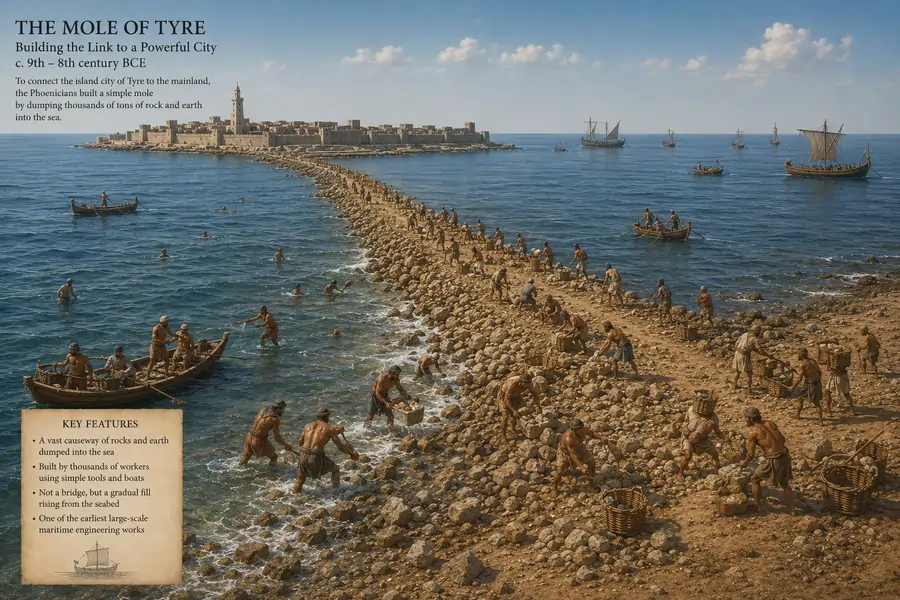
Alexander's first major decision was one of the boldest and most innovative feats of engineering in ancient history. The primary reason why Tyre was difficult to capture was that it was an island city. Alexander ordered the construction of a massive causeway, or mole, extending from the mainland to the island, effectively transforming the island into a mainland city. Arrian describes how Macedonian soldiers used stones, timber, and debris from the abandoned mainland city to build the structure across the sea (Arrian, 2.17).
Initially, the construction of the causeway progressed quickly because the water near the shore remained relatively shallow. However, conditions became increasingly difficult as the mole extended farther toward the island. The sea became deeper, and the Macedonians came under missile fire range from the Tyrian defenders and ships from the city.
The Macedonian workers building the causeway were under constant attack by the Tyrians from inside the walls, who launched arrows and catapult projectiles. Specialised divers from Tyre reportedly sabotaged underwater foundations, creating additional difficulties for the construction. Curtius Rufus notes that the defenders used every advantage offered by the sea to slow Macedonian progress (Curtius Rufus, 4.2).
To protect the construction effort, Alexander built enormous siege towers on the mole itself. These towers were designed to provide supporting fire and contained archers and catapults. The siege towers were designed to suppress Tyrian attacks from the walls and nearby ships. The Tyrians responded to this threat with remarkable ingenuity. They prepared a fireship packed with combustible materials, set it ablaze, and directed it toward the siege towers stationed in the mole. The attack proved devastating. The wooden siege towers were consumed by flames while Tyrian ships simultaneously attacked the mole, destroying large portions of the Macedonian construction works (Arrian, 2.18).
This was a huge setback for Alexander that undid months of progress. Rather than abandon the siege after this setback, Alexander immediately ordered the causeway rebuilt on an even larger scale. Historian Waldemar Heckel argues that this moment demonstrated Alexander's defining characteristic as a commander: his refusal to accept failure even under extreme circumstances (Alexander the Great: Historical Sources in Translation, 2004).
Alexander's Engineering and Tactical Innovations
The Siege of Tyre was an important event in Alexander's conquest that showcased his extraordinary ability to adapt. The siege evolved into a contest of innovation between the Macedonians and the Tyrians, with each side constantly developing new methods to counter the other. Alexander soon realized that engineering alone would not secure victory, especially with the naval superiority enjoyed by the Tyrians. This realization became the turning point of the siege.
Although Alexander was stubborn in not giving up the siege, he showed remarkable leadership skills in realizing his mistakes and making adjustments in his approach. He started to build up his navy to combat the Tyrians. Many Phoenician cities that had surrendered to Alexander contributed ships to his growing fleet. Cyprus also provided major naval reinforcements. According to Arrian, Alexander eventually assembled a fleet of around 200 ships, fundamentally changing the balance of power at sea (Arrian, 2.20).
With naval superiority secured, Alexander now had a lot more options in subduing the Tyrians. He transformed the siege into a coordinated land and sea operation. Macedonian ships blockaded Tyre's harbors, preventing the supply of resources and reinforcements. Siege engines were mounted on Macedonian ships that bombarded the city walls from multiple directions. Historian J.F.C. Fuller considered this one of the earliest successful examples of integrated combined-arms siege warfare (The Generalship of Alexander the Great, 1960).
Alexander also adapted to Tyrian sabotage tactics. When Tyrian divers cut anchor cables attached to Macedonian siege ships, Alexander replaced the ropes with chains, making the anchors far more difficult to sever. This seemingly small adjustment is one of many instances that prove Alexander's ability to adapt to practical battlefield problems. The siege gradually became a war of attrition that favoured the attackers. Macedonian siege engines battered the walls continuously while the naval blockade prevented effective resupply. Despite fierce resistance, Tyre's advantages slowly began to disappear.
The Final Assault on Tyre
After months of relentless pressure from all sides, Macedonian siege engines finally created a breach in the southern walls of Tyre. Once again, Alexander prepared a coordinated assault by both land and sea. Arrian states that Alexander personally participated in the attack, leading troops through the breached fortifications once Macedonian forces gained access to the city (Arrian, 2.23).
Following the breach of the city walls, there was heavy street fighting as Tyrian defenders resisted desperately. However, once Macedonian troops secured portions of the walls and harbors, organized resistance rapidly collapsed. Having resisted the Macedonians for so long, the Tyrians were not shown any mercy. Ancient sources describe large-scale killings and enslavement following the city's fall. Curtius Rufus claims that thousands of Tyrians died during the assault, and many survivors were sold into slavery (Curtius Rufus, 4.4). Ancient casualty figures are often exaggerated, but it is clear that the scale of destruction was severe.
Alexander reportedly spared those who sought refuge inside the temple of Melqart. This act of kindness and mercy was likely for political and religious purposes. By sparing those seeking refuge in the temple, he reinforced his image as a divinely favored conqueror rather than a mere conqueror. The siege had lasted approximately seven months and taken precious time away from Alexander's conquest of Asia. However, it later became one of the greatest military achievements of Alexander's career.
Analysis of Alexander's Military Genius
The Siege of Tyre provides one of the clearest examples of Alexander's brilliance as a commander. While many focus on Alexander's military brilliance in open-field battles such as the Battle of Granicus, the Battle of Issus, or the Battle of Gaugamela, Tyre demonstrated that his abilities extended far beyond cavalry tactics and battlefield maneuvering.
This highlights Alexander's greatest strength, which is his strategic vision. Rather than recklessly pursue Darius after Issus, he understood that securing the Mediterranean coastline was essential for sustaining his Persian campaign. Historian Robin Lane Fox argues that this decision revealed Alexander's growing maturity as a strategist rather than simply a battlefield commander (Fox, 1973).
The siege of Tyre also demonstrated Alexander's adaptability. The Tyrians countered every Macedonian effort to break the defenses. Yet for each problem that they encountered, Alexander consistently developed countermeasures. When the first siege towers were destroyed, he rebuilt them and made the causeway bigger. When Tyrian naval attacks threatened the mole, he strengthened his fleet. When divers sabotaged anchors, he replaced ropes with chains.
Alexander also understood the significance of psychological warfare. Tyre had a reputation as an unconquerable fortress. Capturing the fortress city sent a powerful message throughout the eastern Mediterranean that no one could resist him. The seven-month-long siege also revealed the Macedonian King's relentless determination. Alexander was committed to total victory and willing to accept losses.
The siege further highlighted Alexander's ability beyond open field battles. He was capable of integrating land and sea attacks to help strengthen the siege. The construction of the mole fundamentally altered the geography of the region itself. Modern archaeologists note that sediment accumulation around Alexander's causeway permanently connected Tyre to the mainland over subsequent centuries. This persistence, innovation, and ability to adapt became the defining reasons why he is still considered among the greatest military generals in history.
Consequences of the Fall of Tyre
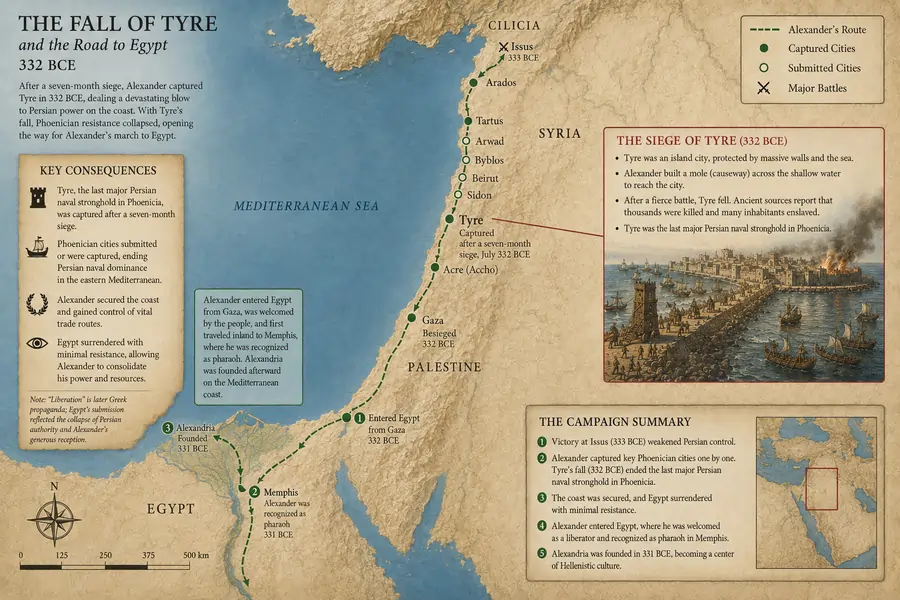
The fall of Tyre had enormous strategic consequences for Alexander's campaign against Persia. Alexander's decision to strengthen his navy provided much-needed naval dominance for the Macedonians. Without Tyre and the Phoenician ports, Persian fleets lost crucial logistical support and operating bases. Historian Peter Green argues that the capture of Tyre effectively secured Alexander's control over the eastern Mediterranean coastline and eliminated the possibility of major Persian naval counterattacks.
The victory also opened the road to Egypt. The fall of the fortress city of Tyre was a big psychological blow for the Persians. Following Tyre's destruction, most remaining coastal cities surrendered quickly, though Gaza resisted and required another difficult siege before falling to Alexander. Alexander's conquest of Egypt soon followed, leading to one of the most important developments of the Hellenistic world: the foundation of Alexandria.
The siege additionally enhanced Alexander's reputation dramatically. This growing reputation helped bolster the morale of his troops while demoralizing his enemies. The Siege of Tyre also influenced military history for centuries. Later Hellenistic and Roman commanders studied Alexander's methods carefully. Historian Adrian Goldsworthy notes that Tyre became one of antiquity's classic examples of persistence, siege engineering, and combined naval-land operations (The Complete Roman Army, 2003).
The Legacy of the Siege
The Siege of Tyre is a unique phase in the career of Alexander the Great. Unlike his other battles, this remains one of the most remarkable examples of innovation and determination in ancient warfare. It demonstrated Alexander's ability to overcome unprecedented obstacles through engineering, adaptability, and strategic insight. The campaign combined nearly every dimension of warfare: naval operations, siege engineering, psychological warfare, logistics, and close-quarters combat. For this reason, many historians continue to regard Tyre as one of the most decisive battles in history.
The siege also forms a crucial part of Alexander's broader military career. Readers seeking a larger overview of his campaigns and strategic methods can explore our detailed guide to Alexander the Great's biography, battles, and strategy. More than two thousand years later, the Siege of Tyre still stands as a powerful example of how determination, innovation, and strategic thinking can overcome even the strongest defenses.
References and Sources
- Arrian, Anabasis of Alexander
- Plutarch, Life of Alexander
- Green, Peter, Alexander of Macedon
- Fuller, J.F.C. The Generalship of Alexander the Great
- Quintus Curtius Rufus (History of Alexander)
- Diodorus Siculus, Bibliotheca Historica
- Waldemar Heckel. Alexander the Great: Historical Sources in Translation. Blackwell Publishing, 2004.
- Robin Lane Fox. Alexander the Great. Penguin Books, 1973.
- Adrian Goldsworthy. The Complete Roman Army. Thames & Hudson, 2003.
Recommended Books
This article may contain affiliate links. If you purchase through these links, I may earn a small commission at no extra cost to you.
Related Articles
Frequently Asked Questions
Why did Alexander the Great build a causeway at Tyre?
Alexander the Great built a massive stone causeway during the Siege of Tyre because the city was located on an island beyond the reach of traditional siege engines. The structure allowed Macedonian troops and siege towers to approach Tyre's walls directly and became one of the most famous engineering feats of ancient warfare.
How did Tyre defend itself against Alexander's siege?
Tyre defended itself using its powerful navy, towering sea walls, and strategic island position. The Tyrians launched fire attacks against Macedonian siege towers, harassed workers building the causeway, and used ships to disrupt Alexander's operations throughout the siege.
What made the Siege of Tyre difficult for Alexander the Great?
The Siege of Tyre was difficult because the city stood on an island protected by deep water and massive fortifications. Alexander initially lacked naval superiority, forcing him to combine engineering innovation, siege warfare, and naval tactics to overcome the city's defenses.
How long did it take Alexander the Great to capture Tyre?
Alexander the Great captured Tyre after a siege lasting approximately seven months in 332 BC. The prolonged operation became one of the most challenging military campaigns of his conquest of the Persian Empire.
Did the Siege of Tyre weaken the Persian Empire?
Yes, the fall of Tyre significantly weakened the Persian Empire by removing one of its most important naval bases in the eastern Mediterranean. This helped Alexander secure the coastline and reduced Persia's ability to challenge Macedonian naval operations.
Does Alexander's causeway at Tyre still exist today?
Yes, the causeway constructed by Alexander during the Siege of Tyre still affects the region today. Over centuries, sediment accumulated around the structure and permanently connected the former island city to the mainland.
Add Comment