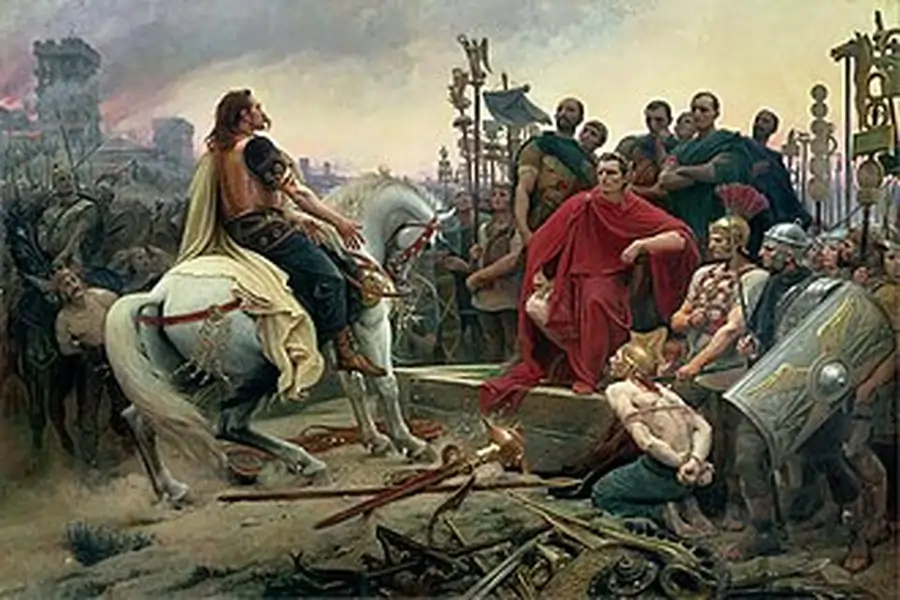
The Battle of Alesia (52 BC) was one of Julius Caesar's greatest military achievements and a decisive moment in the Gallic Wars. In this famous Roman siege, Caesar faced the Gallic leader Vercingetorix, who was trapped inside the fortified town of Alesia while a massive relief army surrounded the Romans. Surrounded on both sides, Caesar ordered the construction of a double wall fortification to defend against both the city's defenders and the incoming forces. This innovative strategy led to a decisive Roman victory, ending major Gallic resistance and paving the way for Julius Caesar's rise to power.
Table of Contents
- The Rise of Julius Caesar in Gaul
- The First Triumvirate Explained: Caesar, Pompey, and Crassus
- Julius Caesar's Campaign in Gaul Explained
- Vercingetorix: Leader of the Gallic Revolt Against Rome
- Why the Battle of Alesia Happened (52 BC)
- Caesar's Double Wall Strategy at Alesia Explained
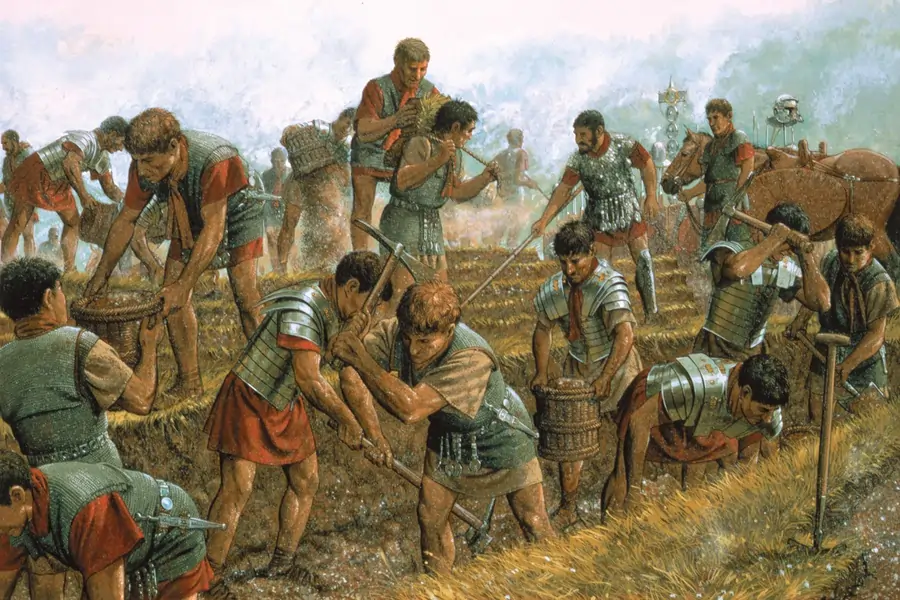
- Roman Fortifications at Alesia: Walls, Ditches, and Towers
- Roman Traps at Alesia: Cippi, Lilia, and Stimuli
- Roman Camps and Troop Movement at Alesia
- What Happened to Civilians During the Siege of Alesia
- Gallic Relief Army at Alesia: A Siege Within a Siege
- Final Battle at Alesia: The Assault at Mont Réa
- Why Vercingetorix Surrendered to Caesar
- Why Caesar Won the Battle of Alesia
- Impact of the Battle of Alesia on Rome and Gaul
The Rise of Julius Caesar in Gaul
Caesar was an ambitious politician seeking military glory (dignitas) and wealth (praeda) to advance his career. According to Plutarch in Life of Caesar and Suetonius in The Twelve Caesars, Caesar's enormous debts and political ambitions made a successful military command essential for his survival. However, by 60 BC, he had only held a few minor titles and was now heavily in debt due to his lavish spending to gain favour in elections. He now had favour among the common people, but he needed a means to bypass the senate and gain prestige (Dignitas) and plunder (Praeda) with which to pay off his debts. For this, he needed an army to wage war.
The First Triumvirate Explained: Caesar, Pompey, and Crassus
The First Triumvirate was an informal secret alliance among three of Rome's most powerful men. Each person in the Triumvirate brought some unique power, which they used to bypass the Roman senate and gain their own influence. The Triumvirate consisted of:
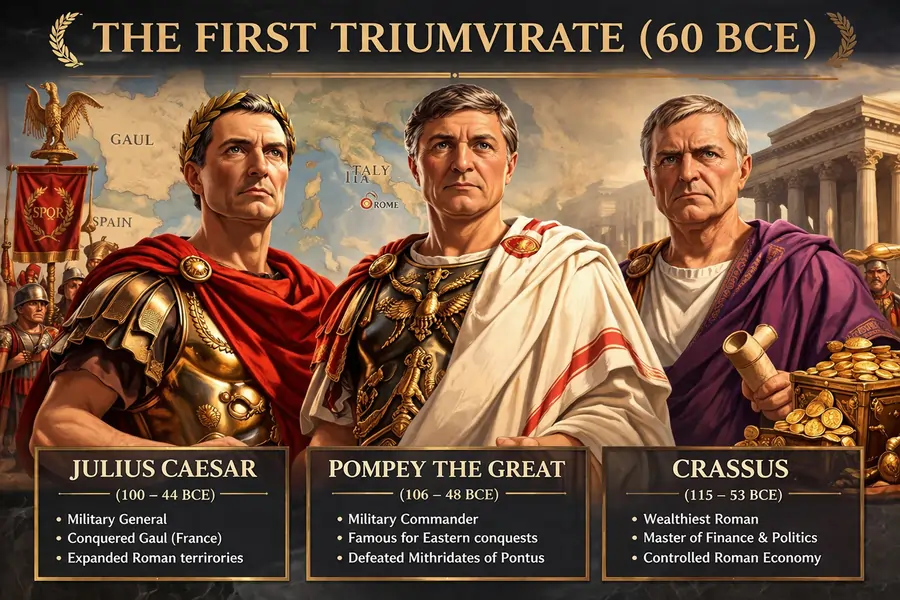
- Gaius Julius Caesar: Julius Caesar was a rising political figure in Rome. He had immense popularity among the people of Rome. He could sway the emotions of the people with his oratory skills. However, he was in heavy debt and needed a war against the Gauls to pay for his debts.
- Gnaeus Pompeius Magnus (Pompey the Great): Pompey was a famous military general and had the loyalty of the Roman legions. He brought a lot of military power to the Triumvirate.
- Marcus Licinius Crassus: Crassus was the wealthiest man in Rome. He was the one who funded Caesar's political campaigns. He had a significant influence over the business class of Rome.
Each member of the Triumvirate had their own objective and goal. Pompey wanted to get formal possession of his eastern territories and grant land to his military veterans. Crassus wanted a reduction in tax for his business allies and personal military glory. Caesar wanted to be elected as consul, and later he wanted an army in Gaul to gain glory and secure wealth.
Julius Caesar's Campaign in Gaul Explained
Caesar was elected as consul of Rome in 59 BC thanks to the Triumvirate. Before the end of his consulship, he secured a five-year governorship over Cisalpine Gaul, Transalpine Gaul, and Illyricum, giving him command of four legions. The duration was later extended to ten years. This was essential for Caesar to gain prestige and plunder to pay off his mountain of debt and stop his enemies in Rome from prosecuting him.
After becoming the governor of Cisalpine Gaul, Transalpine Gaul, and Illyricum, Caesar launched his conquest of Gaul in 58 BC, a campaign he later documented in Commentarii de Bello Gallico (Commentaries on the Gallic War). Modern historian Adrian Goldsworthy notes that although Caesar presented the campaign as defensive, it also greatly enhanced his personal prestige and political influence. This was done without consulting the Roman senate and was an unauthorized action opposed by the senate. His campaign in Gaul was extremely successful. The Gallic tribes were divided, and Caesar used this to his advantage by using rivalries to pit the Gallic tribes against each other. He was also the first Roman general to lead expeditions into Britain. Although he gained very little territory by these actions, they were huge propaganda victories.
Vercingetorix: Leader of the Gallic Revolt Against Rome
Vercingetorix successfully united many previously divided Gallic tribes against Rome. Caesar's own account in The Gallic War describes him as an exceptionally capable leader, while historian Barry Cunliffe argues that his achievement lay not merely in military leadership but in forging an unprecedented pan-Gallic alliance. He did the impossible task of uniting the Gallic tribes to fight the Roman invader. When a massive revolt broke out in Gaul in 52 BC, Vercingetorix seized power by force and began unifying the tribes with strict discipline. Hostages were taken from all the tribes to ensure their loyalty and prevent deserters.
Vercingetorix used a scorched earth policy to starve the Roman army of much-needed supplies. He ordered the Gauls to burn their towns and crops before the Roman army could capture and use them. He defeated Caesar in the Battle of Gergovia, which united all the remaining Gauls to his side to fight the Romans. He was finally backed into the town of Alesia by Caesar and trapped. He sent for help, and a huge relief army was on its way.
Why the Battle of Alesia Happened (52 BC)
Following his defeat at Gergovia, Caesar abandoned the idea of another costly assault. Instead, he opted for a siege, a decision that military historian Adrian Goldsworthy describes as one of Caesar's most strategically sound decisions during the Gallic campaign. Vercingetorix was fine with this outcome as he had already called for reinforcements to relieve the town. He wanted to catch the Roman army in a pincer move between the defenders of the town and the relief army. However, he did not account for the scale of Roman siege preparations.
Alesia was a fortified town on a hill with two rivers flowing on each side. This made the town easy to defend and very difficult to take by assault. The Gauls also had 80,000 defending troops, which was significant. Caesar ordered the construction of a contravallation (A set of fortifications surrounding a besieged city to act as a base of operations). This set of fortifications was eleven Roman miles long (10 miles) with 23 towers.
While the Romans were building the fortifications, Vercingetorix sent out his cavalry to disrupt the construction, but only temporary delays were achieved. Before the contravallation was completed, Vercingetorix sent out all his cavalry under the cover of night to rally all tribes to war and come to help relieve the siege in Alesia. Caesar came to know about the escape of the Gallic cavalry through the deserters of Alesia. He now knew that a relief army would be coming soon.
Caesar's Double Wall Strategy at Alesia Explained
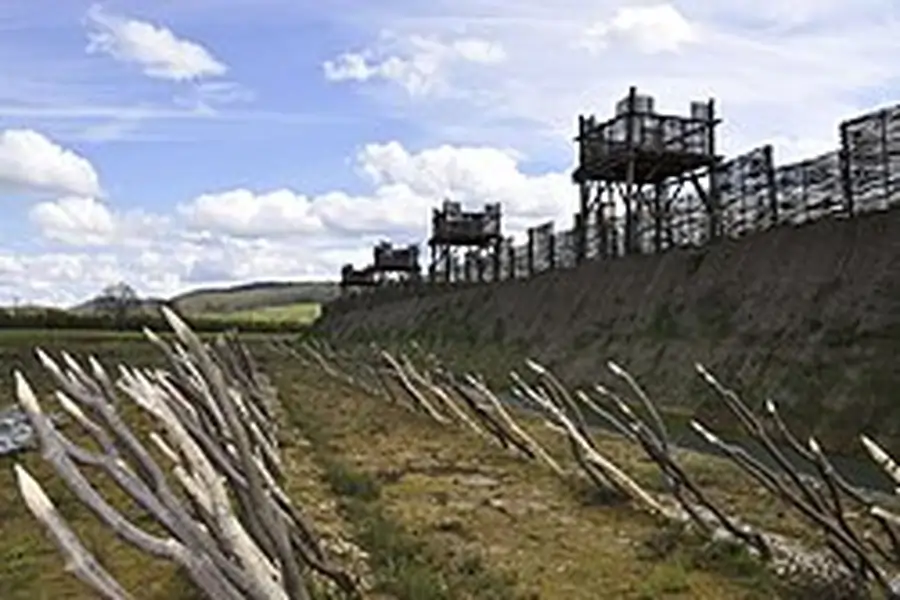
Caesar recognized that once the Gallic relief army arrived, his forces would effectively become besieged themselves. According to Caesar's Gallic War (Book VII), he responded by constructing two concentric lines of fortifications, one facing inward and one outward, an engineering achievement that historian J.F.C. Fuller later described as one of the finest examples of military field engineering in antiquity.
Circumvallation (Inner Line)
- A continuous line of fortifications encircling Alesia
- Approximately 15-16 kilometers in length
- Designed to prevent escape attempts and starve the defenders
Contravallation (Outer Line)
- A second defensive ring facing outward
- Approximately 20-21 kilometers long
- Built to defend against the incoming Gallic relief army
The Roman army was besieging the enemy in Alesia while simultaneously preparing to withstand a siege themselves-a highly risky but brilliantly executed strategy. Archaeological excavations around modern Alise-Sainte-Reine have uncovered portions of these defensive works, broadly confirming Caesar's description of the siege system.
Roman Fortifications at Alesia: Walls, Ditches, and Towers
The Roman fortifications were not simple walls. It was a highly sophisticated multi-layered ring of defenses. It was designed to slow, break, and destroy any attacking force before it could reach the Roman lines.
Ditches (Fossae)
- Two large ditches were dug in front of the fortifications
- Each roughly 15 feet (4.5 meters) wide
- One ditch was often flooded to create an additional obstacle
Rampart and Palisade
- An earthen rampart about 12 feet (3.5 meters) high
- Topped with a wooden palisade of sharpened stakes
- It also included walkways for Roman soldiers to move and fight efficiently
Towers
- Constructed at regular intervals along the fortifications
- Allowed archers, slingers, and artillery to fire from elevated positions
- Created overlapping fields of fire for maximum defensive coverage
Roman Traps at Alesia: Cippi, Lilia, and Stimuli
To further strengthen the defenses, Caesar added multiple concealed traps designed to disrupt and terrorize attacking forces before they could reach the walls.
Cippi
- Small pits containing sharpened wooden stakes
- They were camouflaged with mud and leaves
- Unsuspecting soldiers would be impaled on the stakes
Lilia
- Cone-shaped pits arranged in a staggered pattern
- Each pit contained a sharpened stake at the bottom
- This disrupted the movement of the attackers and broke their momentum
Stimuli
- Iron barbs or hooked spikes hidden in the ground
- This was meant to injure soldiers and slow down charges
These obstacles created deadly killing zones where attackers were slowed, wounded, and exposed to continuous missile fire from Roman defenses.
Roman Camps and Troop Movement at Alesia
Behind the two walls, Caesar constructed multiple fortified camps connected by internal roads. These allowed Roman troops to move quickly to threatened sectors and reinforce weak points during attacks. This was essential as the Romans were outnumbered and had to use their troops efficiently or risk being overwhelmed.
What Happened to Civilians During the Siege of Alesia
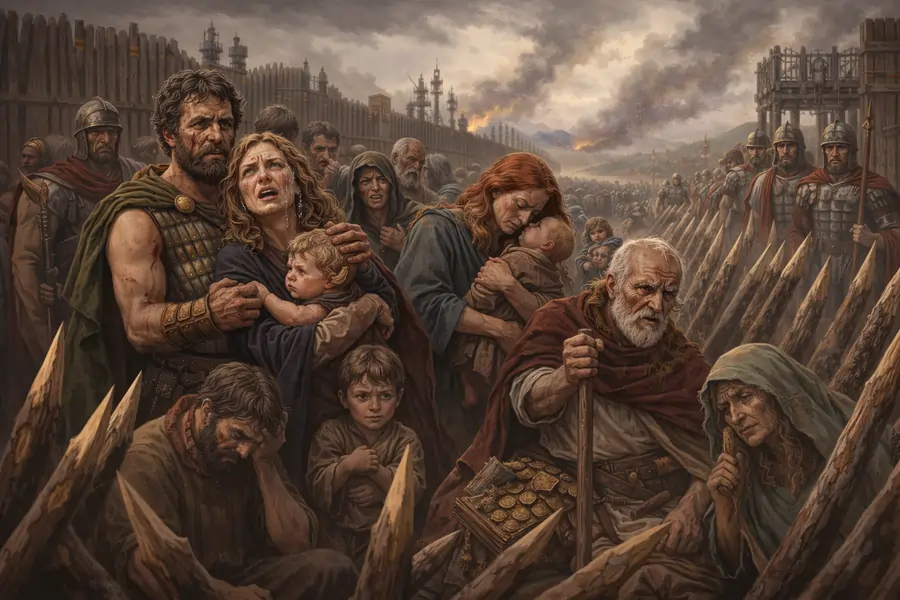
The food reserves in Alesia were rapidly dwindling. There was not enough grain to feed the civilians as well as the 80,000-strong garrison. So Vercingetorix made a cold, calculated decision to send out all of the civilians to the Roman camp. The civilians were all from the Mandubii tribe and were chased away from their home to face the elements.
Vercingetorix hoped Caesar would either accept the refugees as slaves or let them pass outside. However, Caesar did not allow them through and sent them back again. Both the Gauls and the Romans did not take them in, and they were stuck in no man's land. Caesar records in The Gallic War that neither side admitted the civilians, leaving them trapped between the opposing armies where many died from starvation and exposure. Modern historians, including Barry Strauss, regard this episode as one of the bleakest humanitarian tragedies of ancient warfare.
Gallic Relief Army at Alesia: A Siege Within a Siege
When the Gallic relief army finally arrived, Caesar's preparations were put to the ultimate test. It was now time for the Romans to be the besieged as the huge Gallic army surrounded them. The Romans had about 50,000 soldiers and 10,000 auxiliary units. Ancient sources claim the relief army may have numbered over 250,000 warriors. However, many modern historians, including Adrian Goldsworthy and Peter Connolly, consider these figures exaggerated and estimate substantially lower numbers, though the Gauls almost certainly outnumbered Caesar's forces. There were also 80,000 soldiers stuck inside Alesia. This makes it a total of 330,000 Gallic soldiers facing off against 60,000 Romans.
The odds were certainly not in favour of the Romans, and yet the Roman fortifications held. The combination of engineering, discipline, and tactical flexibility gave Caesar and his forces the advantage that they needed. They were not just fighting a normal battle; they had built a killing fortress with fortifications and traps. The Gallic relief army attacked the outer fortifications while the besieged Gauls in Alesia attacked the inner fortifications at the same time.
Final Battle at Alesia: The Assault at Mont Réa
The Gauls had noticed a weakness in the outer fortifications near Mont Réa. They handpicked 60,000 Gallic warriors for this assault, led by Vercassivellaunus, who was the cousin of Vercingetorix. At the same time, the Gauls inside the town launched an all-out attack on the inner fortifications. The Romans under Titus Labienus were hard pressed and on the brink of collapse.
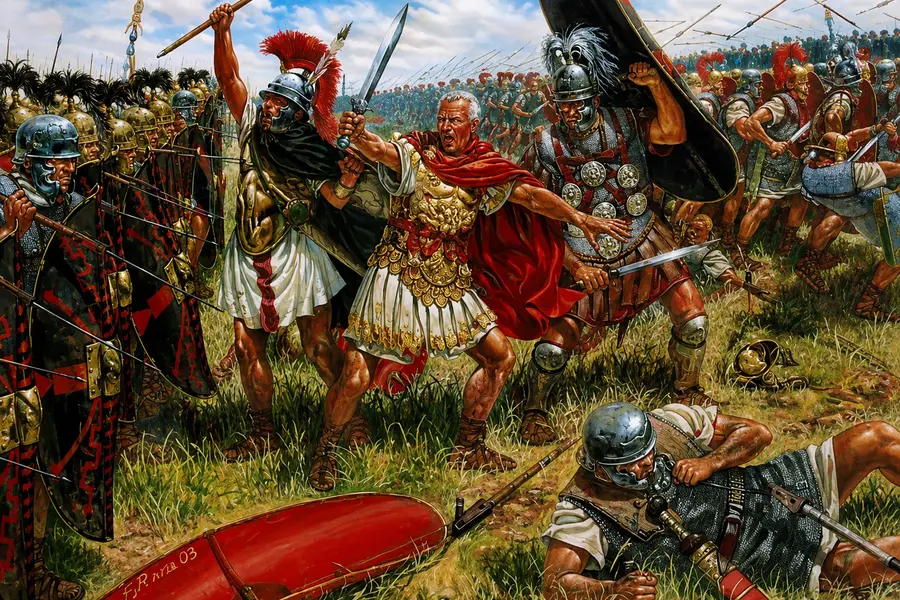
According to Julius Caesar's own account, he personally entered the fighting wearing his distinctive scarlet cloak so that both friend and foe could identify him, boosting Roman morale at the decisive moment. He made himself visible to both the enemy and his troops. Seeing their general on the front lines, the Romans fought back with ferocity. Caesar then led the elite Germanic cavalry out of the fortifications to circle and hit the Gallic relief army in the rear. Caught between the Roman defenses and the cavalry, the Gallic relief army completely broke down and fled.
Why Vercingetorix Surrendered to Caesar
With the assault of the Germanic cavalry, the Gallic army was routed and gave up the relief attempt. With his supplies running low and his people starving, Vercingetorix surrendered to Caesar the following day (October 3, 52 BC). The dramatic image of Vercingetorix riding out in full armour and laying down his weapons originates primarily from later writers such as Plutarch, while Caesar himself provides a far more restrained description of the surrender. This marked the end of the Gallic Wars.
There were a few minor skirmishes in Gaul, but they were not able to band together on this scale ever again. Vercingetorix was captured and held as a prisoner in Rome for 5 years. He was then paraded through the streets as the vanquished Gallic leader and strangled to death in 46 BC.
Why Caesar Won the Battle of Alesia
The Roman victory at Alesia was not simply the result of battlefield courage. Julius Caesar combined engineering, discipline, and tactical flexibility to overcome overwhelming numerical odds. Several key factors explain how the Romans defeated a much larger Gallic force.
Superior Engineering and Fortifications
Caesar's double line of fortifications was the decisive factor in the battle. The circumvallation prevented the defenders in Alesia from escaping, while the contravallation protected the Romans from the incoming relief army. These fortifications transformed the battlefield into a controlled defensive zone where the Romans could fight on their own terms.
Effective Use of Defensive Obstacles
The Roman traps such as cippi, lilia, and stimuli slowed down Gallic attacks and broke their momentum. These obstacles forced attackers into narrow killing zones where Roman archers, slingers, and artillery could inflict heavy casualties. This reduced the advantage of Gallic numerical superiority.
Flexible Roman Command Structure
Caesar positioned his legions across multiple camps connected by internal roads. This allowed Roman troops to move quickly to threatened sectors. When the Gallic assault at Mont Réa nearly broke the Roman lines, Julius Caesar personally led reinforcements to stabilize the situation. This flexibility prevented a breakthrough.
Cavalry Counterattack at the Decisive Moment
The Roman Germanic cavalry played a crucial role in the final phase of the battle. Caesar ordered the cavalry to ride around the Gallic relief army and attack from the rear. This unexpected maneuver caused panic among the attackers and collapsed their assault, turning the tide in favor of Rome.
Gallic Coordination Problems
Although the Gauls had superior numbers, they struggled to coordinate attacks between the relief army and the defenders inside Alesia. Their assaults were not perfectly synchronized, allowing the Romans to shift troops and defend each attack in sequence rather than being overwhelmed all at once.
Through careful planning, strong defensive engineering, and decisive leadership, Caesar turned a dangerous situation into a complete victory. The Battle of Alesia demonstrated that discipline and preparation could overcome even massive numerical superiority.
Impact of the Battle of Alesia on Rome and Gaul
Alesia effectively ended organised Gallic resistance. This led to the complete conquest of Gaul. Historian Mary Beard notes that the conquest of Gaul fundamentally transformed the Roman Republic by vastly increasing Caesar's wealth, military prestige, and political leverage, setting the stage for the civil wars that followed. Rome could now access a vast amount of wealth and natural resources. They also acquired one million slaves captured during the campaign.
The Gallic campaign was a huge triumph for Caesar. He had now become the most powerful man in Rome. The Senate celebrated his victory by granting an unprecedented 20-day thanksgiving (supplicatio). His soldiers from the campaign were fiercely loyal to him rather than the Roman senate. This sudden rise to power eventually led to the Roman Civil War and his road to Dictatorship.
Alesia cemented Caesar's place in history as a brilliant military general. The Battle of Alesia has been studied for its military engineering and siege warfare. The use of "circumvallation" (inner wall) and "contravallation" (outer wall) became a standard model for Roman siege warfare for centuries. Soon, Rome would enter a new phase with the ending of the Roman Republic and birth of the Roman Empire. Roman expansion would continue until their crushing defeat at the Battle of Teutoburg Forest in 9 AD.
Historical Sources and References
- Caesar, Julius. Commentarii de Bello Gallico (The Gallic War). University of Chicago
- Plutarch. Life of Caesar. University of Chicago
- Suetonius. The Twelve Caesars. Project Gutenberg
- Adrian Goldsworthy. Caesar: Life of a Colossus. Yale University Press.
- Adrian Goldsworthy. The Complete Roman Army. Thames & Hudson.
- Barry Cunliffe. The Ancient Celts. Oxford University Press.
- Barry Strauss. The Death of Caesar. Simon & Schuster.
- J.F.C. Fuller. Julius Caesar: Man, Soldier and Tyrant. Da Capo Press.
- Mary Beard. SPQR: A History of Ancient Rome. Liveright Publishing.
- Peter Connolly. Greece and Rome at War. Greenhill Books.
Related Articles
Frequently Asked Questions
What was the double wall built by Caesar at Alesia?
The double wall at Alesia was a unique Roman fortification system built by Julius Caesar. It included an inner wall to trap the Gauls inside the city and an outer wall to defend against the incoming Gallic relief army.
What were circumvallation and contravallation at Alesia?
Circumvallation was the inner ring of fortifications built by the Romans to surround Alesia and prevent escape, while contravallation was the outer ring built to defend against external attacks from the Gallic relief army.
What traps did the Romans use at the Battle of Alesia?
The Romans used several hidden traps at Alesia, including cippi (spiked pits), lilia (cone-shaped pits with stakes), and stimuli (iron barbs). These traps slowed down and injured enemy soldiers before they reached the Roman walls.
Why didn't Caesar attack Alesia directly?
Caesar avoided a direct assault on Alesia because it was a heavily fortified hilltop town. Instead, he chose to besiege it and starve the defenders, which was a safer and more effective strategy.
How did the Romans defend against the Gallic relief army at Alesia?
The Romans defended against the Gallic relief army by building an outer line of fortifications with towers, ditches, and traps. This allowed them to hold their position even while being surrounded.
What made the Battle of Alesia unique in ancient warfare?
The Battle of Alesia was unique because the Roman army was both besieging a city and being besieged at the same time. Caesar's use of double fortifications and layered defenses made it one of the most innovative siege battles in history.
Add Comment