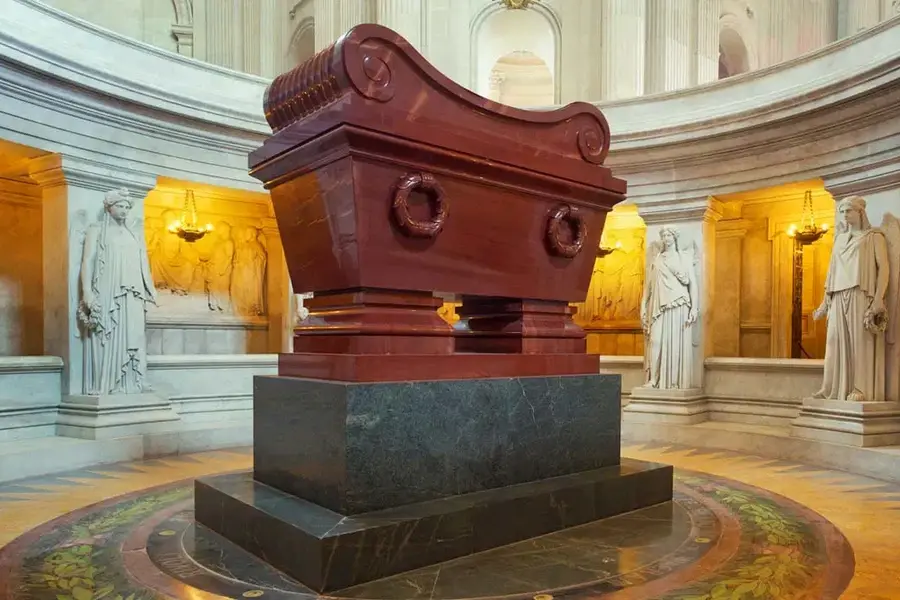
Napoleon Bonaparte spent his life commanding armies, defeating kings and reshaping Europe. Yet his final monument in Paris exerts its power without a single soldier or weapon. Beneath the gilded dome of Les Invalides, his enormous red sarcophagus rests in a sunken circular crypt. Visitors looking down from the gallery must lean over the railing to see it. Those who descend encounter a monument that dominates their surroundings. Completed in 1861, four decades after Napoleon's death, the tomb combines monumental architecture, military symbolism and political memory. Its design transforms a burial place into a carefully staged encounter with one of history's most controversial rulers.
Table of Contents
- Napoleon Bonaparte: From Soldier to Emperor
- Napoleon's Death on Saint Helena
- The Return of Napoleon's Remains to France
- The Construction of Napoleon's Tomb
- The Design: A Tomb Beneath the Visitor
- The Red Sarcophagus and Its Materials
- The Twelve Statues of Victory and Napoleon's Imperial Legacy
- The Dome of Les Invalides
- Does Napoleon's Tomb Make Visitors Bow?
- The Lasting Legacy of Napoleon's Tomb
- References and Further Reading
1. Napoleon Bonaparte: From Soldier to Emperor

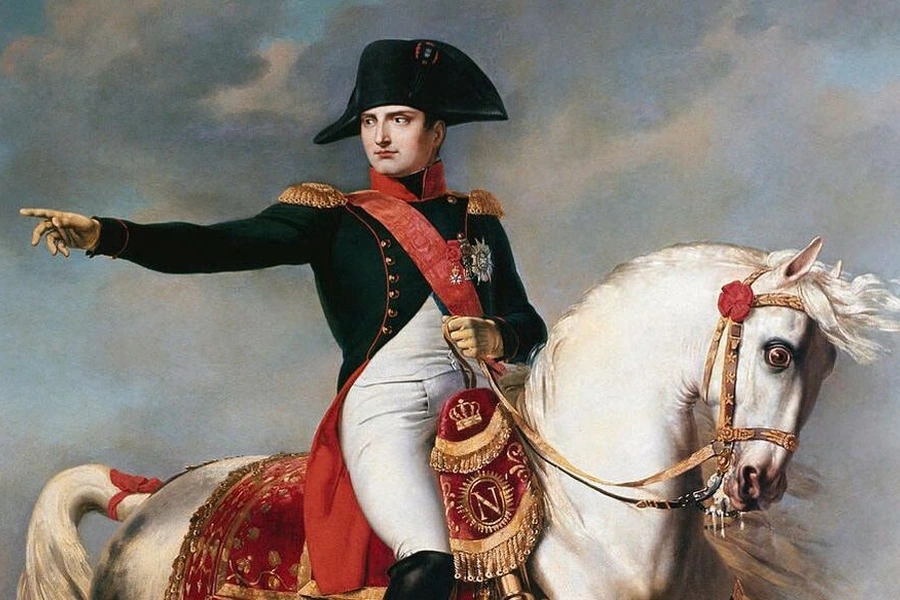
Napoleon was born on 15 August 1769 in Ajaccio, Corsica, shortly after the island came under French control. Educated in military schools on the French mainland, he became an artillery officer and advanced rapidly during the French Revolution. The upheaval destroyed the old political order and created opportunities for ambitious commanders who could deliver military victories.
Napoleon distinguished himself during the Italian campaign of 1796-1797, defeating several Austrian and allied armies through rapid manoeuvres, concentrated force and aggressive battlefield leadership. His Egyptian expedition of 1798 yielded mixed military results but enhanced his public reputation in France. In November 1799, he seized political power in a coup and became First Consul.
In 1804, Napoleon crowned himself Emperor of the French. His armies subsequently defeated major European powers at battles including Austerlitz in 1805, Jena-Auerstedt in 1806 and Wagram in 1809. His achievements extended beyond warfare. The Napoleonic Code helped establish a lasting framework for civil law, while administrative and educational reforms strengthened the French state.
However, the empire depended heavily on continued military success. The invasion of Russia in 1812 ended in catastrophe, and the subsequent campaigns gradually weakened Napoleon's position. Forced to abdicate in 1814, he was exiled to Elba. His return in 1815 led to the Hundred Days, which ended in defeat at Waterloo on 18 June. The Allies sent him into permanent exile on the remote island of Saint Helena in the South Atlantic.
2. Napoleon's Death on Saint Helena
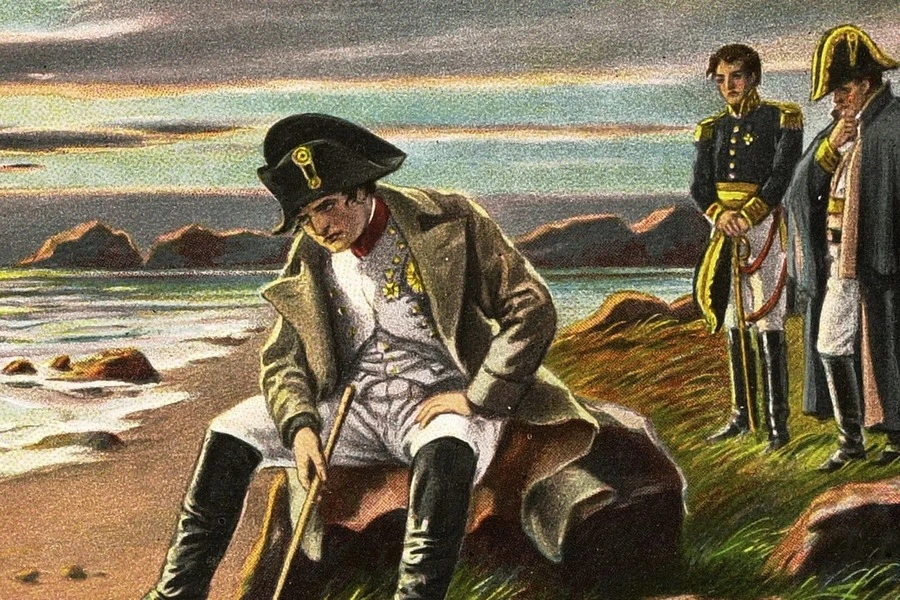
Napoleon spent his final years at Longwood House on Saint Helena, where British authorities closely controlled his movements. The former emperor, who had once directed campaigns across Europe, lived far from France and the political world he had dominated. His health deteriorated during captivity, and he died on 5 May 1821 at the age of 51.
Napoleon's autopsy revealed extensive disease of the stomach, including severe ulceration. Modern medical studies examining the surviving autopsy reports generally support advanced gastric cancer as the most likely underlying cause of death, although alternative theories, most famously arsenic poisoning, have generated considerable debate. The available pathological evidence nevertheless strongly favours severe gastric disease rather than deliberate poisoning.
His last will expressed a different wish. He wanted his remains to rest on the banks of the Seine, among the French people. That request would take almost two decades to fulfil. The contrast between his lonely island burial and the magnificent tomb eventually constructed in Paris forms one of the most striking elements of his posthumous story.
3. The Return of Napoleon's Remains to France
In 1840, King Louis-Philippe's government arranged for Napoleon's remains to be returned to France. The decision also reflected the complicated politics of Napoleonic memory. Louis-Philippe could honour Napoleon as a figure of national military glory without restoring the political system Napoleon had created. The return therefore transformed the defeated emperor into a historical symbol that different sections of French society could interpret in different ways.
The expedition recovered the remains from Saint Helena, and Napoleon's coffin arrived in Paris on 15 December 1840. The event became known as the Retour des Cendres, or Return of the Ashes. The traditional French expression referred to his mortal remains rather than cremated ashes.
The return ceremony attracted enormous public attention. Napoleon's memory had become larger than the historical circumstances of his defeat: veterans remembered their campaigns, admirers celebrated his achievements, and successive political regimes sought to define what he represented.
Napoleon's remains were initially placed in the Chapel of Saint-Jérôme at Les Invalides while a permanent tomb was constructed. The location was appropriate. The Hôtel des Invalides had been established under Louis XIV to house and care for wounded and retired soldiers, and its monumental dome was already associated with France's military heritage.
4. The Construction of Napoleon's Tomb
The return of Napoleon's remains created a new challenge. How could France construct a tomb worthy of a former emperor inside an existing church? The government organised a competition, and architect Louis Visconti was selected to develop the design. His proposal required substantial alterations to the floor of the Dome Church, including excavation for a large circular crypt.
The project was not a simple matter of installing a sarcophagus. The tomb had to fit the existing architecture while establishing its own monumental presence. Visconti designed an open crypt surrounded by a gallery, with the sarcophagus positioned at its centre. Sculptural decoration and commemorative reliefs would connect Napoleon's military victories with his political and administrative achievements.
Visconti died before the work was completed, and other architects continued the project. The construction extended over many years, reflecting both the scale of the undertaking and the complexity of integrating the monument into the historic building. Napoleon's remains were finally transferred into the completed tomb on 2 April 1861, during the reign of his nephew, Napoleon III. The ceremony took place in the presence of the imperial family and senior dignitaries.
5. The Design: A Tomb Beneath the Visitor
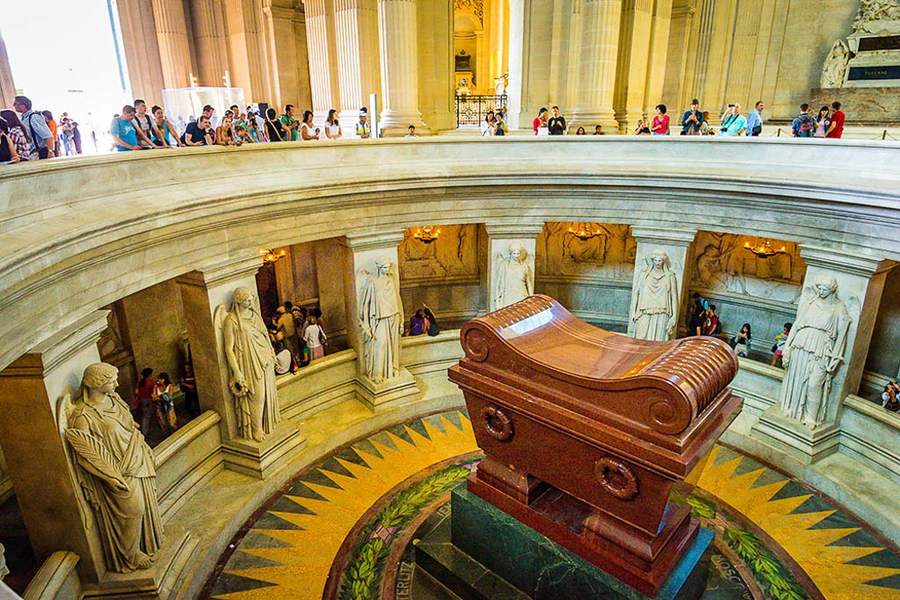
The most unusual feature of Napoleon's tomb is its position within a sunken circular crypt. Instead of placing the sarcophagus on the same level as the visitor, the design separates the monument from the surrounding gallery. People approaching the opening above the crypt look down towards the emperor's resting place.
This arrangement creates a powerful physical experience. A visitor standing at the upper level must lower their gaze and often lean forward to see the sarcophagus clearly. The gesture resembles a bow, although it is not necessarily a deliberate act of reverence. It is a consequence of the architecture itself.
The effect becomes even more interesting when visitors descend into the crypt. From below, the sarcophagus appears imposing against the surrounding space. The visitor who looked down from above now stands beside a massive monument that commands attention.
| Architectural feature | Visitor's experience | Possible interpretation |
|---|---|---|
| Sunken circular crypt | The sarcophagus lies below the upper gallery. | Creates physical separation between Napoleon and ordinary visitors. |
| Upper viewing gallery | Visitors look down into the crypt. | Can evoke reverence or the gesture of bowing. |
| Lower viewing level | The sarcophagus dominates the visitor's immediate surroundings. | Emphasises scale, permanence and monumental authority. |
| Central placement | The tomb becomes the focus of the interior. | Frames Napoleon as the central figure in the commemorative space. |
It is important to distinguish observable architectural effects from claims about the architect's intentions. The layout undeniably changes how visitors view the tomb, but the idea that Visconti deliberately intended every visitor to bow should be presented as an interpretation rather than a proven statement of design intent. Even with that qualification, the central paradox remains compelling. Napoleon's remains lie below the visitor, yet the monument makes him the focus of the encounter. The living person occupies the higher physical position, while the dead emperor commands the greater visual presence.
6. The Red Sarcophagus and Its Materials
At the centre of the crypt stands Napoleon's enormous red sarcophagus, resting on a base of green granite. The reddish stone is commonly called red porphyry in older descriptions, but it is identified in modern accounts as quartzite from the Karelia region, historically associated with Russia. Its colour and polished surface distinguish it from the lighter stone and sculptural decoration surrounding it.
The material contributes to the tomb's sense of grandeur. The sarcophagus is not a modest grave marker carrying a name and dates. It is a massive architectural object, deliberately placed at the centre of the space. Its scale encourages visitors to consider the emperor as a historical figure rather than simply a deceased individual. Napoleon's remains are enclosed within a series of nested coffins inside the outer sarcophagus. The structure conceals the body from view, leaving the monument itself to represent the person buried within it.
This creates a striking contrast with Napoleon's final years. On Saint Helena, his life was restricted by illness, exile and dependence on his captors. In Paris, his resting place is enclosed within a monument that projects stability and permanence. The man who could not escape his island confinement was eventually given one of the most imposing burial places in France.
7. The Twelve Statues of Victory and Napoleon's Imperial Legacy
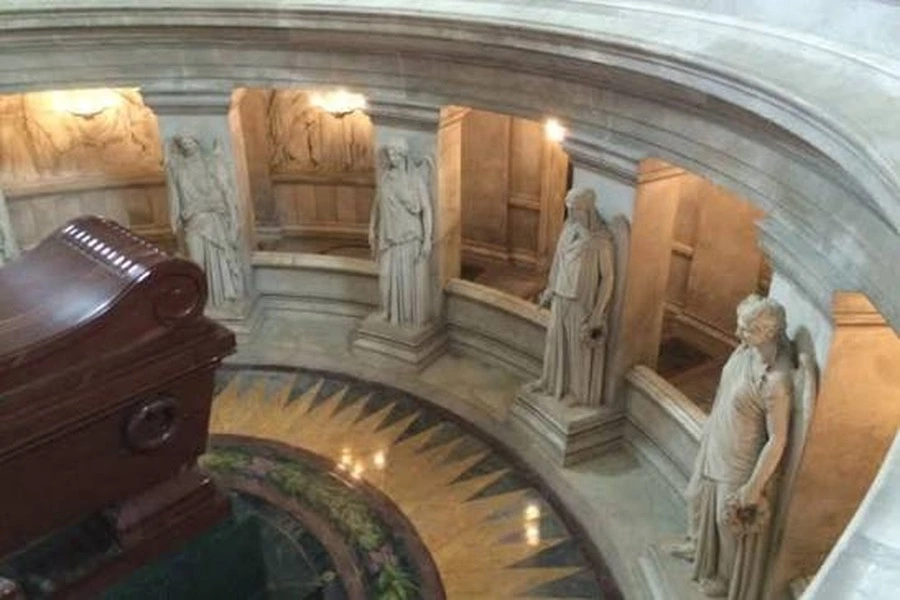
The sarcophagus is surrounded by twelve monumental statues representing Victory, sculpted by James Pradier. Their presence connects the tomb with Napoleon's military career and the campaigns that established his reputation across Europe.
The surrounding architecture carries further commemorative details. The floor records the names of major battles associated with Napoleon, while ten marble reliefs depict achievements of his rule. These reliefs extend beyond warfare to include civil administration, law, education and other institutions associated with the French state.
The sculptural programme therefore presents a particular version of Napoleon's legacy. He appears not only as the general who defeated opposing armies but also as a ruler who transformed the institutions of France. The arrangement invites visitors to see military glory and administrative achievement as connected parts of his historical importance.
Yet the tomb also invites a more critical reading. Napoleon's empire was built through repeated wars that caused enormous suffering and loss of life. The monument's emphasis on victory and state achievement does not automatically convey the experiences of the soldiers and civilians who endured those campaigns. Its grandeur is a statement about remembrance, not a complete account of the historical consequences of Napoleon's rule.
For readers interested in the battles that shaped his reputation, the Battle of Austerlitz and Napoleon's strategy offers a closer look at one of his most celebrated victories. The wider story of his campaigns is explored in Napoleon's Wars: Major Battles and Campaigns.
8. The Dome of Les Invalides
Napoleon's tomb stands beneath the gilded dome of Les Invalides, designed by Jules Hardouin-Mansart during the reign of Louis XIV. The building was originally associated with royal worship and the commemoration of French military power. Its transformation into Napoleon's final resting place connected the emperor with a national tradition that predated him.
The relationship between the dome and the sunken crypt creates a dramatic vertical composition. Above, gilded decoration and soaring architecture draw the eye upwards. Below, the enormous sarcophagus anchors the interior. Visitors experience both the height of the building and the depth of the burial chamber within a single space.
The choice of Les Invalides was also meaningful because of its connection to French soldiers. The institution was established to provide accommodation and care for veterans, while the Dome Church became a place associated with military remembrance. Napoleon's tomb thus occupies a setting that links an individual commander with the wider history of France's armed forces.
Other members of the Bonaparte family and notable French military figures are commemorated within the wider complex. Napoleon's tomb is therefore part of a broader landscape of remembrance, although its size and central placement make it the dominant attraction beneath the dome.
9. Does Napoleon's Tomb Make Visitors Bow?
The power of Napoleon's tomb lies in the relationship between the monument and the person looking at it. Architecture usually provides a setting for an object, but here the setting actively shapes the visitor's posture and perspective. From the upper gallery, the viewer looks down; from the lower level, the sarcophagus rises in visual importance.
This arrangement can be read as a metaphor for Napoleon's place in history. During his lifetime, he sought to stand above other rulers through military victories, political ambition, and imperial authority. After his defeat and death, the monument continued to distinguish him from ordinary people by giving his remains an extraordinary setting.
The tomb also contains a contradiction. A visitor looking down into the crypt occupies the higher physical position, while Napoleon remains below. Yet the viewer's attention is directed towards him, and the monument determines where the visitor looks and how the space is experienced. Physical height does not necessarily translate into symbolic dominance.
That distinction is what makes the tomb such an interesting subject for architectural history. The monument does not need to make a visitor literally kneel. Its scale, position and arrangement can create an impression of deference without requiring any formal gesture of submission.
At the same time, not every visitor will experience the tomb in the same way. Some may see a tribute to military achievement; others may focus on the political ambition behind imperial commemoration or the cost of Napoleon's wars. The architecture encourages attention and reflection, but it does not dictate a single interpretation.
Comparisons with other famous conquerors can deepen this perspective. The greatest military generals in history explores how commanders acquire lasting reputations, while decisive battles in history examines the conflicts that can transform political fortunes. Napoleon's tomb adds another dimension to those stories: the way later generations choose to remember the people who shaped them.
10. The Lasting Legacy of Napoleon's Tomb
Napoleon's tomb is more than a final resting place. It is a monument created decades after his death to preserve a particular vision of his achievements and influence. The sunken crypt, monumental sarcophagus, statues of Victory, and gilded dome combine to make the visitor experience Napoleon as a figure set apart from ordinary life.
Its significance becomes clearer when the tomb is compared with the circumstances of his death. Napoleon died in exile on a remote island, far from the country he had ruled. His remains returned to France in 1840, but another twenty years passed before the permanent monument was completed. The final structure transformed a defeated emperor's burial into a national commemorative event.
Perhaps that is the most enduring paradox of Napoleon's tomb. The emperor who once commanded armies and attempted to reshape Europe can no longer issue an order. Yet, his monument continues to influence the movements and attention of those who enter the crypt. His power is no longer political or military. It survives through architecture, memory, and the stories people tell about him.
In the end, the tomb does not simply ask visitors to look at Napoleon. It makes them consider their own position in relation to him. Whether they see a great commander, an ambitious ruler or a deeply contested historical figure, they encounter a monument that turns remembrance into a physical experience.
References and Further Reading
The following institutional and specialist sources provide further information on Napoleon's death, the return of his remains and the architecture of his tomb.
- Musée de l'Armée - The Dome: Tomb of Napoleon. Official information on the Dome Church, the construction of the tomb and the site's historical significance.
- Fondation Napoléon - Les Invalides, the Military Museum and Tomb of Napoleon. Historical background on Les Invalides and Napoleon's burial place.
- Fondation Napoléon - Napoleon's Death. Information on Napoleon's final illness, death, original burial and subsequent removal of his remains.
- Fondation Napoléon - The Return of Napoleon's Remains to Paris. An account of the 1840 expedition and the political circumstances surrounding the return.
- Fondation Napoléon - Final Burial of the Mortal Remains of Emperor Napoleon I, 2 April 1861. Historical details on the completion of the tomb and the final burial ceremony.
Books and Memorables
This article may contain affiliate links. If you purchase through these links, I may earn a small commission at no extra cost to you.


Related Articles

Frequently Asked Questions
Where is Napoleon's tomb located in Paris?
Napoleon Bonaparte's tomb is located beneath the gilded dome of the Dome Church at Les Invalides in Paris, France. The historic complex was originally established by King Louis XIV to house and care for wounded and retired soldiers. Today, the tomb is one of the site's most important attractions, commemorating Napoleon's military career and his lasting influence on French history.
Why is Napoleon's tomb built in a sunken crypt?
Napoleon's tomb occupies a circular crypt below the floor of the Dome Church at Les Invalides. Designed by architect Louis Visconti, the arrangement allows visitors to view the sarcophagus from an upper gallery or descend to the lower level. Looking down from above creates a striking visual relationship between the visitor and the emperor's resting place, although the idea that this was specifically intended to make visitors bow is an architectural interpretation rather than a confirmed design intention.
What material was used for Napoleon's red sarcophagus?
Napoleon's monumental red sarcophagus is made from reddish quartzite commonly associated with the Karelia region, historically part of Russia. It rests on a green granite base inside the circular crypt at Les Invalides. The polished stone, imposing dimensions and central position make the sarcophagus the focal point of the tomb.
When was Napoleon's tomb built and when was he buried there?
Napoleon's remains were returned from Saint Helena to France in 1840, nineteen years after his death. Architect Louis Visconti designed the monumental tomb at Les Invalides, and construction continued for many years. Napoleon was finally laid to rest in the completed tomb on 2 April 1861, during the reign of his nephew Napoleon III.
Why was Napoleon buried at Les Invalides instead of Saint Helena?
Napoleon was initially buried on the island of Saint Helena after his death in exile on 5 May 1821. In his will, he expressed a wish to rest on the banks of the Seine among the French people. In 1840, the French government arranged for his remains to be returned to Paris. Les Invalides was an appropriate location because of its association with French military history and the commemoration of soldiers.
What do the twelve Victory statues around Napoleon's tomb represent?
The twelve monumental statues representing Victory surround Napoleon's sarcophagus in the crypt at Les Invalides. Sculpted by James Pradier, they connect the tomb with the military victories that shaped Napoleon's reputation. Other decorative elements, including battle inscriptions and marble reliefs depicting achievements of his rule, commemorate both his military campaigns and his contributions to French administration and law.
Add Comment