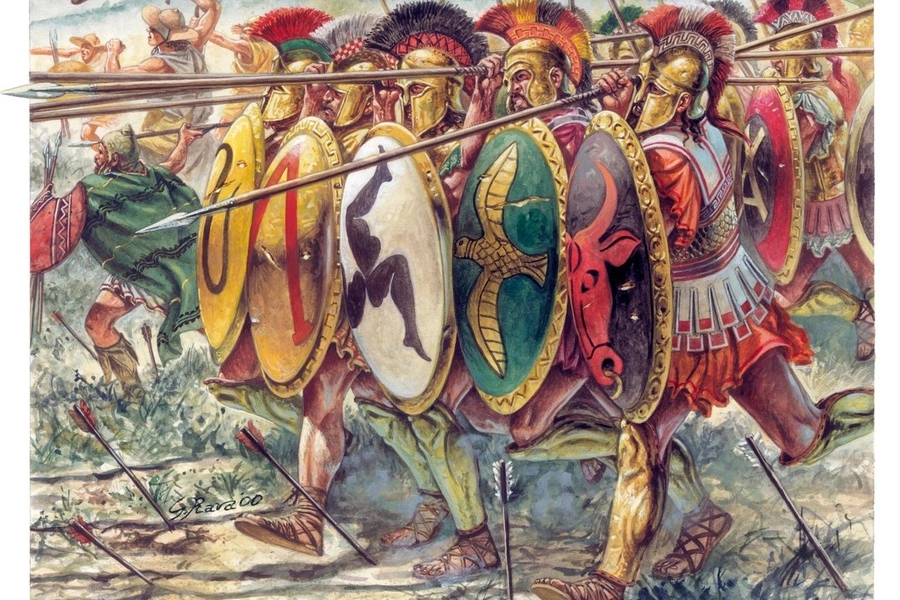
For centuries, the Greek battlefield was dominated by a deceptively simple idea. Heavily armed citizens standing together and advancing as one. The hoplite and the phalanx formation became one of the most recognizable military systems of the ancient world. Still, the reality was more complicated than the familiar image of an immovable wall of shields and spears. Greek armies differed from city to city; their equipment evolved; cavalry and light infantry increasingly mattered; and commanders continually experimented with deeper formations, maneuver, and combined arms. Understanding Greek warfare therefore means looking beyond the stereotype of the Spartan warrior and examining how ordinary Greek hoplites actually fought.
Table of Contents
- What Was a Greek Hoplite?
- Hoplite Weapons and Armor
- How the Greek Phalanx Worked
- The Role of Cavalry and Light Infantry
- Greek Hoplites vs Spartan Hoplites
- Famous Battles and the Evolution of Greek Tactics
- Weaknesses of the Hoplite Phalanx
- Greek Hoplite vs Macedonian Phalanx
- The Evolution and Legacy of Greek Warfare
- Conclusion
- References and Sources
What Was a Greek Hoplite?
The word hoplite is traditionally connected with the Greek term hoplon, meaning weapon or equipment, although the terminology surrounding early Greek infantry and their equipment is more complicated than the modern label suggests. The equipment associated with hoplite warfare developed gradually rather than appearing as a complete military package overnight. Hoplites were generally citizen soldiers. In many Greek city-states, military service was closely connected to citizenship, wealth, and the ability to provide one's own equipment. This meant that the hoplite was not normally a professional soldier in the later Roman or Macedonian sense. A farmer, craftsman or landowner might spend much of his life as a civilian and take up his weapons when his city called him to war.
This social background is important because the hoplite system was not simply a technological invention. It depended upon communities being able to organize large numbers of men, equip them and persuade them to fight shoulder to shoulder. Military service could therefore reinforce the political identity of the polis. The Metropolitan Museum of Art notes that military service became an important marker of citizenship, status and wealth in Archaic Greece. [1] However, the traditional story that a sudden "hoplite revolution" transformed Greek society is now treated much more cautiously by historians. Archaeological evidence and modern scholarship indicate a gradual evolution in equipment, organization, and battlefield practice rather than one neatly defined military revolution. [2]
What Made a Hoplite Different from Other Greek Soldiers?
The defining feature was not simply carrying a spear. Greek armies contained archers, javelinmen, slingers, cavalry, and other troops. What distinguished the hoplite was the combination of relatively heavy protection, a large shield, and equipment intended for close combat in an organized infantry formation.
| Feature | Typical hoplite role |
|---|---|
| Primary role | Close-order heavy infantry |
| Main weapon | Thrusting spear (dory) |
| Secondary weapon | Short sword, commonly a xiphos; some used curved swords |
| Main protection | Large round shield, helmet, body armor and often greaves |
| Battle formation | Close-order phalanx |
| Typical military status | Citizen or allied heavy infantry, though mercenary and professional forces also existed |
Hoplite Weapons and Armor
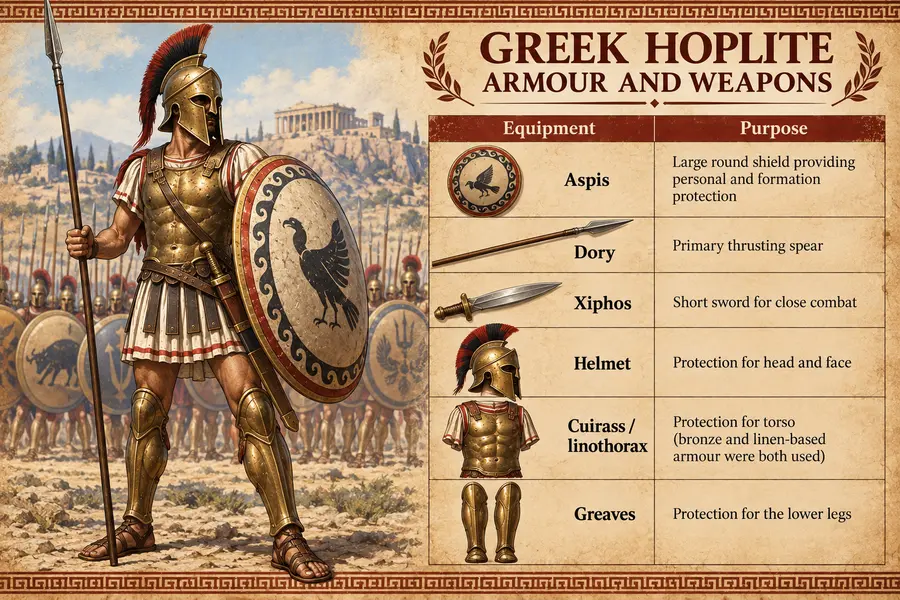
The classic Greek hoplite panoply was expensive. A soldier generally had to acquire and maintain much of his own equipment, meaning that the ability to serve as a hoplite was connected to economic resources. Surviving helmets, cuirasses and shields demonstrate the considerable investment involved. [3]
The Aspis: The Hoplite Shield
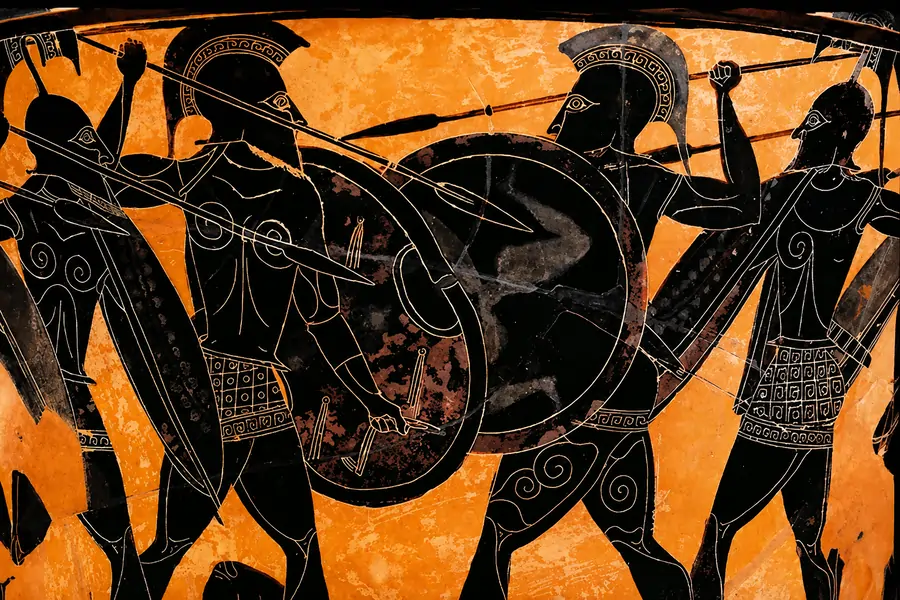
The large round shield, commonly called the aspis, was arguably the most important piece of hoplite equipment. It was substantially different from a modern shield held entirely by a hand grip. The shield was supported by an arm brace known as a porpax together with a hand grip near the rim.
This arrangement allowed a hoplite to control a relatively large shield without relying entirely on a single hand. The shield protected the hoplite's left side and, when soldiers stood close together, its large diameter also created overlapping protection between neighboring men. That second function explains why the shield mattered so much to the phalanx. The hoplite was not simply protecting himself. His position contributed to the survival of the formation as a whole.
The Dory: The Hoplite Spear
The primary offensive weapon was the dory, a thrusting spear generally around two to three metres long, although exact dimensions varied. It was primarily intended for close combat rather than functioning like the much longer Macedonian sarissa. The spear had a metal head and a rear spike, often called a sauroter. The rear spike, or sauroter, could be used as a secondary striking point and also served practical functions, including helping balance the spear and securing it in the ground.
The Xiphos and Other Swords
The spear was the principal weapon, but battles did not necessarily remain spear fights. If formations became compressed, spears could break or become difficult to use. Hoplites therefore carried swords for close combat. The xiphos was a short, double-edged sword associated with Greek infantry, while some warriors carried the curved kopis or machaira. Weapon choice varied by region and period.
Helmet, Cuirass and Greaves
The famous Corinthian helmet enclosed much of the face and protected the head, cheeks and neck. It provided substantial protection but also restricted vision and hearing. Later Greek helmets increasingly emphasized mobility and awareness, including open-faced designs. Body armor could consist of a bronze cuirass, although lighter forms became increasingly common. The linothorax, a laminated linen form of armor, is particularly important when considering how Greek soldiers adapted their equipment over time. Bronze greaves protected the lower legs and were designed to fit around the shin. Together with the shield, helmet, and body armor, these pieces produced a soldier considerably better protected than lightly armed infantry.
| Equipment | Purpose |
|---|---|
| Aspis | Large round shield providing personal and formation protection |
| Dory | Primary thrusting spear |
| Xiphos | Short sword for close combat |
| Helmet | Protection for head and face |
| Cuirass / linothorax | Protection for torso |
| Greaves | Protection for the lower legs |
The Metropolitan Museum describes the typical Classical Greek panoply as including a thrusting spear, bronze helmet, cuirass, greaves and a large shield. Archaeological finds also show that Greek equipment was not completely standardized; materials, shapes and levels of protection changed across time and place. [1] [3]
How the Greek Phalanx Worked
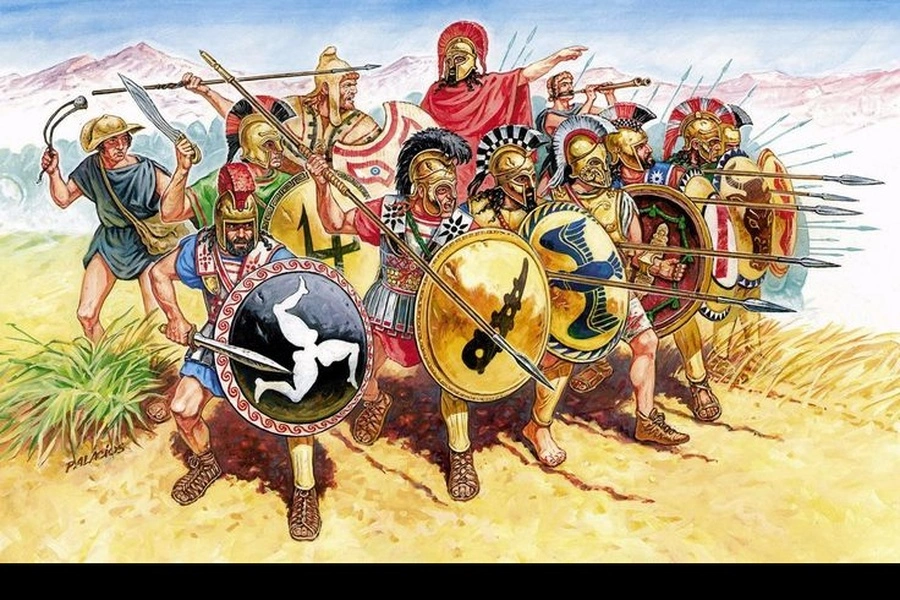
The Greek phalanx was a close-order infantry formation in which hoplites stood in organized ranks and files. Its strength came from concentration. Instead of asking individual warriors to survive independently, the formation brought hundreds of shields, spears, and bodies into a coordinated fighting mass. But the popular image of every Greek phalanx being identical is misleading. Depth varied. Unit organization differed between states. Some armies employed unusually deep formations, while others adapted their deployment according to terrain and circumstances. The evidence does not support a single universal "standard phalanx" that remained unchanged for centuries. [4]
Why the Shield Formation Worked
The aspis was held on the left side of the body. Consequently, a hoplite could provide some protection to the man on his left while keeping much of his own body behind the shield. This encouraged close spacing. There was, however, an important consequence: the formation could drift toward the right as individual soldiers sought greater protection behind their neighbor's shield. Ancient commanders had to deal with the resulting loss of alignment and the danger that a flank might become exposed. The phalanx was therefore not simply a "wall of shields." It was a formation that required men to maintain alignment while moving, turning, and fighting under extreme physical and psychological pressure.
How Did Hoplites Attack?
A Greek phalanx normally attempted to approach the enemy while preserving formation cohesion. Missile fire, shouting, terrain, and battlefield confusion could all interfere with this process. At close range, the spear became the principal weapon. Once opposing formations collided, individual soldiers had limited room to maneuver. The front ranks were directly exposed to the enemy, while the ranks behind them helped maintain the formation's cohesion and fighting pressure.
One of the most debated questions in ancient military history concerns the othismos, often translated as the "push" of the phalanx. Older interpretations imagined two formations literally locking shields and physically pushing one another like rugby scrums. Modern scholarship has questioned whether this accurately describes every hoplite engagement. Recent experimental and biomechanical research has argued that the equipment of the early hoplite was mechanically compatible with fighting under compressive pressure. The exact mechanics remain debated. [5]
The Rightward Drift
The tendency of hoplites to drift rightward is one of the most interesting characteristics of close-order Greek infantry. Because each man's shield offered some protection to the man on his left, soldiers could tend to move rightward as soldiers sought greater protection behind the overlapping shield of the man beside them. This created a battlefield paradox. A formation designed to maintain a straight front could gradually shift sideways, potentially exposing the left flank while its right wing overlapped the enemy's line.
Greek commanders learned to exploit and manage this behavior. Tactical innovation in the fourth century BCE would increasingly involve deliberately manipulating formation depth and deployment rather than simply accepting the traditional arrangement.
Was the Greek Phalanx Eight Men Deep?
Not universally. Eight ranks is frequently used as a convenient description of Classical Greek deployment, but ancient armies did not all use the same depth. Deeper formations appear in several battles, particularly in the fourth century BCE. The most famous example is Leuctra in 371 BCE, where Epaminondas concentrated exceptional depth and striking power against the Spartan right. The battle demonstrates precisely why the phalanx should be understood as a tactical system rather than a fixed formation template.
The Role of Cavalry and Light Infantry in Greek Warfare
Ancient Greek warfare is often presented as a contest between two blocks of hoplites. Real armies were more diverse. Cavalry, peltasts, archers, slingers, and other light troops could determine where a phalanx could safely move and whether it could protect its flanks. Archers and slingers could harass exposed formations, disrupt movement, and force hoplites to advance under missile fire, although their importance varied considerably between armies and periods.
Greek Cavalry
Cavalry was expensive because horses required substantial resources, and the mountainous geography of much of Greece was not naturally ideal for large-scale mounted warfare. Nevertheless, important Greek states fielded cavalry. Thessaly became particularly famous for its mounted troops, while Athens also maintained a significant cavalry force. Cavalry could scout, screen an army, threaten exposed flanks and pursue a retreating enemy.
The limitations of hoplite warfare became particularly obvious when a heavy infantry formation had to operate without adequate flank protection. A hoplite could fight effectively in close formation but was poorly suited to chasing fast-moving troops across open ground.
Peltasts and Other Light Infantry
The peltast was a lighter infantryman equipped with javelins and a smaller shield, commonly called a pelte. Peltasts were more mobile than hoplites and could harass heavy infantry from a distance before withdrawing. The danger was demonstrated dramatically during the Corinthian War. Xenophon describes Iphicrates' peltasts repeatedly attacking Spartan hoplites with javelins and withdrawing before the heavily armed infantry could close with them. The Spartans eventually suffered severe losses because they could not force the mobile troops into the kind of close combat for which their equipment was designed. [6]
| Troop type | Main weapons | Main battlefield role |
|---|---|---|
| Hoplite | Spear and sword | Close-order heavy infantry |
| Peltast | Javelins | Mobile harassment and flank attacks |
| Archer | Bow | Long-range missile fire |
| Slinger | Sling and stones or lead bullets | Long-range harassment |
| Cavalry | Spears, javelins and swords | Reconnaissance, flanking and pursuit |
By the fourth century BCE, Greek commanders increasingly recognized that the battlefield could not be controlled by heavy infantry alone. The direction of Greek military development was toward greater mobility and combined-arms warfare.
Greek Hoplites vs Spartan Hoplites: Separating History from Myth
The Spartan hoplite has become the modern symbol of Greek warfare. Popular culture often presents Spartans as uniquely trained super-soldiers who invented the phalanx, fought without fear, and defeated virtually every army they encountered. The historical picture is more interesting.
Were Spartan Hoplites Different?
Yes, but not because they possessed a fundamentally different type of weapon or armor. Spartan hoplites were recognizable members of the broader Greek heavy-infantry tradition. What distinguished Sparta was its military society, training culture, organization and political structure. Xenophon, writing about Spartan institutions, emphasized the unusually systematic nature of Spartan preparation and organization. His account describes regulations governing campaign organization, exercises, equipment and camp routines. Xenophon's account is valuable but should be treated as an informed interpretation of Spartan institutions rather than a neutral description of Spartan society. [7]
Myth: Spartans Invented the Greek Phalanx
There is no good basis for treating the phalanx as a uniquely Spartan invention. Close-order hoplite warfare developed across the Greek world. Sparta became exceptionally famous for its military culture, but Athens, Corinth, Argos, Thebes and many other states fielded hoplite armies. Modern scholarship has also challenged the older idea that a single "hoplite revolution" can be attributed to one invention or city. The development appears to have been gradual and regionally varied. [2]
Myth: Spartans Were Invincible
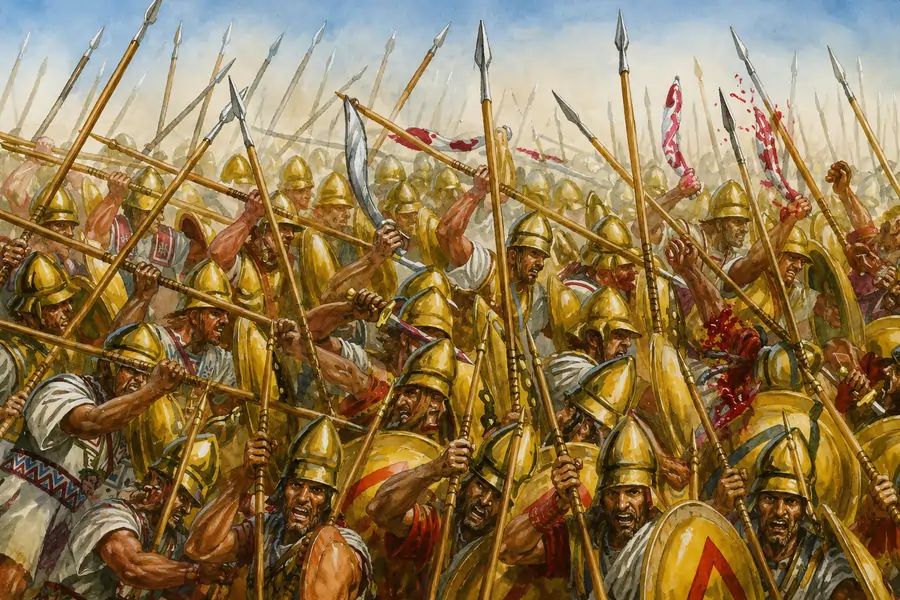
Spartan hoplites were formidable, but Sparta suffered important defeats. The clearest example is Leuctra in 371 BCE, when the Thebans under Epaminondas defeated the Spartan army in a battle that profoundly damaged Spartan military prestige. The earlier Battle of Sphacteria also exposed the vulnerability of Spartan heavy infantry when trapped and subjected to missile attacks. The Spartans' reputation did not make them immune to unfavorable terrain, tactical surprise, or unsuitable battlefield conditions. Even Xenophon's account of the engagement at Lechaeum shows Spartan hoplites being worn down by mobile peltasts and cavalry. [6]
Spartan Hoplites and the Agoge
The agoge was an important part of Spartan society, but it should not be reduced to a modern military boot camp. It was a broader system of socialization, discipline, and education for Spartan citizens. The military dimension was significant, particularly because Spartan society placed extraordinary emphasis on producing citizens capable of collective military service. For a detailed examination of the system, see how the Spartan Agoge system worked.
| Feature | Typical Greek hoplite | Spartan hoplite |
|---|---|---|
| Shield | Aspis | Aspis |
| Primary weapon | Dory | Dory |
| Secondary weapon | Sword | Sword |
| Armor | Varied by wealth and period | Also evolved over time |
| Military culture | Varied by polis | Exceptionally strong military emphasis |
| Training | Varied considerably | More systematic citizen training |
| Battlefield reputation | Dependent on city and army | Exceptionally strong reputation |
The Spartan military reputation was real, but it should not be confused with technological superiority. Sparta's strength came from a particular social and institutional system operating within the wider Greek tradition of hoplite warfare.
Famous Battles and the Evolution of Greek Hoplite Tactics
The best way to understand Greek warfare is to watch the system change on actual battlefields. Marathon, Thermopylae, Plataea and Leuctra reveal very different aspects of Greek military practice.
Battle of Marathon, 490 BCE
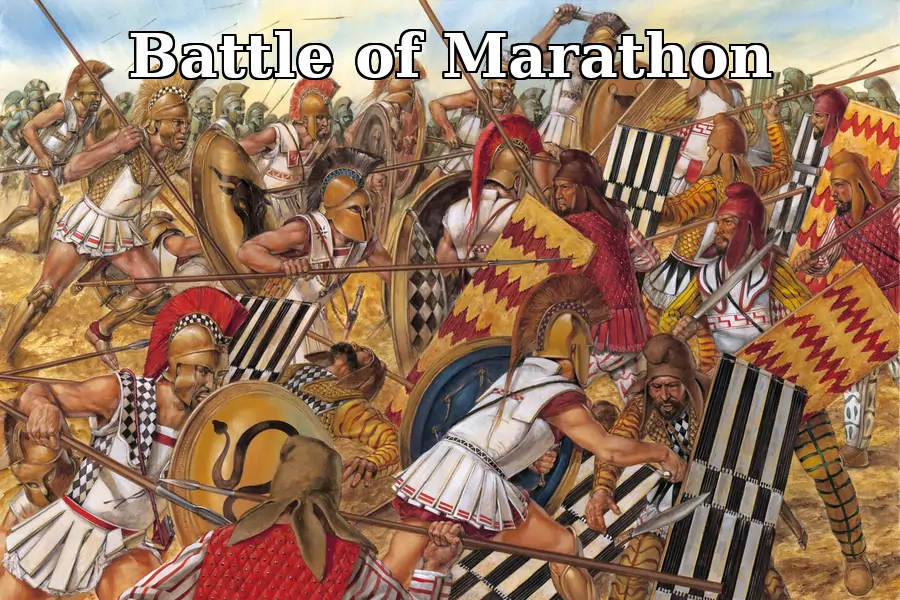
At Marathon, an Athenian and Plataean force confronted the Persian expeditionary army. The battle became one of the most famous examples of Greek heavy infantry defeating a larger and differently equipped force. The traditional explanation emphasizes the superiority of hoplite armor and close-order tactics. Modern scholarship is more cautious. The exact composition of the Persian army, the role of cavalry, and the tactical circumstances remain subjects of scholarly discussion.[8]
Nevertheless, Marathon demonstrated the effectiveness of organized Greek heavy infantry under favorable circumstances. You can read a detailed tactical examination in why Athens won the Battle of Marathon.
Battle of Thermopylae, 480 BCE
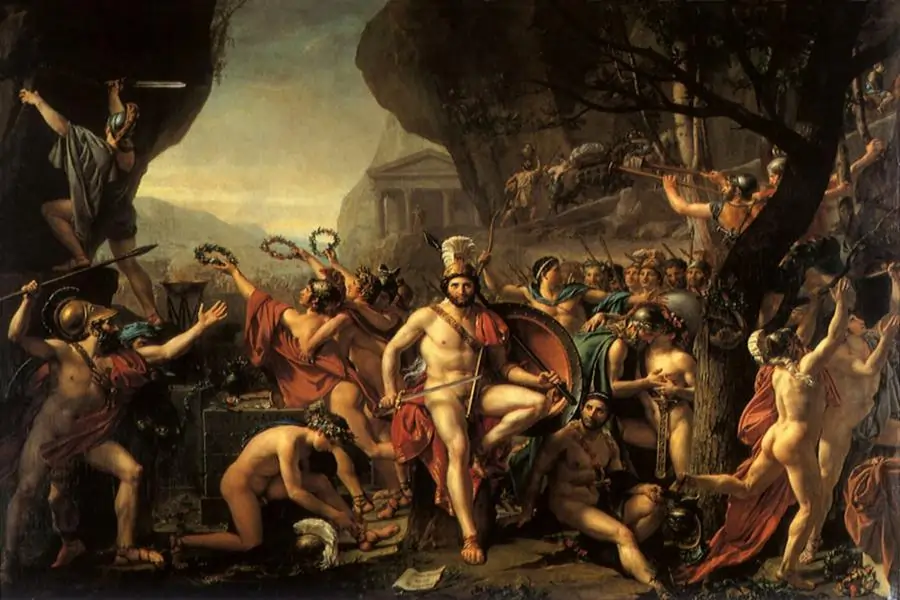
Thermopylae demonstrates how terrain could amplify the strengths of heavy infantry. The narrow pass reduced the Persian numerical advantage and limited the ability of large formations to envelop the Greek defenders. The famous Spartan stand was therefore not simply a demonstration of Spartan superiority. It was an example of a broader military principle. Heavy infantry becomes far more difficult to defeat when terrain prevents an opponent from exploiting its flanks.
Battle of Salamis, 480 BCE
Salamis provides an essential warning against reducing Greek warfare to hoplite combat. The decisive action was fought at sea. Athens' military power depended heavily on its navy, and the Greek victory demonstrated that the outcome of the Persian Wars depended on naval strategy as well as infantry tactics.
The battle also shows how geography could transform military power. In the confined waters around Salamis, the numerical advantage of the Persian fleet became more difficult to exploit. See the Battle of Salamis for a detailed analysis of the strategy and tactics.
Battle of Plataea, 479 BCE
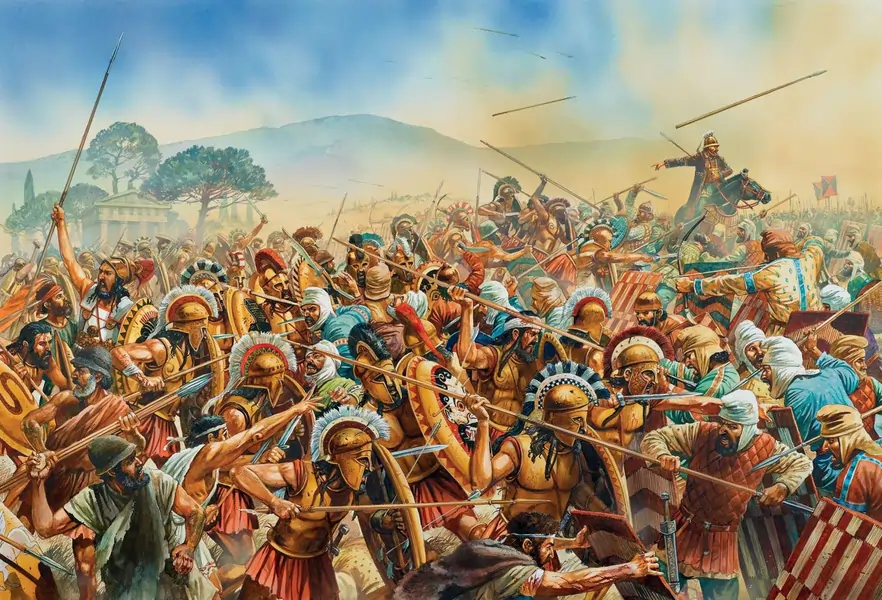
The Battle of Plataea was one of the largest land battles of the Persian Wars and a major demonstration of Greek heavy infantry operating at scale. The battle was not simply "hoplites versus Persians." The Persian army was multinational and included Greek troops, cavalry, and different types of infantry. The Greek coalition likewise consisted of contingents from multiple communities. Plataea is particularly valuable because it shows that Greek military success depended on coalition warfare, command decisions, terrain, and the ability of different contingents to operate together.
The Peloponnesian War
The Peloponnesian War exposed the limitations of traditional hoplite warfare more clearly than the Persian Wars had. Sparta possessed formidable land forces, but Athens possessed a powerful navy and an empire that could supply resources far beyond Attica. The conflict became a long war involving sieges, naval battles, raids, disease, economic pressure, diplomacy and changing alliances. The result demonstrated that a state could not win a major war simply by possessing the strongest hoplite army. Strategy had to integrate different military capabilities.
Battle of Leuctra, 371 BCE
Leuctra marks one of the most important developments in Classical Greek battlefield tactics. Instead of deploying his army with roughly comparable depth across the battlefield, Theban commander Epaminondas concentrated extraordinary depth and striking power on his left wing. His objective was not to fight every section of the Spartan line equally. It was to destroy the Spartan right before the rest of the battlefield could decide the contest.
The result was a decisive Theban victory and the death of the Spartan king Cleombrotus. The battle demonstrated that a phalanx could be manipulated as a tactical instrument rather than simply deployed as a uniform rectangle.
The Sacred Band of Thebes

The Theban military system also included the famous Sacred Band, an elite infantry unit associated with Theban military power. Its importance should not obscure the wider tactical changes taking place in Boeotia, including the use of deeper formations, cavalry and coordinated arms. The Theban defeat of Sparta therefore represented more than the triumph of one elite unit. It demonstrated that the traditional Spartan method of warfare could be countered through concentration, tactical innovation and a better exploitation of the battlefield.
Weaknesses of the Hoplite Phalanx
The hoplite phalanx was powerful because it concentrated combat power. The same characteristics that gave it strength could also become weaknesses.
1. Vulnerability to the Flanks
A phalanx was strongest when its front remained intact. Its shields and spears were oriented primarily toward the enemy ahead. An attack from the side or rear could expose men who had limited room to respond.
2. Difficult Maneuver
Moving hundreds of men in close formation required coordination. Turning, changing direction, or crossing difficult terrain could disrupt the formation.
3. Dependence on Terrain
Relatively open and level ground generally made it easier for a large infantry formation to maintain alignment.
4. Limited Pursuit Capability
A hoplite formation could defeat an enemy and still struggle to exploit the victory. Pursuing broken troops meant sacrificing formation cohesion. Faster cavalry and light infantry were far better suited to pursuit.
5. Vulnerability to Missile Troops
Heavy armor offered protection, but it did not make hoplites immune to missiles. A sufficiently mobile enemy could attack, withdraw, and attack again without allowing the hoplites to bring their superior close-combat equipment into action.
6. Dependence on Cohesion
The greatest weakness of the phalanx was perhaps the simplest: it needed to remain a formation. Once gaps opened, units lost alignment or soldiers began retreating independently, the advantages of collective protection diminished rapidly. The defeat of Spartan troops by Iphicrates' peltasts at Lechaeum is a particularly clear example. The hoplites repeatedly attempted to pursue mobile troops, became increasingly disordered, and suffered heavy casualties. Xenophon reports that approximately 250 Lacedaemonians were killed during the series of engagements. [6]
This is why the evolution of Greek warfare increasingly favored combined arms. Heavy infantry remained important, but cavalry and missile troops could protect its weaknesses while creating opportunities for attack.
Greek Hoplite vs Macedonian Phalanx
The Macedonian phalanx inherited the basic idea of concentrated heavy infantry but transformed the concept. Under Philip II of Macedon, Macedonian infantry became part of a more professional and integrated military system. The biggest visible difference was the replacement of the traditional hoplite spear with the much longer sarissa.
| Feature | Greek Hoplite | Macedonian Phalanx |
|---|---|---|
| Primary spear | Dory | Sarissa |
| Spear length | Roughly 2-3 metres, varying by period | Much longer, commonly estimated at around 5-6 metres |
| Shield | Large aspis | Smaller shield, allowing two-handed sarissa use |
| Armor | Often relatively heavy | Equipment adapted to the two-handed sarissa and the demands of the formation; generally less heavily protected than the classic hoplite panoply. |
| Primary battlefield purpose | Close-order heavy infantry | Deep pike formation forming the infantry anvil |
| Cavalry integration | Varied and often limited | Central to Macedonian combined-arms tactics |
| Army organization | Usually linked to city-state levies | More professional and continuously trained |
The longer sarissa allowed several ranks of Macedonian infantry to project spear points beyond the front of the formation. This created a formidable defensive and offensive hedge of pikes. But the Macedonian phalanx should not be imagined as simply a "better Greek phalanx." It served a different tactical purpose within a much more complex army. Philip and Alexander combined the phalanx with heavy cavalry, light infantry, archers, javelinmen, and specialized troops. The phalanx fixed the enemy while cavalry could exploit a vulnerable flank or deliver the decisive attack.
Why Was the Macedonian Phalanx Different?
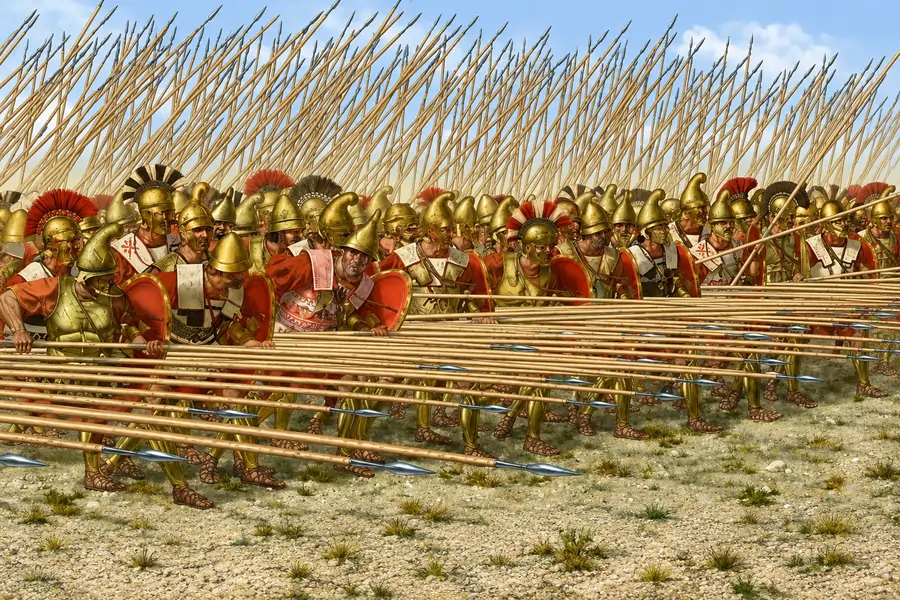
The answer lies in three changes:
First, weapons. The sarissa dramatically increased the reach of the infantry formation.
Second, organization. Macedonian soldiers were increasingly integrated into a more permanent and continuously trained military institution, rather than relying primarily on the occasional mobilization of citizen hoplites.
Third, combined arms. Macedonian commanders did not expect the phalanx to solve every tactical problem. Infantry fixed the enemy while cavalry and other troops created opportunities for decisive attacks.
The Evolution and Legacy of Greek Warfare
Greek warfare did not begin with the hoplite phalanx and end with Macedon's conquest of Greece. It was a continuous process of adaptation. Early hoplite warfare emphasized heavily armed citizen infantry. During the fifth century BCE, naval power, light infantry, and unconventional tactics became increasingly important. The Peloponnesian War demonstrated the strategic importance of fleets, sieges, and economic resources. The fourth century BCE then produced increasingly sophisticated infantry tactics and greater use of cavalry and peltasts.
Leuctra was particularly significant because Epaminondas demonstrated that concentration of force could break a stronger traditional formation. The lesson was not that the phalanx had become useless. Instead, it showed that how a phalanx was deployed could matter as much as how many hoplites an army possessed. The Macedonians pushed this evolution further. Philip II created an army in which infantry, cavalry and specialized troops operated as components of a unified system. Alexander then used this system across enormous distances, adapting it to Persian armies, mountain warfare, sieges and the Indian battlefield.
In this sense, the history of Greek warfare is not simply the story of the hoplite. It is the story of the gradual movement from heavy infantry dominance toward combined-arms warfare. This broader military evolution also provides useful context for understanding why the Roman legion eventually proved capable of defeating Hellenistic phalanxes. The comparison is explored in Roman legion versus Macedonian phalanx and Roman legion organization and tactics.
Conclusion
The Greek hoplite phalanx was powerful not because Greek soldiers were universally better trained or because Spartans possessed secret battlefield techniques. Its strength came from a practical combination of heavy equipment, close formation, mutual protection, discipline and collective morale. But the system was never static. Greek armies experimented with formation depth, cavalry, peltasts, missile troops, naval warfare and unconventional tactics. The defeats suffered by hoplite armies against mobile enemies demonstrated that the phalanx could not dominate every battlefield.
The distinction between ordinary Greek hoplites and Spartan hoplites is particularly important. Sparta developed an unusually militarized society and earned a formidable reputation, but Spartan warriors belonged to the same wider hoplite tradition as the armies of Athens, Corinth, Argos, Thebes and other Greek states. Their weapons were not magical, and their reputation did not make them invincible.
By the fourth century BCE, commanders such as Epaminondas were already demonstrating that the old symmetrical battle line could be manipulated. Philip II then transformed Macedonian infantry through the sarissa, professional organization, and combined-arms warfare. Alexander took that system to an unprecedented scale. The enduring lesson of Greek warfare is therefore not simply that the phalanx was powerful. It is that military systems succeed when their weapons, formations, training, terrain and supporting forces work together. The hoplite phalanx was one of the most important stages in that evolution and its weaknesses ultimately encouraged the innovations that replaced it.
References and Sources
- Metropolitan Museum of Art. Warfare in Ancient Greece. The Met provides an accessible overview of Greek hoplite equipment, the relationship between military service and citizenship, and surviving archaeological evidence for Greek armor and weapons.
- Cambridge University Press. Warfare and Hoplites. In The Cambridge Companion to Archaic Greece. Useful for the historiography of the so-called hoplite revolution and the development of Greek infantry warfare. The chapter emphasizes that many older assumptions about the origins of hoplite warfare have been challenged by modern scholarship.
- Snodgrass, A. M. Early Greek Armour and Weapons: From the End of the Bronze Age to 600 B.C. Edinburgh University Press. A foundational archaeological study of the development of Greek weapons and armor.
- Rawlings, Louis. The Ancient Greeks at War. Manchester University Press. Particularly useful for the development of Greek battlefield practice, the diversity of Greek warfare, and the practical problems involved in deploying large infantry formations.
- Lanphier, H. W. "The Bronze Hoplite Panoply and the Othismos in the Early Phalanx." Greece & Rome. A recent study examining the equipment of early hoplites and the continuing scholarly debate over the physical mechanics of the hoplite push.
- Xenophon. Hellenica. A primary source for fourth-century Greek warfare, including the actions of Iphicrates' peltasts against Spartan hoplites and the Battle of Leuctra.
- Xenophon. Constitution of the Lacedaemonians. An important ancient description of Spartan institutions, training, organization, and military practices. It should be read as Xenophon's interpretation of Sparta rather than as an objective description of every Spartan institution.
- Herodotus. Histories. The principal surviving narrative source for the Persian Wars, including Marathon, Thermopylae and Plataea.
- Cambridge University Press. Research on the transformation of Macedonian military forces under Philip II, including the adoption of the sarissa, lighter equipment, intensive training and increased integration of cavalry.
Books and Memorables
This article may contain affiliate links. If you purchase through these links, I may earn a small commission at no extra cost to you.


Related Articles
Frequently Asked Questions
What was a Greek hoplite?
A Greek hoplite was a heavily armed infantryman who fought primarily in a close-order formation. Hoplites typically carried a large round shield called an aspis, a thrusting spear known as a dory, and a sword, while their armor could include a helmet, cuirass and greaves. Hoplites were commonly citizen soldiers who provided their own equipment and served in the armies of Greek city-states.
How did the Greek hoplite phalanx work?
The Greek hoplite phalanx was a close-order infantry formation in which heavily armed soldiers stood in organized ranks and files. Each hoplite used his large shield to protect himself and provide some protection to the soldier beside him, while the formation presented a dense line of spears toward the enemy. Its effectiveness depended on maintaining cohesion, alignment and morale during the advance and close combat.
What weapons did Greek hoplites use?
The main weapon of a Greek hoplite was the dory, a thrusting spear generally around two to three metres long, although dimensions varied. Hoplites also carried a short sword such as the xiphos for close combat. Their defensive equipment commonly included the large aspis shield, helmet, body armor and greaves, although equipment varied according to period, region and the soldier's resources.
What was the difference between Greek hoplites and Spartan hoplites?
Spartan hoplites used broadly the same fundamental weapons and equipment as other Greek hoplites, including the aspis shield and dory spear. The major difference was Sparta's distinctive military society, training system, organization and emphasis on citizen military service. Spartan hoplites became particularly famous for their discipline and battlefield reputation, but they were part of the wider Greek hoplite tradition rather than a completely separate type of soldier.
What were the main weaknesses of the Greek phalanx?
The Greek phalanx was particularly vulnerable to attacks against its flanks and rear, difficult terrain, disrupted formations and highly mobile enemies. Heavy infantry could also struggle to pursue faster troops once the formation began to break apart. These limitations encouraged Greek commanders to make greater use of cavalry, peltasts and other light infantry, particularly during the fourth century BC.
How was the Macedonian phalanx different from the Greek hoplite phalanx?
The Macedonian phalanx developed from the broader Greek tradition but used much longer sarissa pikes, smaller shields and generally lighter equipment. Macedonian infantry also operated within a more professional and integrated army that combined the phalanx with cavalry and light troops. Under Philip II and Alexander the Great, the phalanx became the infantry component of a larger combined-arms system rather than an isolated battlefield formation.
Add Comment