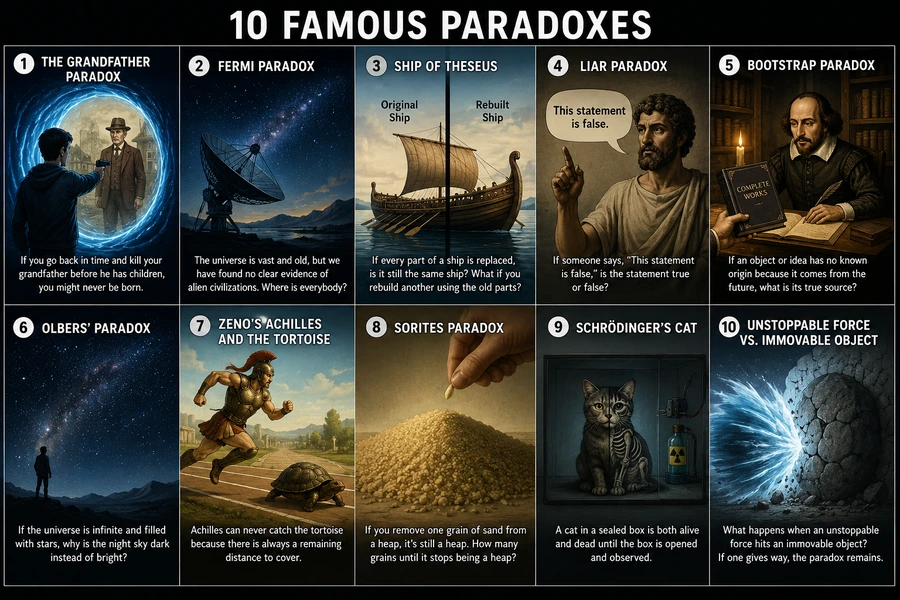
From an ancient Greek philosopher watching a tortoise to a physicist asking where all the aliens are, famous paradoxes have challenged the way humans understand time, identity, truth, infinity, and reality. These seemingly impossible problems were not merely intellectual games. Some influenced the development of mathematics and philosophy, while others exposed uncomfortable questions at the heart of modern physics. In this article, we explore ten of the most famous paradoxes in history, when they emerged, who devised them, what makes them so difficult, and how thinkers have attempted to resolve them.
Table of Contents
A brief history of paradoxes
The word paradox comes from the Greek paradoxon, meaning something contrary to expectation or belief. Long before modern science, philosophers used paradoxes as intellectual weapons. They constructed apparently reasonable arguments that led to impossible or contradictory conclusions, forcing their opponents to reconsider their assumptions. Ancient Greek thinkers such as Zeno of Elea and Eubulides used paradoxes to investigate motion, infinity, truth, and language. Centuries later, astronomers and physicists turned similar reasoning toward the universe itself. Modern paradoxes now involve subjects ranging from time travel and quantum mechanics to extraterrestrial civilizations.
| Paradox | Origin / Associated Figure | Main Question |
|---|---|---|
| Grandfather Paradox | Early 20th-century science fiction | Can changing the past prevent your own existence? |
| Ship of Theseus | Ancient Greece | What makes something remain the same object? |
| Liar Paradox | Eubulides, 4th century BCE | Can a statement about its own truth be true or false? |
| Achilles and the Tortoise | Zeno of Elea, 5th century BCE | How can motion occur if distance is infinitely divisible? |
| Fermi Paradox | Enrico Fermi, 1950 | Why have we not detected extraterrestrial civilizations? |
| Olbers' Paradox | Discussed for centuries; associated with Olbers, 19th century | Why is the night sky dark? |
| Schrödinger's Cat | Erwin Schrödinger, 1935 | What does quantum superposition mean for everyday objects? |
| Bootstrap Paradox | Popularized by Robert A. Heinlein, 1941 | Can an object or piece of information exist without an original source? |
| Sorites Paradox | Eubulides, 4th century BCE | When does a gradual change become a categorical change? |
| Unstoppable Force | Ancient Chinese spear-and-shield story provides an early parallel | Can two absolute opposites exist simultaneously? |
1. The Grandfather Paradox
Imagine that you invent a time machine and travel back to the year 1900. Before your grandfather has met your grandmother, you prevent him from having children. Your parents are therefore never born. Consequently, you are never born either. But this creates the contradiction. If you were never born, you could not have grown up, invented the time machine, travelled into the past, and prevented your grandfather from having children. If you never travelled into the past, your grandfather would live normally, and your parents and you would be born.
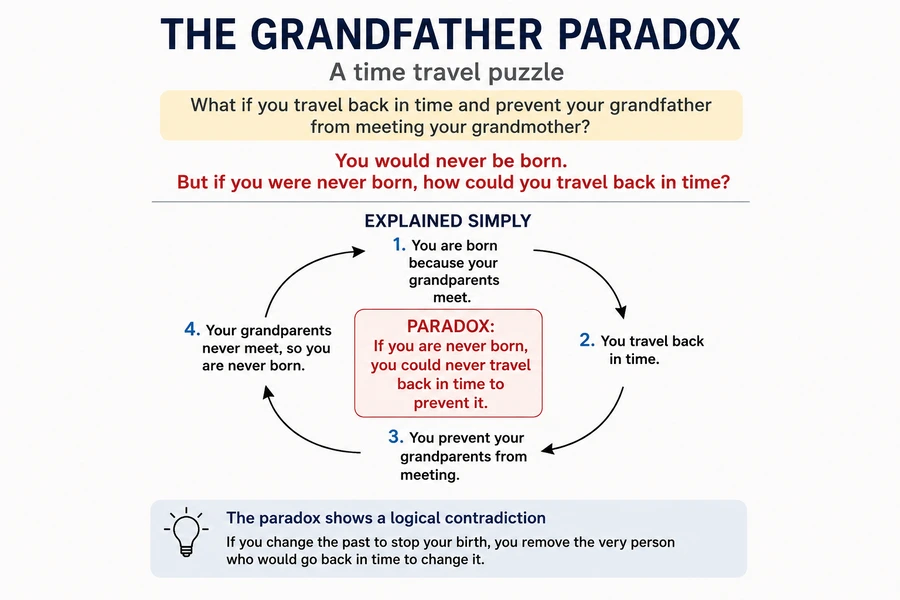
This is the Grandfather Paradox, one of the best-known examples of the problem of changing the past. Despite its name, the exact origin of the scenario is not known with certainty. Paul J. Nahin's historical research traces a version of the idea to science-fiction discussions as early as a 1929 editorial in Science Wonder Stories, while versions appeared repeatedly in 1930s science fiction. The French writer René Barjavel later used a closely related version in his 1943 novel Le Voyageur imprudent.
The paradox raises a fundamental question about time travel and causality. If the past can be changed, can an event be both the cause and the consequence of itself? Proposed solutions include the idea that history is self-consistent, that time travel creates a branching timeline, or that the past simply cannot be altered in a contradictory way.
2. The Ship of Theseus
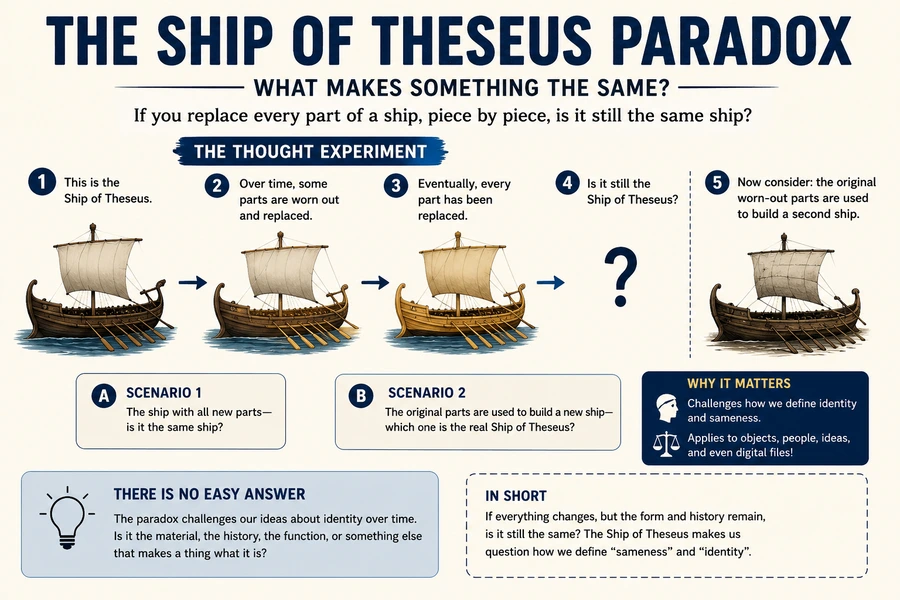
Suppose the Athenians preserve the legendary ship of Theseus for centuries. One wooden plank rots and is replaced. Then another. Over generations, every original component is eventually removed and replaced with new material. Is the resulting vessel still the Ship of Theseus? The question becomes even stranger if someone collects every discarded plank and eventually reconstructs another ship from the original materials. Which ship is the real Ship of Theseus? The vessel that retained its continuous history, or the one made from its original physical components?
The thought experiment has ancient roots. In Life of Theseus, the Greek historian and biographer Plutarch described how the Athenians preserved Theseus' ship by repeatedly replacing its timbers. He noted that philosophers used the vessel to debate whether it remained the same ship or had become something different.
The paradox is really about identity over time. Does identity depend on physical material, continuous history, function, appearance, or something else? The same problem appears in modern life. If every component of a car is replaced over decades, is it still the same car? What about a restored historical building? That makes the Ship of Theseus particularly interesting for historians. Historical objects are often altered, repaired, reconstructed, and restored. The paradox asks whether an object's identity belongs to its original material or to the story that connects its past to the present.
3. The Liar Paradox
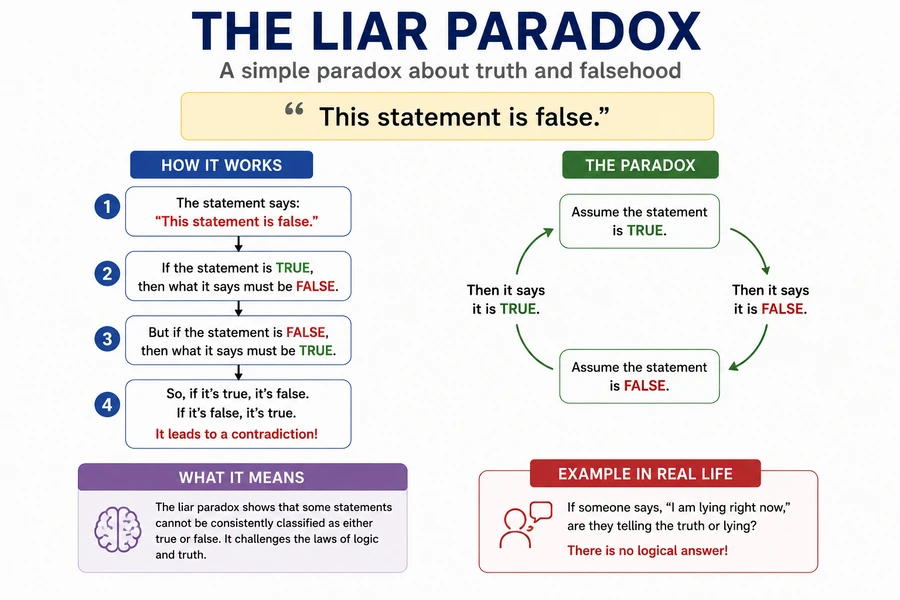
Consider the sentence: "This statement is false." If the statement is true, then what it says must be correct, which means it is false. But if it is false, then it is not true that the statement is false, making it true after all. The result is an apparently endless loop between truth and falsehood.
The Liar Paradox is one of the oldest logical paradoxes. It is commonly associated with Eubulides of Miletus, a Greek philosopher of the Megarian school who lived in the 4th century BCE. Ancient sources indicate that Eubulides discussed the problem, although historians caution that the surviving evidence does not prove beyond doubt that he was its original discoverer.
The problem became enormously important in the history of logic. Centuries of philosophers and logicians tried to determine whether the statement should be considered true, false, meaningless, or something that cannot consistently be assigned either value. Its importance extends into the modern digital world. Computer science, artificial intelligence, mathematics, and theories of language all have to deal with the problem of statements that refer to themselves.
4. Zeno's Achilles and the Tortoise
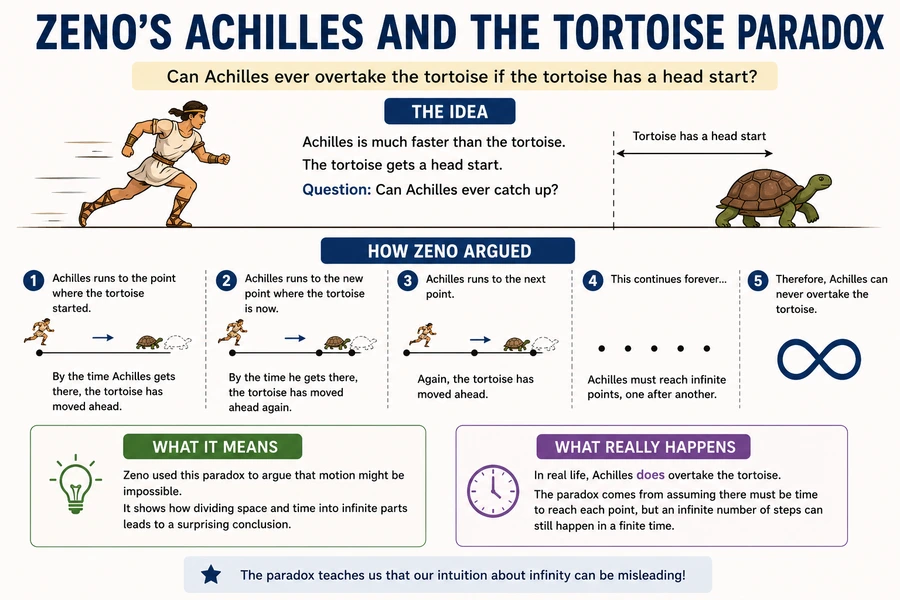
A fast runner named Achilles gives a tortoise a head start. When Achilles reaches the point where the tortoise began, the tortoise has moved a little farther. When Achilles reaches that new point, the tortoise has moved again. Repeat the process, and there always seems to be another gap to cross. So how can Achilles ever catch the tortoise?
This is the famous Achilles and the Tortoise paradox, one of several arguments developed by the Greek philosopher Zeno of Elea during the 5th century BCE. Zeno's arguments were intended partly to defend the philosophy of his teacher Parmenides, who challenged ordinary ideas about plurality, change, and motion. Zeno's original writings are lost, but Aristotle and later commentators preserved descriptions of his arguments.
The puzzle arises because the distance between Achilles and the tortoise can be divided infinitely. Yet modern mathematics gives us a way to understand how an infinite number of progressively smaller intervals can add up to a finite distance. The paradox therefore became an important historical challenge concerning infinity, motion, space, and time. Zeno was not simply claiming that tortoises are unbeatable. His argument forced philosophers to confront a much deeper question. How can a process involving infinitely many stages be completed in a finite amount of time?
5. The Fermi Paradox
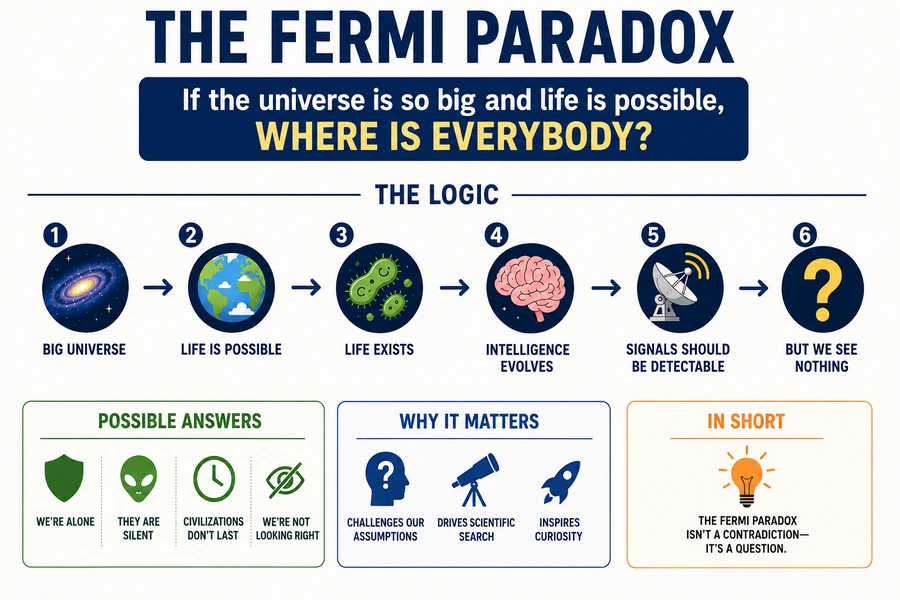
The universe is unimaginably large. Our galaxy alone contains hundreds of billions of stars, and modern astronomy has shown that planets are common. Many stars are billions of years older than the Sun. If life and technological civilizations can emerge on even a small fraction of suitable worlds, it seems reasonable to expect that some civilizations should have appeared long before humanity. Yet we have not found convincing evidence of an extraterrestrial technological civilization. Where is everybody?
This is the central question behind the Fermi Paradox. The paradox is named after Italian-American physicist Enrico Fermi, who reportedly raised the question during a 1950 lunchtime discussion with fellow physicists at Los Alamos. The conversation concerned extraterrestrial life, interstellar travel, and the possibility that advanced civilizations should be detectable. There is an important historical qualification. Fermi did not publish a formal paper called the "Fermi Paradox." The famous formulation was developed later from discussions of his question.
Possible explanations range from intelligent life being extraordinarily rare to civilizations destroying themselves, remaining deliberately quiet, or being too distant for us to detect. Another possibility is simply that our assumptions about how quickly technological civilizations should spread are wrong. The Fermi Paradox remains compelling because humanity has only searched a tiny fraction of the possible astronomical evidence. The absence of detected aliens is therefore not proof that extraterrestrial civilizations do not exist.
6. Olbers' Paradox
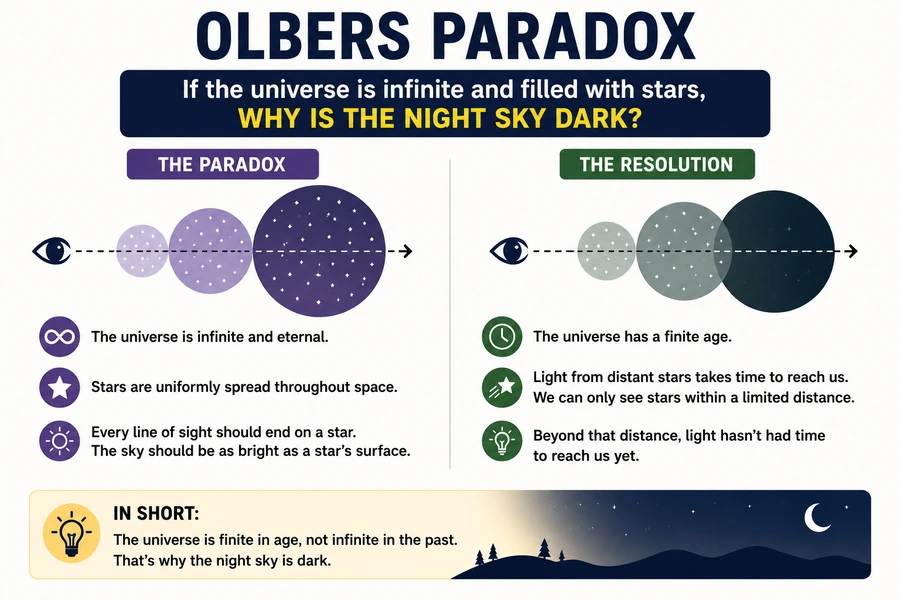
Look into the night sky and you see darkness scattered with stars. That seems perfectly normal. But under an older model of the universe, it creates a remarkable problem. If the universe were infinite, eternal, static, and filled uniformly with stars, then every direction we looked should eventually lead to the surface of a star. Distant stars appear dimmer because their light spreads over a larger area, but there are also more stars occupying those increasingly distant regions. Taken to infinity, the night sky should therefore be bright rather than dark.
This is Olbers' Paradox, named after German astronomer Heinrich Wilhelm Olbers, who discussed it in the 19th century. However, the underlying problem is much older. It can be traced at least to Johannes Kepler in 1610 and was later considered by astronomers including Edmond Halley and Jean-Philippe de Chéseaux.
The modern explanation comes from the fact that the universe is not the eternal, static universe assumed by the original argument. The universe has a finite age; it is expanding, and light from sufficiently distant regions has not had unlimited time to reach us. Cosmic expansion also stretches light toward longer wavelengths. Olbers' Paradox is therefore a fascinating example of how a simple observation, the darkness of the night sky, can reveal that our entire model of the universe is incomplete.
7. Schrödinger's Cat
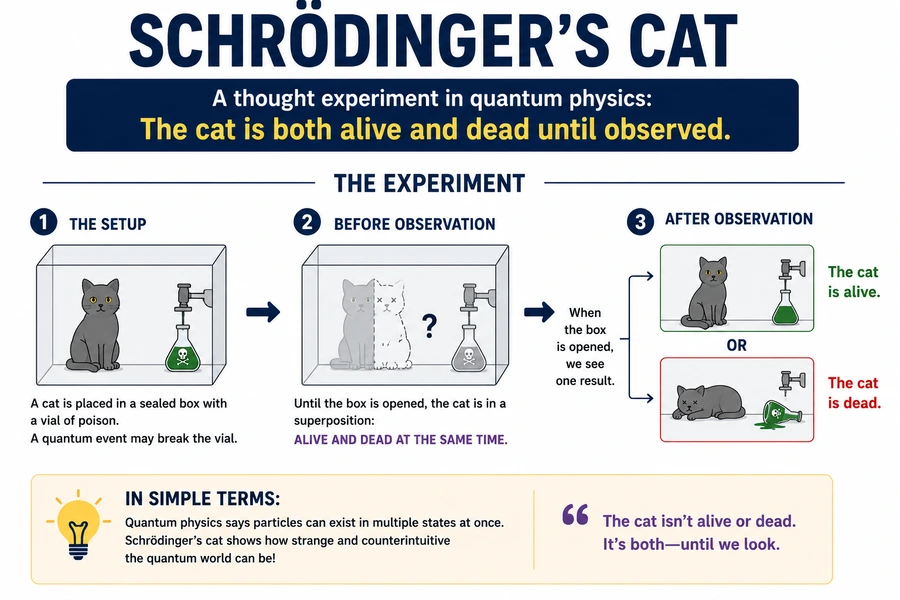
Few scientific thought experiments are as famous as the cat inside an unopened box. In 1935, Austrian physicist Erwin Schrödinger imagined a sealed box containing a cat, a radioactive atom, a detector, and a mechanism that would release poison if the atom decayed. If the atom had a 50 percent probability of decaying during a specified period, quantum mechanics appeared to allow a superposition of multiple states. Schrödinger extended that idea to the entire apparatus. A cat in a sealed box is considered simultaneously alive and dead until the box is opened and observed.
The result became known as Schrödinger's Cat. Schrödinger introduced the thought experiment in his 1935 paper The Present Situation in Quantum Mechanics. His intention was not simply to claim that real cats literally remain half-alive and half-dead. Rather, the thought experiment highlighted the difficulty of applying quantum descriptions to familiar macroscopic reality. The thought experiment became central to debates over the measurement problem in quantum mechanics. It asks where, precisely, the transition occurs between quantum possibilities and the definite outcomes we experience in everyday life.
8. The Bootstrap Paradox
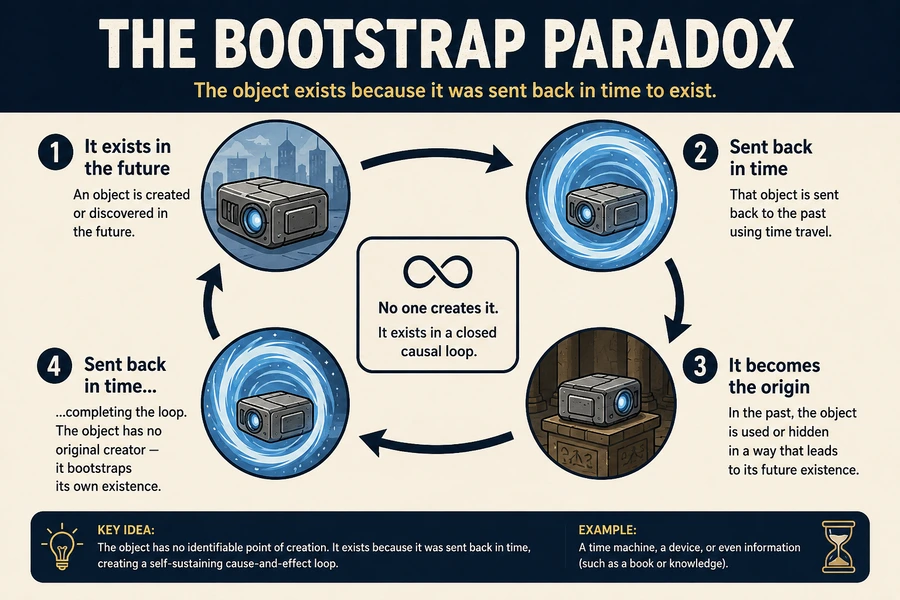
Imagine travelling into the past and meeting a young William Shakespeare. You hand him a book containing all of Shakespeare's plays. He copies the works, publishes them under his name, and becomes famous. Centuries later, you obtain that same book, travel into the past, and give it to Shakespeare. But where did the plays originally come from?
This is the essence of the Bootstrap Paradox, also called an ontological paradox or causal loop. An object, idea, or piece of information exists because it was carried backward in time, yet there is no clear point at which it was originally created.
The modern term is strongly associated with science fiction. Robert A. Heinlein's 1941 story By His Bootstraps presented an elaborate time loop in which events are circularly connected. Heinlein's story was published in Astounding Science Fiction in October 1941 under the name Anson MacDonald. The bootstrap paradox differs from the Grandfather Paradox. The Grandfather Paradox creates a contradiction by changing the past, whereas the bootstrap paradox creates a problem of causal origin. Something exists, but there appears to be no first moment at which it came into existence.
9. The Sorites Paradox
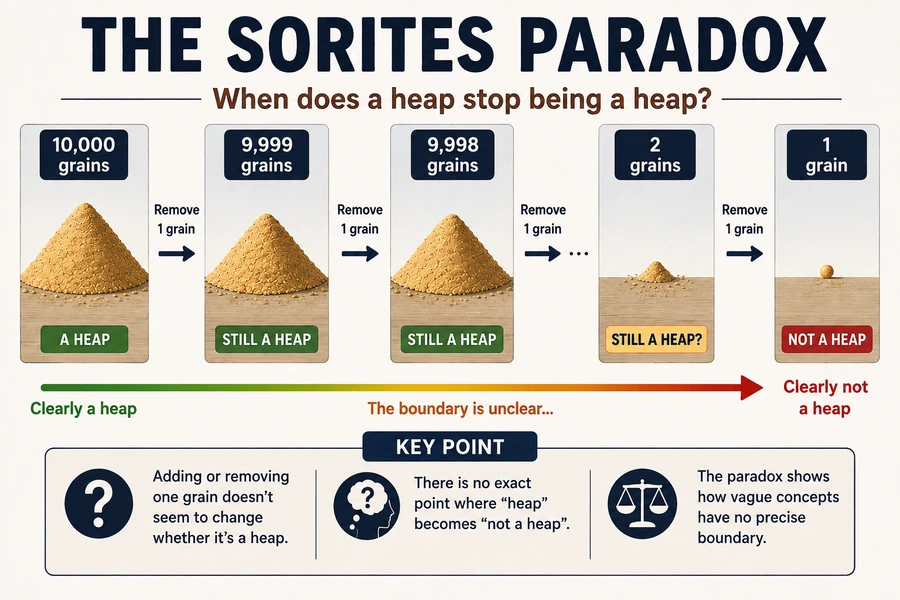
Imagine a heap containing 10,000 grains of sand. Remove one grain. Surely it is still a heap. Remove another. Still a heap. Continue removing grains one at a time. At every individual step, it seems unreasonable to say that removing one grain suddenly transforms a heap into something that is not a heap. Yet eventually only one grain remains, and nobody would normally call a single grain a heap. So when did the heap disappear?
This is the Sorites Paradox, also called the Paradox of the Heap. It is traditionally attributed to Eubulides of Miletus in the 4th century BCE. The Greek word sorites is related to soros, meaning "heap." The paradox exposes a problem with vague concepts. Words such as "heap," "tall," "bald," "old," and "rich" rarely have precise boundaries. There may be obvious cases at either extreme, but there is no obvious single grain of sand whose removal transforms a heap into a non-heap.
The Sorites Paradox remains important in modern philosophy because human language constantly relies on categories with fuzzy boundaries. It shows that ordinary language can be extremely useful without being perfectly precise.
10. The Unstoppable Force and the Immovable Object Paradox
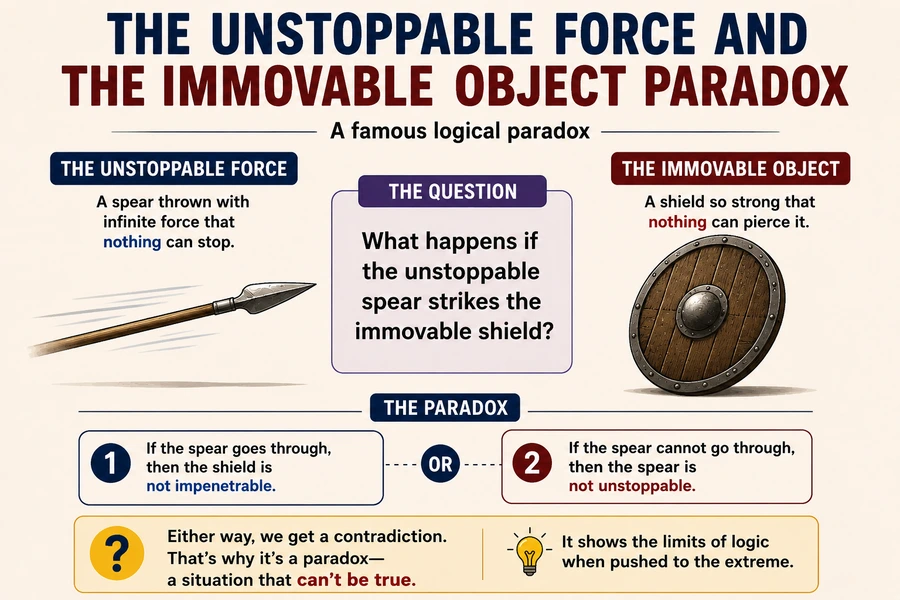
What happens when an unstoppable force meets an immovable object? If the force moves the object, the object was not truly immovable. If the object stops the force, then the force was not truly unstoppable. Either way, one of the original definitions collapses.
Although the modern English formulation is difficult to assign to a single inventor, the underlying contradiction has an ancient parallel in Chinese philosophy. The Han Feizi, associated with the Legalist philosopher Han Fei in the 3rd century BCE, tells of a merchant who boasts that his shield can withstand anything while simultaneously claiming that his spear can pierce anything. When asked what would happen if his spear were used against his shield, he has no answer.
The story is particularly significant because it gave rise to the Chinese expression máodùn, literally "spear-shield," meaning contradiction. The modern unstoppable-force version changes the objects but preserves the underlying logical problem. Two absolute claims cannot necessarily be true at the same time. Strictly speaking, this is better understood as a logical thought experiment than a physical prediction. The contradiction comes from defining two hypothetical entities with mutually incompatible properties.
What these famous paradoxes reveal
These ten paradoxes come from very different periods of history. Zeno and Eubulides were working in the intellectual world of ancient Greece. Plutarch preserved the Ship of Theseus centuries later. Medieval and early modern thinkers continued debating problems of truth and identity, while astronomers such as Kepler and Olbers turned paradoxical reasoning toward the cosmos. In the 20th century, advances in physics and science fiction produced new puzzles involving quantum mechanics and time travel. Yet the same basic pattern appears again and again. Start with assumptions that seem reasonable, follow them carefully, and discover that they lead somewhere unexpected.
That is why paradoxes remain valuable. They are not merely puzzles designed to confuse us. They are tools for identifying hidden assumptions. Zeno forced thinkers to examine infinity. The Ship of Theseus asks what identity actually means. The Liar Paradox tests the foundations of truth. Olbers' Paradox exposed weaknesses in old models of the universe. Schrödinger's Cat challenged our understanding of quantum measurement, while the Fermi Paradox asks what the silence of the cosmos might mean. Perhaps the most interesting lesson is that a paradox does not always mean that nature itself is contradictory. Sometimes the contradiction lies in the assumptions we bring to the problem.
References and Further Reading
- Plutarch, Life of Theseus, particularly the account of the preserved ship and the philosophical debate surrounding its identity.
- Stanford Encyclopedia of Philosophy, Insolubles, for the history of the Liar Paradox and ancient logical discussions.
- John Palmer, Zeno of Elea, and historical discussions of Zeno's paradoxes and their influence on philosophy.
- Lawrence Berkeley National Laboratory, Olbers' Paradox, for the astronomical history and modern cosmological explanation.
- Smithsonian Books, Where Is Everybody in Our Universe?, for the historical account of Enrico Fermi's 1950 question.
- American Physical Society, Schrödinger's Paradoxical Cat, for the history and purpose of Schrödinger's 1935 thought experiment.
- Cambridge University Press, The Present Situation in Quantum Mechanics, discussing Schrödinger's original 1935 paper.
- Heinlein Archives, By His Bootstraps, for publication and manuscript history.
- Williamson, "The Early History of Sorites Paradoxes," for the ancient history of the Heap paradox and Eubulides.
- Han Feizi, Chapter 36, for the ancient Chinese spear-and-shield contradiction underlying the modern irresistible-force thought experiment.
Books and Memorables
This article may contain affiliate links. If you purchase through these links, I may earn a small commission at no extra cost to you.


Related Articles

Frequently Asked Questions
What are the most famous paradoxes in history?
Some of the most famous paradoxes in history include the Grandfather Paradox, Ship of Theseus, Liar Paradox, Zeno's Achilles and the Tortoise, Fermi Paradox, Olbers' Paradox, Schrödinger's Cat, Bootstrap Paradox, Sorites Paradox, and the Unstoppable Force and Immovable Object. They come from different periods and explore problems involving time, identity, truth, infinity, language, physics, and the universe.
What is the oldest famous paradox?
Some of the oldest known paradoxes come from ancient Greece. Zeno of Elea developed several paradoxes of motion in the 5th century BC, including Achilles and the Tortoise, while the Greek philosopher Eubulides of Miletus is traditionally associated with the Liar Paradox and Sorites Paradox in the 4th century BC. These problems were designed to challenge assumptions about motion, truth, and logical reasoning.
What is the Grandfather Paradox in simple terms?
The Grandfather Paradox is a time travel problem in which a person travels into the past and prevents their grandfather from having children. If the grandfather never has children, the time traveler is never born. But if the traveler was never born, they could not have travelled into the past to change history. The paradox illustrates the problem of changing the past while preserving a consistent chain of cause and effect.
Why is the Ship of Theseus considered a paradox?
The Ship of Theseus is considered a paradox because it raises a difficult question about identity. If every part of a ship is gradually replaced until none of its original components remain, it is unclear whether the resulting vessel is still the same ship. The problem becomes even more difficult if the original parts are collected and used to build another ship. The paradox asks whether identity depends on physical material, continuous history, function, or something else.
What is the Fermi Paradox and why is it important?
The Fermi Paradox asks why humanity has not found convincing evidence of extraterrestrial civilizations despite the enormous number of stars and planets in the universe. It is associated with physicist Enrico Fermi, who raised the question during a discussion at Los Alamos in 1950. The paradox is important because it highlights the gap between the possibility that intelligent life could be common and the lack of confirmed evidence that technologically advanced civilizations exist elsewhere.
What is the difference between a paradox and a contradiction?
A contradiction occurs when two statements or claims cannot both be true under the same conditions. A paradox is broader: it is an argument, situation, or result that appears to conflict with common sense, established assumptions, or itself. Some paradoxes reveal genuine logical problems, while others expose weaknesses in how a question has been framed or how concepts such as infinity, identity, probability, or truth are understood.
Add Comment