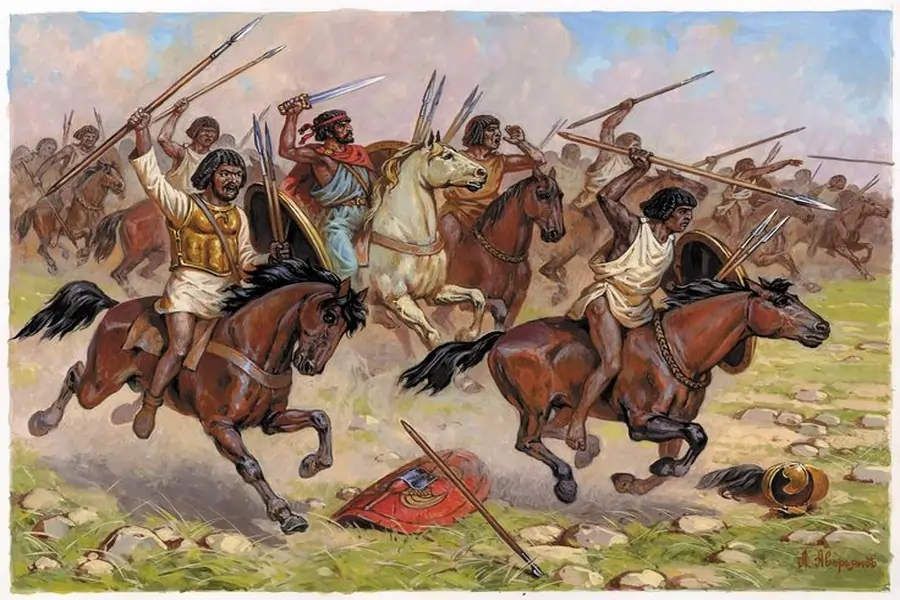
Few military commanders in history understood and utilized cavalry warfare as brilliantly as Hannibal Barca. During the Second Punic War (218-201 BC), Hannibal repeatedly defeated larger Roman armies by using fast, flexible, and highly coordinated cavalry forces. While Rome had one of the strongest heavy infantry during the period, Hannibal built an army that integrated cavalry into every stage of battle. His Numidian, Iberian, and Gallic horsemen gave him strategic mobility, tactical superiority, and battlefield shock power that Rome struggled to counter for years.
Rome would fall for Hannibal's tricks and suffer major defeats in Trebia, Lake Trasimene, and Cannae. This was due to his use of deception and exploiting the mobility of his cavalry to surround enemy legions. Rome would eventually adapt and counter his strategies under Scipio Africanus. Cavalry warfare became one of the defining factors of the Second Punic War. Hannibal's mounted forces did not merely support his army - they became the decisive arm that shattered Roman formations with concentrated attacks, destroyed morale, and helped create some of the greatest battlefield victories in military history.
Table of Contents
- The Importance of Cavalry in Ancient Warfare
- The Size of Hannibal's Cavalry Forces
- Numidian Cavalry
- Iberian Cavalry
- Gallic Cavalry
- Comparison of Hannibal's Cavalry Forces
- Why Hannibal's Cavalry Was Better Than Rome's
- Battle of Trebia
- Battle of Lake Trasimene
- Battle of Cannae
- Why Hannibal's Cavalry Gave Him the Advantage
- How Rome Finally Countered Hannibal's Cavalry
- The Legacy of Hannibal's Cavalry Warfare
- References
The Importance of Cavalry in Ancient Warfare
Most ancient armies used cavalry primarily for scouting and supporting infantry. Before Hannibal's invasion of Italy, Rome also did not prioritize cavalry as a decisive wing. The Roman military system focused heavily on infantry legions. Roman cavalry contingents were relatively small, lightly armed, and comprised the socially elite. The role of their cavalry was usually restricted to supporting the infantry rather than operating independently. The primary role of cavalry troops was to protect the flanks of the infantry and prevent the enemy cavalry from encircling them.
Carthage, by contrast, relied on a multinational military system that included highly specialized cavalry recruited from North Africa, Iberia, and Gaul. Hannibal understood that his infantry could not hope to win a direct fight against the highly trained Roman legions. Therefore, he relied on mobility, surprise, and coordinated maneuver warfare to neutralize the Roman heavy infantry's skill and numerical superiority. The cavalry had a more prominent role in the Carthaginian army. Instead of simply being used for scouting, it became the core foundation of Hannibal's battlefield dominance. Historian Adrian Goldsworthy argues that Hannibal's cavalry superiority formed the key reason for his battlefield successes in Italy.
For broader background on the conflict itself, see Second Punic War: Hannibal vs Rome and Why the Punic Wars Are Still Fascinating Today.
The Size of Hannibal's Cavalry Forces
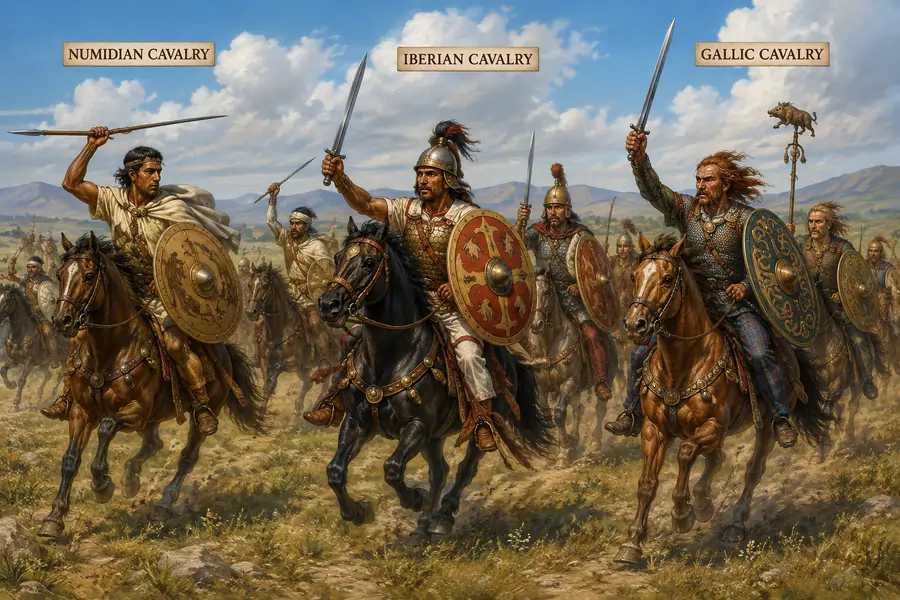
When Hannibal crossed the Alps into Italy in 218 BC, he reportedly commanded approximately 10,000 cavalry units based on surviving ancient sources. His mounted forces included:
- Numidian light cavalry from North Africa
- Iberian medium cavalry from Spain
- Gallic heavy cavalry from Gaul
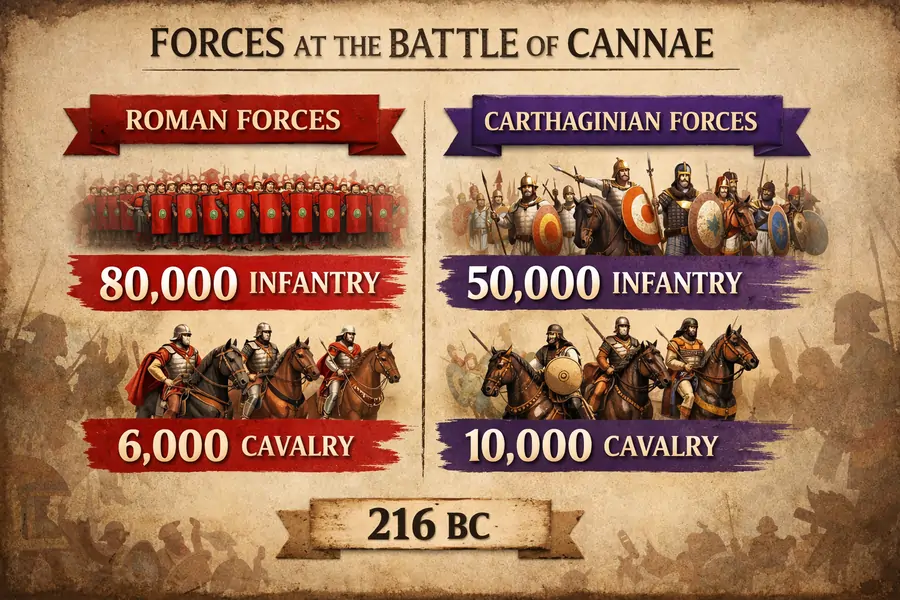
At the Battle of Cannae in 216 BC, Hannibal deployed roughly 10,000 cavalry against about 6,000 Roman horsemen, as stated by historian Polybius. Despite being outnumbered 2:1 by Rome's numerical strength in infantry, Hannibal's superior cavalry decisively routed their Roman counterparts early in the battle and surrounded the Roman legions. Each of Hannibal's mercenary cavalry contingents played a distinct role in his army. They were the key to Hannibal's effective use of terrain and battlefield mobility.
Unlike Rome, which deployed a passive role to cavalry units, Hannibal carefully integrated his cavalry with infantry tactics. His mounted troops screened movements, ambushed supply lines, pursued fleeing enemies, and executed coordinated shock attacks at the enemy's weak points. His deployment of cavalry was very similar to Alexander the Great's use of his Companion cavalry during his world conquest.
Numidian Cavalry: The Masters of Mobility
The Numidian light cavalry became one of the most feared mounted forces of the ancient world. Recruited from North Africa, especially modern Algeria and Tunisia, Numidian horsemen sacrificed armor for speed. They specialized in speed, harassment, and maneuver warfare. They were also highly trained and efficient.
Weapons and Equipment
Unlike heavier cavalry units, Numidians prioritized mobility over direct shock combat. Polybius described the Numidian cavalry as exceptionally agile and difficult to engage effectively in close combat. They had exceptionally high speed, used minimal armor, and carried small shields. Their primary weapon was light javelins (throwing spears), which they would let loose on enemy formations and then quickly retreat. They sometimes carried short swords or daggers, but some sources claim they only carried javelins.
Tactical Role
Numidian cavalry operated as a highly mobile light cavalry unit. Their primary role was harassing enemy infantry without engaging in direct combat. They would draw Roman troops out of formation by constant harassment. They were also effective in pursuing retreating enemies and protecting the flanks of Hannibal's infantry. They also performed the traditional role of reconnaissance and scouting.
Their ability to attack, retreat, and regroup quickly made them extremely difficult for Roman cavalry to engage effectively. Their skill and restraint were what made them legendary. Theodore Ayrault Dodge later described them as among the finest light cavalry forces in ancient military history.
Battlefield Performance
At the Battle of Trebia, Numidian cavalry provoked the Romans by constantly harassing them with javelins and then retreating when chased. They forced the Roman troops to cross freezing waters before battle, exhausting them before the main engagement began. During the Battle of Lake Trasimene, their speed and harassment contributed to the destruction of Roman cohesion during Hannibal's ambush. At Cannae, Numidian horsemen took on a more passive role of pinning down the Roman cavalry long enough for Hannibal's heavier cavalry to win elsewhere before surrounding the Roman army.
Iberian Cavalry: The Balanced Warriors
Iberian medium cavalry from Spain provided Hannibal with versatile and disciplined mounted troops capable of both shock combat and maneuver warfare.
Weapons and Armor
- Spears and thrusting weapons
- Swords such as the falcata
- Medium armor
- Oval shields
Iberian cavalry occupied the middle ground between light Numidian skirmishers and heavy Gallic cavalry. The primary weapon was a heavy thrusting spear, which was used during the initial impact. They also had a secondary throwing javelin that was hurled at the enemy before engaging in close-quarter combat. They carried the distinctive falcata, a forward-curving sword renowned for its cutting power. The Iberians wore medium armor with large oval shields (caetrae).
Tactical Role
The Iberians served as flexible cavalry that could perform the roles of both light and heavy cavalry. They were used to support infantry, execute flanking maneuvers, and also act as shock heavy cavalry. Their discipline made them especially valuable in coordinated battlefield operations. Historian Serge Lancel observed that Hannibal's multinational cavalry system gave him exceptional tactical flexibility.
Battlefield Performance
At the Battle of Cannae, Iberian cavalry fought alongside Gallic horsemen on Hannibal's left flank. Their aggressive assault overwhelmed Roman cavalry and allowed Hannibal to achieve complete battlefield encirclement. Their role demonstrated Hannibal's understanding of combined-arms warfare centuries before the concept became formalized.
Gallic Cavalry: The Shock Force
The Gallic heavy cavalry provided Hannibal with raw offensive power. Recruited from Celtic tribes in Gaul, these horsemen excelled in direct charges and close combat.
Weapons and Equipment
- Long slashing swords
- Heavy spears
- Larger shields
- Sometimes chainmail armor
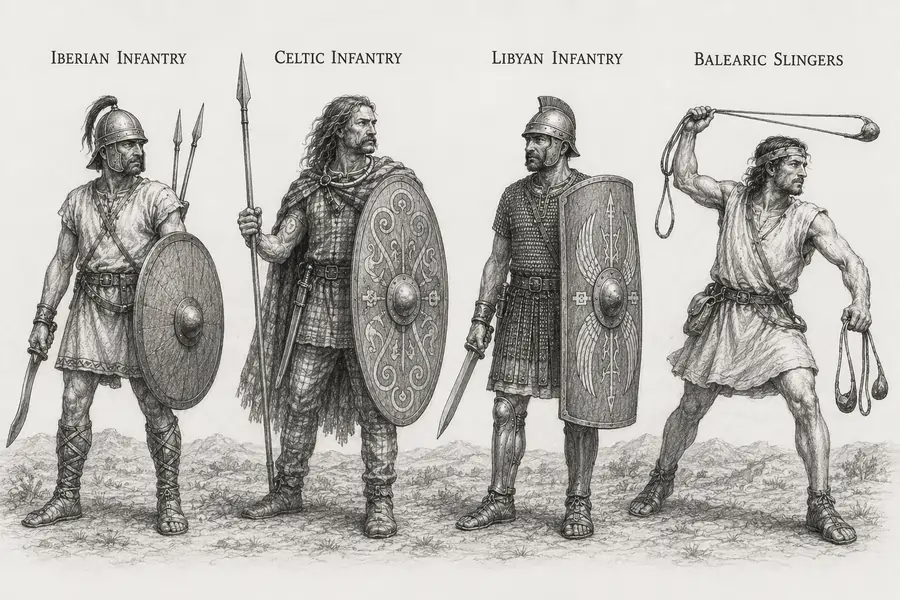
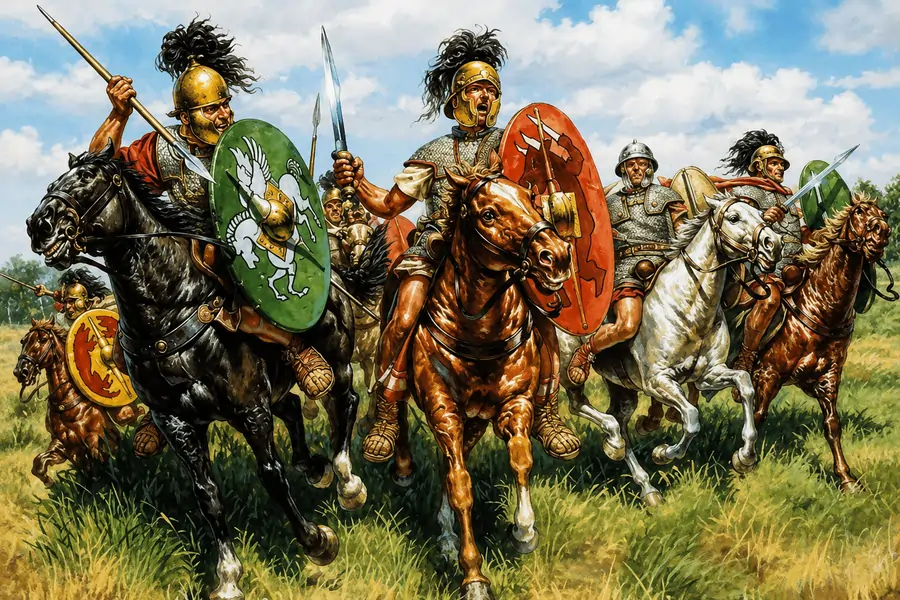
Compared to Numidian cavalry, Gallic horsemen were more heavily armed and aggressive. Unlike their infantry, which were poor and lightly armed, the Gallic cavalry comprised nobles and were heavily armed and armored. Their primary weapon was the Gallic longsword. They also carried heavy thrusting lances. They were armored with a chainmail (Lorica Hamata), large round or oval shields (clipeus), and a helmet.
Tactical Role
The Gallic cavalry were heavy cavalry who specialised in shock charges. Their primary roles were to break through enemy formations and engage in close combat. They had a significant psychological impact on the enemy. Their ferocity often destabilized Roman cavalry morale early in battle. Livy noted that Roman cavalry repeatedly struggled against the aggressive mounted assaults launched by Hannibal's Celtic horsemen.
Battlefield Performance
At Cannae, Gallic and Iberian cavalry smashed the Roman right-wing cavalry commanded by Varro. After routing them, they wheeled behind Roman infantry and helped complete one of the most famous encirclements in military history. Although they were very effective shock troops, they were not as disciplined as the Iberians or the Numidian cavalry.
Comparison of Hannibal's Cavalry Forces
| Cavalry Type | Tactical Role | Armor | Main Weapons | Strengths |
|---|---|---|---|---|
| Numidian Cavalry | Light skirmishing | Very light | Javelins | Mobility, harassment, pursuit |
| Iberian Cavalry | Flexible medium cavalry | Medium | Spears, swords | Versatility, discipline |
| Gallic Cavalry | Heavy shock cavalry | Medium to heavy | Long swords, spears | Charge power, close combat |
Together, these cavalry forces gave Hannibal unmatched tactical flexibility. He could adapt his mounted forces to terrain, enemy formations, and battlefield conditions.
Why Hannibal's Cavalry Was Better Than Rome's
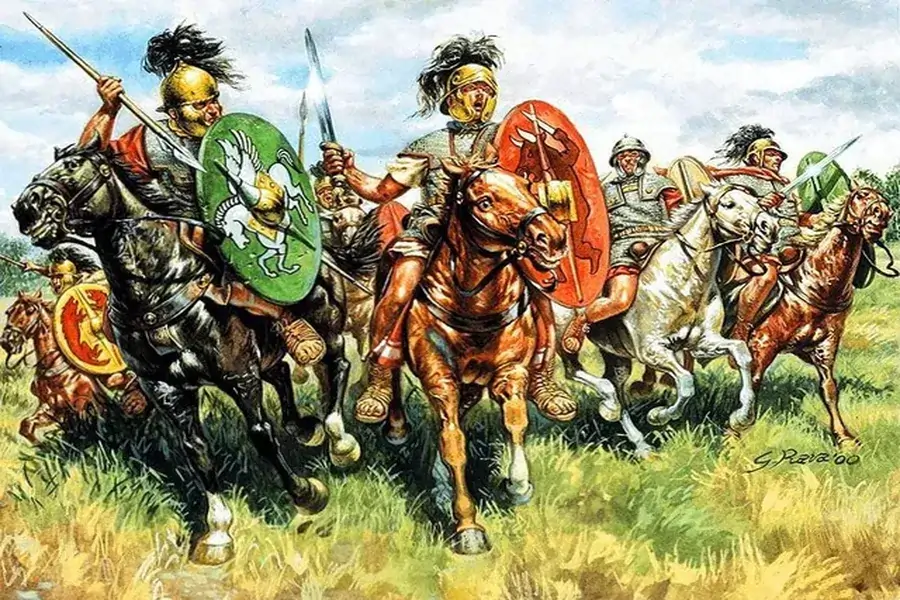
Hannibal's cavalry consistently outperformed Rome's because it was better trained, more specialized, and used far more aggressively. The Roman military system was built around the strength of its infantry, heavy legions. Cavalry did not play a significant role in the Roman military system. Hannibal treated cavalry as a decisive battlefield weapon capable of shaping the outcome of entire battles. This difference in military doctrine became one of the defining advantages of the Carthaginian army during the early years of the Second Punic War.
Specialized Cavalry Forces
Roman cavalry was relatively uniform in composition and primarily served a supporting role for the infantry. Hannibal, however, commanded a diverse cavalry force made up of Numidian light cavalry, Iberian medium cavalry, and Gallic heavy cavalry. Each contingent had a specific battlefield role and complemented the others. The Numidians excelled at reconnaissance, harassment, and pursuit, while the Iberians provided flexibility and discipline. The Gallic cavalry delivered powerful shock attacks capable of breaking enemy formations. This combination gave Hannibal a level of tactical flexibility that Roman commanders could not match.
Superior Training and Experience
Many of Hannibal's cavalrymen came from cultures with long traditions of mounted warfare. The Numidians, in particular, were raised as horsemen from a young age and possessed riding skills that impressed even their enemies. The Romans, however, recruited cavalry units from the aristocratic classes and lacked the same level of specialization. Historian Adrian Goldsworthy notes that Rome's military strengths lay primarily in its infantry, whereas Carthage possessed access to some of the finest cavalry forces in the Mediterranean world.
Better Battlefield Coordination
Hannibal excelled at integrating cavalry operations with infantry tactics. His mounted troops were not deployed merely to protect the flanks; they actively shaped the battle by scouting enemy movements, disrupting formations, attacking weak points, and pursuing fleeing troops. At Trebia, Lake Trasimene, and Cannae, Hannibal used cavalry to create opportunities that his infantry could exploit. Roman commanders often treated cavalry as a secondary arm and failed to coordinate it effectively with the legions.
Psychological Impact
Repeated defeats inflicted by Hannibal's cavalry had a significant effect on Roman morale. Roman horsemen were frequently driven from the battlefield, leaving the infantry vulnerable to encirclement. The aggressive charges of the Gallic cavalry and the constant harassment of the Numidians created uncertainty and fear among Roman commanders. By the time of Cannae, Hannibal's mounted forces had developed a reputation that often influenced Roman decision-making before a battle even began.
The Battle of Trebia and Cavalry Superiority
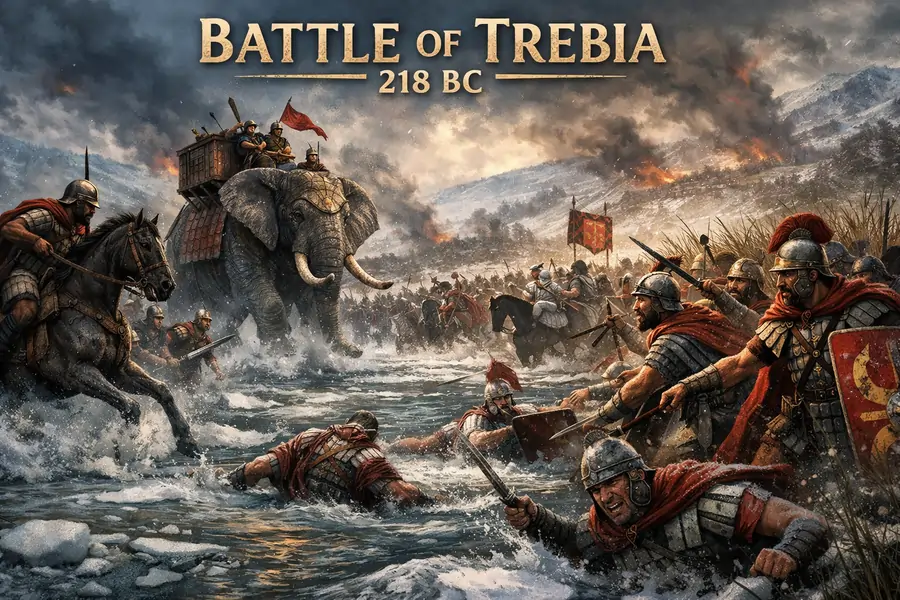
The Battle of Trebia demonstrated Hannibal's ability to combine cavalry mobility with deception. Numidian cavalry provoked the Romans into pursuing them across the freezing Trebia River. The Numidians showed excellent restraint as not to engage the Romans directly and forced them to chase the nimble light cavalry. Exhausted and cold, Roman infantry entered battle already weakened.
The weakened Roman troops faced a well-rested and equipped army. Meanwhile, Hannibal's cavalry dominated the flanks and prevented Roman horsemen from stabilizing the battle. Polybius directly credited Carthaginian cavalry superiority as one of the decisive factors in the Roman defeat.
The Battle of Lake Trasimene
The Battle of Lake Trasimene became one of history's greatest ambushes. Hannibal used terrain brilliantly, concealing his forces around the lake while Roman troops marched into a trap. Cavalry units blocked escape routes and pursued fleeing soldiers. Livy described the Roman retreat as collapsing into confusion and panic. Roman command structures disintegrated under the pressure of Hannibal's coordinated ambush tactics.
The Battle of Cannae: Hannibal's Greatest Cavalry Victory
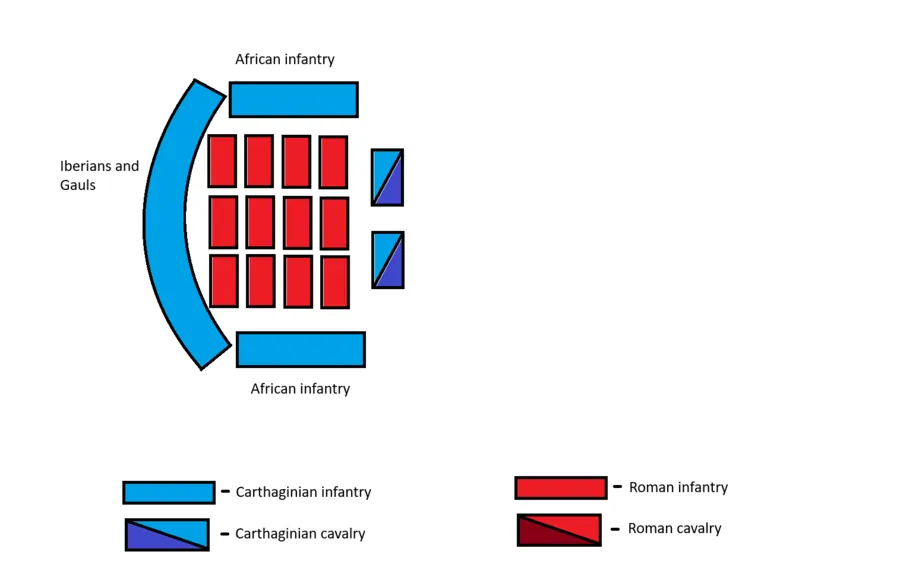
The Battle of Cannae remains the ultimate example of double-envelopment maneuver. Hannibal deliberately weakened his infantry center while placing his strongest cavalry on the wings. Polybius noted that Hannibal intentionally concentrated superior cavalry strength against weaker Roman mounted forces.
His Gallic and Iberian cavalry crushed Roman cavalry on one flank, gaining local superiority, while Numidian horsemen delayed Roman cavalry on the opposite side. Once victorious, Hannibal's mounted troops attacked Roman infantry from behind. The Roman army became completely surrounded and decimated. Ancient estimates suggest that around 70,000 Romans were killed. Military historian J.F. Lazenby described Cannae as one of the finest examples of coordinated cavalry maneuver in ancient warfare.
The battle is frequently ranked among the most decisive battles in history.
Why Hannibal's Cavalry Gave Him the Advantage
1. Superior Mobility
Hannibal's cavalry moved faster than Roman forces and allowed him to choose where and when battles occurred. The Numidian cavalry was especially nimble and highly skilled. They helped harass the slow Roman legions.
2. Tactical Flexibility
Different cavalry types allowed Hannibal to adapt dynamically during combat.
3. Combined-Arms Coordination
Hannibal synchronized infantry and cavalry operations more effectively than Roman commanders. Rome primarily relied on the skill and training of its heavy legions. They used cavalry only for minimal support roles.
4. Psychological Impact
Repeated Roman cavalry defeats damaged morale and confidence. The Roman cavalry was especially afraid of the Gallic heavy cavalry troops in Hannibal's army due to their shock impact and aggression. Livy records that Roman commanders became increasingly hesitant to confront Hannibal in open battle after repeated disasters.
5. Operational Control
Cavalry dominance disrupted Roman scouting, communication, and logistics. Hans Delbrück argued that Hannibal's operational mobility repeatedly denied Rome the strategic initiative. This forced Rome into defensive approaches such as the Fabian Strategy, which avoided direct confrontation.
How Rome Finally Countered Hannibal's Cavalry
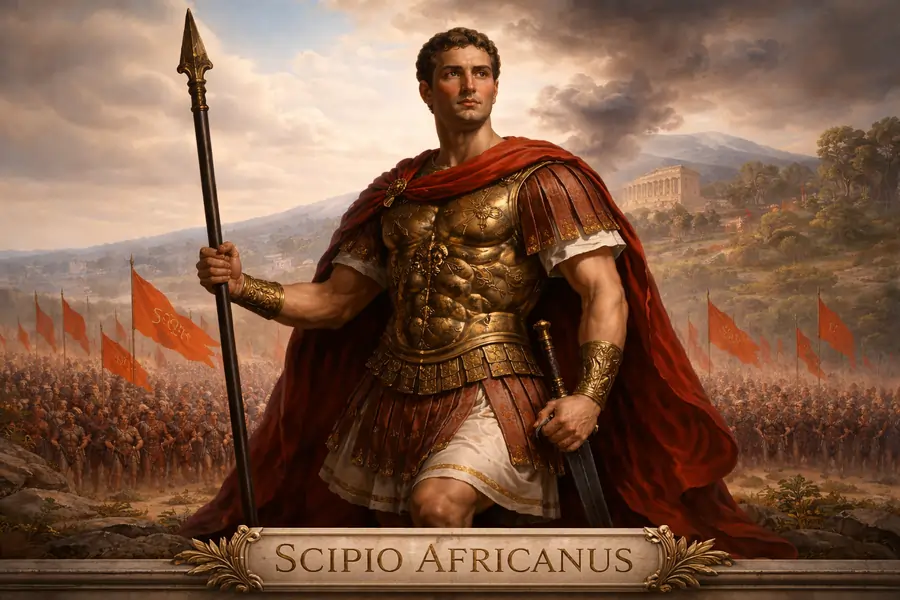
Rome eventually adapted. Under Scipio Africanus, Roman commanders learned from Hannibal's tactics and improved cavalry coordination.
Alliance with Numidia
The most important change came when Rome secured the alliance of Numidian prince Masinissa. Ironically, Rome gained access to the very cavalry system that had once devastated it. With the Numidian cavalry on their side, Rome quickly gained superiority in cavalry.
Battle of Zama
At the Battle of Zama (202 BC), Scipio Africanus fielded strong Numidian cavalry forces alongside Roman troops. For the first time, Hannibal no longer possessed cavalry superiority. Adrian Goldsworthy argues that Scipio's alliance with Masinissa fundamentally altered the balance of mounted warfare in North Africa.
Roman and Numidian cavalry eventually defeated Hannibal's horsemen and attacked his infantry from the rear - effectively using Hannibal's own methods against him. Zama ended the Second Punic War and permanently reduced Carthaginian power.
The Legacy of Hannibal's Cavalry Warfare
Hannibal's cavalry tactics influenced military thinking for centuries. His use of coordinated cavalry operations demonstrated how mobility and battlefield flexibility could overcome numerical disadvantages. Many later commanders, including Napoleon and modern military theorists, studied Hannibal's campaigns carefully.
His victories also exposed weaknesses in the Roman military system, eventually forcing Rome to evolve into a more adaptive and professional military power. Even after Carthage's defeat and destruction in the Third Punic War, Hannibal's battlefield genius continued to be remembered as one of the greatest examples of tactical warfare ever recorded.
For deeper understanding of Roman military evolution, see Roman Legion Structure Explained and Daily Life of a Roman Soldier.
References
- Polybius, The Histories, Book 3.
- Livy, History of Rome, Book 21.
- Lazenby, J.F. Hannibal's War.
- Goldsworthy, Adrian. The Punic Wars.
- Dodge, Theodore Ayrault. Hannibal.
- Delbrück, Hans. History of the Art of War, Volume I.
- Lancel, Serge. Hannibal. Blackwell Publishing.
Recommended Books
This article may contain affiliate links. If you purchase through these links, I may earn a small commission at no extra cost to you.
Related Articles
Frequently Asked Questions
Why was Numidian cavalry so effective against Roman legions?
Numidian cavalry was highly effective because it combined speed, maneuverability, and skirmishing tactics. Unlike Roman cavalry, Numidian horsemen fought with javelins and avoided prolonged close combat. They could harass enemy formations, disrupt communications, scout ahead of the army, and pursue retreating troops. Their mobility made them one of Hannibal's most valuable military assets during the Second Punic War.
How many cavalry soldiers did Hannibal have at the Battle of Cannae?
At the Battle of Cannae in 216 BC, Hannibal commanded approximately 10,000 cavalry, including Numidian, Iberian, and Gallic horsemen. The Romans fielded roughly 6,000 cavalry. Hannibal's superior cavalry force defeated the Roman horsemen on both flanks and then attacked the Roman infantry from the rear, helping complete one of the most famous encirclements in military history.
What was the difference between Numidian, Iberian, and Gallic cavalry?
Numidian cavalry served as light skirmishers armed mainly with javelins and focused on mobility. Iberian cavalry acted as versatile medium cavalry capable of both maneuver and close combat. Gallic cavalry functioned as heavy shock troops who specialized in aggressive charges and hand-to-hand fighting. Together, these three cavalry types gave Hannibal exceptional tactical flexibility on the battlefield.
How did Hannibal use cavalry at the Battle of Trebia?
At the Battle of Trebia in 218 BC, Hannibal used Numidian cavalry to provoke Roman troops into crossing the freezing Trebia River before the main battle. Once the Romans were exhausted and cold, Carthaginian cavalry dominated the flanks while Hannibal's infantry engaged the center. This combination contributed significantly to Rome's defeat.
Why could Rome not defeat Hannibal's cavalry early in the Second Punic War?
Rome relied primarily on its infantry legions and traditionally viewed cavalry as a supporting arm. Hannibal's cavalry forces were more experienced, more diverse, and better coordinated than their Roman counterparts. His Numidian cavalry excelled at skirmishing, while his Iberian and Gallic cavalry provided powerful shock capability. Rome struggled to counter this combination until the later stages of the war.
How did Scipio Africanus counter Hannibal's cavalry at Zama?
Scipio Africanus countered Hannibal's cavalry by securing an alliance with the Numidian king Masinissa. This gave Rome access to highly skilled Numidian horsemen, reducing Hannibal's traditional cavalry advantage. At the Battle of Zama in 202 BC, Roman and Numidian cavalry defeated Hannibal's mounted forces and later returned to attack his infantry from the rear, contributing to Rome's victory.
Add Comment