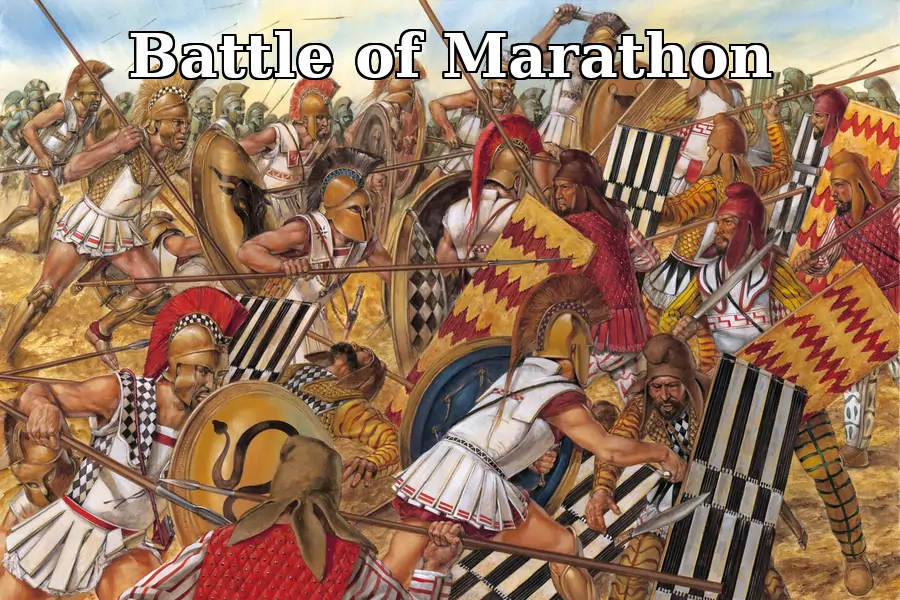
The Battle of Marathon was one of the most significant battles in the ancient world. Fought in 490 BCE between Athens and the Persian Empire, this battle decided the fate of the free Greek city-states. The Athenian victory preserved their independence and demonstrated that the mighty Persian Empire could be defeated. This victory also created the conditions for the flowering of Classical Greek civilization. The Battle of Marathon became a symbol of courage, civic duty, and intelligent military leadership. More than 2,500 years later, historians still study the battle because it illustrates how terrain, morale, strategy, and discipline can overcome numerical superiority.
Table of Contents
Battle of Marathon Overview
The Battle of Marathon took place in September 490 BCE during the First Persian Invasion of Greece.[1] Darius I launched an expedition across the Aegean Sea to punish Athens and Eretria for their support of the Ionian Revolt and to expand Persian influence into mainland Greece.[1][3] After subduing several islands and destroying Eretria, the Persians landed on the plain of Marathon northeast of Athens. There they encountered an Athenian-led army commanded by Miltiades. The Greeks fought a desperate battle and were outnumbered by the Persian troops. However, the Greeks achieved a decisive victory that would become one of the most significant triumphs in military history.[2]
Why Did Persia Invade Greece?
The Persian invasion was driven by a combination of revenge, border security, and strategic expansion. Darius viewed Athens as a troublesome state that interfered in Persian affairs. He wished to secure the western frontier of his empire to prevent further Greek involvement in rebellions. He would not tolerate any form of disrespect from the Greeks.[2][4]
For the Persians, the campaign was not simply a punitive expedition. It was part of a broader imperial strategy aimed at extending Persian influence across the Aegean world. Athens and Eretria became primary targets because of their actions during the Ionian Revolt. Darius would set an example for interfering with Persia.
The Ionian Revolt and Darius's Desire for Revenge
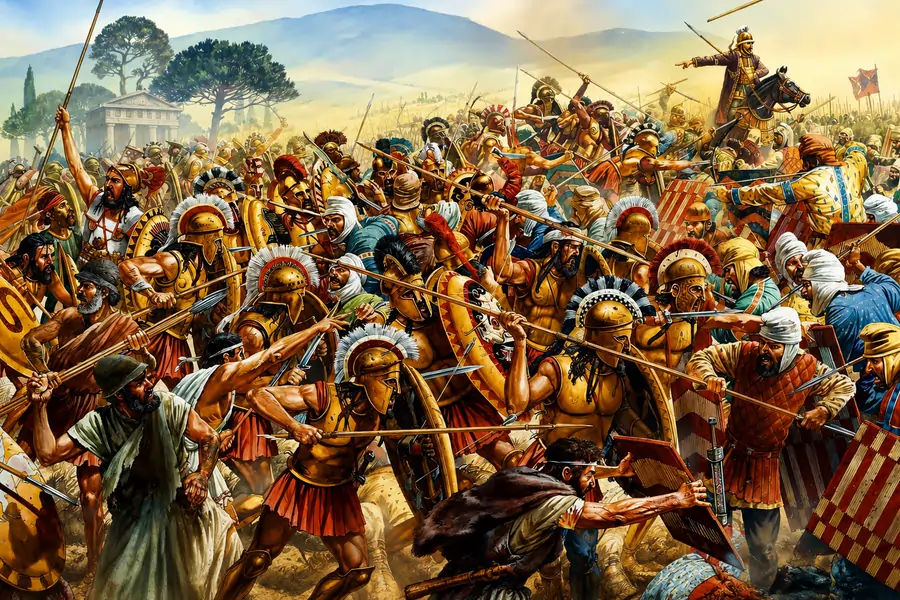
The Battle of Marathon was a direct consequence of the Ionian Revolt of 499-493 BCE.[1] The Greek cities of Ionia, located on the western coast of Asia Minor, had lived under Persian rule for decades. There was dissatisfaction with the Persian authorities over heavy taxation and conscription of forces for the Persian King. This eventually erupted into a rebellion in the Ionian states to overthrow their Persian-backed rulers.
The Ionians requested help from mainland Greece. Sparta refused, but Athens and Eretria sent ships and troops to assist the rebels. The revolt briefly achieved success. The combined Greek forces marched on the city of Sardis and ended up burning it to the ground, including a sacred temple.[1][2]
The burning of Sardis angered Darius deeply. The revolt was eventually crushed, but Darius never forgot Athens' involvement. Herodotus records that the king ordered a servant to remind him daily to "remember the Athenians."[1] Whether the story is entirely true or not, it captures the Persian determination to punish those who had challenged imperial authority. Darius, would use this as an excuse to launch the First Persian Invasion of Greece in 490 BCE.
Why the Battle of Marathon Was Significant
The Battle of Marathon was a turning point during the First Persian invasion of Greece. Had Athens lost the battle in 490 BCE, it would have resulted in the sack and subjugation of Athens. The Persians brought Hippias, the exiled former tyrant of Athens, who would have been installed as a puppet ruler. Democracy would have been killed in its infancy. Sparta was still strong, but it would have been isolated and eventually defeated by the Persians. The later cultural achievements of Classical Greece might have taken a very different course.[2][5]
The battle shattered the perception that Persian armies were invincible. Until Marathon, the Persian Empire had expanded across enormous territories and defeated a wide variety of opponents. They had superiority in numbers and a wide array of specialized mercenary troops to draw upon from their empire. The Greek victory proved that disciplined hoplite formations could defeat the greatest army wielded by the King of Kings.[4]
Marathon also provided a psychological foundation for later Greek resistance. The confidence gained from victory helped the Greeks in future conflicts. It motivated Athens to build up its navy, which was essential in future conflicts.
The Opposing Armies
The Persian Army
The Persian force was commanded by Datis and Artaphernes. Exact numbers remain debated, but modern estimates commonly place the army between 20,000 and 30,000 troops.[2][3] Persian armies comprised multinational organizations composed of soldiers drawn from many regions of the empire. They excelled in mobility, missile warfare, and combined-arms operations. Archers, light infantry, and cavalry formed the backbone of Persian military power. Their cavalry was especially feared. Throughout the empire, mounted troops had repeatedly provided decisive battlefield advantages.
The Greek Army
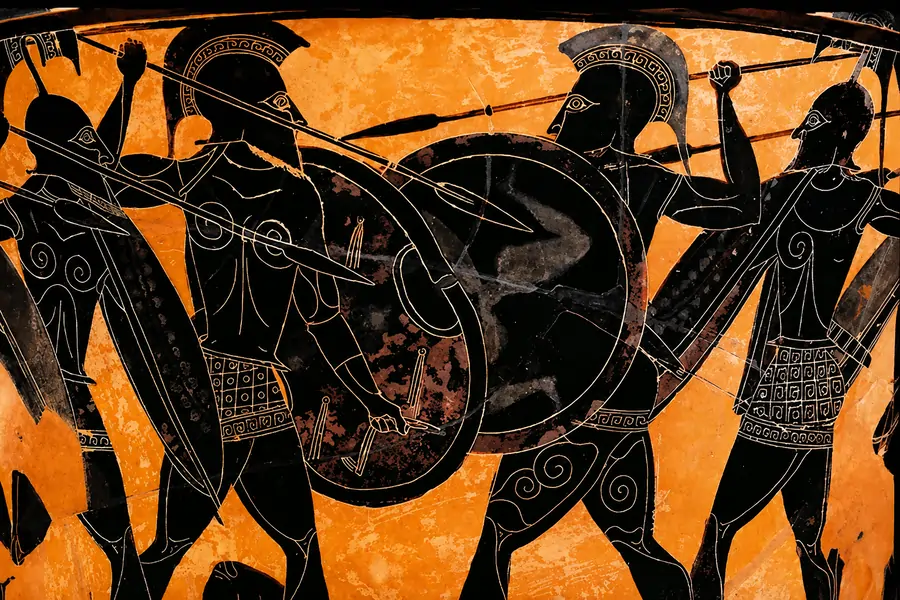
The Greek force consisted primarily of approximately 9,000 Athenian hoplites supported by roughly 1,000 Plataeans.[3] Unlike the Persians, the Greeks relied heavily on heavily armed infantry. Hoplites carried large shields, bronze armor, helmets, and long spears. Although they lacked mobility, they made up for it in discipline and organisation. Fighting shoulder-to-shoulder in the phalanx formation, they were extremely effective in close combat. The battle therefore represented a clash between two very different military systems: Persian mobility and missile power against Greek heavy infantry discipline.
Why the Location and Terrain Mattered
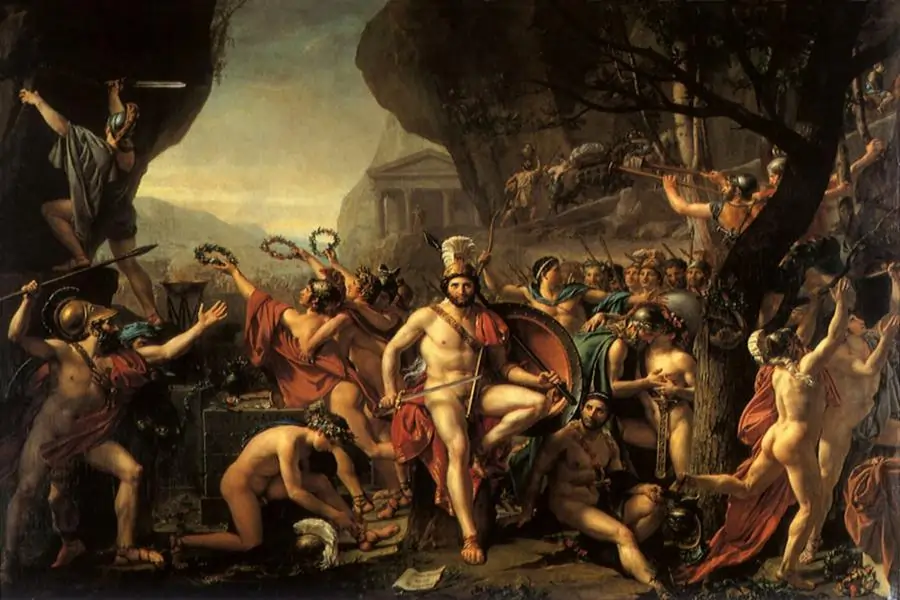
The plain of Marathon played a critical role in the battle's outcome. Mountains, marshes, and the sea bordered the area.[3] Similar to the Battle of Thermopylae fought a decade later, these natural features restricted maneuverability and reduced the effectiveness of Persian cavalry. The Persian army's superiority in numbers was also neutralized by the narrow terrain.
Miltiades understood that he would be heavily outnumbered by the Persian army and chose his battleground carefully. By confronting the Persians at Marathon rather than allowing them to move freely toward Athens, he forced the invaders to fight under conditions favorable to the Greek army. Terrain has often shaped the military outcomes of major battles throughout history. Marathon is an early example of a commander using geography as a force multiplier.
Miltiades and the Greek Strategy
The architect of the Greek victory was Miltiades. Having spent years as a vassal under the Persian King Darius the Great, he had valuable insights into the strengths and weaknesses of the enemy.[1] Miltiades advocated immediate action rather than passive defense. He recognized that prolonged delay would likely benefit the Persians.
His most famous innovation involved altering the traditional phalanx deployment. He knew that the Persians deployed their strongest troops in their center. Instead of maintaining equal strength across the line, he extended his line with superior forces in the wings while thinning the center. This was a calculated risk. The weaker center needed to hold the line before the stronger wings could defeat the Persian flanks and then attack the enemy center from both sides. The plan required discipline, courage, and precise execution. Military historians frequently cite Marathon as one of the earliest successful examples of a deliberate double envelopment strategy.[4]
How the Battle of Marathon Unfolded
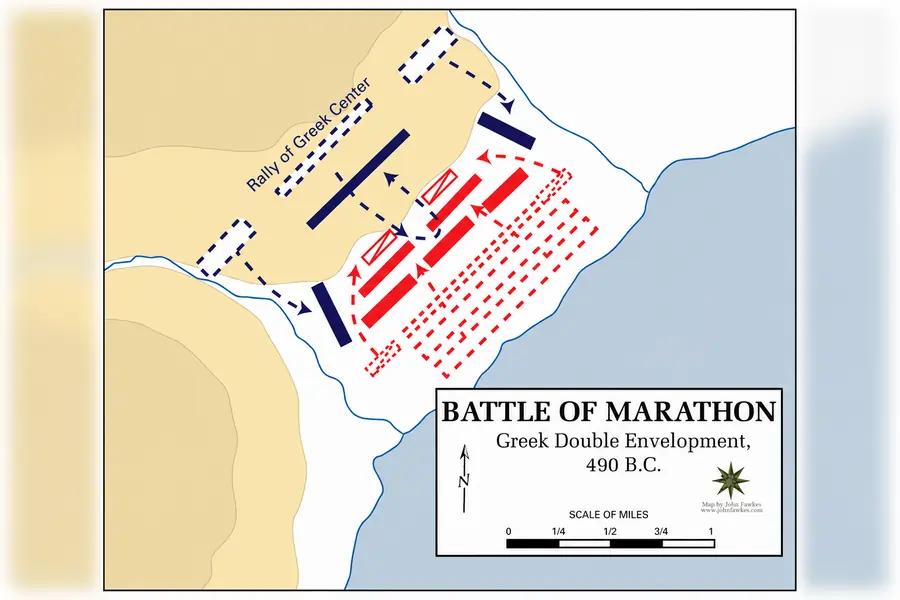
After several days of observation, the Greeks advanced to offer battle. Ancient accounts suggest that the hoplites moved rapidly toward the Persian line to minimize exposure to enemy arrows.[1] When the armies collided, the Persian center initially gained the upper hand. The thinner Greek center was forced backward exactly as Miltiades had anticipated.
Meanwhile, the reinforced Greek wings pushed back the Persian flanks. Their heavier equipment and disciplined formations proved decisive in close combat. After breaking through, the Greek wings turned inward and attacked the Persian center from both sides.[1][4]
Surrounded on three sides, the Persian formation collapsed. Soldiers fled toward their ships while Greek forces pursued them across the battlefield. Fighting continued near the shoreline as the Persians attempted to escape. Herodotus reports that 192 Athenians were killed compared with approximately 6,400 Persians.[1] While modern historians debate the exact Persian casualties, there is broad agreement that the losses suffered by the invaders were severe.[2][4]
Why Did the Greeks Win the Battle of Marathon?
Several factors contributed to the Greek victory:
Optimal Use of Terrain
The Greeks chose a narrow, rugged terrain that suited their heavy infantry and limited cavalry deployments. The Persians could also not use their superiority in numbers due to the narrow terrain.
Absence of Persian Cavalry
Cavalry was one of the main advantages of the Persian army, but they were absent during the battle. Historians believe the Persians were loading their horses back onto their ships to sail toward undefended Athens. Miltiades capitalized on this opportunity and caught the Persians off guard with the unexpected attack. Without their cavalry, the Persians lost their advantage in mobility and reconnaissance.
Greek Advantages in Close Combat
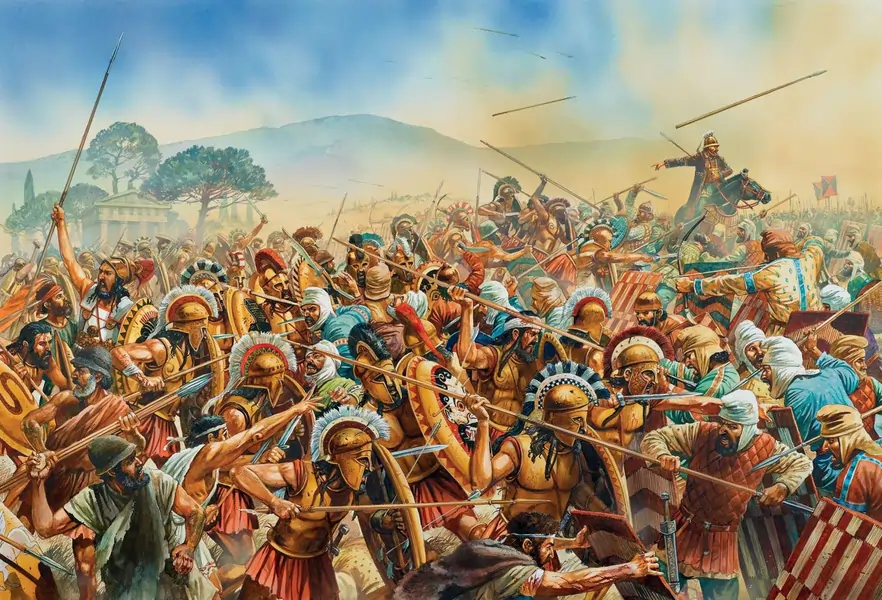
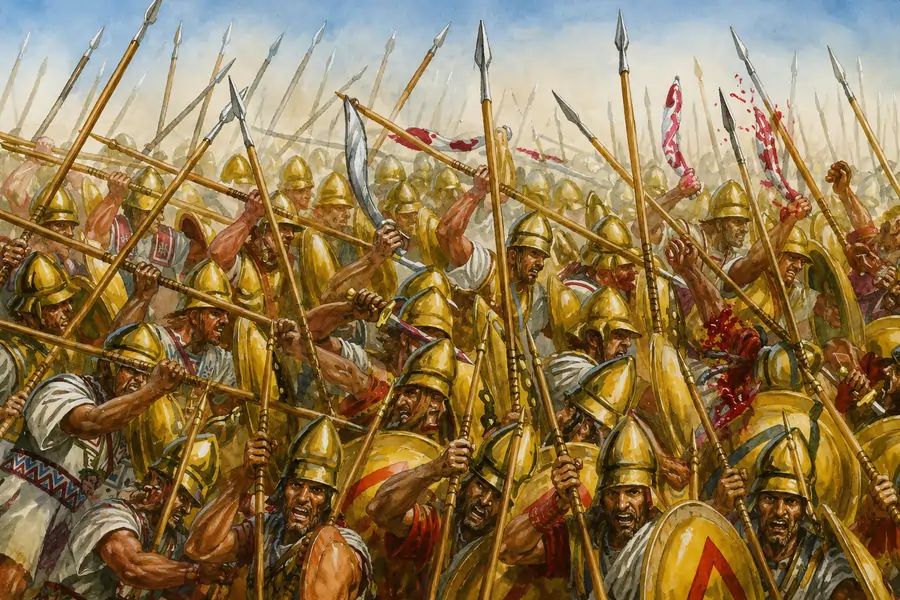
The Greek forces were heavily armored with massive bronze hoplon shields, bronze helmets, breastplates, and shin guards (greaves). They also carried long thrusting spears. They fought in a tight phalanx formation, which was hard to penetrate head-on. Once the Greek hoplites closed the distance, they held the advantage in close combat due to their superior heavy armor.
Compared to the Greeks, the Persians wore light armor. They wore fabric or leather tunics and carried a light wicker shield. The Persian light troops relied heavily on mobility rather than stopping power. However, in the close-combat situation of Marathon, the wicker shields were pierced easily by the heavy spears of the Greeks.
Leadership of Miltiades
Morale was high for the Athenian troops as they were defending their homeland. Miltiades devised a cunning plan by weakening the center and strengthening his flanks, which trapped the Persians in a double-envelopment that crushed them.
The Dead-Sprint Charge
Archers were another advantage enjoyed by the Persians. To combat this, Miltiades arrayed his troops at roughly 150 to 200 metres away. This was just away from the Persian archer's range. In an unprecedented move, Miltiades ordered his heavily armored hoplites to charge at the enemy at full speed to avoid the number of volleys from the archers. Herodotus claimed that this was the first time in history that hoplites charged at the enemy.
For they were the first of all Greeks whom we know of to charge their enemies at a run
Charging at the enemy was risky as it was difficult to maintain formation. It was also physically draining to charge while wearing heavy armor. This was the reason why the Persians mistook the charging Athenians for suicidal madmen. Taken off guard, the Greeks closed the distance quickly.
Aftermath of the Battle
The victory at Marathon did not eliminate the Persian threat. After the battle, the Persian fleet sailed toward Athens, hoping to capture the unprotected city before the Greek army could return. Miltiades anticipated this move and ordered an immediate forced march back to Athens. The victorious army arrived in time to defend the city.
When the Persian fleet appeared offshore, it found the Athenians ready for battle. Rather than risk another engagement, the Persians withdrew.[3] This swift reaction transformed a battlefield victory into a complete strategic success. Herodotus claims that when the Spartan army finally arrived, the battle was already over, and so they marched to Marathon out of curiosity. Inspecting the fallen Persians on the battlefield, they highly praised the Athenians for their victory.[1]
The Legacy of Marathon
The legacy of Marathon reaches far beyond ancient Greece. The battle became a symbol of freedom, civic responsibility, and resistance against foreign domination. For later generations of Greeks, Marathon represented proof that determination and unity could overcome seemingly impossible odds. The victory also ensured the survival of Athens and its political and cultural traditions that would later influence much of Western civilization.[2][5]
The modern marathon race derives from traditions associated with the messenger Pheidippides, although historians continue to debate aspects of the story.[1][6] Today, Marathon remains one of the most studied battles in military history because it demonstrates timeless lessons about leadership, morale, strategy, and terrain.
The Origin of the Marathon Race
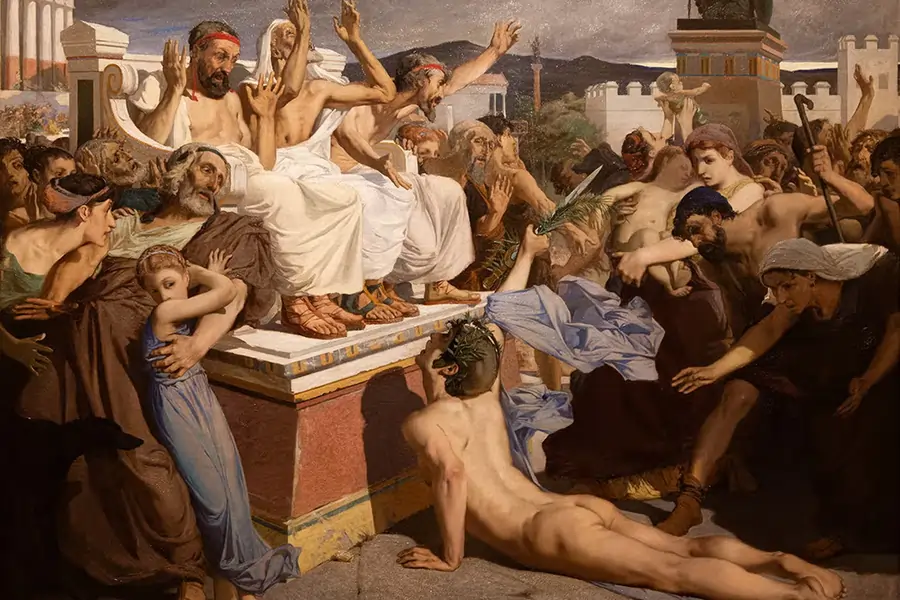
Today, the Battle of Marathon is closely associated with the modern marathon race. However, the origin of the popular story is more complicated than many people realize. The earliest surviving account comes from Herodotus, writing several decades after the battle. Herodotus tells the story of an Athenian messenger named Pheidippides who was dispatched before the battle to seek Spartan assistance against the Persian invasion.[1]
According to Herodotus, Pheidippides ran from Athens to Sparta, a journey of approximately 240 kilometers (150 miles), in only two days. After delivering the request for aid, Pheidippides returned to Athens with the disappointing news that the Spartans could not immediately march because they were observing a religious festival. Herodotus' account contains no story of the messenger collapsing or dying after announcing victory at Marathon.[1]
The more familiar version of the story emerged centuries later. In the first century CE, the Greek writer Plutarch recorded traditions describing a messenger who ran from the battlefield to Athens to announce the Greek victory.[7] Plutarch notes that different sources gave different names for the runner, including Thersippus and Eucles, highlighting uncertainty even in antiquity about the details of the story.
According to these later traditions, the exhausted messenger reached Athens, proclaimed victory with the famous cry of "Rejoice, we conquer!" and then collapsed and died.[7] Although this dramatic account became widely known, it was written more than five centuries after the battle and is generally considered less reliable than Herodotus' earlier narrative.
References
- Herodotus. Histories, Book VI.
- Holland, Tom. Persian Fire: The First World Empire and the Battle for the West.
- Lazenby, J.F. The Defence of Greece 490-479 BC.
- Green, Peter. The Greco-Persian Wars.
- Kagan, Donald. The Outbreak of the Peloponnesian War.
- Encyclopaedia Britannica. "Battle of Marathon."
- Plutarch. On the Glory of Athens, 347C.
Recommended Books
This article may contain affiliate links. If you purchase through these links, I may earn a small commission at no extra cost to you.
Related Articles

Frequently Asked Questions
Why did Darius I choose Marathon as the invasion site?
Marathon offered several advantages for the Persian invasion force. The broad coastal plain provided a suitable landing area for ships, enough space to deploy cavalry, and a direct route toward Athens. Some Persian planners may also have expected support from local political factions in the region, making Marathon an attractive location for launching an attack on Attica.
How did the terrain at Marathon affect the battle?
The terrain played a major role in the Greek victory. The plain of Marathon was bordered by mountains, marshes, and the sea, which restricted movement and limited some of the advantages normally enjoyed by Persian cavalry. Miltiades used the geography of the battlefield to force the Persians into a fight that favored heavily armed Greek hoplites.
Why were Greek hoplites more effective than Persian infantry at Marathon?
Greek hoplites were heavily armored soldiers equipped with large shields, bronze helmets, body armor, and long spears. Persian infantry generally relied on lighter equipment and missile weapons. Once the battle turned into close combat, the protection and discipline of the hoplite phalanx gave the Greeks a significant advantage.
Did the Spartans fight in the Battle of Marathon?
No. Athens requested Spartan assistance before the battle, but the Spartans were observing the religious festival of Carneia and could not immediately march. They arrived after the battle had ended and inspected the battlefield, acknowledging the scale of the Athenian victory.
Was the famous Marathon run really made by Pheidippides?
The answer depends on the source. Herodotus, the earliest historian of the Persian Wars, describes Pheidippides running from Athens to Sparta before the battle to request help. The more familiar story of a messenger running from Marathon to Athens to announce victory appears in later sources such as Plutarch. Modern historians generally consider Herodotus' account the more reliable version.
How did the Battle of Marathon influence later Greek victories against Persia?
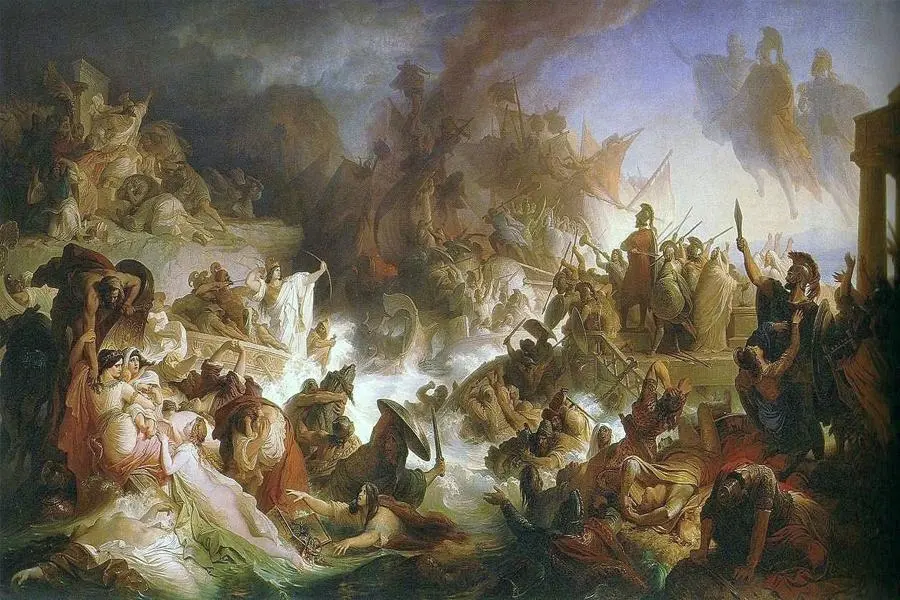
Marathon proved that Persian armies could be defeated and gave the Greek city-states confidence in their military system. The victory helped inspire later resistance during Xerxes' invasion, including the defense of Thermopylae in 480 BCE and the decisive Greek victory at Salamis later that year.
Add Comment