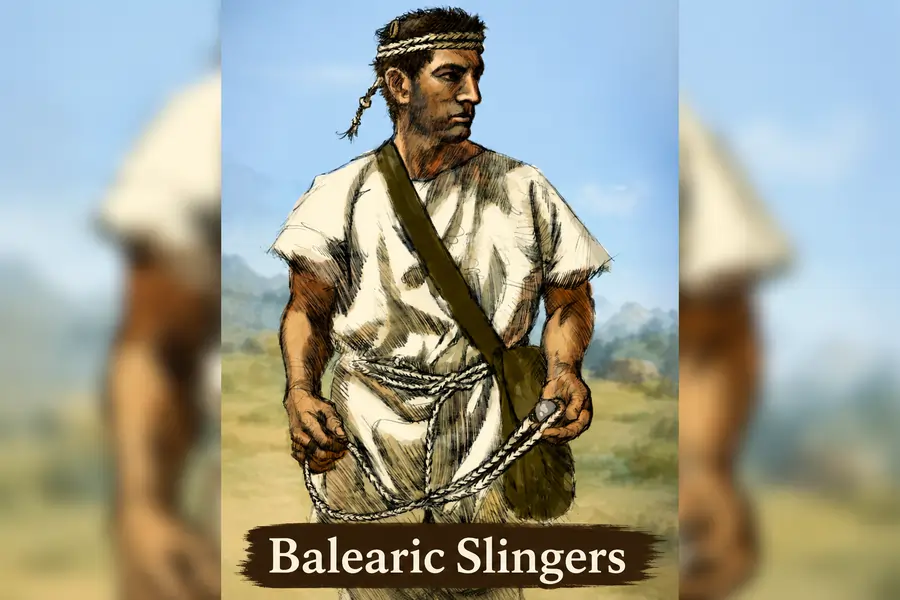
Long before arrows darkened medieval battlefields, the deadly whir of a spinning sling struck fear into ancient armies. The deceptively simple weapon was most deadly in the hands of Balearic slingers. These light infantry, recruited from the Balearic Islands, served as some of Carthage's most valuable auxiliary troops during the Punic Wars. These highly trained specialised warriors could launch stones and lead bullets with astonishing speed, range, and accuracy. Their relentless missile attacks disrupted Roman formations, protected Hannibal's advancing forces, and complemented the devastating charges of the Numidian cavalry. Their reputation became so formidable that after defeating Carthage, Rome chose to incorporate them into its own armies, ensuring that the military traditions of the Balearic Islands endured for centuries.
Table of Contents
- Origin of the Balearic Slingers
- Training and Recruitment
- Weapons and Armour
- Why the Balearic Slingers Were So Effective
- Why Rome Struggled Against the Balearic Slingers
- Battlefield Role During the Punic Wars
- Psychological Impact on Enemy Armies
- Importance in Hannibal's Army
- Service Under Rome
- Legacy of the Balearic Slingers
- References
Origin of the Balearic Slingers
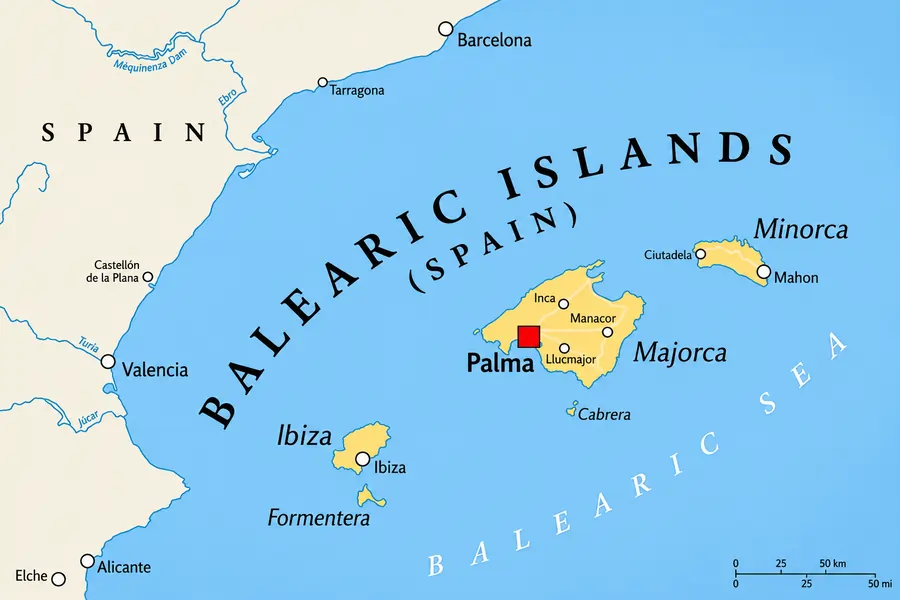
The Balearic slingers originated from the Balearic Islands in the western Mediterranean, an archipelago consisting primarily of Mallorca, Menorca, Ibiza, and Formentera. Situated along important maritime trade routes between Iberia, southern Gaul, North Africa, and Italy, these islands became known throughout antiquity for producing exceptional slingers whose skills surpassed those of almost every other missile troop in the Mediterranean.
The name Balearic is traditionally believed to derive from the Greek verb ballein, meaning "to throw." Ancient Greek writers associated the inhabitants of these islands with their remarkable ability to throw projectiles using a sling, although modern linguists continue to debate the precise etymology. Regardless of its linguistic origins, ancient historians connected the islands with expert slingers and regarded them as the finest practitioners of the weapon in the ancient world (Strabo, Geography 3.5.1; Diodorus Siculus, Bibliotheca Historica 5.17).
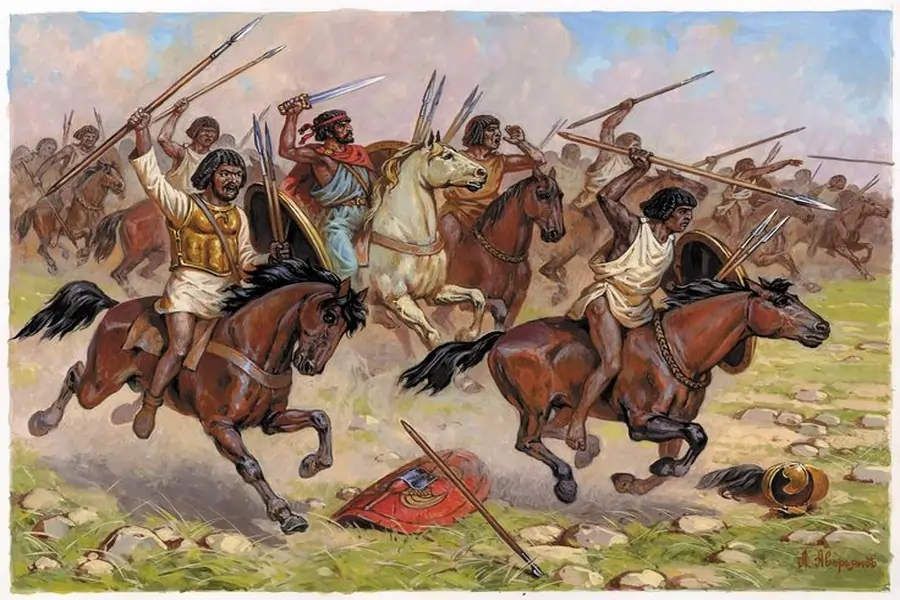
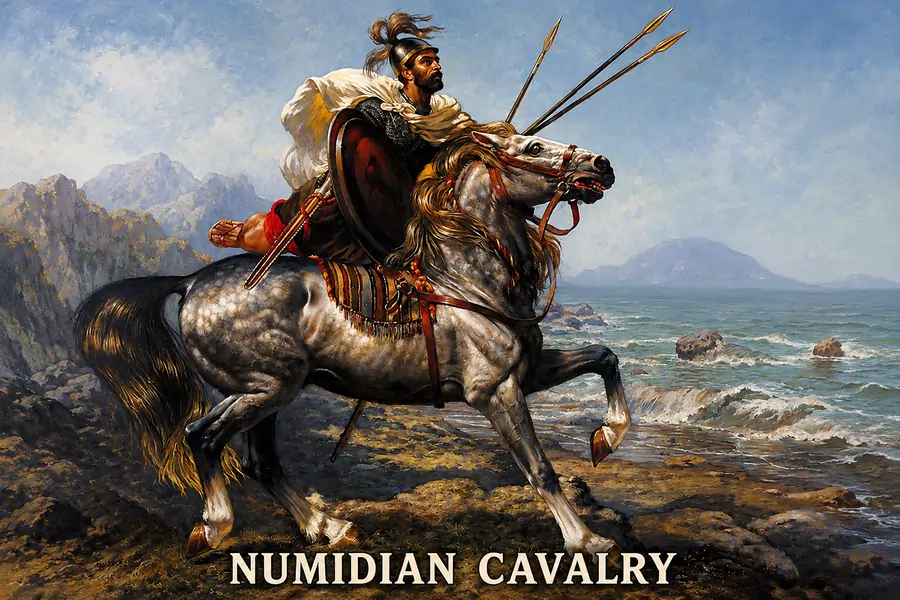
Unlike Rome, Carthage relied heavily upon allied and mercenary contingents recruited from across its sphere of influence. Each mercenary group had different military traditions and specializations. Iberians excelled as aggressive swordsmen, Gauls provided fierce shock troops, the Numidians dominated light cavalry warfare, while the Balearic Islanders supplied unmatched missile troops. Together, these diverse forces formed one of the most sophisticated combined-arms armies of the ancient world, a military system that reached its peak under Hannibal Barca. By the time of the First Punic War, Balearic slingers had already established an international reputation.
Training and Recruitment
The extraordinary effectiveness of the Balearic slingers did not result from superior weapons but from a lifetime of disciplined practice and consistent training. Ancient writers describe a society in which proficiency with the sling formed an essential part of childhood education. According to Strabo, mothers would place bread or other food upon poles or branches, requiring children to knock it down with a sling before they could eat. Although historians debate whether this practice occurred exactly as described, it reflects the widespread ancient belief that Balearic children trained almost from infancy (Strabo, Geography 3.5.1).
This kind of society created elite soldiers whose accuracy and skill could not be matched. Rather than relying upon mass volleys, experienced Balearic slingers were capable of selecting individual targets within enemy formations. Officers, cavalry horses, standard-bearers, and exposed officers often became priority targets because disabling them created confusion disproportionate to the actual casualties inflicted. Young warriors learned not only how to throw accurately but also how to judge range, compensate for wind, choose suitable ammunition, and coordinate with other missile troops. This collective experience transformed them from simple skirmishers into highly disciplined specialists.
Ancient sources also mention that Balearic slingers commonly carried three different slings, each designed for a specific battlefield role. One was wrapped around the head, another tied around the waist, and a third carried in the hand (Diodorus Siculus 5.18). The shortest sling provided greater accuracy during close engagements, the medium-length sling offered versatility, while the longest generated maximum velocity and range against distant targets. Switching between slings allowed these troops to remain effective throughout every stage of a battle.
Weapons and Armour
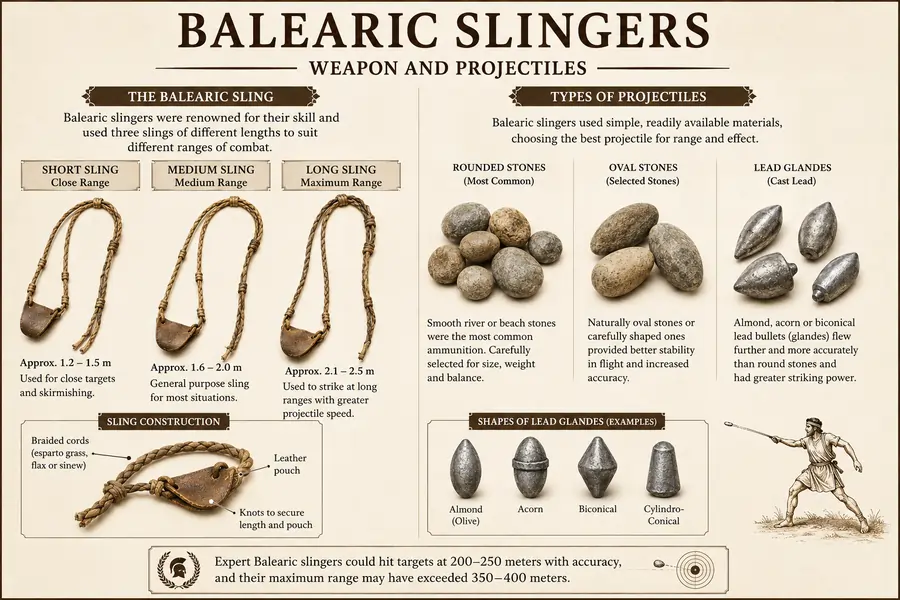
The sling itself was deceptively simple. Usually woven from flax, esparto grass, animal sinew, wool, or horsehair, it consisted of two cords attached to a central pouch that securely held the projectile. Although inexpensive to manufacture, the sling demanded years of practice before it could be used effectively in combat. Balearic slingers employed several different types of ammunition depending upon availability and battlefield requirements.
- Smooth, rounded river stones collected for consistent flight characteristics.
- Carefully shaped baked clay projectiles were used when natural stones were scarce.
- Dense lead bullets (glandes), capable of achieving exceptional velocity and penetrating considerable distances.
Lead bullets represented the deadliest ammunition available. Smaller than ordinary stones yet considerably heavier, they retained speed over longer distances while delivering devastating blunt-force trauma. Archaeological discoveries reveal that many Roman and Hellenistic lead sling bullets carried inscriptions mocking the enemy or invoking divine protection, suggesting that psychological warfare accompanied their physical effects.
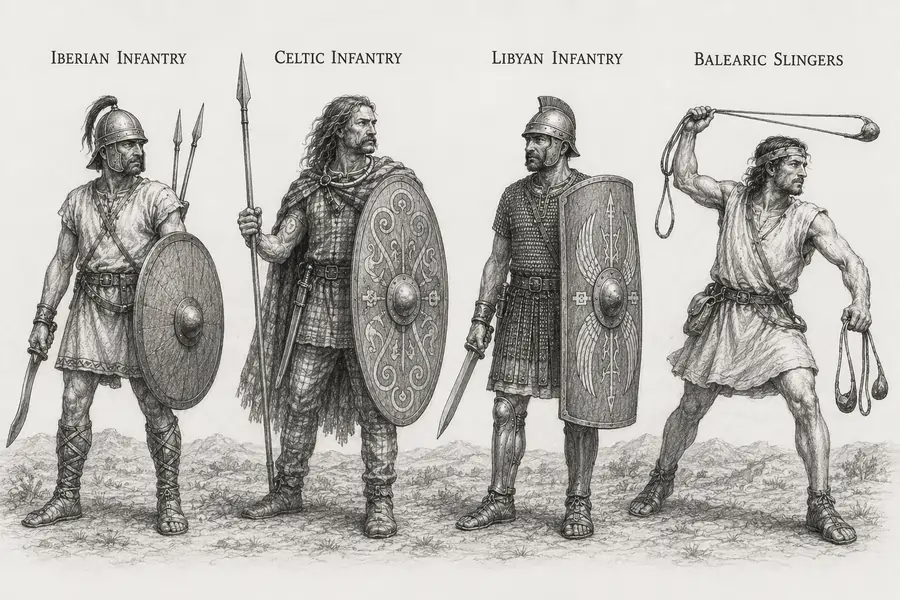
Unlike heavy infantry, Balearic slingers wore very little protective equipment. Most fought wearing only a short tunic, leather sandals, or sometimes barefoot, and a simple cloak depending upon the climate. Their light equipment enabled rapid movement across broken terrain, allowing them to advance in front of the army. They would then harass enemy troops before withdrawing quickly before the enemy charges, and continually reposition throughout an engagement. Some warriors carried a small hide-covered shield and a short knife or spear for emergencies, but these secondary weapons were intended purely for self-defense. Their true strength remained their sling.
Why Were the Balearic Slingers So Effective?
To a modern observer, the sling appears primitive when compared to a bow or crossbow. However, in the hands of an experienced user, it was one of the most lethal missile weapons ever developed. Balearic slingers were among the most effective missile troops of the ancient Mediterranean and often matched or exceeded contemporary archers in range and striking power. They could hit targets over 300 meters away in speeds reaching 150miles/hour. The average ancient archer's range was effectively only 150-200 meters.
The secret to the sling's effectiveness lay in the tremendous speed generated by rotational force. As the slinger swung the weapon overhead or beside the body, centrifugal force accelerated the projectile before one cord was released at precisely the correct angle. The Balearic slingers were considered to be mobile artillery capable of inflicting severe blunt force trauma on the heavily armored troops. While ancient writers naturally exaggerated at times, archaeological experiments have repeatedly demonstrated that sling projectiles possessed enough kinetic energy to fracture bones, dent bronze helmets, crack wooden shields, and kill unarmoured opponents.
Unlike arrows, sling stones were inexpensive and widely available. Balearic slingers could gather smooth river stones during a campaign or carry carefully selected ammunition in leather pouches. This reduced logistical demands on Carthaginian armies operating deep inside enemy territory. During Hannibal's long march through Italy, where resupply remained uncertain, such self-sufficiency represented a considerable military advantage. Another strength was versatility. A trained slinger could vary both the trajectory and power of each throw. Flat trajectories increased accuracy against exposed targets, while high, arcing shots allowed projectiles to descend into tightly packed formations. Against advancing infantry, a barrage of stones could force soldiers to raise their shields prematurely, reducing visibility and slowing their advance.
Perhaps their greatest advantage, however, was precision. Ancient authors consistently praised the Balearic Islanders for their extraordinary accuracy. Vegetius later observed that slingers who trained regularly could strike remarkably small targets, while Livy and Polybius repeatedly mention missile troops disrupting enemy formations before the main battle began. Although these writers rarely distinguished individual Balearic units in every engagement, their repeated inclusion in Carthaginian armies illustrates the confidence commanders placed in their abilities (Vegetius, De Re Militari; Polybius, Histories).
Why Rome Struggled Against the Balearic Slingers
Rome repeatedly struggled against the Balearic slingers because its military system was designed around heavily armed infantry rather than long-range missile troops. Roman legionaries excelled in disciplined close combat, but before they could bring their swords and shields to bear, they first had to endure a barrage of sling stones from opponents who remained well beyond the reach of their weapons. This allowed the Balearic slingers to disrupt Roman formations before the decisive engagement even began.
Superior Range and Mobility
The Balearic slingers often outranged Roman skirmishers armed with javelins and could begin attacking long before the legionaries were able to respond effectively. Their light equipment enabled them to advance, unleash volleys of projectiles, and withdraw rapidly behind friendly lines before Roman infantry could close the distance. Attempting to pursue them usually proved futile, as heavily equipped legionaries quickly lost both speed and formation.
Disrupting Roman Battle Formations
Roman battlefield tactics relied upon disciplined formations that advanced in good order. Continuous missile attacks disrupted this cohesion by forcing soldiers to raise their shields, break formation, or slow their advance. Even when sling stones failed to kill, the powerful blunt-force impacts caused injuries, damaged equipment, and reduced the combat effectiveness of troops before hand-to-hand fighting had even begun.
Difficult to Counter
The Balearic slingers presented Roman commanders with a difficult tactical problem. Their mobility made them poor targets for heavy infantry, while their long range often kept them beyond the effective reach of Roman skirmishers. Unlike archers, they could also replenish much of their ammunition from the surrounding terrain during extended campaigns. As a result, Roman commanders frequently had to endure sustained harassment until their own cavalry or missile troops could drive the slingers from the field.
Forcing Rome to Adapt
Rome eventually recognized the value of specialist missile troops after repeated encounters with armies fielding Balearic slingers, Cretan archers, and other skilled auxiliaries. Rather than relying solely on citizen soldiers, the Republic increasingly recruited specialist allied and auxiliary units that could complement the legions. Ironically, after conquering the Balearic Islands, Rome incorporated Balearic slingers into its own armies, ensuring that the same soldiers who had once harassed Roman legions would later fight in their service across the empire.
Battlefield Role During the Punic Wars
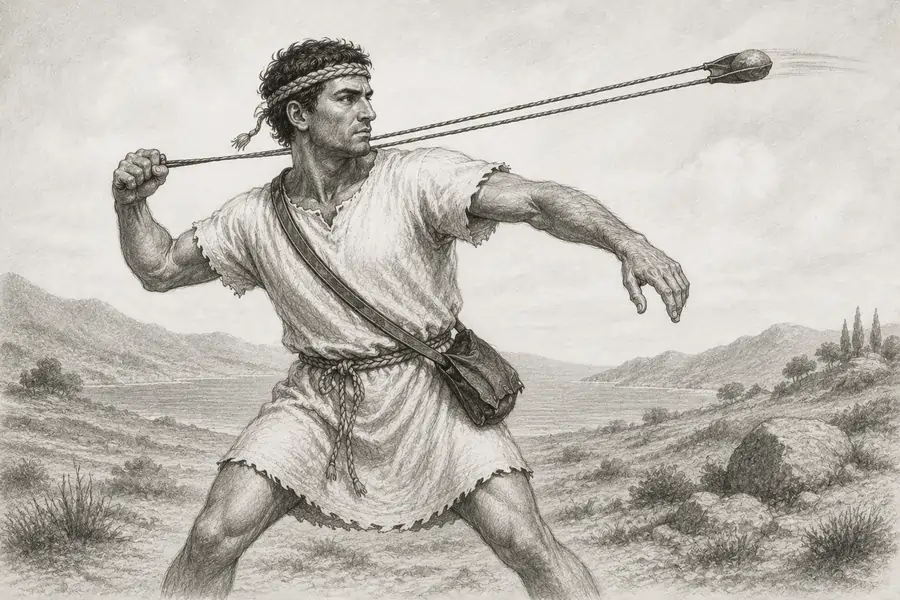
The Balearic slingers were highly specialized, prized troops who were protected and used carefully by Hannibal. They formed part of Carthage's light infantry screen, operating ahead of the main battle line. Their mission was to weaken the enemy physically and mentally before decisive combat began. In most engagements, the slingers advanced alongside javelin throwers and other skirmishers. They exchanged missiles with opposing light infantry, targeted officers and cavalry, and attempted to disorder enemy formations before withdrawing behind the heavier infantry. Because they carried little armour, remaining stationary against advancing legionaries would have been suicidal. Instead, mobility became their greatest protection.
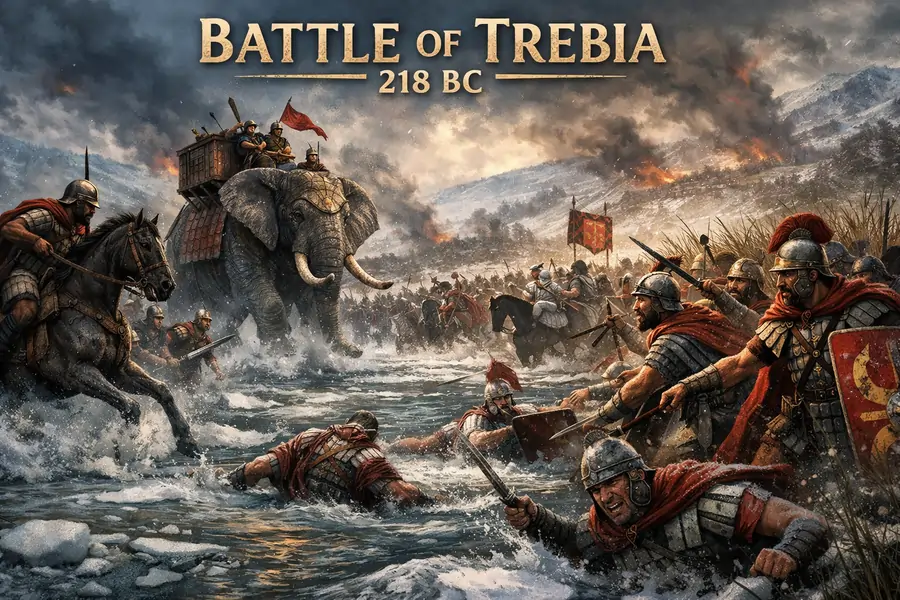
This tactical doctrine fitted perfectly into Hannibal's style of warfare. Rather than relying upon brute force alone, Hannibal sought to shape the battlefield before committing his main forces. Missile troops, cavalry, terrain, and deception all combined to create opportunities that heavier infantry could exploit. During the Battle of Trebia in 218 BC, Hannibal deliberately provoked the Roman army into crossing the freezing Trebia River before breakfast, leaving the legionaries cold, wet, and exhausted. As the Roman army deployed, Carthaginian skirmishers- including Balearic slingers- opened the engagement by showering the advancing Romans with missiles. Although this opening phase receives less attention than Mago's famous ambush, it played an important role in exhausting Roman troops before the decisive clash between the main infantry formations.
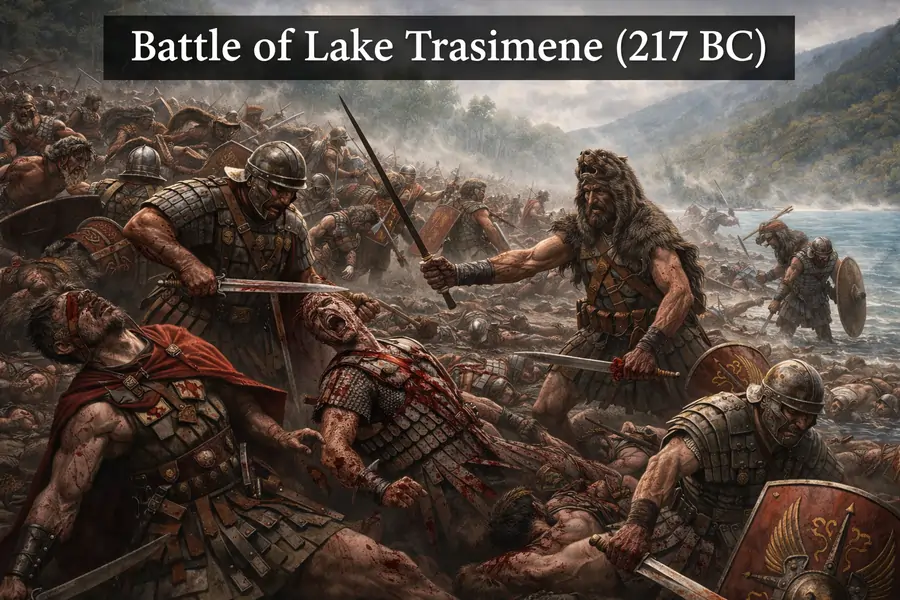
At the Battle of Lake Trasimene, Hannibal exploited terrain rather than superior numbers. Hidden Carthaginian forces attacked the Roman column from multiple directions as it marched through a narrow corridor between the lake and surrounding hills. Within the confusion created by the ambush, Balearic slingers added to the chaos by striking soldiers attempting to organize defensive formations. The psychological shock of unseen projectiles arriving from elevated positions compounded the panic already sweeping through the Roman ranks.
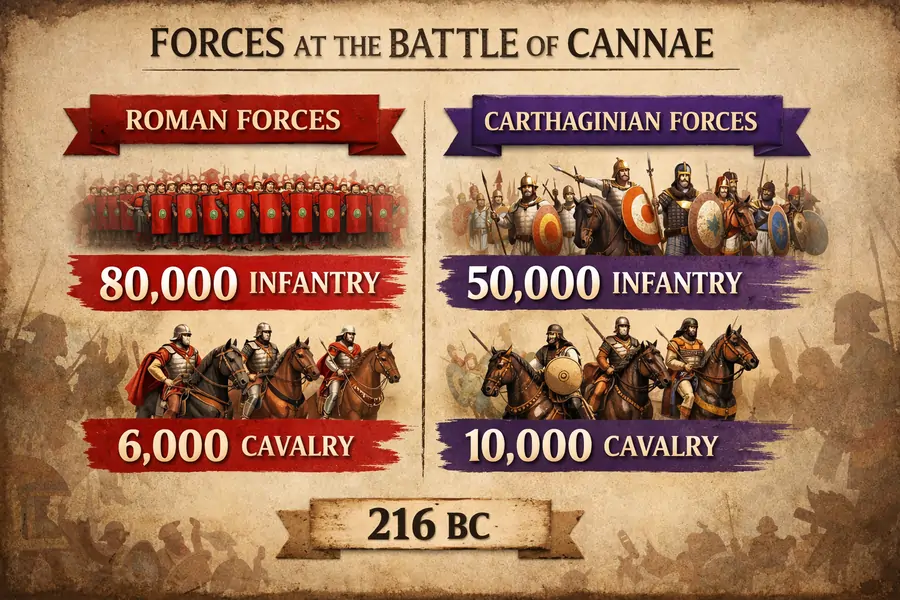
The Balearic slingers reached the height of their battlefield importance during the Battle of Cannae in 216 BC. Before Hannibal's famous double envelopment unfolded, light infantry initiated the battle by engaging Roman skirmishers. The slingers disrupted the advancing legions, inflicted casualties, and encouraged Roman commanders to press forward aggressively. Once their task had been completed, they withdrew through prepared gaps in the Carthaginian line, allowing the heavy infantry to receive the Roman assault. They were instrumental in masking the presence of Hannibal's elite Iberian troops on the flanks.
Even during the final stages of the Battle of Zama, Balearic slingers continued serving within the Carthaginian army despite changing strategic circumstances. By this stage, however, Hannibal lacked the experienced cavalry superiority that had characterized his earlier victories. The slingers remained effective, but missile troops alone could not compensate for Rome's growing tactical advantages and Scipio Africanus' careful battlefield planning.
The Psychological Impact of the Balearic Slingers
One of the most significant contributions of the Balearic slingers was their ability to undermine enemy morale before close combat even began. Ancient warfare depended heavily upon discipline and cohesion. Soldiers fighting shoulder to shoulder relied upon maintaining formation under enormous physical and psychological pressure. Missile troops existed to weaken precisely that cohesion. Unlike arrows, which could often be seen approaching, sling bullets travelled quickly and quietly. Many Roman soldiers probably heard the impact before they understood where the projectile had originated.
Because sling projectiles relied primarily on blunt-force trauma, armour frequently failed to eliminate their effects. A bronze helmet might prevent penetration, yet the wearer could still suffer a concussion or fractured skull. Similarly, shields protected against fatal wounds but transmitted enormous force into the arm holding them. Roman soldiers struck repeatedly before the main engagement, often entering hand-to-hand combat already bruised, fatigued, and psychologically shaken.
The Balearic slingers also excelled at targeting cavalry. Horses frightened easily when struck unexpectedly by fast-moving projectiles. A wounded or panicked horse could throw its rider, disrupt nearby formations, or refuse to charge altogether. By weakening enemy cavalry before the decisive clash, the slingers increased the effectiveness of Carthage's own mounted forces.
Commanders represented another important target. Ancient armies relied heavily upon visual communication rather than complex signalling systems. Officers, standard bearers, and musicians directed movements that kept formations functioning effectively. A well-aimed sling stone that incapacitated one of these individuals could generate confusion far greater than the loss of an ordinary soldier. The psychological effects extended beyond the battlefield itself. Roman soldiers who survived encounters with Balearic slingers carried stories of their remarkable accuracy throughout the Republic. Such reputations mattered in ancient warfare. Troops expecting to face elite missile specialists often advanced more cautiously, giving Hannibal additional opportunities to dictate the pace of battle.
Why the Balearic Slingers Were Indispensable to Hannibal's Army
Hannibal's genius did not lie simply in commanding talented soldiers but in combining diverse troop types into a cohesive fighting system. Every contingent within his multinational army possessed a clearly defined tactical purpose. This integrated approach explains why Hannibal achieved victories against larger Roman armies despite often being outnumbered. Rather than depending upon any single arm of service, he synchronized cavalry, infantry, missile troops, terrain, and deception into a unified operational plan. This combined-arms doctrine meant the Balearic slingers rarely fought in isolation; their value lay in preparing the battlefield for the decisive actions of Hannibal's infantry and cavalry.
The Balearic slingers therefore functioned as force multipliers. Their objective was not to destroy Roman armies independently but to create conditions that magnified the effectiveness of every other branch of Hannibal's forces. By disrupting formations, wounding cavalry mounts, exhausting advancing infantry, and lowering enemy morale, they increased the probability that Carthage's heavier troops would succeed once close combat began.
This philosophy can be observed repeatedly throughout Hannibal's Italian campaign, from his victories at Trebia and Lake Trasimene to his masterpiece at Cannae. Even during operations such as Hannibal's escape from the Ager Falernus, where deception and manoeuvre proved more important than pitched battle, flexible light troops remained essential to protecting the army and confusing Roman commanders. For more on Hannibal's broader use of deception, spectacle and political messaging that created these opportunities, see Hannibal's psychological warfare. The continued presence of Balearic slingers throughout the Second Punic War demonstrates their consistent military value. While historians naturally focus upon Hannibal himself, the success of his campaigns depended equally upon the specialist soldiers who enabled his sophisticated tactical system to function.
The Balearic Slingers Under Roman Rule
The destruction of Carthage did not mark the end of the Balearic slingers. Instead, Rome recognized the same qualities that had once made them such dangerous enemies and chose to incorporate them into its own military system. This pragmatic approach reflected a broader Roman policy of recruiting specialist auxiliary troops from across the empire.
Following Rome's gradual expansion into the western Mediterranean, the Balearic Islands came increasingly under Roman influence before eventually being annexed by the Republic in 123 BC during the campaign of Quintus Caecilius Metellus, who later earned the cognomen Balearicus. Although piracy had become one justification for the conquest, Rome also recognized the islands' strategic location and the military value of their famous slingers (Livy, Periochae; Strabo, Geography 3.5).
Under Roman administration, Balearic slingers continued to serve as auxiliary troops rather than Roman legionaries. Roman legionaries formed the heavily armed backbone of the army, while auxiliaries supplied specialist capabilities that complemented the legions. Alongside Cretan archers, Numidian cavalry, German cavalry, and Syrian archers, the Balearic slingers became one of the empire's elite auxiliary formations.
Archaeological evidence indicates that Balearic auxiliary units were deployed across Gaul, Britain, the Balkans, North Africa, and the eastern provinces wherever experienced missile troops were required. Their continued employment for centuries demonstrates that Roman commanders never considered the sling an obsolete weapon despite the increasing prominence of archery. Even as the Roman army evolved from the manipular formations of the Republic into the professional imperial army established under Augustus, Balearic slingers retained their reputation. Their presence in frontier garrisons illustrates the enduring military value of accurate long-range missile troops capable of harassing enemy formations before close combat.
Balearic Slingers Compared with Other Ancient Missile Troops
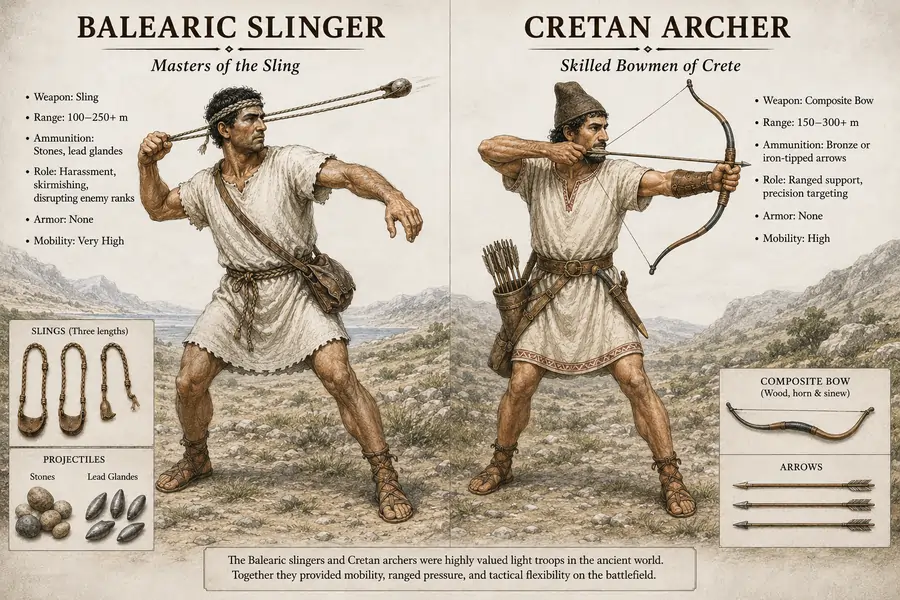
The closest competitors to the Balearic slingers were the Cretan archers, who were widely regarded as the finest bowmen of the Hellenistic world. Cretan archers generally offered a higher rate of fire and greater accuracy at medium ranges. However, bows required carefully crafted arrows that could not easily be replaced during long campaigns. Sling ammunition, by contrast, could often be collected locally, making Balearic slingers particularly valuable for armies operating far from established supply bases.
Within the Roman army itself, the Balearic slingers complemented rather than replaced the velites, the Republic's light infantry armed primarily with javelins. Velites excelled at close-range harassment immediately before the main engagement, whereas Balearic slingers could begin inflicting casualties at considerably greater distances. Together, these different troop types gave Roman commanders flexibility against a wide variety of opponents.
The Legacy of the Balearic Slingers
The legacy of the Balearic slingers extends far beyond the Punic Wars themselves. Although overshadowed in popular history by Hannibal's war elephants and the spectacular victories at Trebia, Lake Trasimene, and Cannae, the Balearic Islanders demonstrated how highly trained specialist troops could influence battles disproportionate to their relatively small numbers. Their success also illustrates one of the defining characteristics of Carthaginian warfare. Unlike Rome, which increasingly relied upon standardized legionary formations, Carthage assembled multinational armies composed of specialist contingents recruited from across the Mediterranean. Hannibal's greatest achievements resulted not simply from tactical brilliance but from his ability to integrate diverse military traditions into a single coordinated fighting force. The Balearic slingers formed an essential part of this system, working alongside the Numidian cavalry, Iberian infantry, Libyan heavy infantry, and Gallic warriors.
Modern experimental archaeology has further enhanced appreciation for these remarkable soldiers. Controlled tests using reconstructed slings have demonstrated that experienced practitioners can hurl projectiles with impressive accuracy over distances exceeding 150 metres, while lead bullets retain significant striking power even farther. Such experiments lend considerable credibility to the descriptions provided by classical historians regarding the destructive potential of Balearic slingers. Beyond their military achievements, the Balearic slingers symbolize the importance of skill over equipment. Armed with what appeared to be little more than cords and stones, they consistently challenged heavily armoured opponents equipped with swords, shields, and spears. Their effectiveness reminds us that training, discipline, and tactical coordination often mattered more than the apparent sophistication of a weapon.
Today, the Balearic slingers remain one of the clearest examples of how specialist light infantry could shape the outcome of ancient battles. Their enduring reputation demonstrates that disciplined training and tactical specialization could make even the simplest weapons decisive on the ancient battlefield. Their legacy survives not only in the writings of Polybius, Livy, Strabo, and Diodorus Siculus but also in the enduring military principle that superior training and tactical integration can transform even the simplest weapon into a decisive instrument of war.
References and Further Reading
- Polybius - The Histories, Books 1-3.
- Livy - History of Rome, Books 21-30.
- Strabo. Geographica, Book 3.
- Diodorus Siculus, Bibliotheca Historica, Book 5.
- Vegetius - De Re Militari
- Pliny the Elder. Natural History.
- Adrian Goldsworthy. The Punic Wars. Cassell, 2000.
- Dexter Hoyos. Mastering the West: Rome and Carthage at War. Oxford University Press, 2015.
- Richard Miles. Carthage Must Be Destroyed. Penguin Books, 2011.
- Boris Rankov. "Missile Troops in the Roman Army." In The Roman Army as a Community.
- Philip Sabin. Lost Battles. Hambledon Continuum, 2007.
- Nicholas Sekunda. Greek and Roman Slingers. Osprey Publishing.
- Duncan B. Campbell. Ancient Slingers. Osprey Publishing.
Recommended Books
This article may contain affiliate links. If you purchase through these links, I may earn a small commission at no extra cost to you.


Related Articles
Frequently Asked Questions
Why were the Balearic slingers so effective in the Punic Wars?
The Balearic slingers were highly effective because they trained from childhood, carried multiple slings for different ranges, and could hurl stones or lead bullets with remarkable speed and accuracy. Their long-range attacks disrupted enemy formations, wounded soldiers before close combat, and provided crucial support to Hannibal's infantry and cavalry during the Punic Wars.
What weapons did the Balearic slingers use in battle?
The Balearic slingers primarily fought with woven slings made from natural fibers such as flax, esparto grass, or sinew. They used smooth stones, baked clay projectiles, and dense lead bullets called glandes as ammunition. Most also carried a small knife or spear for emergencies but relied almost entirely on their sling in combat.
How did the Balearic slingers help Hannibal defeat Roman armies?
The Balearic slingers weakened Roman forces before the main battle by bombarding advancing legionaries with long-range projectiles. Their attacks disrupted formations, injured officers and cavalry horses, lowered enemy morale, and created opportunities for Hannibal's infantry and Numidian cavalry to exploit during battles such as Trebia, Lake Trasimene, and Cannae.
Why did Rome recruit Balearic slingers after defeating Carthage?
Rome recognized that the Balearic slingers were among the finest missile troops in the ancient world. After conquering the Balearic Islands in 123 BC, the Romans recruited them as auxiliary soldiers to provide long-range firepower that complemented the heavily armed Roman legions across the empire.
How far could a Balearic slinger throw a stone?
Ancient sources and modern experimental archaeology suggest that experienced Balearic slingers could accurately strike targets at over 150 meters, while maximum ranges exceeded 300 meters under favorable conditions. Their lead bullets retained enough force to fracture bones, dent helmets, and disable enemy soldiers even at considerable distances.
Were the Balearic slingers better than Cretan archers?
The Balearic slingers and Cretan archers excelled in different roles. Cretan archers generally offered a higher rate of fire and greater precision at medium ranges, while Balearic slingers could use locally available ammunition, strike with tremendous blunt-force power, and operate effectively during long campaigns with minimal logistical support. Many ancient armies, including Rome's, employed both troop types together.
Add Comment