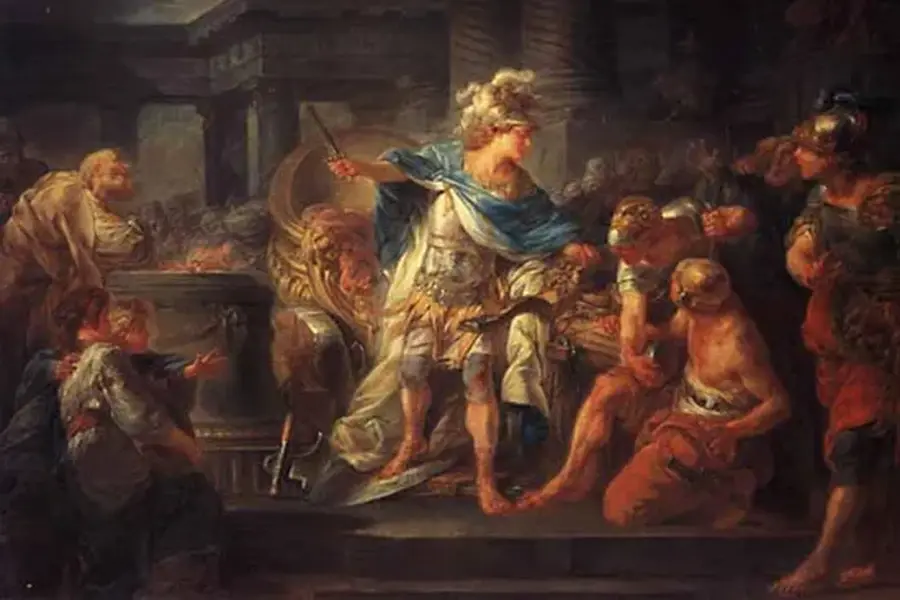
Alexander the Great and the Gordian Knot are remembered together because the episode captures something essential about the Macedonian king. When confronted with a problem that appeared impossible to solve by conventional methods, Alexander refused to accept its rules. In the most famous version of the story, he drew his sword and cut through the ancient knot instead of patiently untying it. However, whether he actually cut the knot is uncertain. Ancient sources give us more than one version, and the historical Alexander may have solved the puzzle in a much less dramatic way. What matters is that the story became a powerful symbol of his ambition, decisiveness, and willingness to redefine the terms of a challenge.
The episode took place at Gordium in Phrygia in 333 BC, during Alexander's invasion of the Persian Empire. By this point, he had already defeated the Persian satraps at the Battle of the Granicus River and captured much of western Anatolia. The Gordian Knot therefore appeared at a particularly important moment. The episode provided Alexander with an opportunity to present his campaign as part of a larger story of destiny and divine favor.
Table of Contents
- What Was the Legend of the Gordian Knot?
- Alexander's Arrival at Gordium
- How Did Alexander Solve the Gordian Knot?
- Did Alexander Actually Cut the Gordian Knot?
- What Was the Prophecy of the Gordian Knot?
- What the Gordian Knot Reveals About Alexander's Character
- Boldness or Recklessness?
- Did the Prophecy Become True?
- What Does "Cutting the Gordian Knot" Mean Today?
- The Legacy of Alexander and the Gordian Knot
- Sources and References
What Was the Legend of the Gordian Knot?
The story of the Gordian Knot begins not with Alexander but with an obscure Phrygian ruler named Gordius. According to the tradition recorded by the ancient historian Arrian, Gordius was originally a poor farmer who possessed a small plot of land and two pairs of oxen. One day, while he was ploughing, an eagle landed on the yoke of his oxen and remained there. Gordius regarded the unusual event as a divine sign and sought an explanation from the prophets of Telmessus. Their interpretation eventually connected Gordius and his family with kingship. Later, when the Phrygians were troubled by internal conflict and needed a ruler, an oracle declared that a king would arrive in a wagon. Gordius and his family appeared in the wagon, and the Phrygians interpreted the prophecy in their favour.
Gordius became associated with the foundation of the royal dynasty, while the wagon itself was preserved as a sacred object. According to the tradition, Gordius dedicated the wagon and its yoke to Zeus. The fastening that attached the yoke to the wagon became the famous Gordian Knot. There was an additional prophecy attached to it. Anyone who could loosen the knot would become ruler of Asia. Arrian gives the prophecy specifically as rule over Asia, while Plutarch reports a broader version in which the person who loosened the fastening was destined to become ruler of the whole world. These differences are important because they show that the story had already developed several versions before later generations turned it into a simple tale of Alexander cutting a rope.
The knot itself was not described merely as an ordinary tangle. Arrian says that it was made from the bark of the cornel tree and that neither its beginning nor its end could be seen. That detail transformed the object from an ordinary knot into a genuine puzzle: the solution was apparently hidden from anyone trying to determine where the cord began or ended. For Alexander, the symbolism could hardly have been more attractive. He had crossed into Asia with the stated intention of defeating the Persian king. Now, in an ancient Phrygian capital, he was confronted with a prophecy promising rule over Asia to the man capable of solving the knot.
Alexander's Arrival at Gordium
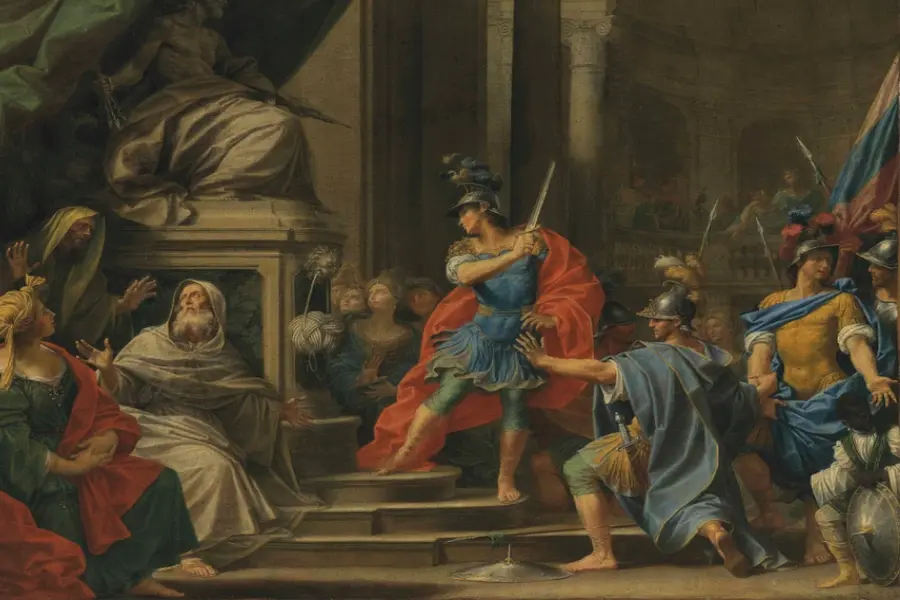
Alexander reached Gordium in 333 BC, after campaigning through Asia Minor. Gordium was an important strategic stopping point because it connected the western regions of Anatolia with the routes leading farther east. The Macedonian army had also received reinforcements there, making the city an important assembly point before Alexander continued toward Cilicia and Syria. The timing mattered. Alexander's campaign had begun dramatically in 334 BC with his crossing of the Hellespont and victory at the Granicus. But the Persian Empire had not been destroyed. Darius III remained alive, and the main Persian army was still capable of challenging Alexander.
Alexander therefore had more than a ceremonial reason for being interested in the old Phrygian relic. The knot offered a remarkable piece of political symbolism. If the ancient prophecy could be connected with Alexander, then his campaign against Persia could be presented not simply as an ambitious military expedition but as the fulfilment of a destiny already announced generations earlier.
Arrian says that Alexander had a strong desire to visit the citadel and see the palace associated with Gordius and his son Midas. He also specifically wanted to see the famous wagon and its knot. The episode was therefore not something that accidentally happened while Alexander was passing through the city. He deliberately went to see the object and engage with the tradition surrounding it. This was characteristic of Alexander's relationship with heroic traditions. He repeatedly connected himself with figures from the Greek mythological and heroic past, particularly Heracles and Achilles. His visit to Gordium gave him another opportunity to place his own campaign within a larger story of divine favour, heroic achievement, and conquest.
How Did Alexander Solve the Gordian Knot?
The famous version of the story is wonderfully simple. Alexander examined the knot but could not determine how it was fastened. Instead of spending hours trying to trace the hidden ends of the cord, he drew his sword and cut through the knot. The gesture was more than a practical solution. Alexander had effectively changed the question. The prophecy did not necessarily say that the knot had to be untied in a particular manner. It said that whoever loosened it would fulfil the prophecy. Alexander therefore found a way to achieve the result without accepting the conventional interpretation of how it should be accomplished.
The story is often summarized as Alexander deciding that the knot could be solved by force rather than patience. But that interpretation risks making the episode seem simpler than it actually was. The ancient sources preserve a second possibility that is considerably more interesting.
| Version | How Alexander solved the knot | Ancient sources |
|---|---|---|
| Traditional sword-cutting account | Alexander drew his sword and cut through the knot, effectively bypassing the need to untie it. | Arrian and Plutarch |
| Aristobulus' account | Alexander removed the pin holding the yoke to the wagon pole and detached the yoke without cutting through the knot. | Arrian and Plutarch, citing Aristobulus |
| Historical conclusion | The exact method cannot be established with certainty because the ancient sources preserve conflicting accounts. | Arrian explicitly acknowledges the uncertainty |
The difference between these accounts is crucial. The Gordian Knot is usually presented as a story about Alexander's willingness to cut through an impossible problem. But one of our earliest surviving accounts does not actually allow us to say with certainty that Alexander used his sword.
Did Alexander Actually Cut the Gordian Knot?
We do not know. This is one of the most important historical qualifications to the famous story. Our principal narrative source, Arrian, wrote several centuries after Alexander but relied heavily on earlier works by men who had accompanied Alexander, especially Ptolemy and Aristobulus. In his account of the Gordian Knot, Arrian presents two versions.
The first is the dramatic story familiar today: Alexander struck the knot with his sword and declared it loosened. The second came from Aristobulus, an engineer and historian who had served with Alexander. According to Aristobulus, Alexander did not need to destroy the knot at all. He removed the hestor, or pin, that held the yoke assembly together. Once the pin had been removed, the yoke could be separated from the wagon pole, and the problem was effectively solved. Plutarch independently preserves the same basic alternative.
Arrian is unusually cautious. After presenting both versions, he essentially admits that he cannot confidently establish what Alexander actually did. What is clear is that Alexander and his companions left the wagon believing that the prophecy had been fulfilled. That night, according to Arrian, thunder and flashes of light appeared, which Alexander interpreted as divine confirmation and followed with sacrifices to the gods.
This gives us an important distinction between history and legend. The historical core is quite plausible: Alexander visited Gordium, saw the famous wagon, encountered the prophecy, and performed an act that was subsequently interpreted as fulfilling it. The precise mechanics of the solution are uncertain. The sword-cutting version may have survived because it was dramatically perfect. A young conqueror arrives at an ancient puzzle, refuses to be defeated by it, draws his sword, and transforms an impossible challenge into a single decisive action. It is exactly the kind of story that fits Alexander's reputation.
Aristobulus' version is less cinematic but arguably more revealing. If Alexander really removed the pin, he was not simply using brute force. He was examining the problem's structure and identifying a hidden point of leverage. In that sense, the alternative version may actually tell us something very similar to the sword story. Alexander succeeded because he refused to assume that the problem had to be solved in the obvious way.
What Was the Prophecy of the Gordian Knot?
The prophecy is usually remembered as saying that whoever untied the Gordian Knot would become ruler of all Asia. That is broadly correct, but the ancient evidence is more complicated. Arrian states that the person who loosened the fastening of the wagon's yoke was destined to rule Asia. Plutarch, however, records a version in which the successful person would become king of the whole world.
| Source | Prophecy | Significance |
|---|---|---|
| Arrian | The person who loosened the knot would rule Asia. | Fits Alexander's campaign against the Persian Empire. |
| Plutarch | The person who loosened the fastening would become ruler of the whole world. | Creates a much broader heroic and universal interpretation. |
The ambiguity actually strengthens the story's usefulness to Alexander. "Asia" could carry different meanings depending on the political context. For a Macedonian conqueror fighting Persia, it could naturally suggest the Persian Empire and the territories under its control.
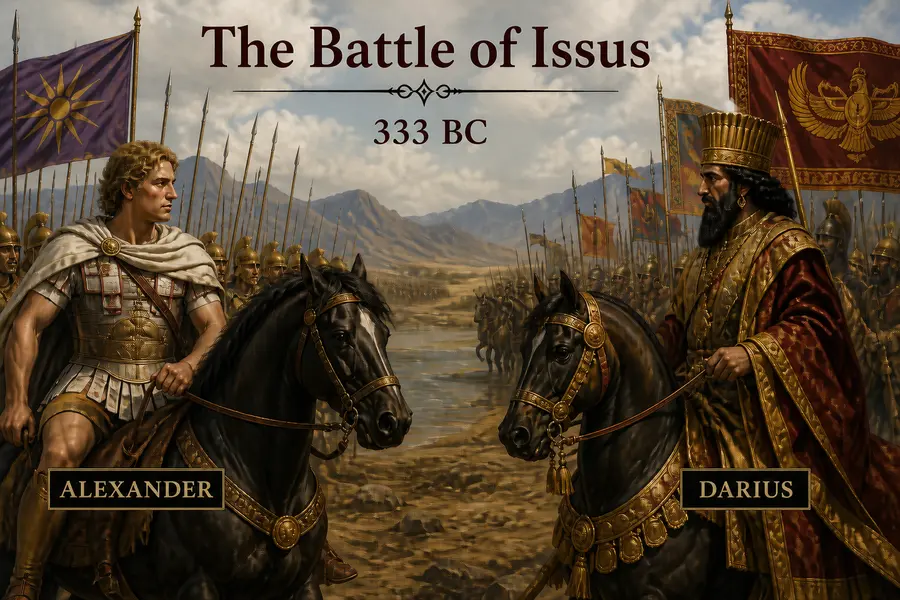
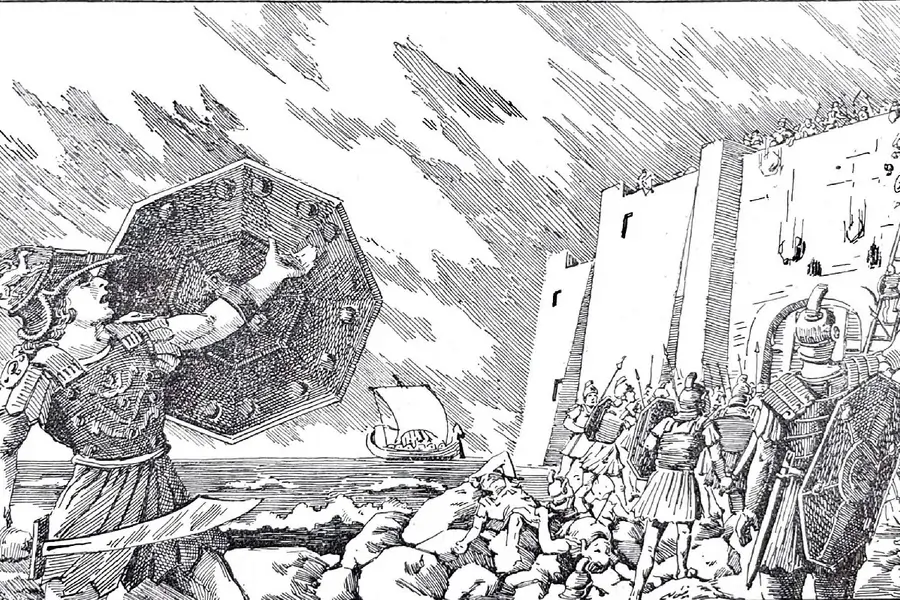
Alexander's later victories made the prophecy look remarkably accurate. Within months of Gordium, he defeated Darius III at the Battle of Issus. He then captured the eastern Mediterranean coast, endured the extraordinary Siege of Tyre, conquered Egypt, and eventually defeated Darius decisively at the Battle of Gaugamela. By 331 BC, the Persian imperial heartland was effectively open to him. Alexander continued through Mesopotamia, Persia, Central Asia, and eventually into the Indian subcontinent. He would go much farther than anyone at Gordium could reasonably have expected.
What the Gordian Knot Reveals About Alexander's Character
The Gordian Knot became famous because it seems to capture Alexander's personality in a single gesture. Whether or not the sword was actually used, the story portrays a ruler unwilling to accept an obstacle simply because tradition declared it difficult.
Alexander was willing to challenge assumptions
The most important feature of the story is not the sword. It is the refusal to accept the problem's traditional framing. Everyone expected the knot to be untied. Alexander the Great either cut through it or found a mechanical way around the apparent difficulty. In both versions, he questioned the assumption that the solution had to follow the method everyone expected.
That quality can also be seen in his military career. Alexander repeatedly attacked problems from unexpected directions. At the Granicus, he aggressively crossed a river defended by Persian cavalry. At Issus, he exploited the narrow battlefield to prevent the much larger Persian army from using its numerical advantage effectively. At Tyre, he solved an apparently formidable geographical problem by constructing a causeway toward the island fortress.
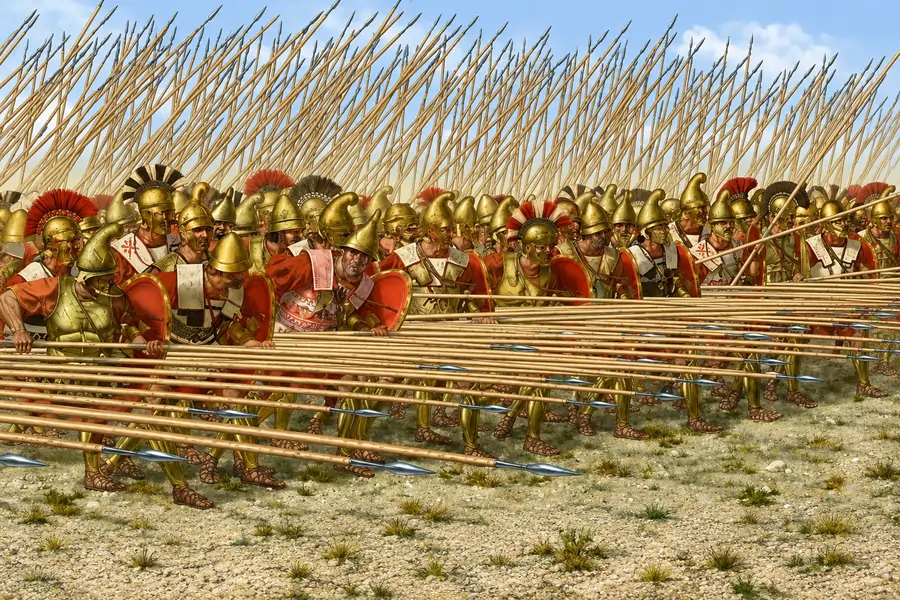
The same mindset appears on a much larger scale in his campaigns. His success was not simply a matter of courage. Alexander frequently combined speed, engineering, intelligence, logistics, and tactical flexibility. His army's effectiveness depended heavily on systems that went beyond the king's personal bravery, including the Macedonian phalanx and the Companion Cavalry. That makes the Gordian Knot a useful miniature version of Alexander's broader approach: identify the decisive point, act quickly, and do not allow conventional expectations to dictate the solution.
But the same quality could become dangerous
Alexander's boldness was also one of his greatest risks. The king repeatedly placed himself in dangerous situations. He personally led cavalry charges, fought close to enemy lines, and accepted enormous physical risks. His ambition also pushed the army farther from Macedonia than any previous Macedonian campaign had required. The disastrous Gedrosian Desert crossing is a particularly striking reminder that Alexander's willingness to attempt the extraordinary could produce catastrophic consequences. Thousands of men died during the march through the harsh terrain. That makes the Gordian Knot an interesting window into the dual nature of Alexander's character. The same instinct that helped him overcome obstacles could also lead him into unnecessary danger.
Boldness or Recklessness?
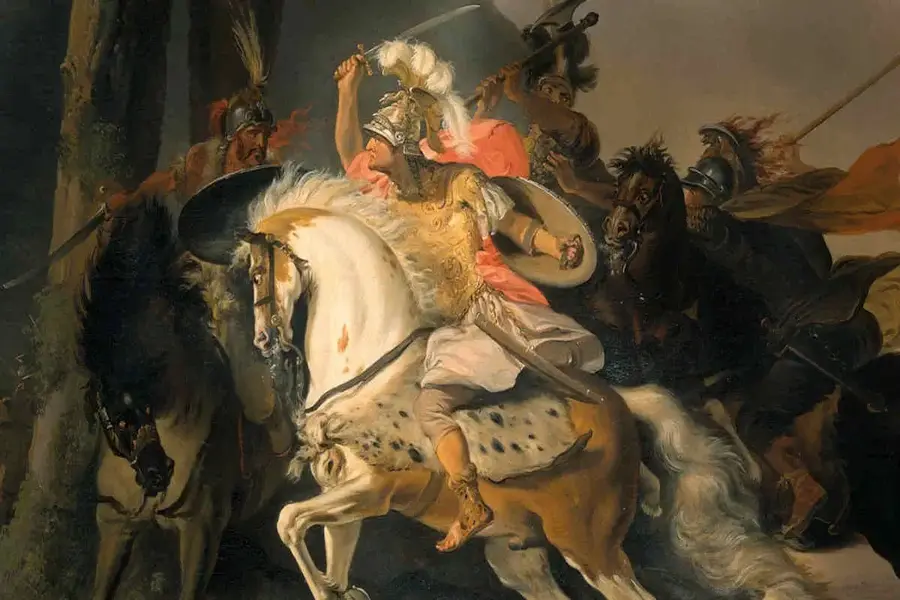
Was Alexander's solution to the Gordian Knot an example of brilliant boldness or reckless impatience? The answer depends partly on which ancient version we believe. If Alexander simply became frustrated and hacked the knot apart, the episode can be interpreted as a display of impatience. He could not solve the puzzle according to its traditional rules, so he destroyed the obstacle. But if Aristobulus preserved the more accurate account, Alexander's action looks much more calculated. Removing the pin was not an act of uncontrolled anger. It was a practical solution that exposed how the mechanism actually worked.
There is therefore a useful lesson in the ambiguity of the sources. The phrase "cut the Gordian Knot" encourages us to think of Alexander as someone who always preferred force over patience. The surviving evidence does not justify such a simple conclusion. Alexander was certainly bold. But throughout his campaigns, his boldness was often accompanied by careful preparation. His army depended on sophisticated logistics, engineering, and tactical coordination. His victories over Darius were not won simply because Alexander was fearless. They resulted from his ability to recognize opportunities and concentrate force at decisive moments. The Gordian Knot therefore works better as a symbol of decisiveness and unconventional thinking than as proof that Alexander was simply reckless.
Did the Gordian Knot Prophecy Become True?
In a literal historical sense, the prophecy cannot be proved to have caused Alexander's success. There is no evidence that the gods guaranteed his conquest because he solved the knot. But as a piece of political symbolism, the prophecy became extraordinarily effective. Alexander went on to conquer the Persian Empire and establish an enormous empire stretching from Greece and Egypt through Persia and into parts of Central and South Asia. His victories at Issus and Gaugamela destroyed the political power of Darius III, while his later campaigns pushed the Macedonian army all the way to the Hyphasis River in India.
That makes the Gordian story one of those rare ancient legends that acquired greater power because later events seemed to validate it. Had Alexander been defeated at Issus or Gaugamela, the Gordian Knot might have become a forgotten anecdote. Instead, his extraordinary military success transformed the prophecy into apparent evidence of destiny. This is one reason Alexander's relationship with prophecy matters. He did not operate in a modern world in which political legitimacy was separated neatly from religion and omens. Divine signs, ancestral traditions and heroic mythology could all contribute to how a ruler understood his authority. The Gordian Knot gave Alexander something particularly valuable: a story in which an ancient prophecy appeared to recognize him as the man destined to rule Asia.
What Does "Cutting the Gordian Knot" Mean in Modern Language?
Today, a Gordian knot means an extremely complicated or seemingly insoluble problem. To cut the Gordian Knot means to solve such a problem through a bold, direct or unconventional action rather than attempting to resolve every complication one by one. In modern language, the expression might describe a leader who eliminates the central obstacle to a stalled project, a government that radically simplifies an unwieldy system, or an engineer who approaches a technical problem from an entirely different direction.
The phrase has been part of English literary culture for centuries. Shakespeare used the Gordian Knot metaphor in Henry V, where the Archbishop of Canterbury praises King Henry's ability to deal with difficult matters. The survival of the expression shows just how successful the Alexander story became. A relatively obscure episode from a fourth-century BC campaign eventually became a universal metaphor for solving difficult problems.
The Legacy of Alexander and the Gordian Knot
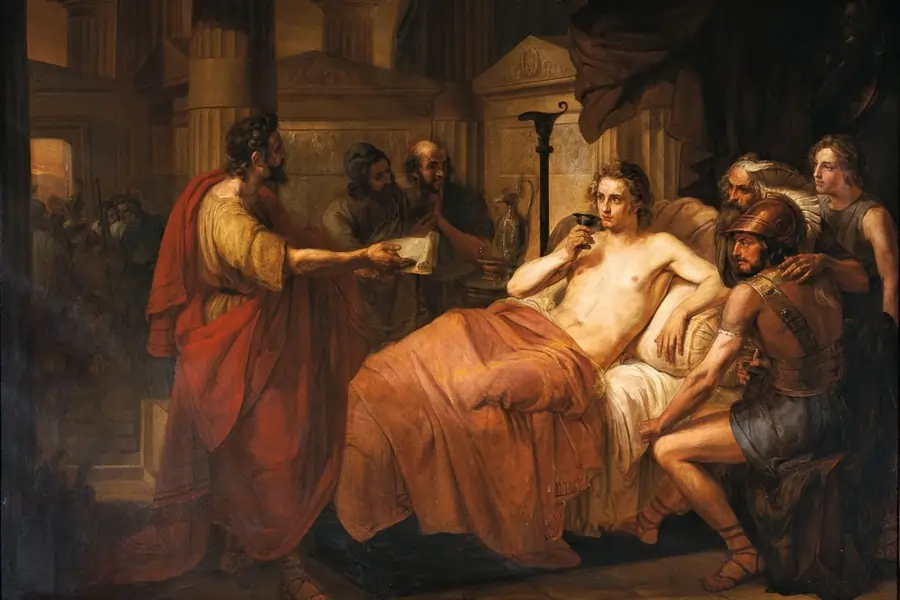
The historical Alexander disappeared in 323 BC, dying in Babylon at only 32 years of age. However, the Gordian Knot became one of the most enduring stories associated with Alexander because it transformed a relatively obscure episode at Gordium into a symbol of his character. Whether Alexander cut the knot with his sword or solved the problem by removing the wagon's pin cannot be established with certainty. What survived was the larger idea: Alexander confronted an apparently impossible challenge and found a way to overcome it.
The story gained even greater power because Alexander went on to conquer the Persian Empire and much of the territory that lay beyond it. His later achievements made the prophecy at Gordium appear remarkably prescient, even though there is no historical evidence that the prophecy caused his victories. Over time, the distinction between the historical event and the legendary version became less important than the symbolism attached to it.
That symbolism survives in the expression "cutting the Gordian Knot," which now describes solving a seemingly impossible problem through a bold or unconventional approach. The enduring lesson of the story is therefore not simply that Alexander used a sword. It is that a problem's apparent rules do not always determine its solution-and that sometimes the most effective response is to approach the problem from an entirely different direction.
Did Alexander really cut the Gordian Knot? We cannot know with certainty.
Did he solve it? Ancient tradition says that he did.
Did he eventually rule much of Asia? Yes, on a scale that made the old prophecy seem remarkably prophetic.
Sources and References
- Arrian, Anabasis of Alexander, Book 2.3. The account describes the Phrygian tradition surrounding Gordius, the prophecy concerning rule over Asia, the two explanations for Alexander's solution, and the thunder and lightning that followed.
- Plutarch, Life of Alexander, 18. Plutarch records both the famous sword-cutting version and Aristobulus' alternative explanation involving the wagon pin.
- Penn Museum, Digital Gordion, "The Gordian Knot." Provides archaeological and historical context for Gordium and the tradition associated with the wagon.
- Quintus Curtius Rufus (History of Alexander). A later ancient narrative source for Alexander's campaigns and the Gordian episode.
Books and Memorables
This article may contain affiliate links. If you purchase through these links, I may earn a small commission at no extra cost to you.


Related Articles

Frequently Asked Questions
What was the Gordian Knot and why was it important to Alexander the Great?
The Gordian Knot was an ancient knot attached to a sacred wagon associated with Gordius, the legendary founder of the Phrygian royal dynasty. A prophecy stated that whoever loosened the knot would become ruler of Asia. When Alexander the Great encountered the knot at Gordium in 333 BC, he treated the prophecy as a significant omen during his campaign against the Persian Empire.
Did Alexander the Great actually cut the Gordian Knot?
It is uncertain whether Alexander actually cut the Gordian Knot with his sword. Arrian and Plutarch both preserve the famous sword-cutting version, but they also report an alternative account attributed to Aristobulus. According to Aristobulus, Alexander removed a pin securing the yoke to the wagon pole and detached the yoke without cutting the knot. The ancient sources therefore do not allow the exact method to be established with certainty.
How did Alexander solve the Gordian Knot according to ancient sources?
Ancient sources preserve two explanations for how Alexander solved the Gordian Knot. The famous tradition says that he drew his sword and cut through the knot. A second account, attributed to Aristobulus, says that Alexander discovered the pin securing the yoke and removed it, allowing the yoke to be detached. Both Arrian and Plutarch preserve these competing versions.
What was the prophecy of the Gordian Knot?
The Gordian Knot prophecy stated that the person who successfully loosened the knot would become ruler of Asia. Arrian records this version, while Plutarch preserves a broader tradition connecting the knot with rulership of the world. Alexander's subsequent conquest of the Persian Empire made the prophecy appear remarkably significant to later generations.
What does cutting the Gordian Knot mean today?
Cutting the Gordian Knot is a modern expression for solving a complicated or seemingly impossible problem through a bold and unconventional action. Instead of trying to resolve every individual difficulty, a person may remove the central obstacle or change the way the problem is approached. The expression comes directly from the traditional story of Alexander at Gordium.
When did Alexander encounter the Gordian Knot?
Alexander encountered the Gordian Knot at Gordium in Phrygia in 333 BC, during his campaign against the Persian Empire. He had already defeated Persian forces at the Battle of the Granicus River in 334 BC and was preparing to continue eastward toward the main Persian army under King Darius III.
Add Comment