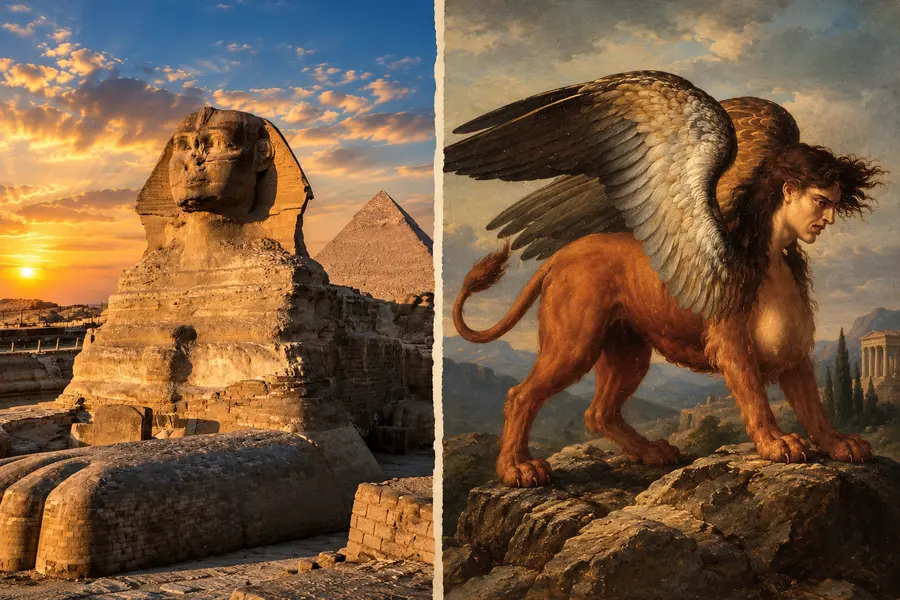
The Sphinx is one of the most enduring creatures of the ancient world. However, the familiar image hides two very different traditions. In ancient Egypt, the Sphinx was primarily a powerful royal and sacred symbol. A lion's body joined to a human or divine head, representing strength, protection, kingship, and the power of the pharaoh. In Greek mythology, however, the Sphinx became a terrifying female monster who haunted Thebes, killed those who could not answer her riddle, and ultimately met her fate when Oedipus solved it. The Great Sphinx of Giza and the Sphinx of Oedipus therefore belong to related artistic traditions, but they do not tell the same story.
Understanding that distinction reveals why the Sphinx has survived for thousands of years as a symbol of mystery. From the royal monuments of ancient Egypt to Greek tragedy and modern popular culture, the Sphinx has repeatedly been transformed. From guardian to monster, from divine symbol to riddle-maker, and finally into an enduring metaphor for an unsolved mystery.
Table of Contents
- What Is the Sphinx?
- The Sphinx in Egyptian Mythology
- The Great Sphinx of Giza
- What Does the Sphinx Represent in Egypt?
- The Origin of the Sphinx in Greek Mythology
- Oedipus and the Riddle of the Sphinx
- What Happened to the Sphinx?
- Egyptian Sphinx vs. Greek Sphinx
- The Legacy of the Sphinx
- Why the Sphinx Still Fascinates Us
- References and Further Reading
What Is the Sphinx?
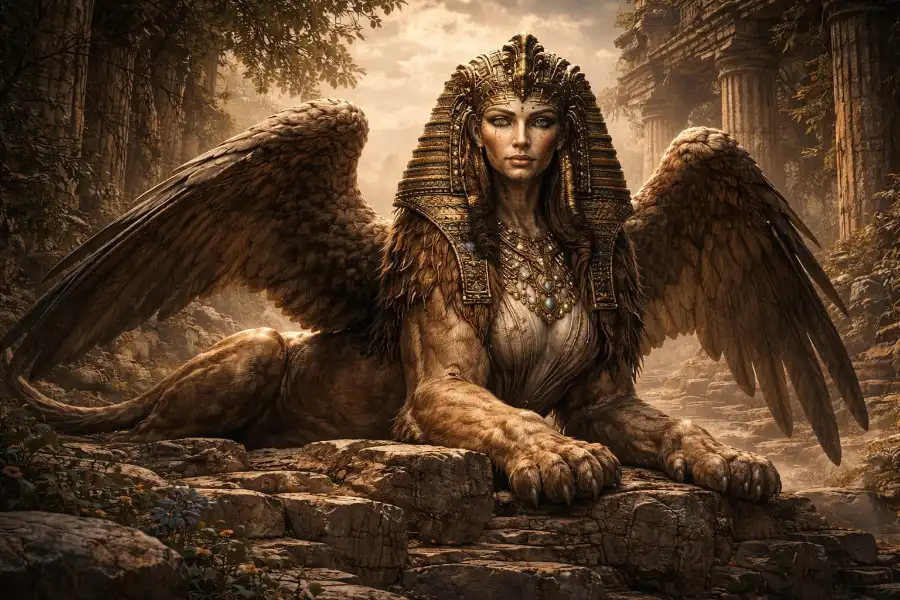
A sphinx is a composite creature traditionally depicted with the body of a lion and a human head. The combination is important. The lion represented physical strength and royal power, while the human or divine head could connect the image with royal or divine power. The word "sphinx" itself is Greek. Ancient Egyptians had their own names and concepts for these composite figures, and the modern term should not be assumed to describe a single Egyptian mythical creature with one fixed identity. The Greek word was later applied to Egyptian statues because Greek observers recognized a visual resemblance between Egyptian royal monuments and their own mythological Sphinx.
Egyptian sphinxes could also vary considerably. Some had human heads, while others could possess the heads of rams or falcons. The Metropolitan Museum of Art notes that sphinxes in Egyptian art commonly represented the pharaoh, while lion imagery carried longstanding associations with kingship and divine guardianship. The Greek Sphinx was something different. She was a female monster associated with Thebes, possessing the body of a lion, the head and breast of a woman, and wings. Ancient sources disagree about some details of her parentage and physical form, but the central story is consistent. She challenged travelers with a deadly riddle until Oedipus succeeded where others had failed.
The Sphinx in Egyptian Mythology
The Egyptian sphinx is best understood not simply as a monster but as an image of royal power and protection. Lions already had a deep symbolic importance in ancient Egypt. Their physical strength, territorial behavior, and association with the horizon made them powerful images of protection. Egyptian artists combined this formidable animal body with the head of a ruler to create a visual statement. The king possessed both human authority and the overwhelming strength of the lion.
The Metropolitan Museum of Art describes the sphinx as a royal symbol in which the strength of the lion is combined with the recognizable features of the ruling king. Sphinxes were also commonly placed as guardians near temples and sacred spaces. This helps explain why Egyptian sphinxes are frequently shown in a calm, recumbent posture. Unlike the Greek monster waiting to attack a traveler, an Egyptian sphinx could appear almost serene. Its role was not necessarily to threaten ordinary people with a puzzle. Instead, its imposing presence proclaimed that the sacred and royal space was protected.
Were Egyptian sphinxes gods?
Not necessarily. The term "sphinx" describes an artistic form rather than one single Egyptian deity. A sphinx could represent a pharaoh, embody divine attributes, or serve a protective function. In later Egyptian history, sphinx imagery was also associated with particular gods and could take on increasingly elaborate forms.
One example is the later god Tutu, who could be represented as a royal sphinx with a lion's body and human head. His iconography demonstrates how flexible the sphinx form became within Egyptian religious imagery. It is therefore more accurate to speak of sphinx imagery in ancient Egyptian religion than to imagine a single Egyptian "Sphinx god" equivalent to the monster in Greek mythology.
The Great Sphinx of Giza
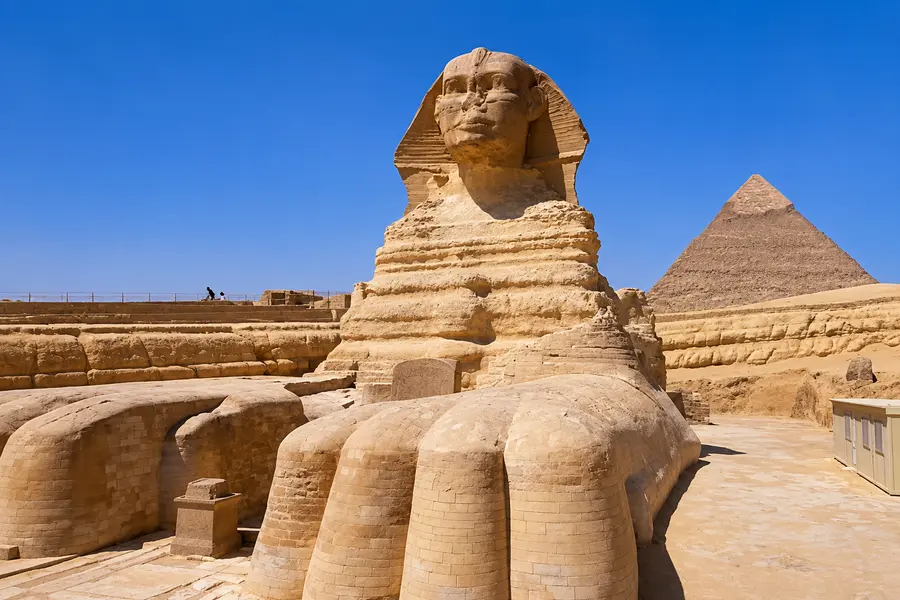
The most famous sphinx in the world is the Great Sphinx of Giza, carved directly from the limestone bedrock on the Giza Plateau in Egypt. The monument dates to Egypt's Fourth Dynasty, generally placed around 2613-2494 BCE. Current evidence strongly associates its construction with the reign of Khafre, the king who built the second great pyramid at Giza. The Egyptian Ministry of Tourism and Antiquities notes the similarities between the Sphinx's facial features and surviving representations of Khafre, as well as the monument's close architectural relationship with Khafre's valley temple and pyramid complex.
| Feature | Great Sphinx of Giza |
|---|---|
| Location | Giza Plateau, Egypt |
| Period | Fourth Dynasty, Old Kingdom |
| Likely ruler represented | Khafre |
| Form | Lion's body with human/royal head |
| Material | Natural limestone bedrock |
| Primary symbolism | Royal power, protection, kingship and divine associations |
| Later religious identity | Associated with Horemakhet, "Horus in the Horizon" |
The scale of the monument is extraordinary, but its location is equally significant. The Sphinx was not an isolated sculpture randomly placed in the desert. It formed part of the monumental landscape surrounding Khafre's pyramid complex. Its proximity to temples and the pyramid suggests that its meaning was connected to the king, his mortuary cult, and the sacred geography of Giza.
The Sphinx and Horus in the Horizon
Centuries after its construction, the Great Sphinx acquired another important religious identity. During the New Kingdom, it became associated with Horemakhet, meaning "Horus in the Horizon." The monument was consequently incorporated into a religious tradition centered on the sun and the rebirth of divine power. This later interpretation is recorded in connection with the monuments erected around the Sphinx. The Egyptian Ministry of Tourism and Antiquities notes that Amenhotep II established a temple near the Sphinx dedicated to Horemakhet, while Thutmose IV later erected the famous Dream Stela between the creature's paws.
The Dream Stela and Thutmose IV
The Dream Stela tells one of the most famous later stories connected with the Great Sphinx. According to the inscription, the young prince Thutmose fell asleep near the monument when much of the Sphinx was buried by sand. In the dream, the Sphinx appeared to him and promised him the kingship if he cleared away the sand that covered its body.
Thutmose eventually became Pharaoh Thutmose IV and carried out restoration work at the monument. A fragment of the Sphinx's later beard is now held by the British Museum, which also records the monument's later association with Horemakhet and the restoration tradition surrounding Thutmose IV. The story transformed the Sphinx from an ancient royal monument into something more personal. A sacred being capable of communicating with a future king.
What Does the Sphinx Represent in Egypt?
The meaning of the Egyptian sphinx changed across thousands of years, but several themes remained remarkably consistent.
1. Royal power
The lion was one of the strongest visual symbols available to Egyptian artists. Giving a pharaoh a lion's body transformed royal authority into physical strength. The British Museum similarly describes the Egyptian sphinx as an expression of royal power, combining the physical strength of the lion with the authority of the king.
2. Protection
Sphinxes were frequently used as guardians. They could stand at temple entrances or line ceremonial approaches, creating a symbolic boundary between ordinary space and sacred space. Their posture, lying forward with powerful legs ready to move, reinforced their protective character.
3. Divine kingship
The sphinx united two worlds. The lion represented animal strength and cosmic power, while the human head represented the individual ruler. The result was an image of the pharaoh as more than an ordinary human ruler.
4. Solar power and the horizon
The association of the Great Sphinx with Horemakhet connected the monument with Horus and the horizon. The lion itself had ancient associations with the horizon and the rising sun, making the Sphinx an especially powerful image of renewal and divine protection.
The Origin of the Sphinx in Greek Mythology
The Greek Sphinx developed into a distinctly different figure within Greek mythology. Greek tradition imagined the Sphinx as a monstrous female creature associated with Thebes. She had a woman's head and upper body, the body and tail of a lion, and wings. Some ancient descriptions add other features, and surviving sources disagree over her exact genealogy. Hesiod's Theogony, one of the earliest surviving Greek sources to mention the creature, describes the Sphinx as a child of Orthus and the Chimera. Later writers, including Apollodorus, instead give her Typhon and Echidna as parents. These variations are typical of Greek mythology, where myths were preserved through multiple local and literary traditions rather than a single authoritative canon.
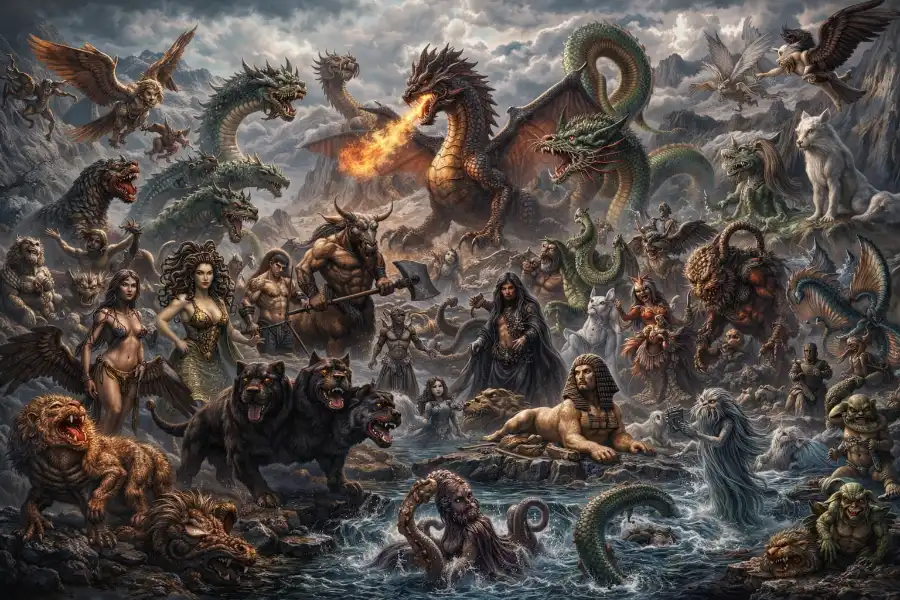
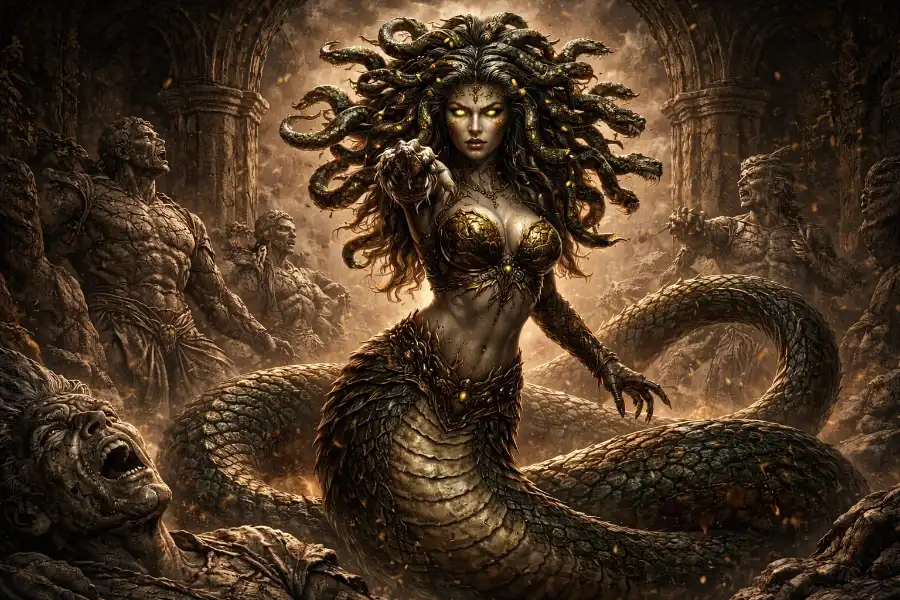
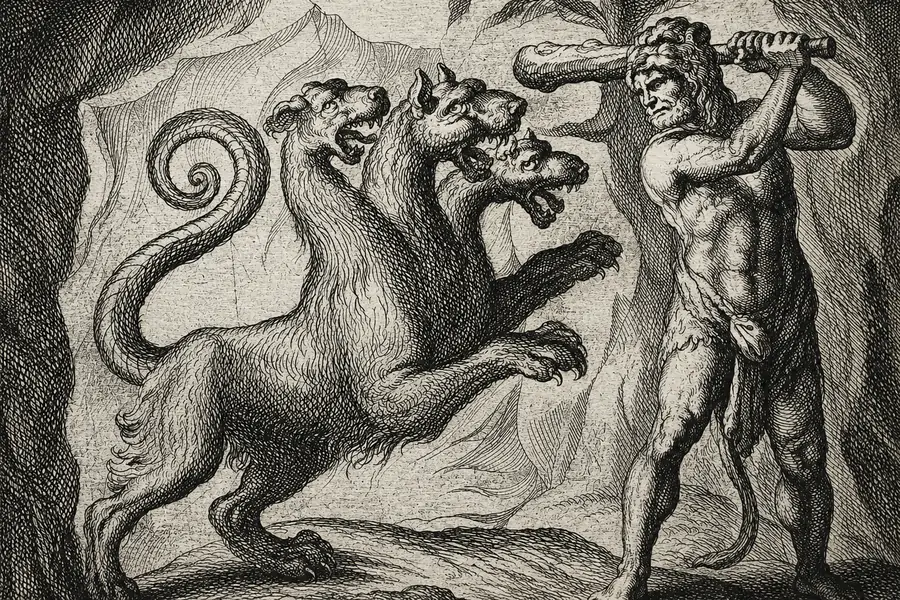
The Sphinx was sent to plague Thebes. She established herself near the city and challenged those who encountered her. Anyone who could not answer her riddle was killed. That detail makes the Greek Sphinx fundamentally different from the Egyptian royal sphinx. The Egyptian creature represented protection and authority. The Greek monster represented danger, death, and the limits of human knowledge. The Sphinx therefore belongs among the great monsters of Greek mythology, alongside creatures such as Medusa and Cerberus. Yet her weapon was unusual. Medusa could turn people to stone, and Cerberus guarded the realm of the dead, while the Sphinx killed through a test of intelligence. For another look at the wider tradition of Greek monsters, see the most dangerous mythological creatures and monsters.
Oedipus and the Riddle of the Sphinx
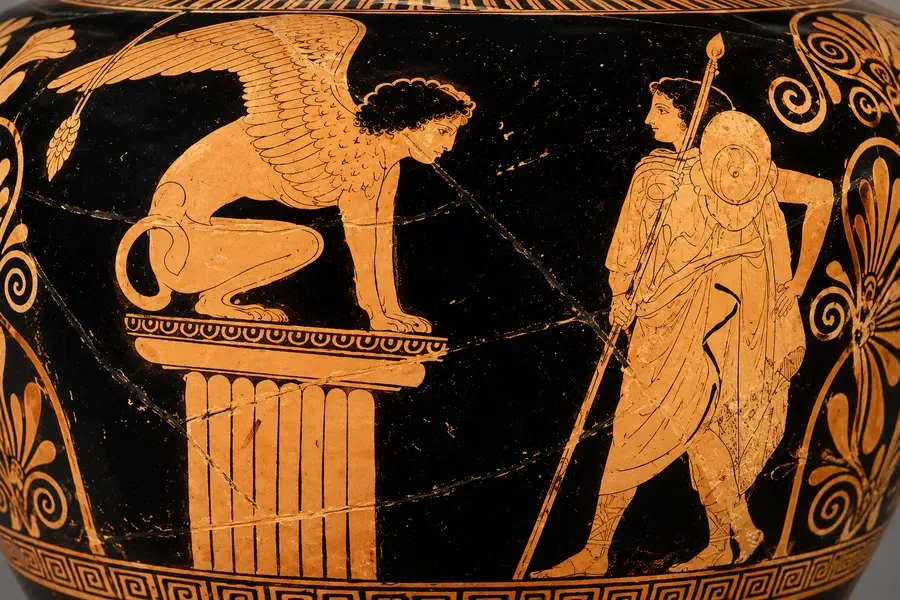
The most famous episode in the history of the Sphinx begins when Oedipus arrives at Thebes. The Sphinx had been devastating the city, killing those who could not solve her riddle. According to the account preserved by Pseudo-Apollodorus, the riddle asked what creature had one voice but became four-footed, two-footed, and three-footed.
Oedipus answered: man.
The explanation was simple but brilliant. A human being crawls on four limbs as an infant. As an adult, he walks upright on two legs. In old age, he may use a walking stick as a third support. The answer exposed the weakness hidden inside the Sphinx's seemingly impossible question. The solution was not a strange beast or supernatural creature. It was humanity itself.
"What is that which has one voice and yet becomes four-footed and two-footed and three-footed?"
The ancient tradition says that the Sphinx then destroyed herself by throwing herself from the height where she had been waiting. Apollodorus records that Oedipus subsequently became king of Thebes, unknowingly marrying Jocasta and fulfilling the terrible prophecy that lies at the heart of his wider story.
Why is the riddle so powerful?
The riddle works because it compresses an entire human life into a single image. Childhood, adulthood, and old age are transformed into three different forms of movement. That makes the Sphinx more than a monster. She becomes a symbol of a question humanity cannot escape: what does it mean to be human?
There is also an important irony. Oedipus is celebrated because he can answer the Sphinx's question, yet he cannot answer the larger mystery of his own identity. He knows the answer to the riddle of humanity while remaining ignorant of his own origins. That contradiction is central to the tragedy of Oedipus. His intellectual victory over the Sphinx becomes one step toward the discovery of a truth he desperately wishes he did not know. The encounter became a popular subject in Greek art. Fifth-century BCE Athenian vase paintings depict Oedipus contemplating the winged Sphinx, demonstrating how deeply the story had entered Greek visual culture.
What Happened to the Sphinx?
The answer depends on which Sphinx we mean. The Greek Sphinx dies at the end of the story of Oedipus. In the best-known tradition, she throws herself from a height after Oedipus solves her riddle. Ancient authors preserve slightly different versions of the episode, but her defeat marks the end of her role as the terror of Thebes. The Great Sphinx of Giza never disappeared. Instead, it endured for thousands of years, repeatedly buried, uncovered, restored, reinterpreted, and studied.
Sand repeatedly accumulated around the monument. The Dream Stela of Thutmose IV preserves one ancient restoration episode, while modern archaeological work has continued to address the monument's preservation and history. The Sphinx also lost parts of its original appearance. Its nose is famously missing, although the popular story that Napoleon's soldiers destroyed it is not supported by the evidence. Drawings made before Napoleon's Egyptian campaign already show the missing nose. The monument also lost much of its ceremonial beard; fragments are preserved in museums, including the British Museum.
Egyptian Sphinx vs. Greek Sphinx
The similarities between the two traditions are striking enough to create confusion, but their differences are even more important.
| Feature | Egyptian Sphinx | Greek Sphinx |
|---|---|---|
| Typical form | Lion's body with human or divine head | Female human head and lion body, usually with wings |
| Primary association | Pharaoh, kingship, protection and divinity | Thebes, death, riddles and catastrophe |
| Typical role | Guardian and royal symbol | Monster and killer |
| Most famous example | Great Sphinx of Giza | Sphinx of Thebes |
| Connection with a ruler | Often directly represents the king | Defeated by Oedipus |
| Relationship with riddles | None central to its Egyptian function | Central to the myth |
| Ultimate fate | Survived as a monument | Killed/destroyed after Oedipus solved the riddle |
The important point is that the Great Sphinx of Giza is not the creature that challenged Oedipus. The two were connected in later cultural imagination because Greek writers used the word "sphinx" for a class of Egyptian and Near Eastern composite creatures, while Greek mythology developed its own distinctive monster. There was, however, a broader cultural world in which composite creatures circulated between Egypt, the Near East, and the Greek world. Winged sphinxes appear in Egyptian and Near Eastern contexts, while Greek artists developed their own distinctive versions. The Metropolitan Museum, for example, notes that wings became part of some Egyptian sphinx imagery during later periods, showing that the iconography itself was not completely static.
The Legacy of the Sphinx
The Sphinx survived because it offered later civilizations something almost irresistible. An image that could mean several things at once. To the ancient Egyptians, the lion-human form expressed the power of kingship and the protection of sacred places. To the Greeks, the Sphinx became a terrifying guardian of forbidden knowledge. To later writers, she became the embodiment of mystery itself. Her influence can be seen throughout literature, art, archaeology, architecture, and popular culture. The phrase "riddle of the Sphinx" has become part of everyday language, even among people who have never read Sophocles or encountered the ancient Greek sources.
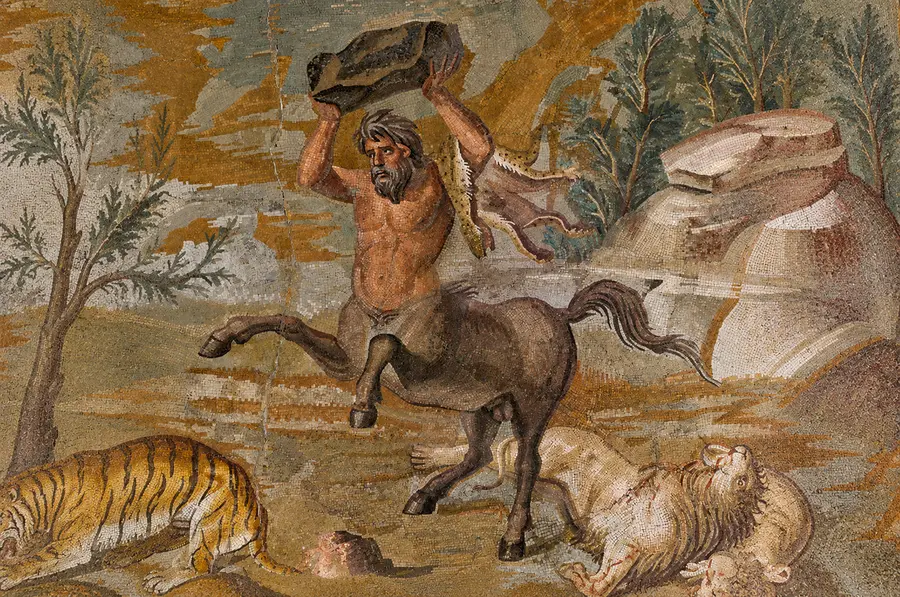
The Sphinx also became closely associated with the broader fascination with ancient Egypt. European travelers, artists, archaeologists, and writers repeatedly used the monument as an emblem of an ancient civilization whose meanings seemed partly hidden beneath the desert. Its modern symbolism is therefore broader than either ancient tradition. Today, a sphinx can represent mystery, silence, wisdom, secrecy, power, guardianship, or an unanswered question. That flexibility explains why the creature continues to appear in modern fantasy and mythology. It sits naturally alongside other legendary beings such as the Cerberus of Greek mythology, the tragic figure of Medusa, and the Centaurs of Greek mythology.
Why the Sphinx Still Fascinates Us
The Sphinx has survived for more than four thousand years because it is more than a statue and more than a monster. The Great Sphinx of Giza embodies the Egyptian connection between kingship, divine power, protection, and the strength of the lion. Its monumental silence reflects the worldview of a civilization that built enormous monuments to connect earthly rulers with the divine order. The Greek Sphinx, by contrast, turns the same basic idea of a human-animal hybrid into something darker. She stands at the boundary between knowledge and ignorance, demanding that humans prove that they understand themselves. Oedipus succeeds, but his victory is bitterly ironic because the mystery of his own identity remains unsolved.
That may be the deepest reason the Sphinx remains so compelling. She asks us to look at the boundary between what we know and what we do not. The Egyptian Sphinx watches silently over the landscape; the Greek Sphinx demands an answer. One guards a sacred monument. The other guards a secret. And thousands of years later, both remain impossible to ignore.
References and Further Reading
- Egyptian Ministry of Tourism and Antiquities - Great Sphinx of Giza: construction, relationship with Khafre, Horemakhet and the Dream Stela.
- The Metropolitan Museum of Art - Egyptian sphinx imagery, royal symbolism, temple guardianship, and examples of royal sphinxes.
- The Metropolitan Museum of Art - Sphinx of Thutmose III and the development of Egyptian royal sphinx imagery.
- British Museum - Great Sphinx material, the later association with Horemakhet and the restoration tradition of Thutmose IV.
- Hesiod and later Greek mythographers - ancient traditions concerning the genealogy and nature of the Greek Sphinx.
- Pseudo-Apollodorus, Bibliotheca - the Sphinx's riddle and Oedipus's answer.
- Diodorus Siculus, Library of History - an additional ancient account of Oedipus and the Sphinx's riddle.
Books and Memorables
This article may contain affiliate links. If you purchase through these links, I may earn a small commission at no extra cost to you.


Related Articles

Frequently Asked Questions
What did the Sphinx represent in ancient Egypt?
In ancient Egypt, the sphinx represented royal power, strength, protection, and divine authority. Its lion's body symbolized the strength and ferocity of the king, while its human head connected that power with the pharaoh. Sphinxes were often placed near temples, sacred spaces, and royal monuments as protective figures. The Great Sphinx of Giza was later associated with Horemakhet, or Horus in the Horizon, giving it an additional connection with the sun and divine kingship.
Is the Great Sphinx of Giza the same Sphinx from the story of Oedipus?
No. The Great Sphinx of Giza and the Sphinx from the story of Oedipus belong to different cultural traditions. The Egyptian Sphinx was generally a male, wingless figure with a lion's body and human or royal head, associated with kingship and protection. The Greek Sphinx was a female winged monster with a woman's head and lion's body who terrorized Thebes by killing people unable to solve her riddle. Although the two share a similar hybrid form, their meanings and mythology are very different.
What was the riddle of the Sphinx in Greek mythology?
The famous riddle of the Greek Sphinx asked what creature walks on four legs in the morning, two legs at midday, and three legs in the evening. Oedipus answered 'man.' The answer refers to the stages of human life: a baby crawls on four limbs, an adult walks on two legs, and an elderly person may use a walking stick as a third support. Oedipus was able to solve the riddle when other travelers had failed.
Why did the Sphinx kill people who could not answer her riddle?
In Greek mythology, the Sphinx was a dangerous monster sent to plague the city of Thebes. She confronted travelers and demanded that they solve her riddle. Those who failed were killed and devoured. The riddle therefore functioned as a deadly test rather than simply a puzzle. The story presents the Sphinx as a creature that combines physical danger with intellectual power, making her different from many Greek monsters that rely primarily on brute strength.
What happened to the Sphinx after Oedipus solved the riddle?
After Oedipus correctly answered the Sphinx's riddle, the Sphinx was defeated. In the best-known ancient tradition, she threw herself from her rocky position and died. Her defeat ended the threat that had been terrorizing Thebes, and Oedipus was rewarded with the throne. This victory, however, began the tragic part of Oedipus's story because he later discovered that he had unknowingly fulfilled a prophecy by killing his father and marrying his mother.
Why is the Egyptian Sphinx different from the Greek Sphinx?
The Egyptian and Greek Sphinxes developed different meanings despite sharing a lion-human form. Egyptian sphinxes were primarily associated with royal authority, strength, divine power, and protection, and they were generally depicted without wings. The Greek Sphinx was a female winged monster associated with Thebes, death, and the riddle challenged by Oedipus. The Egyptian Sphinx protected sacred and royal spaces, while the Greek Sphinx threatened travelers and killed those who could not answer her question.
Add Comment