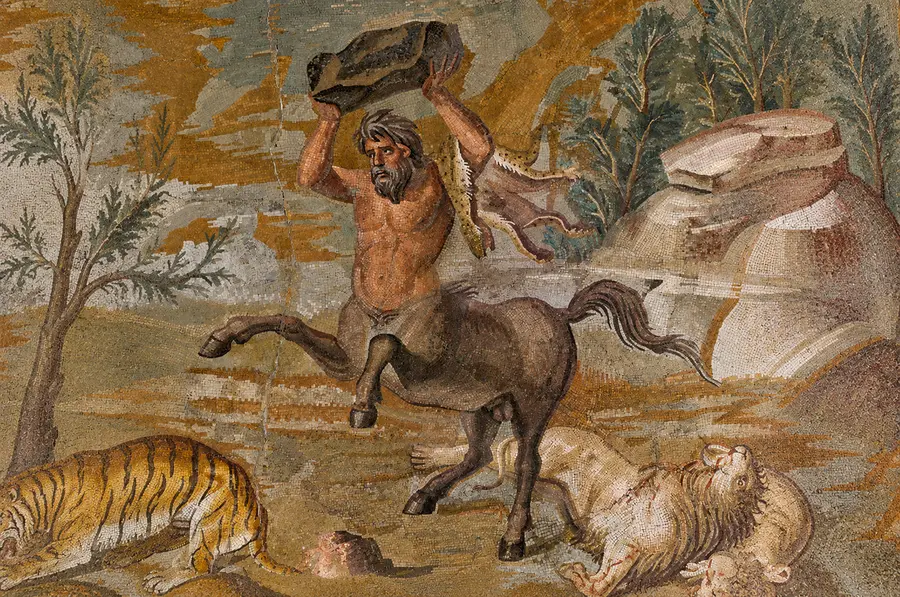
Half human and half horse, centaurs were among the most fascinating creatures in Greek mythology. Yet they were more than wild monsters roaming the mountains. Greek stories used centaurs to explore the uneasy boundary between civilization and instinct, wisdom and violence, self-control and excess. Most were portrayed as unruly and dangerous, but figures such as Chiron showed that a centaur could also represent wisdom, healing, education, and heroic virtue.
From the violent Centauromachy at the wedding of the Lapith king Peirithous to the tragic story of Nessus and Heracles, centaurs repeatedly appear at moments when human order begins to break down. Their unusual nature also made them powerful subjects for Greek artists, who transformed the struggle between centaurs and heroes into one of the defining images of ancient Greek art. This article explores the origins of centaurs, the Centauromachy, Chiron, Nessus, the symbolism of centaurs, and their enduring legacy.
Table of Contents
What Were Centaurs?
Centaurs, known in ancient Greek as kentauroi, were mythical beings with the upper body of a human joined to the body and four legs of a horse. In the form that eventually became standard in Greek art, the human torso emerged from the horse's body at the point where the animal's neck would normally begin. Their physical form immediately created a contradiction. A centaur possessed human intelligence, hands, speech, and emotions, yet was also physically tied to the animal world. Ancient Greek artists exploited this duality to portray centaurs as embodiments of uncontrolled appetite and physical aggression. The Princeton University Art Museum notes that centaurs could represent both savage brutality and courage or benevolence, making their personalities as divided as their bodies.
Most centaur myths associate them with the mountainous regions of Thessaly, particularly Mount Pelion. They were imagined as creatures of the wilderness rather than members of settled Greek society. They hunted, drank wine, fought, and frequently violated the customs expected of civilized men. That distinction is important because Greek mythology did not simply ask whether centaurs were good or evil. Instead, their stories repeatedly ask what happens when human reason loses control over physical desire. The centaur therefore became a useful mythological figure for exploring the tension between the civilized human and the untamed animal.
| Feature | Typical depiction | Mythological significance |
|---|---|---|
| Body | Human torso with horse body and legs | Blurs the boundary between human and animal |
| Habitat | Mountains and forests | Represents the wilderness beyond the city |
| Behavior | Violent, drunken, impulsive | Associated with excess and lack of self-control |
| Exceptions | Chiron and a few others | Show that instinct can coexist with wisdom |
The visual idea was already established surprisingly early. A bronze group from around 750 BCE in the Metropolitan Museum of Art depicts a man fighting a centaur, demonstrating how early Greek artists were fascinated by the hybrid creature.
The Origin of the Centaurs
There was no single universally accepted creation story for all centaurs. Ancient Greek mythology frequently preserved several versions of the same tradition, and the centaurs are a good example of this flexibility. One important genealogy begins with Ixion, king of the Lapiths. Ixion was notorious for his crimes and eventually became obsessed with Hera, Zeus's wife. According to a tradition recorded by Diodorus Siculus, Zeus created a cloud resembling Hera, known as Nephele, and Ixion fathered a monstrous offspring with her. This being became associated with the origin of the centaur race.
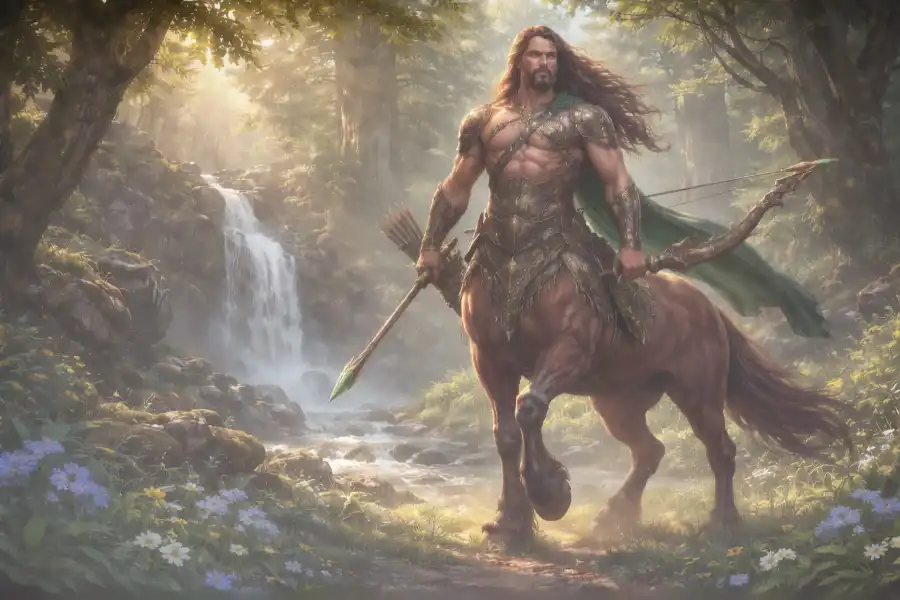
Another tradition distinguishes between the original Centaur, sometimes called Kentauros, and the later race of centaurs. In this version, Kentauros was associated with Ixion and Nephele and subsequently mated with the mares of Mount Pelion, producing the race of half-human, half-horse beings. Ancient sources preserve different genealogies, and later mythographers sometimes blended them together. This complicated genealogy is significant because it connects the centaurs with Ixion's moral transgression. Their very existence could therefore be interpreted as a consequence of uncontrolled desire and disrespect for divine and social boundaries.
Not All Centaurs Had the Same Origin
Chiron provides the clearest exception. He was not descended from Ixion in the usual tradition. Chiron was said to be the son of the Titan Cronus and the Oceanid nymph Philyra. Cronus reportedly took the form of a horse while with Philyra, which explains Chiron's unusual hybrid form. This separate genealogy helps explain why Chiron is so different from the violent centaurs of the Centauromachy. He does not merely behave differently; mythology gives him an entirely different ancestry.
What Did Centaurs Eat?
Greek mythology does not provide a clearly defined diet for centaurs, and ancient sources do not describe a regular food system for the entire race. However, their stories frequently associate them with wine, feasting, hunting, and the wilderness. In the Centauromachy, for example, the centaurs become intoxicated at the wedding feast of Peirithous and Hippodameia, suggesting that they participated in the same communal feasting traditions as humans.
Centaurs were also commonly portrayed as inhabitants of mountainous and forested regions, where hunting would have been a natural part of their existence. Ancient art sometimes depicts them carrying or pursuing game, reinforcing their association with the wilderness. However, it would be misleading to claim that Greek mythology established a specific diet of raw meat, plants, or other foods for all centaurs. Their food habits were not an important enough part of most surviving myths to be described in detail. Wine is therefore more significant to the mythology of centaurs than any particular food. Their inability to control themselves after drinking became a central part of the Centauromachy and helped establish the centaur as a symbol of excess and uncontrolled desire.
The Centauromachy: Centaurs vs. Lapiths
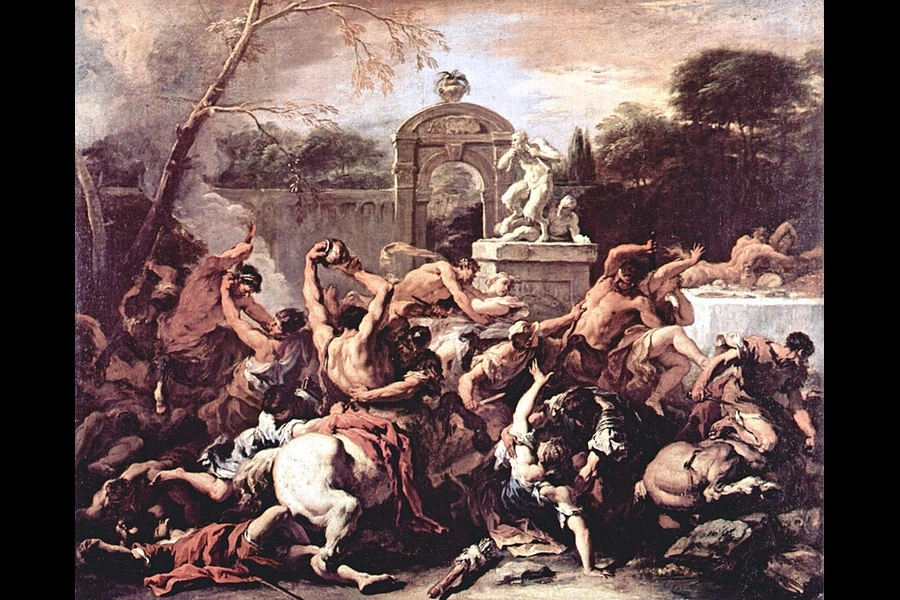
The most famous story involving centaurs is the Centauromachy, the battle between the centaurs and the Lapiths. It began during the wedding celebration of Peirithous, king of the Lapiths, and Hippodameia. The centaurs had been invited to the wedding because they were connected to the same Thessalian world as the Lapiths. Everything initially appeared peaceful. But the centaurs were unaccustomed to wine and quickly became intoxicated. During the feast, one centaur, often identified as Eurytion, attempted to seize Hippodameia. Other centaurs followed, attacking or attempting to carry away women at the celebration. The Acropolis Museum identifies this wedding feast as the central narrative represented by the Parthenon's southern metopes.
The Lapiths fought back. What began as a wedding feast became a chaotic battle between men and centaurs. Weapons were not always conventional. According to the artistic tradition, objects from the banquet itself could become weapons: vessels, furniture, stones, branches, and other objects were used in the struggle. Theseus, the Athenian hero and close friend of Peirithous, played an important role in the battle. His presence gave the story a specifically Athenian dimension. The conflict was no longer simply a fight between neighboring peoples. It became a mythological demonstration of heroic order defeating uncontrolled violence.
Caeneus and the Death of a Nearly Invulnerable Hero
One of the strangest episodes concerns Caeneus, a Lapith warrior who was said to have been transformed from a woman into a man and granted invulnerability by Poseidon. Because ordinary weapons could not harm him, the centaurs changed their tactics. Instead of stabbing Caeneus, they attacked him with enormous tree trunks and stones, eventually forcing him into the ground. This episode became a favorite subject for ancient artists because it allowed the centaurs to appear powerful even against an apparently invulnerable opponent. A late fifth-century BCE bronze centaur in the Metropolitan Museum's collection is associated with the Caeneus episode.
Why Was the Centauromachy So Important?
The Centauromachy became one of the most important visual expressions of the conflict between civilization and savagery in Greek art. The Princeton University Art Museum describes the myth as a vehicle for exploring institutions such as marriage, warfare, and xenia, the Greek ideal of guest-friendship. The message was particularly powerful because the centaurs violated several rules simultaneously. They became intoxicated, abused hospitality, attacked women, and transformed a sacred social occasion into violence. The Lapiths, by contrast, represented the restoration of social order.
The story became enormously influential in Greek sculpture. The western pediment of the Temple of Zeus at Olympia, completed around the middle of the fifth century BCE, depicted the Centauromachy on a monumental scale. The Acropolis Museum also preserves the Parthenon's famous southern metopes, where the battle between Lapiths and centaurs unfolds across a series of violent encounters. Interestingly, the symbolism was not confined to mythology. For Greek audiences, the centaur could stand for the dangerous consequences of abandoning restraint. The battle was therefore simultaneously a heroic adventure and a moral lesson.
Chiron: The Wise Centaur
If the Centauromachy presents the centaur as a symbol of uncontrolled violence, Chiron presents the opposite possibility. He was wise, disciplined, compassionate, and highly educated. Rather than living as a savage outsider, Chiron became a teacher to some of the greatest heroes in Greek mythology. Chiron was associated with Mount Pelion and was renowned for his knowledge of medicine, hunting, music, and other arts. Ancient traditions connected him with the education of heroes including Achilles, Jason, Asclepius, and Heracles. The Princeton University Art Museum specifically identifies Chiron as a wise and just centaur who educated heroes such as Achilles and Jason.
His role as teacher is especially important. Greek mythology frequently presents heroes as possessing extraordinary physical ability but needing instruction in how to use that ability. Chiron represents the civilizing force of education. He possesses the physical nature associated with the centaurs but demonstrates that intelligence, discipline, and knowledge can overcome instinct. His connection with Asclepius is particularly significant. Asclepius became the legendary master of medicine, and Chiron's reputation for knowledge of healing helped connect the centaur with medical wisdom. Later traditions even associated Chiron with the origin of the constellation Centaurus.
Chiron's story also contains a tragic irony. Although he was immortal, he suffered a wound that could not heal. In one tradition, Heracles accidentally wounded him with an arrow poisoned by the Hydra's venom. Chiron eventually surrendered his immortality so that Prometheus could become immortal in his place. The wise teacher who could heal others was unable to heal himself. That paradox makes Chiron one of the most memorable figures in Greek mythology: the centaur who mastered the very instincts that defined his kind, yet remained vulnerable to suffering.
Nessus and the Death of Heracles
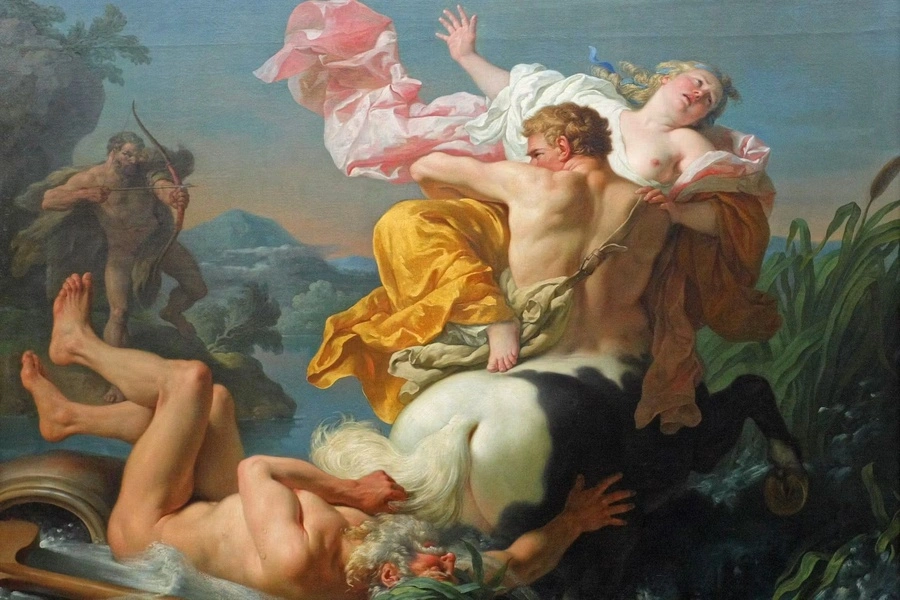
Another famous centaur, Nessus, is remembered for a story that ultimately contributed to the death of Heracles. Unlike Chiron, Nessus belongs to the darker tradition of centaurs whose instincts lead to violence and betrayal. Heracles was travelling with his wife Deianira when they reached the river Evenus. Nessus worked as a ferryman and offered to carry Deianira across the river while Heracles crossed separately. According to the surviving tradition, Nessus attempted to assault Deianira during the crossing.
Heracles responded immediately. He shot Nessus with an arrow that had been poisoned with the deadly venom of the Lernaean Hydra. The dying centaur then devised a final act of revenge. Nessus told Deianira that his blood could preserve Heracles' love. Believing him, she later used blood taken from the centaur to prepare a garment for her husband when she feared he had fallen in love with another woman. The blood, however, had been contaminated by the Hydra's poison. When Heracles put on the garment, the poison caused unbearable agony and ultimately led to his death. The story is preserved in different forms by authors including Sophocles, Apollodorus, Diodorus Siculus, and Ovid.
The story gives Nessus an unusual role in the mythology of Heracles. He does not defeat the hero in combat. Instead, his revenge survives his own death and becomes the indirect cause of Heracles' destruction. Nessus also demonstrates how Greek mythology often treats monsters and supernatural creatures differently from modern fantasy. A creature does not need to be physically invincible to be dangerous. Nessus' greatest weapon was ultimately deception.
What Did Centaurs Symbolize?
The symbolism of centaurs cannot be reduced to a single meaning. Their stories changed depending on the context, and ancient artists could use them to represent different aspects of human experience.
1. Civilization Versus the Wild
The most important interpretation is the contrast between civilization and wilderness. The human half of the centaur suggests intelligence and social identity, while the horse half connects the creature to physical instinct and nature. The Centauromachy makes this symbolism explicit. The centaurs abandon restraint at a wedding feast, while the Lapiths fight to restore order. The Acropolis Museum's description of the Parthenon metopes emphasizes the centaurs' drunken assault on the Lapith women and the resulting battle.
2. The Dangers of Excess
Wine is central to the Centauromachy. The centaurs do not simply drink; they lose control. Their drunkenness becomes a metaphor for excess without restraint. Greek culture valued wine, but it also placed considerable importance on moderation. The centaurs illustrate what happens when pleasure becomes uncontrolled appetite. Their failure is therefore not drinking itself but the inability to stop.
3. The Conflict Within Human Nature
A centaur can also be interpreted as a visual metaphor for the divided human personality. The creature literally contains two natures, one rational and human, the other physical and animal. This interpretation explains why Chiron is so important. He demonstrates that the animal side does not automatically make a being savage. Knowledge and discipline can transform instinct into strength. In this sense, Chiron and the violent centaurs represent two possible outcomes of the same hybrid nature.
4. The Boundary Between Human and Animal
Centaurs also challenged Greek ideas about what counted as human. They spoke, reasoned, formed communities, and participated in human events, yet their bodies placed them permanently outside ordinary society. This fascination with hybrids was widespread in Greek mythology. The same imaginative world produced creatures such as Medusa, whose tragic transformation and monstrous appearance created another complicated boundary between humanity and monstrosity.
| Centaurs can represent | How the myths express it |
|---|---|
| Wildness | Life outside settled civilization |
| Excess | Drunkenness and uncontrolled desire |
| Violence | The battle with the Lapiths |
| Wisdom | Chiron's teaching and healing |
| Human duality | The combination of human intelligence and animal instinct |
The Legacy of the Centaurs
The centaur survived far beyond the myths in which it first appeared. Few creatures from Greek mythology have proved so visually adaptable. Ancient Greek sculptors repeatedly used centaurs to create dramatic scenes of movement, struggle, and physical power. The Parthenon's southern metopes are perhaps the best-known example. Dating to the fifth century BCE, the series presents the Centauromachy through individual confrontations between Lapiths and centaurs. One surviving metope shows a Lapith attacking a centaur with a sword, while another depicts a centaur attempting to seize a Lapith woman.
The Temple of Zeus at Olympia used the same myth on its western pediment. Cambridge's Faculty of Classics notes that the pediment presents a Centauromachy with Apollo at the center, contrasting the god's rational order with the violence unfolding around him. Centaur imagery continued into the Hellenistic and Roman periods, although its meaning could change. The Metropolitan Museum of Art notes that by the Hellenistic period centaurs could appear in more playful and pastoral settings alongside figures such as Eros and Dionysus, rather than always representing savage enemies of civilization.
Later European artists returned repeatedly to the ancient stories. Nessus and Deianira became especially popular subjects, while Theseus fighting a centaur became a powerful image of heroic strength. The Metropolitan Museum's collection includes works inspired directly by Ovid's account of the Centauromachy and by earlier Greek artistic models. Modern fantasy eventually transformed the centaur again. Contemporary depictions often emphasize their noble, mysterious, or magical qualities, particularly through characters inspired by Chiron. But the ancient myths were more complicated. The original Greek centaur was not simply a friendly magical horse-man or a generic monster. He was a contradiction made flesh.
The violent centaurs represented what happened when appetite overcame reason. Chiron represented knowledge overcoming instinct. Nessus represented the destructive consequences of uncontrolled desire and revenge. The Centauromachy turned these ideas into a dramatic conflict between civilization and chaos. >That is why centaurs have endured for more than two thousand years. The centaur remains one of Greek mythology's most effective symbols precisely because the boundary between human and beast is never completely secure. Greek storytellers placed that conflict on the body of a single creature, giving later generations an image that could represent violence, instinct, wisdom, temptation, and the struggle for self-control.
References and Further Reading
- Diodorus Siculus, Library of History, Book 4. Diodorus preserves a genealogy connecting Ixion, Nephele, and the origin of the centaurs.
- Ovid, Metamorphoses, Books 9 and 12. Ovid provides important literary versions of the stories of Nessus and Deianira and the Centauromachy.
- Apollodorus, Bibliotheca. An important mythographical source for the genealogies and adventures of centaurs, Heracles, and other Greek heroes. The surviving tradition concerning Nessus is summarized alongside references to Apollodorus.
- Pausanias, Description of Greece, Book 5. Pausanias records the Centauromachy represented in the sculpture of the Temple of Zeus at Olympia.
- Acropolis Museum, Parthenon South Metopes. The museum's collection documentation provides detailed information about the fifth-century BCE representations of the Centauromachy.
- Metropolitan Museum of Art. Its Greek and Roman collections preserve early and Classical representations of centaurs and demonstrate their continuing importance in Greek art.
- Princeton University Art Museum, The Centaur's Smile: The Human Animal in Early Greek Art. This resource discusses the symbolism of centaurs, their role in Greek art, the Centauromachy, and the contrasting figure of Chiron.
- University of Cambridge, Faculty of Classics. The Temple of Zeus at Olympia collection provides context for the Centauromachy and its relationship to Greek ideas of order and rationality.
Books and Memorables
This article may contain affiliate links. If you purchase through these links, I may earn a small commission at no extra cost to you.


Related Articles

Frequently Asked Questions
What were centaurs in Greek mythology?
Centaurs were mythical creatures with the upper body of a human and the body and four legs of a horse. Greek mythology generally associated them with the mountains and forests of Thessaly, especially Mount Pelion. Many centaur stories portray them as wild, violent, and prone to excess, although figures such as Chiron were famous for wisdom, healing, and teaching heroes.
Where did the centaurs come from in Greek mythology?
One major Greek tradition traces the origin of the centaur race to Ixion and Nephele, a cloud created in the likeness of Hera. Their offspring, Kentauros, was said to have mated with the mares of Magnesia, producing the centaurs. Chiron had a different origin: he was traditionally the son of Cronus and the nymph Philyra, which helps explain why he was portrayed as a wiser and more civilized centaur.
Why did the centaurs fight the Lapiths?
The Centauromachy began at the wedding of the Lapith king Peirithous and Hippodameia. The centaurs became intoxicated during the feast and attempted to seize Lapith women, including the bride. The Lapiths fought back, beginning a major battle in which Theseus also took part. In Greek art, the Centauromachy became a powerful representation of the conflict between civilized society and uncontrolled violence.
Who was Chiron the centaur in Greek mythology?
Chiron was the most famous wise centaur in Greek mythology. Unlike the violent centaurs associated with the Centauromachy, he was renowned for wisdom, medicine, hunting, music, and education. Chiron was traditionally said to have taught heroes including Achilles, Jason, and Asclepius. His character shows that centaurs in Greek mythology were not universally portrayed as savage creatures.
What did centaurs symbolize in ancient Greek mythology?
Centaurs often symbolized the tension between civilization and the wild, reason and instinct, and self-control and excess. Their human and horse bodies made them a natural symbol of divided human nature. Stories such as the Centauromachy emphasized uncontrolled desire and violence, while Chiron represented wisdom and disciplined strength. Their symbolism could therefore change depending on the individual centaur and the myth.
Who was Nessus and how did the centaur cause the death of Heracles?
Nessus was a centaur who offered to carry Heracles' wife Deianira across the river Evenus but attempted to abduct her. Heracles killed Nessus with a poisoned arrow. Before dying, Nessus deceptively told Deianira that his blood could preserve Heracles' love. Years later she used it on a garment given to Heracles, unaware that the poison caused terrible suffering and ultimately contributed to the hero's death.
Add Comment