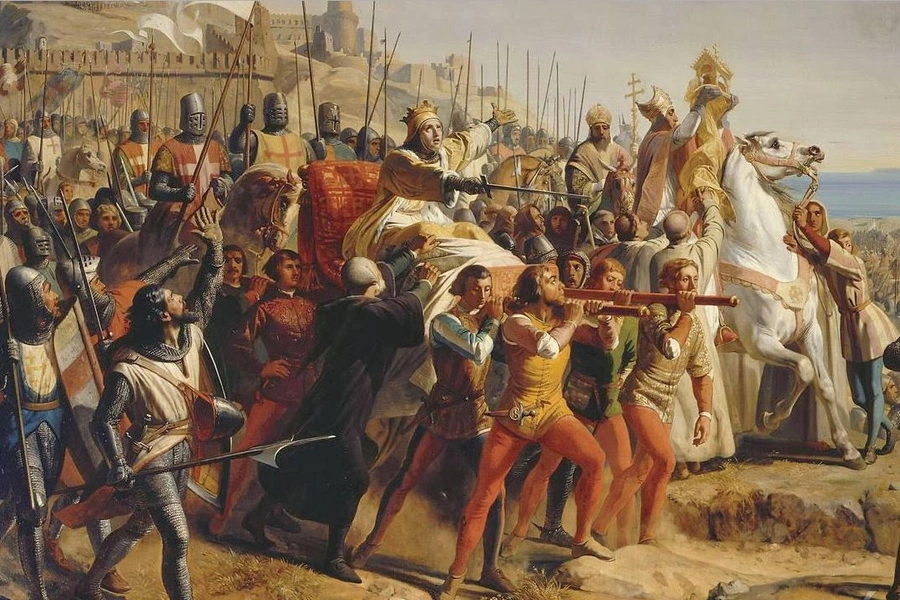
In November 1177, a young king afflicted by leprosy faced one of the most formidable military commanders of the medieval world. Saladin, the ruler of Egypt and much of Syria, had invaded the Kingdom of Jerusalem with a substantial army, expecting to encounter limited resistance. Yet near Montgisard, the campaign took an unexpected turn. Baldwin IV assembled the forces available to him, seized an opportunity to attack the invading army, and inflicted a major defeat on Saladin. The victory became one of the most remarkable episodes in Crusader history, demonstrating how battlefield awareness, timing, and determined leadership could overcome a seemingly stronger opponent.
Table of Contents
The Kingdom of Jerusalem Under Baldwin IV
The Kingdom of Jerusalem was established in 1099 following the First Crusade, when Western European armies captured the city from the Fatimid Caliphate. Over the following decades, the Crusaders established several territories along the eastern Mediterranean coast. However, their survival depended on maintaining military strength against powerful neighbouring Muslim states.
By the 1170s, the kingdom faced an increasingly dangerous situation. Its most formidable opponent was Saladin, who had consolidated his authority over Egypt and was gradually extending his influence into Syria. The unification of these territories created a substantial military and economic power capable of threatening the Crusader states. In 1174, Baldwin IV inherited the throne following the death of his father, King Amalric I. He was just 13 years old. His reign presented an extraordinary challenge because he suffered from leprosy, a disease that affected his peripheral nerves and gradually restricted his physical abilities. The precise progression of his illness is difficult to reconstruct, but its effects became increasingly severe during his reign.
William of Tyre, the kingdom's archbishop and one of its most important contemporary chroniclers, had personally known Baldwin since childhood. His account describes how the young prince's illness was initially recognised through a loss of sensation in his hands. Despite his condition, Baldwin received a royal education and was prepared for the responsibilities of kingship. His illness did not prevent him from demonstrating considerable political and military ability. As his condition worsened, however, the kingdom's succession and internal politics became increasingly complicated. Rival factions among the nobility competed for influence, while the threat from Saladin continued to grow.
Saladin's Rise and the Invasion of 1177
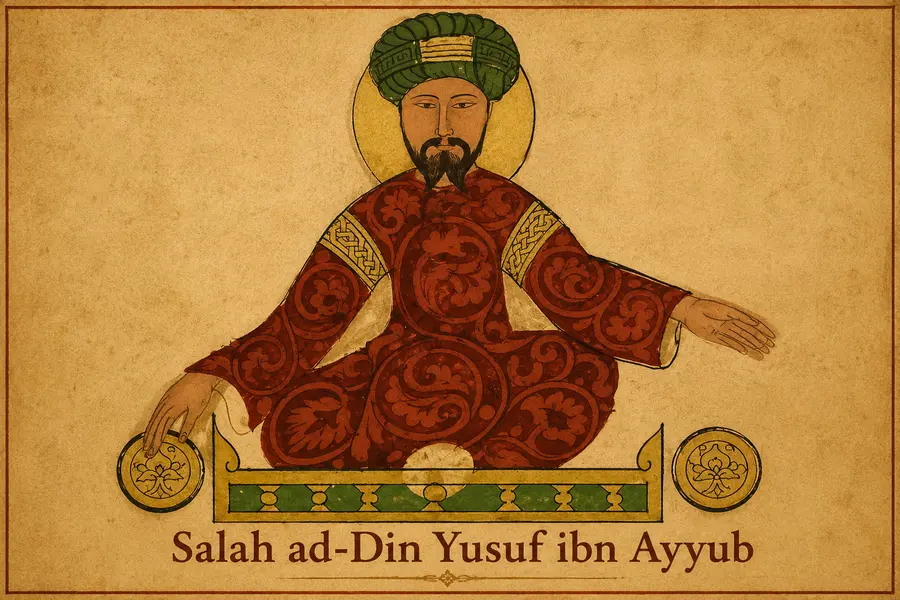
While Baldwin struggled to preserve his kingdom, Saladin was building an empire. Born in Tikrit in 1137 or 1138, Saladin rose through the ranks of the military establishment under the service of Nur ad-Din, the powerful ruler of Syria. In 1169, Saladin became vizier of Egypt, eventually establishing his authority over the country. Following Nur ad-Din's death in 1174, he expanded his influence into Syria and brought Damascus under his control. His growing empire gave him access to considerable resources, manpower, and strategic depth.
Saladin's broader objective was to weaken the Crusader states and eventually bring Jerusalem under his control. His position had strengthened considerably after the consolidation of Egypt and Syria, giving him access to substantial resources. In 1177, he launched a major campaign against the Kingdom of Jerusalem, taking advantage of the difficulties Baldwin faced in assembling his forces. The invasion initially progressed with limited resistance, and Saladin's troops spread across the countryside to raid settlements and collect supplies.
Saladin's advance was initially successful. His soldiers raided settlements, captured prisoners, and devastated agricultural areas. The dispersed nature of the invading force, however, would eventually become a serious weakness.
The Opposing Armies: Crusaders vs Ayyubids
The military imbalance between the two sides was one of the defining features of the campaign. Saladin possessed a larger army, supported by the resources of Egypt and his growing Syrian territories. Baldwin, on the other hand, had to gather whatever forces were available to defend the kingdom.
| Kingdom of Jerusalem | Saladin's Ayyubid forces |
|---|---|
| Heavy cavalry knights | Light and medium cavalry |
| Infantry and crossbowmen | Mounted archers and supporting infantry |
| Knights Templar | Experienced Egyptian and Syrian troops |
| Royal forces and local contingents | Mobile cavalry formations and other contingents |
The Crusader army relied heavily on its armoured knights. These warriors were trained to fight on horseback and could deliver powerful charges when organised into an effective formation. Their armour, weapons and horses made them particularly dangerous in close combat. The Ayyubid forces relied more heavily on mobility. Mounted archers could harass enemy formations, attack from a distance and withdraw before heavier cavalry could engage them. This approach was particularly effective against Crusader armies forced to march across open and exposed terrain.
The Knights Templar provided an important military contingent during the campaign. Their forces were based in the southern Crusader territories and were able to reinforce Baldwin's army as the invasion developed. The exact number of Templars who fought at Montgisard, and the identities of all their commanders, remain uncertain.
The Battle of Montgisard: 25 November 1177
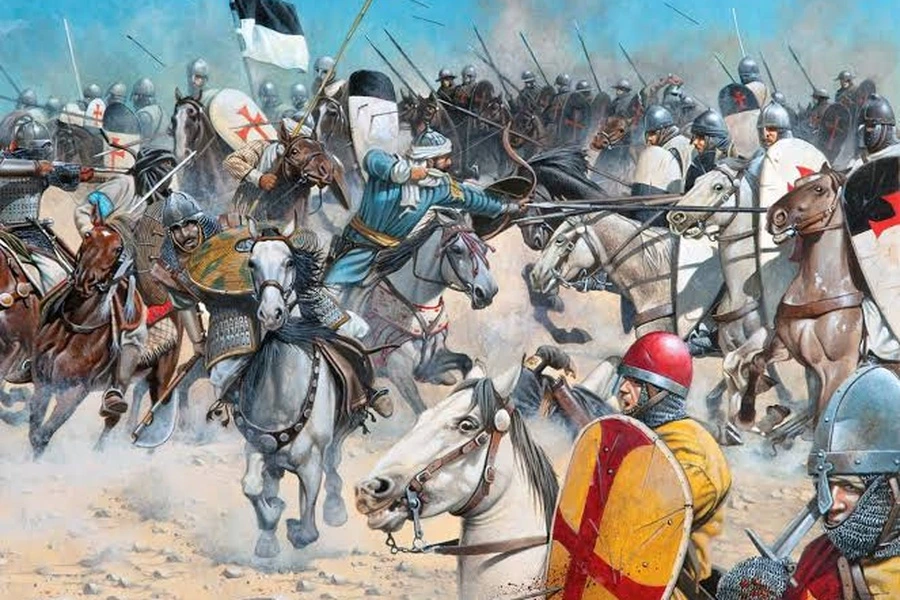
Saladin Advances Towards Jerusalem
Saladin's army reached Ascalon, a strategically important coastal city in the southern Kingdom of Jerusalem, in November 1177. Baldwin moved to confront the invasion but faced a considerable numerical disadvantage. Rather than risk a direct engagement under unfavourable conditions, he withdrew into Ascalon. Saladin apparently considered the immediate Crusader threat contained. He continued his advance into the kingdom, allowing his troops to disperse to raid settlements and gather supplies. This decision reduced the ability of his army to respond quickly if a large enemy force suddenly appeared.
Meanwhile, Baldwin sought to strengthen his position. The Templars, who had been operating in the region around Gaza, were brought into the campaign. Their forces joined the royal army, giving the king additional cavalry and experienced military personnel. The Crusaders now had an opportunity to challenge Saladin. The invading army was no longer concentrated in a single formation, and its dispersed troops were vulnerable to a sudden attack.
Baldwin IV Takes the Initiative
On 25 November 1177, Baldwin's forces encountered Saladin's army in the region traditionally associated with Montgisard. The precise location of the battlefield remains disputed, and modern attempts to identify it with a specific archaeological site have not produced universal agreement. What is clear from the historical accounts is that the Crusaders managed to engage Saladin's forces at a moment when the invading army was vulnerable.
For Baldwin, this was an opportunity to reverse the course of an invasion that threatened the survival of his kingdom. His army was smaller, but Saladin's dispersed formations offered an opening that the Crusaders could exploit.
The Crusader Cavalry Charge
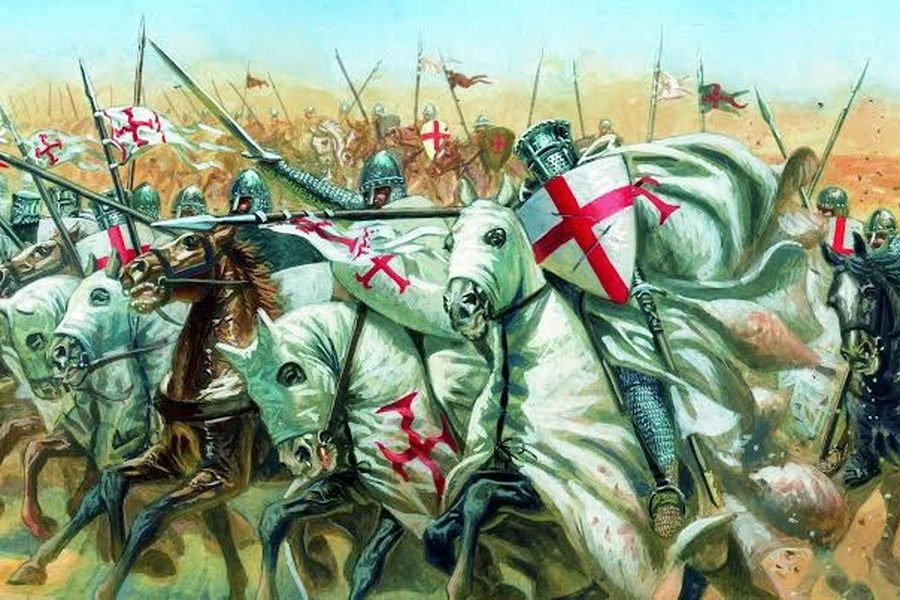
The decisive moment came when Baldwin's forces launched a sudden attack against Saladin's army. The invading troops had spread across the countryside during the campaign, and the sultan's forces were not positioned to respond as a single, fully concentrated formation. The Crusaders exploited this vulnerability, striking with a force that included heavily armoured cavalry and other troops. The attack disrupted the opposing ranks and made it difficult for Saladin's commanders to restore order.
Once the Crusader assault gained momentum, the engagement developed into a rout. Units that could not withstand the attack began to withdraw, while the breakdown of coordination made an organized response increasingly difficult. Saladin narrowly escaped the disaster and retreated with the surviving elements of his army. The defeat was severe, although the precise scale of the casualties cannot be established confidently from the surviving accounts. The sultan himself narrowly escaped capture or death.
The victory was particularly remarkable because Baldwin had managed to turn a seemingly disastrous invasion into a decisive battlefield success. The young king had demonstrated that the numerical superiority of an army did not automatically guarantee victory. The surviving narrative is dominated by William of Tyre's account, which presents the victory as an extraordinary reversal and interprets it partly through the religious significance of the campaign.
The Role of the True Cross
One of the most striking details in Christian accounts of Montgisard is the presence of the True Cross. Believed by Christians to be a relic of the cross on which Jesus was crucified, the relic was carried into battle as a sacred object and a powerful symbol of the Christian kingdom's religious identity. Its presence reflected the religious significance of warfare in the Crusader states. The Crusaders viewed the defence of Jerusalem and its surrounding territories as both a political responsibility and a religious duty.
William of Tyre interpreted the victory through this religious perspective, presenting it as an example of divine assistance. While modern historians must distinguish such interpretations from military evidence, the relic undoubtedly held enormous symbolic importance for Baldwin's army.
Why Did Baldwin IV Win the Battle of Montgisard?
Montgisard was decided by the interaction of opportunity, surprise, and battlefield cohesion. Saladin's invasion had created a situation in which his forces were spread across a wide area. Baldwin was able to bring together the troops available to him and attack when the invading army was vulnerable. The Crusader advantage was not simply the power of its cavalry, but its ability to concentrate force at a moment when the opposing army struggled to respond effectively.
- Exploiting a dispersed enemy: Saladin's troops were spread across the countryside, reducing their ability to assemble quickly against the Crusader attack.
- Effective timing: Baldwin recognised an opportunity to engage the invading army when its organisation was vulnerable.
- Heavy cavalry: The Crusader knights delivered a concentrated assault that disrupted the Ayyubid formations.
- Military cohesion: The ability of Baldwin's forces to organise and fight together was crucial in exploiting the weaknesses of the opposing army.
- Command and determination: Baldwin's decision to take the offensive demonstrated confidence and an understanding of the changing battlefield situation.
It is important not to interpret the battle as proof that Saladin was an incompetent commander. His later campaigns demonstrated considerable strategic and operational ability. Montgisard was a serious setback, but it was also a consequence of the particular circumstances in which his army found itself. The importance of leadership and battlefield decision-making is a recurring theme in military history. Similar lessons can be found in the campaigns of commanders such as Alexander the Great, whose ability to exploit weaknesses in larger enemy armies helped establish his reputation as one of history's greatest military leaders. Our list of the greatest military generals in history explores these qualities in greater detail.
Aftermath of the Battle of Montgisard
The victory did not eliminate the threat posed by Saladin. His territories remained intact, and he continued rebuilding his military strength after the defeat. The Kingdom of Jerusalem still faced serious problems of manpower, resources, and internal political rivalry. In 1179, Saladin defeated the Crusaders at the Battle of Marj Ayyun and captured the fortress at Jacob's Ford. These setbacks demonstrated that Montgisard had not permanently changed the balance of power. Baldwin had won a remarkable victory, but the kingdom's struggle for survival continued.
However, the victory did not eliminate the threat posed by Saladin. His empire remained powerful, and he continued to rebuild his military strength. The Crusader states still faced a significant disadvantage in manpower and resources. Subsequent campaigns demonstrated that Montgisard had not permanently changed the strategic balance. In 1179, Saladin defeated the Crusaders at the Battle of Marj Ayyun and destroyed much of the newly constructed fortress at Jacob's Ford. The kingdom continued to face pressure from the Ayyubid forces.
Baldwin's health also continued to deteriorate. Although he remained politically active and continued to lead his kingdom, his illness increasingly restricted his ability to rule. He died in 1185, leaving behind a kingdom that remained vulnerable to internal divisions and external threats.
The Legacy of Montgisard
The Battle of Montgisard occupies an important place in the military history of the Crusades. It demonstrated that a smaller army could defeat a larger invading force when circumstances, organisation and battlefield timing worked in its favour. For Baldwin IV, the battle became the defining military achievement of his reign. His victory challenged the perception that his illness made him incapable of leading an army and established his reputation as a determined military ruler.
For Saladin, Montgisard was a setback rather than a catastrophe. He retained control over his territories, continued to campaign against the Crusaders, and eventually achieved his most important objective. In 1187, Saladin defeated the Crusader army at the Battle of Hattin. The defeat destroyed much of the kingdom's military strength and allowed him to capture Jerusalem in October of that year. The contrast between Montgisard and Hattin illustrates how dramatically the fortunes of the Crusader states could change within a decade.
Montgisard therefore deserves recognition as one of the remarkable victories of medieval warfare. It was not a permanent turning point in the Crusades, nor did it end Saladin's ambitions. Its significance lies in how Baldwin IV seized an unexpected opportunity to defend a kingdom that appeared increasingly vulnerable. Against a powerful opponent, the young leper king demonstrated that military success depended not only on the size of an army but also on the ability to recognise and exploit the right moment. The battle remains a compelling example of leadership under extraordinary circumstances and a reminder that even the most powerful military campaigns can be undone by a moment of vulnerability.
References and Further Reading
- William of Tyre, A History of Deeds Done Beyond the Sea, translated by Emily Atwater Babcock and A. C. Krey, Columbia University Press, 1943. The principal near-contemporary Latin narrative for Baldwin IV's reign and the campaign of 1177.
- Bernard Hamilton, The Leper King and His Heirs: Baldwin IV and the Crusader Kingdom of Jerusalem, Cambridge University Press, 2000. An important scholarly study of Baldwin IV, his illness, political position, and reign. Read the publisher's book excerpt.
- John France, Crusaders and Settlers in the East, 1096-1291, in The Cambridge History of War. Provides broader context for Crusader military organisation and warfare.
- Fordham University, Internet Medieval Sourcebook, William of Tyre: Baldwin IV Becomes King of Jerusalem. Read the translated primary-source extracts.
- Journal of Medieval Military History, Volume XI. Contains a scholarly discussion of the location, chronology, and historical evidence surrounding Montgisard. Consult the volume.
- Crusades Research Atlas, Battle of Montgisard. A useful reference for the competing accounts of the battlefield location, army sizes, and historical evidence. View the battle record.
Books and Memorables
This article may contain affiliate links. If you purchase through these links, I may earn a small commission at no extra cost to you.


Related Articles


Frequently Asked Questions
Why did Baldwin IV fight Saladin at the Battle of Montgisard?
Baldwin IV fought Saladin at the Battle of Montgisard in November 1177 to defend the Kingdom of Jerusalem against an invading Ayyubid army. Saladin had launched a major campaign into the Crusader territories, expecting limited resistance. Baldwin assembled the available Crusader forces, including Knights Templar, and confronted the invading army near Montgisard. His victory prevented Saladin from achieving his immediate military objectives.
How did Baldwin IV defeat Saladin despite having a smaller army?
Baldwin IV defeated Saladin by exploiting the dispersed state of the Ayyubid army. While Saladin's troops were spread across the countryside conducting raids, Baldwin assembled a concentrated Crusader force and launched an attack when the opposing army was vulnerable. The powerful charge of the Crusader heavy cavalry disrupted the Ayyubid formations and contributed to a major battlefield rout. The exact numerical strength of both armies remains uncertain.
What role did the Knights Templar play in the Battle of Montgisard?
The Knights Templar provided experienced military support to Baldwin IV during the Battle of Montgisard in 1177. Led by their Grand Master, Odo de St Amand, the Templars joined the Crusader forces defending the Kingdom of Jerusalem. Their disciplined cavalry and military experience strengthened Baldwin's army and contributed to the victory over Saladin's invading forces.
Was Baldwin IV personally present at the Battle of Montgisard?
Yes. Baldwin IV personally accompanied the Crusader army during the Battle of Montgisard on 25 November 1177. Despite suffering from leprosy, which progressively affected his physical abilities, he continued to participate in military campaigns. Contemporary accounts describe his presence with the army and the True Cross during the confrontation with Saladin's forces.
Where was the Battle of Montgisard fought in 1177?
The Battle of Montgisard was fought on 25 November 1177 in the southern part of the Kingdom of Jerusalem, near the region of Ramla. The battlefield is traditionally associated with Montgisard and the area around modern Gezer in present-day Israel. The precise location remains debated among historians because medieval accounts do not provide sufficiently detailed geographical information.
Did Saladin recover from his defeat at the Battle of Montgisard?
Yes. Although the defeat at Montgisard in 1177 was a major setback, Saladin retained control of his territories and rebuilt his military strength. He subsequently defeated the Crusaders at Marj Ayyun in 1179 and won the decisive Battle of Hattin in 1187. Following the victory at Hattin, Saladin captured Jerusalem in October 1187, achieving the objective that had driven many of his earlier campaigns.
Add Comment