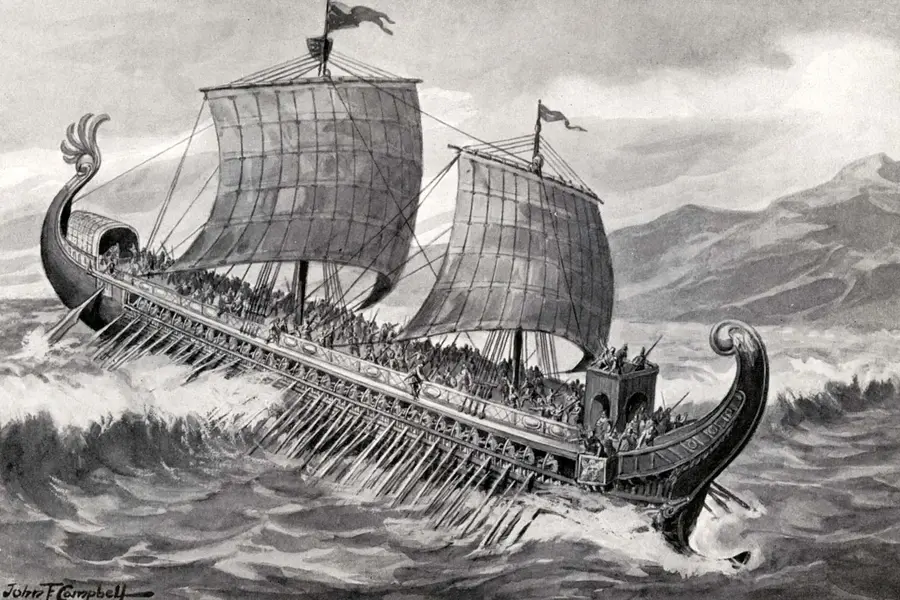
For centuries, control of the Mediterranean was decided not only by armies marching across battlefields but also by fleets fighting for supremacy at sea. From the early war galleys of the eastern Mediterranean to the formidable Greek triremes and enormous Roman quinqueremes, ancient warships transformed the way civilizations fought, traded and built empires. The development of naval technology introduced new weapons, sophisticated manoeuvres and increasingly complex military organizations. It also created a new kind of battlefield, where a skilled crew could destroy a much larger force through speed, coordination and tactical ingenuity. The evolution of ancient naval warfare was therefore more than a story of bigger ships. It was a competition between engineering, manpower and military strategy that ultimately helped determine the fate of Greece, Persia, Carthage and Rome.
Table of Contents
- The Origins of Ancient Naval Warfare
- The Rise of the Ancient Galley
- The Greek Trireme Revolution
- The Rise of Larger Warships: Quadriremes and Quinqueremes
- How Ancient Naval Battles Were Fought
- Rome and the Transformation of Naval Warfare
- The Decline of the Classical Galley
- Conclusion: How Ancient Warships Changed the Mediterranean
- References and Further Reading
1. The Origins of Ancient Naval Warfare
Long before the Greeks and Romans fought for control of the Mediterranean, ancient civilizations had recognized the military and economic importance of controlling waterways. Rivers and coastal waters provided faster routes for transporting soldiers, weapons, food, and other supplies than overland journeys did. They also allowed rulers to project military power far beyond the immediate reach of their armies.
Some of the earliest evidence of organized naval activity comes from ancient Egypt. During the Old and Middle Kingdoms, Egyptian rulers used river vessels and seagoing ships to transport troops, secure trade routes, and conduct expeditions. The Nile provided a natural transportation network, while access to the eastern Mediterranean was important for acquiring timber and other resources.
During the Late Bronze Age, maritime kingdoms along the Levantine coast also employed ships for military purposes. Vessels were used to transport warriors, conduct coastal raids, and blockade enemy harbours. However, these early fleets should not be confused with the specialized battle fleets that emerged centuries later. Ships were often multipurpose vessels, and there is limited evidence for permanently organized forces composed exclusively of purpose-built warships during this earlier period.
The eastern Mediterranean gradually became an important centre of maritime activity. The Phoenician city-states, particularly Tyre, Sidon and Byblos, developed extensive trading networks stretching across the Mediterranean. Their ships connected ports in the Levant, Cyprus, North Africa, Sicily and the Iberian Peninsula. Although the Phoenicians are particularly remembered for their commercial and navigational achievements, their maritime experience also made them important naval allies and opponents. Phoenician contingents served in the fleets of the Persian Empire, providing ships and experienced crews during the Greco-Persian Wars.
As maritime trade expanded, competition over ports, islands and coastal settlements intensified. Rulers needed ships that could protect commercial routes, transport armed forces and challenge rival fleets. Over time, some vessels became increasingly specialized for naval combat, incorporating features that improved speed, manoeuvrability and the ability to carry fighting personnel. This was not a uniform transition across the Mediterranean, but it laid the foundations for the specialized war fleets that emerged during the first millennium BC.
2. The Rise of the Ancient Galley
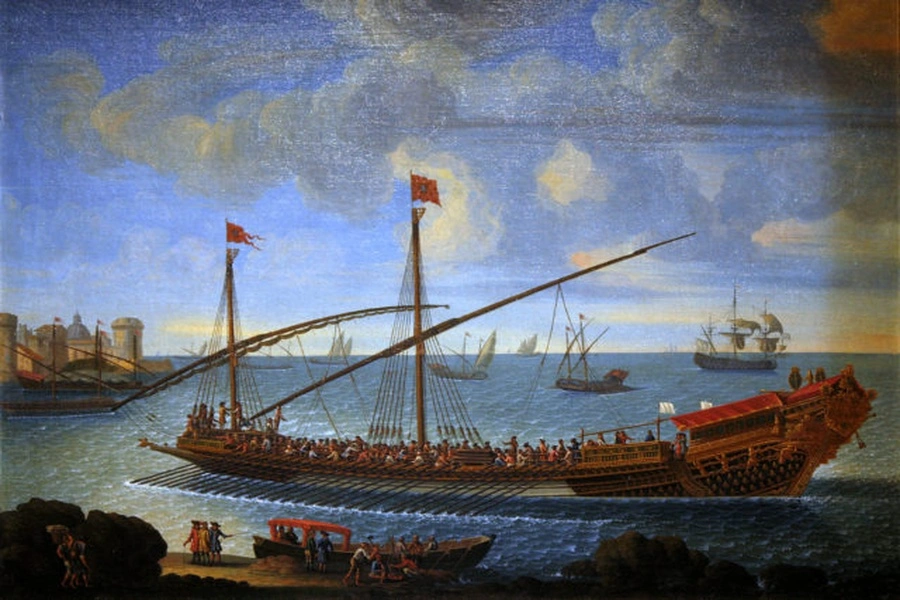
The galley became one of the most important warship designs in Mediterranean history. Unlike sailing vessels that depended primarily on wind conditions, galleys were propelled by human-powered oars. This gave their commanders greater control over movement, particularly in narrow waters, during coastal operations and when manoeuvring against enemy ships.
The earliest Mediterranean war galleys were relatively simple vessels. The penteconter, an ancient Greek warship traditionally equipped with approximately fifty oars, represented an important stage in the development of dedicated fighting vessels. Its long and narrow hull provided space for a substantial rowing crew while maintaining the speed required for military operations.
As naval warfare became more sophisticated, shipbuilders experimented with placing oarsmen at different levels. The bireme, generally understood as a vessel with two rowing banks, represented an important development in ancient ship design. By arranging rowers at different levels, shipbuilders could increase the vessel's rowing power without simply extending the hull. The precise chronology and arrangements of the earliest biremes remain subjects of scholarly discussion. Ancient warships generally carried sails for longer journeys and used oars when precise control or additional speed was required. Sails reduced the physical burden on the crew during transit, while oars allowed commanders to manoeuvre independently of the wind.
Why were galleys so effective in ancient warfare?
The Mediterranean presented naval commanders with a combination of enclosed seas, islands, narrow channels and relatively short distances between important ports. These geographical conditions favoured vessels capable of operating close to shore and responding quickly to changes in battle formations. Galleys offered several important advantages:
- Independent propulsion: Oars allowed ships to move even when the wind was weak or blowing in an unfavourable direction.
- Greater manoeuvrability: Skilled crews could accelerate, reverse and change direction more effectively than many sailing vessels.
- Military flexibility: Galleys could transport soldiers, conduct raids, intercept enemy shipping and participate in ship-to-ship combat.
- Controlled movement: Commanders could coordinate movements and maintain formations without relying entirely on wind conditions.
However, galleys also had serious limitations. Their large rowing crews required substantial quantities of food and water, while prolonged rowing was physically exhausting. Their relatively shallow hulls and limited cargo capacity made extended operations difficult. They were also vulnerable to storms and rough seas, particularly when operating far from sheltered coastal waters. Consequently, ancient naval warfare was closely connected to logistics, weather and geography. A powerful fleet was only useful if its ships could be maintained, supplied and crewed.
3. The Greek Trireme Revolution
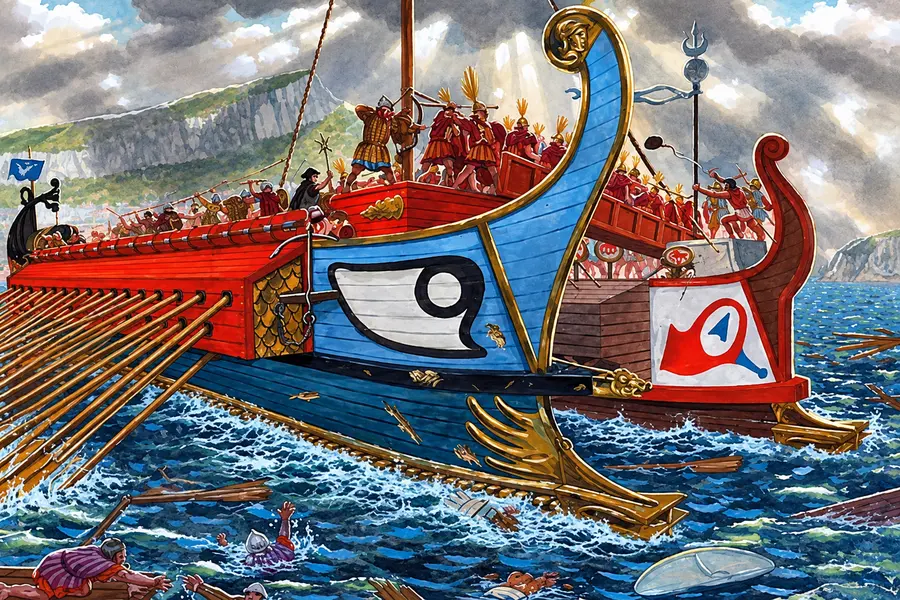
Few warships in ancient history achieved the reputation of the Greek trireme. Developed in the eastern Mediterranean during the Archaic period, the trireme became the dominant warship of classical Greek naval warfare. Its combination of speed, manoeuvrability and striking power transformed naval combat and helped Athens emerge as a major maritime power.
The Greek term trieres referred to a warship organized around three rowing arrangements. It is important to understand that a trireme did not necessarily have three conventional decks stacked vertically like the floors of a modern building. Instead, its rowers operated at three different heights, using carefully arranged oars to maximize the available rowing power.
How was a Greek trireme constructed?
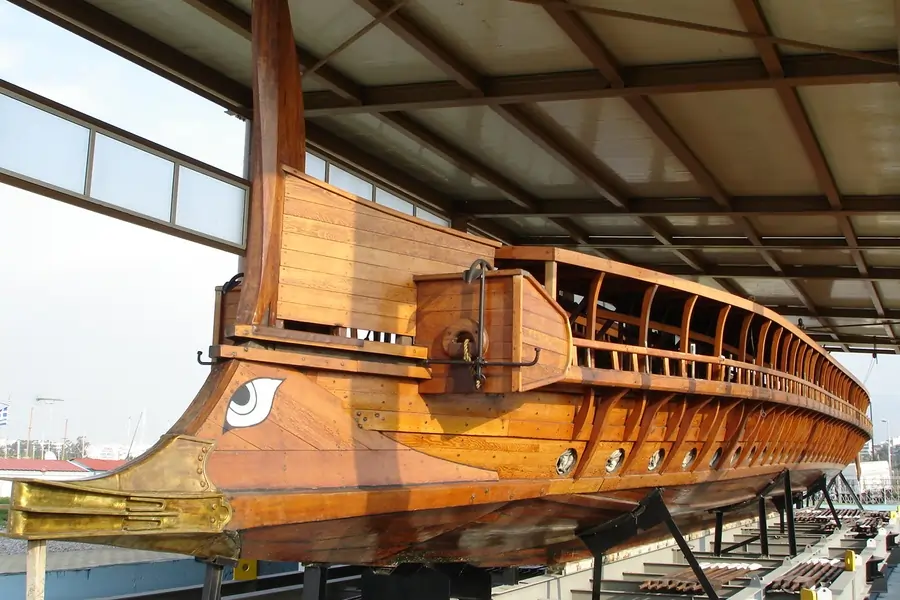
A classical Athenian trireme was a relatively long, narrow, and lightweight vessel. Its design emphasized speed and agility rather than the ability to carry large quantities of cargo or withstand prolonged heavy combat. The hull was constructed primarily from timber, with different types of wood selected for their strength, weight, and availability. The keel provided the structural foundation, while the planking and internal framing gave the vessel its shape and rigidity. The ships were often equipped with a detachable mast and sail, which could be used during journeys and removed or lowered when preparing for battle.
One of the most important engineering features was the arrangement of the oars. The three groups of rowers were traditionally identified as:
- Thranitai: The uppermost group of rowers, positioned on an outrigger structure.
- Zygitai: The middle group, positioned closer to the main hull.
- Thalamitai: The lowest group, rowing from positions within the hull.
The arrangement allowed approximately 170 oarsmen to propel a standard Athenian trireme. With officers, sailors, a helmsman, and a contingent of fighting personnel, the total complement was generally around 200 men.
| Feature | Typical Athenian Trireme |
|---|---|
| Length | Approximately 35-37 metres |
| Beam | Approximately 5-6 metres, excluding the full outrigger arrangement |
| Oarsmen | Approximately 170 |
| Total crew | Approximately 200 |
| Propulsion | Three rowing arrangements and a sail |
| Primary weapon | Bronze-clad bow ram |
| Primary role | Fast naval combat and manoeuvring |
Note: These are approximate figures for the classical Athenian trireme. Dimensions and crew arrangements varied between periods and reconstructions.
The crew and organization of a trireme
Operating a trireme required an unusually high degree of coordination. Unlike a conventional sailing vessel, its performance depended on the ability of a large rowing crew to work together. Even a small loss of synchronization could affect acceleration, manoeuvrability and the effectiveness of a ramming attack. The rowers were not simply interchangeable labourers. Their experience and coordination were essential to the ship's fighting ability. Athens invested considerable resources in maintaining its fleet and recruiting trained personnel. Rowers were generally free men who received wages, although the precise composition of crews varied according to circumstances.
The trireme also carried a smaller contingent of marines, known as epibatai, who fought during boarding actions. Archers and other missile troops could provide additional support. The captain, known as the trierarch, was responsible for the ship's command and administration, while specialist officers managed navigation and rowing operations.
The bronze ram: The trireme's principal weapon
The most distinctive feature of a Greek trireme was the bronze-clad ram projecting from the bow near the waterline. Rather than relying primarily on archers or boarding parties, a well-trained trireme crew attempted to destroy enemy vessels through carefully executed collisions. The ram was designed to penetrate or damage the wooden hull of an opposing ship. A successful strike could open the vessel to flooding, damage its structural framework, or leave it unable to manoeuvre. The attacking ship would ideally withdraw quickly before becoming entangled with the damaged vessel.
This made speed and precision essential. A trireme needed enough momentum to damage its opponent but also sufficient control to avoid a collision that could disable the attacking vessel itself. The archaeological discovery of ancient naval rams and modern experimental research have helped historians understand the engineering behind this weapon. Recent experimental studies have examined how the bronze ram transferred impact forces into wooden ship structures and the conditions required to damage a hull.
The trireme and the rise of Athenian naval power
The trireme's importance became particularly evident during the Greco-Persian Wars. Themistocles, the Athenian statesman, recognized that Athens needed a powerful fleet to protect itself against the expanding Persian Empire. Using revenues from the Laurion silver mines, Athens invested heavily in constructing triremes. This decision transformed the city's military capabilities and created the foundations of its maritime empire.
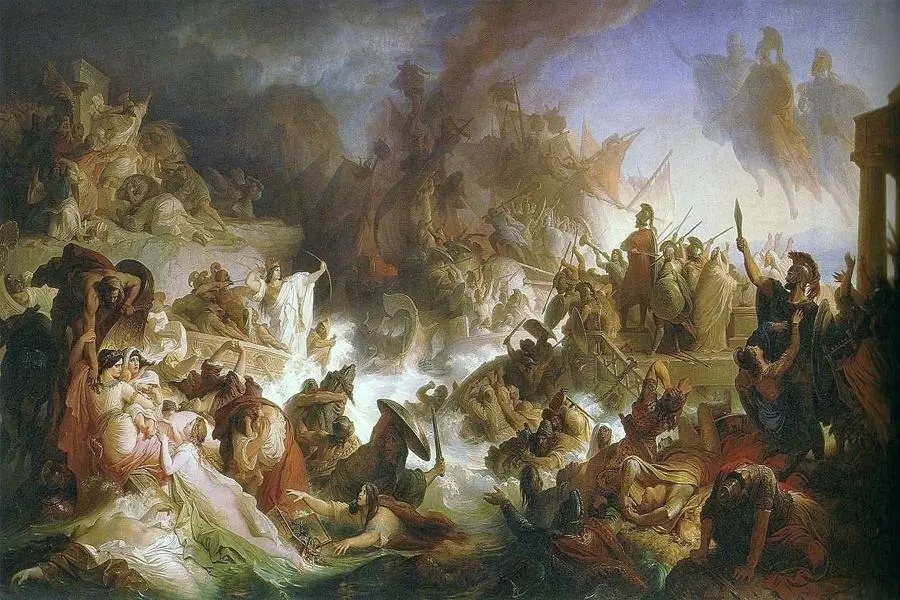
During the Battle of Salamis in 480 BC, the Greek fleet used its knowledge of local waters and the manoeuvrability of its ships to defeat a much larger Persian naval force. The narrow straits restricted the ability of the Persian fleet to deploy its numerical superiority effectively. The victory was a turning point in the Greco-Persian Wars. The importance of the Greek naval victory is explored in our detailed account of the Battle of Salamis and the tactics that defeated the Persian fleet.
Another important engagement was the Battle of Mycale in 479 BC. Although primarily remembered for the destruction of the Persian forces on land, the battle also demonstrated the continuing importance of naval power and amphibious operations in the eastern Aegean. Read more about the Battle of Mycale and the final phase of the Persian invasion of Greece. Following the Persian defeat, Athens used its fleet to establish and maintain the Delian League. What began as an alliance against Persia gradually developed into an Athenian maritime empire. The trireme had become more than a weapon of war: it was an instrument of political power.
4. The Rise of Larger Warships: Quadriremes and Quinqueremes
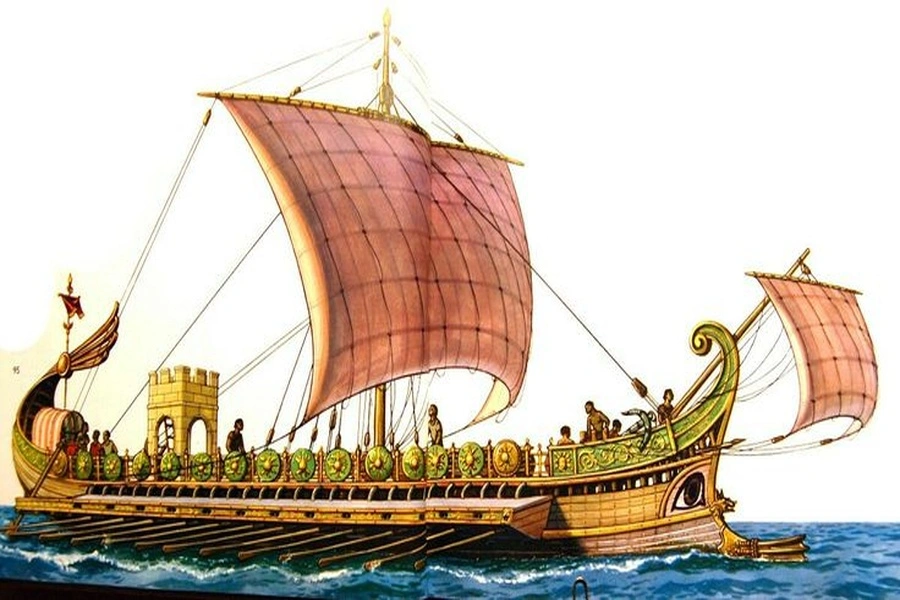
The success of the trireme did not end the development of ancient warship technology. During the fourth and third centuries BC, naval architects and military commanders began experimenting with increasingly large vessels. The resulting arms race transformed the Mediterranean into a testing ground for some of the most ambitious warships of the ancient world.
The expansion of Macedonian power under Philip II and Alexander the Great, followed by the struggles between the Hellenistic successor kingdoms, created new demands for naval strength. Powerful rulers such as the Ptolemies of Egypt and the Antigonids of Macedon invested heavily in large fleets. The result was the development of quadriremes, quinqueremes and larger vessels collectively described by modern historians as polyremes.
What was a quadrireme?
The quadrireme, or four, represented an intermediate stage in the development of larger warships. It was designed to accommodate greater rowing power and carry more fighting personnel than a conventional trireme. However, the numerical designation should not be interpreted as proof that the ship had four vertically stacked levels of rowers. Ancient terminology reflected the organization of its rowing system, which could involve multiple men operating a single oar. The exact arrangements of several larger ship classes remain debated among historians.
The Roman quinquereme
The quinquereme became one of the most important warships of the Hellenistic and Roman Republican periods. Its name referred to a five-part rowing arrangement, although this did not mean that the vessel had five vertically stacked banks of oars. One widely discussed reconstruction places groups of rowers across two levels, with multiple men operating individual oars. The exact arrangement remains debated because no complete quinquereme has been recovered.
There is no universally accepted reconstruction of the quinquereme's exact rowing arrangement. One influential interpretation suggests that groups of rowers were distributed across two levels, with combinations of multiple men operating individual oars. The classification therefore describes the rowing system rather than five simple vertical banks. The quinquereme was particularly suited to the naval warfare of the Hellenistic period and the Punic Wars. Its size allowed commanders to deploy substantial numbers of soldiers and provided a stable platform for close combat.
The Hellenistic naval arms race
The competition between the successor kingdoms of Alexander the Great encouraged increasingly ambitious naval construction projects. Larger warships were developed to carry more soldiers, support sieges and provide a powerful presence during operations against fortified ports.
Ancient sources refer to ships classified as sixes, eights, tens and even much larger vessels. Some Hellenistic rulers commissioned enormous polyremes that required hundreds or potentially thousands of crew members, depending on the design and the interpretation of ancient accounts.
One particularly famous example was the Tessarakonteres, a colossal vessel associated with Ptolemy IV Philopator of Egypt in the third century BC. Described by ancient writers as a forty, it was an extraordinary demonstration of royal ambition and engineering resources. Its precise construction and practical capabilities remain uncertain, and it may have been more useful as a ceremonial or prestige vessel than as an efficient fighting ship.
The development of these massive warships reflected a change in naval strategy. While classical triremes emphasized speed and manoeuvrability, larger Hellenistic vessels increasingly relied on heavier construction, extensive decks, additional marines and substantial weapon platforms.
| Warship | General characteristics | Historical significance |
|---|---|---|
| Penteconter | Approximately 50 oars | Early dedicated fighting vessel |
| Bireme | Two rowing levels | Increased rowing power |
| Trireme | Three-part rowing arrangement | Dominant classical Greek warship |
| Quadrireme | Four-part rowing classification | Development of larger warships |
| Quinquereme | Five-part rowing classification | Major warship of the Punic Wars |
| Hellenistic polyremes | Large multi-oared vessels | Naval arms race of the successor kingdoms |
The transition towards larger vessels was not necessarily an improvement in every respect. Bigger warships required more timber, more experienced shipwrights, larger crews and greater quantities of supplies. They were also more expensive to maintain and could be less manoeuvrable than smaller vessels. Ancient naval commanders therefore had to balance size and striking power against speed, cost and operational flexibility.
5. How Ancient Naval Battles Were Fought
Ancient naval warfare was considerably more sophisticated than two fleets sailing towards each other and attempting to ram their opponents. Commanders needed to understand the capabilities of their vessels, maintain formation, coordinate their crews, and exploit weaknesses in the enemy's deployment. The principal methods of naval combat evolved around two broad approaches: disabling enemy vessels through manoeuvring and ramming, or bringing ships close enough for soldiers to board and capture them.
Ramming and manoeuvring
During the classical Greek period, ramming was one of the most important naval tactics. A skilled trireme crew attempted to approach an enemy vessel from an advantageous angle and strike its hull using the bronze ram. Two manoeuvres frequently discussed in accounts of Greek naval warfare were the diekplous and the periplous. The diekplous involved attempting to pass through gaps in the enemy formation. Once through the opposing line, attacking ships could turn and strike vulnerable areas, particularly the sides or sterns of enemy vessels. These manoeuvres were difficult to execute under combat conditions. Their success depended on the quality of the crews, the spacing of the opposing ships and the ability of a commander to maintain coordination once the engagement began.
The periplous involved outmanoeuvring the opponent by moving around its formation or attacking from an exposed flank. Its effectiveness depended on having sufficient sea room and crews capable of executing coordinated movements. Both manoeuvres required exceptional timing and discipline. A poorly executed attack could leave a vessel exposed to counterattacks or cause it to collide with friendly ships.
Boarding and hand-to-hand combat
Although ramming was central to classical Greek naval tactics, boarding remained an important method of defeating enemy vessels. Once ships collided or became entangled, marines could cross onto the opposing deck and fight the enemy crew. Naval vessels often carried hoplites, archers, and other fighting personnel. These soldiers transformed a naval engagement into a close-quarters infantry battle.
Boarding became particularly important during the Hellenistic period, when larger ships could carry substantial numbers of marines. Heavier vessels were often better suited to sustained combat at close range than the lighter triremes of classical Greece.
Naval artillery and missile weapons
Ancient fleets also employed missile weapons. Archers and javelin throwers could attack exposed crews, while larger vessels sometimes carried mechanical artillery such as catapults. These weapons were particularly useful during sieges and operations against coastal fortifications. Naval artillery could also disrupt enemy formations before ships came into boarding range. However, artillery did not immediately replace ramming or boarding as the primary methods of naval combat. Its effectiveness depended on the type of vessel, the available space and the tactical situation.
Formation, command and communication
Maintaining formation was essential when fleets consisted of dozens or hundreds of ships. Commanders needed to ensure that individual vessels remained in their assigned positions and responded to changes in the overall battle plan. Ancient fleets relied on visual signals, including standards, flags, trumpets and other audible instructions. The exact systems varied between civilizations and periods, but maintaining communication was particularly difficult once battle began and ships became separated.
Weather, visibility, smoke and the noise of combat could quickly disrupt coordination. A fleet that lost its formation risked being attacked in smaller groups by a more disciplined opponent. The importance of training and tactical coordination explains why numerical superiority did not always guarantee victory. The Greek victories against Persia, particularly at Salamis, demonstrated how geography and experienced crews could overcome a much larger force.
6. Rome and the Transformation of Naval Warfare
Rome's emergence as a major naval power was one of the most significant developments in ancient military history. Unlike Athens and Carthage, which had long maritime traditions, the Roman Republic initially relied primarily on its land armies. Its expansion into southern Italy and Sicily, however, brought it into direct conflict with a power whose military strength depended heavily on control of the sea. That power was Carthage.
Rome enters the naval arena
At the outbreak of the First Punic War in 264 BC, Rome faced a serious strategic disadvantage. Carthage possessed an established fleet, experienced sailors, and a long history of maritime warfare. The Romans recognized that they could not secure Sicily or prevent Carthaginian attacks on the Italian coastline without developing a fleet of their own.
According to the Greek historian Polybius, the Romans decided to construct a large fleet around 261 BC. Their shipbuilders lacked experience with quinqueremes, the principal warships of the period. Polybius describes how a captured Carthaginian vessel served as a model for Roman shipbuilders.
The Romans constructed approximately 100 quinqueremes and 20 triremes for their initial major fleet. They also trained crews through exercises conducted on land before sending them into combat. This was an extraordinary undertaking. Rome was attempting to challenge a maritime power using a fleet that had been assembled largely from scratch.
The corvus: Turning naval battles into infantry engagements
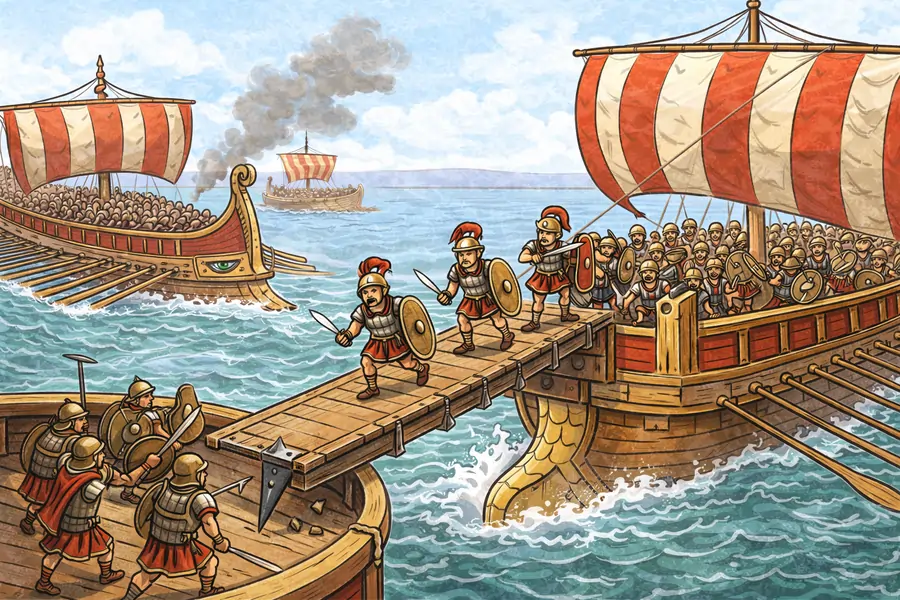
Rome's most famous naval innovation during the First Punic War was the corvus, a boarding device intended to reduce the importance of traditional naval manoeuvring. The device consisted of a movable wooden bridge fitted with a heavy metal spike. When a Roman ship approached an enemy vessel, the bridge could be lowered onto its deck, securing the two ships together and allowing Roman soldiers to cross over. This gave Rome a way to exploit the strength of its infantry in a form of warfare where Carthage had traditionally enjoyed the advantage.
Rather than relying entirely on the skill of its rowers to ram enemy ships, Rome could use its greatest military strength: its infantry. This innovation helped Rome win the Battle of Mylae in 260 BC, its first major naval victory against Carthage. The corvus also played a role in the Roman victory at Cape Ecnomus in 256 BC, one of the largest naval engagements of the ancient world.
However, the device had limitations. It added weight to the vessel and could affect stability, particularly in rough seas. It was not a permanent solution to every naval problem, and its use appears to have declined during the later stages of the war. For a detailed examination of its construction and military importance, read our article on the Roman corvus and its role in the First Punic War.
How Carthage and Rome changed naval warfare
The First Punic War demonstrated that naval supremacy depended on much more than ship design. Both Rome and Carthage suffered enormous losses, particularly during storms and large-scale fleet operations. Carthage initially possessed the advantage in naval experience and manoeuvring. Rome, however, demonstrated an exceptional ability to mobilize manpower, construct replacement vessels, and adapt its tactics.
The Battle of the Aegates Islands in 241 BC marked the decisive Roman victory that brought the First Punic War to an end. Carthage was forced to abandon Sicily, and Rome emerged as the dominant naval power in the western Mediterranean.
The conflict fundamentally changed Roman military capabilities. Rome had entered the war as a predominantly land-based power but emerged with the experience, infrastructure, and strategic understanding required to operate large fleets. Our articles on the First Punic War between Rome and Carthage and how Rome defeated the Carthaginian navy explore this transformation in greater detail.
The Roman navy during the late Republic and Empire
Following its victory over Carthage, Rome continued to develop its naval forces. During the late Republic, lighter and more manoeuvrable vessels became increasingly important. One of the most prominent designs was the liburnian, a warship associated with the Adriatic maritime traditions of the Liburnians. Roman fleets increasingly employed these vessels for patrol duties, escort operations and the suppression of piracy.
The Battle of Actium in 31 BC demonstrated the continuing importance of naval power in Roman politics. Octavian's fleet, commanded by Marcus Agrippa, defeated the forces of Mark Antony and Cleopatra. The victory eliminated their challenge to Octavian's authority and helped establish the Roman Empire.
Following the establishment of imperial rule, Rome maintained permanent naval forces based at important ports, including Misenum and Ravenna. These fleets protected commercial routes, transported troops, patrolled coastlines, and helped secure the empire's maritime frontiers.
7. The Decline of the Classical Galley
The trireme and quinquereme did not disappear overnight. Galley warfare remained important for centuries, but the strategic requirements of Mediterranean fleets gradually changed. During the Roman Imperial period, Rome's dominance reduced the likelihood of large-scale fleet engagements against another Mediterranean power of comparable strength. Naval forces increasingly concentrated on patrolling coastlines, protecting shipping, transporting troops, and suppressing piracy.
During the Roman Imperial period, the large fleet engagements that had characterized the Punic Wars became less common. Rome's dominance reduced the likelihood of another major Mediterranean power assembling a fleet capable of challenging it directly.
Naval forces increasingly concentrated on protecting trade routes, transporting troops, suppressing piracy, and securing the empire's frontiers. Smaller and more versatile warships became useful for these missions. The liburnian and related lighter galleys gradually assumed greater importance. Their manoeuvrability and comparatively lower operating costs made them suitable for routine patrol and escort duties.
From Roman galleys to Byzantine dromons
The transformation of Mediterranean naval warfare continued into late antiquity and the Byzantine period. The Eastern Roman Empire inherited much of the maritime infrastructure and naval experience of the Roman world, but it also developed new warship designs suited to changing military conditions.
One of the most important vessels was the dromon, a warship that evolved over several centuries. Byzantine dromons generally employed oars and sails, carried fighting personnel, and could be equipped with weapons intended for close combat.
Byzantine naval forces also became famous for their use of Greek fire, an incendiary weapon that could be projected against enemy ships. Its precise composition remains uncertain, and the technology was closely guarded.
The dromon represented a new stage in the history of Mediterranean naval warfare. Although it retained the basic advantages of oar-powered vessels, it belonged to a different technological and strategic environment from the classical trireme. The long history of the galley therefore continued well beyond the fall of the Western Roman Empire in 476 AD. Its principles remained relevant in Mediterranean warfare throughout the medieval period.
8. Conclusion: How Ancient Warships Changed the Mediterranean
The evolution of ancient naval warfare was a gradual process shaped by competition between maritime civilizations. Early vessels were primarily used for transportation, trade, and coastal operations. As naval conflict became more organized, shipbuilders developed specialized fighting vessels capable of carrying larger crews and delivering more powerful attacks.
The Greek trireme represented one of the greatest achievements of classical naval engineering. Its speed, manoeuvrability and disciplined rowing crew made it an exceptionally effective warship. It helped Athens defeat Persia at Salamis and establish a maritime empire that influenced the political development of the Greek world. The subsequent development of larger warships, particularly the quinquereme, reflected the changing demands of Hellenistic and Roman warfare. These vessels carried more soldiers and were better suited to boarding actions and large-scale naval engagements.
Rome's rise as a naval power demonstrated that technological superiority alone was not enough to guarantee victory. Its success against Carthage depended on the ability to mobilize resources, learn from defeat and adapt naval warfare to its existing military strengths. Ultimately, ancient naval supremacy was built on the interaction of shipbuilding, manpower, tactics, logistics and political ambition. The warships of Greece, Carthage and Rome were not merely instruments of combat. They were essential components of the economic and military systems that shaped the ancient Mediterranean world.
References and Further Reading
The following ancient sources and modern academic studies provide a foundation for understanding the development of ancient warships, naval tactics, and Mediterranean maritime power.
Primary sources
- Polybius, The Histories, Book I, particularly sections 20-23 and 59-63. An important contemporary account of the First Punic War, Roman naval construction and the development of the Roman fleet. Read Polybius, Book I.
- Thucydides, History of the Peloponnesian War. An essential ancient account of Athenian naval power, the Peloponnesian War, and the role of naval strategy in classical Greece.
- Herodotus, The Histories. An important source for the Persian Wars, the Greek and Persian fleets, and the Battle of Salamis.
- Xenophon, Hellenica. Provides additional evidence for Greek naval warfare and the political and military struggles of the fourth century BC.
Modern academic studies
- Morrison, J. S., Coates, J. F. and Rankov, N. B. The Athenian Trireme: The History and Reconstruction of an Ancient Greek Warship. Cambridge University Press. A major study of trireme design, construction and experimental reconstruction.
- Jordan, Borimir. "The Crews of Athenian Triremes." L'Antiquité Classique, Vol. 69, 2000, pp. 81-101. Read the academic article.
- Murray, William M. "Hellenistic and Roman Republican Naval Warfare Technology." In The Sea in History: The Ancient World, 2017. A study of the development of larger warships and the Hellenistic naval arms race. View the publication.
- Holladay, A. J. "Further Thoughts on Trireme Tactics." Greece & Rome, Vol. 35, Issue 2. An academic discussion of ancient Greek naval manoeuvres, including the diekplous and periplous. View the research.
- Rankov, Boris. "The Dimensions of the Ancient Trireme: A Reconsideration of the Evidence." A study examining the dimensions and reconstruction of the classical trireme.
- Mark, Samuel. "The Earliest Naval Ram." International Journal of Nautical Archaeology, Vol. 37, Issue 2, 2008, pp. 253-272. View the research.
Related Articles
Frequently Asked Questions
How many rowers were needed to operate an ancient Greek trireme?
A typical classical Athenian trireme required approximately 170 rowers arranged in three rowing groups: thranitai, zygitai and thalamitai. Including officers, sailors, a helmsman and marines, the total crew was generally around 200 men. The large rowing crew allowed the trireme to achieve considerable speed and manoeuvrability during naval battles.
What was the difference between a Greek trireme and a Roman quinquereme?
The Greek trireme and Roman quinquereme differed primarily in their rowing arrangements, size and military roles. A trireme used three rowing groups and typically carried around 170 rowers, while a quinquereme employed a five-part rowing arrangement and was generally larger. Quinqueremes could carry more fighting personnel and were particularly important during the Punic Wars. Neither classification necessarily represented the number of vertically stacked decks.
How did ancient warships ram and sink enemy vessels?
Ancient warships such as Greek triremes used a reinforced bronze-clad ram fitted near the waterline of the bow. Crews accelerated towards enemy vessels and attempted to strike their wooden hulls at an angle that caused structural damage or flooding. Successful attacks required precise coordination between rowers and the helmsman. A well-executed ramming manoeuvre could disable or sink an enemy ship before its crew had an opportunity to board.
Why did ancient Greek warships use three levels of rowers?
Greek shipbuilders developed the trireme's three-part rowing arrangement to increase propulsion without making the vessel excessively long. By positioning rowers at different heights and arranging their oars carefully, they could generate considerable power while retaining the narrow hull needed for speed and manoeuvrability. This design helped the trireme become one of the most effective warships of classical Mediterranean warfare.
How did ancient naval battles differ from battles fought on land?
Ancient naval battles depended heavily on ship manoeuvrability, rowing coordination, wind conditions and control of sea formations. Unlike land battles, where armies could hold defensive positions, naval forces had to maintain balance and avoid collisions while attacking moving targets. Greek fleets often relied on ramming and manoeuvring, whereas Roman fleets increasingly used boarding tactics to turn naval engagements into close-range infantry battles.
Why did Roman quinqueremes become important during the First Punic War?
Roman quinqueremes became important because they allowed the Roman Republic to challenge Carthage's established naval power during the First Punic War (264-241 BC). Rome rapidly constructed a large fleet of these warships and introduced the corvus, a boarding bridge that allowed Roman soldiers to cross onto enemy vessels. This helped Rome compensate for its lack of naval experience by exploiting the strength of its infantry. The Roman victory at the Battle of Mylae in 260 BC demonstrated the effectiveness of this approach.
Add Comment