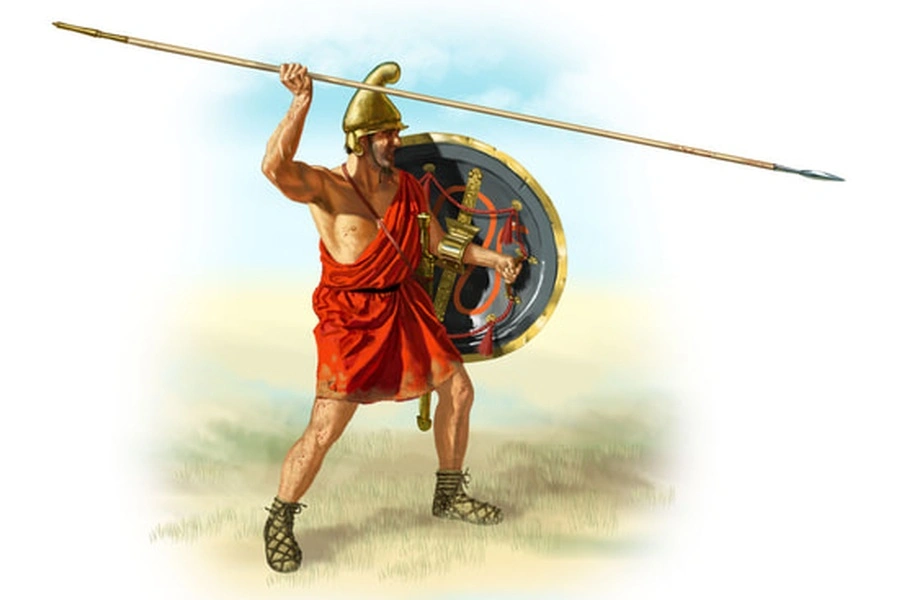
Alexander the Great's army is often remembered for its terrifying Macedonian phalanx and the devastating charge of the Companion Cavalry. Yet between these two famous arms stood a less celebrated formation that made Alexander's battlefield system remarkably flexible: the hypaspists. These elite infantrymen could fight alongside the phalanx, keep pace with Alexander's cavalry, storm fortifications, cross difficult terrain, and take part in the most dangerous assaults of the Macedonian conquest. They were not simply "better phalangites." Their importance came from occupying the tactical space between heavy pikemen and more mobile cavalry.
From the campaigns of Philip II to Alexander's conquest of the Persian Empire and India, the hypaspists became one of the most trusted formations in the Macedonian army. Their precise origins, equipment, organization, and later development remain subjects of scholarly debate, but the ancient sources repeatedly place them at the center of Alexander's most demanding operations. Understanding the hypaspists therefore explains something fundamental about Alexander's military success. His army did not depend on one spectacular weapon or formation, but on combining different kinds of infantry and cavalry into a coordinated battlefield system.
Table of Contents
- Who Were the Hypaspists?
- The Origins of the Macedonian Hypaspists
- Hypaspist Weapons, Armor and Equipment
- Why Did Alexander Need the Hypaspists?
- Hypaspists vs. Macedonian Phalangites
- Organization and Command
- How Alexander Used the Hypaspists
- The Hypaspists at the Battle of Granicus
- The Hypaspists at the Battle of Issus
- The Hypaspists at Gaugamela
- Hypaspists and the Siege of Tyre
- The Hypaspists at the Hydaspes
- Who Were the Silver Shields?
- Why the Hypaspists Mattered
- The Legacy of the Hypaspists
- References and Further Reading
Who Were the Hypaspists?
The Greek word hypaspistēs is usually translated as "shield-bearer." The name originally denoted a person who carried or protected another person's shield. Still, by the fourth century BC it had come to be associated with a specialized military corps in the Macedonian army. Under Alexander, the hypaspists were elite infantry who served both military and royal functions. Their position in the army was unusual. The ordinary Macedonian phalangites were organized primarily around the enormous sarissa, a long pike that allowed the phalanx to present an intimidating forest of spear points. The hypaspists, by contrast, appear to have retained a more conventional infantry panoply, giving them considerably greater flexibility in close combat.
Ancient sources repeatedly place the hypaspists beside Alexander's most important formations. At Granicus, Issus and Gaugamela, they operated close to the Companion Cavalry and the main phalanx. During operations in Asia and India, they also appear in assault columns and rapidly moving detachments. Arrian's Anabasis mentions the hypaspists numerous times, demonstrating that they were not merely ceremonial guards but an operational component of Alexander's army. [1]
Their elite status also had a political dimension. The hypaspists were closely associated with the Macedonian king and royal court. One formation within the corps, the agema, functioned as a royal guard. This relationship meant that the hypaspists were among the troops Alexander could trust with missions where failure could expose the king himself. It is important, however, not to imagine the hypaspists as a completely separate type of soldier from the beginning of Macedonian history. Their precise development is uncertain. Modern historians debate when the corps was formally established, how it was recruited, and exactly how its equipment differed from that of other Macedonian infantry.
The Origins of the Macedonian Hypaspists
The origins of the hypaspists are one of the least certain aspects of the Macedonian army. Ancient writers provide little direct information about their creation, and the surviving accounts were written decades or centuries after Philip II and Alexander. One traditional explanation connects them with the reforms of Philip II. The evidence is too fragmentary to reconstruct a single moment when the hypaspists were created as a formal corps. Philip transformed Macedonia from a kingdom vulnerable to its neighbors into one of the most formidable military powers in the eastern Mediterranean. His reforms included the development of the Macedonian phalanx, improvements in cavalry organization, more systematic military training, and the integration of different types of infantry.
A second tradition associated the development of this type of infantry with the Greek commander Iphicrates. Ancient and later writers sometimes connected hypaspist-style infantry with the reforms attributed to Iphicrates in the fourth century BC. This should be treated cautiously. The evidence does not allow historians to establish a simple chain in which Iphicrates invented the exact Macedonian hypaspist corps later used by Alexander. What seems more plausible is that Macedonian military development absorbed several existing Greek infantry traditions while adapting them to Macedonian needs. The result was a corps that combined a substantial shield and spear with comparatively mobile battlefield tactics.
The distinction between the hypaspists and ordinary phalangites may therefore have emerged from function as much as from equipment. The Macedonian army needed infantry capable of protecting the vulnerable edges of the phalanx, supporting cavalry operations and moving rapidly with the king. The hypaspists fulfilled that requirement. By the beginning of Alexander's Asian campaign, roughly 3,000 hypaspists accompanied the expedition. Their internal organization is debated, although Arrian later describes three chiliarchies of hypaspists during the Indian campaign. Their presence in the expeditionary army is significant. Alexander did not leave his elite infantry behind in Macedonia. They were part of the force he considered essential for the conquest of the Persian Empire. [2]
Hypaspist Weapons, Armor and Equipment
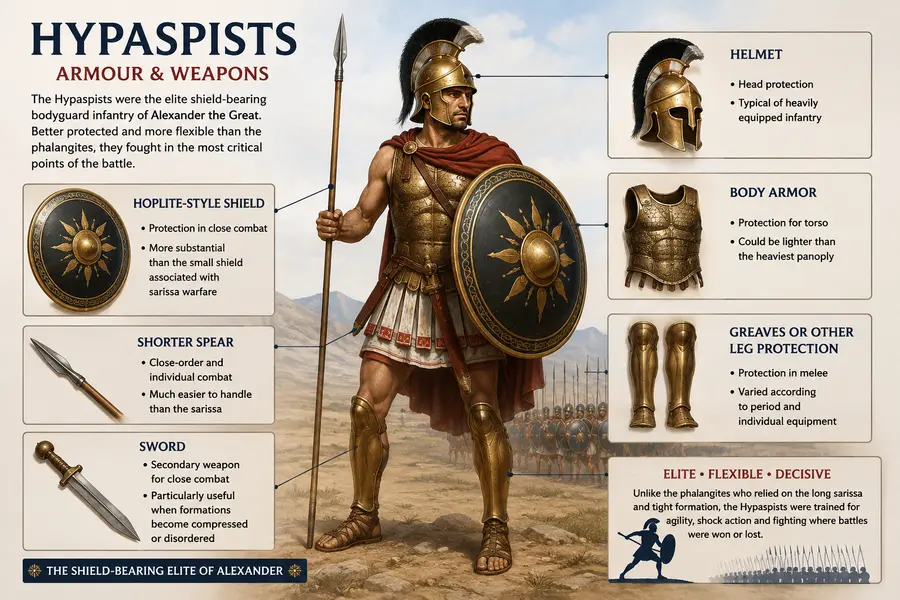
The exact equipment of an Alexander-era hypaspist cannot be reconstructed with complete certainty. Ancient descriptions are limited, archaeological evidence is incomplete, and equipment in ancient armies was rarely uniform. Nevertheless, the evidence strongly suggests that the hypaspists were equipped more like heavy infantry than like lightly armed skirmishers.
| Equipment | Likely Function | Difference from Phalangites |
|---|---|---|
| Hoplite-style shield | Protection in close combat | More substantial than the small shield associated with sarissa warfare |
| Shorter spear | Close-order and individual combat | Much easier to handle than the sarissa |
| Sword | Secondary weapon for close combat | Particularly useful when formations became compressed or disordered |
| Helmet | Head protection | Typical of heavily equipped infantry |
| Body armor | Protection for torso | Could be lighter than the heaviest panoply |
| Greaves or other leg protection | Protection in melee | Varied according to period and individual equipment |
Archaeological and iconographic evidence supports the idea that hypaspists normally carried a substantial shield and a spear rather than relying on the sarissa. Modern scholarship has emphasized that the Macedonian army continued to use conventional spear-and-shield infantry equipment alongside the sarissa. Minor M. Markle's study of Macedonian weaponry, for example, argues that literary and archaeological evidence indicates that hypaspists normally used the spear and hoplite-style shield. [3]
Why Did Alexander Need the Hypaspists?
Alexander's greatest military advantage was not the phalanx alone. It was the ability to make different formations solve different battlefield problems. The Companion Cavalry supplied the army's great shock weapon. The Macedonian phalanx pinned and pressured the enemy's main infantry. Light troops such as the Agrianians provided missile power and mobility. The hypaspists occupied the dangerous middle ground between these forces.
Imagine Alexander's typical battlefield problem. His cavalry might identify an opportunity on one flank and launch a decisive charge. The phalanx could advance more slowly in the center. But if the cavalry moved too far ahead, a gap could appear between horse and infantry. If the enemy attacked that gap, the cavalry might become isolated and the phalanx exposed. The hypaspists could bridge this tactical gap. They could advance rapidly enough to support cavalry, yet fight heavily enough to withstand serious opposition. At the same time, they could protect the flank of the phalanx. Their flexibility made them particularly valuable in an army whose entire battle plan depended on coordination.
This explains why Alexander repeatedly placed them near the junction between the phalanx and Companion Cavalry. They were effectively part of the connective tissue of the Macedonian army. Their usefulness became even greater away from open battlefields. Alexander's campaign involved river crossings, mountain warfare, sieges, pursuit operations, and assaults against fortified positions. The phalanx could dominate an open plain, but it was not the ideal tool for every one of these tasks.
Hypaspists vs. Macedonian Phalangites
The difference between hypaspists and phalangites is fundamental to understanding Alexander's army.
| Feature | Hypaspists | Macedonian Phalangites |
|---|---|---|
| Primary role | Flexible elite infantry and royal guard | Main battle-line infantry |
| Primary weapon | Spear and sword | Sarissa |
| Shield | Hoplite-style shield | Smaller shield suited to sarissa use |
| Formation | Flexible formations and close-order infantry | Dense phalanx |
| Mobility | Relatively high | More restricted |
| Best environment | Open ground, difficult terrain, assaults and rapid operations | Open ground where formation cohesion could be maintained |
| Relationship to king | Strong royal and guard association | Regular Macedonian infantry |
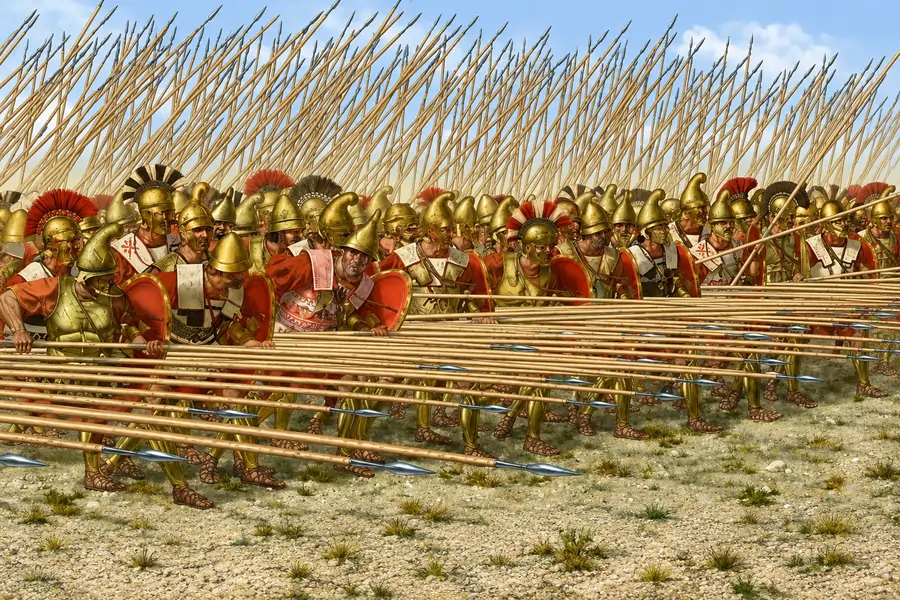
The phalanx was an extraordinary weapon when used correctly. The long sarissa allowed several ranks of soldiers to project spear points toward the enemy, creating a formation difficult to approach from the front. For a deeper examination of why this system worked, see Why the Macedonian Phalanx Was So Effective. But the phalanx had a weakness. It depended heavily on cohesion. The longer the weapon and the deeper the formation, the more difficult it became to respond to sudden changes in direction, terrain, or enemy pressure. The hypaspists were the answer to that problem. They could operate beside the phalanx without being as tightly constrained by it. This did not make them inherently superior soldiers in every circumstance.
The later Roman experience demonstrated the point dramatically. Roman legionaries eventually exploited weaknesses in Macedonian-style phalanxes when terrain and close-order fighting disrupted their formations. The broader comparison is explored in Why the Roman Legion Defeated the Macedonian Phalanx.
Organization and Command
Alexander's hypaspists were commonly organized into three large units, each theoretically numbering around 1,000 men. These were known as chiliarchies. The exact organization is debated, however, and the ancient sources do not always use terminology consistently. Nicanor, son of Parmenion, was the principal commander of the hypaspists during the early Asian campaign. He appears in that role at Granicus, Issus, and Gaugamela. His position was significant. While his brother Philotas commanded the Companion Cavalry, Nicanor commanded the elite infantry operating close to the cavalry and the phalanx. [4]
Within the corps was the agema, the royal elite. The precise relationship between the agema, the royal hypaspists and the other hypaspist formations remains debated, partly because the terminology of the ancient sources changes over time. What is clear is that these troops enjoyed unusually close proximity to the king. Their duties could involve ceremonial guard work, battlefield service, and dangerous assault missions. The combination of elite status and battlefield exposure created a valuable institutional advantage.
How Alexander Used the Hypaspists
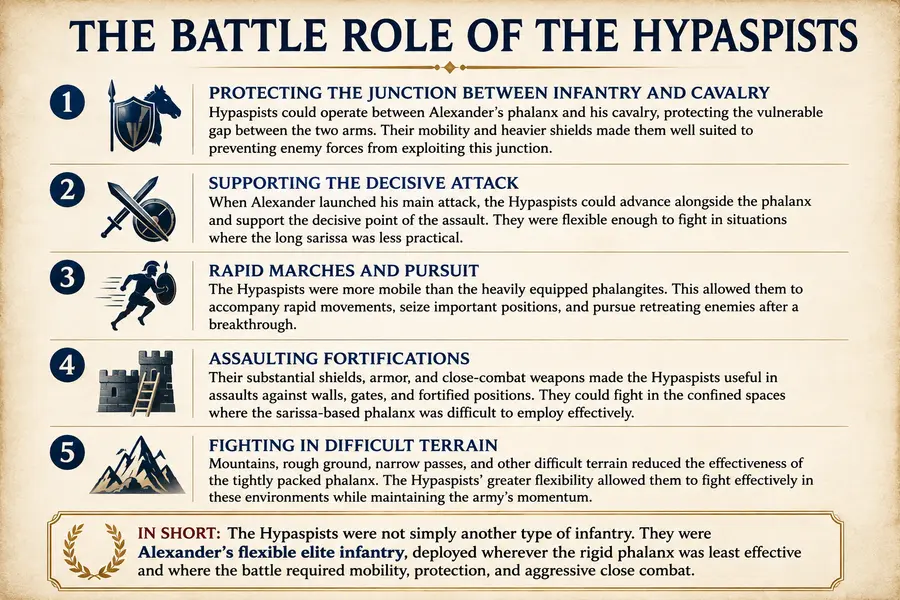
Alexander used the hypaspists in several distinct ways.
1. Protecting the junction between infantry and cavalry
This was perhaps their most important battlefield function. The hypaspists often stood beside the phalanx near the Companion Cavalry. Their position helped prevent the two major arms of Alexander's army from becoming dangerously separated.
2. Supporting the decisive attack
Alexander frequently created a point of maximum pressure. His cavalry would attack at the decisive moment while the infantry maintained pressure elsewhere. Hypaspists could accompany or support the advance without being as slow or cumbersome as the main phalanx.
3. Rapid marches and pursuit
Alexander's campaigns repeatedly demanded fast movement. Hypaspists appear in mobile columns alongside archers, Agrianians and cavalry. Their ability to move quickly made them ideal for pursuing retreating enemies or reinforcing threatened positions.
4. Assaulting fortifications
Sieges were another environment in which the hypaspists proved their value. They could fight on ramps, walls, and breaches where the sarissa was less convenient. The final assault on Tyre provides an excellent example. A unit of hypaspists under Admetus was among the troops committed to the breach in the city's defenses. Admetus was killed during the assault, but Alexander and the attackers continued forward. The episode illustrates the dangerous nature of hypaspist service: they were frequently used precisely where the fighting was most intense. [5]
5. Difficult terrain
Alexander's army repeatedly operated in mountainous regions, river valleys, and broken terrain. The hypaspists were much more useful in such conditions than a tightly packed sarissa formation. This flexibility became increasingly important as the campaign moved farther from the traditional battlefields of Greece and Macedonia.
The Hypaspists at the Battle of Granicus
The Battle of Granicus in 334 BC was Alexander's first major confrontation with the Persian Empire. It was also the first major demonstration of how his army's different components could work together. Alexander's right wing contained the formations closest to his own command. The hypaspists under Nicanor were positioned beside the phalanx and close to the cavalry. This position was not accidental. The river crossing and the Persian cavalry created a chaotic battlefield in which cohesion could easily break down.
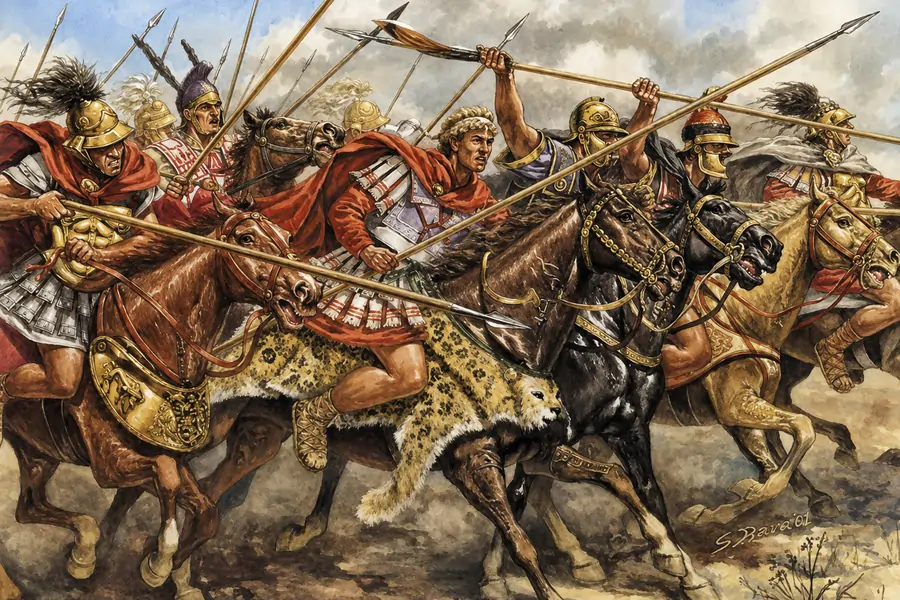
The hypaspists helped anchor the infantry-cavalry junction while Alexander led the Companion Cavalry into the decisive attack. It is tempting to portray Granicus simply as a cavalry victory, but that misses the larger tactical system. Alexander's cavalry needed infantry support, while the infantry needed the cavalry to exploit the enemy's collapse. The hypaspists occupied the space where those two forces met.
The Hypaspists at the Battle of Issus
At Issus in 333 BC, Alexander faced Darius III under very different circumstances. The battlefield was narrow, with mountains on one side and the Mediterranean coast on the other. Darius's numerical advantage was therefore difficult to exploit. The hypaspists again occupied their characteristic position between the main phalanx and the Companion Cavalry. Nicanor commanded them.
This was particularly important because the terrain compressed Alexander's army. The Macedonian phalanx could not simply spread across an enormous battlefield. The hypaspists provided a relatively flexible infantry force at the critical junction. Alexander eventually attacked the Persian left and drove toward the center, while the Macedonian phalanx engaged the Persian infantry. The resulting pressure caused Darius to flee.
Issus demonstrates the hypaspists' less glamorous but extremely important function. They were not necessarily the troops who delivered the most famous charge. Instead, they helped keep Alexander's battle line coherent while the decisive attack unfolded. The wider political and military background of the battle is covered in The Battle of Issus: Alexander vs. Darius, while the role of Darius's family and the consequences of the battle are discussed in Alexander the Great, Darius and the Battle of Issus.
The Hypaspists at Gaugamela
Gaugamela in 331 BC was the greatest test of Alexander's combined-arms system. Darius had selected an enormous plain that allowed his cavalry, chariots, and massed infantry to maneuver. Unlike Issus, there was plenty of space for the Persian army to exploit its numerical advantage. Alexander arranged his army so that the hypaspists again stood near the junction of the Companion Cavalry and the phalanx. Nicanor remained their commander.
Alexander deliberately refused to advance straight toward the Persian center. Instead, he moved obliquely, drawing Persian forces toward him and creating opportunities for a decisive penetration. That maneuver placed enormous demands on the cohesion of his army. If the center failed to keep pace, a gap could open between Alexander's cavalry and the phalanx. The hypaspists were ideally placed to help maintain the connection.
When Alexander finally launched his decisive cavalry attack toward Darius's position, the hypaspists and other infantry formations remained part of the broader coordinated advance. Their contribution was therefore less spectacular than the Companion Cavalry's charge but essential to the architecture of the battle. Curtius Rufus and Diodorus use the term Argyraspides, or "Silver Shields," in their descriptions of the elite infantry at Gaugamela, while Arrian uses hypaspists. Scholars generally regard these references as evidence that the formations were closely connected, although the exact chronology of the Silver Shields' name remains debated. [6]
Hypaspists and the Siege of Tyre
Alexander's conquest was not simply a sequence of open-field battles. Fortified cities presented an entirely different tactical problem. At the Siege of Tyre, Alexander constructed a massive causeway across the sea, brought siege engines against the walls, and eventually coordinated naval and land attacks. The final assault required soldiers capable of fighting on narrow bridges, against walls and through breaches.
The hypaspists were well suited to this kind of fighting. A sarissa could be devastating in a massed formation but was awkward when soldiers were climbing, crossing a breach, or fighting in confined spaces. A shield, shorter spear, and sword were much more practical. The death of Admetus during the assault demonstrates the danger. He was not leading ceremonial guards from a safe distance. Hypaspist commanders could be directly exposed to enemy weapons at the point of assault.
The Hypaspists at the Battle of the Hydaspes
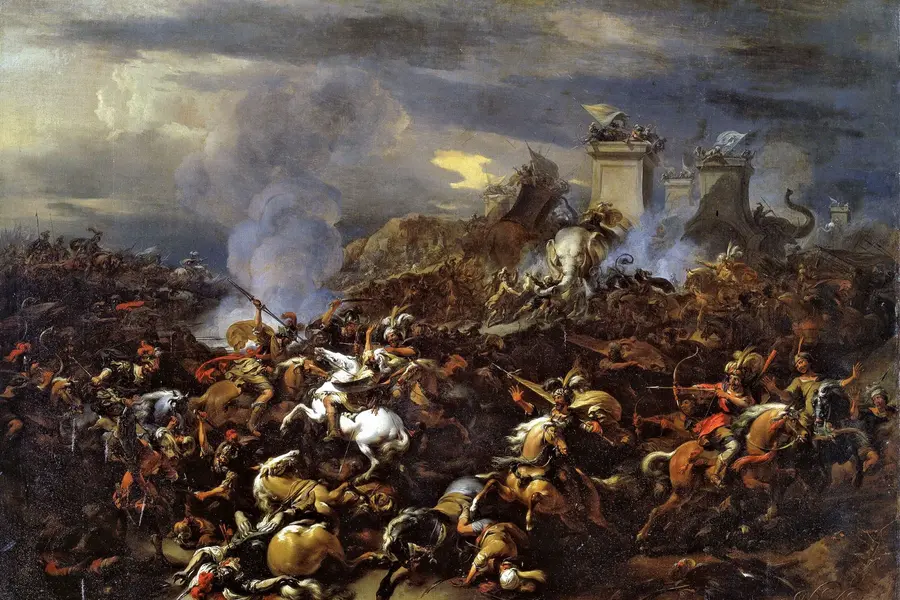
By the time Alexander reached India, the hypaspists had already spent years campaigning across multiple environments. Their experience was invaluable. The Battle of the Hydaspes in 326 BC pitted Alexander against King Porus. The battlefield presented a completely different challenge from Granicus, Issus and Gaugamela. Porus possessed war elephants, a powerful infantry force and cavalry, while the Hydaspes itself created a major obstacle.
Arrian describes Alexander crossing the river with a force that included hypaspists, Agrianian troops, archers and other mobile infantry. Seleucus commanded the royal hypaspists during the river operation. Their presence during the crossing is revealing. Alexander was not simply taking his largest possible force across the river. He selected troops capable of moving quickly and responding to an uncertain situation. The hypaspists were among the infantry he trusted for this dangerous maneuver. [7]
Once the battle developed, the Macedonian army had to deal with Indian elephants, which could disrupt infantry formations and create chaos. The hypaspists' flexibility would have been especially valuable in such circumstances, although the surviving sources do not provide enough detail to reconstruct every movement of the corps with confidence. The Hydaspes illustrates how the hypaspists could be employed as an experienced mobile infantry force well beyond the conventional battlefield role associated with the Macedonian phalanx.
Who Were the Silver Shields?
The Silver Shields, or Argyraspides, are often treated as though they were simply another name for Alexander's hypaspists. The reality is more complicated. The term argyraspides means "silver shields." Ancient sources connect the name with shields or equipment decorated with silver. Justin states that Alexander had his soldiers' equipment overlaid with silver before the Indian campaign, while other sources place the term in connection with the elite infantry at Gaugamela. [8]
This creates a chronological problem. The evidence suggests that the name became especially prominent toward the later part of Alexander's reign, while the exact institutional relationship between the Silver Shields and the earlier hypaspists is not completely certain. There is nevertheless a strong connection. At Gaugamela, Diodorus and Curtius describe Argyraspides in the position where Arrian places the hypaspists, under Nicanor. This strongly suggests that the terms referred to the same elite infantry tradition, at least in that context. [9]
The Silver Shields became much more famous after Alexander's death. During the Wars of the Successors, the Argyraspides developed an extraordinary reputation for experience and battlefield effectiveness. Many had served under Alexander for years and had become hardened veterans of the Persian and Indian campaigns. Under Eumenes, they were among the most formidable troops in the early Hellenistic world. Their reputation was so strong that commanders valued them not only for their fighting ability but also for the prestige attached to their name.
Why the Hypaspists Mattered
The hypaspists mattered because Alexander's army needed more than a powerful phalanx. The Macedonian phalanx was a superb weapon for fixing the enemy in place. The Companion Cavalry was the army's decisive shock force. But between those two weapons existed a problem. How could Alexander connect them while still possessing infantry capable of independent movement? The hypaspists solved much of that problem.
They could stand beside the phalanx, move with the cavalry, perform royal guard duties through the agema, storm walls, and participate in rapid marches. They were not required to perform one tactical function over and over again. This flexibility was particularly important because Alexander's campaign constantly changed character. In one year he might fight a major set-piece battle; in another he might cross mountains, besiege a city or pursue a fleeing king. The same army had to perform all these tasks. The hypaspists provided a reusable elite infantry capability.
Alexander's hypaspists therefore represent an important principle in military history: elite troops are most valuable when their specialization solves a specific tactical problem. The hypaspists were not elite simply because they were brave. Their value came from being trained and equipped for tasks that the main body of the army could not perform as efficiently.
The Legacy of the Hypaspists
The hypaspists did not disappear as an idea after Alexander's death. The most famous direct continuation of Alexander's elite infantry was the Argyraspides, or Silver Shields, who became renowned during the Wars of the Successors. Their broader legacy, however, was the concept of flexible heavy infantry capable of operating between specialized battlefield formations.
Alexander's army is often remembered as a combination of the Macedonian phalanx and Companion Cavalry, but the hypaspists helped make that combination work. They could support the phalanx, move alongside the cavalry, protect vulnerable gaps, fight in difficult terrain and undertake assaults where the sarissa was impractical. Their versatility allowed Alexander to adapt his army to very different environments, from the battlefields of Persia to fortified cities and the river crossings of India.
Their importance therefore reveals something fundamental about Alexander's military success. He did not rely on a single superior weapon or formation. He inherited Philip II's sophisticated military system and used its different components together, assigning each formation a role suited to its strengths. The hypaspists were one of the clearest examples of this approach: they were not the most spectacular troops in Alexander's army, but they provided the flexibility that connected its principal fighting arms.
They could operate at the junction between the phalanx and cavalry, giving Alexander a flexible infantry force where the two arms met. Their story shows why Alexander's army was more than a collection of elite soldiers. It was an integrated military system in which each component compensated for the weaknesses of another. For a broader examination of Alexander's campaigns and military system, see Alexander the Great: Biography, Battles and Strategy Guide.
References and Further Reading
Primary Sources
- Arrian. Anabasis of Alexander, especially Books I-V. Arrian's account is one of the principal sources for the organization and battlefield deployment of Alexander's army. See the Perseus Digital Library editions of the classical sources.
- Diodorus Siculus. Bibliotheca Historica, Book XVII. Diodorus provides an important alternative tradition for Alexander's campaigns and refers to the Argyraspides at Gaugamela.
- Quintus Curtius Rufus. Historiae Alexandri Magni, especially Books IV and VIII. Curtius preserves valuable details concerning Alexander's army and the Silver Shields.
- Plutarch. Life of Alexander. Useful for Alexander's career, personality, and several episodes of the campaign, although Plutarch's biography is not a military manual.
Modern Scholarship
- Markle, Minor M. "The Macedonian Sarissa, Spear, and Related Armor." American Journal of Archaeology 81, no. 3 (1977). This study is particularly useful for understanding the weapons and armor associated with Macedonian infantry.
- Heckel, Waldemar. Who's Who in the Age of Alexander the Great. Routledge. A valuable reference for the officers and commanders associated with Alexander's army.
- Bosworth, A. B. Conquest and Empire: The Reign of Alexander the Great. Cambridge University Press. A major modern study of Alexander's campaigns and imperial rule.
- English, Stephen. The Army of Alexander the Great. Pen & Sword. Provides detailed discussion of Macedonian organization, equipment, and tactics.
Books and Memorables
This article may contain affiliate links. If you purchase through these links, I may earn a small commission at no extra cost to you.


Related Articles
Frequently Asked Questions
Who were Alexander's hypaspists?
Alexander's hypaspists were an elite corps of Macedonian infantry who served alongside the main phalanx and Companion Cavalry. They were heavily armed but more mobile than ordinary phalangites, allowing them to protect the junction between infantry and cavalry, fight in difficult terrain, participate in assaults, and accompany Alexander on demanding operations.
What weapons and armor did Alexander's hypaspists use?
Alexander's hypaspists probably carried a large shield, a shorter spear, and a sword, along with a helmet and body armor. Their equipment gave them greater flexibility in close combat than the sarissa-armed Macedonian phalangites. Unlike the phalangites, they were not primarily dependent on the extremely long sarissa for their battlefield effectiveness.
What was the difference between hypaspists and Macedonian phalangites?
Hypaspists were more flexible elite infantry, while Macedonian phalangites formed the main battle line with the long sarissa. The phalanx was designed to fight as a dense formation on relatively open ground, whereas hypaspists could move more easily, fight in broken terrain, support cavalry, protect the phalanx's flank, and take part in assaults against fortified positions.
Why did Alexander need hypaspists in his army?
Alexander needed hypaspists because his phalanx and Companion Cavalry had different tactical limitations. The hypaspists could operate between these formations, helping maintain the connection between infantry and cavalry while also providing mobile heavy infantry for river crossings, difficult terrain, pursuit operations and assaults. Their flexibility made Alexander's combined-arms army more effective.
Did Alexander's hypaspists fight at Granicus, Issus and Gaugamela?
Yes. The hypaspists played an important role in Alexander's major battles against Persia. At Granicus, Issus and Gaugamela, they were positioned close to the junction between the Macedonian phalanx and Companion Cavalry. This allowed them to support Alexander's decisive attacks while helping maintain the cohesion of his main battle line.
Who were the Silver Shields in Alexander's army?
The Silver Shields, or Argyraspides, were an elite Macedonian infantry formation closely associated with the hypaspists. Ancient sources use different terminology, and historians debate exactly when the name became established. The Silver Shields became especially famous after Alexander's death, when these veteran soldiers fought in the Wars of the Successors and gained a reputation as some of the most experienced infantry in the Hellenistic world.
Add Comment