Diogenes of Sinope remains one of history's most controversial and unique philosophers. While many Greek thinkers sought truth through lectures, debates, and academies, Diogenes chose a different path. He lived with almost no possessions, mocked wealth and political power, rejected social conventions, and believed that happiness could only be found by living in accordance with nature rather than society's artificial rules. His encounters with kings like Alexander the Great, philosophers, and ordinary Athenians became legendary, making him one of the most memorable figures of Classical Greece. More than two thousand years later, his ideas continue to influence philosophy, psychology, and modern discussions about minimalism, consumerism, and personal freedom.
Table of Contents
- What Is Cynicism?
- Who Was Diogenes?
- Early Life of Diogenes
- Why Did Diogenes Become a Cynic?
- Why Did Diogenes Live in a Barrel?
- Diogenes and Alexander the Great
- Searching for an Honest Man
- Discarding His Wooden Bowl
- The Rich Man's House
- Plato's Featherless Biped
- Walking Backwards into the Theater
- Diogenes' Strange Public Behavior
- His Witty Replies to Philosophers and Kings
- How Did Diogenes Die?
- Legacy of Diogenes
What Is Cynicism?
Modern English uses the word cynicism to describe people who distrust others or assume that everyone acts out of selfish motives. Ancient Cynicism, however, meant something very different. The philosophy founded by Antisthenes in the fourth century BC argued that people should reject unnecessary wealth, luxury, fame, and social status to live according to nature. The name Cynic comes from the Greek word kynikos, meaning "dog-like." Critics used the term to mock philosophers who ignored social etiquette, lived outdoors, and cared little for appearances. Rather than rejecting the label, Diogenes embraced it. Like a dog, he believed a person should live simply, take only what was necessary, remain loyal to truth, and never pretend to be something they were not.
For the Cynics, virtue, not money or reputation, was the only true good. They argued that most human suffering came from chasing things that nature never required. Expensive homes, fashionable clothing, political office, and public admiration created dependence rather than happiness. This philosophy sharply contrasted with the ambitions of many Greek city-states, where political influence, military victories, and public honor were highly prized. During the same era, rulers such as Alexander the Great sought to build vast empires, while Diogenes believed that mastering oneself was a greater achievement than conquering nations.
Who Was Diogenes?
Diogenes of Sinope was a Greek philosopher who lived during the fourth century BC, generally dated to around 412 or 404 BC to 323 BC. He was born in the Black Sea city of Sinope, located in modern-day Turkey, before eventually settling in Athens, the intellectual center of the Greek world. Unlike philosophers such as Plato or Aristotle, Diogenes founded no academy, wrote no known books, and left behind no systematic philosophical treatise. Almost everything known about him comes from later writers, particularly the third-century AD historian Diogenes Laërtius, whose Lives and Opinions of Eminent Philosophers preserves dozens of stories about his life.
Although some anecdotes may have become exaggerated over time, they consistently portray a man who challenged hypocrisy wherever he found it. Whether speaking to ordinary citizens, respected philosophers, or powerful rulers, Diogenes refused to alter his opinions. His influence extended far beyond his lifetime. Later Stoic philosophers admired his independence and self-control, while Roman writers celebrated his fearless honesty. Today he remains one of the best-known representatives of Ancient Greek philosophy precisely because he transformed philosophical ideas into everyday actions.
| Fact | Details |
|---|---|
| Full Name | Diogenes of Sinope |
| Born | c. 412-404 BC |
| Died | 323 BC |
| Birthplace | Sinope, on the Black Sea |
| School | Cynicism |
| Known For | Living in extreme simplicity and challenging social conventions |
Early Life of Diogenes
The details of Diogenes' childhood remain uncertain, but ancient sources agree that he grew up in Sinope, a prosperous Greek trading colony on the Black Sea. His father, Hicesias, is believed to have worked as a banker or handled the city's coinage, placing the family in a relatively comfortable social position. According to one ancient tradition, Diogenes became involved in a scandal concerning the defacement or adulteration of currency. Whether he personally altered coins or was implicated through his father's profession remains unclear, but the incident allegedly resulted in exile from Sinope.
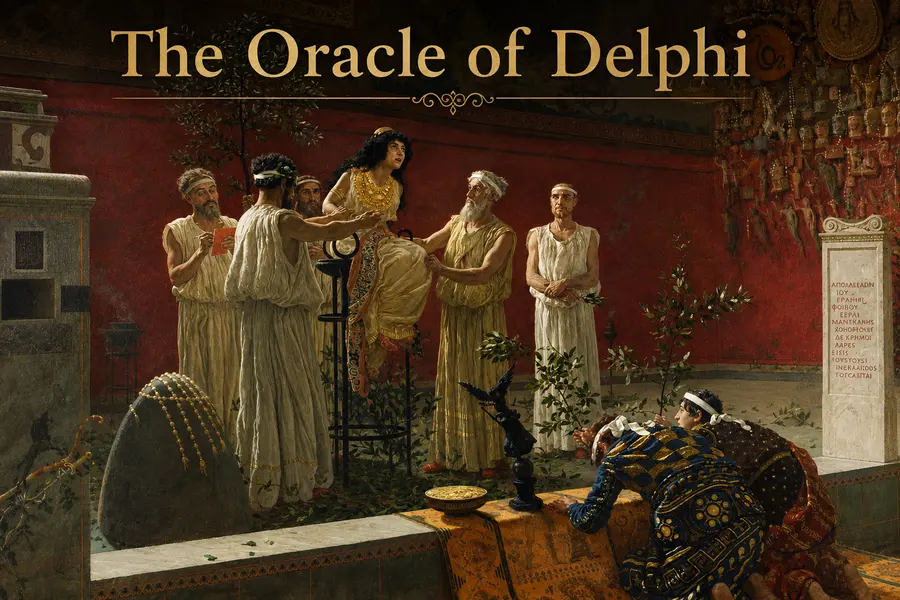
For many historians, this event became a symbolic turning point. Diogenes later claimed that he had been instructed by the Oracle at Delphi to "deface the currency." While many interpreted this literally, Diogenes argued that the Oracle referred instead to society's moral values. Rather than changing coins, he sought to expose the false values that people treated as precious-wealth, prestige, and social status. This reinterpretation became the foundation of his philosophical mission. Instead of rejecting counterfeit money, he aimed to reject what he considered counterfeit ways of living.
Why Did Diogenes Become a Cynic?
After arriving in Athens, Diogenes encountered the teachings of Antisthenes, a disciple of Socrates and the founder of Cynicism. Ancient sources describe Antisthenes as initially refusing to accept him as a student. Diogenes reportedly followed him everywhere until persistence finally won the philosopher's respect. Whether entirely factual or partly legendary, the story reflects Diogenes' determination. He admired Socrates' belief that virtue mattered more than wealth, but he believed even Socrates had not gone far enough. Society itself, Diogenes argued, encouraged people to pursue unnecessary desires.
According to Cynic philosophy, nature provides everything essential for life. Hunger requires simple food, not lavish feasts. Cold requires shelter, not luxurious mansions. Friendship requires honesty rather than political alliances or financial advantage. Diogenes concluded that civilization had complicated human existence by creating artificial needs. Every possession beyond necessity became another source of anxiety, dependence, or disappointment. This belief explains why he deliberately embraced poverty. Unlike those forced into hardship, Diogenes chose a life without luxury because he believed voluntary simplicity created genuine freedom.
Why Did Diogenes Live in a Barrel?
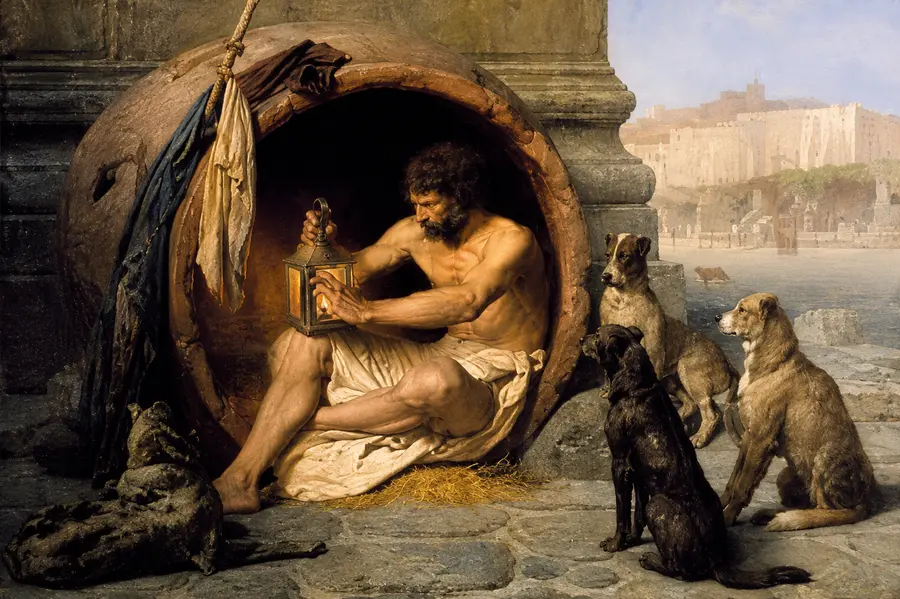
Perhaps no image is more closely associated with Diogenes than that of an old philosopher living inside a giant barrel. While the story is true in spirit, the object was almost certainly not a wooden barrel like those used today. Ancient Greek sources describe Diogenes living inside a pithos, a massive ceramic storage jar used to hold grain, wine, or olive oil. These jars were large enough for a person to sit or sleep inside and were commonly found near public buildings and marketplaces.
Choosing such a dwelling was not merely a consequence of poverty. It was a public demonstration of his philosophy. Most Athenians measured success by owning larger homes, finer furniture, and more luxurious possessions. Diogenes intentionally did the opposite. By making his home in the marketplace, he rejected the idea that happiness depended on property or social standing.
Living outdoors also allowed him to remain constantly visible. His entire life became a philosophical lesson. Instead of delivering lectures inside a school, Diogenes invited people to question their own assumptions simply by observing how differently he lived. Ancient writers record that he owned almost nothing beyond a cloak, staff, small bag, and a wooden bowl-until even that proved unnecessary.
| Common Myth | Historical Reality |
|---|---|
| Diogenes lived in a wooden barrel. | He probably lived in a large ceramic storage jar called a pithos. |
| He lived there because he was homeless. | He deliberately chose extreme simplicity as a philosophical statement. |
| He avoided society. | He lived in busy public spaces so people would constantly confront his ideas. |
Diogenes and Alexander the Great
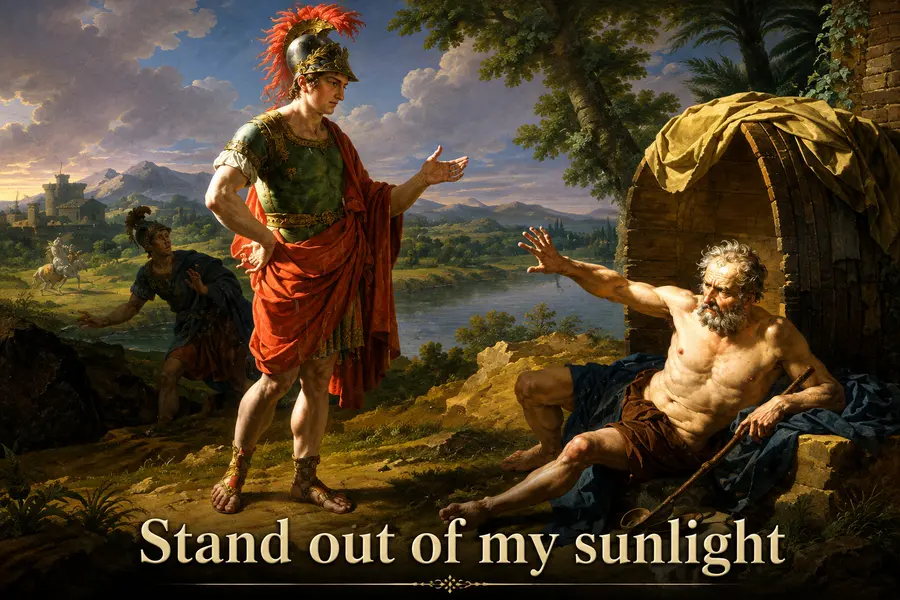
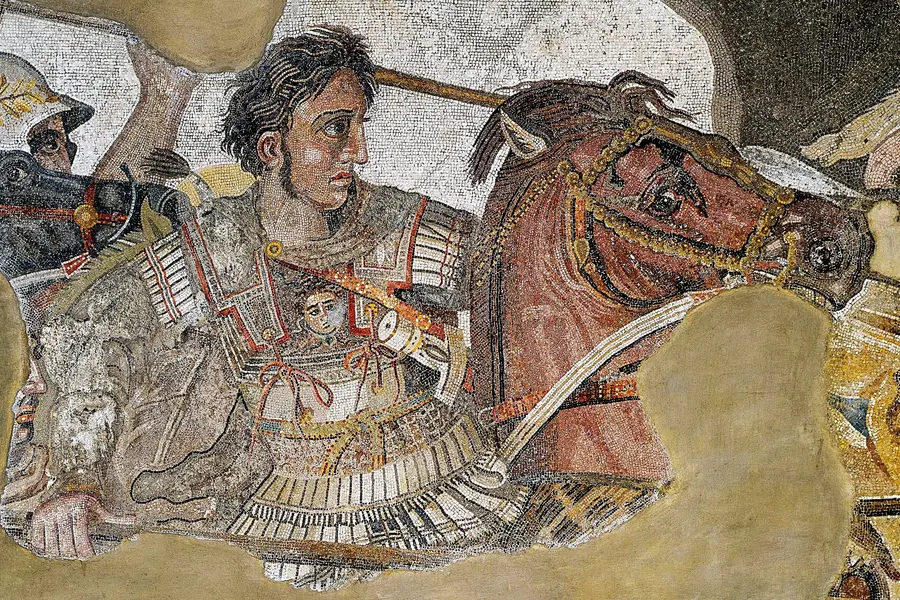
One of the most famous encounters in the history of philosophy is the meeting between Diogenes and Alexander the Great. Although ancient authors differ on the exact details, the core story has endured for more than two millennia because it perfectly captures the contrast between political power and personal freedom.
By the time the meeting supposedly occurred, Alexander had already emerged as the dominant figure in Greece. The young Macedonian king would soon launch the campaigns that created one of history's greatest empires, defeating Persia and transforming the ancient world. According to Plutarch, Alexander sought out Diogenes while the philosopher was relaxing outside his pithos. Surrounded by attendants, soldiers, and admirers, the king approached the elderly Cynic and asked whether there was anything he could do for him. Diogenes reportedly replied with extraordinary calm:
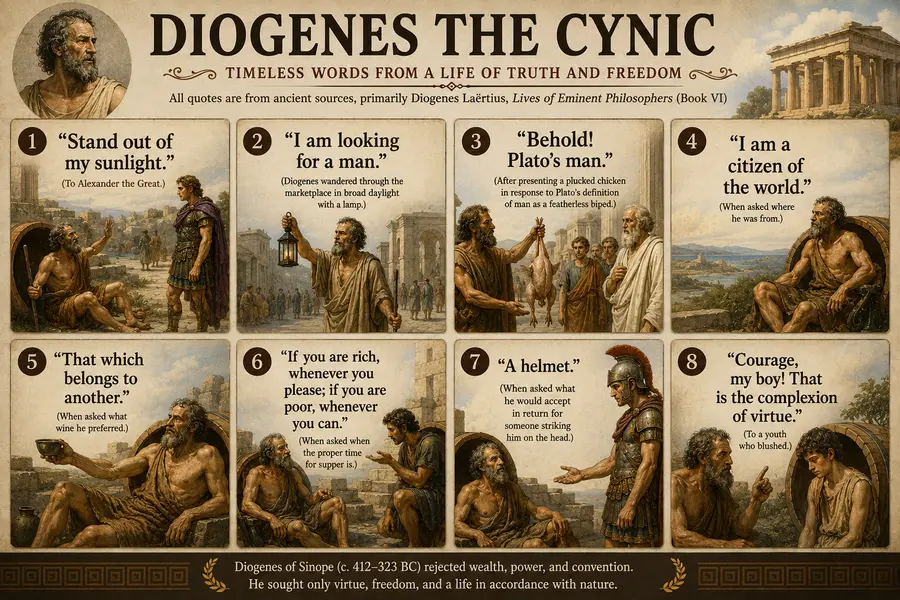
"Yes. Stand out of my sunlight."
The response astonished everyone present. Most people treated Alexander almost as a living god, yet Diogenes viewed him simply as another man who happened to be blocking the sun. Rather than taking offense, Alexander is said to have admired the philosopher's independence. As he departed, he famously remarked:
"If I were not Alexander, I would wish to be Diogenes."
Whether every word of the conversation is historically accurate cannot be proven. Nevertheless, the anecdote survives because it illustrates two opposing visions of success. Unlike Alexander, Diogenes believed that true freedom required conquering one's own desires rather than other people. To him, a king who depended upon armies, wealth, and public admiration was less free than a philosopher who needed nothing. In many ways, the story represents the enduring conflict between external success and inner contentment, a debate that continues to resonate in modern society.
Searching for an Honest Man
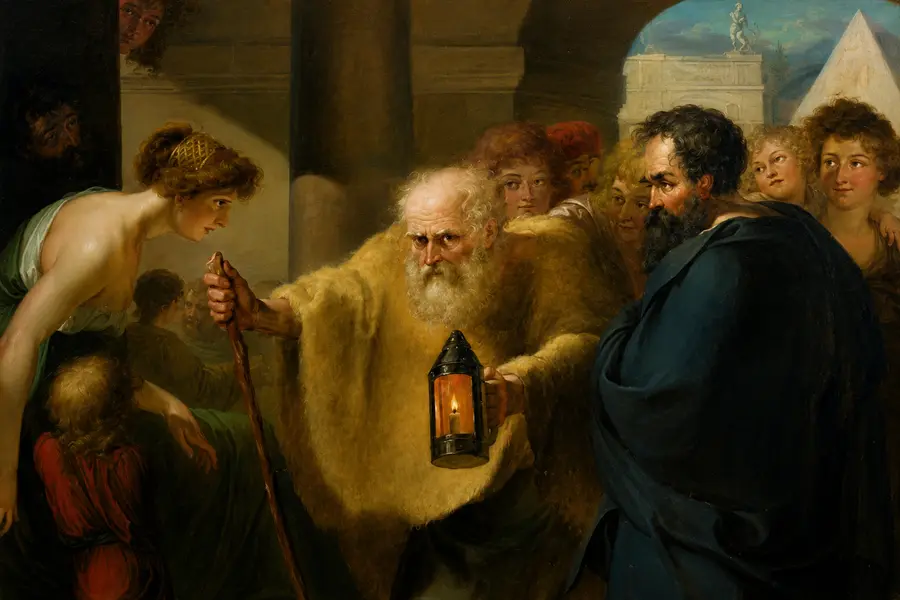
Among the many stories associated with Diogenes, none is more enduring than the image of the old philosopher wandering through Athens in broad daylight carrying a lit lantern. Curious crowds naturally asked what he was doing. His answer became one of the most famous lines in ancient philosophy:
"I am looking for an honest man."
At first glance, the act seems absurd. A lantern is unnecessary in daylight, and Athens was one of the largest and most sophisticated cities in the Greek world. Yet Diogenes intended precisely that contradiction. His strange behavior forced people to stop, stare, and ask questions, creating an opportunity to challenge their assumptions. The lantern was not meant to illuminate dark streets but to expose what Diogenes believed was a darker problem-the moral hypocrisy hidden beneath respectable appearances.
To Diogenes, many Athenians claimed to value justice, wisdom, and virtue while pursuing wealth, political influence, or social recognition above everything else. Citizens praised honesty but lied when convenient. Politicians spoke of serving the public while advancing their own interests. Merchants boasted about fairness yet cheated customers whenever possible. By claiming that he could not find a single honest person even in the middle of the day, Diogenes accused society of valuing reputation more than character.
The anecdote also reflects an important aspect of Cynic philosophy. Rather than teaching through abstract arguments, Diogenes transformed philosophy into public performance. His actions became visual demonstrations that ordinary people could neither ignore nor easily forget. Modern historians caution that the episode cannot be independently verified, but it appears in several ancient traditions and perfectly reflects the moral criticisms that define Cynicism.
Discarding His Wooden Bowl
Although Diogenes deliberately lived with very few possessions, he still carried a simple wooden bowl that allowed him to drink water. One day, according to ancient sources, he watched a young boy kneel beside a stream and cup water in his hands. The sight immediately embarrassed the philosopher. If the child could drink without a bowl, Diogenes realized that even this small possession was unnecessary. He threw away the bowl at once, reportedly declaring that the boy had surpassed him in simplicity.
The story illustrates an important distinction within Cynicism. Diogenes did not seek poverty merely for its own sake. Instead, he constantly questioned whether every possession genuinely served a necessary purpose. Most people gradually accumulate objects that promise convenience or comfort. Diogenes believed that every unnecessary possession also created dependence. More belongings meant more things to protect, repair, replace, or worry about losing.
Even after reducing his life to little more than a cloak, staff, and small bag, he continued asking whether further simplification was possible. This relentless self-examination distinguished him from people who merely pretended to reject luxury while quietly retaining comforts. Diogenes insisted that philosophy demanded consistency between belief and action. The anecdote continues to resonate because it asks a timeless question: how many of the things we consider essential are actually conveniences that have become habits?
Diogenes' Encounter in a Rich Man's House
Another famous story illustrates Diogenes' contempt for excessive luxury and social pretension. He was once invited into the lavish home of a wealthy citizen. Proud of his spotless floors and expensive furnishings, the owner warned the philosopher not to spit anywhere inside the house. Diogenes looked around the magnificently decorated room, walked toward the owner, and spat directly in his face.
When the horrified man demanded an explanation, Diogenes reportedly replied that it was the only dirty place he could find. The anecdote is deliberately shocking, but its philosophical point is clear. Diogenes believed that moral corruption mattered far more than physical cleanliness.
Wealthy Athenians often invested enormous effort in displaying elegant homes, luxurious clothing, and refined manners. Yet, according to Diogenes, many neglected virtues such as honesty, humility, generosity, and self-control.
The philosopher reversed ordinary standards of respectability. Beautiful buildings meant little if their owners possessed ugly characters. Whether the incident occurred exactly as described is impossible to determine, but the story reflects Diogenes' willingness to insult even influential citizens if he believed they valued appearance above virtue.
Plato's "Featherless Biped" and the Plucked Chicken

Perhaps the most famous rivalry in Greek philosophy was between Diogenes and Plato. While Plato built one of the ancient world's greatest philosophical schools, Diogenes viewed elaborate theories with deep suspicion. He preferred practical demonstrations over abstract definitions. Their disagreement is perfectly illustrated by the famous "featherless biped" story. According to Diogenes Laërtius, Plato once attempted to define a human being as:
"A featherless biped."
At first, the definition impressed many students because it appeared logically precise. Diogenes, however, believed that philosophical language often became detached from reality. The next day he entered Plato's Academy carrying a plucked chicken. Holding it before the assembled students, he declared:
"Behold! Plato's man."
The joke immediately exposed the weakness of Plato's definition. The embarrassed Academy reportedly revised the definition by adding the qualification that humans possess broad, flat fingernails. Whether entirely historical or embellished over time, the anecdote captures the intellectual contrast between the two philosophers. The plucked chicken story remains one of philosophy's most memorable examples of using humor to expose weaknesses in intellectual arguments.
| Plato | Diogenes |
|---|---|
| Favored abstract definitions. | Preferred practical demonstrations. |
| Taught inside the Academy. | Taught in public streets. |
| Explored ideal forms and metaphysics. | Focused on everyday virtue and simplicity. |
| Used philosophical dialogue. | Used satire, humor, and public behavior. |
Walking Backwards into the Theater
One day Diogenes was seen entering a theater while walking backwards. Spectators naturally stared at the unusual sight and asked why he behaved so strangely. His reply was simple:
"This is what I have been trying to do all my life."
Like many Cynic anecdotes, the story works on two levels. On the surface, it describes an eccentric old philosopher behaving oddly. Beneath the humor lies a criticism of conformity. Most people, Diogenes believed, spend their lives moving in the same direction as everyone else. They adopt popular opinions, pursue fashionable ambitions, and rarely question social expectations.
By literally walking against the normal direction of movement, Diogenes symbolized his refusal to follow the crowd. The theater itself carried symbolic meaning. Greek theaters represented civic life, entertainment, and public opinion. Entering backwards suggested a rejection of conventional values and a willingness to view society from an entirely different perspective. The anecdote remains relevant because independent thinking often appears strange to those who follow accepted norms.
Diogenes' Strange Public Behavior
Ancient writers frequently describe Diogenes behaving in ways that shocked respectable Athenians. He begged openly, slept in public places, ate in the marketplace, interrupted conversations, insulted influential citizens, and ignored many conventions governing polite society. Some stories even claim that he deliberately performed natural bodily functions in public to demonstrate that people should not feel ashamed of what nature requires.
Such accounts have made Diogenes one of history's most controversial philosophers. Modern readers often wonder whether these actions reflected genuine eccentricity or carefully planned philosophical demonstrations. Most scholars believe they served both purposes.
Diogenes sought to distinguish between natural behavior and social customs. Eating when hungry, sleeping when tired, or seeking shelter from cold were natural needs. Embarrassment surrounding these activities, he argued, existed only because society had created artificial rules about what was considered respectable.
By deliberately violating those expectations, Diogenes hoped to expose how many customs people accepted without questioning their purpose. At the same time, ancient biographers almost certainly exaggerated some incidents to emphasize his reputation for fearlessness and unconventional living. Even allowing for exaggeration, the consistent picture is that of a philosopher willing to sacrifice comfort, reputation, and popularity to remain faithful to his beliefs.
Diogenes' Witty Replies to Philosophers and Kings
Diogenes possessed a sharp wit that enabled him to distill complex ideas into memorable one-line responses. Ancient writers preserved dozens of these sayings because they reflected his fearless personality and his ability to challenge authority with humor rather than violence. Many of these exchanges occurred with rulers, philosophers, and wealthy citizens who expected respect simply because of their position. When someone asked where he came from, Diogenes answered:
"I am a citizen of the world."
This statement is among the earliest recorded expressions of cosmopolitanism, the idea that people belong to humanity rather than to a single city or nation. When questioned about why people gave money to beggars but not to philosophers, he reportedly observed that people feared becoming poor or disabled, but never expected to become philosophers.
On another occasion, he was mocked for begging for money from a statue. Diogenes explained that he was practicing disappointment so that future refusals would not trouble him. His wit also revealed a deep understanding of human psychology. Rather than responding with anger when insulted, he often replied with humor that exposed the weakness of the insult itself. These brief exchanges helped spread his reputation throughout Greece. Many who never met Diogenes still encountered his philosophy through collections of sayings that circulated for generations.
| Famous Reply | Meaning |
|---|---|
| "Stand out of my sunlight." | True freedom cannot be purchased by power. |
| "I am looking for an honest man." | Society values appearance over virtue. |
| "I am a citizen of the world." | Human identity is greater than political boundaries. |
| Plucked chicken at Plato's Academy. | Humor can expose weak philosophical definitions. |
| Practicing by begging from a statue. | Emotional resilience comes through accepting rejection. |
More than two thousand years later, these concise remarks remain widely quoted because they combine humor, courage, and philosophical insight. They demonstrate why Diogenes continues to be remembered not merely as an eccentric, but as one of antiquity's most provocative thinkers.
The Legacy of Diogenes: How One Cynic Changed Greek Philosophy
Diogenes never founded a school comparable to Plato's Academy or Aristotle's Lyceum. He wrote no surviving philosophical treatises, held no political office, and commanded no army. Yet his influence on Western philosophy has proven remarkably enduring. His ideas survived because they were preserved through memorable stories that communicated philosophical principles in ways ordinary people could understand. For many Greeks, Diogenes represented the ultimate challenge to conventional society. At a time when success was measured by wealth, political influence, military glory, and public honor, he argued that these achievements often distracted people from the only thing that truly mattered: living a virtuous life.
His philosophy encouraged individuals to examine whether their goals genuinely reflected their own values or merely society's expectations. This message resonated with later generations living through political instability and social change, helping Cynicism spread throughout the Hellenistic world. Although later Cynics rarely adopted Diogenes' extreme lifestyle in its entirety, they embraced his central belief that freedom begins by reducing dependence on external possessions and public approval.
Influence on Stoicism
One of Diogenes' greatest contributions was his indirect influence on Stoicism, one of the most important philosophical schools of antiquity. The founder of Stoicism, Zeno of Citium, is said to have been inspired after reading about the Cynics and later studying under the Cynic philosopher Crates of Thebes, who himself had been deeply influenced by Diogenes. While the Stoics rejected many of Diogenes' more provocative public demonstrations, they adopted several of his central ideas, including:
- Virtue is the highest good.
- External wealth does not determine happiness.
- Self-control leads to freedom.
- People should focus only on what they can control.
These principles later shaped the writings of Roman Stoics such as Seneca, Epictetus, and Marcus Aurelius, ensuring that Diogenes' influence extended far beyond Classical Greece.
The Historical Reliability of the Stories
Almost every famous anecdote about Diogenes comes from writers who lived centuries after his death. The principal source is Diogenes Laërtius, writing in the third century AD, more than five hundred years after Diogenes himself lived. Other important sources include Plutarch, Dio Chrysostom, and Lucian. These authors often relied on earlier works that have since been lost, making it difficult for historians to verify individual stories.
Even where individual anecdotes cannot be confirmed, historians generally agree that they reflect Diogenes' consistent philosophical outlook. The remarkable consistency across different ancient authors suggests that these stories preserved genuine aspects of his personality, even if later storytellers embellished certain details. In other words, the literal accuracy of every anecdote matters less than the philosophical ideas they were intended to convey.
Diogenes and Greek Society
Diogenes occupied a unique place within Greek society. He criticized nearly every institution around him, yet he also became one of the most famous public figures of his age. Rather than withdrawing from civilization, he deliberately lived at its center, in marketplaces, public squares, and busy streets, where his actions would provoke discussion. His philosophy depended upon engaging with society even as he rejected many of its values.
His criticism extended to politicians, wealthy merchants, respected philosophers, and even ordinary citizens. No one, in his view, deserved exemption from scrutiny. Ironically, this relentless criticism strengthened rather than weakened Greek philosophical culture. By challenging accepted assumptions, Diogenes encouraged public debate about ethics, happiness, freedom, and the purpose of human life. Even those who disagreed with him were forced to defend their own beliefs more carefully because of his relentless challenges.
How Did Diogenes Die?
Like many episodes from his life, the circumstances surrounding Diogenes' death remain uncertain. Ancient writers preserved several conflicting accounts, and no contemporary evidence survives to determine which, if any, is correct. Most agree that he died in 323 BC, the same year as Alexander the Great, but they disagree on the cause of his death.
According to Diogenes Laërtius, one tradition claimed that Diogenes became seriously ill after eating a raw octopus. Another suggested that he died from an infected dog bite, a story that perhaps reflected the lifelong association between the philosopher and the "dog-like" Cynics. A third and even more remarkable tradition claimed that Diogenes voluntarily held his breath until he died, presenting his death as the final demonstration of self-control over both body and mind. Modern historians generally regard this last account as symbolic rather than historical.
Because these accounts were written centuries after Diogenes' lifetime, historians cannot determine which version, if any, reflects what actually happened. The conflicting traditions instead highlight how quickly the philosopher became a legendary figure whose life and death inspired stories designed to illustrate his character. Regardless of the exact cause, Diogenes' reputation endured because of the ideas he championed rather than the manner of his death. His challenge to wealth, status, and social convention continued to influence later philosophers long after his passing.
Diogenes in Modern Culture
Few ancient philosophers have remained as recognizable in popular culture as Diogenes. His image carrying a lantern, living inside a large storage jar, or telling Alexander the Great to move out of his sunlight continues to appear in books, films, political commentary, and works of art. His philosophy has also found renewed relevance in the modern world.
Advocates of minimalism frequently cite Diogenes as an early example of voluntary simplicity. Critics of consumer culture often invoke his rejection of unnecessary possessions as a reminder that happiness cannot always be measured through material success. Psychologists studying well-being have likewise noted that Diogenes emphasized ideas supported by modern research, including the limited relationship between wealth and long-term happiness once basic needs have been met.
At the same time, few people advocate copying his lifestyle completely. Sleeping outdoors, rejecting social customs, and deliberately provoking strangers are hardly practical models for modern life. Instead, his enduring appeal lies in the questions he forces people to ask:
- How much do we really need to live well?
- Do we pursue success because we truly value it or because others expect it?
- How often do we confuse comfort with happiness?
- Can freedom exist without independence from material possessions?
These questions remain surprisingly relevant more than two millennia after Diogenes walked the streets of Athens.
References
- Diogenes Laërtius. Lives and Opinions of Eminent Philosophers, Book VI.
- Plutarch, Life of Alexander
- Dio Chrysostom. Discourses.
- Lucian of Samosata. Dialogues of the Dead.
- Donald R. Dudley. A History of Cynicism: From Diogenes to the Sixth Century A.D. Cambridge University Press.
- Luis E. Navia. Diogenes the Cynic: The War Against the World. Humanity Books.
- William Desmond. Cynics. Routledge.
- Robin Hard (Translator). Diogenes Laertius: Lives of the Eminent Philosophers. Oxford University Press.
- Pierre Hadot. Philosophy as a Way of Life. Blackwell Publishing.
- A. A. Long. Hellenistic Philosophy: Stoics, Epicureans, Sceptics. University of California Press.
Books and Memorables
This article may contain affiliate links. If you purchase through these links, I may earn a small commission at no extra cost to you.


Related Articles


Frequently Asked Questions
Why did Diogenes the Cynic live in a barrel?
Diogenes did not actually live in a wooden barrel as commonly depicted. Ancient sources describe him living in a large ceramic storage jar called a pithos. He chose it deliberately to reject luxury and demonstrate the Cynic belief that happiness comes from living simply and according to nature rather than owning expensive possessions.
Did Diogenes the Cynic really meet Alexander the Great?
According to ancient writers such as Plutarch, Diogenes met Alexander the Great in Corinth. When Alexander offered to grant him any wish, Diogenes famously replied, 'Stand out of my sunlight.' While historians cannot verify every detail of the story, it has been preserved for centuries because it perfectly illustrates the contrast between political power and personal freedom.
Why did Diogenes carry a lantern during the day?
Diogenes carried a lit lantern in broad daylight because he claimed he was 'looking for an honest man.' The act was a symbolic criticism of Athenian society, suggesting that genuine honesty and virtue were so rare that they could not easily be found even in a crowded city.
Why did Diogenes throw away his wooden bowl?
Ancient sources say Diogenes threw away his wooden bowl after seeing a young boy drink water using only his hands. He concluded that even the bowl was an unnecessary possession. The story reflects the Cynic belief that people should own only what is truly essential for life.
What was the rivalry between Diogenes and Plato about?
Diogenes and Plato represented two very different approaches to philosophy. Plato focused on abstract ideas and formal definitions, while Diogenes emphasized practical living and direct experience. Their most famous exchange involved Plato defining humans as 'featherless bipeds,' prompting Diogenes to present a plucked chicken and declare, 'Behold Plato's man,' exposing the weakness of the definition.
How did Diogenes the Cynic influence later philosophy?
Diogenes became the most famous representative of Cynicism, a philosophy that emphasized virtue, self-sufficiency, and freedom from material wealth. His ideas strongly influenced later Stoic philosophers such as Zeno of Citium, helping shape one of the most important philosophical traditions of the ancient world.
Add Comment