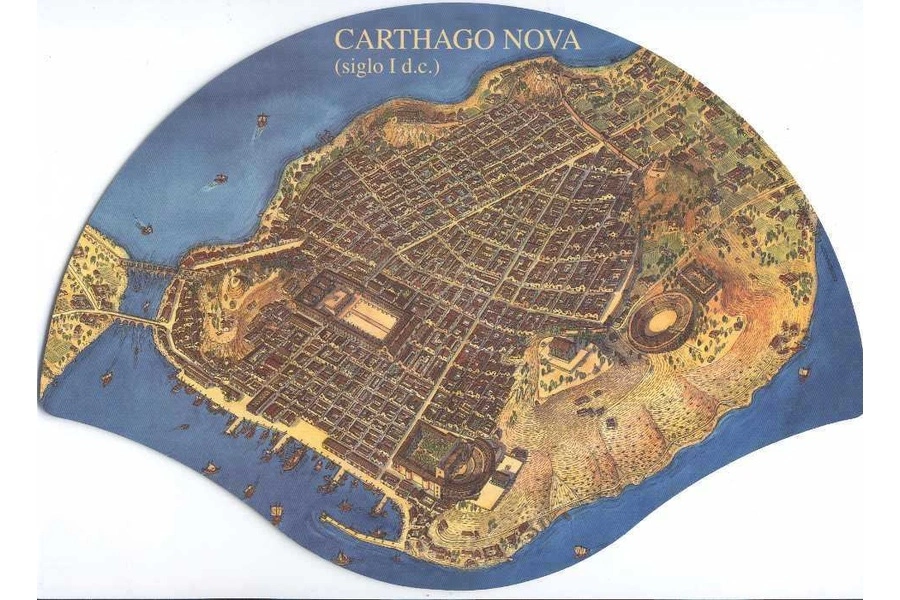
In 209 BC, a young Roman general attempted something that seemed almost impossible. Capturing New Carthage, one of the most important Carthaginian strongholds in Hispania, before its defenders could even organise a response. Protected by the sea, a lagoon and formidable fortifications, the city appeared almost impregnable. Yet Scipio Africanus had discovered a weakness that its defenders had overlooked. Using intelligence gathered from local fishermen, a carefully coordinated assault and an unexpected approach through the lagoon enabled Scipio to breach the city's defences and capture it in a remarkably short operation. The victory did more than secure a strategic port. It deprived Carthage of its principal base in Spain and transformed the course of the Second Punic War.
Table of Contents
- Why Was New Carthage So Important to Carthage?
- Scipio Africanus: The Young Roman General Seeking Revenge
- New Carthage: A Fortress Protected by Nature
- Scipio's Plan: A Surprise Attack on New Carthage
- The Secret Intelligence That Changed the Siege
- The Roman Assault Begins: Attacking from Land and Sea
- The Lagoon Crossing: Scipio's Most Brilliant Manoeuvre
- The Fall of New Carthage: Mago's Surrender
- What Did Scipio Do With the Prisoners and Spanish Hostages?
- Why the Capture of New Carthage Changed the Second Punic War
- Was the Capture of New Carthage a Military Masterstroke?
- Conclusion: The Day Scipio Changed the War in Hispania
- References and Further Reading
Why Was New Carthage So Important to Carthage?
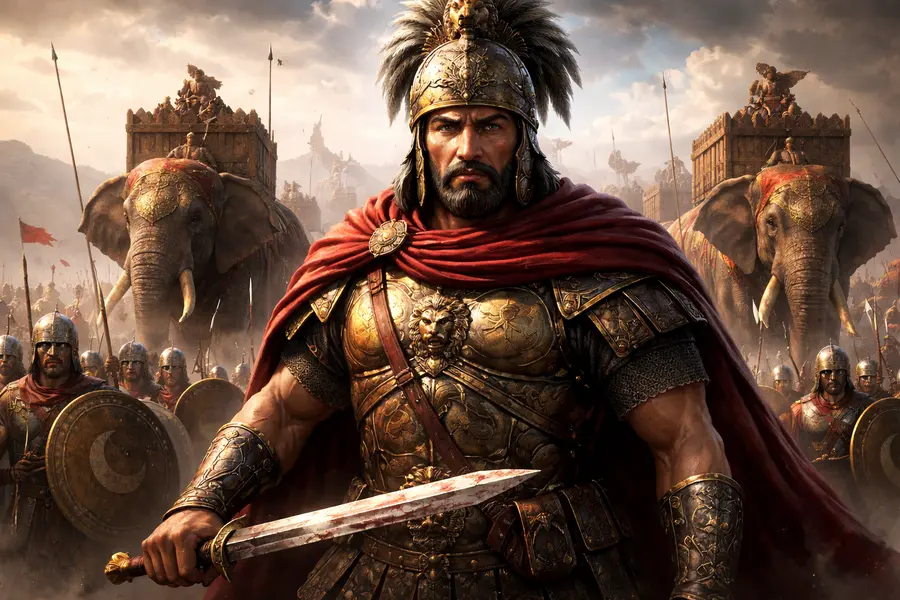
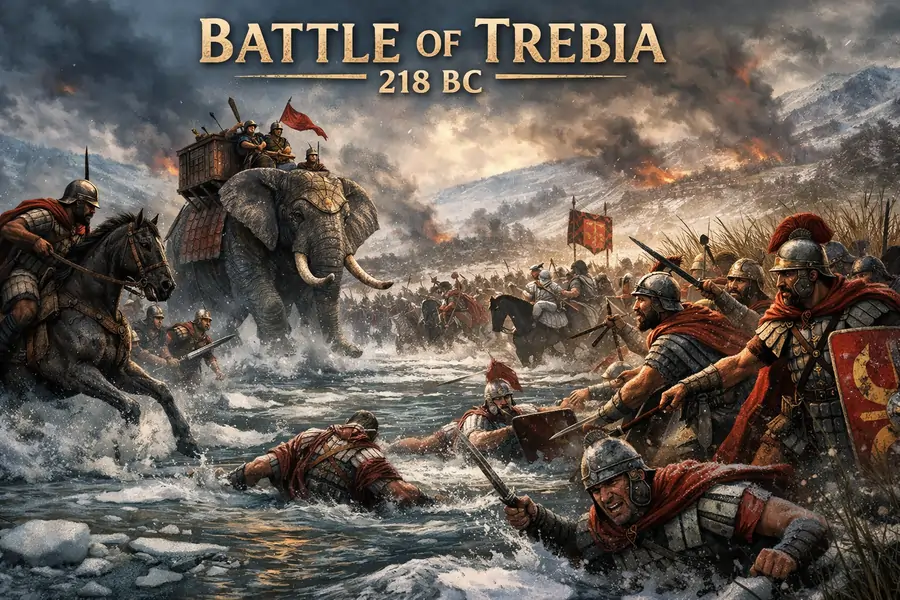
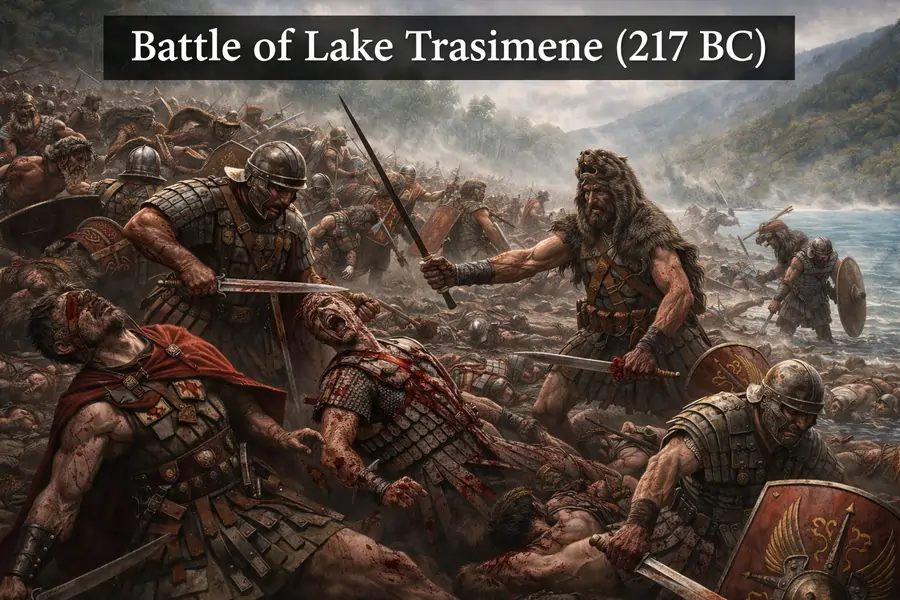
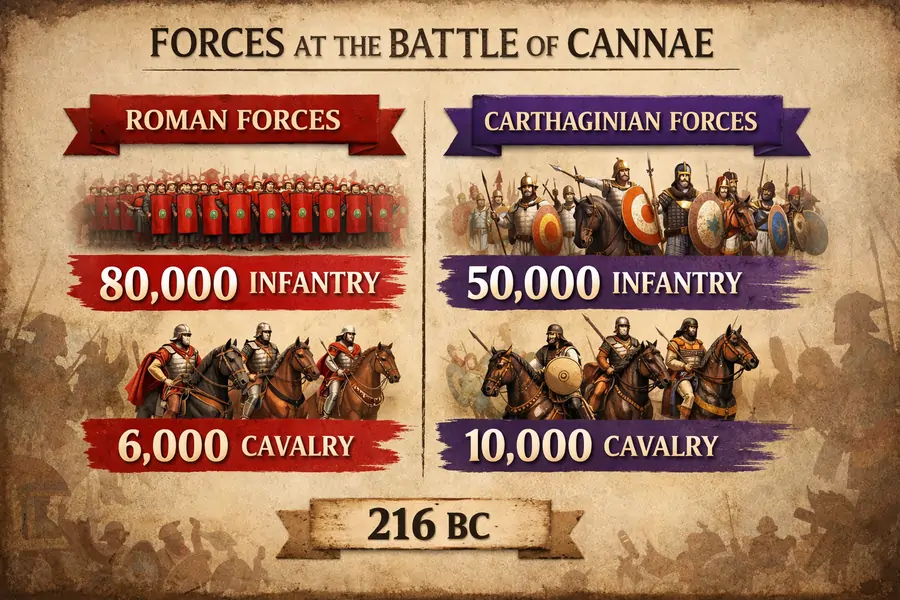
By 209 BC, the Second Punic War had entered its ninth year. Hannibal Barca had crossed the Alps, defeated several Roman armies, and inflicted devastating losses on the Republic. His victories at Trebia in 218 BC, Lake Trasimene in 217 BC and Cannae in 216 BC had exposed the weaknesses of the Roman military system. Despite his successes in Italy, Hannibal had not managed to force Rome to surrender.
Meanwhile, Carthage maintained a powerful military presence in Hispania (modern Spain and Portugal). The peninsula supplied the Carthaginian war effort with soldiers, money, provisions and access to valuable mineral resources. It was also the base from which Carthaginian commanders coordinated their operations against Roman forces.
At the centre of this network stood New Carthage, known to the Romans as Carthago Nova and today called Cartagena. Founded by Hasdrubal the Fair, the successor of Hamilcar Barca, the city had become the principal Carthaginian stronghold in Hispania. New Carthage was valuable for several reasons:
- Strategic harbour: Its natural harbour provided a protected anchorage for the Carthaginian fleet and facilitated communication with North Africa.
- Military supplies: The city stored weapons, equipment and provisions required by Carthaginian forces operating in Hispania.
- Treasury: A substantial portion of Carthage's financial resources in the peninsula was kept within the city.
- Political control: Carthage held hostages from several Iberian communities there to discourage rebellion and secure the loyalty of local rulers.
- Military administration: Its location made it an important centre for coordinating the Carthaginian presence in the peninsula.
The Greek historian Polybius, one of the principal ancient sources for the Second Punic War, emphasised the city's importance. In his account, Scipio learned that New Carthage contained the Carthaginian treasury, military supplies and hostages from across Hispania. Capturing it would therefore inflict damage far beyond the loss of a single fortified town (Polybius, Histories, Book 10.8).
For Rome, the city represented an opportunity to strike at the foundations of Carthaginian power in Spain. Rather than continuing to fight the Carthaginian armies in the field, Scipio decided to attack the centre that supported them.
Scipio Africanus: The Young Roman General Seeking Revenge
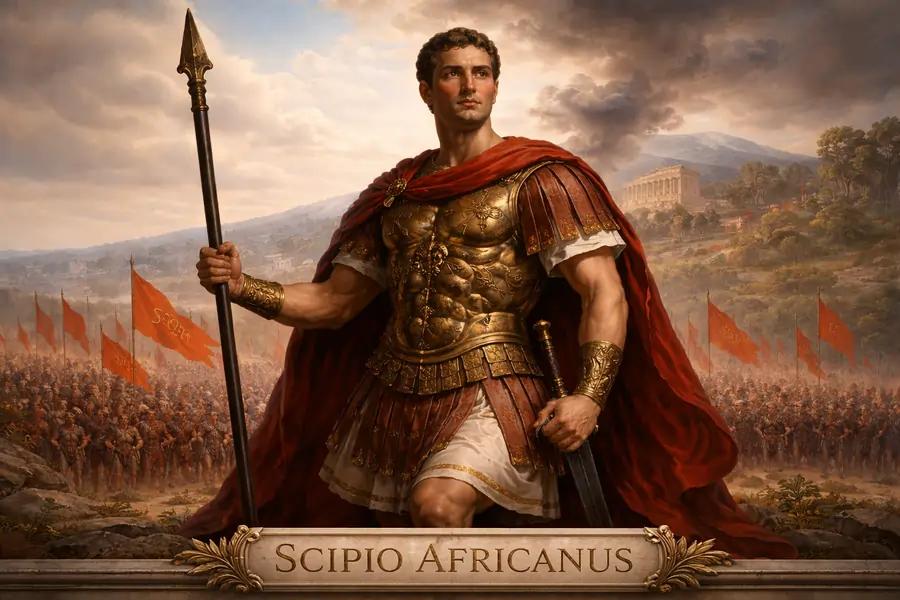
Publius Cornelius Scipio had a personal reason to fight Carthage. His father, Publius Cornelius Scipio, and uncle, Gnaeus Cornelius Scipio Calvus, had commanded Roman forces in Hispania. Both were killed in 211 BC during the disastrous Roman campaign against the Carthaginians. The deaths of the two commanders threatened to destroy Rome's position in the peninsula. Carthaginian forces had regained the initiative, and the remaining Roman troops were in a precarious position.
Scipio volunteered to take command of the Roman forces in Hispania. Despite his relative youth and limited experience as an independent commander, he was appointed to the position in 210 BC. His appointment was a considerable gamble. He inherited a difficult military situation and faced three experienced Carthaginian commanders:
- Hasdrubal Barca: Hannibal's brother and an experienced Carthaginian general.
- Hasdrubal son of Gisgo: Another important Carthaginian commander operating in Hispania.
- Mago Barca: Hannibal's younger brother, who also commanded Carthaginian forces in the peninsula.
These commanders had considerable resources and could potentially combine their armies against the Romans. Scipio recognised that confronting all three simultaneously would be dangerous. His predecessors had already suffered disastrous defeats, and he did not want to repeat their mistakes.
Instead, he looked for an opportunity to strike at a target that would weaken all three Carthaginian armies without requiring a decisive confrontation with them. New Carthage offered precisely that opportunity. Scipio's subsequent career would make him one of Rome's most celebrated generals. His military achievements eventually culminated in the defeat of Hannibal at Zama in 202 BC.
New Carthage: A Fortress Protected by Nature
Scipio's decision to attack New Carthage was bold, but the city was not an easy target. Its geography offered considerable natural protection, making a conventional assault extremely difficult. The ancient city occupied a peninsula overlooking a sheltered gulf on the southeastern coast of Hispania. The surrounding waters and lagoon restricted the approaches available to an attacking army.
According to Polybius, the city was surrounded by the sea on its eastern and southern sides, while a lagoon lay to the west. A narrow strip of land connected the peninsula to the mainland, providing the principal landward approach. A canal also connected the lagoon with the sea. This arrangement created several defensive advantages:
| Geographical feature | Military advantage |
|---|---|
| Natural harbour | Provided a protected anchorage and made naval access difficult to disrupt. |
| Surrounding sea | Restricted the directions from which an attacking force could approach. |
| Lagoon | Acted as a natural obstacle against an assault from the western side. |
| Narrow land approach | Allowed defenders to concentrate their attention on the principal landward entrance. |
| Fortified walls and elevated positions | Provided additional protection against direct attacks. |
New Carthage was not necessarily impregnable, but its geography made a conventional assault costly. An attacking army approaching from the mainland would have to advance towards the fortified defences while the defenders could concentrate their forces on a relatively restricted front. However, Scipio had identified something that could change the entire operation. The lagoon, which appeared to be one of the city's strongest natural defences, might also provide an unexpected route into the city.
Scipio's Plan: A Surprise Attack on New Carthage
Scipio spent the winter of 210-209 BC gathering information and preparing his campaign. Rather than immediately marching against one of the Carthaginian armies, he concentrated on understanding New Carthage's military importance and physical layout. His decision was based on a calculated assessment of the risks. The three Carthaginian commanders were operating separately, and their forces were not positioned to respond immediately to an attack on the city. Scipio believed he could capture the stronghold before they had time to combine their armies.
Polybius describes how Scipio made detailed inquiries about the city and its surroundings. He gathered information about its defences, the number of trained soldiers protecting it, the harbour and the lagoon. The information revealed an important weakness. Although New Carthage had a large population, its permanent military garrison was relatively small. Polybius gives the number of trained defenders in the citadel as approximately 1,000. Much of the remaining population consisted of artisans, merchants, and sailors rather than experienced soldiers.
This was a crucial discovery. The city possessed formidable physical defences, but it did not have a large professional army stationed inside it. Scipio also understood that he needed to prevent the Carthaginian commanders from learning about his intentions. He therefore kept the details of his plan secret, sharing them only with his trusted associate Gaius Laelius.
Laelius commanded the Roman fleet and would play an important role in the operation. By coordinating the land army with the navy, Scipio could threaten the city from different directions and prevent the defenders from concentrating their attention on a single attack. The operation was designed around three advantages: surprise, speed, and the city's geographical weaknesses.
The Secret Intelligence That Changed the Siege
One of the most remarkable aspects of Scipio's capture of New Carthage was the way he gathered intelligence. He did not rely exclusively on scouts, captured prisoners, or military reconnaissance. Instead, he turned to people who understood the local geography better than anyone else: fishermen.
During his inquiries about the lagoon, Scipio learned from local fishermen that much of it was surprisingly shallow. They also informed him that its water level regularly receded, making it possible to cross on foot in several places. This information transformed his understanding of the city's defences.
To the Carthaginian defenders, the lagoon was a natural barrier that protected the western side of the city. They had little reason to expect a large Roman force to cross it during an assault. Scipio, however, realised that the lagoon could become an alternative approach. If the water receded sufficiently, Roman soldiers could cross the exposed shallows and reach the walls from an unexpected direction. The plan had several advantages:
- It allowed the Romans to approach a section of the defences that was not the principal focus of the city's protection.
- It could catch the defenders by surprise while they were occupied with attacks from the land and sea.
- It offered a way to bypass the difficult landward approach.
- It reduced the need to rely entirely on conventional siege operations.
Scipio kept the information secret, even from most of his own soldiers. The success of the operation depended on the defenders not anticipating the lagoon crossing. There was also a psychological dimension to the plan. According to Polybius, Scipio told his soldiers that the god Neptune had appeared to him in a dream and promised assistance in the coming operation. He presented the expected change in the water as divine support.
Whether Scipio genuinely believed this account or deliberately used it to encourage his soldiers is impossible to establish. Nevertheless, it illustrates how he combined practical military planning with an understanding of the importance of morale and religious belief in the Roman army. For Scipio, the fishermen's information was more valuable than a large siege engine. It revealed a way to attack the city where its defenders least expected it.
The Roman Assault Begins: Attacking from Land and Sea
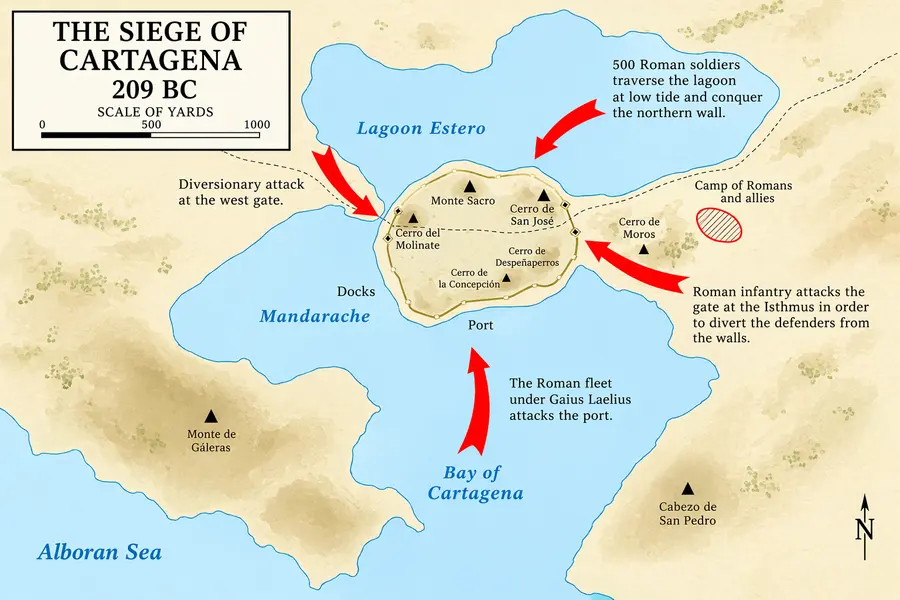
In 209 BC, Scipio marched against New Carthage with a substantial Roman force. The Roman fleet under Gaius Laelius also moved towards the city, allowing the army and navy to coordinate their attacks. The timing was critical. Scipio wanted to capture New Carthage before the Carthaginian commanders operating elsewhere in Hispania could send reinforcements.
When the Roman forces arrived, the defenders were taken by surprise. The city had not been prepared for a major assault, and its relatively small trained garrison was insufficient to defend every approach simultaneously. Scipio organised the attack to place pressure on the city's principal defences.
The land assault
The Roman army approached from the eastern side, where the peninsula connected to the mainland. This was the most obvious route into the city and the direction from which the defenders would naturally expect an attack. Roman soldiers advanced towards the walls using ladders and other assault equipment. The defenders responded by concentrating their efforts on the attacking force, attempting to prevent the Romans from gaining a foothold.
The initial assault was difficult. The walls provided the defenders with a significant advantage, while the Roman soldiers had to advance under missile fire and attempt to scale the fortifications. Scipio's objective was not simply to overwhelm the walls through superior numbers. The attack also served to occupy the defenders and draw their attention towards the eastern side of the city.
The naval assault
At the same time, Gaius Laelius brought the Roman fleet into position along the seaward approaches. The ships, equipped with various missile weapons, added pressure from the water and helped prevent the defenders from concentrating exclusively on the landward assault. Coordinating a land army and a fleet was not a simple undertaking in the ancient world. Communication was limited, and the commanders had to ensure that their forces acted at the appropriate time. Scipio's plan placed the Carthaginian garrison under pressure from multiple directions. While the defenders concentrated on the Roman attacks, another force was preparing to exploit the weakness in the lagoon.
The Lagoon Crossing: Scipio's Most Brilliant Manoeuvre
The most famous episode of the capture of New Carthage was the Roman crossing of the lagoon. It was the moment when Scipio's intelligence and planning translated into a decisive military advantage. As the assault progressed, Scipio waited for the water level to recede. According to Polybius, the lagoon became sufficiently shallow for Roman soldiers to cross on foot.
Scipio then sent a selected force of approximately 500 soldiers towards the lagoon-side defences. They carried scaling ladders and advanced through the shallow water, taking advantage of the defenders' attention being directed towards the main attacks. The crossing was dangerous. Soldiers moving through shallow water could lose their footing, become separated or be exposed to missile fire if discovered. Nevertheless, the element of surprise offered a considerable advantage.
When the Roman soldiers reached the walls, they discovered that the defenders were not adequately positioned to resist an attack from that direction. The Carthaginian garrison had concentrated its attention on the more obvious approaches. The Romans placed their ladders against the walls and began climbing. With the defenders distracted elsewhere, the soldiers managed to gain access to the fortifications.
Once the Romans had established themselves on the walls, the situation changed rapidly. The defenders now faced the possibility of being attacked from behind while the main Roman forces continued pressing from the landward side. The surprise assault undermined the defensive arrangement of the city. The walls that had protected New Carthage from a conventional attack could not prevent Roman soldiers from entering through an unexpected approach. Scipio had effectively turned the city's natural geography against its defenders. Polybius attributes the opportunity to the regular recession of the water.
In a detailed study published in The Classical Quarterly in 2018, historian J. H. Richardson examined the traditional explanation of the lagoon's changing water level. He questioned several assumptions surrounding the role of the tide and considered alternative explanations involving wind and the physical characteristics of the lagoon. The central military point remains clear. Scipio exploited local knowledge of the lagoon to identify an unexpected approach into New Carthage. The exact natural process that made the crossing possible remains a subject of historical debate.
The Fall of New Carthage: Mago's Surrender
Once the Romans breached the city's defences, the battle became increasingly chaotic. The Carthaginian defenders, already under pressure from attacks on multiple fronts, struggled to maintain an organised resistance. Roman soldiers poured into the city, and the fighting spread through its streets. What had begun as a contest against the city's walls was now a desperate struggle for control of its interior. The defenders withdrew towards the elevated positions and the citadel, hoping to make a final stand.
According to Livy, some of the Carthaginian soldiers retreated towards a hill within the city, while others sought refuge in the citadel. Mago gathered the remaining armed defenders and attempted to hold these positions. Scipio, however, was determined not to allow the defenders an opportunity to regroup. He divided his forces, sending one group to capture the hill while another advanced against the citadel. The remaining Carthaginian resistance was gradually overwhelmed as Roman troops tightened their control over the city.
The capture of the hill left Mago's position increasingly desperate. With Roman soldiers controlling much of New Carthage and the citadel under attack, there was little prospect of holding out until reinforcements arrived. Mago eventually surrendered himself and the remaining stronghold to Scipio. The commander who had been entrusted with defending one of Carthage's most important possessions had lost the city in a single day.
The victory, however, came at a terrible cost for the inhabitants. Livy describes extensive bloodshed during the final assault. Roman soldiers killed many of the adult inhabitants they encountered as they moved through the city. The violence continued until the citadel surrendered and Scipio gave the signal for the killing to stop. Only then did the assault give way to the looting and occupation of the captured city.
For the people of New Carthage, the fall was not simply the transfer of a strategic port from one power to another. It meant the sudden collapse of the authority that had governed their city and the arrival of an invading army in its streets. The capture had been remarkably swift, but it was not bloodless. Scipio had secured one of the most important Carthaginian strongholds in Hispania before the other commanders could intervene. The military consequences would be immense, but the human cost of the victory was already evident.
What Did Scipio Do With the Prisoners and Spanish Hostages?
The capture of New Carthage gave Rome control of more than a strategically important port. The city also contained a large number of prisoners, valuable craftsmen, and hostages taken from Iberian communities. Scipio understood that these people could play an important role in his wider campaign. Instead of treating every captive in the same way, he made distinctions between different groups.
According to Polybius, nearly 10,000 people were captured. Scipio separated the citizens of New Carthage, the craftsmen, and other prisoners. His treatment of the captives included several important decisions:
- Citizens of New Carthage: Scipio released the local citizens and restored their property. This was intended to encourage cooperation with Roman rule.
- Skilled craftsmen: Approximately 2,000 craftsmen were retained as public slaves and put to work for the Roman military effort.
- Spanish hostages: Scipio arranged for the hostages from Iberian communities to be released and treated them with considerable attention.
- Other prisoners: The remaining captives were dealt with according to their status and military usefulness.
The release of the Spanish hostages was particularly important. Carthage had used them as a means of maintaining control over the Iberian communities. Their families and local leaders had strong reasons to remain loyal to Carthage while their relatives were held in the city. Scipio recognised that releasing the hostages could weaken this system of political control. He also understood that treating them well could help establish a favourable reputation among the Iberian peoples.
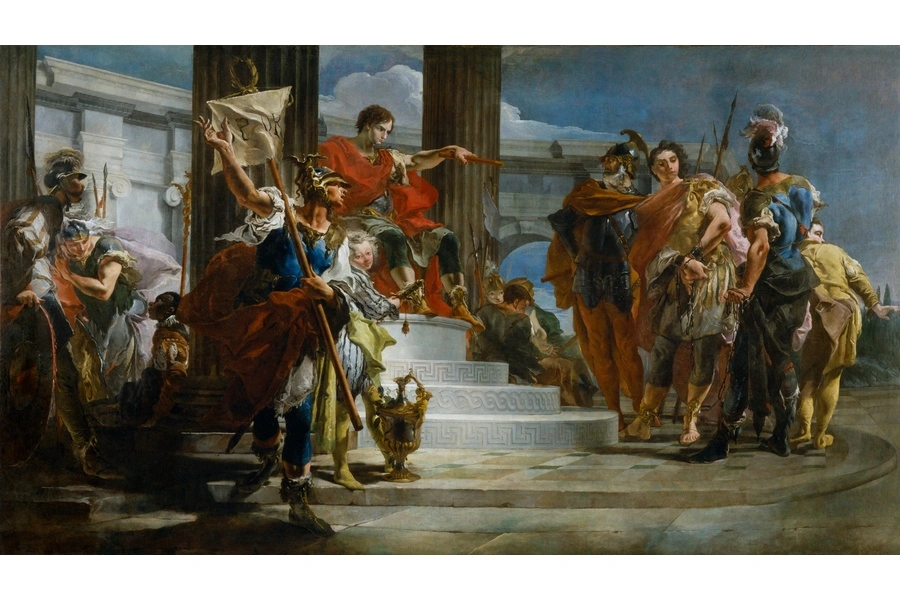
One famous episode concerns a young Iberian woman who was brought before Scipio after the capture. According to Polybius, she was exceptionally beautiful and was offered to him by his soldiers as a gift. Scipio reportedly learned that she was betrothed to a Celtiberian leader named Allucius. Rather than keeping her, he arranged for her to be returned to her family and future husband, along with the ransom brought by her relatives.
Allucius was reportedly so impressed by this gesture that he became an ally of Rome and brought additional support to Scipio. This story may have been shaped by ancient traditions that presented Scipio as an exceptionally virtuous commander. There was also a practical military benefit to the capture. Polybius records that Scipio used the city's shipbuilding resources and skilled workers to strengthen the Roman fleet. The capture therefore provided Rome with both immediate material gains and additional military capacity.
Why the Capture of New Carthage Changed the Second Punic War
The fall of New Carthage was one of the most important Roman victories in Hispania during the Second Punic War. It removed a major Carthaginian stronghold and gave Rome access to resources that could support further operations in the peninsula. Its importance extended well beyond the walls of the city.
1. Carthage lost its principal base in Hispania
New Carthage was the centre of Carthaginian military administration in the region. Its loss disrupted the organisation of Carthaginian forces and deprived the commanders of a secure base for storing supplies and coordinating operations. Although Carthage still maintained substantial armies elsewhere in Hispania, the loss of the city made it considerably more difficult to sustain its position.
2. Rome captured valuable military resources
The Romans acquired weapons, provisions, money, ships and other equipment. These resources helped Scipio strengthen his army and continue the campaign against the remaining Carthaginian forces. The capture of skilled craftsmen was also important. Their labour could be redirected towards producing equipment and supporting Roman military operations.
3. Carthage lost its political leverage over Iberian communities
The release of the hostages weakened one of the principal instruments through which Carthage maintained the loyalty of local rulers. Scipio used the opportunity to establish relationships with Iberian communities and attract new allies. This was especially important because the Carthaginian presence in Hispania depended heavily on cooperation with local peoples. Rome did not need to defeat every Iberian community militarily if it could persuade some of them to support its campaign.
4. Rome gained an important naval base
The harbour at New Carthage was a valuable acquisition. It gave Rome a secure position on the southeastern Spanish coast and improved its ability to move troops and supplies by sea. The capture also reduced Carthage's ability to use the harbour as a base for communications with North Africa.
5. Scipio gained the initiative in Hispania
The victory strengthened Scipio's reputation and gave him the resources needed to continue his offensive. Rather than being forced to respond to Carthaginian movements, he could increasingly dictate the direction of the campaign. The capture of New Carthage was followed by further Roman successes, including the Battle of Baecula in 208 BC and the decisive Battle of Ilipa in 206 BC.
By the end of 206 BC, Carthaginian power in Hispania had effectively collapsed. Scipio's campaign had removed one of Carthage's most important sources of military and financial support. The victory at New Carthage was therefore an essential step in the eventual Roman victory in the Second Punic War. For the wider context of the conflict, see our account of the Punic Wars and their significance in ancient history.
Was the Capture of New Carthage a Military Masterstroke?
The capture of New Carthage demonstrated that Scipio understood the relationship between intelligence, geography, military planning, and political strategy. His victory was not simply the result of superior numbers or a successful frontal assault. Several aspects of the operation deserve particular attention.
| Scipio's decision | Its military significance |
|---|---|
| Choosing New Carthage as the target | Struck at the centre of Carthaginian power rather than engaging all three enemy armies. |
| Gathering local intelligence | Revealed weaknesses in the city's natural defences. |
| Keeping the plan secret | Preserved the element of surprise and reduced the risk of information reaching the defenders. |
| Coordinating land and naval forces | Forced the defenders to divide their attention between multiple attacks. |
| Exploiting the lagoon | Allowed Roman soldiers to approach a less expected section of the fortifications. |
| Releasing the hostages | Turned a military victory into an opportunity to weaken Carthaginian political influence. |
However, it is important not to attribute the entire success to Scipio's personal brilliance. The operation also benefited from favourable circumstances. The Carthaginian commanders were dispersed, the garrison was relatively small, and the city was not prepared for an immediate large-scale attack.
The ancient accounts also require careful interpretation. Polybius was an important historian, but his account of Scipio is sometimes favourable. Livy presents a related narrative with differences in emphasis and detail. Modern historians have therefore examined both the military events and the way later writers portrayed Scipio's achievements.
A 2021 scholarly study by Luca Beltramini, comparing Polybius and Livy on the capture of New Carthage, highlights these differences in their presentation of Scipio's leadership. The accounts should be read critically rather than treated as identical eyewitness records. Nevertheless, the broad achievement is difficult to dispute. Scipio identified a strategically important target, gathered information that revealed an unexpected opportunity and organised a coordinated operation that secured the city in a remarkably short time.
Conclusion: The Day Scipio Changed the War in Hispania
The capture of New Carthage in 209 BC was one of the defining moments of Scipio Africanus' military career. At a relatively young age, he had achieved what earlier Roman commanders in Hispania had failed to accomplish: a major victory that fundamentally weakened Carthaginian power in the peninsula. His success was not based on brute force alone. He studied the city's geography, gathered information from local fishermen, concealed his intentions, and coordinated an assault that exploited the defenders' greatest weakness. Once the city fell, he used its resources and the release of its hostages to strengthen Rome's political and military position.
New Carthage demonstrated that the outcome of a military campaign could be decided before the main fighting began. By understanding the enemy's position and identifying an unexpected route to victory, Scipio transformed a difficult siege into a decisive Roman success.
Hannibal had once demonstrated the importance of surprise and unconventional tactics when he crossed the Alps and defeated Roman armies at Trebia, Lake Trasimene and Cannae. Scipio now showed that Rome could learn from its greatest adversary and use similar strategic thinking against Carthage. The capture of New Carthage did not end the Second Punic War, but it marked the beginning of the end of Carthaginian power in Hispania. A few years later, Scipio would carry the war into Africa and defeat Hannibal at Zama, securing Rome's victory in the conflict.
References and Further Reading
The following ancient accounts and modern scholarly works provide the historical foundation for this article. Ancient historians wrote with their own perspectives and political assumptions, so comparing their accounts is essential when reconstructing the events.
- Polybius, The Histories, Book 10, Chapters 6-20. The principal ancient account of Scipio's planning, the geography of New Carthage, the lagoon crossing, the assault, and the treatment of prisoners and hostages. Read Polybius, Book 10.
- Livy, Ab Urbe Condita, Book 26, Chapters 42-51. An important alternative account of the Roman campaign and capture of New Carthage, including the final assault and the surrender of Mago. Explore Livy's historical works at the Perseus Digital Library.
- J. H. Richardson (2018), "P. Cornelius Scipio and the Capture of New Carthage: The Tide, the Wind and Other Fantasies," The Classical Quarterly, Volume 68, Issue 2, pp. 458-474. A scholarly examination of the traditional explanation of the lagoon crossing and the debate surrounding the water level. Read the article at Cambridge University Press.
- J. S. Morrison, "Dilution of Oarcrews with Prisoners of War," The Classical Quarterly. Discusses Polybius' account of the prisoners captured at New Carthage and Scipio's use of the opportunity to increase the Roman fleet. Explore The Classical Quarterly.
- Luca Beltramini (2021), "Livio e Polibio sull'assedio di Nova Carthago." A scholarly comparison of the different portrayals of Scipio's capture of New Carthage in Livy and Polybius. View the University of Padua research record.
Books and Memorables
This article may contain affiliate links. If you purchase through these links, I may earn a small commission at no extra cost to you.


Related Articles
Frequently Asked Questions
How did Scipio Africanus capture New Carthage in 209 BC?
Scipio Africanus captured New Carthage in 209 BC by combining a land assault, a naval attack and a surprise manoeuvre through the shallow lagoon surrounding the city. After learning from local fishermen that the lagoon's water level sometimes receded, Scipio sent approximately 500 Roman soldiers across the exposed shallows to attack a less-defended section of the walls. The defenders were distracted by the main Roman assault, allowing the soldiers to scale the fortifications and enter the city. The coordinated attack resulted in the capture of New Carthage before the other Carthaginian armies could arrive.
Why was New Carthage so important to Hannibal and the Carthaginian army?
New Carthage, known as Carthago Nova, was the principal Carthaginian stronghold in Hispania during the Second Punic War. It contained military supplies, weapons, money and a valuable natural harbour. The city also held Iberian hostages whose families and communities were important to maintaining Carthaginian political control in Spain. Losing New Carthage deprived Carthage of a major military and administrative centre and gave Rome access to valuable resources for its campaign in Hispania.
How did Scipio know that the lagoon at New Carthage could be crossed?
Scipio learned about the lagoon's shallow areas and changing water level through information provided by local fishermen. They explained that the water sometimes receded enough to expose sections of the lagoon floor, making it possible to cross on foot. Scipio used this local knowledge to plan a surprise attack against the city's northern defences. Although ancient accounts describe the water receding during the assault, historians still debate the precise natural mechanism behind the change in water level.
How many Roman soldiers crossed the lagoon during the capture of New Carthage?
According to the ancient historian Polybius, Scipio sent approximately 500 Roman soldiers across the shallow lagoon during the assault on New Carthage in 209 BC. The soldiers carried scaling ladders and approached a section of the city's walls that was less heavily defended. Their surprise attack allowed the Romans to gain access to the fortifications while the Carthaginian defenders were occupied by attacks from the land and sea.
What happened to the Spanish hostages after Scipio captured New Carthage?
After capturing New Carthage, Scipio released the Iberian hostages held by the Carthaginians and treated them favourably. Carthage had used these hostages to secure the loyalty of local Spanish communities. By returning them to their families, Scipio weakened Carthaginian political influence and encouraged Iberian leaders to support Rome. This decision helped transform the capture of New Carthage from a military victory into a significant diplomatic success.
Did the capture of New Carthage help Rome defeat Hannibal in the Second Punic War?
Yes. The capture of New Carthage in 209 BC was an important step towards Rome's eventual victory in the Second Punic War. It deprived Carthage of its principal base in Hispania, disrupted its supply network and provided the Romans with weapons, money, ships and other resources. Scipio subsequently defeated Carthaginian forces at Baecula in 208 BC and Ilipa in 206 BC, effectively ending Carthaginian power in Spain. He later invaded North Africa and defeated Hannibal at the Battle of Zama in 202 BC.
Add Comment