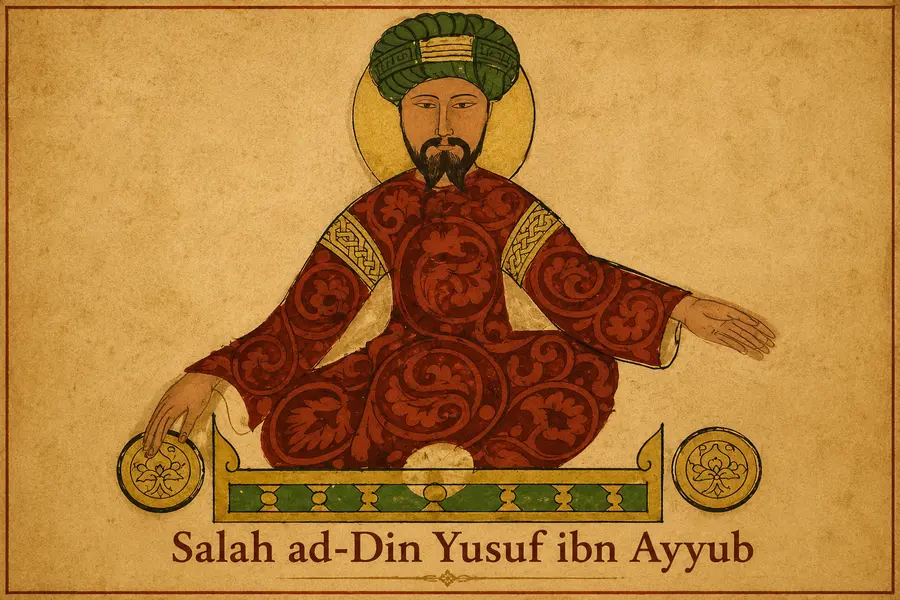
Saladin (1137/1138-1193), known in Arabic as Salah ad-Din Yusuf ibn Ayyub, transformed the political and military landscape of the medieval Middle East. Rising from relative obscurity as the nephew of a Kurdish commander, he united much of the fractured Muslim world, ended the Fatimid Caliphate in Egypt, founded the Ayyubid dynasty, defeated the Crusader Kingdom of Jerusalem at the Battle of Hattin, and recaptured Jerusalem in 1187. His victories prompted the launch of the Third Crusade, where he faced one of Europe's greatest warrior kings, Richard the Lionheart. Yet Saladin's reputation rests not only on his battlefield successes but also on his statesmanship, diplomacy, and reputation for mercy, qualities that earned admiration from both Muslim and Christian chroniclers. More than eight centuries later, Saladin remains one of history's most celebrated military leaders and continues to symbolize unity, justice, and resistance against foreign conquest.
Table of Contents
- Who Was Saladin?
- The Muslim World Before Saladin
- How Saladin Rose to Power
- Saladin's Major Military Campaigns
- The Capture of Jerusalem
- Saladin and the Third Crusade
- Saladin vs. Richard the Lionheart
- Saladin's Military Tactics
- Why Was Saladin So Successful?
- The Character of Saladin
- How Did Saladin Die?
- Legacy of Saladin
Who Was Saladin?
Saladin was the founder of the Ayyubid dynasty and one of the greatest military commanders of the medieval Islamic world. Although remembered primarily for defeating the Crusader states and recovering Jerusalem, his greatest achievement may have been political rather than military. He succeeded where generations of Muslim rulers had failed by bringing Egypt, Syria, northern Mesopotamia, and parts of Arabia under a single leadership. This unity gave the Islamic world the strength necessary to confront the Crusader kingdoms that had existed along the eastern Mediterranean coast for nearly ninety years.
Born around 1137 or 1138 in Tikrit, in present-day Iraq, Saladin came from a Kurdish military family. His father, Najm ad-Din Ayyub, and his uncle Shirkuh served the powerful Turkish ruler Nur ad-Din, who governed Syria and was one of the leading Muslim opponents of the Crusaders. Unlike many famous conquerors, Saladin was not initially viewed as a natural warrior. Contemporary accounts suggest that as a young man he showed greater interest in religious studies, Islamic law, and scholarship than in military glory. His rise to power therefore surprised many of his contemporaries.
Over time, Saladin developed into a skilled commander, administrator, and diplomat. His leadership combined military ability with careful political calculation. Instead of relying solely on conquest, he frequently secured alliances through negotiation, marriages, and agreements with rival rulers, allowing him to consolidate power without exhausting his resources. Historians frequently rank Saladin among history's greatest military leaders because he successfully combined political vision with battlefield success.
| Quick Facts About Saladin | Details |
|---|---|
| Full Name | Salah ad-Din Yusuf ibn Ayyub |
| Born | 1137/1138, Tikrit (modern Iraq) |
| Ethnicity | Kurdish |
| Dynasty | Ayyubid Dynasty |
| Known For | Recapturing Jerusalem in 1187 and leading the Muslim resistance during the Crusades |
| Main Opponents | Kingdom of Jerusalem, Crusader States, Richard the Lionheart |
| Died | 1193, Damascus |
What Was the Situation in the Muslim World Before Saladin?
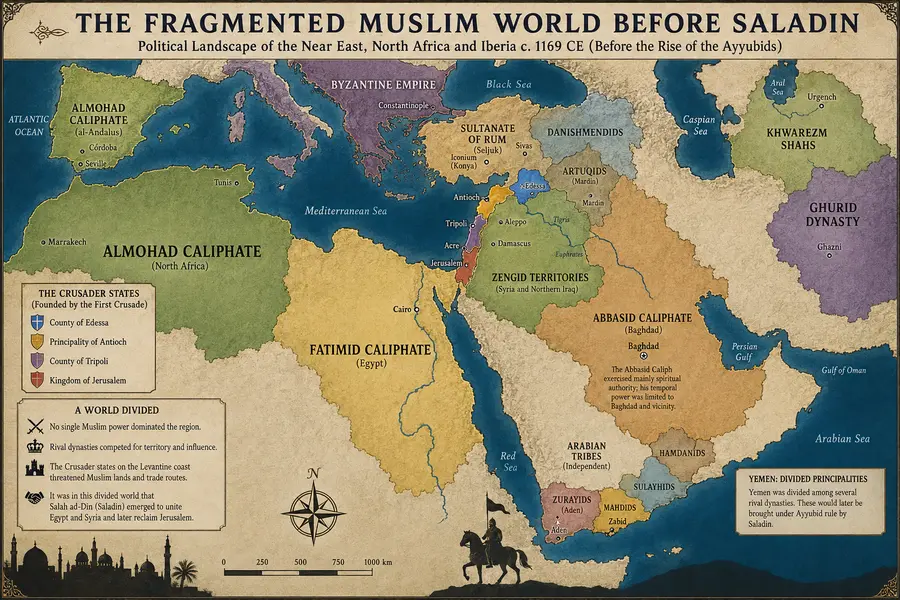
To understand Saladin's achievements, it is essential to appreciate how divided the Islamic world had become during the twelfth century. Although Muslim civilization remained wealthy and culturally advanced, political unity had largely disappeared. Instead of a single empire, numerous competing dynasties struggled against one another while the Crusader states established themselves along the Levantine coast.
The First Crusade (1096-1099) had taken advantage of this fragmentation. European Crusaders captured Jerusalem in 1099 after a brutal siege and founded several Crusader states, including the Kingdom of Jerusalem, the County of Tripoli, the Principality of Antioch, and the County of Edessa. Rather than presenting a united front, Muslim rulers often viewed each other as greater threats than the Crusaders themselves. Several factors contributed to this political fragmentation.
The Decline of Central Authority
The Abbasid Caliph in Baghdad still held immense religious prestige, but his political authority had weakened considerably. Real power rested with regional rulers who governed independently. The once-unified Islamic empire had become a patchwork of competing kingdoms, each pursuing its own interests.
The Rivalry Between Sunni and Shia Dynasties
The Islamic world was also divided by religious and political rivalries. Egypt was ruled by the Fatimid Caliphate, a Shia dynasty that competed for legitimacy with the Sunni Abbasid Caliphate in Baghdad. Syria and northern Mesopotamia were controlled by various Sunni rulers, creating further divisions that prevented coordinated action against the Crusaders.
Competition Among Muslim Princes
Powerful local emirs frequently fought each other over territory, taxation, and prestige. Alliances shifted constantly, and it was not unusual for Muslim rulers to negotiate with Crusader leaders against their own Muslim rivals. These internal conflicts consumed manpower and resources that might otherwise have been used to recover lost territories.
The Crusader States Grew Stronger
The Crusader kingdoms benefited greatly from Muslim disunity. Although relatively small in population, they occupied strategically important cities, castles, and trade routes stretching along the eastern Mediterranean. Fortified strongholds such as Krak des Chevaliers and Kerak enabled Crusader forces to control movement through key regions and launch raids into neighboring Muslim territories. For decades after the First Crusade, no Muslim ruler possessed both the military strength and political authority necessary to eliminate the Crusader states. Instead, victories tended to be local and temporary.
Nur ad-Din Prepared the Way
Before Saladin emerged, the most determined Muslim opponent of the Crusaders was Nur ad-Din Zengi, ruler of Syria. Nur ad-Din worked tirelessly to unite Sunni territories and promoted the idea of jihad as a collective struggle to recover lands lost to the Crusaders. His capture of Edessa in 1144 marked the first major Muslim victory over a Crusader state and inspired confidence throughout the Islamic world.
Although Nur ad-Din died before Jerusalem was recovered, his reforms laid much of the political and military foundation that Saladin later expanded. Many historians therefore view Saladin as both an innovator and the heir to Nur ad-Din's broader strategy of Muslim unification.[1]
How Saladin Rose to Power
Saladin's rise was anything but inevitable. Unlike rulers who inherited powerful kingdoms, he built his authority gradually through military service, political skill, and administrative competence. His career demonstrates how opportunity, preparation, and careful decision-making combined to produce one of history's most remarkable leaders.
Serving Under Shirkuh
Saladin's first significant military experience came while serving under his uncle Shirkuh, one of Nur ad-Din's most trusted generals. During the 1160s, Egypt became the focus of an intense struggle involving the Fatimid Caliphate, the Crusader Kingdom of Jerusalem, and Nur ad-Din's Syrian forces. Although the Fatimid government remained wealthy, it had become politically unstable. Rival factions competed for influence, while Crusader kings repeatedly attempted to bring Egypt under their control.
Whoever dominated Egypt would gain access to enormous financial resources and could threaten the other side from the south. Nur ad-Din therefore dispatched Shirkuh to intervene in Egyptian politics. Saladin accompanied these expeditions, gaining valuable experience in campaigning, diplomacy, and administration. Though still relatively unknown, he demonstrated reliability and earned the confidence of both his uncle and Nur ad-Din.
Becoming Vizier of Egypt
In 1169, Shirkuh unexpectedly died shortly after becoming vizier of Egypt. Rather than appointing one of the more experienced commanders, the Fatimid court selected Saladin as his successor. Contemporary observers regarded the appointment as surprising because Saladin was only in his early thirties and lacked an established independent power base.
What appeared to be a compromise appointment soon transformed Middle Eastern politics. As vizier, Saladin carefully strengthened his own position. He replaced unreliable officials with loyal administrators, reorganized the Egyptian army, improved financial administration, and gradually expanded his authority without provoking unnecessary resistance.
The End of the Fatimid Caliphate
One of Saladin's most significant political achievements came in 1171 when he formally ended the Fatimid Caliphate. Instead of recognizing the Shia Fatimid caliph, Friday prayers were henceforth offered in the name of the Sunni Abbasid Caliph in Baghdad. This symbolic act reunited Egypt with the wider Sunni Islamic world after more than two centuries of Fatimid rule.[2]
The transition occurred with remarkably little violence. Rather than destroying Egypt's institutions, Saladin preserved much of the existing administrative system while redirecting its loyalty. This pragmatic approach ensured stability and allowed Egypt's wealth to support future military campaigns.
From Governor to Independent Ruler
Although Saladin remained formally loyal to Nur ad-Din, relations between the two leaders gradually became strained. Nur ad-Din expected Egypt to remain subordinate to his Syrian kingdom, while Saladin increasingly exercised independent authority. When Nur ad-Din died in 1174, his heir was still a child. The resulting political instability created an opportunity that Saladin skillfully exploited. Instead of attempting immediate conquest, he entered Damascus peacefully after receiving support from influential local leaders. Over the following decade, he gradually extended his authority across Syria, northern Mesopotamia, and parts of Arabia through a mixture of military campaigns, negotiated settlements, and strategic alliances.
By the mid-1180s, Saladin had achieved something no Muslim ruler had accomplished since before the First Crusade: the political unification of Egypt and Syria under a single government. This strategic transformation fundamentally altered the balance of power in the Near East. The Crusader Kingdom of Jerusalem now faced a unified opponent capable of coordinating massive campaigns across multiple fronts. Just as leaders such as Alexander the Great and Julius Caesar combined political ambition with military skill to reshape their worlds, Saladin understood that lasting battlefield success depended first on building a stable political foundation. Only after securing that foundation did he launch the campaigns that would culminate in one of the most decisive victories of the Crusades.
Saladin's Major Military Campaigns
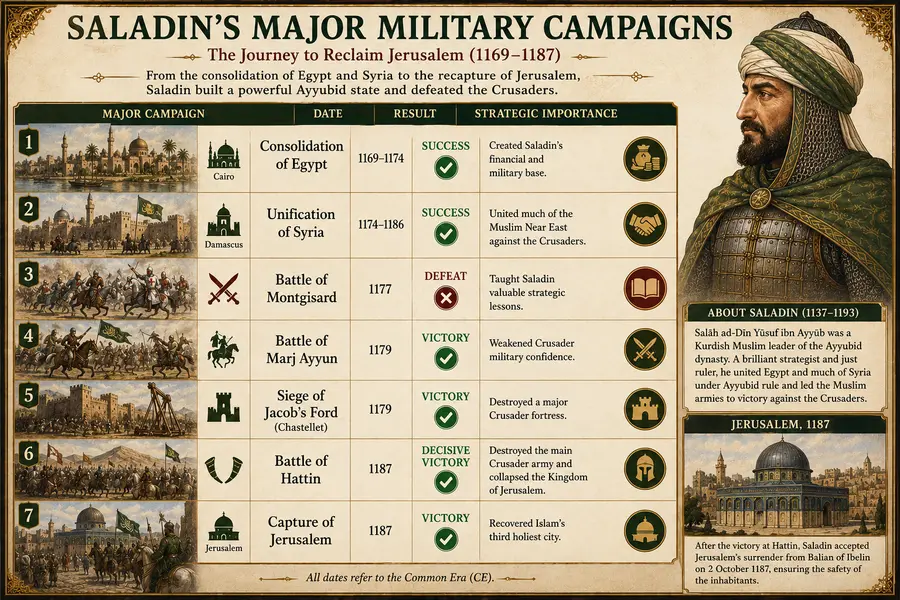
By the mid-1180s, Saladin had accomplished what earlier Muslim rulers had failed to achieve: he had united Egypt, Syria, much of Upper Mesopotamia, and the Hejaz under a single authority. Political unity alone, however, did not guarantee victory over the Crusader states. Saladin still faced a network of heavily fortified castles, experienced Frankish knights, and rulers who had defended their kingdoms for nearly a century.
Rather than rushing into a decisive confrontation, Saladin spent years strengthening his army, securing alliances, suppressing rebellions, and gradually wearing down Crusader power. His campaigns demonstrate remarkable strategic patience. He often preferred isolating his enemy economically and politically before committing to major battles.
| Major Campaign | Date | Result | Strategic Importance |
|---|---|---|---|
| Consolidation of Egypt | 1169-1174 | Success | Created Saladin's financial and military base |
| Unification of Syria | 1174-1186 | Success | United the Muslim front against the Crusaders |
| Battle of Montgisard | 1177 | Defeat | Taught Saladin valuable strategic lessons |
| Battle of Marj Ayyun | 1179 | Victory | Weakened Crusader military confidence |
| Siege of Jacob's Ford | 1179 | Victory | Destroyed a major Crusader fortress |
| Battle of Hattin | 1187 | Decisive Victory | Destroyed the main Crusader army |
| Capture of Jerusalem | 1187 | Victory | Recovered Islam's third holiest city |
The Lesson of Montgisard (1177)
One of the defining moments in Saladin's military career was not a victory but a painful defeat. In 1177, believing the Crusaders were divided and vulnerable, Saladin invaded the Kingdom of Jerusalem with a large force. Expecting little resistance, his army became spread out while foraging and raiding across the countryside. King Baldwin IV of Jerusalem, despite suffering from leprosy, responded with extraordinary speed. Accompanied by Reynald of Châtillon and the Knights Templar, Baldwin launched a surprise attack near Montgisard.
Saladin's army was caught completely off guard. Many of his soldiers had dispersed in search of supplies, while others were burdened with captured loot. Unable to organize an effective defense, the Muslim army suffered a severe defeat, and Saladin narrowly escaped capture. Although Montgisard temporarily strengthened Crusader morale, it proved equally important for Saladin's development as a commander. He became far more cautious about extending his supply lines, dispersing his forces, or underestimating his opponents. Many historians argue that the discipline and operational planning displayed during Saladin's later campaigns were shaped in part by the lessons learned at Montgisard.[3]
Victories at Marj Ayyun and Jacob's Ford
Saladin quickly recovered from the setback at Montgisard. In 1179, he defeated Crusader forces at the Battle of Marj Ayyun, restoring Muslim confidence while weakening the military prestige of the Kingdom of Jerusalem. Later that year, he turned his attention to Jacob's Ford, where the Crusaders were constructing a powerful fortress overlooking the Jordan River. The castle threatened communication between Damascus and southern Syria and would have provided the Crusaders with a dangerous forward base.
Recognizing the strategic danger, Saladin moved rapidly before construction was completed. His engineers breached the unfinished defenses while his soldiers stormed the fortress. The garrison was overwhelmed, and the castle was destroyed before it could become a permanent threat. The destruction of Jacob's Ford demonstrated Saladin's understanding that fortifications could shape future campaigns. Eliminating strategic strongholds before they became operational was often more valuable than winning open battles.
Preparing for a Decisive War
Throughout the early 1180s, Saladin avoided unnecessary risks while continuing to strengthen his position. He expanded his network of fortresses, improved communication between Egypt and Syria, recruited additional cavalry, and ensured that supplies could sustain prolonged campaigns. His political authority also grew steadily as more Muslim rulers acknowledged his leadership.
The Crusader Kingdom, meanwhile, experienced increasing internal divisions. Rival noble families competed for influence, succession disputes weakened royal authority, and aggressive leaders such as Reynald of Châtillon repeatedly violated peace treaties by attacking Muslim caravans and threatening pilgrims traveling to Mecca. When Reynald seized a major Muslim caravan despite an existing truce, Saladin declared that decisive action could no longer be delayed. The confrontation that followed would change the history of the Crusades.
The Battle of Hattin (1187)

The Battle of Hattin, fought on 4 July 1187, stands among the most decisive battles in medieval history. More than any other engagement, it determined the fate of the Crusader Kingdom of Jerusalem and paved the way for the recovery of the Holy City.
The Strategic Situation
Saladin's objective was not simply to defeat the Crusader army but to lure it into fighting under conditions entirely favorable to the Muslims. Instead of attacking Jerusalem directly, he captured the city of Tiberias, knowing the Crusader leadership would feel compelled to relieve it.
The plan worked perfectly. The Crusader army, led by King Guy of Lusignan, abandoned its secure position near fresh water at Sephoria and marched across the scorching summer landscape toward Tiberias. Saladin's cavalry constantly harassed the advancing army, denying it access to wells while preventing effective reconnaissance.
Control of Water
One of Saladin's greatest strategic achievements was recognizing that logistics could decide a battle before swords were drawn. The July heat of Galilee was relentless. Thousands of Crusader soldiers and horses marched for hours without reliable access to water. Saladin's forces occupied every important spring and watering point along the route.
By the time the Crusaders reached the Horns of Hattin, exhaustion, dehydration, and disorder had already reduced their combat effectiveness. To worsen conditions further, Muslim troops reportedly set dry grass on fire, filling the air with smoke while increasing the unbearable heat.[4]
The Collapse of the Crusader Army
When battle commenced, the Crusaders attempted repeated cavalry charges to break through the encirclement. Saladin anticipated these attacks. His mounted archers surrounded the Crusader formations, showering them with arrows while avoiding close combat until the enemy had been worn down. As thirst and fatigue took their toll, the disciplined Crusader formations gradually broke apart.
Once gaps appeared, Saladin committed his heavier cavalry to decisive attacks. The result was catastrophic for the Kingdom of Jerusalem. Most of the Crusader army was destroyed or captured. King Guy of Lusignan fell into Saladin's hands, along with numerous leading nobles. The treasured relic known as the True Cross, carried into battle by the Crusaders, was also captured. Only a handful of knights escaped.
The Fate of Reynald of Châtillon and King Guy
Among the prisoners was Reynald of Châtillon, whose repeated attacks on Muslim caravans and pilgrims had helped trigger the campaign. According to contemporary Muslim chronicler Baha ad-Din ibn Shaddad, Saladin personally confronted Reynald and reminded him of his broken promises. According to Baha ad-Din, when Reynald refused to repent, Saladin executed him himself, while sparing King Guy, explaining that "it is not the custom of kings to kill kings."[5] Whether every detail of the story is entirely accurate remains debated, but both Muslim and Christian sources agree that Reynald alone among the senior prisoners was deliberately executed.
Why Hattin Was So Important
The Battle of Hattin effectively destroyed the military strength of the Crusader Kingdom. Most experienced knights had been killed or captured. The surviving fortresses were left without sufficient defenders, allowing Saladin to capture city after city over the following months. Acre, Nablus, Jaffa, Ascalon, Caesarea, Sidon, Beirut, and numerous castles surrendered in rapid succession. The road to Jerusalem now lay open.
The Capture of Jerusalem (1187)
On 20 September 1187, less than three months after Hattin, Saladin arrived before the walls of Jerusalem. The city held immense religious significance for Muslims, Christians, and Jews alike. It had remained under Crusader control since the First Crusade in 1099, when Christian forces captured the city following a bloody siege that contemporary chroniclers describe as ending in widespread slaughter. For Muslims, recovering Jerusalem was both a political objective and a profound religious mission.
The Siege Begins
Jerusalem's defense was organized by Balian of Ibelin, one of the few experienced Crusader nobles who had escaped Hattin. Although the city still possessed formidable walls, its defenders were desperately short of trained soldiers. Many knights had died at Hattin, leaving civilians to help man the defenses. Saladin initially attacked the western walls before shifting operations to a more vulnerable northern sector. Muslim engineers employed siege towers, mangonels, and miners to weaken the fortifications while continuous bombardment placed enormous pressure on the defenders.
Negotiation Instead of Massacre
Unlike the First Crusaders in 1099, Saladin did not seek revenge through indiscriminate slaughter. Recognizing that further resistance was unlikely to succeed, Balian negotiated surrender terms. Saladin agreed to allow civilians to leave after paying a ransom. Many who could not afford payment were freed through the generosity of Muslim commanders, while Saladin himself reportedly ordered additional captives released at his own expense.[6]
Although some inhabitants entered temporary slavery because they lacked ransom money, a common medieval practice, the scale of violence was dramatically lower than during the Crusader conquest nearly ninety years earlier.
Jerusalem Returns to Muslim Rule
On 2 October 1187, the anniversary of the Prophet Muhammad's traditional Night Journey according to Islamic tradition, Jerusalem formally returned to Muslim control. The cross placed atop the Dome of the Rock was removed, Islamic worship resumed at Al-Aqsa Mosque, and Christian holy sites were largely preserved rather than destroyed.
The recovery of Jerusalem became Saladin's greatest political and military achievement. Throughout the Islamic world, celebrations marked what many regarded as the reversal of one of the greatest defeats in Muslim history. In Europe, however, news of Jerusalem's fall caused shock and outrage. Pope Gregory VIII responded by calling for a new crusade. Kings who had previously shown little interest in the Holy Land now prepared for one of the largest military expeditions of the Middle Ages. The result would be the Third Crusade, bringing Saladin face to face with England's legendary warrior king, Richard the Lionheart.
The Third Crusade (1189-1192)
The fall of Jerusalem in 1187 sent shockwaves throughout Christian Europe. The loss of the Holy City was viewed not merely as a political setback but as a religious catastrophe. Pope Gregory VIII responded by issuing the papal bull Audita Tremendi, calling upon the rulers of Europe to launch a new crusade to recover Jerusalem.
The resulting expedition became known as the Third Crusade. It brought together three of Europe's most powerful monarchs: Emperor Frederick I Barbarossa of the Holy Roman Empire, King Philip II of France, and King Richard I of England, better known as Richard the Lionheart. Although Frederick drowned in Asia Minor before reaching the Holy Land and much of his army dispersed, the arrival of Richard and Philip ensured that Saladin would face formidable opponents.
The Siege of Acre
The first major objective of the crusaders was the strategically vital port of Acre. The city had been under siege by Crusader forces since 1189, while Saladin repeatedly attempted to relieve its defenders. The result was one of the longest and most exhausting sieges of the medieval period.
For nearly two years, both armies suffered from disease, shortages, and continuous fighting. When Richard arrived in 1191, he brought renewed energy, advanced siege equipment, and disciplined leadership. After sustained bombardment, Acre finally surrendered in July 1191. The victory restored Crusader morale but also marked the beginning of the famous rivalry between Richard and Saladin.
The March Along the Coast
Following Acre's capture, Richard faced the difficult task of marching his army south toward Jaffa while avoiding destruction by Saladin's cavalry. Saladin repeatedly harassed the Crusader column with mounted archers, hoping to provoke an undisciplined charge or separate individual units from the main army. Richard refused to take the bait.
Instead, he maintained strict marching discipline, keeping infantry toward the landward side and the fleet sailing parallel along the coast to provide supplies. This careful coordination denied Saladin the opportunity to isolate portions of the Crusader army. The campaign demonstrated the high level of military professionalism possessed by both commanders.
Saladin vs. Richard the Lionheart
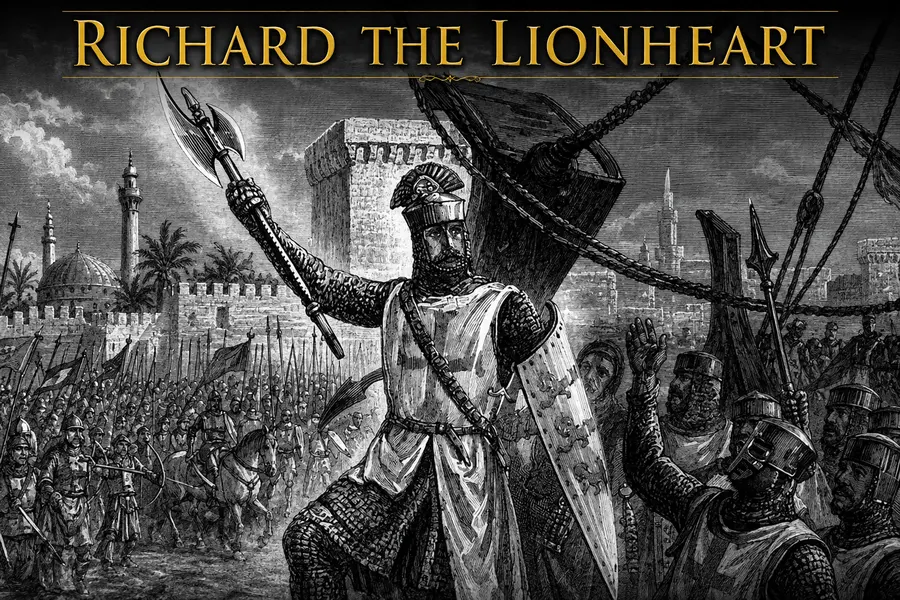
The contest between Saladin and Richard the Lionheart remains one of the most famous rivalries in military history. Although they never met face to face, their campaigns became legendary for the mutual respect shown by two of the medieval world's greatest commanders. Each possessed different strengths.
| Saladin | Richard the Lionheart |
|---|---|
| Master strategist and statesman | Exceptional battlefield commander |
| Expert in mobile warfare | Superior heavy cavalry tactics |
| United diverse Muslim territories | Inspired elite Crusader armies |
| Preferred attrition and maneuver | Favored decisive battlefield action |
| Outstanding diplomat | Aggressive offensive leader |
The Battle of Arsuf (1191)
The most famous battle between the two leaders occurred near Arsuf on 7 September 1191. As Richard's army marched south along the Mediterranean coast, Saladin launched repeated attacks designed to wear down the Crusaders through constant arrow fire and cavalry harassment. For hours, Richard maintained strict discipline, refusing to allow his knights to charge prematurely despite heavy pressure. Eventually, after the Knights Hospitaller could no longer endure the attacks, they launched an unauthorized cavalry charge.
Rather than allowing the assault to become disorganized, Richard immediately committed his entire mounted reserve. The coordinated counterattack struck Saladin's forces with tremendous force. Although the Muslim army withdrew in good order rather than collapsing, Richard won a clear tactical victory and secured the coastal route to Jaffa. Importantly, Arsuf did not destroy Saladin's army. Unlike the Crusaders at Hattin, Saladin preserved most of his experienced troops and remained capable of continuing the war.
The Road to Jerusalem
Twice Richard advanced toward Jerusalem. Twice he turned back. Although many Crusader nobles urged an immediate assault, Richard recognized the logistical realities. Even if Jerusalem were captured, maintaining control while surrounded by Saladin's larger army would prove extremely difficult. Supply lines from the coast would remain vulnerable, and the city itself lacked sufficient provisions for a prolonged defense.
Saladin, meanwhile, strengthened Jerusalem's fortifications and prepared for a siege while continuing to threaten Crusader communications. The resulting strategic deadlock prevented either side from achieving complete victory.
The Treaty of Jaffa
After nearly three years of exhausting warfare, both commanders recognized that continued fighting offered diminishing returns. In September 1192, Saladin and Richard concluded the Treaty of Jaffa. Under its terms:
- The Crusaders retained a narrow strip of territory along the Mediterranean coast.
- Jerusalem remained under Muslim control.
- Christian pilgrims received safe access to the Holy City.
- A three-year truce temporarily ended major hostilities.
The agreement reflected practical statesmanship rather than absolute victory. Neither leader achieved all of his objectives, yet both preserved their core strategic interests.
A Relationship Built on Mutual Respect
Despite fighting bitter campaigns against one another, numerous medieval chroniclers describe episodes illustrating mutual respect between Saladin and Richard. When Richard became ill, Saladin reportedly sent fruit, snow for cooling drinks, and even his personal physician.[7]
On another occasion, after Richard lost his horse in battle, Saladin is said to have sent two replacement horses so that his opponent would not fight on foot. Although some details may have become embellished over time, these stories reflect the widespread medieval perception that both rulers embodied ideals of honorable leadership.
Saladin's Military Tactics
Saladin rarely relied on overwhelming force alone. His greatest strength lay in combining logistics, intelligence, maneuver, diplomacy, and psychological pressure into a coherent military strategy.
1. Mobility Above All Else
His armies depended heavily on highly mobile cavalry capable of covering great distances quickly. Rather than remaining tied to fixed positions, Saladin constantly maneuvered to threaten enemy communications, supply routes, and vulnerable garrisons.
2. Mastery of Logistics
Campaigns were planned around access to water, food, grazing land, and secure supply lines. Hattin demonstrated that controlling logistics could decide a campaign before the main battle even began.
3. Horse Archers and Continuous Harassment
Mounted archers repeatedly attacked enemy formations while avoiding close combat. Constant harassment exhausted opponents physically and psychologically before heavier cavalry delivered decisive attacks.
The importance of morale in medieval warfare cannot be overstated. Exhaustion, thirst, and uncertainty often proved as dangerous as enemy weapons. These psychological pressures affected soldiers in much the same way as those discussed in our article on the mindset and morale of ancient soldiers.
4. Intelligence Networks
Saladin invested heavily in reconnaissance. Scouts monitored enemy movements while local allies supplied information regarding Crusader fortifications, troop numbers, and political disagreements. This intelligence allowed him to choose favorable battlefields and avoid unnecessary risks.
5. Siege Warfare
Although remembered primarily for field battles, Saladin was also an accomplished practitioner of siege warfare. He employed engineers, miners, siege towers, mangonels, and coordinated assaults to reduce heavily defended cities throughout Syria and Palestine.
6. Political Warfare
Perhaps Saladin's greatest weapon was diplomacy. He frequently persuaded rival Muslim rulers to join him through negotiation rather than conquest, conserving military resources while strengthening overall unity.
Why Was Saladin So Successful?
Saladin's achievements resulted from a combination of military ability, political vision, and personal leadership. Few commanders have demonstrated excellence across so many different areas simultaneously.
He United a Divided World
Before confronting the Crusaders, Saladin recognized that Muslim disunity posed a greater threat than the Crusader kingdoms themselves. By uniting Egypt and Syria, he fundamentally changed the strategic balance of power.
He Chose Battles Carefully
Unlike reckless conquerors, Saladin rarely fought battles merely for glory. He preferred favorable terrain, reliable intelligence, secure logistics, and overwhelming strategic advantages.
He Learned from Failure
The defeat at Montgisard did not discourage him. Instead, he analyzed his mistakes, improved discipline, and returned as a far stronger commander.
He Balanced Force with Diplomacy
Many cities surrendered because Saladin offered generous terms rather than destruction. This reduced resistance while allowing his armies to continue advancing without costly sieges.
He Inspired Loyalty
Contemporary chroniclers consistently emphasize Saladin's generosity, religious devotion, and personal humility. These qualities helped maintain the loyalty of soldiers drawn from diverse ethnic and regional backgrounds.
The Character of Saladin
Saladin's military victories alone would have secured his place in history, but his personal character elevated his reputation even further. Muslim writers praised his piety, generosity, modest lifestyle, and commitment to justice. Remarkably, many Christian chroniclers also described him as an honorable opponent despite fighting against him.
Unlike numerous medieval rulers, Saladin accumulated little personal wealth. According to Baha ad-Din ibn Shaddad, when Saladin died, his treasury contained only a handful of gold and silver coins after much of his wealth had been distributed in charity.[8]
His willingness to negotiate, release prisoners, and respect civilian populations contrasted sharply with the brutality often associated with medieval warfare. This should not suggest that Saladin's campaigns were bloodless, sieges remained violent, prisoners were sometimes executed, and warfare inevitably caused suffering. Nevertheless, compared with many of his contemporaries, both Muslim and Christian, his conduct was generally viewed as restrained and pragmatic.
How Did Saladin Die?
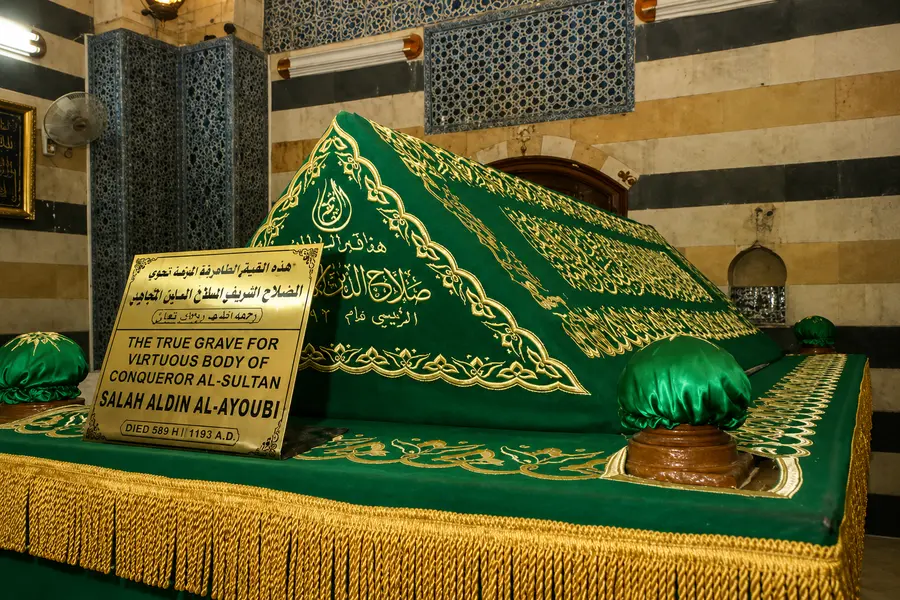
Saladin died on 4 March 1193 in Damascus at the age of approximately fifty-five. Unlike many great military leaders, he did not die in battle or through assassination. Contemporary chroniclers record that he fell ill with a fever after returning from campaigns associated with the Third Crusade. Despite receiving treatment from the leading physicians of his court, his condition steadily worsened over the course of several days until he passed away.
The exact nature of Saladin's illness remains uncertain. Medieval sources describe symptoms such as fever and progressive weakness but do not provide enough medical detail for a reliable modern diagnosis. Historians have suggested possibilities including typhoid fever, malaria, or another infectious disease common in the medieval Near East, but no theory can be confirmed with certainty.
Saladin's death marked the end of one of the most remarkable careers of the Crusades. Although his empire was later divided among his heirs, the political and military transformation he achieved endured. By uniting much of the Muslim world and recovering Jerusalem, he permanently altered the balance of power in the Near East. His reputation for justice, generosity, and strategic brilliance ensured that his legacy outlived the empire he created, making him one of the most admired rulers of the medieval world.
Legacy of Saladin
When Saladin died in Damascus on 4 March 1193, he left behind an empire stretching from Egypt to northern Mesopotamia. Although the Ayyubid Empire later fragmented under his successors, the political transformation he initiated permanently altered the history of the Middle East. His greatest achievement was not merely recovering Jerusalem but demonstrating that unity could overcome decades of political fragmentation. By combining Egypt's wealth with Syria's military strength, he reversed nearly a century of Crusader expansion and restored Muslim confidence after generations of defeat.
Saladin also reshaped the ideals of leadership in both the Islamic world and medieval Europe. Muslim historians celebrated him as a champion of justice and defender of Islam, while many European chroniclers portrayed him as the model of the honorable enemy. His rivalry with Richard the Lionheart became one of history's most enduring examples of mutual respect between opposing commanders. Modern historians continue to study Saladin not only for his battlefield victories but also for his ability to integrate military planning, diplomacy, logistics, administration, and political strategy into a unified approach to leadership.
More than eight centuries after his death, Saladin remains one of history's most influential rulers. His campaigns continue to be examined in military academies, his leadership inspires political thought across the Middle East, and his name remains synonymous with courage, justice, and strategic brilliance. Whether viewed as a conqueror, statesman, or reformer, Saladin's story demonstrates that enduring success is built not solely through battlefield victories but through vision, discipline, and the ability to unite people behind a common purpose.
References
- Malcolm Cameron Lyons & D.E.P. Jackson. Saladin: The Politics of the Holy War. Cambridge University Press, 1982.
- Jonathan Phillips. The Life and Legend of the Sultan Saladin. Yale University Press, 2019.
- Thomas Asbridge. The Crusades: The Authoritative History of the War for the Holy Land. HarperCollins, 2010.
- Steven Runciman. A History of the Crusades, Volume II. Cambridge University Press, 1952.
- Baha ad-Din ibn Shaddad. The Rare and Excellent History of Saladin. (Translated by D.S. Richards). Ashgate Publishing, 2002.
- Ibn al-Athir. The Chronicle of Ibn al-Athir for the Crusading Period. (Translated by D.S. Richards). Ashgate Publishing.
- William of Tyre. A History of Deeds Done Beyond the Sea. Medieval source.
- Baha ad-Din ibn Shaddad. The Rare and Excellent History of Saladin.
Books and Memorables
This article may contain affiliate links. If you purchase through these links, I may earn a small commission at no extra cost to you.


Related Articles
Frequently Asked Questions
Why was Saladin able to defeat the Crusader Kingdom of Jerusalem?
Saladin defeated the Crusader Kingdom of Jerusalem because he first united the previously divided Muslim states of Egypt and Syria, giving him greater manpower, resources, and strategic coordination. His victory at the Battle of Hattin in 1187 destroyed the main Crusader army, leaving Jerusalem vulnerable to siege and eventual surrender.
How did Saladin unite the Muslim world before fighting the Crusaders?
Before launching his campaign against the Crusader states, Saladin gradually brought Egypt, Syria, northern Mesopotamia, and parts of Arabia under Ayyubid rule through a combination of diplomacy, military campaigns, and political alliances. This unity allowed him to concentrate his forces against the Crusaders instead of fighting rival Muslim rulers.
What military tactics made Saladin such a successful commander?
Saladin relied on highly mobile cavalry, mounted archers, strong intelligence networks, careful logistics, and strategic patience. Rather than seeking immediate battles, he weakened opponents by disrupting supplies, controlling water sources, and forcing them to fight under unfavorable conditions, as demonstrated at the Battle of Hattin.
Did Saladin and Richard the Lionheart ever meet in person?
No. Although Saladin and Richard the Lionheart fought against each other throughout the Third Crusade, there is no reliable historical evidence that they ever met face to face. They communicated through messengers and negotiated truces while earning mutual respect for each other's military leadership.
How did Saladin treat the people of Jerusalem after capturing the city?
When Saladin captured Jerusalem in 1187, he negotiated the city's surrender instead of ordering a massacre. Many residents were allowed to leave after paying a ransom, while others were freed through the generosity of Saladin and his commanders. His relatively restrained treatment of civilians contrasted with the mass killings that followed the Crusader capture of Jerusalem in 1099.
Why is Saladin still remembered as one of history's greatest military leaders?
Saladin is remembered not only for recapturing Jerusalem but also for uniting the Muslim world, defeating the Crusaders at the Battle of Hattin, and successfully resisting the Third Crusade led by Richard the Lionheart. His combination of military strategy, political leadership, diplomacy, and reputation for fairness has made him one of the most respected commanders in world history.
Add Comment