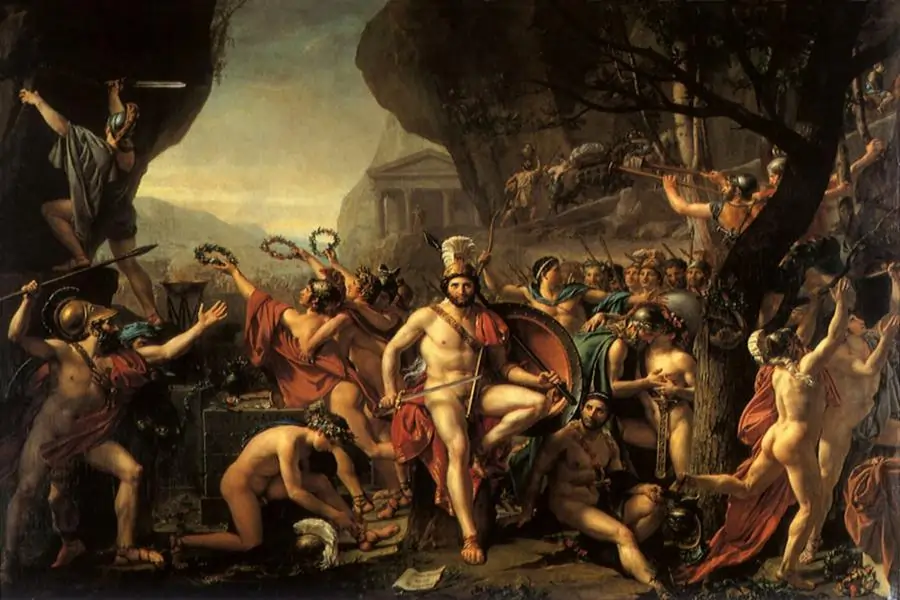
The Battle of Thermopylae remains one of the most famous military encounters in history. The battle portrays the heroic last stand of the 300 Spartan warriors along with their Greek allies. Fought in 480 BC during the Greco-Persian Wars, the small Greek force led by King Leonidas of Sparta resisted the massive Persian army of King Xerxes I. Despite ending in defeat, the battle became a symbol of courage, discipline, and strategic brilliance, as described by the Greek historian Herodotus in Histories (Book 7).
This article explores the battle in depth-covering its causes, strategy, terrain advantages, and long-term significance-while answering a key question: how were the Greeks able to hold out so long against overwhelming odds?
Table of Contents
- What Was the Battle of Thermopylae?
- Where Is Thermopylae and Why It Mattered
- Who Were the Spartans?
- Greek and Persian Forces Compared
- Greek Phalanx Formation Explained
- How the Battle Unfolded
- The Betrayal of Ephialtes
- Why Greeks Held Out So Long
- Why Did Leonidas Stay Behind at Thermopylae?
- Significance of the Battle
- Lessons from Thermopylae
What Was the Battle of Thermopylae?
The Battle of Thermopylae was fought in 480 BC between an alliance of Greek city-states and the Persian Empire under Xerxes I. According to Herodotus (Histories, Book 7), around 7,000 Greek troops initially defended the pass before the famous final stand. The battle took place during the second Persian invasion of Greece, where the Persian King Xerxes hoped to conquer the Greek mainland after earlier Persian setbacks.
Where Is Thermopylae and Why It Mattered
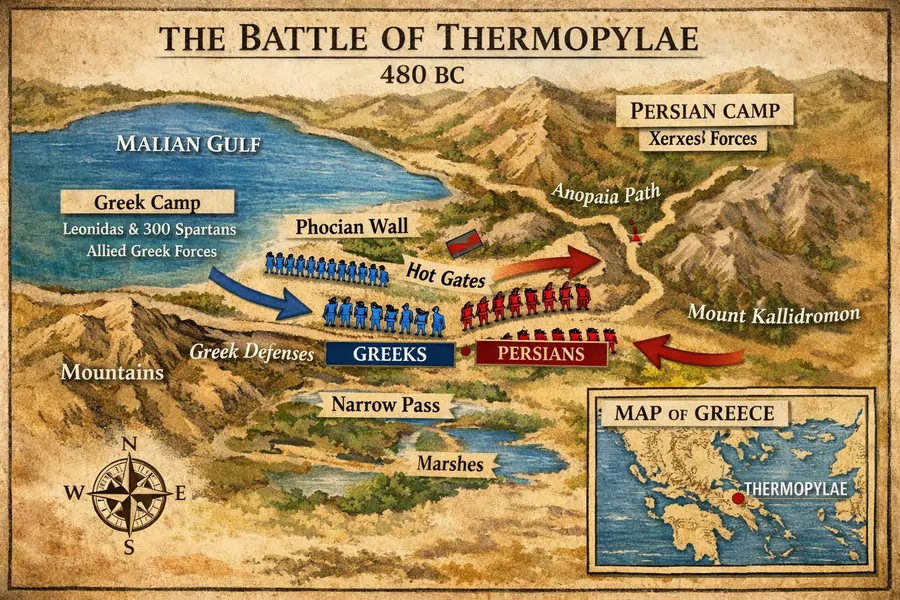
Thermopylae, meaning "Hot Gates," was a narrow pass between mountains and the sea in central Greece. The pass was less than 100 meters wide in some places, making it one of the most strategically valuable choke points for the Greeks to fend off the vast number of Persian warriors. Modern military historian Victor Davis Hanson argues that Thermopylae perfectly demonstrates how terrain can compensate for numerical inferiority, making the narrow pass the Greeks' greatest strategic asset.
The Persian army vastly outnumbered the Greeks, and facing them in an open field was not viable. This narrow terrain, however, allowed the Greeks to neutralize the Persian army's numerical superiority. The narrow corridor prevented large formations, cavalry maneuvers, and encirclement tactics. The Greeks had superior individual soldiers and equipment, which would provide them with a decisive advantage in this terrain.
Key insight: The battle was not just about bravery-it was about choosing the perfect battlefield.
Who Were the Spartans?
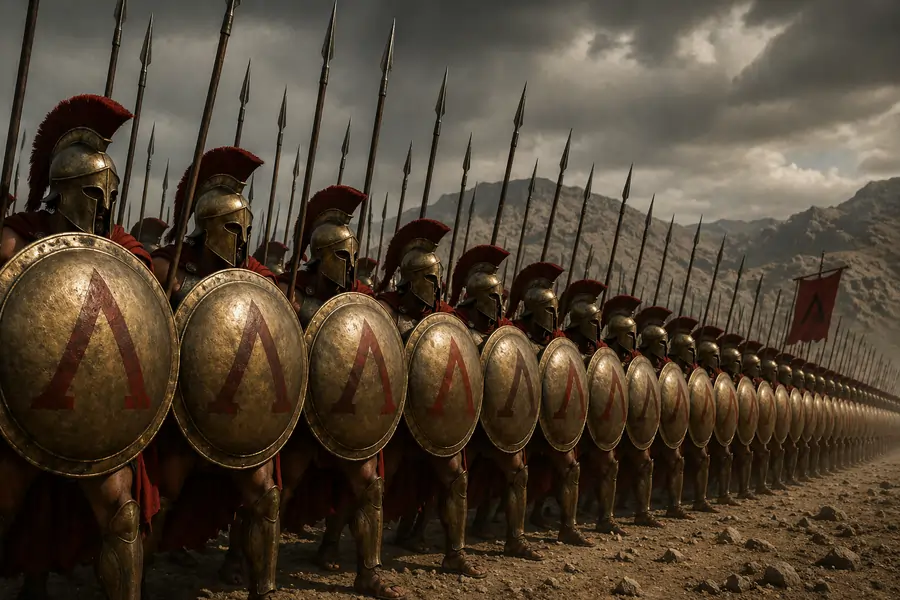
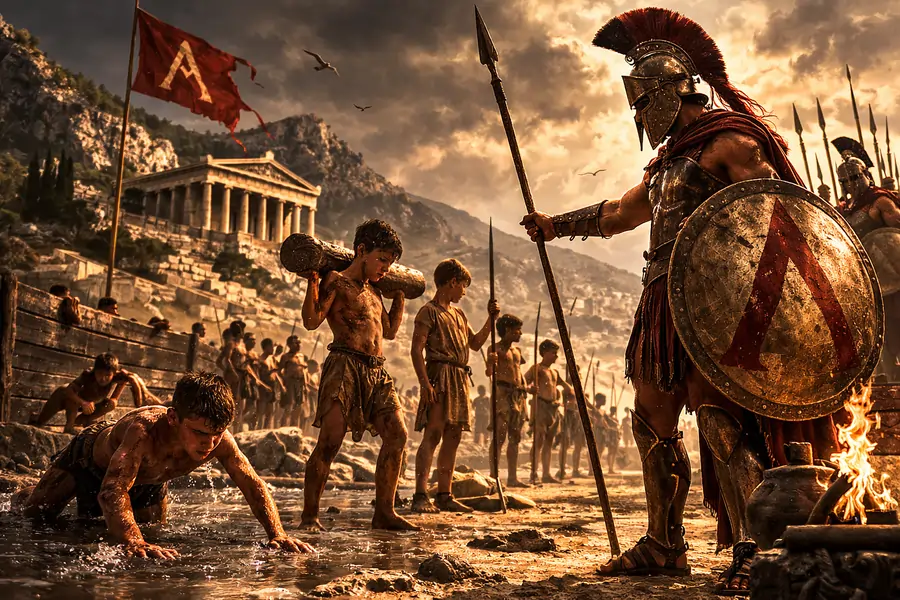
The Spartans were among the most disciplined and feared warrior societies in history. Their entire culture was built around military excellence. Serving in the military was mandatory, and training was rigorous. From a young age, Spartan boys underwent the brutal Agoge training system, which focused on endurance, discipline, and combat skills.
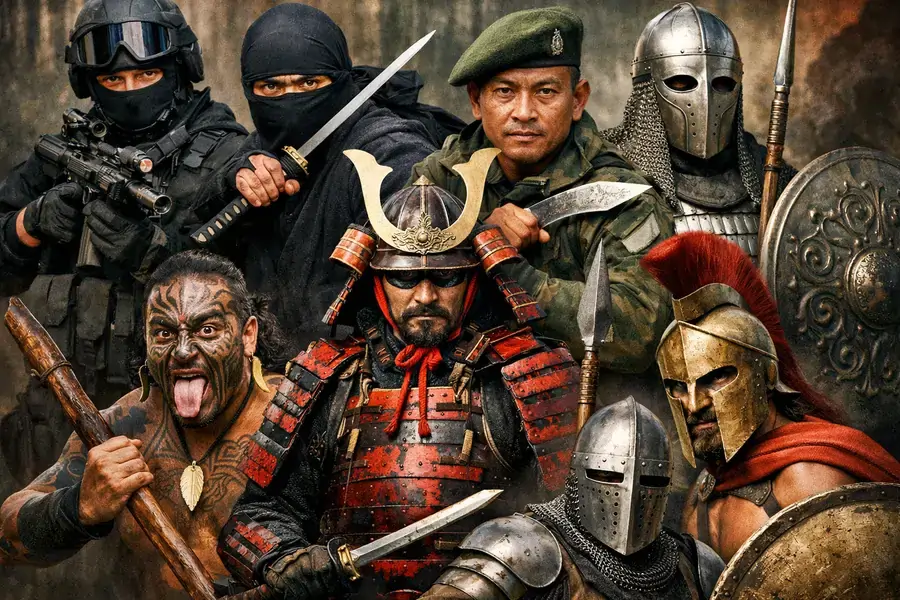
Compared to other warrior cultures, Spartans stood out for their cohesion and training. You can explore similar elite forces in this article on the greatest warrior groups in history. Unlike many ancient armies, Spartan soldiers fought as a unified unit rather than as individuals, making them exceptionally effective in formation combat. In the tight corridors of Thermopylae, this would prove deadly effective.
Greek and Persian Forces Compared
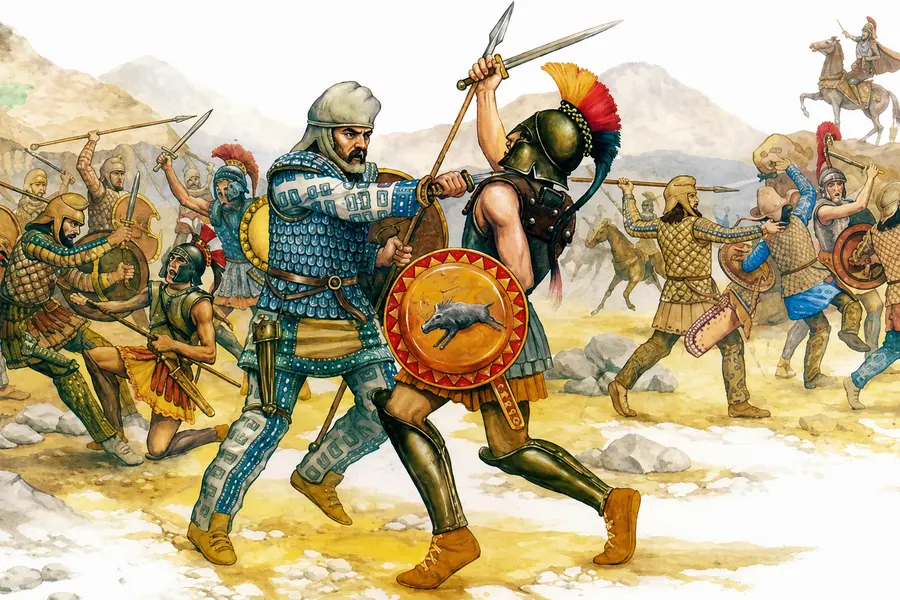
The Greek forces at Thermopylae initially numbered around 7,000 soldiers, drawn from a coalition of city-states including Sparta, Thespiae, Thebes, Corinth, and others. At the core of this force were the famous Spartan hoplites, widely regarded as some of the most disciplined soldiers in the ancient world. Greek warriors fought as heavily armored infantry, wearing bronze helmets, breastplates, greaves, and carrying large round shields known as hoplons. Their primary weapon was the long spear (doru), supported by a short sword (xiphos) for close combat. What made the Greeks especially formidable was their use of the phalanx formation-a tightly packed line of soldiers whose overlapping shields and coordinated movements created a near-impenetrable defensive wall. This formation required intense discipline, training, and trust between soldiers, qualities that were particularly strong among the Spartans.
In contrast, the Persian army led by Xerxes I was vast, with modern estimates ranging between 120,000 and 300,000 troops. Although ancient sources often exaggerated these numbers, it is largely accepted that the Persian troops vastly outnumbered the Greeks. The Persian empire was vast and had a multi-ethnic army composed of soldiers from across the empire, including Medes, Persians, Egyptians, and other ethnic groups. Their strength lay in numbers, mobility, and flexibility rather than heavy armor. Persian infantry typically wore lighter equipment, such as wicker shields and soft armor, and relied heavily on ranged combat using bows. They were supported by cavalry units, which were highly effective in open terrain but largely useless in the confined space of Thermopylae. Xerxes also deployed his elite guard, the Immortals, a unit of highly trained soldiers. Ancient sources such as Herodotus describe an enormous Persian army, although modern historians including Peter Green and Tom Holland consider these figures exaggerated and generally estimate between 120,000 and 300,000 troops.
The contrast between the two forces was not just in numbers, but in fighting style and battlefield effectiveness. Greek hoplites were designed for close-quarters combat, where their heavy armor and disciplined formations gave them a clear advantage. Persian troops, on the other hand, excelled in open battlefields where they could use their numbers, cavalry, and missile weapons effectively. However, at Thermopylae, the narrow pass neutralized these advantages. The Persians were forced into frontal assaults against a well-defended position, where their lighter armor and less cohesive formations put them at a significant disadvantage. As a result, despite overwhelming numerical superiority, the Persian army struggled to make meaningful progress against the Greek defenders during the early stages of the battle.
Greek Phalanx Formation Explained
The Greek phalanx was a tightly packed formation of soldiers with overlapping shields and projecting spears. Each soldier coordinated with the others to present an impenetrable shield wall. Arrows simply bounced off the heavy Spartan shields, and light infantry found it difficult to get through the mass of shields and spears. Historian Victor Davis Hanson, in The Western Way of War, identifies the disciplined hoplite phalanx as one of the defining military innovations of classical Greece.
- Created a nearly impenetrable shield wall
- Maximized defensive strength
- Required intense discipline, trust, and training
This formation was highly effective in confined spaces like Thermopylae, where the Persian army could not fully deploy its numbers. If you're interested in how disciplined formations evolved, compare this with the Roman legion structure and tactics.
How the Battle of Thermopylae Unfolded
Day 1: Persian Overconfidence Meets Greek Discipline
On the first day of battle, Xerxes expected a swift and decisive victory. Confident in his army's overwhelming size, he ordered repeated frontal assaults against the Greek position. However, the narrow pass of Thermopylae prevented the Persians from deploying their full numbers, forcing them into tight formations where they could not maneuver effectively. Herodotus records that Xerxes expected the Greeks to scatter at the sight of his army but was surprised by their disciplined resistance (Histories, Book 7).
The Greek forces, led by the Spartans, took full advantage of this terrain. Fighting in the disciplined phalanx formation, they created a solid wall of shields and spears that proved nearly impossible to break. Persian infantry, lightly armored and accustomed to more open battlefields, struggled in close combat. Wave after wave of Persian soldiers were pushed back with heavy casualties, while the Greeks maintained their lines with remarkable coordination and minimal losses.
By the end of the first day, it was clear that this would not be an easy victory for Xerxes. The Greek defense had turned what should have been a quick conquest into a costly stalemate.
Day 2: The Immortals Fail to Break the Line
Frustrated by the lack of progress, Xerxes escalated the attack on the second day by sending in his elite guard, the Immortals. This unit, known for its skill and prestige, was expected to crush the Greek resistance and end the battle.
According to Herodotus, even the Persian Immortals failed to break the Spartan line despite repeated assaults, illustrating the effectiveness of the Greek defensive formation. The confined space nullified their ability to outmaneuver the Greeks, and their lighter armor left them vulnerable in close combat. The Spartans and their allies continued to fight in disciplined rotations, allowing fresh troops to replace those on the front lines. This ensured that the Greek defense remained strong throughout the day.
In addition, the Greeks employed tactical withdrawals-feigning retreat to draw Persian forces forward before turning and attacking again. This strategy disrupted Persian momentum and inflicted further casualties. By the end of the second day, Xerxes' elite troops had failed just as the regular forces had, and the Greek line remained unbroken.
Day 3: Final Encirclement
A turning point occurred when a Greek traitor revealed a hidden mountain path, allowing Persian forces to outflank the defenders. With the Greeks surrounded, they could not hold out any longer, and Leonidas ordered the retreat of most Greek troops and prepared for the famous last stand.
The Betrayal of Ephialtes
The turning point of the battle came not from strength, but from betrayal. A local Greek named Ephialtes revealed to Xerxes the existence of a hidden mountain path that bypassed the main pass at Thermopylae. Under the cover of night, Persian forces were sent along this route to outflank the Greek defenders. The betrayal of Ephialtes is described in detail by Herodotus, who names him as the local Greek responsible for revealing the Anopaea mountain path to Xerxes. This highlights the importance of intelligence and local knowledge in warfare.
When news of the encirclement reached King Leonidas, he understood that the position was no longer defensible. Rather than retreat with his entire force, he made a strategic decision to dismiss most of the Greek army, preserving their lives for future battles. Leonidas remained behind with a small force, including the 300 Spartans, 700 Thespians who chose to stay voluntarily, and a contingent of Thebans.
In the final stage of the battle, the remaining Greeks fought with extraordinary determination despite being surrounded. Their spears broke, their weapons failed, and they were gradually pushed back into a smaller defensive position. Even after the death of Leonidas, the Spartans continued to resist, fighting with swords, hands, and whatever weapons they could find.
Ultimately, the Persian army overwhelmed the defenders through sheer numbers. The last of the Greek forces were killed, marking the end of the battle. However, their resistance had already achieved its purpose-delaying the Persian advance and creating a powerful symbol of courage and sacrifice that would echo throughout history.
Why Were the Greeks Able to Hold Out So Long?
This is the most important strategic question.
1. Terrain Advantage
The narrow pass limited Persian movement and prevented flanking for most of the battle. No matter the size of the army, the Persians could only fight with a limited number of troops facing the Greeks at a time.
2. Superior Armor
Greek hoplites had heavy armor and shields, giving them an advantage in close combat. The lightly armored Persian troops were not suited for close-quarter combat. With limited to no room available for maneuvering, they were outclassed by the heavy troops.
3. Discipline and Training
Spartan training ensured soldiers maintained formation even under extreme pressure. These warriors were trained to endure extreme hardships and continue fighting.
4. Tactical Rotation
Greek forces rotated troops to avoid exhaustion, maintaining effectiveness throughout the battle.
5. Leadership
King Leonidas chose the battlefield wisely and maintained morale among his troops. The presence of the Spartan King on the frontlines bolstered the morale of the Greeks.
Why Did Leonidas Stay Behind at Thermopylae?
Once the Greek position was outflanked, King Leonidas faced a critical decision: retreat and preserve his remaining forces, or stay and delay the Persian advance. He chose to dismiss the majority of the Greek army and remain behind with a small force consisting of:
- 300 Spartans
- 700 Thespians
- A contingent of Theban forces
Plutarch later portrayed Leonidas' decision as both a strategic sacrifice and an embodiment of Spartan ideals, although modern historians debate the exact motivations behind the final stand. First, by holding his ground, he ensured that the Persian army would be delayed for as long as possible, buying valuable time for other Greek city-states to prepare their defenses-especially the naval forces that would later play a decisive role in the war.
Second, Spartan law and culture placed immense importance on honor, discipline, and obedience. As a Spartan king, Leonidas was expected to lead by example and never retreat in the face of the enemy. His stand was not just a military decision, but also a reflection of the values instilled through the Spartan system of training and warfare.
There may also have been a strategic calculation behind sacrificing a small force to preserve the larger Greek army. By allowing most of the troops to withdraw, Leonidas ensured that Greece would still have soldiers available for future battles, rather than risking destruction in a hopeless fight.
In the final phase of the battle, the remaining Greeks fought with extraordinary determination despite being surrounded. Their resistance, though ultimately ending in death, transformed the battle into a powerful symbol of sacrifice and defiance. Leonidas' choice ensured that Thermopylae would not be remembered merely as a defeat, but as one of the most enduring examples of courage in military history.
Significance of the Battle of Thermopylae
Military historian John Keegan argued that Thermopylae demonstrates how morale, leadership, and terrain can outweigh numerical superiority, making it one of history's enduring military case studies.
1. Strategic Delay
The battle slowed the Persian advance, allowing Greece to prepare defenses. This would eventually turn out to be a pyrrhic victory for the Persians, and they would eventually be defeated in the Battle of Plataea and the naval battle in Salamis.
2. Psychological Impact
It inspired Greek unity and resistance against Persia. All the squabbling Greek city-states were united under one purpose.
3. Military Lessons
Thermopylae demonstrated the importance of terrain, discipline, and morale.
4. Long-Term Outcome
The delay contributed to later Greek victories, including the naval Battle of Salamis.
Lessons from Thermopylae: Strategy, Discipline, and the Power of Morale
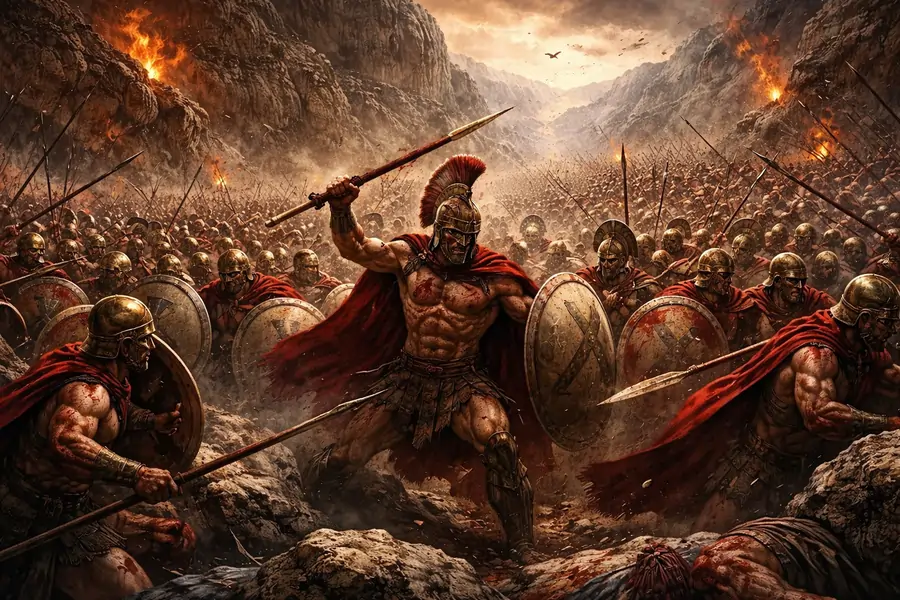
The Battle of Thermopylae offers some of the most important military lessons in history. Although the Greeks were ultimately defeated, their ability to hold off a vastly larger force provides valuable insights into strategy, leadership, and battlefield dynamics that are still studied today.
1. Terrain Can Outweigh Numbers
One of the most significant lessons from Thermopylae is the importance of terrain in warfare. The narrow pass limited the Persian army's ability to deploy its full strength, effectively neutralizing its numerical superiority. In open terrain, the Persians could have easily surrounded and overwhelmed the Greek forces. However, in a confined space, only a small number of soldiers could engage at a time, allowing the Greeks to fight on equal terms.
This demonstrates a key principle of warfare: choosing the battlefield can be just as important as the size of the army. Even a smaller force can hold off a much larger one if the terrain is used effectively.
2. Discipline Is a Force Multiplier
The effectiveness of the Greek defense was largely due to the discipline of its soldiers, especially the Spartans. Fighting in the phalanx formation required precise coordination, trust, and the ability to maintain formation under extreme pressure. Unlike less organized forces, the Greeks did not fight as individuals but as a unified unit.
This level of discipline allowed them to execute complex maneuvers, such as coordinated advances, defensive holds, and tactical withdrawals. It also meant that even when facing overwhelming odds, the Greek line did not break easily. In many battles throughout history, poorly disciplined troops have collapsed under pressure-but at Thermopylae, discipline allowed a small force to remain effective far longer than expected.
3. Morale Influences Outcomes
Morale played a crucial role in the battle. The Greek soldiers, particularly the Spartans, were highly motivated by a sense of duty, honor, and loyalty to their city-states. They understood the importance of their mission and were prepared to fight to the death if necessary.
In contrast, many Persian troops were part of a vast, multi-ethnic army and may not have shared the same level of personal commitment to the cause. While the Persian army was powerful, morale can often determine how long soldiers are willing to endure hardship and danger.
The willingness of the Greeks to stand their ground, even when defeat became inevitable, demonstrates how strong morale can extend resistance and influence the psychological impact of a battle far beyond its immediate outcome.
4. Intelligence and Local Knowledge Can Decide Battles
The eventual Persian victory at Thermopylae was not achieved through brute force alone, but through superior intelligence and local knowledge. The betrayal by Ephialtes, who revealed a hidden mountain path, allowed the Persians to outflank the Greek position and ultimately surround them.
This highlights a critical lesson: information can be more decisive than strength. No matter how strong a defensive position may be, it can be compromised if the enemy gains access to critical knowledge about terrain or strategy.
Throughout history, many battles have been won or lost based on intelligence, reconnaissance, and the ability to exploit weaknesses-Thermopylae is one of the earliest and most striking examples of this principle.
5. Strategic Sacrifice Can Shape Larger Outcomes
Although often overlooked, another key lesson from Thermopylae is the concept of strategic sacrifice. Leonidas' decision to remain behind with a small force allowed the majority of the Greek army to withdraw safely. This ensured that Greece still had troops available for future battles, rather than losing everything in a single engagement.
This kind of calculated sacrifice can delay an enemy, buy time, and influence the broader course of a war. In the case of Thermopylae, the stand helped inspire Greek unity and contributed to later victories, such as the Battle of Salamis.
Ultimately, Thermopylae teaches us that even in defeat, the right decisions can have lasting strategic impact.
Conclusion
The Battle of Thermopylae was not just a heroic last stand, but a carefully chosen defensive effort that demonstrated the power of terrain, discipline, and leadership. While the Greeks were ultimately defeated, their resistance delayed the Persian advance and strengthened Greek unity-contributing to later victories that shaped the course of history. Thermopylae endures as a timeless example of how strategy and determination can allow a smaller force to challenge overwhelming odds.
References
- Herodotus - Histories
- Plutarch. Sayings of the Spartans
- Victor Davis Hanson. The Western Way of War: Infantry Battle in Classical Greece
- Peter Green. The Greco-Persian Wars.
- Tom Holland. Persian Fire: The First World Empire and the Battle for the West.
- John Keegan. A History of Warfare.
Recommended Books
This article may contain affiliate links. If you purchase through these links, I may earn a small commission at no extra cost to you.
Related Articles
Frequently Asked Questions
Why did the Greeks choose Thermopylae as a battlefield?
The Greeks chose Thermopylae because it was a narrow mountain pass that limited the size of the Persian army that could engage at one time. This allowed a smaller Greek force to hold off a much larger army by neutralizing its numerical advantage.
How did Spartan training help in the Battle of Thermopylae?
Spartan training through the agoge system focused on discipline, endurance, and fighting in formation. This allowed Spartan soldiers to maintain the phalanx under pressure, making them highly effective in the confined terrain of Thermopylae.
What made the Greek phalanx so effective at Thermopylae?
The Greek phalanx was effective because it created a tightly packed wall of shields and spears. In the narrow pass, this formation made it difficult for Persian forces to break through, especially since they were more lightly armored.
Why couldn't the Persian army use its full strength at Thermopylae?
The narrow terrain of Thermopylae prevented the Persian army from deploying its full numbers. Only a limited number of soldiers could fight at once, which reduced the advantage of having a much larger army.
Did all Greek soldiers stay for the final stand at Thermopylae?
No, most Greek forces were dismissed by King Leonidas after the Persians outflanked the position. Only a small group, including the 300 Spartans and 700 Thespians, stayed behind to fight to the death.
How did the Battle of Thermopylae influence later Greek victories?
The battle delayed the Persian advance and gave Greek forces time to prepare. It also boosted morale and unity among Greek city-states, contributing to later victories such as the Battle of Salamis.
Add Comment