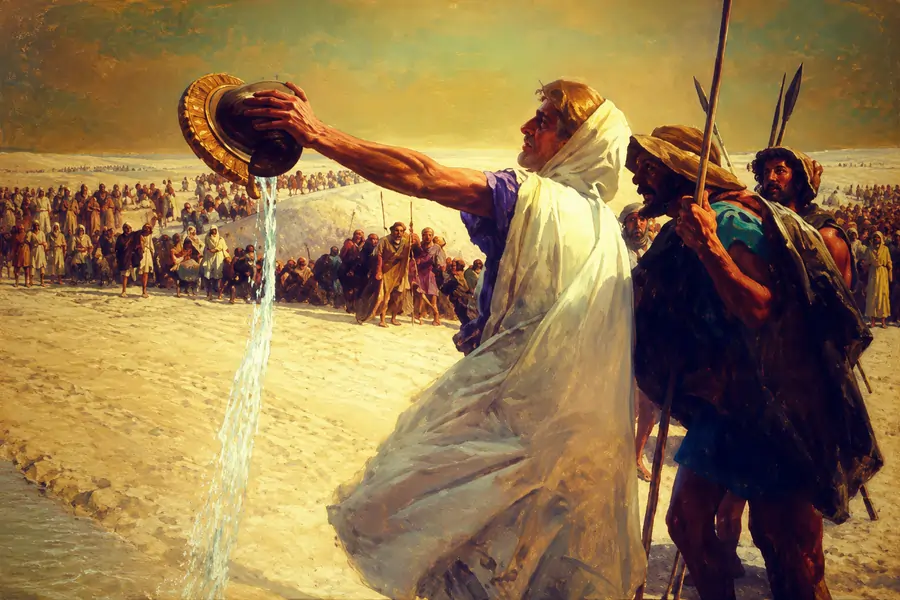
Alexander the Great conquered the Persian Empire, defeated much larger armies using his decisive leadership, and marched farther than almost any commander of the ancient world. Yet the Gedrosian Desert Crossing in 325 BC nearly destroyed everything he had built. After a decade of brilliant military victories and undefeated campaigning, Alexander led tens of thousands of exhausted soldiers through one of the harshest deserts on earth. Men died from thirst, starvation, disease, heat exhaustion, and disorganization. Supply lines collapsed, intelligence failed, and the Macedonian king who had mastered military logistics suddenly found himself trapped inside a harsh desert with no way out. Ancient historian Arrian described the crossing as one of the most devastating ordeals suffered by Alexander's army (Anabasis, Book VI).
Although Alexander eventually escaped the desert and reunited his surviving forces, the crossing permanently damaged his army and changed the final years of his reign. Historian Robin Lane Fox argues that the disaster revealed "the limits of Alexander's ambition and endurance," while Donald Engels viewed the march as a severe logistical miscalculation despite Alexander's earlier brilliance in supply management.
Table of Contents
- Alexander the Great and His Mastery of Logistics
- What Was the Gedrosian Desert Crossing?
- Why Did Alexander Choose the Gedrosian Desert Route?
- Why Logistics Failed During the Crossing
- How Intelligence and Planning Collapsed
- The Horrific Conditions Inside the Gedrosian Desert
- The Famous Water in a Helmet Incident
- How Alexander Eventually Escaped the Desert
- How Many Soldiers Died in the Gedrosian Desert?
- Legacy of the Gedrosian Desert Crossing
- FAQ
- References and Sources
Alexander the Great and His Mastery of Logistics
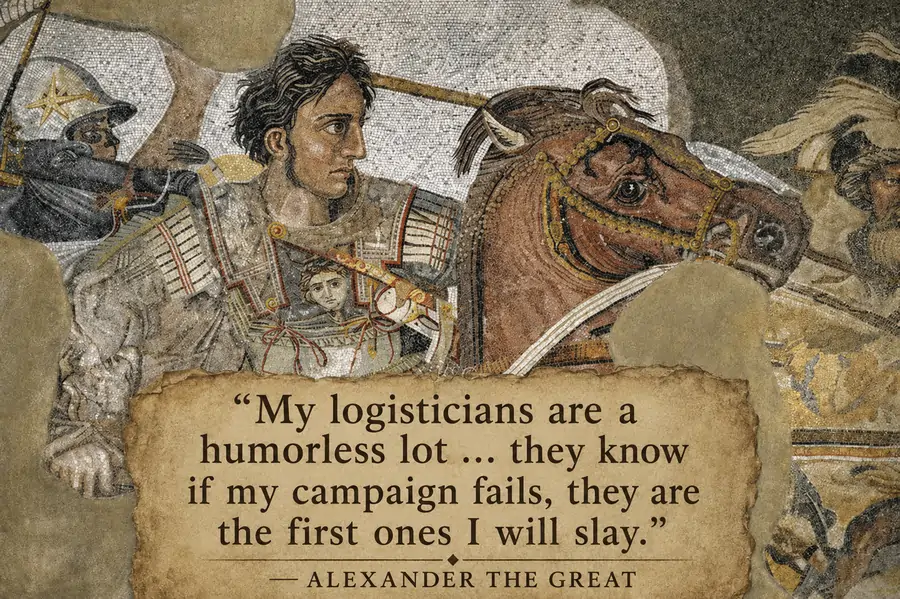
Before the Gedrosian disaster, Alexander the Great had built a reputation as one of history's finest military logisticians. His campaigns stretched from Greece to India, yet his army was supplied adequately and high on morale. Military historian Donald Engels argued that Alexander's logistical system was one of the primary reasons behind his military success. Unlike many ancient rulers who relied on massive baggage trains, Alexander emphasized speed, mobility, and flexible supply arrangements (Engels, Alexander the Great and the Logistics of the Macedonian Army).
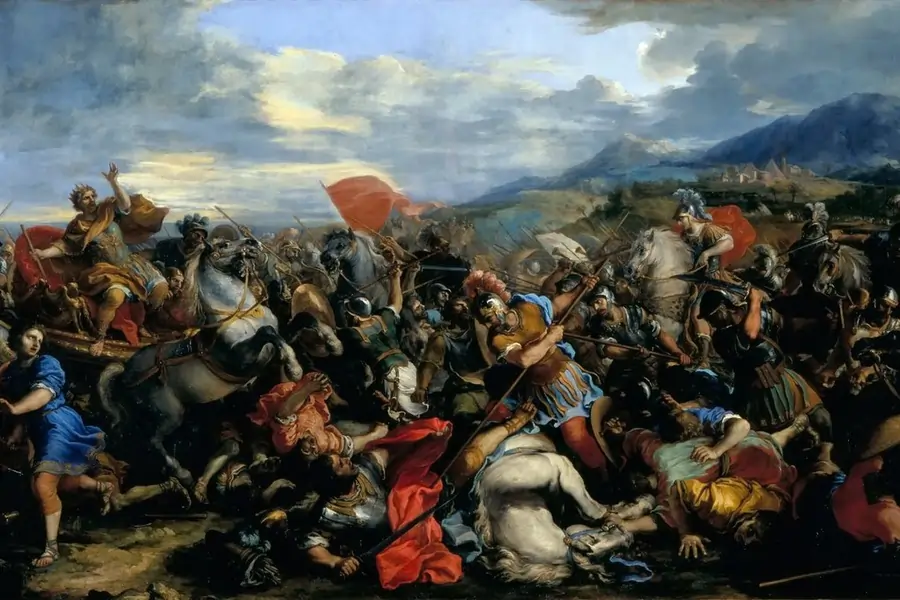
His army carried lighter equipment, established supply depots, captured port cities to establish naval support, and often survived through controlled local foraging. These methods allowed Alexander to sustain his army's momentum during difficult campaigns across Asia without worrying about his extended supply routes. Alexander's logistical brilliance was clearly visible during victories at battles such as the Battle of the Granicus River, the Battle of Issus, and the Battle of Gaugamela. Arrian repeatedly praised Alexander's ability to move rapidly while maintaining operational cohesion.
For a deeper analysis of his campaign logistics, see How Alexander the Great Managed Logistics.
By 325 BC, however, the Macedonian army had been campaigning continuously for nearly a decade. Soldiers were exhausted and homesick, supply systems were stretched thin, and morale had begun to decline after the brutal Indian campaigns, especially following the difficult Battle of the Hydaspes. Historian Peter Green notes that Alexander's army by this stage was physically exhausted and psychologically strained after years of continuous warfare across Asia (Alexander of Macedon). Alexander had to comply with the demands of his men and return to Macedonia.
What Was the Gedrosian Desert Crossing?
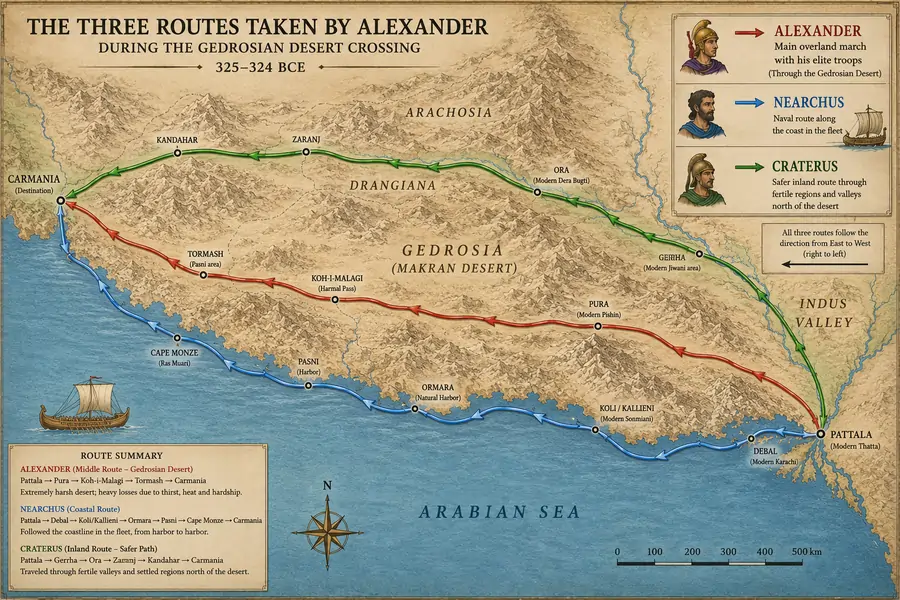
The Gedrosian Desert Crossing was Alexander's march through the harsh desert region of Gedrosia, located primarily in modern-day southern Iran and parts of Pakistan's Makran coast. Ancient historians described the region as one of the deadliest environments known to the ancient world. Arrian claimed that no previous invading army had crossed the region successfully without suffering catastrophic losses (Anabasis, Book VI).
The crossing occurred during Alexander's return journey from India in 325 BC. Instead of retracing safer inland routes, Alexander divided his forces into multiple groups:
| Commander | Route Taken | Purpose |
|---|---|---|
| Alexander | Gedrosian Desert | Main overland march with his elite troops |
| Nearchus | Naval coastal route | Explore maritime route |
| Craterus | Safer inland route | Transport wounded troops and their veteran soldiers |
Why Did Alexander Choose the Gedrosian Desert Route?
Alexander personally led the most dangerous route through the desert. Ancient writers such as Plutarch and Curtius Rufus later portrayed the march as one of the greatest ordeals of his career. Historians continue to debate why Alexander chose such a deadly path when safer alternatives existed.
1. Desire to Surpass Legendary Conquerors
According to Arrian, it was his thirst for glory that prompted Alexander to take this dangerous route. He wanted to succeed where Cyrus the Great and Semiramis had supposedly failed. The king often pursued symbolic achievements designed to strengthen his personal legend. Historian Robin Lane Fox argues that Alexander's personality increasingly combined military strategy with heroic self-image and mythological ambition (Alexander the Great).
2. Coordinating with Nearchus' Fleet
Alexander also hoped to coordinate the army with Nearchus' naval expedition along the coast. The goal was to establish communication and supply depots between India and the Persian Gulf. Historian J.F.C. Fuller believed the expedition also had strategic value because Alexander wanted to explore maritime trade and naval routes linking his empire.
3. Punishing His Army After Mutiny
Curtius Rufus suggested that Alexander had become increasingly frustrated with the army's refusal to continue deeper into India (Histories of Alexander the Great). Some historians like Peter Green believe Alexander chose the difficult route to make the journey "hell on earth" out of frustration after the mutiny. The harsh desert march may therefore have been partly intended to reassert authority and punish his troops for defying him.
However, modern historians reject this claim that Alexander intentionally marched his army through the desert to punish them. First, the bulk of his mutineering troops did not go by this route. Most of his heavy infantry (the men who protested) were sent through a more hospitable northern route through Arachosia under the command of General Craterus. Secondly, Alexander himself led the troops through the desert, sharing the same suffering as his men. Lastly, sabotaging his own elite army would have put Alexander in a defenseless position to defend his new Empire.
4. Dangerous Overconfidence
Modern historians often argue that Alexander simply became overconfident after years of uninterrupted victories. His obsession with creating a legendary image for himself led him to be overconfident. Peter Green describes the Gedrosian march as one of the clearest examples of Alexander's increasing recklessness during the later stages of his reign.
Why Logistics Failed During the Crossing
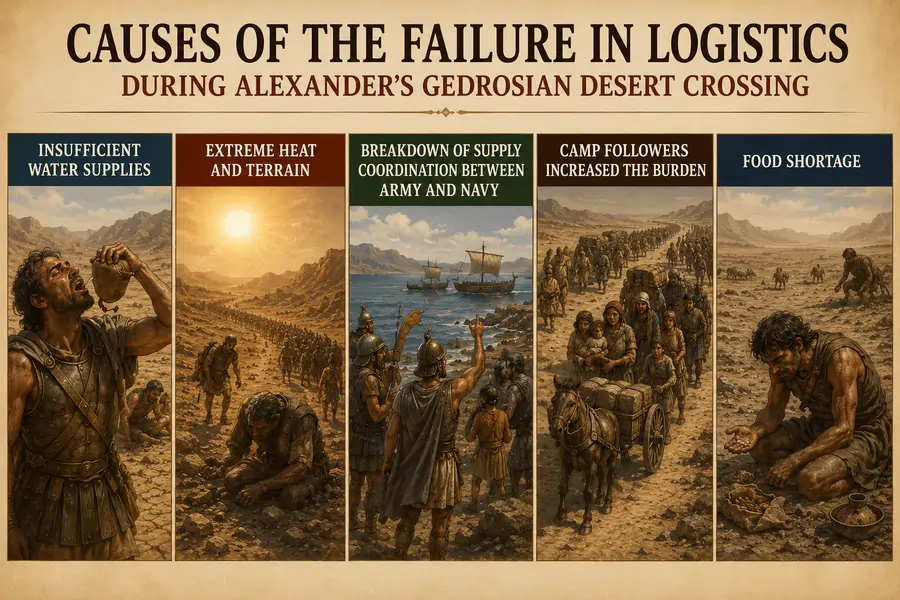
The Gedrosian Desert Crossing is now widely regarded as one of the greatest logistical failures in ancient military history. Despite Alexander's reputation for careful planning in logistics and intelligence gathering, this trek went horribly wrong for the following reasons.
Insufficient Water Supplies
The greatest problem was water scarcity in the desert. Ancient armies required enormous daily water consumption levels for soldiers, horses, and animals. Alexander had planned to make close contact with his naval fleet to carry heavy supplies and dig coastal wells for securing water. This plan failed when monsoon rains prevented his fleet from sailing on time, which caused him to lose contact with them. The mountainous terrain also prevented Alexander from reaching the coastline or digging wells. Retreating Gedrosian tribes also poisoned existing wells that hindered the Macedonians.
Arrian described entire groups collapsing from thirst as wells failed to provide adequate supplies to the huge number of troops. Historian Donald Engels argues that Alexander underestimated both the environmental conditions and the sheer logistical burden of moving such a large force through the desert.
Extreme Heat and Terrain
The Makran region featured brutal temperatures, shifting dunes, and rocky terrain that exhausted both men and animals. The Macedonians were also not accustomed to such harsh climates. Curtius Rufus described soldiers abandoning weapons and armor simply to continue marching. As pack animals died, transport capacity collapsed, forcing the army to abandon supplies.
Breakdown of Supply Coordination
Alexander intended for Nearchus' fleet to support the land march, but communication repeatedly failed. Due to the late departure of the fleet, Alexander had to march ahead, which caused him to lose contact. To further worsen his situation, the Makran coastline features rugged mountain ridges that drop directly into the sea. This prevented the army from reaching the coastline and forced them to march completely inland. Historian Robin Lane Fox notes that poor mapping and limited geographic knowledge made coordination between the army and fleet nearly impossible.
Camp Followers Increased the Burden
The Macedonian army was accompanied by civilians, servants, traders, and families. Plutarch noted that these noncombatants suffered heavily during the crossing because they were less capable of enduring the physical hardships. Due to this, casualties among the camp followers were significantly higher.
Food Shortages
The Gedrosian region provided little opportunity for local foraging. Unlike earlier campaigns where Alexander could seize grain and livestock, the desert offered almost no sustainable resources. His original plan was to store food in his ships and use them as floating granaries. However, this plan fell apart when he lost contact with the Navy.
How Intelligence and Planning Collapsed
Alexander's effective intelligence system failed in the Gedrosian Desert. The brutal desert exposed the limits of ancient geographic knowledge. Arrian and Strabo both mention the scarcity of reliable information regarding water sources and distances. The region remained only loosely integrated into imperial administrative systems, leaving reliable geographic information limited. Therefore, there were no maps, logistical information, or paperwork to study. Alexander's army was virtually going in blind into the vast desert.
Alexander relied on local guides recruited from the edge of the desert. However, they had inadequate knowledge of the terrain or the vastness of the desert. The shifting dunes also removed any trail or landmarks. Arrian notes that the guides quickly became completely lost because they did not know how to navigate using the stars or the sun.
Seasonal climate changes were poorly understood. There was also an instance where sudden monsoon rains in a distant mountain caused a flash flood that created unexpected devastation. Curtius Rufus described sudden floods drowning thousands of camp followers, animals, and sleeping soldiers. His scouts also failed to realize that fierce monsoon winds blew directly into the Indus Delta, which prevented Nearchus's fleet from sailing and supplying Alexander's army.
The local tribes in the region were also hostile and prevented Alexander from securing supplies. The coast was occupied by Ichthyophagi (Fish eaters) who spoke a completely different language not known to Alexander's interpreters. The inland tribes retreated and employed a "Scorched earth policy" by poisoning the wells as they retreated. Modern historians often cite the Gedrosian crossing as proof that even elite armies can collapse when intelligence and environmental knowledge fail.
The Horrific Conditions Inside the Gedrosian Desert
The harsh conditions of the Gedrosian Desert shocked even veterans who had survived years of brutal warfare. Arrian described soldiers collapsing from heat exhaustion and dehydration while animals died across the marching route. Food shortages became so severe that surviving transport animals were sometimes slaughtered for meat.
Catastrophic flash floods caused thousands of casualties. With no way of transporting the sick and wounded, many were left behind in the sand to die. Soldiers had to march for days under the sun without water. When they came across a rare watering hole, many drank so much, so fast, that their bodies went into shock and they died on the spot. Women and camp followers suffered especially high mortality rates because they struggled to maintain the pace of the army. Historian Peter Green describes the crossing as less a military march and more "a prolonged struggle for survival."
The Famous Water in a Helmet Incident
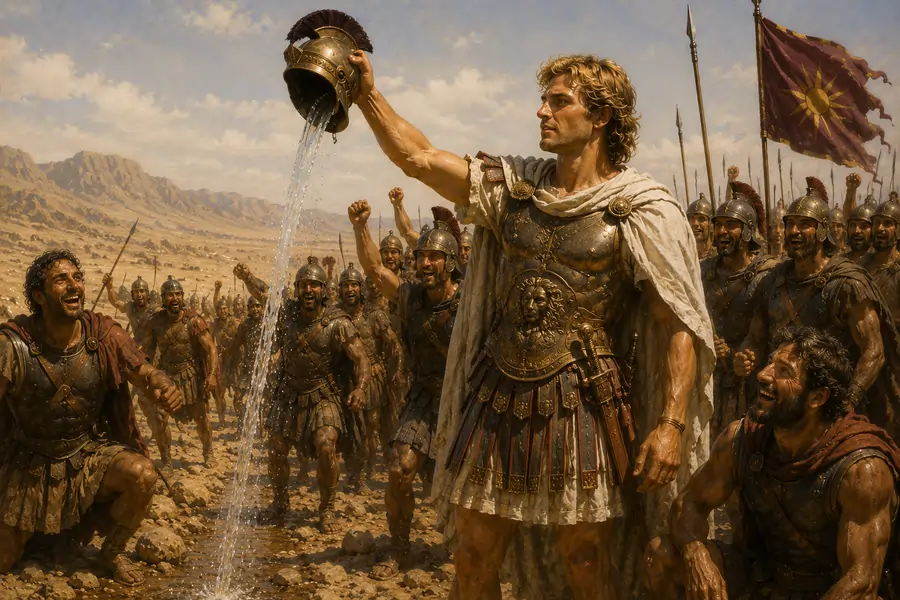
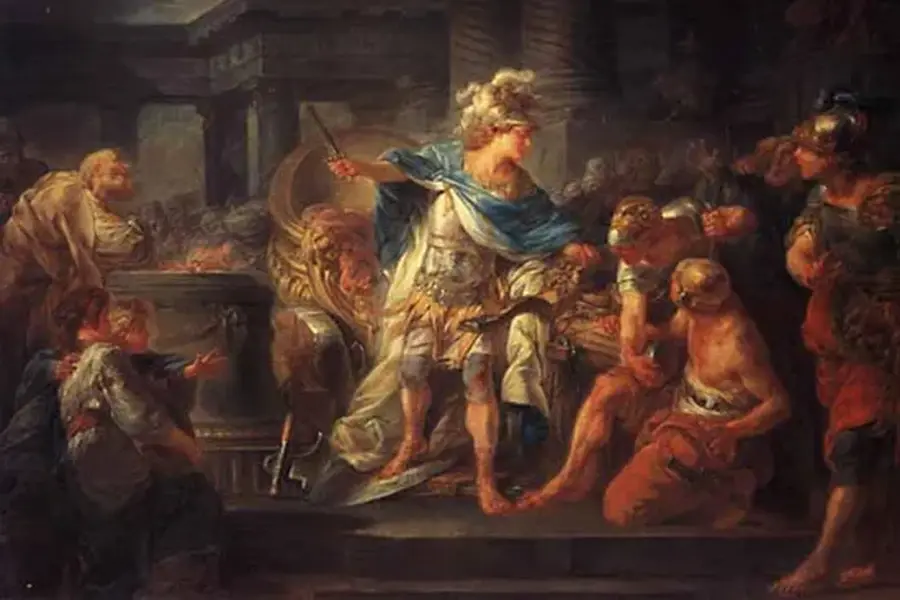
One of the most famous stories from the crossing involved a helmet filled with water. According to Arrian, during the desperate crossing, several soldiers found a small amount of water and brought it to Alexander in a helmet. The king looked at the exhausted troops around him and realized the water would barely help him while thousands remained thirsty. Instead of drinking it, Alexander poured the water onto the ground.
Plutarch argued that the gesture dramatically improved morale because it showed Alexander was willing to suffer alongside his men. Arrian mentioned that the gesture was so powerful that it seemed to quench the thirst of all of his men. Seeing their King choose to share their torment, the morale of the troops skyrocketed, and they demanded to keep marching.
How Alexander Eventually Escaped the Desert
Despite catastrophic losses, Alexander eventually guided the surviving army out of Gedrosia. The following factors contributed to the safe passage of the remaining troops.
Strong Leadership
Ancient historians consistently emphasized Alexander's personal presence during the crisis. Plutarch noted that Alexander marched alongside his troops and shared their hardships directly rather than isolating himself from the suffering. The water in a helmet incident significantly improved the morale of his struggling troops. When the local guides admitted to being lost, Alexander took over the navigation personally. He identified that the main mistake was going too far inland and turned the army south toward the Arabian Sea.
Reaching Fertile Territory
Eventually, the survivors reached Carmania, where access to food and water allowed the army to recover. The reunion with Nearchus' fleet also boosted morale significantly.
Experienced Veterans
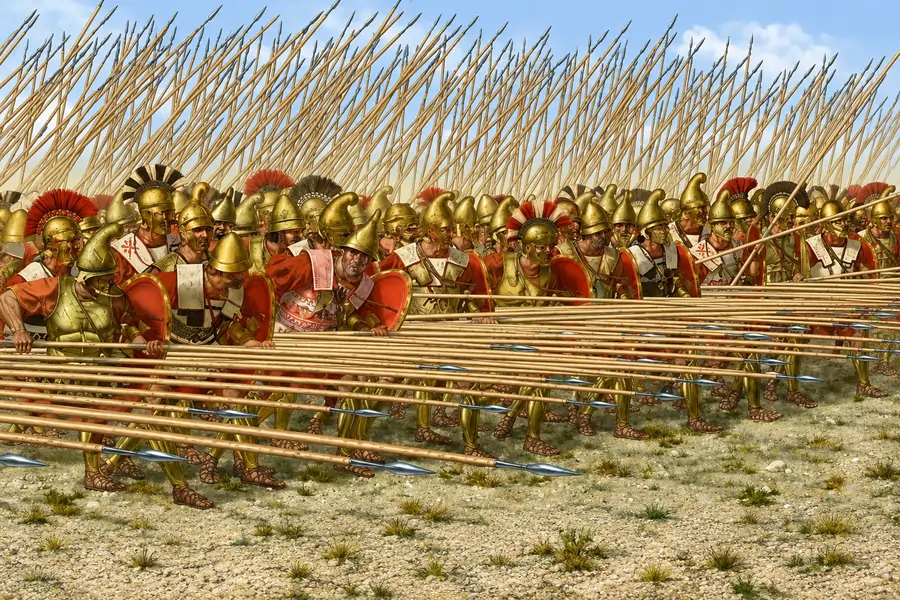
The Macedonian army remained one of the most disciplined forces of the ancient world. They were able to handle harsh conditions better due to their training and endurance. The same infantry systems that had dominated battlefields through the Macedonian phalanx also helped maintain organizational cohesion during the disaster.
How Many Soldiers Died in the Gedrosian Desert?
Exact casualty figures remain uncertain because ancient sources disagree considerably.
| Category | Estimated Losses |
|---|---|
| Soldiers | 12,000 killed |
| Camp followers | Possibly tens of thousands |
| Pack animals | Massive losses |
| Supplies and equipment | Severe destruction as most equipment was abandoned |
Arrian suggested the losses exceeded any suffering Alexander had previously experienced during his campaigns. Modern historians estimate that perhaps one-third of the marching force may have perished. Historian Robin Lane Fox argues that the Gedrosian losses permanently weakened Alexander's military capacity during the final years of his empire.
Legacy of the Gedrosian Desert Crossing
The Gedrosian Desert Crossing became one of the defining episodes of Alexander's legacy. It was one of the few instances where Alexander's famous logistics and intelligence gathering failed horribly. The Macedonians faced significant losses considerably larger than any of the battles they had fought earlier. It represented reckless ambition that caused unnecessary suffering.
Military historians frequently study the crossing as a classic example of how logistics, terrain, and environmental conditions can destroy armies more effectively than enemy forces. Historian Donald Engels considered the march one of the clearest demonstrations that even brilliant commanders remain vulnerable when supply systems fail. Alexander's army had reached the limits of exhaustion after years of continuous campaigning.
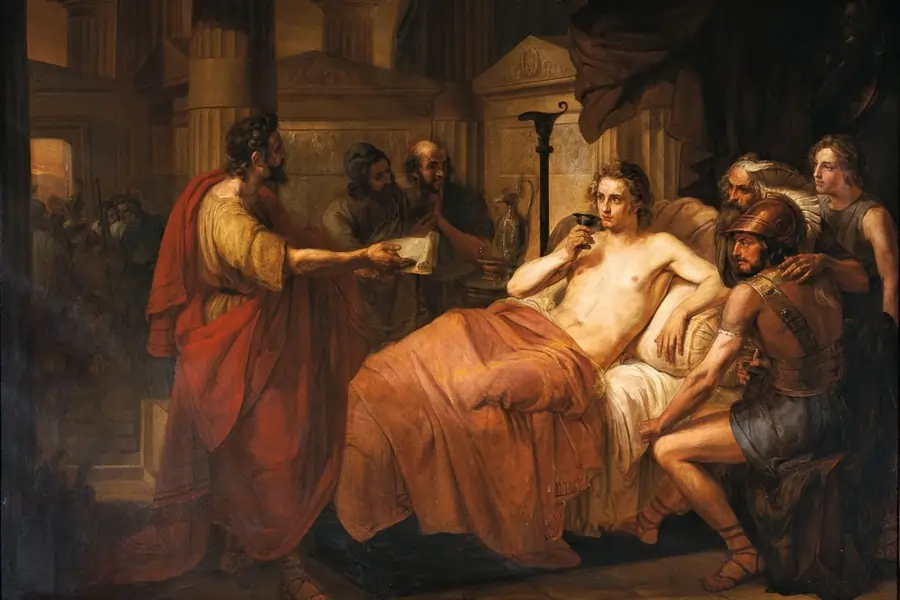
Alexander's decision to put himself in harm's way to share the suffering of his soldiers bolstered the morale of his troops. He personally took over the navigation and led his army to the coastline, which ultimately saved them from destruction. Only a few years later, Alexander the Great would die in Babylon in 323 BC, leaving behind a legacy unrivaled in ancient history.
References and Sources
- Arrian, Anabasis of Alexander
- Plutarch, Life of Alexander
- Quintus Curtius Rufus (History of Alexander)
- Strabo - Geography
- Robin Lane Fox - Alexander the Great
- Peter Green - Alexander of Macedon
- Donald Engels - Alexander the Great and the Logistics of the Macedonian Army
- J.F.C. Fuller - The Generalship of Alexander the Great
- Encyclopaedia Britannica: Alexander the Great
- Livius.org: Alexander the Great
- Arrian's Anabasis Translation
Recommended Books
This article may contain affiliate links. If you purchase through these links, I may earn a small commission at no extra cost to you.
Related Articles
Frequently Asked Questions
Why did Alexander the Great choose the Gedrosian Desert route instead of a safer path?
Alexander the Great likely chose the Gedrosian Desert route to support Nearchus' naval expedition, surpass legendary conquerors like Cyrus the Great, and prove the endurance of his army. Many historians also believe Alexander's growing ambition and confidence after years of victories influenced the decision.
How did Alexander the Great survive the Gedrosian Desert Crossing?
Alexander survived the Gedrosian Desert Crossing through strict discipline, experienced veteran troops, and his ability to maintain morale during extreme hardship. The army eventually reached the fertile region of Carmania, where surviving soldiers gained access to food, water, and rest.
What logistical mistakes caused the Gedrosian Desert disaster?
The Gedrosian Desert disaster was caused by poor water availability, failed coordination with Nearchus' fleet, inaccurate intelligence about terrain and distances, food shortages, and the difficulty of moving a massive army through one of the harshest deserts in the ancient world.
How many soldiers did Alexander lose in the Gedrosian Desert?
Ancient historians provide different estimates, but modern historians believe Alexander lost thousands of soldiers and camp followers during the Gedrosian Desert Crossing. Some estimates suggest that up to one-third of the marching force may have died from thirst, starvation, exhaustion, and disease.
What was the water in the helmet story during Alexander's desert march?
During the Gedrosian Desert Crossing, several soldiers found a small amount of water and brought it to Alexander in a helmet. Instead of drinking it himself, Alexander poured the water onto the ground to show solidarity with his thirsty troops, greatly boosting morale.
Why is the Gedrosian Desert Crossing considered Alexander's greatest failure?
Many historians consider the Gedrosian Desert Crossing Alexander's greatest failure because the march caused devastating losses without achieving major military gains. The disaster exposed the limits of even Alexander's leadership, logistics, and intelligence systems.
Add Comment