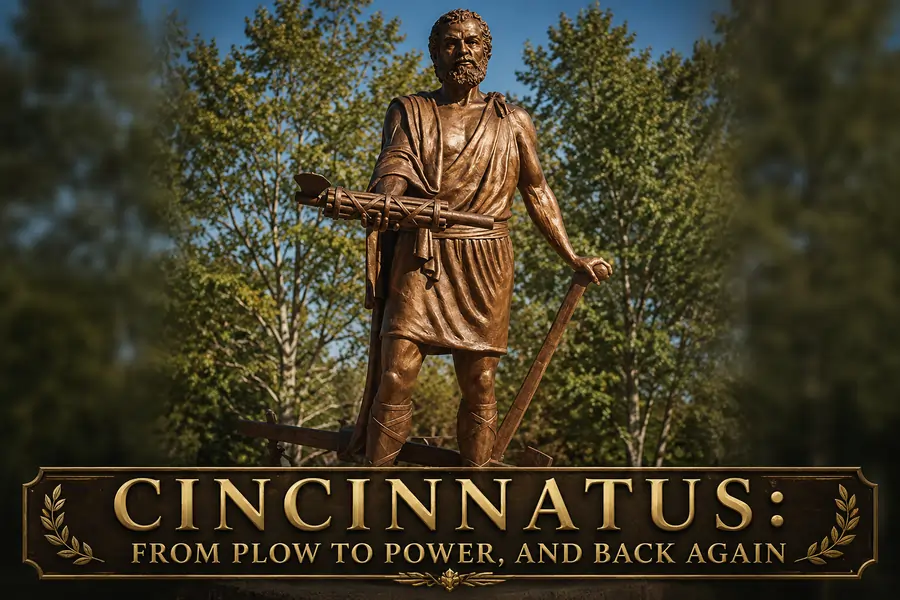
Few figures from the Roman Republic represent the ideals of duty, humility, and selfless leadership more than Lucius Quinctius Cincinnatus. Unlike many rulers throughout history who fought to gain and preserve power, Cincinnatus became legendary for willingly surrendering it. According to Roman tradition, he was called from his small farm, granted extraordinary authority as dictator, an office limited to a maximum term of six months during a military emergency, saved Rome from disaster, and then returned to ordinary life after only a few days. His actions became one of history's most famous examples of civic virtue - the belief that a citizen should place the needs of the state above personal ambition.
The story of Cincinnatus influenced generations of leaders, including George Washington, who was later compared to the Roman farmer-general for resigning his military command after victory in the American Revolution. Although historians continue to debate how much of the traditional account is historical and how much was shaped by Roman moral storytelling, Cincinnatus remains an enduring symbol of restrained power and responsible leadership.
Table of Contents
- Early Life of Cincinnatus
- The Roman Dictator: Role, Powers, and Term Limits
- The Crisis That Led to Cincinnatus Becoming Dictator
- How Cincinnatus Saved Rome in Sixteen Days
- Why Cincinnatus Gave Up Absolute Power
- The Second Dictatorship of Cincinnatus
- How George Washington Followed the Example of Cincinnatus
- Legacy of Cincinnatus and Civic Virtue
- References
Early Life of Cincinnatus: From Roman Aristocrat to Farmer
Lucius Quinctius Cincinnatus was born around 519 BC into the ancient patrician Quinctia family, one of the aristocratic clans of early Rome. He lived during the first century of the Roman Republic, a period when Rome was still a small but ambitious city-state struggling for survival against neighboring Italian peoples. Unlike the later Roman Empire that controlled territories across Europe, North Africa, and the Middle East, the Rome of Cincinnatus was still fighting for dominance in central Italy. The professional armies and advanced military organization discussed in the later development of the Roman legion system had not yet fully evolved. Early Republican armies were largely made up of citizen-soldiers who temporarily left their farms to fight when Rome was threatened.
Cincinnatus first became known as a respected member of Rome's conservative patrician class. According to the Roman historian Livy, he served as consul in 460 BC during a period of intense political conflict between the wealthy patricians and the common citizens known as plebeians (Livy, History of Rome, Book 3).
His political career was strongly influenced by his son, Caeso Quinctius. Ancient accounts describe Caeso as a powerful but aggressive young aristocrat who opposed plebeian reforms. After being accused of violent behavior and forced into exile, Cincinnatus reportedly had to pay a large financial penalty, causing him to lose much of his wealth. Roman tradition claims that after these events, Cincinnatus retired from public life and worked a small farm across the Tiber River. Whether this image is completely accurate or partly symbolic, Roman writers used it to present him as the ideal citizen - a man who valued simple living and responsibility over luxury and political ambition.
The Roman Dictator: Role, Powers, Purpose, and Term Limits
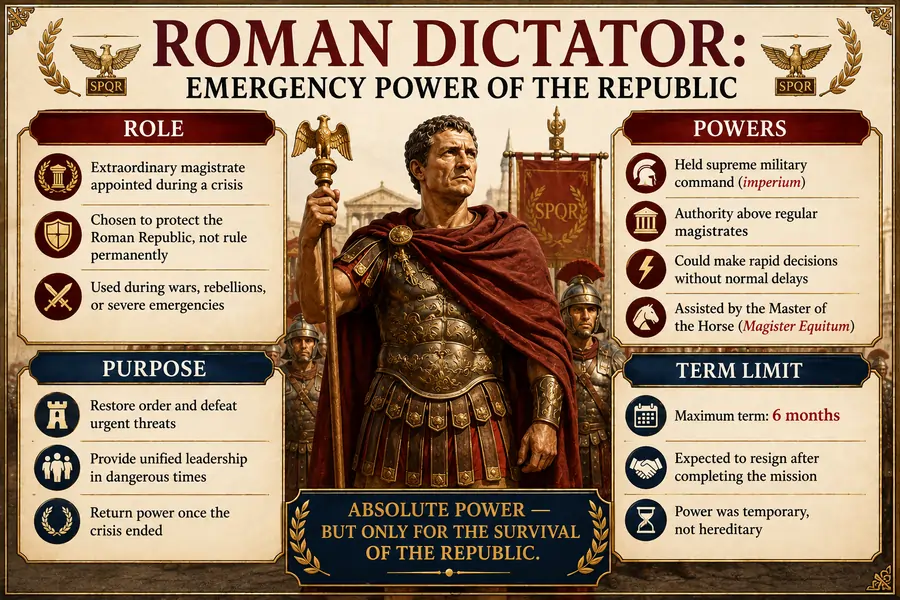
To understand why the story of Cincinnatus became so important, it is necessary to understand the position of the dictator in the Roman Republic. Unlike the modern meaning of the word, a Roman dictator was originally a temporary emergency office created to protect the state during moments of extreme danger. The Roman Republic normally avoided giving unlimited authority to one individual. Political power was divided between elected officials, especially the two consuls who served together each year. This system was designed to prevent the return of monarchy after Rome removed its kings in 509 BC.
However, during a severe military crisis, political rebellion, or internal emergency, the Romans believed that divided leadership could become dangerous. A dictator could therefore be appointed to make quick decisions without the delays of normal political debate. A Roman dictator had extraordinary authority known as imperium. He could command armies, issue orders, and take actions necessary to resolve the emergency. However, this power came with an important restriction: the dictator was expected to resign after completing his mission and could not legally hold the office longer than six months.
This temporary nature separated early Republican dictators from later rulers who used emergency powers for permanent control. Centuries after Cincinnatus, figures such as Julius Caesar transformed the meaning of dictatorship when Caesar was eventually appointed dictator for life. Caesar's rise and the political consequences of unlimited authority are explored further in the history of Julius Caesar's rise to power and assassination.
The Crisis That Led to Cincinnatus Becoming Dictator
The most famous episode in the life of Cincinnatus occurred in 458 BC during Rome's conflict with the Aequi, a neighboring Italic people who frequently fought against the young Republic. According to Livy, a Roman army commanded by consul Lucius Minucius Esquilinus became trapped by the Aequi near Mount Algidus. The Roman forces were surrounded and faced the possibility of destruction unless immediate help arrived.
The situation represented exactly the type of emergency for which the dictatorship had been created. Rome needed a commander who could act quickly, organize a rescue force, and defeat the enemy before the trapped army collapsed. The Senate decided that Cincinnatus was the man for the task.
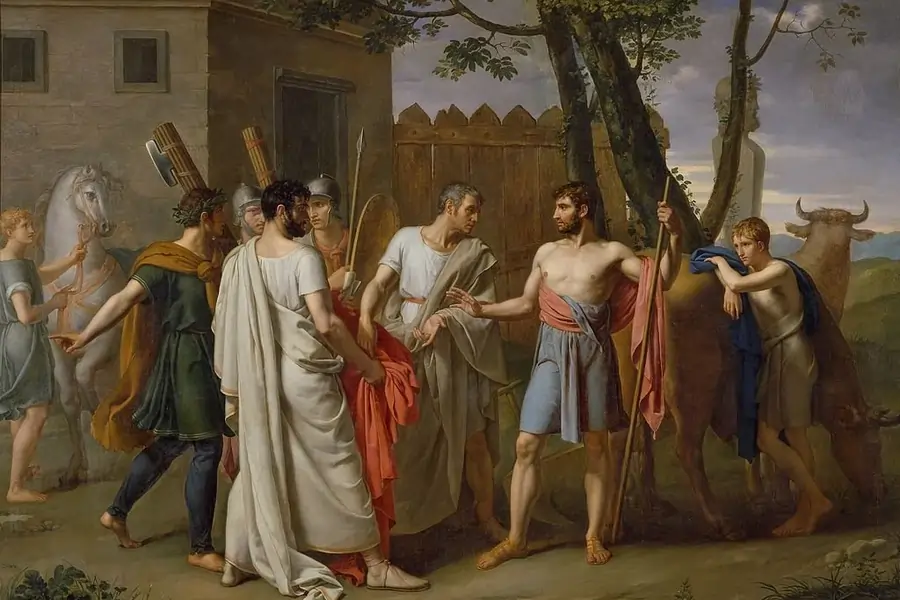
The most famous scene from the story describes Roman messengers arriving at Cincinnatus' farm. Instead of finding a wealthy politician seeking power, they found him personally working his land. The messengers informed him that Rome had appointed him dictator and requested that he put on his official toga to receive the authority of the Republic. This image - a farmer leaving his plow to save his country - became one of the most powerful symbols in Roman history. It represented the belief that the greatest leaders were those who accepted power as a responsibility rather than a personal reward.
How Cincinnatus Saved Rome: The Campaign Against the Aequi
After accepting the dictatorship, Cincinnatus immediately began preparing a rescue operation. Ancient sources emphasize the speed and discipline of his response. Rather than using his new authority for personal advantage or political revenge, he focused entirely on solving the emergency that threatened Rome. According to Livy, Cincinnatus ordered all eligible Roman men of military age to gather before sunset with weapons and several days of food supplies. This rapid mobilization reflected the citizen-soldier tradition of early Rome, where ordinary farmers and landowners were expected to defend the Republic during times of war.
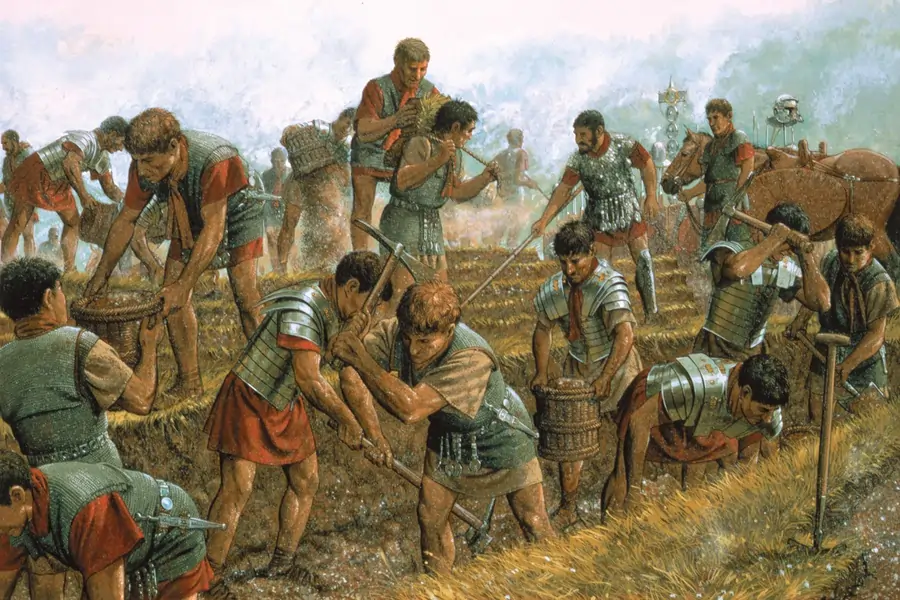
Unlike the later professional soldiers of the Roman Empire, early Roman armies depended heavily on temporary military service. Soldiers balanced their duties as warriors with responsibilities at home, a tradition that shaped the values and mentality of Roman fighting forces for centuries. The demanding lifestyle and expectations placed on Roman soldiers are explored further in daily life inside the Roman army.
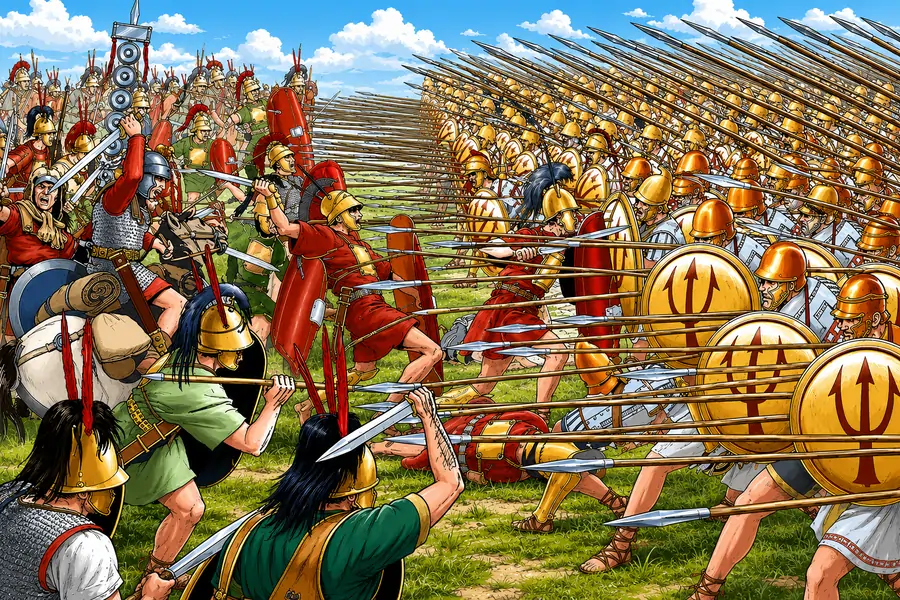
Cincinnatus marched his newly assembled army toward Mount Algidus, where the trapped Roman forces were surrounded by the Aequi. Instead of launching a reckless attack, he used organization, discipline, and battlefield engineering to reverse the situation. During the night, his soldiers surrounded the Aequi camp and constructed defensive works around the enemy position. The besiegers suddenly became the besieged. When morning arrived, the Aequi found themselves trapped between the original Roman army inside their lines and the newly arrived army of Cincinnatus outside them.
This use of surrounding defenses and battlefield construction became a recurring strength in Roman military history. Centuries later, Julius Caesar famously used a far more advanced version of a similar concept during the Battle of Alesia, where Roman engineering played a decisive role in defeating a larger enemy force.
The Aequi, realizing that their position was hopeless, surrendered. According to Roman tradition, Cincinnatus achieved victory with minimal unnecessary destruction. His goal was not conquest or personal glory but the completion of the mission Rome had assigned him. While some details of Livy's account may have been shaped by later Roman ideals, the story illustrates values deeply admired in the Republic: discipline, preparation, duty, and controlled use of power.
Why Cincinnatus Gave Up Absolute Power After Victory
The most remarkable part of the Cincinnatus story was not simply that he defeated Rome's enemies. Many generals throughout history achieved impressive victories. What made Cincinnatus legendary was what he did after winning. As dictator, Cincinnatus legally possessed extraordinary authority for up to six months. He commanded the army and held powers greater than any other Roman official. In a world where many leaders used military success to increase their personal influence, he had an opportunity to extend his control.
Instead, ancient accounts state that Cincinnatus resigned after only sixteen days. Once the emergency ended, he gave up the dictatorship and returned to his farm. This voluntary surrender of power became the defining moment of his legacy. Roman historians later presented it as proof that true leadership meant serving the community rather than dominating it.
The contrast between Cincinnatus and later ambitious commanders became even stronger during the final years of the Republic. Generals such as Sulla, Pompey, and Julius Caesar commanded armies loyal personally to them, creating political struggles that eventually ended the Republican system.
Although Caesar was considered one of the greatest military commanders in history and achieved victories that changed Rome forever, his accumulation of power created fears that Rome was returning to monarchy. The difference between temporary authority and permanent rule became one of the central political questions of Roman history. For this reason, Cincinnatus became the ideal example of a citizen-leader: someone who accepted extraordinary power only when necessary and abandoned it when the responsibility was complete.
The Second Dictatorship of Cincinnatus: Did It Really Happen?
Roman tradition records that Cincinnatus was called to serve as dictator a second time in 439 BC. By this point, he was believed to be around eighty years old. The crisis involved Spurius Maelius, a wealthy Roman who purchased large amounts of grain during a famine and distributed it to the population. While this made Maelius popular among ordinary citizens, some members of the Roman elite accused him of trying to gain enough public support to make himself king.
Fear of monarchy was extremely powerful in Republican Rome. After overthrowing their kings in the sixth century BC, the Romans viewed any attempt to establish personal rule as a direct threat to their political system. According to Livy, Cincinnatus was appointed dictator again to handle the crisis. His master of cavalry, Gaius Servilius Ahala, confronted Maelius and killed him after he allegedly refused to appear before the dictator.
However, modern historians debate whether this second dictatorship happened exactly as described. Ancient Roman writers often shaped historical stories to communicate moral and political lessons. The account of Maelius may have been influenced by later conflicts between aristocrats and popular reformers. Some scholars argue that the story reinforced the Roman belief that protecting the Republic justified extreme action against anyone suspected of seeking kingship. Others suggest that the details may have been exaggerated to strengthen the legendary image of Cincinnatus as Rome's defender.
Unlike the first dictatorship, where Cincinnatus was portrayed as saving Rome from an external military threat, the second dictatorship focused on internal political danger. Whether completely historical or partly legendary, both stories served the same purpose: presenting Cincinnatus as a man who placed the survival of the Republic above personal ambition.
How George Washington Followed the Example of Cincinnatus
More than two thousand years after the early Roman Republic, the story of Cincinnatus gained new importance during the creation of the United States. Many leaders of the American Revolution studied Roman history and looked to the Roman Republic for examples of citizenship, government, and public responsibility.
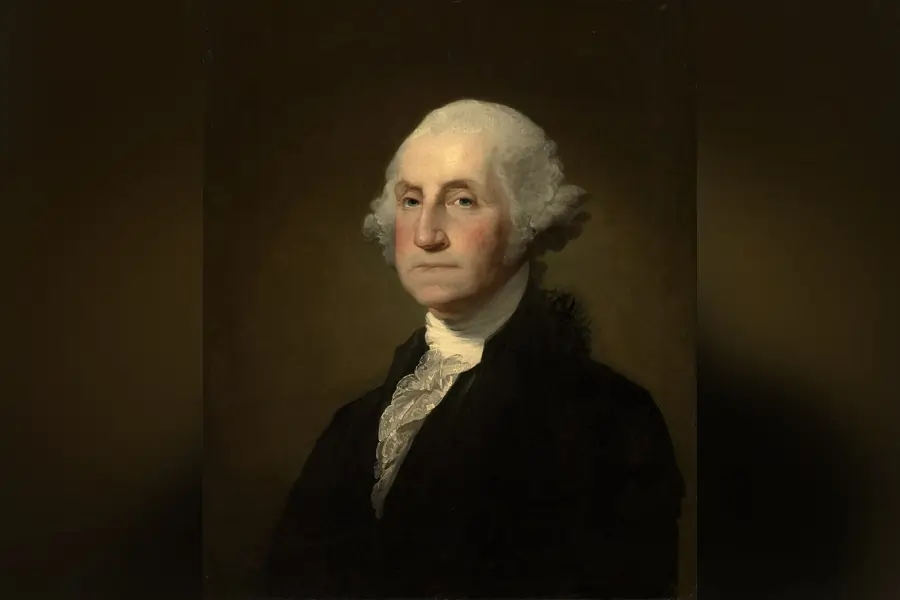
Among these leaders, George Washington became the figure most frequently compared to Cincinnatus. During the American Revolutionary War, Washington served as commander of the Continental Army against Great Britain. After years of conflict, the American colonies achieved independence, leaving Washington in control of a victorious army and making him one of the most influential figures in the new nation.
History provided many examples of successful generals who used military victories to seize political power. Ancient commanders often gained authority through battlefield success, and some of the most famous military leaders in history transformed victories into personal rule. The relationship between military achievement and political power can be seen in many of the greatest generals in world history.
However, Washington chose a different path. In 1783, after the Treaty of Paris ended the Revolutionary War, he resigned his military commission and returned to private life at Mount Vernon rather than using his popularity and army to dominate the new government. This decision immediately reminded many observers of Cincinnatus returning to his farm after saving Rome. Like the Roman dictator, Washington demonstrated that military authority should serve the state rather than become a tool for personal ambition.
The comparison became even stronger when Washington later stepped away from political power again. After serving two terms as the first president of the United States, he voluntarily retired instead of remaining in office indefinitely. The connection between Washington and Cincinnatus was celebrated through the creation of the Society of the Cincinnati in 1783, an organization founded by officers of the Continental Army. The society deliberately chose its name to honor the Roman leader who symbolized public service and the peaceful surrender of power.
Legacy of Cincinnatus: A Legendary Symbol of Civic Virtue and Selfless Leadership
The legacy of Cincinnatus survived for centuries because his story represented one of the most important ideals of republican government - civic virtue. Civic virtue means that citizens and leaders have responsibilities beyond their own personal interests and should act for the benefit of the wider community. To the Romans, Cincinnatus represented several qualities they believed were necessary for the survival of the Republic: discipline, humility, loyalty, and respect for limits on power.
His actions became especially meaningful because Roman history repeatedly showed the danger of unchecked ambition. During the later Republic, competition between powerful generals and politicians created decades of instability. Military victories, political rivalries, and personal ambition eventually contributed to the collapse of the Republican system.
The story of Cincinnatus also reflects the unique relationship between Roman society and military service. Rome's greatest strength was not only its weapons or tactics but also the cultural values that encouraged discipline and sacrifice. Modern historians approach the Cincinnatus story carefully. Writers such as Livy recorded events centuries after they occurred, and Roman historians often used earlier figures as moral examples. Because of this, some details of Cincinnatus' life may represent Roman ideals as much as historical fact.
However, the influence of the story itself is undeniable. Whether every event happened exactly as described or was enhanced through tradition, Cincinnatus became a model for how societies imagine responsible leadership. His example continues to appear in discussions about political ethics, military leadership, and constitutional government. The central message remains powerful: authority should be accepted as a duty, exercised responsibly, and surrendered when the task is complete.
Why Cincinnatus Remains Important Today
The story of Cincinnatus has lasted for more than two thousand years because it addresses a timeless question: what should powerful people do when they no longer need to hold power? Many historical figures are remembered for the territories they conquered, the battles they won, or the empires they created. Cincinnatus is remembered for something very different - walking away.
His military victory over the Aequi was important for early Rome, but it was his resignation that made him legendary. By returning to ordinary life after holding supreme authority, he created an example that influenced later ideas about republican government and responsible leadership.
From ancient Rome to the founding of the United States, Cincinnatus became a reminder that true greatness is not always measured by how much power someone gains. Sometimes history remembers those who have the strength to give power away.
References
- Livy - History of Rome, Book 3. Primary ancient source describing the dictatorship of Cincinnatus and the crisis against the Aequi.
- Dionysius of Halicarnassus. Roman Antiquities. Ancient account of early Roman history and Republican political traditions.
- Cornell, T. J. The Beginnings of Rome: Italy and Rome from the Bronze Age to the Punic Wars. Routledge, 1995.
- Forsythe, Gary. A Critical History of Early Rome: From Prehistory to the First Punic War. University of California Press, 2005.
- Flower, Harriet I. Roman Republics. Princeton University Press, 2010.
- Ellis, Joseph J. His Excellency: George Washington. Alfred A. Knopf, 2004.
Recommended Books
This article may contain affiliate links. If you purchase through these links, I may earn a small commission at no extra cost to you.


Related Articles
Frequently Asked Questions
Why did Cincinnatus give up power after becoming dictator of Rome?
Cincinnatus gave up power because he believed the role of dictator was a temporary responsibility rather than a personal reward. After defeating the Aequi and rescuing the trapped Roman army in 458 BC, he resigned after only sixteen days even though he could legally hold the position for up to six months. His decision became a famous example of Roman civic virtue and selfless leadership.
How long did Cincinnatus serve as dictator of Rome?
According to Roman tradition, Cincinnatus served as dictator for only sixteen days during his first dictatorship in 458 BC. Roman dictators were allowed to hold emergency powers for up to six months, but Cincinnatus resigned immediately after completing his mission and returned to his farm.
Why was Cincinnatus working on a farm when Rome chose him as dictator?
Ancient Roman accounts state that Cincinnatus was living a simple farming life after leaving politics when messengers arrived to appoint him dictator. The image of Cincinnatus leaving his plow to save Rome became a powerful symbol of humility, duty, and the idea that leaders should serve their country rather than seek power.
Did Cincinnatus really become dictator of Rome twice?
Roman sources claim that Cincinnatus became dictator twice, first during the military crisis against the Aequi in 458 BC and again during the political crisis involving Spurius Maelius in 439 BC. However, some modern historians debate details of the second dictatorship because early Roman stories were often shaped by later moral and political traditions.
How was George Washington inspired by Cincinnatus?
George Washington was compared to Cincinnatus because both men voluntarily gave up powerful positions after completing their duties. Washington resigned command of the Continental Army after the American Revolution instead of using his military influence to gain permanent power, reminding many people of Cincinnatus returning to his farm after saving Rome.
Why is Cincinnatus considered an example of civic virtue?
Cincinnatus is considered an example of civic virtue because he placed the needs of Rome above personal ambition. His willingness to accept emergency power during a crisis and surrender it once the danger ended became a lasting symbol of responsible leadership and service to the public good.
Add Comment