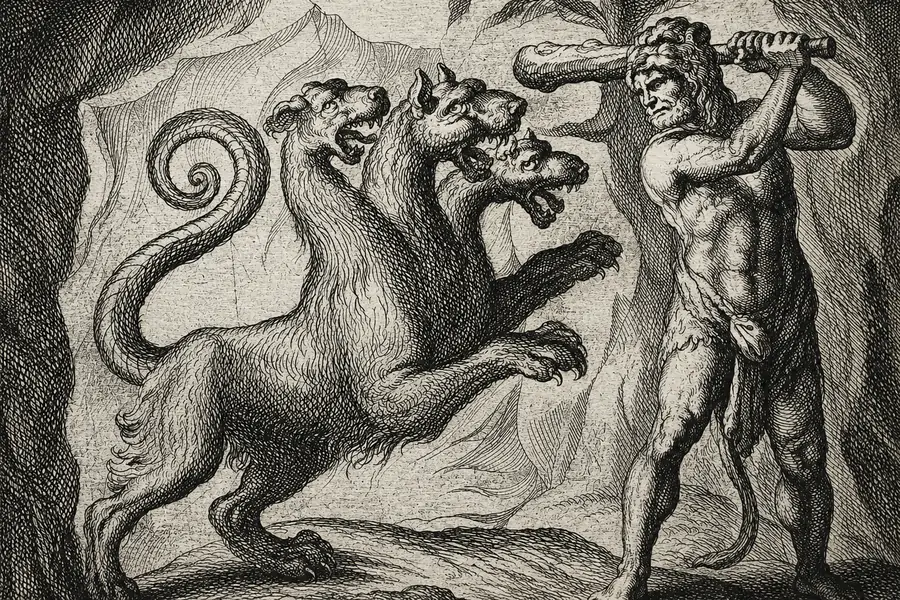
Cerberus, the three-headed dog of Hades, is one of the most well-known mythical creatures in Greek mythology. The fearsome guardian of the Greek Underworld stands watch at the gates of Hades. Cerberus represented far more than a terrifying monster. To the ancient Greeks, he symbolized the boundary between life and death, ensuring that the dead remained in the Underworld while preventing the living from entering without divine permission.
Unlike many mythical beasts that appear in only a single legend, Cerberus plays an important role across numerous ancient literary works, including Hesiod's Theogony, Apollodorus' Bibliotheca, Virgil's Aeneid, Ovid's Metamorphoses, and Seneca's tragedies. His most famous appearance comes during the Twelfth Labor of Hercules, when the Greek hero was ordered to capture the beast without using weapons. This encounter became one of the defining stories of Greek mythology and cemented Cerberus as the legendary guardian of the realm of the dead. Over the centuries, artists and writers portrayed Cerberus in different ways. Some described him as having three heads; others gave him fifty or even one hundred. He was depicted with a serpent for a tail, snakes growing from his back, and a monstrous roar capable of terrifying gods and mortals alike. These changing depictions reflected the evolving traditions of Greek mythology rather than contradictions in the stories.
If you're interested in other legendary creatures from ancient myths, explore our guide to the most dangerous mythological creatures and monsters.
Table of Contents
- Who Was Cerberus?
- The Origin of Cerberus
- Who Were Cerberus' Parents?
- Meaning of the Name Cerberus
- What Did Cerberus Look Like?
- Why Did Cerberus Have Three Heads?
- Different Ancient Depictions of Cerberus
- Cerberus' Powers and Abilities
- Cerberus' Siblings
- Famous Encounters with Cerberus
- What Did Cerberus Symbolize?
- Legacy of Cerberus
- Frequently Asked Questions
- References
Who Was Cerberus?
Cerberus was the monstrous watchdog of the Underworld in Greek mythology. His duty was simple but vital: guard the entrance to the kingdom of Hades so that the souls of the dead could never escape and unauthorized mortals could never enter. Ancient writers consistently portrayed Cerberus as absolutely loyal to Hades and Persephone, acting not out of malice but as the faithful protector of divine law.
Unlike many monsters that actively hunted humans, Cerberus rarely left the Underworld. He remained stationed near the entrance to the realm of the dead, where he greeted arriving souls but attacked anyone attempting to flee. This role made him one of the most important symbols of the irreversible nature of death in Greek religion. Although modern popular culture almost always depicts Cerberus with three heads, ancient Greek mythology presents a much more varied picture. Different poets, playwrights, and artists described him in different ways, reflecting centuries of evolving oral tradition.
The Origin of Cerberus
The earliest surviving account of Cerberus appears in Hesiod's Theogony, written around the eighth or seventh century BC. In this foundational work of Greek mythology, Hesiod describes Cerberus as one of the many terrifying offspring born to the monsters Typhon and Echidna (Theogony, lines 310-312).
Unlike ordinary animals, Cerberus belonged to a divine bloodline of primordial monsters created during the chaotic age before the Olympian gods fully established their rule. Many of these creatures represented dangerous natural forces that challenged cosmic order before eventually being defeated or contained by Zeus and the Olympians.
Rather than wandering freely like many of his siblings, Cerberus was assigned a permanent purpose. Hades, ruler of the Underworld, made him guardian of the entrance to his kingdom. In this role, Cerberus became less a destructive monster and more a divine servant enforcing the natural separation between the living and the dead.
This distinction is important because Greek mythology often portrays monsters as embodiments of chaos. Cerberus, however, helped preserve order. By preventing the dead from escaping and the living from entering recklessly, he maintained one of the fundamental boundaries of the Greek cosmos. Later mythographers, including Apollodorus in the Bibliotheca (2.5.12), continued this tradition, identifying Cerberus as the faithful hound of Hades and describing him as one of the greatest obstacles faced by heroes who ventured into the Underworld.
Who Were Cerberus' Parents?
Cerberus' terrifying appearance becomes easier to understand once his parentage is known. His father was Typhon, considered the deadliest monster in Greek mythology, while his mother was Echidna, often called the "Mother of Monsters."
Typhon
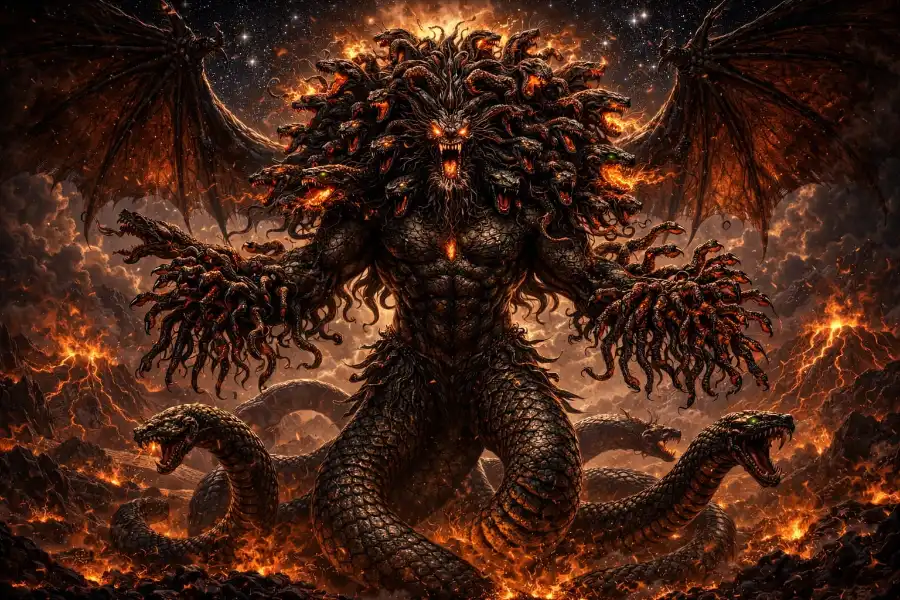
According to Hesiod, Typhon was an enormous serpentine giant whose strength rivaled that of the Olympian gods. Born from Gaia and Tartarus after the defeat of the Titans, Typhon launched one final rebellion against Zeus. Ancient descriptions portray him with countless dragon heads, fiery eyes, immense wings, and a voice capable of producing every sound imaginable-from roaring lions to barking dogs and hissing serpents.
Zeus ultimately defeated Typhon using his thunderbolts and imprisoned him beneath Mount Etna, where later Greeks believed his struggles caused volcanic eruptions. Hesiod's account established Typhon as the ancestor of many of Greek mythology's greatest monsters.
Echidna
Echidna possessed the upper body of a beautiful woman and the lower body of a massive serpent. Unlike many monsters that were eventually slain, Hesiod notes that Echidna lived deep within the earth, immortal and ageless.
Her unique role in mythology was being the mother of all monsters. Rather than terrorizing heroes herself, she gave birth to creatures that would become legendary adversaries throughout Greek myth. The union of Typhon and Echidna represented the joining of two of the most chaotic beings in existence, producing an extraordinary generation of monsters whose stories became central to Greek heroic tradition.
Meaning of the Name Cerberus
The exact meaning of the name Cerberus remains uncertain and has been debated by scholars for centuries. The Greek form, Kerberos (Κέρβερος), appears consistently across ancient literature, but its linguistic origin is unclear.
One theory proposes that the name may derive from an ancient Indo-European word associated with spotted dogs, connecting Cerberus to guard dogs commonly kept throughout the ancient world. Another suggests the name simply evolved from an older mythological tradition that predated classical Greek civilization. Although no definitive explanation exists, ancient audiences would have immediately recognized the name as referring to the terrifying guardian of Hades rather than an ordinary animal.
What Did Cerberus Look Like?
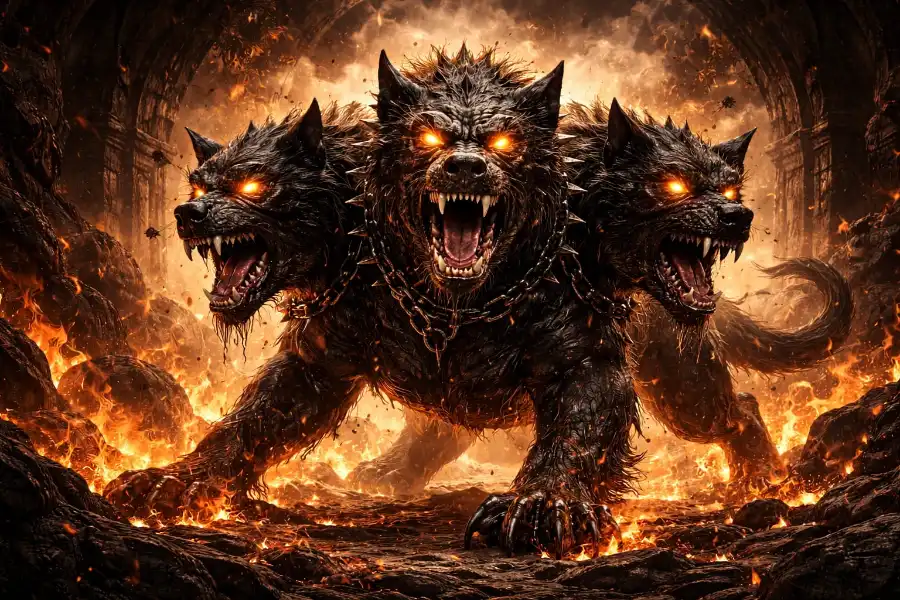
Cerberus is traditionally imagined as an enormous dog with three heads, but ancient descriptions reveal a creature that was considerably more monstrous than modern artwork often suggests. Apollodorus describes Cerberus as possessing three dog heads, the tail of a dragon, and numerous snake heads growing along his back (Bibliotheca, 2.5.12). This depiction became one of the most influential descriptions in later Greek and Roman art.
His three heads allowed him to watch multiple directions simultaneously, making it nearly impossible for anyone to approach unnoticed. The serpent tail reinforced his connection to his monstrous parents, while the writhing snakes covering his body emphasized his supernatural origins. Ancient vase paintings frequently portray Cerberus as a muscular hound larger than any natural dog, often shown standing beside Hades or confronting Hercules during the hero's final labor. Despite artistic differences, several characteristics remain remarkably consistent:
- Multiple canine heads
- An enormous muscular body
- A serpent or dragon-like tail
- Snakes emerging from the neck, shoulders, or back
- Powerful jaws capable of crushing intruders
- A fierce, unwavering expression reflecting his role as guardian
Rather than emphasizing speed, artists usually portrayed Cerberus as an immovable obstacle-a living barrier between two worlds.
Why Did Cerberus Have Three Heads?
Ancient Greek writers never provided a single definitive explanation for Cerberus' three heads, leaving later scholars to propose several interpretations. The most practical explanation is that multiple heads allowed Cerberus to watch every direction at once, making escape from the Underworld impossible.
Others interpret the three heads symbolically. They have been associated with the past, present, and future, or with birth, life, and death. Although these interpretations come largely from later philosophical traditions rather than early Greek mythology, they reflect Cerberus' enduring role as the guardian of one of the most important boundaries in the Greek cosmos.
Different Ancient Depictions of Cerberus
One of the most fascinating aspects of Cerberus is that ancient authors did not always agree on his appearance. These differences illustrate how Greek mythology evolved across centuries through oral storytelling before eventually being written down.
Hesiod's Fifty-Headed Cerberus
The earliest literary description appears in Hesiod's Theogony, where Cerberus astonishingly possesses fifty heads. Although this number sounds extraordinary, Greek poets often used exaggerated figures to emphasize supernatural power rather than provide literal descriptions. Hesiod also describes Cerberus as shameless, immensely powerful, and possessing a terrifying bark that echoed throughout the Underworld.
The Three-Headed Tradition
By the Classical period, the three-headed version had become the dominant representation. This simpler depiction appeared more frequently in sculpture, painted pottery, mosaics, and dramatic literature. Apollodorus, Virgil, Ovid, and numerous later writers all followed this tradition, helping establish the familiar image recognized today.
One Hundred Heads in Later Poetry
Some later Roman authors, particularly Horace, dramatically increased Cerberus' size by referring to him as possessing one hundred heads. Like Hesiod's earlier description, this was likely intended as poetic exaggeration emphasizing his terrifying nature rather than an attempt to standardize mythology.
These differing accounts demonstrate that Greek myths were never entirely fixed. Instead, poets adapted familiar stories for new audiences while preserving Cerberus' essential role as the eternal guardian of the Underworld.
Cerberus' Powers and Abilities
Cerberus' greatest strength was not merely his physical power but his absolute reliability as the guardian of the Underworld. Unlike dragons or sea monsters driven by instinct or hunger, Cerberus never abandoned his assigned duty. Ancient sources attribute several extraordinary abilities to him:
- Immense physical strength capable of overpowering even legendary heroes.
- Multiple heads that allowed constant vigilance from every direction.
- Supernatural endurance, enabling him to guard the gates of Hades eternally.
- A terrifying bark that inspired fear among mortals and spirits alike.
- Venomous serpents growing from his body, adding another layer of protection.
Despite these formidable powers, Cerberus was not invincible. Exceptional figures aided by divine favor, most famously Hercules, could overcome him, and even then they did so only temporarily. In the next section, we'll explore Cerberus' equally infamous siblings, the lesser-known two-headed guardians that resemble him, and the legendary encounters that made him one of the most enduring figures in Greek mythology.
Cerberus' Siblings: The Monstrous Family of Typhon and Echidna
Cerberus was only one member of what ancient writers considered the most terrifying family in Greek mythology. According to Hesiod's Theogony (lines 270-336), his parents, Typhon and Echidna, produced a succession of monsters that challenged gods and heroes alike. Nearly every famous Greek hero eventually encountered one of Cerberus' siblings. Although ancient sources differ slightly on the exact genealogy, the following creatures are consistently identified as Cerberus' brothers and sisters.
Orthrus
Orthrus (also called Orthos) was Cerberus' two-headed brother and the watchdog of the giant Geryon. Like Cerberus, Orthrus guarded something of immense importance, protecting Geryon's legendary red cattle on the island of Erytheia. During the Tenth Labor of Hercules, the hero killed Orthrus before defeating Geryon and driving the cattle back to Greece (Apollodorus, Bibliotheca, 2.5.10).
Orthrus also fathered several famous monsters. Ancient traditions identify him as the father of the Sphinx and, in some accounts, the Nemean Lion, further extending Typhon's monstrous bloodline.
The Lernaean Hydra
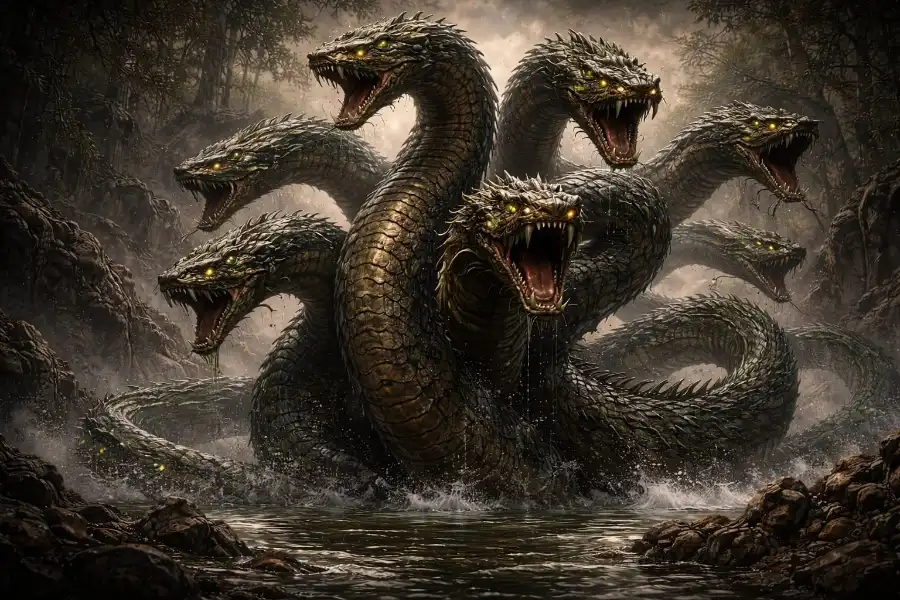
The Hydra was the many-headed serpent that terrorized the region around Lake Lerna. Every time one of its heads was severed, two more grew in its place, making it nearly impossible to defeat. Hercules finally overcame the Hydra during his Second Labor by cauterizing each neck after removing a head, preventing regeneration (Apollodorus, Bibliotheca, 2.5.2).
The Hydra and Cerberus share several similarities. Both possessed multiple heads, both served as nearly insurmountable obstacles, and both eventually faced Hercules.
The Chimera
The Chimera combined the features of several animals into one terrifying creature. It possessed the body and head of a lion, a goat emerging from its back, and a serpent forming its tail. Ancient authors also describe it as breathing fire. The hero Bellerophon, riding the winged horse Pegasus, defeated the Chimera by attacking from the air, avoiding its deadly flames (Homer, Iliad, Book 6).
The Nemean Lion
Some ancient traditions identify the Nemean Lion as another offspring of Typhon and Echidna, while others attribute different parentage. The lion's hide was completely impervious to ordinary weapons. Hercules strangled the beast during his First Labor before wearing its skin as his most recognizable armor.
The Colchian Dragon
The sleepless dragon that guarded the Golden Fleece in Colchis is also listed among Typhon and Echidna's offspring in some ancient genealogies. Unlike Cerberus, this dragon never slept, making it an ideal guardian until Medea magically lulled it into unconsciousness to aid Jason and the Argonauts.
The Caucasian Eagle
Several later traditions include the giant eagle that eternally consumed Prometheus' liver among the descendants of Typhon and Echidna. Although not universally accepted, this genealogy reflects the tendency of later mythographers to connect many fearsome creatures to the same monstrous family. Together, these siblings demonstrate that Cerberus belonged to a lineage whose members became defining challenges for nearly every great Greek hero.
Famous Encounters with Cerberus
Hercules and the Twelfth Labor
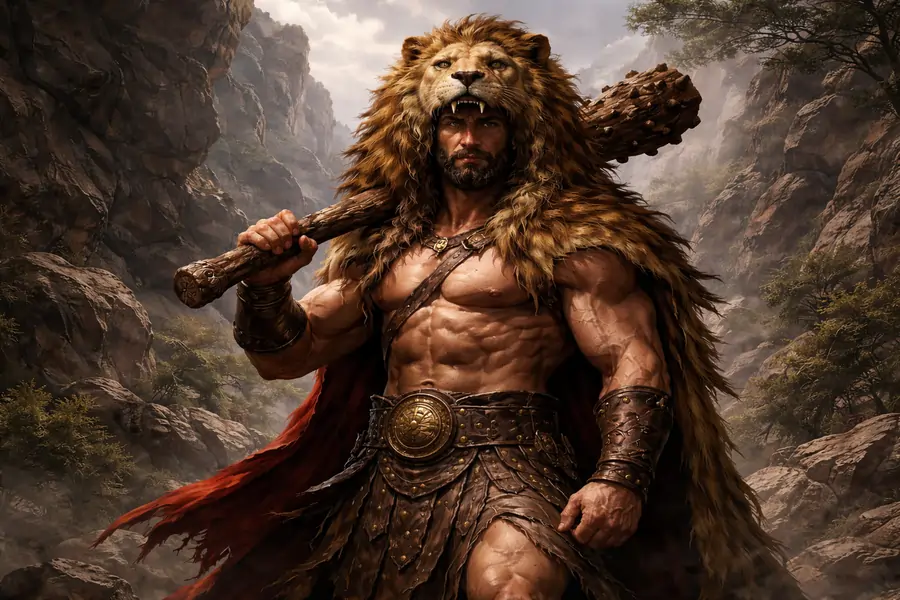
The most famous story involving Cerberus occurs during the final and most difficult of Hercules' Twelve Labors. King Eurystheus believed no mortal could enter the Underworld, subdue its guardian, and return alive. He therefore ordered Hercules to bring Cerberus back from Hades without killing the beast or using weapons.
Before descending into the Underworld, Hercules underwent purification and received initiation into the Eleusinian Mysteries according to several traditions. These sacred rites prepared him for entering the realm of the dead. Once inside, Hercules obtained permission from Hades himself. The God agreed on one condition: Cerberus must be subdued using only physical strength.
Apollodorus recounts that Hercules confronted the monstrous hound armed only with his lion skin for protection. Despite Cerberus' snapping jaws, serpent tail, and immense strength, Hercules wrapped his powerful arms around the beast and gradually forced it into submission (Bibliotheca, 2.5.12).
He then led Cerberus to the surface, astonishing Eurystheus, who reportedly hid inside a large storage jar at the sight of the monster. After proving the labor complete, Hercules respectfully returned Cerberus to Hades, restoring the natural order. This labor differed from Hercules' earlier victories because the objective was not to kill a monster but to demonstrate mastery through courage, endurance, and self-control.
Orpheus Enters the Underworld
The legendary musician Orpheus succeeded where most mortals would have failed, not through violence, but through music. Virgil's Georgics and Ovid's Metamorphoses describe how Orpheus played his divine lyre so beautifully that Cerberus became calm, allowing him to pass peacefully in search of his wife Eurydice. The episode emphasizes that wisdom, beauty, and art could occasionally overcome even the most terrifying monsters.
Aeneas and the Honey Cake
In Virgil's Aeneid (Book 6), the Trojan hero Aeneas journeys into the Underworld accompanied by the Sibyl of Cumae. Rather than confronting Cerberus directly, the Sibyl throws the guardian a honey cake mixed with a powerful sleeping potion. After consuming it, Cerberus falls asleep, allowing the travelers to continue safely. This practical solution became one of the best-known Roman adaptations of the Cerberus myth.
Psyche's Journey to the Underworld
In Apuleius' The Golden Ass, Psyche must descend into the Underworld during one of Aphrodite's impossible tasks. Following careful instructions, she carries two honey cakes. One is offered to Cerberus, allowing her to pass without conflict. The story reinforces Cerberus' role as a guardian who could be appeased through proper ritual rather than mindless violence.
What Did Cerberus Symbolize?
Modern audiences often view Cerberus simply as a monster, but ancient Greeks attached much deeper symbolic meaning to him. Most importantly, Cerberus represented the boundary between life and death. Once a soul entered Hades, there could be no easy return. His presence reinforced the permanence of mortality and the divine order established by the gods.
Scholars have also interpreted Cerberus as symbolizing:
- The inevitability of death.
- The protection of sacred boundaries.
- Loyalty and unwavering duty.
- The dangers of attempting to overcome natural laws.
- The triumph of courage and wisdom over fear.
- The transition between the mortal and divine worlds.
His multiple heads may also symbolize constant vigilance, ensuring that nothing escaped his attention.
The Legacy of Cerberus
Few creatures from Greek mythology have enjoyed the lasting influence of Cerberus. His image appears in medieval manuscripts, Renaissance paintings, Dante's Inferno, modern novels, films, role-playing games, and video games.
Unlike monsters such as Medusa, whose stories emphasize tragedy and transformation, Cerberus remained remarkably consistent throughout history. He was never evil for its own sake; instead, he faithfully carried out the responsibility assigned to him by Hades.
His influence also extends beyond Greek mythology. The image of a supernatural guardian dog appears in numerous cultures, suggesting that Cerberus reflects a widespread human belief that the boundary between life and death should be carefully protected.
References
- Hesiod - Theogony, lines 270-336.
- Apollodorus - Bibliotheca (The Library), Book 2.5.
- Homer - Iliad, Book 6.
- Virgil - Aeneid, Book 6.
- Ovid - Metamorphoses, Book 10.
- Apuleius. The Golden Ass, Book 6.
- Pausanias - Description of Greece
- Oxford Classical Dictionary. 4th Edition. Oxford University Press.
- Grimal, Pierre. The Dictionary of Classical Mythology. Wiley-Blackwell.
- Morford, M., Lenardon, R., & Sham, M. Classical Mythology. Oxford University Press.
Books and Memorables
This article may contain affiliate links. If you purchase through these links, I may earn a small commission at no extra cost to you.


Related Articles

Frequently Asked Questions
Why did Hades choose Cerberus to guard the Underworld?
In Greek mythology, Cerberus was chosen because he was an immensely powerful and loyal offspring of Typhon and Echidna. His role was to prevent the souls of the dead from escaping the Underworld while stopping unauthorized living mortals from entering, preserving the natural order between life and death.
What ancient Greek books mention Cerberus?
Cerberus appears in several important ancient works, including Hesiod's Theogony, Apollodorus' Bibliotheca, Virgil's Aeneid, Ovid's Metamorphoses, and Apuleius' The Golden Ass. These sources describe his origin, appearance, and famous encounters with heroes such as Hercules, Orpheus, and Aeneas.
Why is Cerberus sometimes shown with fifty or one hundred heads?
The earliest surviving description by Hesiod gives Cerberus fifty heads, while some later Roman poets mention one hundred. Over time, Greek and Roman artists simplified the creature into the familiar three-headed guardian, which became the standard depiction in art and popular culture.
Did anyone besides Hercules defeat or outsmart Cerberus?
Yes. Although Hercules physically subdued Cerberus during his Twelfth Labor, other mythological figures passed the guardian without fighting. Orpheus calmed him with the music of his lyre, while Aeneas and Psyche safely entered the Underworld after Cerberus was distracted with specially prepared honey cakes.
How was Cerberus different from other monsters in Greek mythology?
Unlike creatures such as Medusa, the Hydra, or the Chimera, Cerberus was not portrayed as an evil monster attacking innocent people. Instead, he faithfully served Hades as the guardian of the Underworld, carrying out an important divine duty by maintaining the boundary between the living and the dead.
Who were Cerberus' brothers and sisters in Greek mythology?
According to ancient Greek mythology, Cerberus' siblings included several famous monsters born to Typhon and Echidna, such as Orthrus, the Lernaean Hydra, the Chimera, and in many traditions, the Nemean Lion and the Colchian Dragon. Many of these creatures later became legendary opponents of Greek heroes.
Add Comment