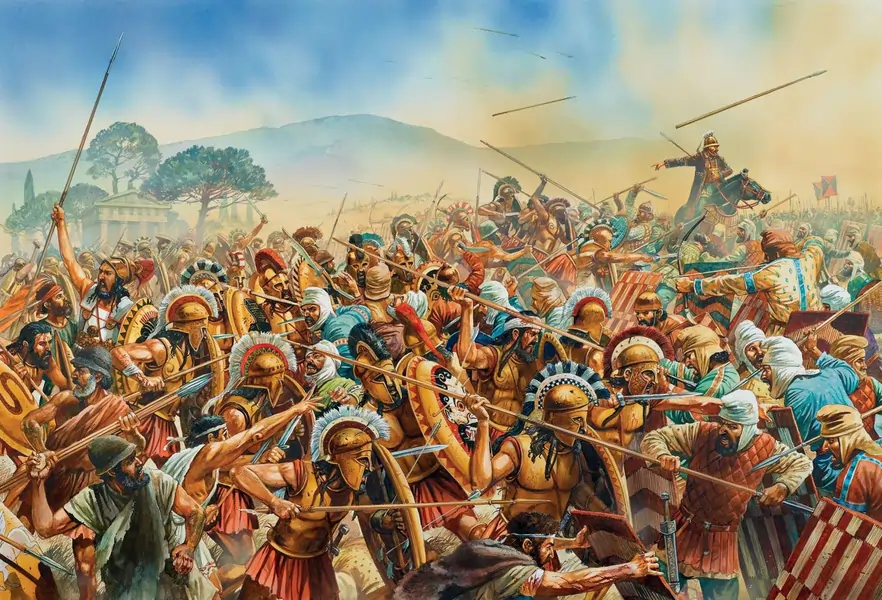
The Battle of Plataea, fought in 479 BCE, was one of the most decisive battles in ancient history. After four years of careful planning, the Persian King Xerxes I launched a massive invasion of the Greek city-states. The victory at Platea finally ended Persia's attempt to conquer mainland Greece. While the heroic stand at Thermopylae and the naval triumph at Salamis are more widely known, Plataea was the battle that destroyed the main Persian field army and shifted the balance of power, putting a decisive end to the Persian invasion. Plataea and the near-contemporary Greek victory at Mycale marked the end of the Persian offensive against mainland Greece, the beginning of the Delian League, and Greek civilization entered its Golden Age.
Table of Contents
- Background: The Persian Invasion of Greece
- Lead-Up to the Battle of Plataea
- The Commanders and Opposing Armies
- Why the Greeks Refused Battle
- The Eleven-Day Stalemate
- The Greek Withdrawal and Start of the Battle
- The Battle of Plataea Step by Step
- The Death of Mardonius and Collapse of the Persian Army
- Why Did the Greeks Win the Battle of Plataea?
- Casualties and Immediate Aftermath
- Plataea and the Battle of Mycale
- The Rise of the Delian League
- Why the Battle of Plataea Was Important
- References and Further Reading
Background: The Persian Invasion of Greece
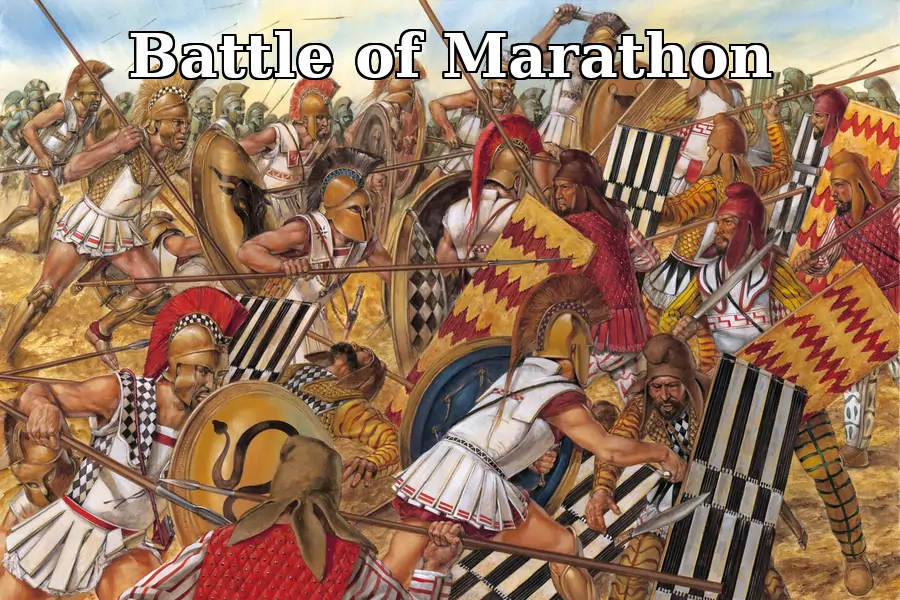
The Battle of Plataea was the culmination of the Greco-Persian Wars. The conflict began when the Persian King Darius decided to punish Athens and the Greek city-states for supporting the Ionian revolt. Persia also sought to extend its influence westward by subjugating the Greek world. Athens defeated the first major Persian invasion at the Battle of Marathon in 490 BCE. The victory at Marathon asserted Athenian dominance and proved that the Persian armies were not invincible.
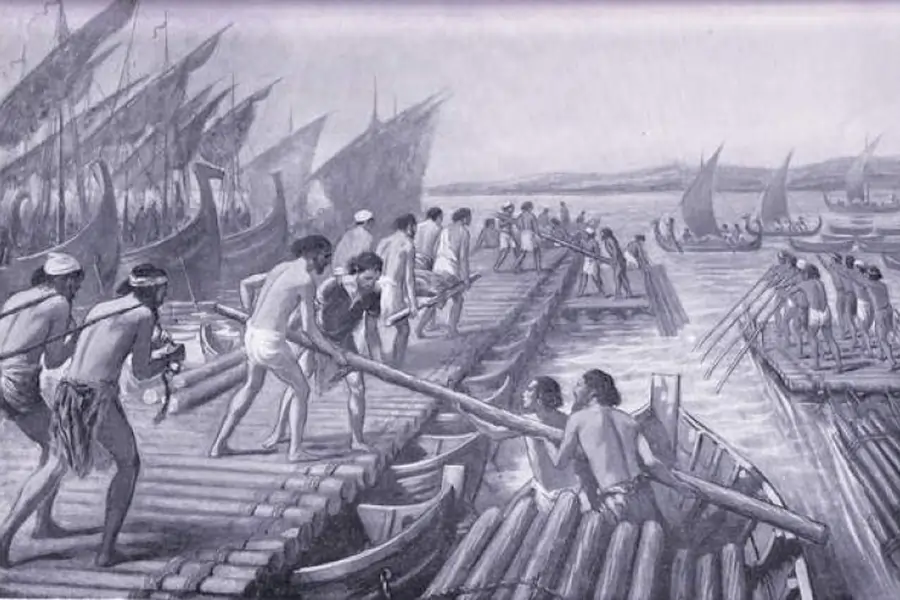
Ten years later, King Xerxes I launched a much larger invasion. The invasion is famous for two incredible feats of engineering:
- The Hellespont Bridges: 100,000 Persian soldiers walked across the Hellespont (now the Dardanelles, Turkey) from Asia into Europe using massive floating pontoon bridges built by lashing together hundreds of ships.
- The Mount Athos Canal: Xerxes ordered the construction of a two-kilometer-long canal dug directly through the base of Mount Athos for his warships. This was done to avoid a treacherous peninsula where a previous Persian fleet had been shipwrecked.
The Persian army advanced through Greece. The famous Spartan-led defense at Thermopylae delayed the Persians but ultimately failed. An empty Athens was set ablaze by the Persians. The turning point came later in 480 BCE at the Battle of Salamis. There, the Greek fleet destroyed much of the Persian navy, forcing Xerxes to return to Asia with a significant portion of his forces. However, Xerxes left behind a large army under his trusted general Mardonius to complete the conquest of Greece. The campaign of 479 BCE would determine the fate of all of Greece.
Lead-Up to the Battle of Plataea
Herodotus records that Mardonius believed diplomacy might achieve what military force had failed to accomplish and attempted to persuade Athens to abandon the Greek alliance (Herodotus, Histories 8.140-144). Athens was offered generous terms, including autonomy and territorial expansion, if it abandoned its alliance with Sparta. Modern historian Peter Green notes that Persian strategy increasingly relied on exploiting divisions among the Greek city-states rather than achieving a purely military solution (Green, 1996).
According to Herodotus, the Athenians declared that no amount of Persian gold could persuade them to submit (Herodotus, Histories 8.143). Tom Holland argues that this decision represented a turning point in the war because it removed any realistic possibility of dividing the Greek alliance (Holland, 2005). Their refusal forced Sparta and the Peloponnesian states to commit fully to a land campaign against Persia. A large Greek coalition army was assembled under Spartan leadership.
After the Athenians refused Mardonius's offer, the Persians once again occupied Athens in 479 BCE. Although the population of the city was already evacuated, the Persians destroyed what little was left of the city. Realizing that the Greeks were preparing a major offensive, Mardonius withdrew northward into Boeotia. The plains around Plataea offered excellent terrain for Persian cavalry operations and provided easier access to supply routes. The Greeks followed and established positions in the foothills south of the Asopus River near the town of Plataea.
The Commanders and Opposing Armies
The Greek Commanders
The Greek coalition was commanded by the Spartan regent Pausanias, acting on behalf of the young Spartan king Pleistarchus. Other notable commanders included:
- Aristides of Athens
- Ameinias of Plataea
- Various leaders from Corinth, Megara, Tegea, and other allied states
Pausanias faced the challenge of coordinating one of the largest allied armies ever assembled in Greek history. Although strong, there was distrust, differences of opinion, and volatility in this brittle alliance.
The Persian Commanders
The Persian army was led by Mardonius, nephew and son-in-law of Xerxes. Ancient sources portray him as one of Persia's most capable generals. Mardonius had fought during earlier campaigns and understood both Persian strengths and Greek weaknesses. Unlike many Persian commanders, he was willing to take calculated risks.
Size of the Armies
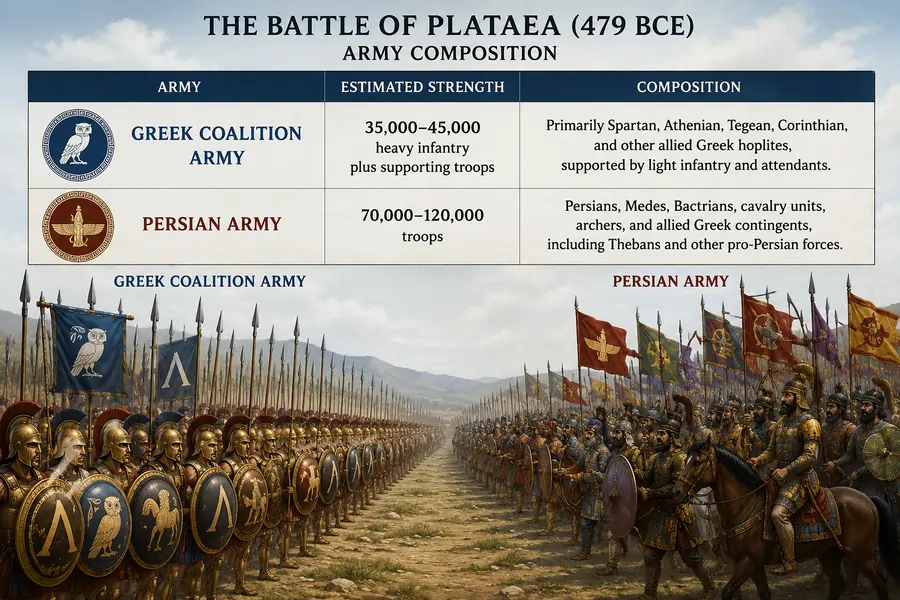
The exact numbers remain debated. Herodotus provides enormous figures, but most modern historians favor lower estimates based on logistical and archaeological evidence (Lazenby, 1993; Cawkwell, 2005). Most modern estimates suggest:
| Army | Estimated Strength | Composition |
|---|---|---|
| Greek Coalition Army | 35,000-45,000 heavy infantry plus supporting troops | Primarily Spartan, Athenian, Tegean, Corinthian, and other allied Greek hoplites, supported by light infantry and attendants. |
| Persian Army | 70,000-120,000 troops | Persians, Medes, Bactrians, cavalry units, archers, and allied Greek contingents, including Thebans and other pro-Persian forces. |
The Greek force consisted largely of hoplites- heavily armored infantry fighting in phalanx formation. These soldiers represented some of the most effective close-combat troops of the ancient world. For those interested in the evolution of disciplined infantry formations, please go through our article on why the Macedonian phalanx was so effective.
Why the Greeks Refused Battle
The terrain around Plataea played a central role in the campaign. Mardonius was aware of his superiority in cavalry and wanted to fight on the open plains north of the foothills. Such ground allowed Persian cavalry to maneuver freely and exploit one of Persia's greatest military advantages.
Pausanias understood the danger posed by the enemy cavalry. They had repeatedly proven effective against less mobile opponents on open ground. Therefore, the Greeks occupied elevated terrain along the slopes of Mount Cithaeron. By remaining on higher ground, the Greeks neutralized much of the Persian cavalry threat. Mardonius would now be forced to attack uphill against heavily armored hoplites. This decision reflected a key principle of ancient warfare: never fight on terrain that maximizes the enemy's strengths.
The Eleven-Day Stalemate
Both armies faced off without attacking for a long period of time during the Battle of Plataea. For approximately eleven days, neither side launched a major attack. Neither side wanted to give up their terrain advantage and attack the enemy under unfavourable conditions. Mardonius repeatedly attempted to provoke the Greeks into descending onto the plain. Persian cavalry conducted raids and harassment operations against Greek positions. According to Herodotus (Histories 9.49-57), the Persian cavalry commander Masistius led particularly aggressive attacks. During one engagement, Masistius was killed, providing a significant morale boost to the Greeks.
Despite this initial success, the Greeks remained cautious and patient. Pausanias knew that a premature advance could lead to certain disaster. As days passed, Mardonius intensified his pressure on Greek supply lines. Persian cavalry controlled much of the surrounding countryside and disrupted routes bringing food and water to the Greek army. This created an increasing logistical problem for the Greeks, who were stuck without reliable supply channels.
The importance of morale, supply, and endurance in ancient warfare is often overlooked. Similar factors shaped many battles discussed in our article on ancient soldiers, morale, and survival rates.
The Greek Withdrawal and Start of the Battle
By the eleventh day, the Greek supply position had become increasingly difficult to manage. The Gargaphia spring, one of their primary water sources, was threatened by Persian cavalry. Food supplies were also becoming unreliable. Remaining indefinitely on the slopes was no longer practical. Pausanias therefore ordered a nighttime withdrawal to more secure positions closer to Plataea.
The maneuver, however, quickly became disorganized. Different contingents moved at different times. Communication problems confused the Greek line. By dawn, many units were separated from one another. At daybreak, Mardonius spotted the disorganised Greeks and interpreted the movement as a retreat and possible collapse of Greek morale. Believing victory was within reach, he ordered an immediate pursuit of the fleeing enemy.
This decision sparked the beginning of the Battle of Plataea, one of the most important battles in history.
The Battle of Plataea Step by Step
Persian Pursuit
Seeking to take advantage of the disorganized Greek units, Mardonius advanced rapidly with elite Persian infantry and supporting forces. Other Persian contingents followed behind. The Persians hoped to catch the Greeks while they were scattered and vulnerable.
Spartan Stand
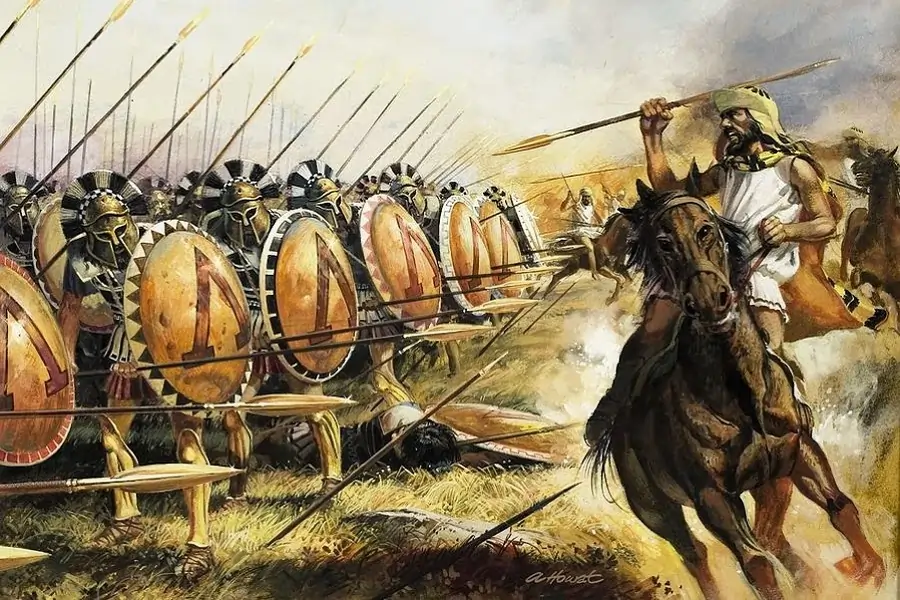
The Spartans and Tegeans became the primary target of the Persian attack. Pausanias reportedly delayed his advance while conducting religious sacrifices, seeking favorable omens before committing to battle. Herodotus records that Spartan troops endured unnecessary sustained missile fire while waiting for the necessary signs.
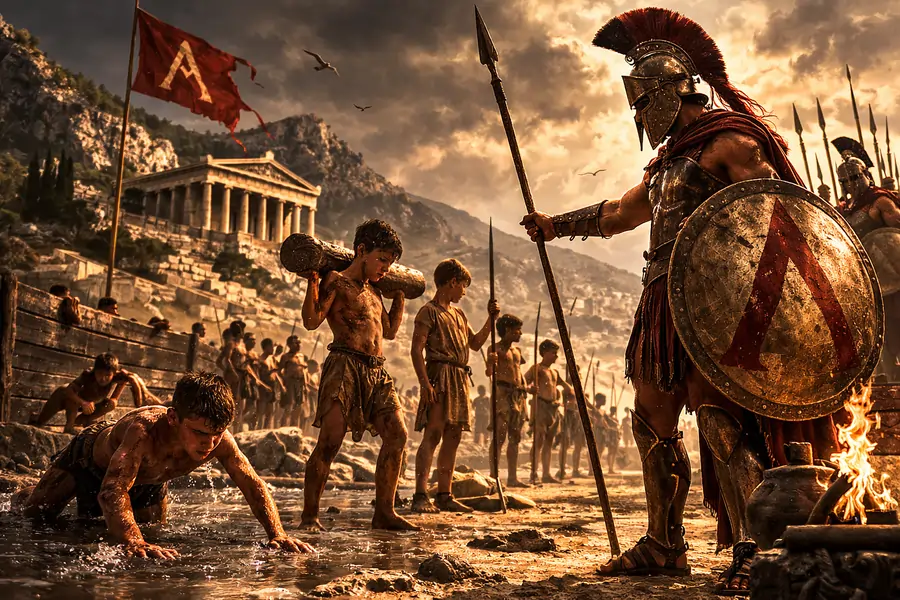
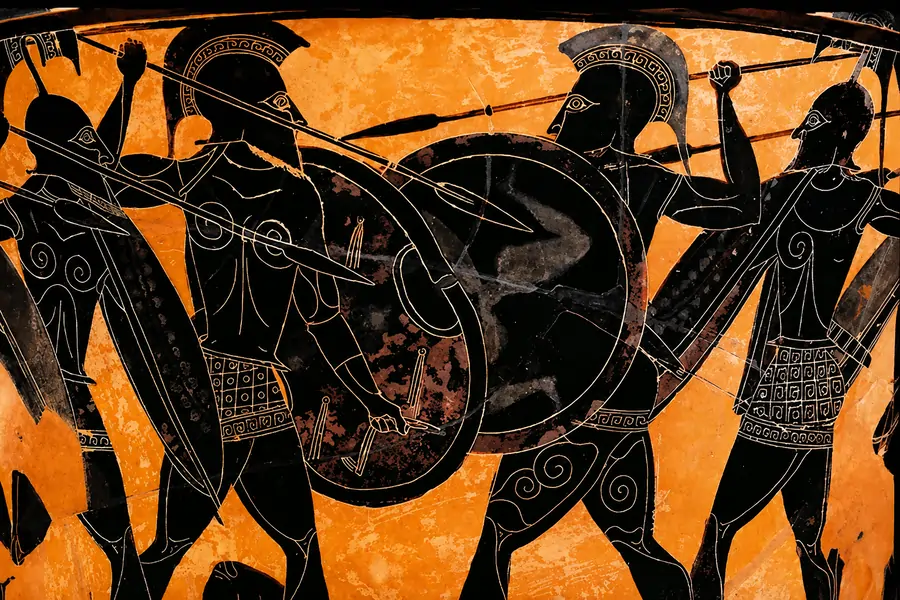
Eventually, favorable omens appeared, and the Spartans advanced. The resulting clash highlighted the differences between the two military systems. The Persian infantry relied heavily on mobility and was lightly armored. They used missile weapons and lighter equipment. The Spartans fought with large shields, heavy bronze armor, helmets, and long spears. Their training, supported by the rigorous Spartan Agoge system, made them exceptionally disciplined under pressure.
The Athenian Front
Elsewhere, Athenians engaged Persian-allied Greek contingents, particularly the Thebans. This separate battle prevented reinforcements from reaching Mardonius and played an important role in the overall Greek victory.
The Death of Mardonius and Collapse of the Persian Army
The turning point came when the Persian commander Mardonius was suddenly killed during the fighting. Plutarch states that a Spartan warrior named Arimnestus hurled a stone that struck Mardonius in the head while Mardonius was riding a white horse near the center of the Persian line. Although modern historians debate the exact circumstances, there is broad agreement that his death triggered the collapse of Persian resistance.
Ancient armies often depended heavily on the presence of their commanders on the battlefield. Once Mardonius fell, Persian morale deteriorated rapidly. The Spartans and Tegeans pressed forward, breaking through Persian defensive positions. The Athenians fought a fierce battle against the Theban phalanx on the left wing. Upon hearing of their commander's death, many Persian troops retreated toward their fortified camp. The Greeks stormed the camp after fierce fighting. Without centralized command, Persian resistance crumbled. What had begun as a pursuit of retreating troops by the Persians turned into a catastrophic defeat.
Why Did the Greeks Win the Battle of Plataea?
The Greek victory at Plataea was the result of several strategic advantages coming together at the critical moment. While the Persian army likely outnumbered the Greeks, the battle ultimately favored the side that better understood its own strengths and weaknesses.
Superior Terrain Selection
Throughout the campaign, Pausanias refused to fight on the open plains where Persian cavalry could dominate. This is reflected by the 11-day stalemate before the battle. By operating near the foothills of Mount Cithaeron, the Greeks ensured that any decisive engagement would be fought in terrain that limited Persian mobility and improved the efficiency of their heavy infantry.
Neutralizing Persian Cavalry
Persian cavalry had been instrumental in disrupting Greek supply lines, but it failed to deliver a decisive battlefield advantage. Once the fighting shifted to broken terrain and close-range combat, Persia's strongest military arm was largely unable to influence the outcome.
Hoplite Superiority in Close Combat
The battle eventually became a close-quarter engagement between infantry. In this environment, heavily armored Greek hoplites held a clear advantage over the lightly armored infantry. The discipline and cohesion of the Greek phalanx proved decisive once the lines collided.
Persian Overconfidence
Mardonius misinterpreted the Greek nighttime withdrawal as a retreat rather than a redeployment. Instead of continuing to pressure the Greek supply situation, he launched an aggressive pursuit to engage the Greeks under unfavorable conditions.
Death of Mardonius
This was the single most important cause of the significant drop in morale for the Persians. The loss of the Persian commander removed the central figure holding the army together. The loss of Mardonius shattered Persian command cohesion and accelerated the collapse of organized resistance.
Greek Coalition Unity
Perhaps the most important factor was the continued cooperation between Sparta, Athens, and their allies. Persian strategy had long relied on dividing the Greek city-states through diplomacy and intimidation. At Plataea, however, the alliance held together after Athens declined the Persian offer. In the end, Plataea was won not by a single charge or tactical maneuver, but by superior strategy, disciplined infantry, effective leadership, and an alliance that remained united when Persia expected it to fracture.
Casualties and Immediate Aftermath
Herodotus claims that only about 3,000 Persian troops escaped while the rest were killed. This puts the Persian casualty count at about 257,000. The Greek casualties, as stated by Herodotus, were only 159 (91 Spartans, 17 Tegeans, and 52 Athenians died). Modern historians generally regard these figures as exaggerated.
Modern estimates vary considerably, but most historians agree that Persian casualties were extremely heavy, likely numbering tens of thousands. Greek losses are estimated to be only about 1,500. Regardless of the exact number of casualties, the battle resulted in the destruction of Persia's field army in Greece. The threat of the Persian invasion of Greece was effectively over.
Plataea and the Battle of Mycale
Ancient tradition held that the Greek victory at Mycale occurred on the same day as Plataea. Although modern historians debate the exact chronology, Peter Green notes that the two victories collectively ended Persia's offensive capabilities in the Aegean and transformed the strategic balance of power (Green, 1996). At the Battle of Mycale on the coast of Asia Minor, the Greeks attacked the Persian naval forces, which had beached all their warships and set up a fortified camp.
The Greeks landed their troops, with the heavily armored Greeks attacking the Persian camp. They achieved another decisive victory, burning the remaining Persian ships and encouraging revolts among Greek cities in Asia Minor. Together, Plataea and Mycale eliminated both the land and naval threats posed by Persia. The dual victories transformed the strategic situation across the eastern Mediterranean.
The Rise of the Delian League
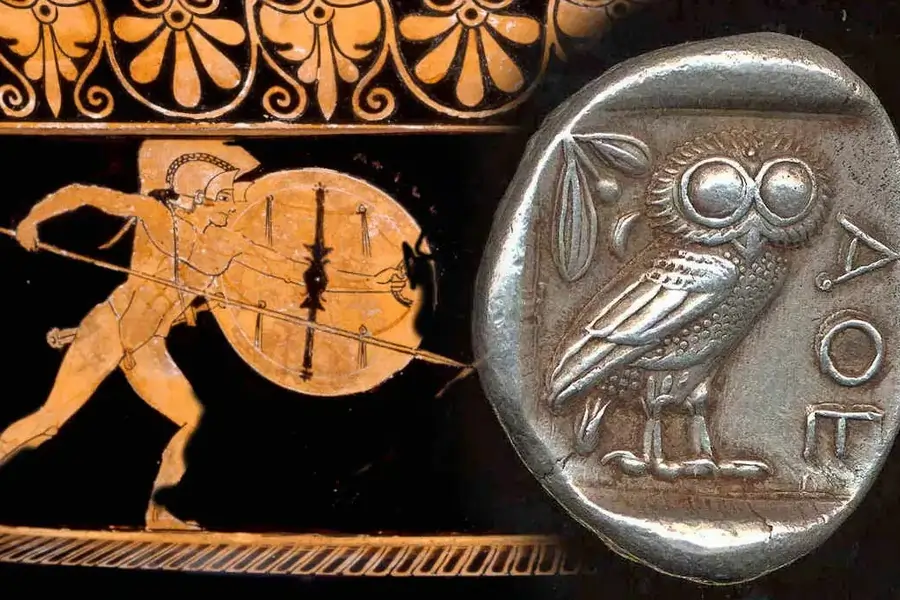
Following Plataea and Mycale, the Greek alliance had neutralized the threat of Persia on Greek soil. But they faced a new question: should the war end, or should Greece carry the fight into Persian territory? Sparta, traditionally focused on the Peloponnese, showed little interest in long overseas campaigns.
Athens, however, saw an opportunity. In 478 BCE, Athens organized the Delian League, a coalition of Greek city-states dedicated to continued operations against Persia. Member states contributed ships, money, or troops. Initially conceived as a defensive alliance against the threat of Persian aggression, the league gradually evolved into an Athenian maritime empire.
The rise of Athens after Plataea would eventually lead to the cultural achievements of the Greek Golden Age. Sparta would form the Peloponnesian League, fearing Athenian dominance, resulting in later conflicts such as the Peloponnesian War. The long-term political consequences of Plataea therefore extended far beyond the battlefield itself.
Why the Battle of Plataea Was Important
The Battle of Plataea deserves recognition as one of the most influential and historically significant battles fought in ancient history.
- First, it permanently ended Persia's attempt to conquer mainland Greece. After the Battle of Plataea, the Persian army was destroyed, eliminating it as a threat.
- Second, it preserved the independence of the Greek city-states, allowing Greek political institutions, philosophy, science, and culture to develop without foreign domination. If the Greeks had failed, the whole of Greece would have been subjugated.
- Third, it marked the beginning of Athenian ascendancy and laid the foundations for the Delian League. The Greek Golden Age was made possible in part by the security created through the victories at Plataea and Mycale.
- Fourth, it demonstrated the effectiveness of disciplined heavy infantry against larger armies. The Persian infantry struggled against heavily armored Greek hoplites in close combat.
- Finally, Plataea helped shape the future of Western civilization. Had the battle ended differently, the political and cultural development of Greece might have taken an entirely different path. Democracy would have been lost in its infancy.
The Battle of Plataea completed the defense of Greece. It was not merely a battlefield victory but a strategic turning point that ended the Persian invasion, safeguarded Greek independence, and opened the path to the rise of Athens and the Delian League. The consequences of the battle would echo throughout the ancient world for centuries.
References and Further Reading
Ancient Sources
- Herodotus, Histories, Book IX.
- Plutarch, Life of Aristides.
- Diodorus Siculus, Bibliotheca Historica
Modern Scholarship
- Holland, Tom. Persian Fire: The First World Empire and the Battle for the West.
- Lazenby, J.F. The Defence of Greece 490-479 BC.
- Green, Peter. The Greco-Persian Wars.
- Cawkwell, George. The Greek Wars.
- Sekunda, Nicholas. Plataea 479 BC: The Most Glorious Victory Ever Seen.
Recommended Books
This article may contain affiliate links. If you purchase through these links, I may earn a small commission at no extra cost to you.
Related Articles

Frequently Asked Questions
Why did the Greeks wait 11 days before fighting at the Battle of Plataea?
The Greeks delayed battle for approximately 11 days because they refused to fight on terrain that favored Persian cavalry. By remaining on the foothills south of the Asopus River, they forced Mardonius to either attack uphill or continue a costly stalemate. This patience allowed the Greeks to avoid one of the Persian army's greatest strengths until circumstances forced a decisive engagement.
How did Persian cavalry affect the Battle of Plataea?
Persian cavalry played an important role before the battle by harassing Greek positions and disrupting supply lines. Their attacks contributed to the Greek decision to withdraw from their original position. However, once the main battle began, the terrain and close-quarters fighting limited the cavalry's effectiveness, preventing it from having a decisive impact on the outcome.
What happened after Mardonius was killed at Plataea?
The death of Mardonius caused a rapid collapse in Persian command and morale. As the senior Persian commander, he was central to coordinating the army's operations. After his death, Persian resistance weakened, many troops retreated toward their fortified camp, and the Greeks were able to turn a hard-fought battle into a decisive victory.
Why was the Battle of Plataea more important than Thermopylae?
While Thermopylae became famous for the heroic Spartan stand, Plataea had a far greater strategic impact. Thermopylae delayed the Persian advance, but Plataea destroyed the main Persian field army in Greece. The victory permanently ended Persia's attempt to conquer mainland Greece and secured Greek independence.
How did the Battle of Plataea lead to the Delian League?
After the victories at Plataea and Mycale in 479 BCE, many Greek city-states wanted to continue the war against Persia and protect Greek communities in the Aegean. Athens took the lead in organizing this effort, resulting in the formation of the Delian League in 478 BCE. The alliance eventually became the foundation of Athenian power during the Classical period.
Did the Battle of Plataea and the Battle of Mycale happen on the same day?
Ancient Greek sources, particularly Herodotus, state that the victories at Plataea and Mycale occurred on the same day. Modern historians debate whether this was literally true, but there is broad agreement that the two battles took place very close together in 479 BCE and collectively ended the Persian offensive against Greece.
Add Comment