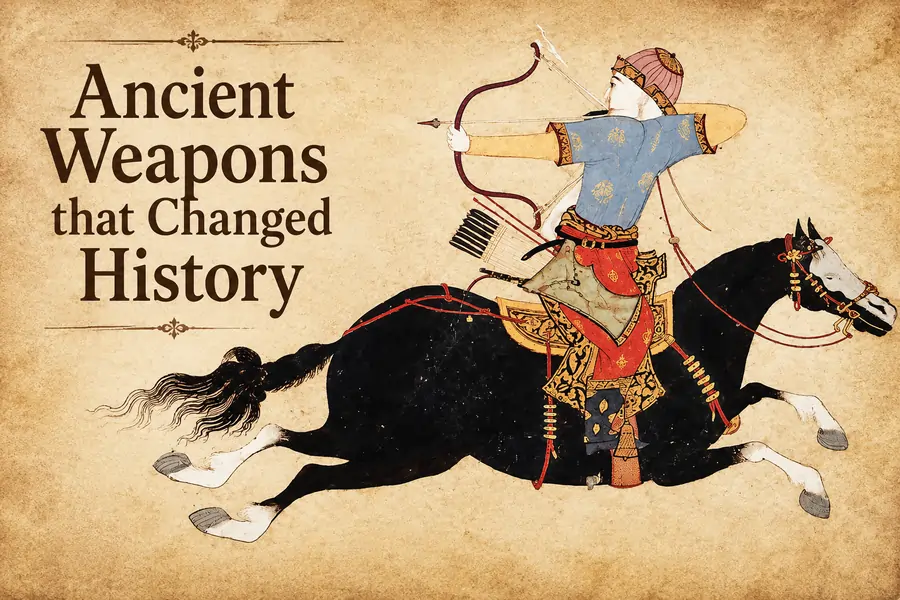
Some weapons were so powerful that they redefined the nature of battles and transformed civilizations. Throughout ancient history, military innovations repeatedly shifted the balance of power between rival kingdoms and empires. A longer spear allowed Macedonian armies to conquer Persia, and a boarding bridge turned inexperienced Roman sailors into victorious marines. At the same time, powerful composite bows enabled mounted archers to dominate vast regions of Eurasia. These innovations influenced tactics, strategy, logistics, and even the rise and fall of some of history's greatest civilizations.
This list focuses on innovations that fundamentally changed the conduct of warfare in the ancient world rather than simply being effective battlefield weapons. Many excellent weapons existed, but these ten reshaped military tactics, strategy, or the balance of power between civilizations. The items in the list are presented in thematic order and not ranked.
| Weapon / Military Innovation | Civilization(s) | Primary Period | Why It Changed History |
|---|---|---|---|
| Sarissa Pike | Macedon | 4th Century BCE | Enabled the Macedonian phalanx, allowing Philip II and Alexander the Great to conquer the Persian Empire and spread Hellenistic culture. |
| Composite Bow | Hittites, Assyrians, Persians, Scythians, Parthians | Bronze Age - Late Antiquity | Combined power and portability made mounted archery highly effective and transformed warfare across Eurasia. |
| Roman Corvus | Roman Republic | First Punic War (264-241 BCE) | Allowed Roman legionaries to board enemy ships, helping Rome overcome Carthage's naval superiority and win the First Punic War. |
| War Elephants | Indian Kingdoms, Seleucid Empire, Carthage, Ptolemaic Egypt | 4th Century BCE - 2nd Century BCE | Introduced powerful shock tactics that disrupted infantry and cavalry formations while forcing opponents to develop new battlefield strategies. |
| Greek Trireme Ram | Greek City-States, Phoenicians | 6th-4th Century BCE | Made maneuverability and ramming the dominant form of naval warfare, playing a decisive role in battles such as Salamis. |
| Crossbow | Ancient China (Warring States, Qin, Han) | 5th Century BCE onward | Enabled powerful, accurate missile fire with minimal training, allowing states to equip large armies with effective ranged weapons. |
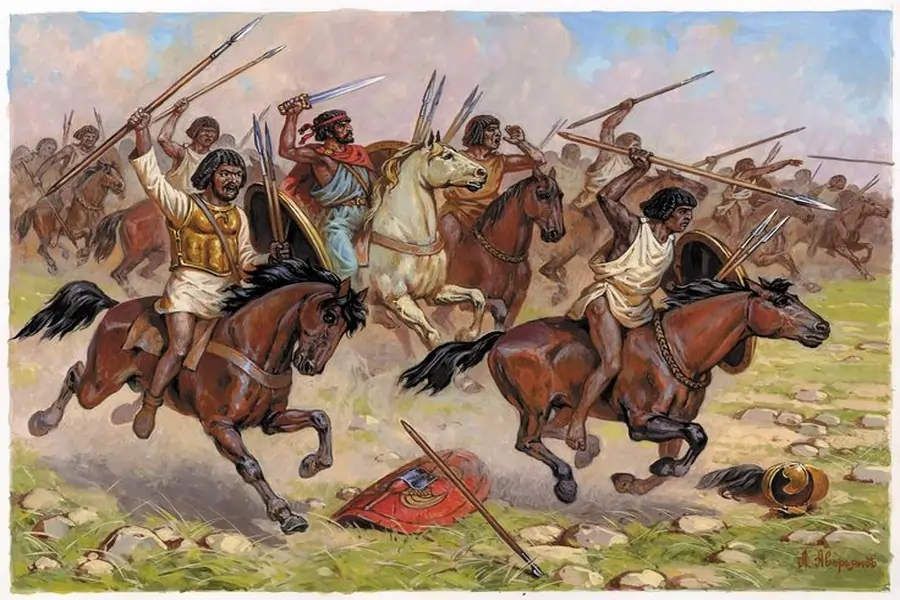
| Heavy Cavalry | Macedon, Parthians, Sarmatians, Romans | 4th Century BCE onward | Developed devastating shock tactics that complemented infantry formations and influenced cavalry warfare for centuries. |
| Catapults & Ballistae | Greeks, Macedonians, Romans | 4th Century BCE onward | Revolutionized siege warfare by allowing armies to breach fortified cities and attack defenders from a safe distance. |
| Iron Weapons | Assyrians, Greeks, Persians, Romans, Celtic Tribes | Iron Age | Made weapons cheaper and more widely available, enabling the rise of large standing armies and powerful territorial empires. |
| Roman Gladius | Roman Republic & Roman Empire | 3rd Century BCE - 3rd Century CE | Became the signature weapon of Roman legionaries, perfectly complementing disciplined infantry tactics that conquered much of Europe and the Mediterranean. |
Table of Contents
- Sarissa Pike
- Composite Bow
- Roman Corvus
- War Elephants
- Greek Trireme Ram
- Crossbow
- Heavy Cavalry
- Catapults & Ballistae
- Iron Weapons
- Roman Gladius
1. Sarissa Pike - The Weapon That Built Alexander's Empire
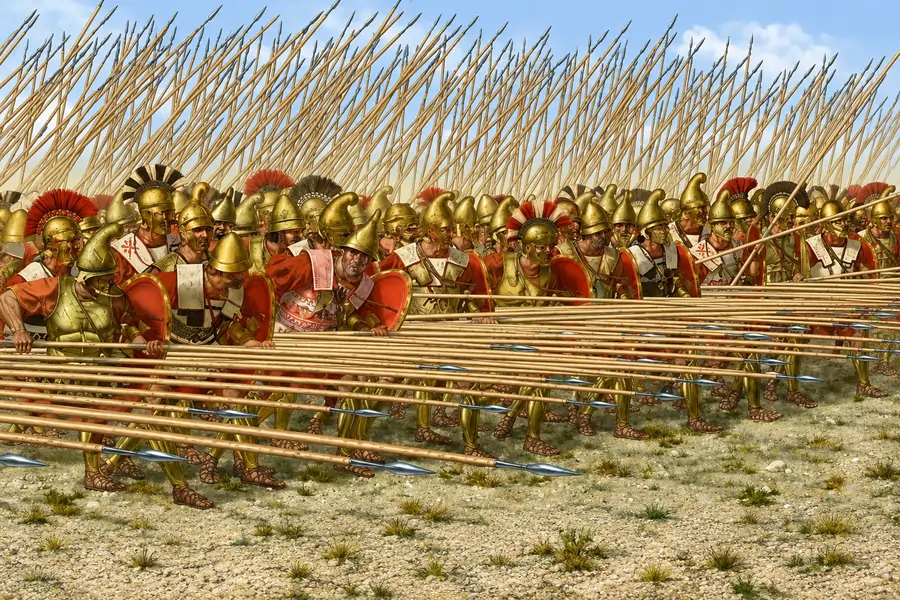
Few military innovations changed ancient warfare as dramatically as the sarissa. Measuring between 5 and 6 meters (16-20 feet), this exceptionally long pike transformed the traditional Greek hoplite phalanx into one of the most formidable fighting formations in history. More than just a longer spear, the sarissa fundamentally altered infantry tactics and enabled Macedonia to conquer much of the known world.
The Birth of the Sarissa
The sarissa was introduced during the reign of Philip II of Macedon in the mid-fourth century BCE. After observing the strengths and weaknesses of contemporary Greek armies, Philip reorganized the Macedonian military into a highly disciplined professional force. His reforms included standardized training, permanent military service, and the introduction of the sarissa as the primary infantry weapon.
Unlike the traditional Greek dory, which measured approximately 2-3 meters, the sarissa nearly doubled its length. Constructed primarily from tough cornel wood, the weapon featured an iron spearhead and a bronze butt spike known as the sauroter, or "lizard killer." The butt spike served multiple purposes, including balancing the weapon, anchoring it in the ground, and acting as a secondary spearhead if the primary point broke.
How the Sarissa Changed Battlefield Tactics
The true strength of the sarissa lay not in the weapon itself but in the disciplined formation that wielded it. Macedonian phalangites stood shoulder to shoulder, presenting several rows of spear points toward the enemy simultaneously. Ancient historian Polybius observed that the first five ranks could all project their spearheads beyond the front line, creating an almost impenetrable hedge of iron.
This dense wall of spear points forced enemy infantry to fight at a significant disadvantage. Opponents armed with shorter spears or swords often struggled to reach the Macedonian front ranks before being struck multiple times. The phalanx excelled on open terrain, where its cohesion and reach could be fully exploited.
Alexander the Great and the Sarissa
Although Philip II created the weapon, it was his son Alexander the Great who demonstrated its full potential. During campaigns against Persia between 334 and 323 BCE, the Macedonian phalanx served as the army's anvil while the elite Companion Cavalry acted as the hammer.
At battles such as the Granicus, Issus, and Gaugamela, the phalanx pinned Persian forces in place while Alexander personally led devastating cavalry charges against vulnerable sections of the enemy line. This combination of disciplined infantry and aggressive cavalry tactics proved nearly unstoppable.
Its Lasting Legacy
The sarissa dominated Hellenistic warfare for nearly two centuries after Alexander's death. His successor kingdoms-the Seleucids, Antigonids, and Ptolemies-all adopted the Macedonian phalanx as the core of their armies. However, the weapon's strengths also revealed its weaknesses. The extremely long pike required rigid formations and relatively flat terrain. As Roman legions increasingly fought the Macedonian kingdoms during the second century BCE, their more flexible manipular formations exploited gaps and uneven ground to outmaneuver the phalanx.
The decisive Roman victories at Cynoscephalae (197 BCE) and Pydna (168 BCE) demonstrated that tactical flexibility had begun to outweigh sheer reach. You can read more about this evolution in our article explaining why the Roman legion defeated the Macedonian phalanx.
Historical significance: The sarissa enabled Macedonia's rise from a regional kingdom to the dominant power of the ancient world, allowing Alexander the Great to build one of history's largest empires and spread Hellenistic culture across three continents (Hammond, 1989; Engels, 1978).
2. Composite Bow - The Weapon That Dominated Eurasian Warfare
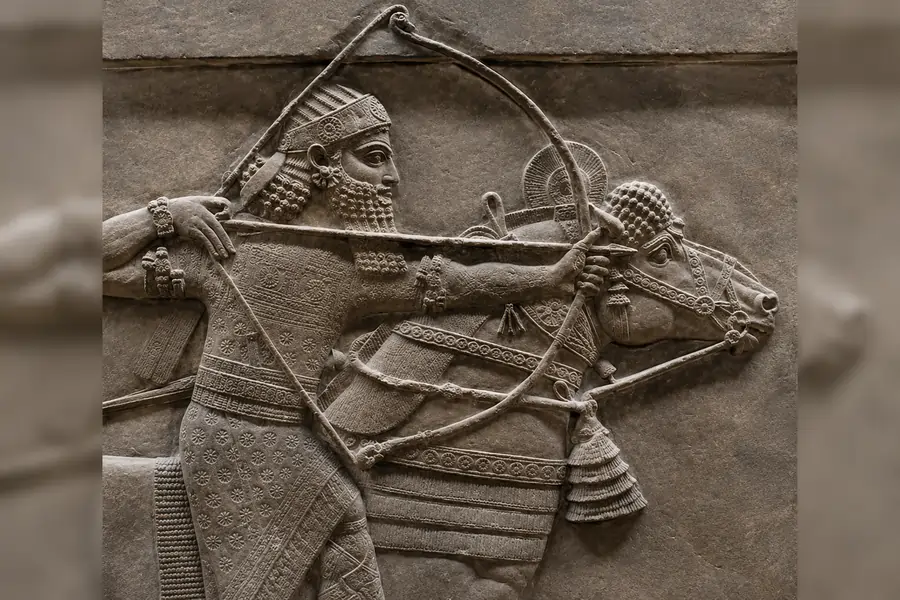
Long before gunpowder transformed warfare, the composite bow represented one of humanity's greatest military technologies. Compact, powerful, and remarkably efficient, it allowed armies to strike enemies from greater distances while remaining highly mobile. From the Hittites and Assyrians to the Persians, Scythians, and Parthians, civilizations across Eurasia relied on composite bows to achieve military superiority.
What Made the Composite Bow Different?
Unlike a simple self bow carved from a single piece of wood, the composite bow combined several materials, each chosen for a specific purpose. Bowyers laminated wood, horn, and animal sinew using natural adhesives derived from fish bladders or animal collagen.
- Wood provided the central structure.
- Horn resisted compression during the draw.
- Sinew stored enormous tensile energy.
This layered construction allowed the bow to store significantly more energy than a traditional wooden bow of similar size. As a result, arrows traveled faster, farther, and with greater penetrating power.
The Perfect Weapon for Horse Archers
Perhaps the composite bow's greatest advantage was its compact size. Unlike long bows, which became cumbersome on horseback, composite bows could easily be used by mounted warriors. This innovation gave rise to one of history's most effective military systems: horse archery.
Nomadic peoples such as the Scythians, Sarmatians, and later the Huns perfected hit-and-run tactics that allowed them to remain beyond the reach of slower infantry formations. Rather than engaging in close combat, mounted archers continuously circled enemy formations while showering them with arrows. The famous "Parthian Shot," in which retreating horsemen turned to fire accurately while riding away, became one of antiquity's most feared battlefield maneuvers.
Changing the Nature of Warfare
The composite bow made mobility as important as discipline. Heavy infantry could no longer rely solely on shield walls or dense formations to secure victory. Commanders increasingly required fast cavalry, missile troops, and combined-arms tactics to counter mounted archers.
One of the most famous demonstrations occurred at the Battle of Carrhae in 53 BCE, where Parthian horse archers repeatedly harassed the Roman army before heavily armored cataphracts delivered the decisive blow. Roman commander Marcus Licinius Crassus suffered one of the Republic's worst military defeats. For centuries, the composite bow remained the dominant missile weapon across much of Asia and the Near East, influencing military doctrine far beyond its original inventors.
Historical significance: The composite bow transformed cavalry warfare by enabling highly mobile armies capable of defeating slower infantry forces, influencing military strategy across Eurasia for nearly two thousand years (Keegan, 1993; Nicolle, 1990).
3. Roman Corvus - The Boarding Bridge That Won a War
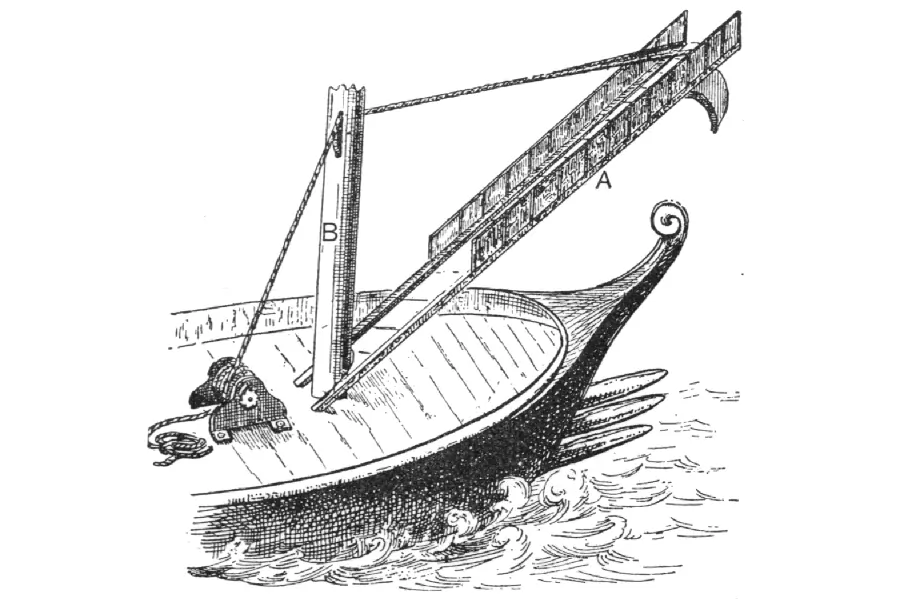
Unlike many military innovations that improved an existing weapon, the Roman corvus completely changed the way naval battles were fought. It allowed Rome, a civilization with little naval experience, to defeat the greatest maritime power in the western Mediterranean. During the First Punic War, the corvus played a decisive role in helping Rome challenge Carthaginian naval supremacy and ultimately establish itself as the dominant Mediterranean power.
Rome's Greatest Weakness
When the First Punic War began in 264 BCE, Carthage possessed one of the world's finest navies. Its sailors had generations of experience maneuvering fast quinqueremes and using traditional naval tactics centered around speed and ramming. Rome, by comparison, excelled at land warfare but lacked experienced crews. Facing a superior naval opponent, Roman commanders devised an innovative solution: instead of becoming better sailors, they would turn naval battles into infantry battles.
How the Corvus Worked
The corvus was essentially a large wooden boarding bridge mounted near the bow of Roman warships. Measuring roughly eleven meters long, it featured a heavy iron spike beneath its tip. Once Roman ships closed with an enemy vessel, sailors lowered the bridge. The iron spike embedded itself into the opposing deck, locking both ships together. Legionaries then charged across the bridge and fought hand-to-hand combat, where Roman infantry discipline gave them a decisive advantage.
A Tactical Revolution at Sea
The innovation completely undermined traditional naval tactics. Carthaginian commanders could no longer rely solely on superior seamanship or maneuverability because every close engagement risked becoming a Roman infantry battle.
The effectiveness of the corvus became apparent during the Battle of Mylae in 260 BCE, where Roman forces won their first major naval victory. Subsequent victories further weakened Carthaginian naval dominance and gradually shifted control of the western Mediterranean toward Rome.
Its Strategic Importance
Although later Roman fleets gradually abandoned the corvus due to concerns about stability in rough seas, the invention had already served its purpose. It bought Rome enough time to develop experienced sailors and a professional navy capable of competing directly with Carthage. Rome's eventual victory in the First Punic War marked the beginning of its emergence as the dominant naval power in the western Mediterranean.
Historical significance: The corvus neutralized Carthage's greatest military advantage and helped Rome secure victory in the First Punic War, laying the foundation for centuries of Roman expansion (Polybius, Histories; Goldsworthy, 2000).
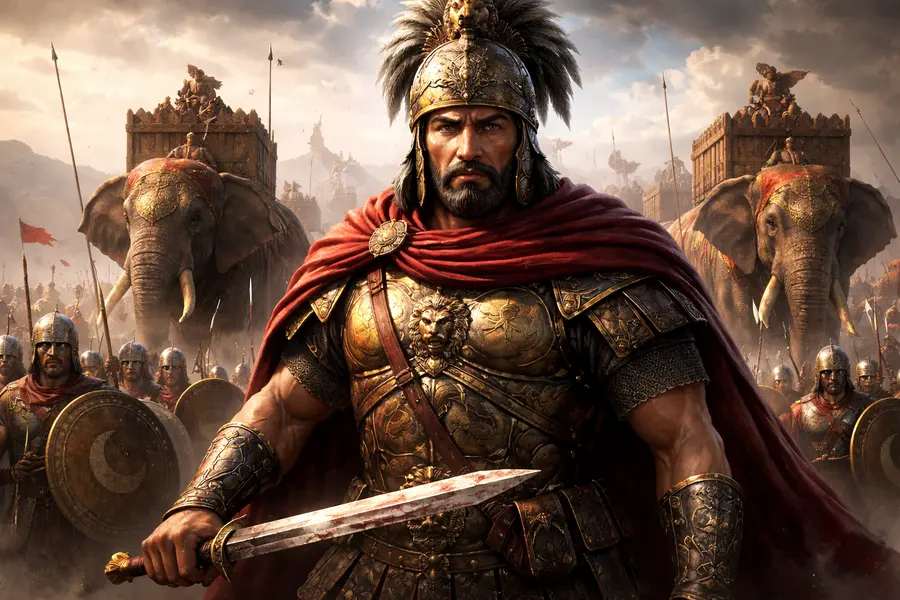
4. War Elephants - Ancient History's Living Battle Tanks
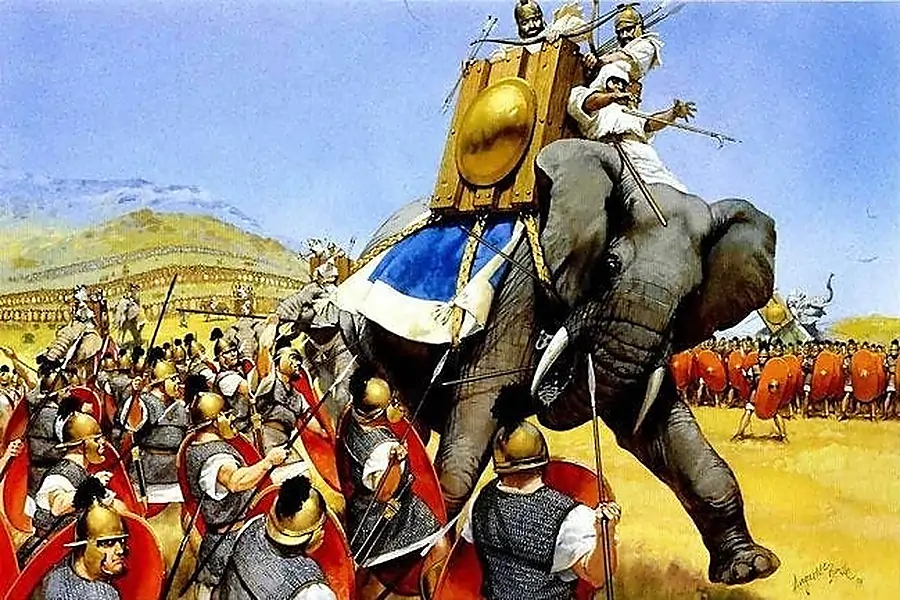
Long before armored vehicles appeared on the battlefield, ancient commanders deployed one of history's most intimidating military assets: war elephants. Towering above infantry formations and capable of causing immense physical and psychological disruption, these animals reshaped battlefield tactics across much of Asia, the Middle East, and the Mediterranean.
The Origins of War Elephants
War elephants were first employed extensively in the Indian subcontinent, where rulers developed specialized methods for training, equipping, and controlling these enormous animals. Skilled mahouts guided the elephants into battle, often accompanied by archers or javelin throwers positioned on their backs.
Following Alexander the Great's invasion of India, Hellenistic kingdoms rapidly adopted elephant corps into their own armies. The Seleucid Empire, Ptolemaic Egypt, and Carthage all recognized their potential as powerful shock weapons.
How Were They Used in Battle?
War elephants rarely functioned as simple charging animals. Instead, commanders employed them for several tactical purposes.
- Breaking dense infantry formations.
- Disrupting cavalry attacks.
- Creating panic among inexperienced troops.
- Providing elevated platforms for missile troops.
Their sheer size often frightened horses unfamiliar with elephants, making them particularly effective against cavalry. However, disciplined soldiers eventually learned to counter them by targeting the animals with missiles, opening lanes for them to pass harmlessly, or attacking their vulnerable legs and handlers.
Famous Battles Featuring War Elephants
One of the most famous encounters occurred at the Battle of the Hydaspes in 326 BCE, where King Porus deployed approximately 200 elephants against Alexander the Great. Although Alexander ultimately prevailed, the battle demonstrated both the destructive power and limitations of elephant warfare. War elephants also became closely associated with Hannibal Barca during the Second Punic War. Although only a handful survived the famous crossing of the Alps, their presence became one of history's enduring military legends.
Psychological Warfare on Four Legs
Perhaps the elephants' greatest contribution lay in their psychological impact. For soldiers encountering them for the first time, the sight of armored animals advancing amid deafening trumpets could be deeply unsettling. Ancient writers frequently described inexperienced troops breaking ranks before contact was even made.
Over time, however, experienced armies adapted. Roman commanders, in particular, developed disciplined responses that reduced the elephants' effectiveness, illustrating a recurring theme in military history: every innovation eventually inspires a countermeasure.
Historical significance: War elephants introduced a new dimension of shock warfare, forcing armies from India to the Mediterranean to rethink battlefield tactics and develop specialized countermeasures (Kistler, 2007; Connolly, 1998).
5. Greek Trireme Ram - The Weapon That Made Sea Power Decisive
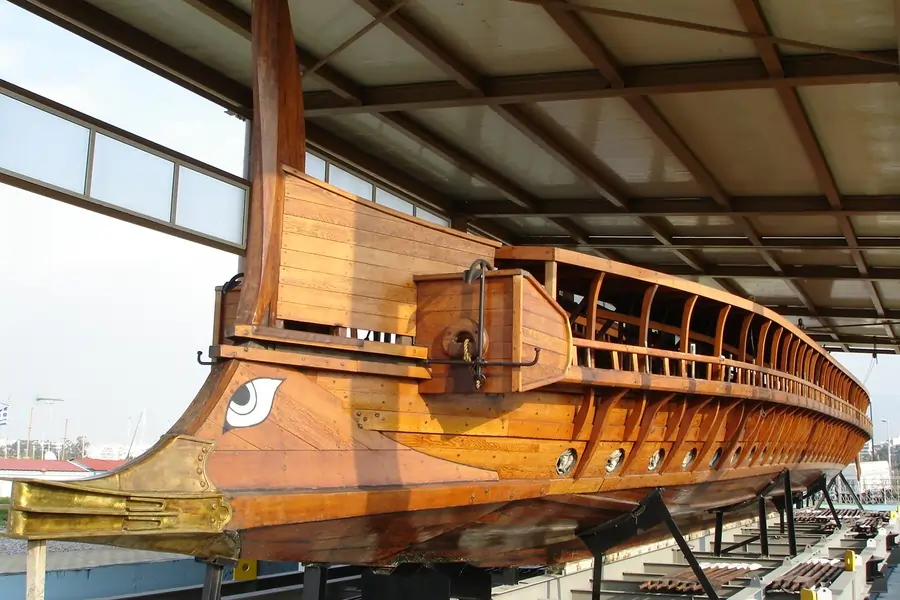
Long before cannons dominated naval warfare, victory at sea depended on speed, maneuverability, and one devastating weapon mounted beneath a ship's waterline-the bronze ram. Attached to the bow of the Greek trireme, this reinforced bronze beak transformed naval combat from floating infantry engagements into contests of precision maneuvering and tactical coordination. Entire fleets could be destroyed without soldiers ever boarding enemy vessels. The trireme itself represented one of the greatest engineering achievements of the ancient world, but it was the bronze ram that made the vessel truly revolutionary.
What Was a Greek Trireme?
The trireme was a sleek warship powered primarily by approximately 170 oarsmen arranged in three vertical rows. Unlike slower merchant ships, triremes were designed for speed, acceleration, and rapid maneuvering. Typical features included:
- Length of approximately 37 meters (120 feet).
- Three tiers of synchronized rowers.
- Lightweight wooden construction.
- A reinforced bronze ram mounted below the bow.
- A small contingent of marines and archers.
Because these ships depended on coordinated rowing rather than sails during battle, experienced crews could accelerate quickly and execute complex maneuvers that heavier ships struggled to match.
The Bronze Ram Changed Naval Warfare
Before large-scale artillery existed at sea, the ram became the primary offensive weapon. The objective was not to sink an enemy through prolonged combat but to strike the hull with tremendous force. A successful collision could:
- Punch holes below the waterline.
- Break enemy oars, leaving ships helpless.
- Cripple steering systems.
- Cause flooding that forced crews to abandon ship.
Rather than relying on superior numbers of marines, admirals increasingly emphasized seamanship and tactical maneuvering. Battles became contests of positioning, timing, and disciplined rowing.
The Battle of Salamis
The greatest demonstration of the trireme's effectiveness came during the Battle of Salamis (480 BCE). Facing the vastly larger Persian fleet, Greek commander Themistocles deliberately lured the enemy into the narrow Straits of Salamis. The confined waters prevented Persian numerical superiority from being fully exploited. Greek triremes repeatedly rammed Persian ships while the larger enemy fleet struggled to maneuver. The destruction of much of Xerxes' navy effectively ended Persian hopes of conquering mainland Greece and preserved the independence of the Greek city-states.
A Legacy That Lasted Centuries
The bronze ram dominated Mediterranean naval warfare for nearly five centuries. Every major naval power-including Athens, Sparta, Carthage, and later Rome-designed fleets around the principles of speed and ramming. Only with the Roman invention of the corvus did boarding actions temporarily become more important than maneuver warfare.
Historical significance: The bronze ram transformed naval warfare by making maneuverability and coordinated rowing the deciding factors in battle. It helped secure Greek victory at Salamis and shaped Mediterranean sea power for centuries (Thucydides; Casson, 1995).
6. Crossbow - The Weapon That Democratized Missile Warfare
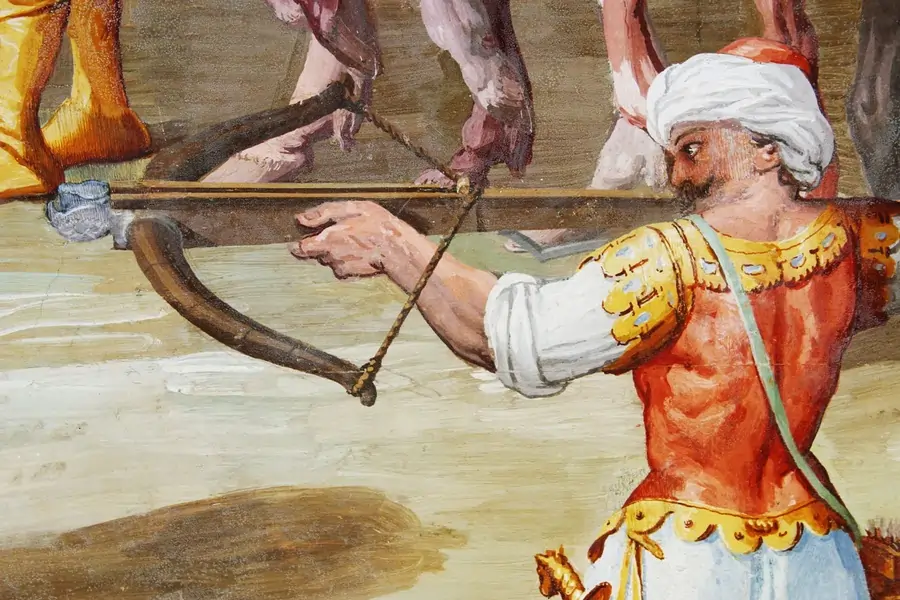
The invention of the crossbow represented one of the greatest advances in ancient military technology. While traditional bows required years of practice to master, crossbows enabled relatively inexperienced soldiers to deliver powerful, accurate shots with far less training. This innovation fundamentally altered warfare in ancient China and later spread across Eurasia.
How Did a Crossbow Work?
Unlike conventional bows, the crossbow mounted a short composite bow horizontally on a wooden stock. The string was drawn back mechanically and locked into place using a sophisticated trigger mechanism. When the trigger was pulled, the stored energy propelled a short, heavy bolt at remarkable speed. Its major components included:
- A wooden stock.
- A composite bow or prod.
- A bronze trigger mechanism.
- A groove that guided the bolt.
The bronze trigger represented a remarkable feat of ancient engineering and allowed soldiers to hold the weapon fully drawn until the precise moment of firing.
Advantages Over Traditional Bows
The crossbow offered several significant advantages over traditional bows. It required far less training to use effectively, allowing states to equip large numbers of soldiers with powerful ranged weapons. Its mechanical design delivered excellent armor penetration, while the trigger mechanism enabled greater accuracy by allowing users to aim carefully before firing. Unlike conventional bows, a crossbow could also remain fully drawn without tiring the shooter, making it particularly effective for defensive positions and coordinated volleys.
Traditional archers relied on strength and years of constant practice. Crossbowmen, by comparison, could become effective soldiers much more quickly. This made the weapon particularly attractive to states fielding large conscript armies.
The Rise of Massed Missile Fire
Ancient Chinese kingdoms during the Warring States Period adopted crossbows extensively. Entire formations of disciplined crossbowmen could unleash coordinated volleys capable of breaking advancing infantry or cavalry before they reached melee range. Some states standardized production, allowing thousands of interchangeable bronze trigger mechanisms to be manufactured efficiently-an extraordinary achievement for the ancient world. By the time the Qin dynasty unified China in 221 BCE, crossbows had become one of its most valuable military assets.
Changing Battlefield Dynamics
The crossbow shifted military power away from elite professional archers toward disciplined formations equipped with standardized weapons. Commanders could now field effective missile troops on a much larger scale, increasing both battlefield flexibility and the destructive potential of massed ranged attacks.
Historical significance: The crossbow enabled states to equip large armies with powerful ranged weapons while reducing the years of training traditionally required for skilled archers. It became one of the defining weapons of ancient Chinese warfare (Needham, 1986; Sawyer, 1993).
7. Heavy Cavalry - The Shock Force That Broke Empires
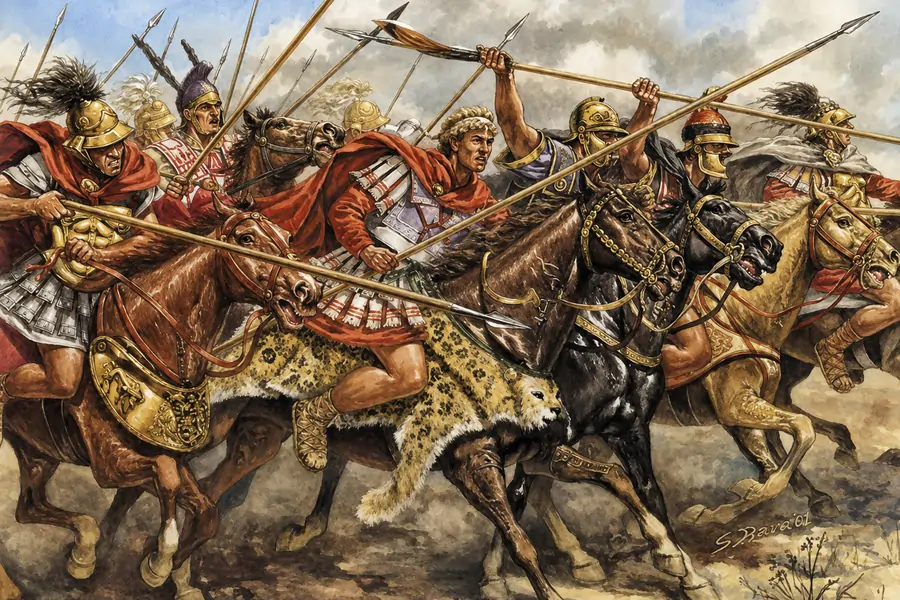
If disciplined infantry dominated much of the ancient battlefield, heavy cavalry often delivered the decisive blow. Fast, heavily armored, and capable of tremendous impact, elite cavalry units repeatedly turned stalemates into crushing victories. Rather than simply scouting or harassing enemy forces, heavy cavalry evolved into specialized shock troops designed to smash weakened formations through speed, momentum, and concentrated force.
The Evolution of Heavy Cavalry
Early cavalry primarily served reconnaissance and skirmishing roles. Over time, however, improvements in horse breeding, protective equipment, saddles, and riding techniques allowed cavalry to fight directly against infantry.
Although the widespread use of stirrups belongs largely to the medieval period, ancient heavy cavalry achieved remarkable effectiveness without them by relying on strong saddles, exceptional horsemanship, disciplined formations, and long training. Later civilizations such as the Sarmatians and Parthians fielded cataphracts-horsemen and horses both protected by extensive armor.
Alexander's Companion Cavalry
The finest heavy cavalry of the Classical period was undoubtedly Alexander the Great's Companion Cavalry. Unlike the Macedonian phalanx, whose role was to pin the enemy in place, the Companion Cavalry sought decisive breakthroughs. Alexander personally led these elite horsemen into battle.
Once the phalanx fixed enemy forces, the Companions charged vulnerable sections of the opposing line, often targeting commanders or exposed flanks. This coordinated use of infantry and cavalry became one of history's greatest examples of combined-arms warfare.
Shock Action on the Battlefield
Heavy cavalry depended upon:
- Speed.
- Mass.
- Formation discipline.
- The momentum of horse and rider.
Rather than fighting prolonged melee engagements, cavalry attempted to strike enemy formations at precisely the right moment-usually after infantry had already disrupted them. Well-executed charges frequently caused panic, opened gaps, and initiated routs that infantry alone struggled to achieve.
From Macedonia to Rome
Alexander's methods influenced military doctrine across the Hellenistic world. The Seleucids expanded heavy cavalry forces, while eastern powers such as the Parthians developed heavily armored cataphracts capable of overwhelming lighter opponents.
Rome itself increasingly relied upon allied cavalry and later incorporated more specialized mounted forces as it encountered enemies whose mobility exceeded that of traditional legionaries. Heavy cavalry remained one of the decisive arms of warfare well into Late Antiquity.
For another excellent example of cavalry deciding battles, explore how Hannibal's cavalry dominated Roman armies during the Second Punic War.
Historical significance: Heavy cavalry transformed battlefield tactics by introducing devastating shock attacks that complemented disciplined infantry formations, influencing military doctrine from Alexander's conquests through the Roman Empire and beyond (Arrian; Xenophon; Connolly, 1998).
8. Catapults and Ballistae - The Siege Weapons That Changed Fortification Warfare
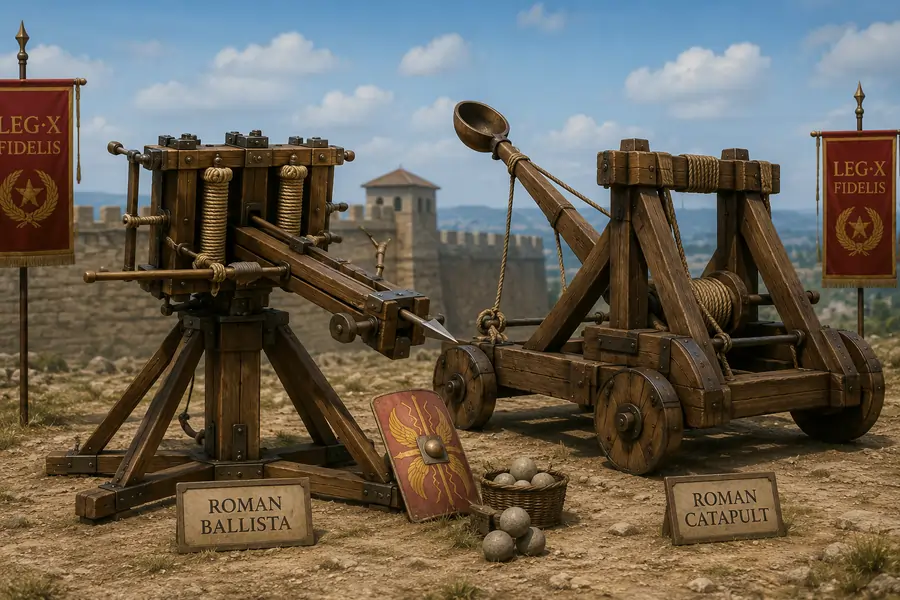
Throughout much of ancient history, fortified cities represented the greatest obstacle to conquest. Thick stone walls could resist direct assault for months or even years. The development of mechanical artillery changed that balance forever. Catapults and ballistae allowed armies to attack fortifications from a safe distance, making sieges faster, deadlier, and more systematic than ever before.
The Origins of Ancient Artillery
The earliest mechanical artillery appeared in the Greek world during the fourth century BCE. Engineers gradually progressed from oversized bows to sophisticated torsion-powered machines capable of launching heavy projectiles over impressive distances. Alexander the Great rapidly adopted these innovations during his campaigns, while the Romans later refined them into standard equipment for both sieges and field armies.
How Were They Built?
Unlike simple lever-powered machines, most advanced ancient artillery relied upon bundles of tightly twisted animal sinew or hair. These torsion springs stored enormous amounts of energy. When released, the arms rotated violently, launching projectiles at high speed. Construction required:
- Heavy wooden frames.
- Torsion springs made from sinew.
- Throwing arms.
- Precision-engineered release mechanisms.
Roman military engineers became particularly skilled at constructing and maintaining these complex machines during lengthy campaigns.
Catapult vs. Ballista
Although often confused today, these weapons served slightly different purposes.
| Feature | Catapult | Ballista |
|---|---|---|
| Primary Purpose | Destroy fortifications and bombard enemy positions. | Accurately target enemy soldiers, officers, and siege crews. |
| Typical Ammunition | Large stones, incendiary projectiles, and heavy missiles. | Massive bolts, long iron-tipped projectiles, and heavy darts. |
| Effective Against | City walls, towers, gates, and defensive structures. | Infantry, cavalry, siege operators, and defenders on battlements. |
| Combat Role | Siege bombardment and structural destruction. | Long-range precision fire and anti-personnel support. |
| Modern Comparison | Similar to an artillery piece. | Comparable to a giant mechanical crossbow or sniper weapon. |
Roman armies frequently employed both simultaneously during sieges.
Transforming Siege Warfare
Before artillery became widespread, attackers usually relied upon starvation, mining operations, ladders, or costly frontal assaults. Mechanical artillery dramatically expanded a commander's options. Catapults weakened defensive walls while ballistae suppressed defenders attempting repairs or manning battlements. Artillery also served psychological purposes by preventing defenders from safely occupying walls.
Combined with siege towers, battering rams, and disciplined engineering units, these machines greatly increased the chances of capturing even heavily fortified cities. Alexander's famous siege of Tyre demonstrated how innovative siege technology could overcome defenses once considered impregnable.
The Beginning of Scientific Warfare
Perhaps more than any previous weapon, catapults and ballistae represented the growing importance of engineering in military success. Victories increasingly depended not only on courageous soldiers but also on mathematicians, architects, carpenters, and engineers capable of designing sophisticated siege equipment. This marked an important step toward increasingly technical forms of warfare.
Historical significance: Catapults and ballistae revolutionized siege warfare by enabling armies to systematically destroy fortifications, suppress defenders, and conquer cities that had once resisted conventional assaults for years (Marsden, 1969; Vitruvius, De Architectura).
9. Iron Weapons - The Technological Revolution That Armed Empires
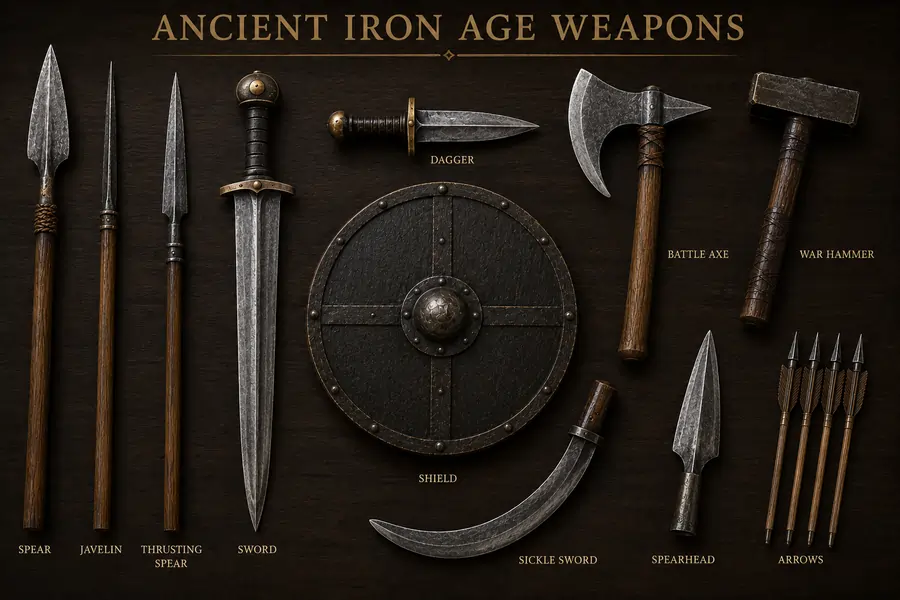
Unlike the other entries in this list, iron weapons were not a single invention but a technological revolution that permanently transformed warfare. The transition from bronze to iron fundamentally changed how armies were equipped, how states mobilized soldiers, and how empires projected military power.
For centuries, bronze had been the dominant material for swords, spearheads, axes, and armor. However, bronze production depended on copper and tin-two metals that were often found hundreds of kilometers apart. Disruptions to trade networks could severely limit weapon production. Iron changed that equation entirely.
From Bronze to Iron
The widespread adoption of iron began during the early Iron Age, around 1200 BCE, although some cultures had experimented with iron centuries earlier. Unlike bronze, iron ore was abundant across much of Europe, Asia, and the Near East.
Initially, iron weapons were not necessarily superior to high-quality bronze weapons. Early iron contained impurities and required skilled blacksmiths to forge effectively. Over time, however, advances in smelting, forging, and heat treatment dramatically improved their quality. As metallurgy progressed, iron eventually surpassed bronze in durability, availability, and production scale.
Why Iron Changed Warfare
The greatest advantage of iron was not simply that it produced stronger weapons-it made large armies economically possible. States no longer depended on scarce tin imports to equip thousands of soldiers. Instead, they could manufacture enormous quantities of:
- Swords
- Spearheads
- Arrowheads
- Axes
- Agricultural tools that supported military logistics
This reduced costs and allowed kingdoms to arm increasingly larger standing armies.
The Rise of Professional Militaries
As iron became more accessible, warfare gradually shifted away from small aristocratic warrior elites toward larger citizen and professional armies. Powerful states such as Assyria built formidable military machines supported by standardized iron weapons, disciplined infantry, and sophisticated logistics.
Later civilizations-including the Greeks, Persians, Carthaginians, and Romans-benefited from increasingly advanced ironworking techniques that improved both weapon quality and production capacity. The Roman Republic, in particular, demonstrated the strategic value of standardized equipment. Thousands of legionaries could be armed with reliable iron swords, pila, helmets, and armor, enabling Rome to replace battlefield losses more efficiently than many rivals.
Economic Power Became Military Power
Iron also strengthened the economies that supported military campaigns. Iron tools improved agriculture, allowing states to produce greater food surpluses. Larger populations could therefore support bigger armies, longer campaigns, and expanding empires. In this sense, iron reshaped not only weapons but the entire military infrastructure of the ancient world.
Historical significance: The widespread adoption of iron enabled states to equip larger armies at lower cost, accelerating the rise of professional militaries and helping powerful empires dominate the ancient world (Snodgrass, 1964; Waldbaum, 1978).
10. Roman Gladius - The Sword That Conquered an Empire
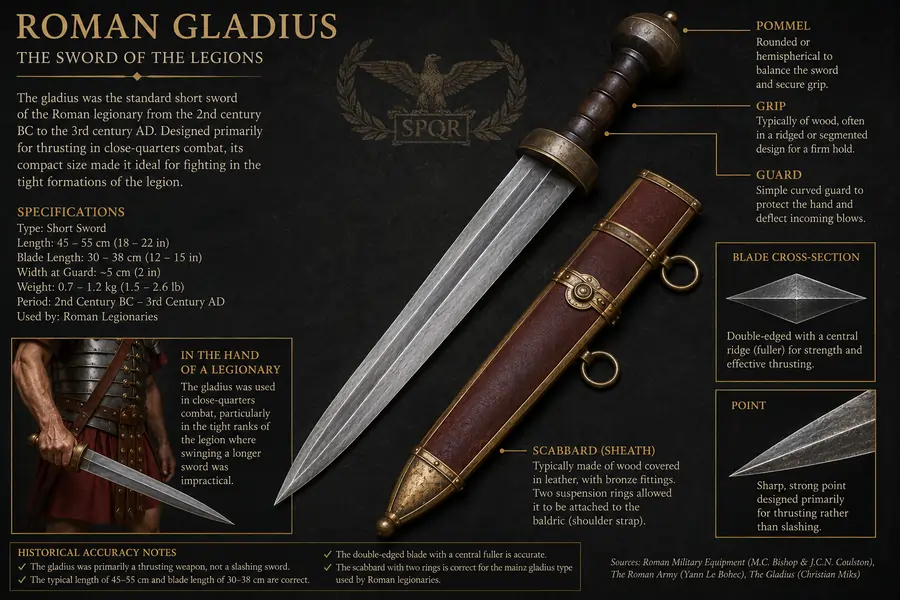
No weapon symbolizes Roman military power more than the gladius. Although relatively short by ancient standards, this double-edged sword became one of history's most successful military weapons because it perfectly complemented Roman discipline, training, and battlefield tactics. The gladius was not the longest sword nor the most ornate. Its true strength lay in its efficiency.
Origins of the Gladius
The Roman gladius was heavily influenced by the swords used by Iberian warriors during Rome's campaigns in Hispania. Impressed by their effectiveness, the Romans adopted and refined the design into what historians commonly refer to as the gladius hispaniensis. Over time, several variants appeared, including:
- Gladius Hispaniensis
- Mainz Gladius
- Fulham Gladius
- Pompeii Gladius
Despite minor differences, all shared the same philosophy: a compact, highly maneuverable sword optimized for disciplined infantry combat.
Designed for Roman Legionaries
Most gladii measured between 60 and 70 centimeters (24-28 inches) in length. Although relatively short compared to many ancient swords, this compact design offered significant tactical advantages. It provided excellent maneuverability in the tight formations of the Roman legion, enabled quick and precise thrusting attacks, reduced fatigue during prolonged combat, and could be used effectively from behind the protection of the large Roman scutum shield.
Unlike many warriors who relied on powerful slashing attacks, Roman legionaries were trained primarily to thrust with the gladius. A controlled thrust required less movement, kept the soldier better protected behind the shield, and was generally more likely to inflict a fatal wound. This emphasis on disciplined technique, combined with the gladius' practical design, made it one of the most effective infantry swords of the ancient world.
The Gladius and the Roman Legion
The gladius achieved its greatest effectiveness because of the military system that surrounded it. Roman legionaries fought as disciplined units rather than individual warriors, with every soldier trained to operate in close coordination with his comrades. Their success depended not on individual swordsmanship but on maintaining formation, following commands, and executing well-rehearshed battlefield tactics.
A typical Roman attack began with legionaries advancing in organized formations before hurling their pila to disrupt enemy lines and weigh down opposing shields. They then closed the distance behind the protection of the large scutum, using the gladius to deliver quick, precise thrusts at close range. This seamless combination of missile weapons, defensive equipment, and disciplined infantry tactics proved devastating against many opponents throughout the Roman Republic and the early Empire.
Why the Gladius Became Legendary
The gladius accompanied Roman armies from Britain to Mesopotamia. Whether facing Gauls, Carthaginians, Macedonians, or Germanic tribes, the sword remained one of the defining symbols of Roman military professionalism. Its reputation stemmed not from extraordinary metallurgy alone but from the disciplined soldiers who wielded it. Like the sarissa and the Roman corvus, the gladius demonstrates an important lesson in military history: weapons are often most effective when integrated into a larger tactical system. By Late Antiquity, the longer spatha gradually replaced the gladius as Roman battlefield tactics evolved.
Historical significance: The gladius became the signature weapon of Rome's professional legions, contributing to centuries of Roman military success through its perfect integration with disciplined infantry tactics (Goldsworthy, 2003; Bishop & Coulston, 2006).
Conclusion
History is often remembered through the names of great generals, decisive battles, and powerful empires, yet behind every military success stood innovations that transformed the way wars were fought. The sarissa enabled Macedonia to conquer the Persian Empire, while the Roman corvus temporarily overturned centuries of naval tradition. Composite bows allowed mounted archers to dominate the open plains of Eurasia, and the crossbow gave ancient states the ability to arm effective missile troops on an unprecedented scale.
Other innovations reshaped warfare in different ways. War elephants introduced psychological shock to the battlefield, bronze rams turned naval maneuver into the decisive factor at sea, heavy cavalry perfected the art of the decisive charge, and catapults made even the strongest fortifications vulnerable. Meanwhile, the widespread adoption of iron allowed empires to equip larger armies than ever before, while the Roman gladius demonstrated that the effectiveness of a weapon often depended as much on training and doctrine as on the weapon itself.
Together, these weapons and military innovations influenced the rise and fall of civilizations across Europe, Asia, and North Africa. Many were eventually replaced or countered by new technologies, but their impact continued to shape military thinking for centuries. Even today, historians study these innovations to understand how advances in technology, engineering, and battlefield tactics repeatedly altered the course of human history.
References and Further Reading
- Arrian, Anabasis of Alexander
- Bishop, M. C., & Coulston, J. C. N. Roman Military Equipment. Oxbow Books, 2006.
- Casson, Lionel. Ships and Seamanship in the Ancient World. Johns Hopkins University Press, 1995.
- Connolly, Peter. Greece and Rome at War. Greenhill Books, 1998.
- Engels, Donald W. Alexander the Great and the Logistics of the Macedonian Army. University of California Press, 1978.
- Goldsworthy, Adrian. The Punic Wars. Cassell, 2000 and The Complete Roman Army. Thames & Hudson, 2003.
- Hammond, N. G. L. Philip of Macedon. Johns Hopkins University Press, 1989.
- Keegan, John. A History of Warfare. Vintage Books, 1993.
- Kistler, John M. War Elephants. University of Nebraska Press, 2007.
- Marsden, E. W. Greek and Roman Artillery. Oxford University Press, 1969.
- Needham, Joseph. Science and Civilisation in China, Volume 5. Cambridge University Press, 1986.
- Nicolle, David. Arms and Armour of the Crusading Era. Greenhill Books, 1990.
- Polybius - The Histories
- Sawyer, Ralph D. The Seven Military Classics of Ancient China. Basic Books, 1993.
- Snodgrass, Anthony. Early Greek Armour and Weapons. Edinburgh University Press, 1964.
- Thucydides - History of the Peloponnesian War
- Vitruvius. De Architectura.
- Waldbaum, Jane C. From Bronze to Iron. Paul Åströms Förlag, 1978.
- Xenophon. Hipparchicus and Cyropaedia.
Books and Memorables
This article may contain affiliate links. If you purchase through these links, I may earn a small commission at no extra cost to you.


Related Articles
Frequently Asked Questions
Why was the sarissa more effective than the Greek dory spear?
The sarissa was significantly longer than the traditional Greek dory, measuring up to 6 meters (20 feet) in length. This allowed multiple ranks of the Macedonian phalanx to project their spear points beyond the front line, creating a dense wall of pikes that was difficult for enemy infantry to penetrate. Its effectiveness depended on disciplined formations and coordinated tactics rather than the weapon alone.
How did the Roman corvus help Rome defeat Carthage at sea?
The Roman corvus was a wooden boarding bridge fitted with an iron spike that locked onto enemy ships. It allowed Roman legionaries to board Carthaginian vessels and fight hand-to-hand combat, turning naval engagements into infantry battles where Rome held the advantage. This innovation played a key role in several Roman victories during the First Punic War.
Why were composite bows better for horse archers than long bows?
Composite bows were shorter and more compact than long bows, making them easier to use from horseback. Despite their smaller size, their layered construction of wood, horn, and sinew stored more energy, allowing them to shoot arrows with excellent range and penetrating power. This made them the preferred weapon of mounted archers such as the Scythians, Parthians, and other steppe peoples.
What made the Greek trireme so successful in naval warfare?
The Greek trireme combined speed, maneuverability, and a powerful bronze ram mounted below the bow. Skilled crews used coordinated rowing to outmaneuver enemy ships before striking their hulls or breaking their oars with the ram. This tactic proved decisive during battles such as Salamis, where Greek naval tactics overcame a much larger Persian fleet.
Why did iron weapons replace bronze weapons in ancient armies?
Iron gradually replaced bronze because iron ore was far more abundant and less dependent on long-distance trade. As ironworking techniques improved, states could manufacture large quantities of swords, spearheads, and other weapons at lower cost, making it practical to equip larger armies and sustain prolonged military campaigns.
Why is the Roman gladius considered one of the most effective ancient swords?
The Roman gladius was designed to work with the tactics of the Roman legion rather than as an individual dueling weapon. Its short, double-edged blade allowed legionaries to deliver quick thrusts while remaining protected behind the large scutum shield. Combined with disciplined formations and standardized training, the gladius became one of the defining weapons of Roman military success.
Add Comment