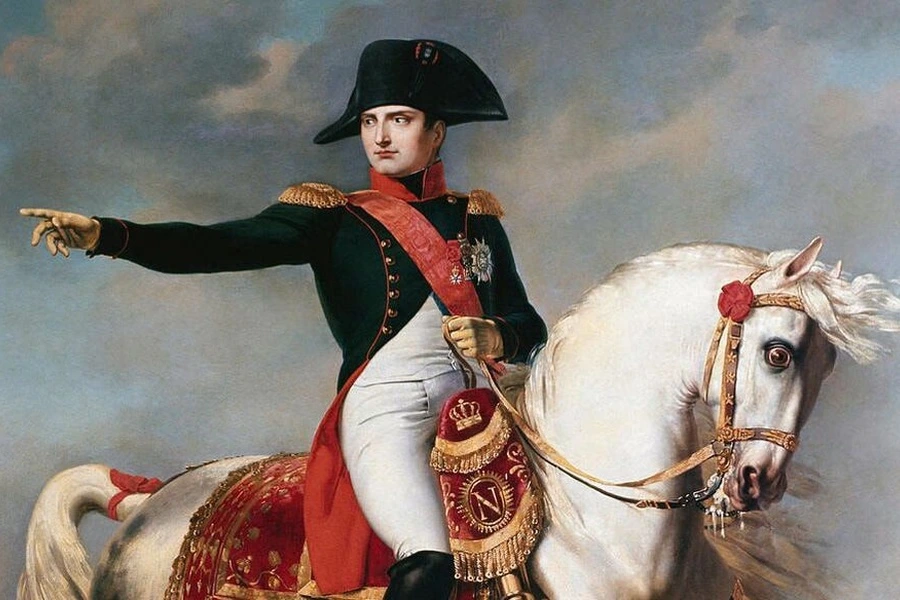
For more than two decades, Napoleon Bonaparte rose from a young artillery officer to the most powerful military commander in Europe, fighting campaigns from Italy and Egypt to Russia, Germany and finally Waterloo. His wars transformed European politics, destroyed old monarchies, created new states, and introduced a style of warfare in which speed, concentration, aggressive maneuver, and psychological pressure could turn apparently impossible situations into spectacular victories. Yet the same military system that carried Napoleon to Austerlitz and Friedland eventually collapsed in Russia, Spain, and Germany. This is the story of Napoleon's major campaigns and battles. From his rise as a young artillery officer during the French Revolution to his final defeat at Waterloo in 1815.
Table of Contents
- Napoleon's Wars Timeline
- Napoleon's Rise as a Soldier
- The First Italian Campaign, 1796-1797
- The Egyptian Campaign, 1798-1799
- The Second Italian Campaign and Marengo, 1800
- The War of the Third Coalition, 1805
- Austerlitz: Napoleon's Greatest Victory
- The Prussian Campaign, 1806
- The Polish Campaign, 1807
- The Peninsular War and Spain, 1808-1814
- The Austrian Campaign and Wagram, 1809
- Napoleon's Invasion of Russia, 1812
- The German Campaign and Battle of Leipzig, 1813
- The Campaign in France, 1814
- The Hundred Days and Waterloo, 1815
- Why Was Napoleon So Successful?
- Why Did Napoleon's Military System Fail?
- The Legacy of Napoleon's Wars
- References and Further Reading
Napoleon's Wars Timeline
| Year | Campaign or war | Major battles and events | Result |
|---|---|---|---|
| 1793 | Siege of Toulon | Toulon | Napoleon's rise to prominence |
| 1795 | Paris uprising | 13 Vendémiaire | Napoleon gains political importance |
| 1796-1797 | First Italian Campaign | Montenotte, Lodi, Arcole, Rivoli | Major French victory; Treaty of Campo Formio |
| 1798-1799 | Egyptian Campaign | Pyramids, Battle of the Nile, Acre, Battle of Aboukir | Land victories but strategic failure |
| 1800 | Second Italian Campaign | Marengo | French victory |
| 1805 | War of the Third Coalition | Ulm, Trafalgar, Austerlitz | Major French victory on land |
| 1806 | Prussian Campaign | Jena, Auerstedt | Prussian army defeated |
| 1807 | War of the Fourth Coalition / Polish Campaign | Eylau, Friedland | French victory; Treaties of Tilsit |
| 1808-1814 | Peninsular War | Bailén, Salamanca, Vitoria | Long-term French strategic failure |
| 1809 | Austrian Campaign | Aspern-Essling, Wagram | French victory, but heavy losses |
| 1812 | Russian Campaign | Smolensk, Borodino, Berezina | Catastrophic French retreat |
| 1813 | German Campaign | Lützen, Bautzen, Leipzig | Coalition victory |
| 1814 | Campaign in France | Six Days' Campaign, Paris | Napoleon abdicates |
| 1815 | Hundred Days | Ligny, Waterloo | Final defeat and exile |
Napoleon's Rise as a Soldier
Napoleon was born in Ajaccio, Corsica, in 1769 and trained as an artillery officer. His early career unfolded during the French Revolution, when the destruction of the old royal military hierarchy created extraordinary opportunities for ambitious young officers. His first major opportunity came at the Siege of Toulon in 1793. Napoleon helped identify the artillery positions that enabled the British evacuation of the strategically important French port. He was only 24 years old when he was promoted to brigadier general.
Two years later, Napoleon again demonstrated his usefulness to the revolutionary government by helping suppress the royalist uprising of 13 Vendémiaire in Paris. The experience brought him into the political orbit of the Directory and eventually gave him command of the Army of Italy. Napoleon's rise therefore cannot be separated from the political instability of revolutionary France. Like other great military commanders in history, he possessed unusual tactical ability, but his opportunities were also created by the extraordinary political and military circumstances of his age.
The First Italian Campaign, 1796-1797
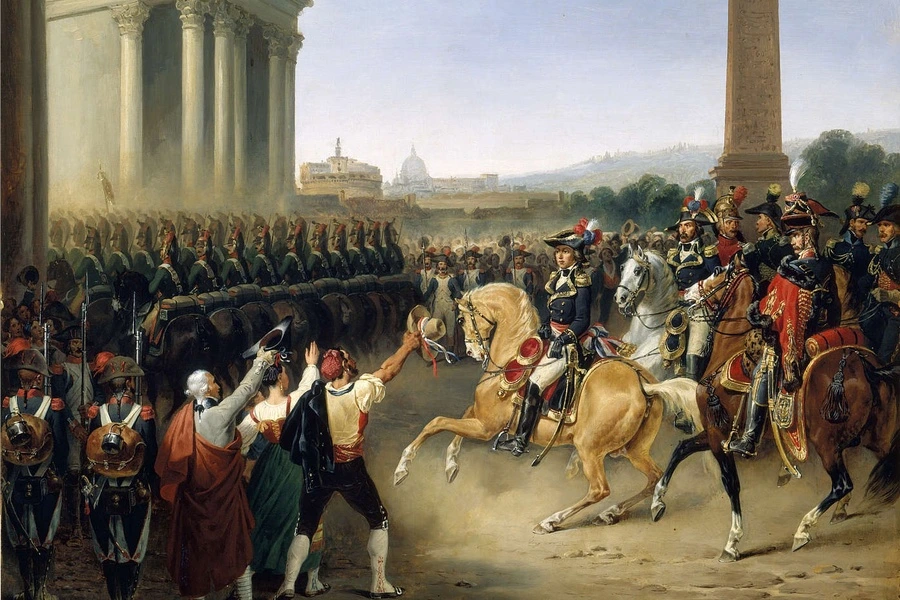
The First Italian Campaign was the campaign that transformed Napoleon from a promising general into a European celebrity. When he assumed command in March 1796, the French Army of Italy was poorly supplied and facing Austrian and Piedmontese forces. Napoleon's answer was not to wait for overwhelming strength. He moved rapidly between the enemy armies and attacked them separately before they could combine. The opening victories at Montenotte, Millesimo, Dego and Mondovi forced Piedmont-Sardinia out of the war. Napoleon then turned against Austria. At Lodi on 10 May 1796, French troops fought their way across the Adda River under heavy fire. The battle became one of the early foundations of Napoleon's legend, although later accounts greatly romanticized his personal role in the fighting.
Napoleon then captured Milan and turned his army toward the Austrian forces defending Mantua. A series of Austrian attempts to relieve the fortress produced some of the campaign's most famous battles, including Arcole in November 1796 and Rivoli in January 1797. Rivoli shattered Austria's final major attempt to relieve Mantua and effectively ended its ability to maintain its position in northern Italy. The campaign ended with the Treaty of Campo Formio in October 1797. Napoleon had defeated Austrian armies repeatedly, reorganized territories in northern Italy, and returned to France as one of the most celebrated figures of the Revolution. The official Napoleon Foundation's chronology identifies Lodi, Arcole, and Rivoli among the defining battles of this campaign. [1]
The campaign also demonstrated something important about Napoleon's relationship with his soldiers. He understood how to turn military hardship into motivation, promising his poorly supplied troops wealth, glory and victory. Interestingly, later memoirs sometimes transformed these speeches into polished pieces of propaganda, reminding us that Napoleon was not only a commander but also an exceptionally skilled creator of his own legend. [2]
The Egyptian Campaign, 1798-1799
Napoleon's next major expedition took him far beyond Europe. In 1798, he led a French expedition to Egypt, officially presented partly as an attempt to threaten British interests and trade routes to India. The expedition also had an unusual scientific dimension, bringing scholars and engineers alongside the soldiers. The French captured Malta and landed at Alexandria before defeating the Mamluk army at the Battle of the Pyramids on 21 July 1798. Napoleon's infantry formed large defensive squares that could absorb cavalry attacks while artillery punished the enemy from protected positions. But the spectacular land victory was followed by disaster at sea. On 1 August, Admiral Horatio Nelson destroyed much of the French fleet at the Battle of the Nile. Napoleon's army was now effectively stranded in Egypt.
Napoleon expanded the campaign into Syria in 1799. He captured Jaffa but failed to take the heavily defended fortress of Acre. After returning to Egypt, he defeated an Ottoman force at Aboukir in July 1799. He then abandoned the expedition and secretly returned to France, leaving General Kléber in command. The Egyptian campaign was therefore both a military achievement and a strategic failure. Napoleon had conquered Egypt's principal centers but had failed to establish a secure route home or achieve the wider strategic objective against Britain. The chronology of the campaign records the sequence from the capture of Alexandria and the victory at the Pyramids to the naval disaster at Aboukir and the unsuccessful siege of Acre. [3]
The Second Italian Campaign and Marengo, 1800
Napoleon returned to France at a moment of political crisis. In November 1799, he helped overthrow the Directory in the coup of 18 Brumaire and became First Consul. His political survival depended partly on military success. Austria remained at war with France, and Napoleon personally took command of the Army of the Reserve in 1800. He crossed the Great St Bernard Pass and descended into northern Italy in a maneuver designed to threaten the Austrian army's communications.
The decisive confrontation came at Marengo on 14 June 1800. The battle initially went badly for Napoleon. Austrian forces pushed the French army back and appeared close to victory. Then General Louis Desaix arrived with reinforcements. French artillery and a cavalry charge helped reverse the battle, turning an apparent defeat into a dramatic French victory. Marengo was costly, but its political consequences were enormous. Together with Moreau's victory at Hohenlinden later that year, it helped force Austria toward peace. The Treaty of Lunéville followed in 1801. Historian Don Barry notes that Marengo strengthened Napoleon's political authority in France as much as it strengthened his military reputation. [4]
The War of the Third Coalition, 1805
After several years of relative peace, Britain and France returned to war in 1803. Napoleon assembled the enormous Boulogne Army for a possible invasion of Britain, but British naval superiority made a direct invasion increasingly unrealistic. Instead, Napoleon turned his army east when Austria and Russia joined Britain in the Third Coalition.
The campaign of 1805 displayed the mature version of Napoleon's operational system. His army moved rapidly across Europe in separate corps that could march independently but concentrate quickly when required. The system allowed Napoleon to move large forces over enormous distances while keeping them sufficiently dispersed to march efficiently and sufficiently close to concentrate for battle. The first major success came at Ulm. Napoleon maneuvered around the Austrian army under General Mack and forced its surrender in October 1805. The French then entered Vienna. The campaign culminated at Austerlitz on 2 December 1805. The French army defeated the combined Austrian and Russian forces in one of the most famous victories in military history.
Austerlitz: Napoleon's Greatest Victory
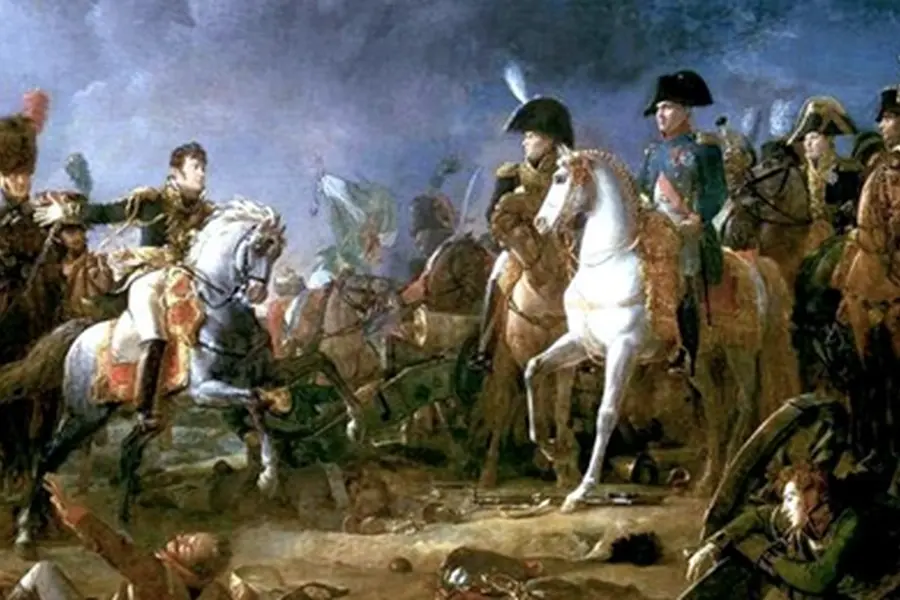
Austerlitz is often regarded as Napoleon's masterpiece. Napoleon deliberately made the French right appear vulnerable, encouraging the Allied commanders to commit heavily against it. When the Allied army committed heavily toward that sector, Napoleon struck the weakened center with overwhelming force. The capture of the Pratzen Heights split the Allied army and turned the battle into a decisive French victory. The battle is often called the Battle of the Three Emperors because Napoleon faced Emperor Francis II of Austria and Tsar Alexander I of Russia.
The victory destroyed the Third Coalition's immediate military position. Austria signed the Treaty of Pressburg, while Napoleon's influence over Germany expanded dramatically. In 1806, the Holy Roman Empire was dissolved after centuries as the central political framework of much of German-speaking Europe. Austerlitz belongs in any discussion of the most decisive battles in history because its consequences extended far beyond the battlefield.
The Prussian Campaign, 1806
Napoleon's victory over Austria and Russia did not end resistance. Prussia became increasingly alarmed by French domination of central Europe and entered the war in 1806. The result was catastrophic for the Prussian army. On 14 October 1806, two major battles took place almost simultaneously. Jena and Auerstedt. Napoleon defeated the main Prussian army at Jena, while Marshal Louis-Nicolas Davout fought and defeated a larger Prussian force at Auerstedt.
The speed of the French advance then turned battlefield defeat into national collapse. French troops entered Berlin, and Prussia was forced into a humiliating peace. The campaign demonstrated that Napoleon was not simply winning individual battles. He was destroying enemy armies through a combination of rapid marching, operational maneuver, and relentless pursuit.
The Polish Campaign, 1807
Napoleon's next enemy was Russia. The fighting shifted into Poland and East Prussia, where severe winter conditions made campaigning difficult. The first major confrontation was the Battle of Eylau in February 1807. Unlike Austerlitz or Jena, Eylau was not a clean French victory. The battle was exceptionally bloody and ended without a decisive destruction of the Russian army. Napoleon eventually recovered the initiative and defeated the Russians at Friedland on 14 June 1807. The victory brought Tsar Alexander I to the negotiating table.
The resulting Treaties of Tilsit temporarily transformed the European balance of power. Napoleon now dominated much of continental Europe, while Prussia had been drastically weakened. The Napoleonic Empire had reached its greatest territorial expansion yet, but Napoleon was also creating a dangerous problem. Nearly every defeated state remained a potential enemy waiting for an opportunity to recover. The apparent partnership between Napoleon and Alexander I was unstable, however, and disagreements over Poland, trade and the Continental System would eventually push the two powers back toward war.
The Peninsular War and Spain, 1808-1814
Spain became the war Napoleon could not finish. In 1808, Napoleon intervened directly in Spanish politics, eventually placing his brother Joseph Bonaparte on the Spanish throne. The move triggered widespread resistance. What Napoleon expected to be a manageable political operation developed into a prolonged war involving Spanish guerrillas, British troops and Portuguese forces. The Battle of Bailén in July 1808 was a shock. A French army surrendered to Spanish forces, demonstrating that French armies could be defeated outside the major continental battlefields where Napoleon normally concentrated his strength.
Napoleon personally entered Spain later in 1808 and defeated several Spanish forces, but the wider conflict could not be solved by a single campaign. British intervention under Sir Arthur Wellesley, later the Duke of Wellington, gradually transformed the peninsula into a permanent drain on French resources. The war became increasingly brutal. French troops faced ambushes, destroyed communications and irregular warfare, while the British and Portuguese developed a powerful defensive system based around fortified positions, supply networks and the use of terrain.
Important battles included Talavera, Salamanca and Vitoria. Wellington's victory at Vitoria in 1813 effectively destroyed French power in Spain. The Peninsular War matters enormously when explaining Napoleon's eventual downfall. It consumed soldiers and resources that Napoleon desperately needed elsewhere. The emperor could win enormous battles in central Europe while still losing control of the countryside in Spain.
The Austrian Campaign and Wagram, 1809
Austria saw an opportunity to strike back in 1809. Napoleon moved quickly into central Europe, but this campaign was more difficult than the lightning victories of 1805 and 1806. At Aspern-Essling in May 1809, Napoleon suffered one of his first major battlefield reverses. The French attempted to cross the Danube near Vienna, but fierce Austrian resistance and the disruption of the French bridges prevented Napoleon from sustaining the offensive. Napoleon regrouped and returned to the offensive. The climax came at Wagram on 5-6 July 1809, where a massive French army defeated the Austrians after two days of intense fighting.
Wagram was a victory, but it was not an effortless masterpiece like Austerlitz. Napoleon had begun to encounter opponents capable of adapting to his methods. The war also exposed the increasing cost of maintaining French dominance. The official Napoleon Foundation's chronology lists Eckmühl, Aspern-Essling and Wagram among the defining battles of the 1809 Austrian campaign. [5]
Napoleon's Invasion of Russia, 1812
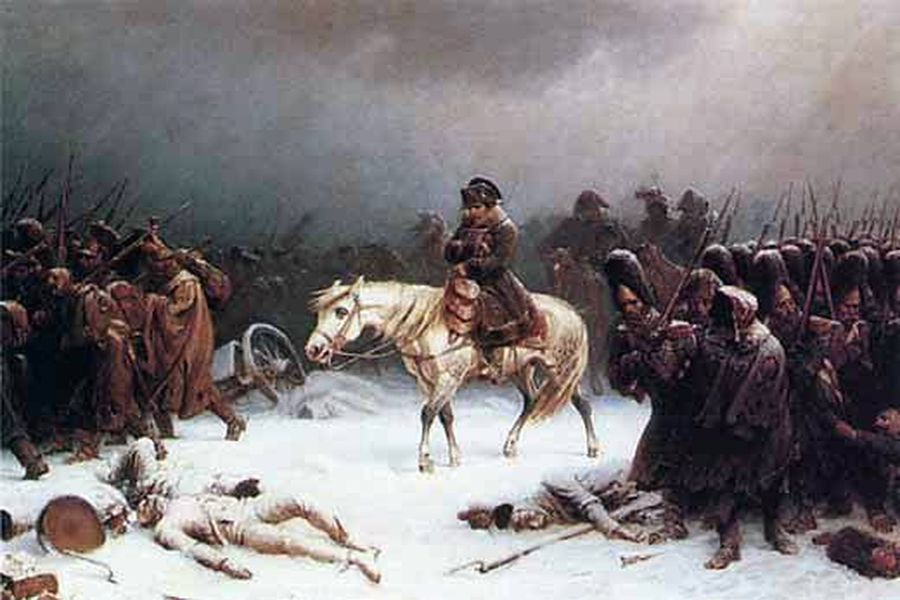
The invasion of Russia was the turning point of Napoleon's career. The Franco-Russian relationship established at Tilsit deteriorated over time. Economic pressure, disagreements over Poland, and Napoleon's Continental System contributed to the breakdown. In June 1812, Napoleon invaded Russia with an enormous multinational army generally known as the Grande Armée. The army crossed the Niemen and advanced deep into Russian territory. The Russians repeatedly withdrew rather than allowing Napoleon to destroy their main army in a decisive engagement.
There were major battles at Smolensk and later Borodino. The Battle of Borodino on 7 September 1812 was one of the bloodiest single days of the campaign. Napoleon gained the field, but the Russian army survived. That distinction was crucial. Napoleon entered Moscow expecting the occupation of the Russian capital to force Alexander I to negotiate. Instead, the city was largely abandoned, and fires destroyed substantial portions of it. No peace agreement followed. Napoleon finally began his retreat.
The retreat from Moscow became a catastrophe. Hunger, disease, exhaustion, inadequate supplies, desertion, attacks by Russian forces, and the enormous distances involved progressively destroyed the Grande Armée. Severe winter weather then compounded an already catastrophic retreat. The crossing of the Berezina River in November became one of the campaign's most famous episodes. The Russian campaign did not simply cost Napoleon soldiers. It destroyed much of the veteran core of his army. He could raise another army, but replacing experienced officers, cavalrymen, and veterans was far more difficult. The chronology published by the Fondation Napoléon places Smolensk, the Battle of the Moskva, the retreat, and Berezina among the defining events of the 1812 campaign. [6]
The German Campaign and Battle of Leipzig, 1813
Napoleon returned from Russia and rapidly assembled a new army. But the character of the war had changed. Prussia joined Russia, Austria eventually entered the coalition, and Napoleon's German allies became increasingly unreliable. Napoleon won victories at Lützen and Bautzen in 1813, demonstrating that his personal battlefield ability had not disappeared. But victory was no longer enough. Napoleon lacked the cavalry and experienced troops necessary to exploit his successes as effectively as he had before 1812.
The decisive confrontation came at Leipzig from 16-19 October 1813. Often called the Battle of Nations, Leipzig brought together enormous armies from France and the coalition. Russia, Prussia, Austria and Sweden participated in the coalition fighting Napoleon. Napoleon's position gradually became untenable as additional Allied forces arrived. The French were defeated and forced to retreat westward.
Leipzig was more than another battlefield defeat. It shattered Napoleon's control over Germany and encouraged former French allies to defect. According to the historical chronology of the Fondation Napoléon, the 1813 German campaign culminated in Leipzig before the emperor retreated toward France. [7] Leipzig was one of the largest battles fought in Europe before the First World War and one of the bloodiest confrontations of the Napoleonic era. [8]
The Campaign in France, 1814
In 1814, Napoleon was finally fighting on French soil. The coalition armies crossed into France while Napoleon attempted to use his remaining forces with remarkable aggressiveness. The Six Days' Campaign of February 1814 produced a series of victories at Champaubert, Montmirail, Château-Thierry and Vauchamps. These victories showed that the aging emperor was still capable of extraordinary operational maneuver. He repeatedly moved between coalition armies and defeated individually vulnerable forces.
But France could no longer replace the losses of years of warfare. Coalition armies eventually converged on Paris. Paris fell in March 1814, and Napoleon abdicated on 6 April. He was exiled to the island of Elba. For the first time in nearly two decades, Napoleon was no longer the dominant military power in Europe.
The Hundred Days and Waterloo, 1815
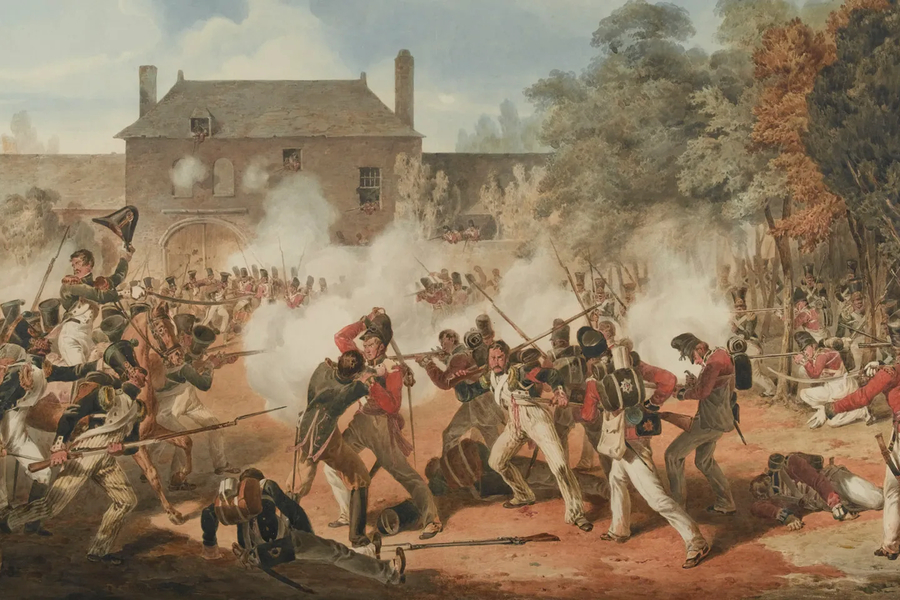
Napoleon's military career should have ended on Elba. Instead, in February 1815, he escaped and returned to France. His return created the extraordinary episode known as the Hundred Days. Napoleon rebuilt an army and faced a coalition that was already preparing for war. He understood that time was his enemy. If the British, Prussian, Austrian and Russian armies could combine, France would almost certainly be overwhelmed. Napoleon therefore attempted to defeat the coalition armies separately before they could unite.
His first major success came at Ligny on 16 June 1815, where the French defeated the Prussian army commanded by Gebhard von Blücher. But the Prussians were not destroyed. They withdrew and remained capable of returning to the battlefield. Two days later, Napoleon faced Wellington's Allied army at Waterloo. The battle began late after overnight rain had turned the ground into difficult terrain. Wellington occupied a strong defensive position and used farms such as Hougoumont and La Haye Sainte to anchor his line.
French attacks repeatedly failed to break the Allied army. Most importantly, the Prussian army arrived during the battle. Napoleon's strategy depended on keeping Wellington and Blücher separated. Ligny had driven the Prussians from the field, but they were able to withdraw toward Wavre and maintain contact with Wellington. Their arrival at Waterloo transformed the battle. The final attack by elements of the Imperial Guard was repulsed, and the failure shattered the remaining French army's ability to continue the battle. Napoleon's army disintegrated, and the emperor returned to Paris. He abdicated for the second time. Waterloo was therefore more than a tactical defeat. It ended Napoleon's attempt to recover power and brought the Napoleonic era to a definitive close. The battle took place on 18 June 1815 and was fought primarily between Napoleon's French army and Wellington's Allied army, with Blücher's Prussians playing a decisive role in the outcome. [9]
Why Was Napoleon So Successful?
Napoleon's victories were not produced by one secret tactic. His strength came from combining several military advantages into a coherent system.
| Napoleonic principle | How it worked | Example |
|---|---|---|
| Speed | Rapid marches allowed French forces to concentrate before the enemy could react. | Italy, 1796; Jena, 1806 |
| Corps system | Large formations could march separately and concentrate for battle. | 1805 campaign |
| Concentration | Napoleon sought overwhelming local superiority at decisive points. | Austerlitz, 1805 |
| Artillery | Massed guns could batter key enemy positions before infantry or cavalry attacks. | Friedland, Wagram |
| Operational maneuver | French armies attempted to threaten enemy communications and rear areas. | Ulm, 1805 |
| Flexible command | Marshals and corps commanders could operate independently within Napoleon's broader plan. | 1806 and 1807 campaigns |
| Morale | Napoleon cultivated loyalty, ambition, and identification with the army's victories. | Grande Armée |
The French military system also benefited from the transformation of warfare during the Revolution. France could mobilize much larger numbers of soldiers than many traditional European monarchies. Napoleon's genius was less about inventing an entirely new form of warfare than about combining Revolutionary France's manpower, corps organization, mobility, artillery and aggressive operational command into an exceptionally effective system. His leadership was particularly powerful because he understood the relationship between battlefield success and morale. Victory generated confidence, confidence encouraged aggressive maneuver, aggressive maneuver could generate another victory. This psychological dimension is one reason Napoleon belongs in any serious discussion of the greatest military generals in history.
Why Did Napoleon's Military System Fail?
Napoleon's decline cannot be explained simply by saying that he became a worse general. His enemies learned, adapted, and became stronger, while the strategic problems confronting France became increasingly difficult. Several weaknesses accumulated.
- Too many enemies: Napoleon repeatedly defeated individual coalitions, but France eventually faced several major powers simultaneously.
- Overextension: The French Empire became too large to control easily.
- Spain: The Peninsular War tied down French troops and resources for years.
- Russia: The 1812 campaign destroyed much of the veteran Grande Armée.
- Cavalry losses and attrition: The Russian campaign severely weakened the experienced cavalry Napoleon relied upon for reconnaissance and pursuit. Continuous warfare also meant that France was not able to replace veteran troops quickly.
- Coalition learning: Austria, Prussia and Russia increasingly adapted their armies and operational methods to counter Napoleon.
- Economic warfare: Napoleon's attempt to weaken Britain through the Continental System created political and economic problems across Europe.
The Legacy of Napoleon's Wars
Napoleon fought across Europe for roughly two decades, but the consequences of his wars lasted much longer. His victories spread French political and legal influence across large parts of Europe. The Napoleonic Code influenced legal systems far beyond France. Old political structures disappeared, German states were reorganized, and ideas associated with the French Revolution spread even where French armies were resisted. At the same time, Napoleon's domination helped stimulate powerful forms of nationalism. Germans, Spaniards, Russians and others increasingly defined themselves in opposition to French imperial rule.
The military legacy was equally profound. Napoleon demonstrated the enormous potential of operational mobility, mass armies, corps organization and concentrated artillery. European states responded by reforming their own armies. His career also offers a striking contrast with earlier conquerors. Napoleon admired figures such as Alexander the Great and studied the campaigns of antiquity. The parallels between them are fascinating. Both commanders built enormous multinational empires through rapid campaigns and repeated decisive victories.
Yet Napoleon's wars were fought in a fundamentally different military world. Mass conscription, increasingly professional staff systems, large artillery trains and sophisticated logistics made early nineteenth-century warfare vastly different from the warfare of Alexander, Hannibal or Caesar. Ultimately, Napoleon's career is compelling because it contains both extremes of military history. At Austerlitz, he demonstrated how brilliantly an army could be maneuvered. In Russia, he discovered the limits of even an enormous army. At Waterloo, he found that the European powers had learned to coordinate against him.
His wars therefore tell a larger story than that of one brilliant commander. They show how military innovation can transform international politics-and how even the most successful military system can eventually be overwhelmed by distance, resistance, resources, and a coalition determined to learn from its defeats.
References and Further Reading
- Fondation Napoléon. Chronologies des batailles et des campagnes menées par l'Empereur. Napoleon.org campaign and battle chronology.
- Fondation Napoléon. Timeline: Consulate/First French Empire. Napoleon's campaigns and political chronology.
- Fondation Napoléon. The Egyptian Campaign. Chronology of the Egyptian Campaign, 1798-1801.
- Fondation Napoléon. In the Footsteps of Napoleon I. Overview of Napoleon's early campaigns and military career.
- Fondation Napoléon. Austerlitz, 2 December 1805: A Timeline. Austerlitz campaign chronology.
- Napoleon Series. Battles and Campaigns. A specialist research collection containing military studies, orders of battle, eyewitness accounts and translated archival material. Napoleon Series military archive.
- Napoleon Series. Eyewitness Accounts. A collection of memoirs, letters and firsthand accounts from soldiers and officers of the Napoleonic Wars. Napoleonic eyewitness accounts.
- David G. Chandler. The Campaigns of Napoleon: The Mind and Method of History's Greatest Soldier. Macmillan, 1966. A major study of Napoleon's military campaigns and operational methods.
- Alexander Mikaberidze. The Napoleonic Wars: A Global History. Oxford University Press, 2020. A broad modern treatment placing Napoleon's European wars within their wider international context.
- Andrew Roberts. Napoleon: A Life. Viking, 2014. A modern biography examining Napoleon's military career alongside his political and personal life.
- Charles Esdaile. The Peninsular War: A New History. Palgrave Macmillan, 2003. A detailed study of the conflict in Spain and Portugal and its importance to Napoleon's downfall.
- Adam Zamoyski. 1812: Napoleon's Fatal March on Moscow. HarperPress, 2004. A detailed reconstruction of the Russian campaign and its catastrophic retreat.
Books and Memorables
This article may contain affiliate links. If you purchase through these links, I may earn a small commission at no extra cost to you.


Related Articles
Frequently Asked Questions
What were Napoleon's major military campaigns?
Napoleon's major military campaigns included the First Italian Campaign of 1796–1797, the Egyptian Campaign of 1798–1799, the Second Italian Campaign of 1800, the 1805 campaign against the Third Coalition, the Prussian and Polish campaigns of 1806–1807, the Peninsular War in Spain and Portugal, the Austrian campaign of 1809, the invasion of Russia in 1812, the German Campaign of 1813, the Campaign in France of 1814, and the Hundred Days campaign of 1815. Together, these campaigns trace Napoleon's rise from revolutionary general to emperor and his eventual defeat at Waterloo.
Which battles show Napoleon's military strategy at its best?
Several battles demonstrate different aspects of Napoleon's military strategy. Austerlitz in 1805 is often considered his greatest battlefield masterpiece because he deliberately encouraged the Allied army to weaken its center before attacking it decisively. Ulm demonstrated his ability to defeat an enemy through operational maneuver, while Jena-Auerstedt showed the effectiveness of rapid concentration and coordinated corps. Friedland and the Six Days' Campaign of 1814 also demonstrate Napoleon's ability to defeat larger forces through speed and maneuver.
Why did Napoleon's invasion of Russia fail in 1812?
Napoleon's invasion of Russia failed because his enormous army had to operate across vast distances while the Russians repeatedly withdrew rather than allowing themselves to be decisively destroyed. Supply problems worsened as the Grande Armée advanced deeper into Russia. Although Napoleon won the Battle of Borodino and occupied Moscow, Tsar Alexander I refused to negotiate. The subsequent retreat exposed the army to hunger, disease, exhaustion, attacks and severe winter conditions, destroying much of Napoleon's veteran army.
What was Napoleon's most important victory before Waterloo?
Austerlitz in 1805 is generally considered Napoleon's most important victory before Waterloo. The battle destroyed the immediate military strength of the Third Coalition and forced Austria to seek peace. It also established Napoleon's reputation as one of Europe's most formidable commanders. The victory had political consequences beyond the battlefield, helping Napoleon reorganize Germany and accelerating the eventual dissolution of the Holy Roman Empire.
How did the Peninsular War weaken Napoleon's empire?
The Peninsular War weakened Napoleon by tying down large numbers of French troops in Spain and Portugal for years. French forces faced Spanish resistance, guerrilla warfare and British and Portuguese armies commanded by Arthur Wellesley, later the Duke of Wellington. Battles such as Bailén, Salamanca and Vitoria demonstrated the limits of French control. The prolonged conflict consumed soldiers and resources that Napoleon needed for his wider European wars and became one of the major factors contributing to the weakening of French power.
Why did Napoleon lose the Battle of Waterloo after winning so many battles?
Napoleon lost Waterloo because the strategic circumstances of 1815 were very different from those of his earlier victories. He attempted to defeat Wellington's Allied army and the Prussian army separately, but the Prussians were able to retreat after Ligny and return to the battlefield at Waterloo. Wellington's defensive position proved difficult for the French to break, while repeated French attacks failed to produce a decisive breakthrough. The arrival of Blücher's Prussian forces placed additional pressure on Napoleon's army and helped turn the battle into his final defeat.
Add Comment