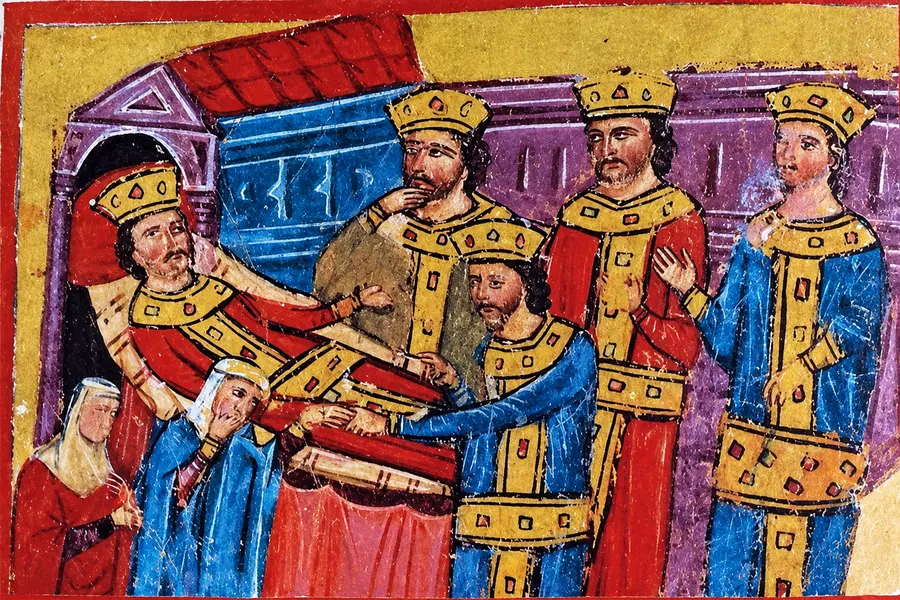
The Wars of the Diadochi were the brutal succession wars that followed the death of Alexander the Great in 323 BC, as his generals, relatives, and former companions fought for control of the largest empire the ancient Mediterranean world had yet seen. For more than four decades, men such as Antigonus, Ptolemy, Seleucus, Lysimachus, Cassander, and Eumenes fought across Greece, Egypt, Anatolia, Syria, Mesopotamia, Persia, and beyond. Their wars destroyed the political unity Alexander had created but also gave birth to the Hellenistic kingdoms that dominated the eastern Mediterranean and Near East for centuries.
What makes the Wars of the Diadochi especially fascinating is that they were not simply a series of battles between ambitious generals. They were a struggle over the inheritance of the World's largest empire. The empire changed hands repeatedly as alliances shifted, kings were murdered, armies defected, and enormous territories were traded. This is the story of how Alexander's empire was divided, why the Diadochi turned against one another, how Antigonus the One-Eyed nearly reunited the empire, why the Battle of Ipsus in 301 BC became the decisive turning point, and how the final survivors created the Seleucid, Ptolemaic, and Antigonid worlds of the Hellenistic age.
Table of Contents
- Alexander the Great's Conquest and His Sudden Death
- Who Were the Diadochi?
- The First Settlement of the Empire
- The First War of the Diadochi
- The Settlement of Triparadeisus
- The Second War of the Diadochi
- Eumenes vs. Antigonus: The Battle of Gabiene
- Antigonus the One-Eyed: The Man Who Nearly Reunited Alexander's Empire
- The Third War of the Diadochi
- The Peace of 311 BC: The Empire Is Dying
- The Battle of Ipsus: The Decisive Moment
- The Final Wars: Lysimachus, Seleucus and the Last Diadochi
- Why Did Alexander's Empire Collapse?
- The Legacy of the Wars of the Diadochi
- References and Primary Sources
Alexander the Great's Conquest and His Sudden Death
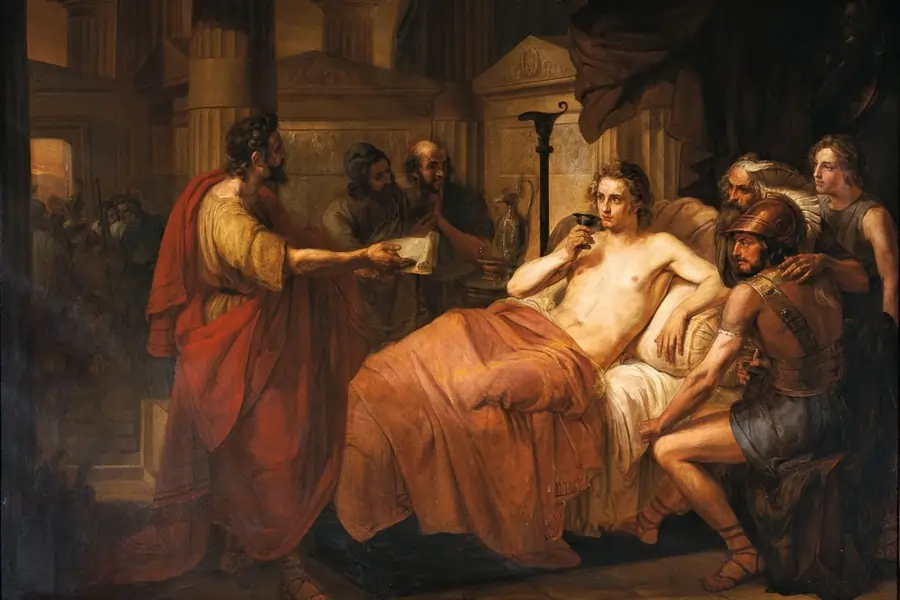
Alexander III of Macedon inherited an extraordinarily powerful military machine from his father, Philip II, in 336 BC. Philip had united Macedon, subdued the Greek states, and created the military framework that Alexander would use to invade the Persian Empire. Alexander's conquest began in 334 BC when he crossed the Hellespont into Asia. His victories at the Battle of the Granicus, Issus, and ultimately Gaugamela shattered Persian resistance. By 331 BC, the Achaemenid Empire was effectively broken. Alexander captured Babylon, Susa, and Persepolis before pursuing the Persian king Darius III into the eastern provinces.
His campaigns then carried him through Bactria and Sogdiana and into the Indian subcontinent. The Battle of the Hydaspes against King Porus in 326 BC demonstrated that Alexander could still win major battles thousands of kilometres from Macedon, but his soldiers were increasingly exhausted. His soldiers, exhausted after years of campaigning and reluctant to advance farther into India, eventually refused to continue beyond the Hyphasis. Alexander returned toward Mesopotamia by a disastrous route through the Gedrosian Desert. The catastrophic journey cost the army heavily, as described in greater detail in Alexander's Gedrosian Desert Crossing.
Yet Alexander was still thinking about conquest. According to Diodorus Siculus, Alexander's plans included enormous naval projects, new cities, major temple construction, and further expeditions to the western Mediterranean.[1] His empire was therefore not a finished political system when he returned to Babylon. It was still expanding. In June 323 BC, Alexander suddenly fell seriously ill in Babylon. Ancient sources describe a prolonged fever, although later writers also preserved stories of poisoning. The precise cause of death remains uncertain. The ancient evidence is discussed in greater detail in How Did Alexander the Great Die?
Alexander died at approximately 32 years of age. The problem was immediate. He had conquered an enormous empire but had not created an undisputed mechanism for succession. His wife, Roxana, was pregnant, while hishalf-brother Philip III Arrhidaeus was not in a position to exercise independent authority, while Alexander IV was still unborn. The question of who would rule therefore became a political and military crisis. Diodorus records the famous tradition that when Alexander was asked to whom he left his kingdom, he replied with the Greek word kratistos, commonly understood as "to the strongest."[2] Whether the story preserves Alexander's exact words or later tradition, it perfectly captured the reality that followed. His empire had no single obvious successor.
Who Were the Diadochi?
The Greek word Diadochoi means "Successors." It is the name modern historians use for the commanders and political figures who competed for Alexander's inheritance. They were not all equally powerful, and they did not form a permanent group. Some died during the first decade of conflict; others rose only later. Their ambitions also changed over time.
| Figure | Position and Territory | Historical Significance |
|---|---|---|
| Perdiccas | Regent of the empire | Initially attempted to preserve central authority |
| Antipater | Macedonia and Greece | Experienced Macedonian commander and political stabilizer |
| Craterus | Senior Macedonian commander | One of Alexander's most respected generals |
| Ptolemy | Egypt | Founder of the Ptolemaic dynasty |
| Antigonus | Much of Anatolia and later Asia | The strongest early challenger to imperial unity |
| Seleucus | Babylonia and later the eastern empire | Founder of the Seleucid dynasty |
| Lysimachus | Thrace | Major power in northern Anatolia and Thrace |
| Eumenes | Cappadocia and later eastern territories | Brilliant general who fought for the royal house |
| Cassander | Macedonia | Eventually established control over Macedon |
One of the remarkable features of the conflict was the prominence of Eumenes of Cardia. Unlike most of the major commanders, Eumenes was Greek rather than Macedonian. His survival depended less on inherited military prestige than on intelligence, diplomacy, and tactical ability. His career illustrates why the Wars of the Diadochi cannot simply be reduced to "Alexander's generals fighting." These were experienced political operators dealing with armies, satraps, cities, dynastic claims, treasuries, and competing ideas of legitimacy.
The First Settlement of the Empire
The first attempt to prevent the empire from collapsing came at Babylon immediately after Alexander's death. The settlement attempted to preserve the Argead monarchy while distributing actual power among the commanders. Philip III Arrhidaeus was recognized as king, while Alexander and Roxana's unborn child would become a second king if the child were male. Roxana subsequently gave birth to Alexander IV. Perdiccas emerged as the dominant regent, while Antipater retained control of Macedonia and Greece. Ptolemy received Egypt, Lysimachus received Thrace, Antigonus received Great Phrygia, Lycia, and Pamphylia, and Eumenes received Cappadocia and Paphlagonia.[3]
Unlike Ptolemy, Antigonus, Lysimachus, and Eumenes, Seleucus did not initially receive a major satrapy. He instead held the prestigious command of the Companion cavalry before receiving Babylonia at Triparadeisus. The arrangement looked orderly on paper. In reality, it contained the seeds of future war. Every commander possessed soldiers. Several controlled wealthy provinces. The royal family was young and politically vulnerable. Most importantly, there was no permanent political institution capable of compelling the generals to obey the regent.
The First War of the Diadochi
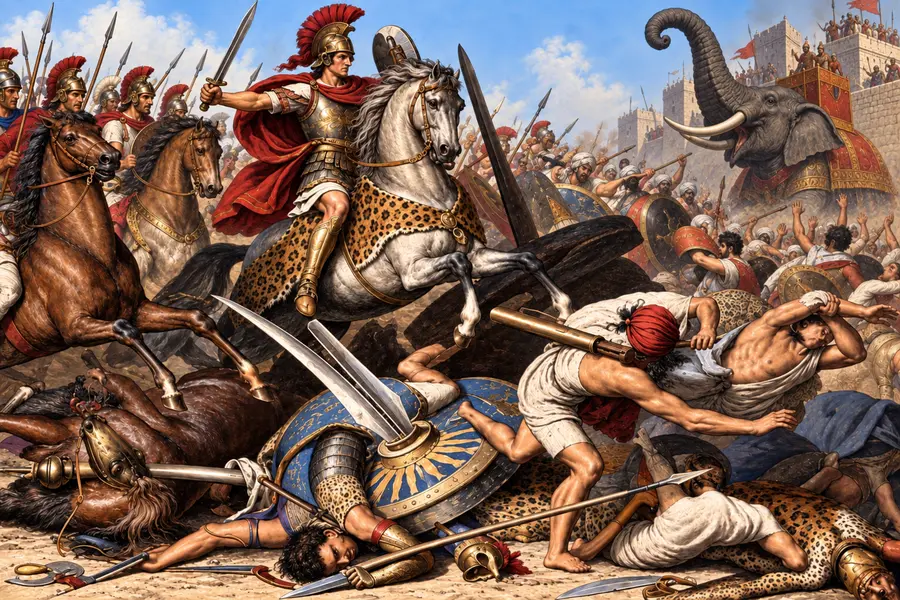
The first major conflict began almost immediately. News of Alexander's death encouraged rebellion in Greece. Athens and several Greek states launched what became known as the Lamian War against Macedonian authority. Antipater initially suffered setbacks and was forced to seek refuge in Lamia. The crisis demonstrated that Macedon itself was not automatically secure simply because Alexander had conquered Greece.
At the same time, Perdiccas increasingly appeared determined to strengthen the authority of the central regency. This alarmed other commanders, especially Ptolemy, whose independent control of Egypt made him difficult to dominate. The central dispute eventually became a coalition war. Antipater, Craterus, Antigonus, and Ptolemy opposed Perdiccas, while Eumenes remained loyal to the regent. Eumenes proved particularly important because he defeated Neoptolemus and then faced Craterus in battle. According to Diodorus, Eumenes commanded roughly 20,000 infantry and 5,000 cavalry, while Craterus had around 20,000 infantry and more than 2,000 cavalry.[4]
Craterus was killed in the fighting. His death was politically significant. Craterus was one of the most respected Macedonian commanders and had strong personal connections with Alexander's veterans. His loss strengthened the perception that the empire's most senior generation of commanders was destroying itself. Perdiccas then invaded Egypt, where Ptolemy had established a remarkably strong position. The campaign ended disastrously. Perdiccas failed to force a successful crossing of the Nile, suffered heavy losses, and was eventually assassinated by his own officers in 321 BC.[5] The first attempt to maintain Alexander's empire under a single regent had failed.
The Settlement of Triparadeisus
After Perdiccas' death, the surviving commanders met at Triparadeisus in Syria in 321 BC. This settlement reorganized the empire once again.
| Leader | Major Position |
|---|---|
| Antipater | Regent and supreme commander |
| Ptolemy | Confirmed in Egypt |
| Antigonus | General of the royal army in Asia |
| Seleucus | Satrap of Babylonia |
| Lysimachus | Thrace |
| Eumenes | Maintained as a major enemy of Antigonus |
The settlement effectively made Antigonus the principal military instrument of the royal government in Asia. His assignment was to destroy the remaining forces loyal to Eumenes and other enemies. This decision would create a new power struggle. Antigonus was no longer simply another satrap. He was becoming the commander with the largest independent military base in Asia.
The Second War of the Diadochi
The second phase of the Wars of the Diadochi grew out of the death of Antipater in 319 BC. Instead of leaving the regency to his son Cassander, Antipater appointed the veteran Polyperchon. Cassander considered this unacceptable and eventually allied himself with Antigonus. The conflict soon became entangled with the royal family. Olympias, Alexander's mother, returned to Macedonia and helped overthrow Philip III Arrhidaeus and his wife Eurydice. Cassander later defeated Olympias and had her executed.
Meanwhile, Eumenes remained one of the most determined defenders of the royal dynasty. Antigonus pursued him across Asia, but Eumenes repeatedly survived through a combination of tactical skill and political maneuvering. At one point he took refuge in the fortress of Nora, where his small force resisted Antigonus. The struggle eventually moved into the eastern provinces, where Eumenes gathered support from satraps who feared Antigonus' growing power.
Eumenes vs. Antigonus: The Battle of Gabiene
The Battle of Gabiene in 316 BC was one of the strangest victories in ancient military history because Eumenes arguably performed better on the battlefield yet still lost the war. By this stage, Eumenes commanded a huge multinational army containing Macedonian veterans, eastern troops, cavalry, and elephants. Antigonus had also built a formidable army. Diodorus gives Eumenes approximately 36,700 infantry, 6,000 cavalry, and 114 elephants. Antigonus had more than 28,000 infantry, 8,500 cavalry, and 65 elephants.[6]
The battle itself demonstrated the continuing effectiveness of veteran Macedonian infantry. Eumenes' Silver Shields were particularly formidable. Diodorus describes them as older soldiers, many around sixty or seventy years of age, but extraordinarily experienced.[7] The infantry battle went heavily in Eumenes' favour. The Silver Shields reportedly routed the opposing phalanx. Antigonus, however, had a different objective. While the main armies were engaged, his cavalry attacked Eumenes' baggage train. The move changed everything.
The baggage contained the families and possessions of many soldiers. Once it was captured, Eumenes' army faced a crisis of morale and loyalty. His soldiers no longer cared only about tactical victory; they wanted their families and property back. The Silver Shields seized Eumenes and handed him over to Antigonus, effectively securing the return of their families and possessions.[8] Eumenes was executed. The tragedy was profound. He had spent years fighting in the name of Alexander's royal house, but the very soldiers who had won the battle for him ultimately delivered him to his enemy.
Antigonus the One-Eyed: The Man Who Nearly Reunited Alexander's Empire
With Eumenes dead, Antigonus became the most powerful military figure in Asia. He now controlled an enormous territory stretching across much of Anatolia and the eastern provinces. He also seized immense royal wealth. Diodorus reports that the treasure accumulated under Antigonus reached tens of thousands of talents.[9] Antigonus was no longer interested in merely defending his satrapy. He wanted supremacy. His ambition represented the closest serious attempt to reunite Alexander's empire under a single successor. This is why Antigonus is central to understanding the Wars of the Diadochi.
His greatest advantage was military power. His greatest weakness was that the other successors understood exactly what he was attempting. Ptolemy feared an Asian power capable of dominating Syria and the eastern Mediterranean. Seleucus wanted to recover Babylonia. Lysimachus wanted to preserve his position in Thrace and Anatolia. Cassander wanted Macedonia and Greece. Antigonus therefore created the very coalition that would eventually destroy him.
The Third War of the Diadochi
By 315 BC, Cassander, Ptolemy, Lysimachus, and Seleucus had reasons to oppose Antigonus. Seleucus was particularly important. Antigonus had taken control of Babylonia, forcing Seleucus to flee to Egypt. Rather than accepting defeat, Seleucus persuaded Ptolemy to support him. Seleucus eventually returned to Babylonia and began rebuilding his power. This was one of the most consequential developments of the entire Diadochi period. Seleucus did not merely recover a satrapy; he established the territorial base from which the Seleucid Empire would emerge.
Antigonus fought on multiple fronts. He also used the language of Greek freedom to undermine his opponents, presenting himself as a defender of the autonomy of Greek cities. The war therefore became a mixture of military campaigns, propaganda, diplomacy, sieges, naval warfare, and dynastic politics. Antigonus' son Demetrius emerged as an important commander. His victories, particularly in the eastern Mediterranean, demonstrated that the next generation of Macedonian rulers was beginning to replace the original companions of Alexander.
The Peace of 311 BC: The Empire Is Dying
By 311 BC, none of the major powers had achieved a decisive victory. The resulting Peace of 311 BC was therefore less a genuine settlement than a recognition of reality. The treaty formally recognized the major territorial positions of the competing rulers. Cassander was recognized as general of Europe until Alexander IV reached maturity. Lysimachus retained Thrace, Ptolemy retained Egypt, and Antigonus was recognized as the leading authority in Asia. The Greek cities were also formally associated with the principle of autonomy.[10]
There was a devastating irony. The treaty still acknowledged Alexander IV as the future king. But the political system had already made his survival dangerous. Alexander IV was the legitimate son of Alexander the Great. As long as he lived, the Diadochi could theoretically claim to rule only as guardians or representatives of the royal house. Alexander IV and his mother Roxana were eventually murdered on Cassander's orders around 310/309 BC. Alexander's legitimate male line had effectively disappeared. The political fiction of a united Macedonian Empire was now almost impossible to maintain.
The Battle of Ipsus: The Decisive Moment
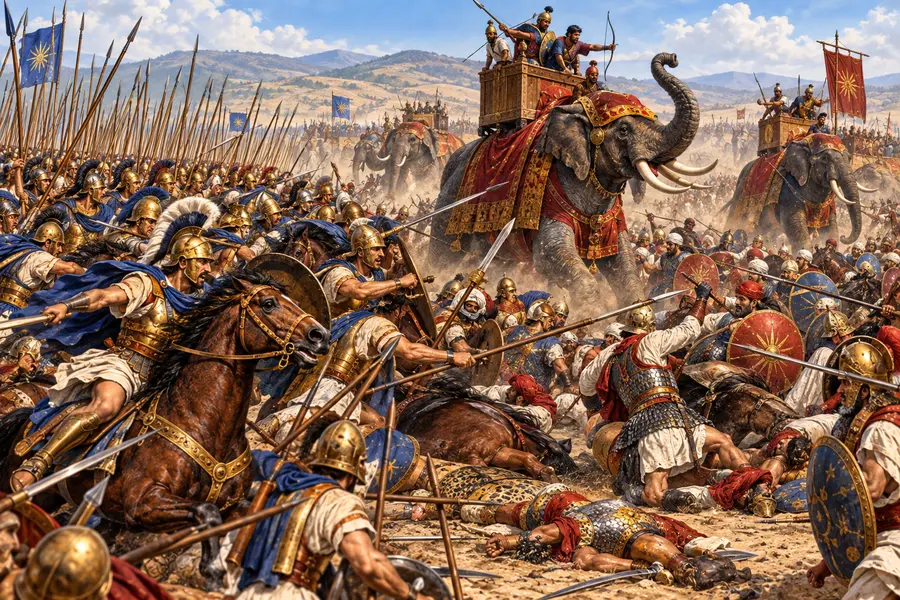
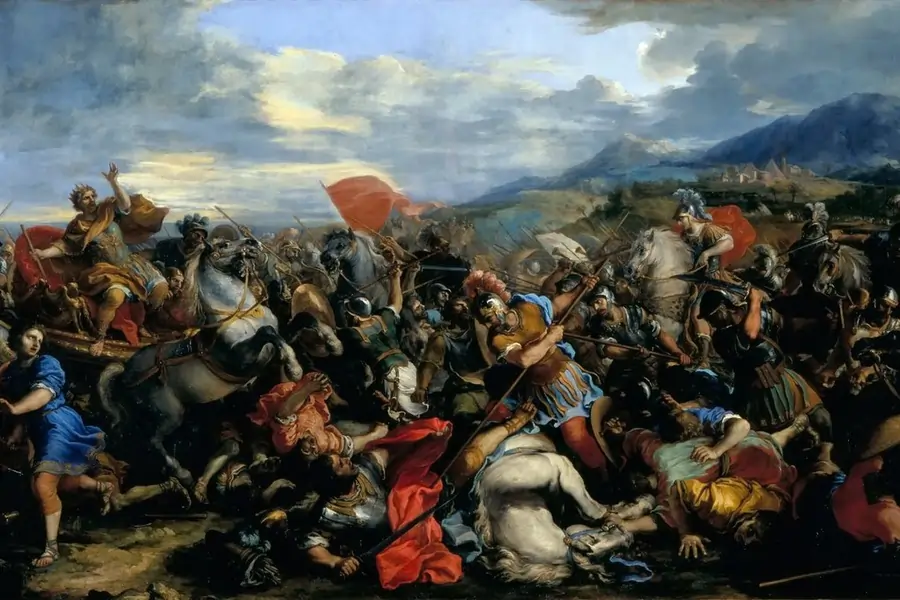
If the death of Alexander began the collapse of his empire, the Battle of Ipsus in 301 BC made the division permanent. Antigonus, by then in his seventies or possibly older, remained determined to dominate the successor states. His son Demetrius was one of the most talented commanders of his generation. The coalition against them consisted primarily of Seleucus and Lysimachus, with Cassander supporting the anti-Antigonid cause. Ptolemy did not participate in the battle itself. According to the ancient account, he withdrew after believing he had achieved a victory elsewhere.[11]
The armies assembled near Ipsus in Phrygia. Ancient accounts give enormous numbers. Plutarch records that Antigonus possessed more than 70,000 infantry, 10,000 cavalry, and 75 elephants, while his opponents fielded approximately 64,000 infantry, 10,500 cavalry, 400 elephants, and 120 scythed chariots.[12] Ancient numerical figures must be treated cautiously, but the basic picture is clear. Ipsus was a massive Hellenistic battle.
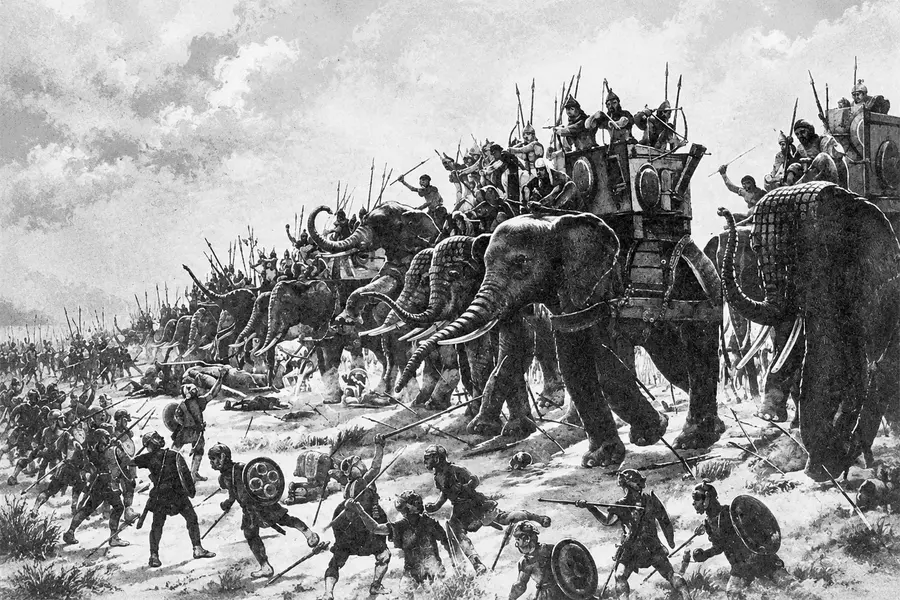
The decisive weapon was the elephant. Demetrius defeated the opposing cavalry on his wing and pursued them. But this success created a dangerous separation from the main army. Seleucus exploited the opening with his large elephant force. The elephants effectively created a wall between Demetrius' cavalry and the battlefield. Demetrius could not return to support his father. Antigonus was left exposed.
Enemy cavalry and infantry closed around his position, and the elderly commander was struck by multiple missiles and killed.[13] With Antigonus dead, the last serious attempt to reunite Alexander's empire under one ruler had failed. Ipsus therefore deserves its reputation as one of the decisive battles of the ancient world. It permanently changed the balance of power in the Hellenistic East and divided Antigonus' former territories among his enemies.
The Final Wars: Lysimachus, Seleucus and the Last Diadochi
Ipsus did not immediately end the Wars of the Diadochi. Demetrius survived and continued to play a major role. He eventually seized Macedonia in 294 BC, becoming king there, although his position remained unstable. Lysimachus and Pyrrhus of Epirus eventually drove Demetrius out of Macedonia. Demetrius then turned toward Asia but was captured by Seleucus. He died in captivity in 283 BC. By this stage the original generation of Alexander's commanders was disappearing.
Ptolemy had established himself securely in Egypt, creating the Ptolemaic dynasty. Seleucus controlled the enormous eastern territories of the former empire and founded the Seleucid dynasty. Lysimachus ruled Thrace and large parts of Asia Minor. But the final confrontation came between Lysimachus and Seleucus. In 281 BC, their armies met at the Battle of Corupedium in western Anatolia. Lysimachus was killed, leaving Seleucus as the dominant surviving Diadoch.[14] Yet Seleucus himself would survive his final victory for only a brief time. He was assassinated later in 281 BC by Ptolemy Ceraunus. In a remarkable twist, the man who had begun his career as one of Alexander's relatively minor commanders had become the last great survivor of the original Diadochi generation.
Why Did Alexander's Empire Collapse?
The collapse of Alexander's empire was not caused by one mistake. It resulted from several structural weaknesses that became visible immediately after his death.
There Was No Clear Adult Successor
Alexander died before establishing an uncontested adult heir. His son Alexander IV was an infant, while Philip III Arrhidaeus could not personally dominate the competing commanders. This created a vacuum at the top of the empire.
The Empire Was Too Large to Control Personally
Alexander's territories stretched from Greece to Egypt and from Anatolia through Mesopotamia into Central Asia and India. Communication was slow, regional armies were powerful, and governors could build independent political bases. The same logistical achievements that allowed Alexander to conquer such an enormous territory could not automatically create a stable administration after his death. His remarkable military logistics are explored in How Alexander the Great Managed Logistics.
The Macedonian Army Was Also a Political Institution
Alexander's soldiers were not simply passive servants of a bureaucracy. The Macedonian army could influence succession, recognize kings, abandon commanders, and sometimes determine who held power. The surrender of Eumenes at Gabiene is one of the clearest examples. Tactical victory did not guarantee political survival.
The Generals Had Their Own Power Bases
Ptolemy had Egypt. Lysimachus had Thrace. Antigonus controlled Anatolia. Seleucus eventually controlled Babylonia and the eastern provinces. These territories supplied money, soldiers, cities, and strategic depth. Once these commanders realized they could survive independently, there was little reason to submit permanently to another successor.
Alexander's Empire Had Not Become a Nation-State
Alexander had conquered an empire rather than created a unified nation in the modern sense. Macedonian, Greek, Egyptian, Iranian, Central Asian, and Indian political traditions continued to coexist. Alexander had experimented with cultural integration and elite intermarriage, but these policies were incomplete when he died. The successors therefore inherited a vast imperial structure without inheriting a universally accepted imperial identity.
The Legacy of the Wars of the Diadochi
The Wars of the Diadochi destroyed Alexander's unified empire, but they did not destroy his influence. Instead, they created the Hellenistic world. Three major dynastic powers eventually dominated the former empire.
| Dynasty | Founder | Core Territory | Major Centre |
|---|---|---|---|
| Ptolemaic | Ptolemy I | Egypt and eastern Mediterranean possessions | Alexandria |
| Seleucid | Seleucus I | Syria, Mesopotamia and much of the former eastern empire | Seleucia and Antioch |
| Antigonid | Antigonus' dynasty | Macedonia and Greece | Macedonia |
The political fragmentation of Alexander's empire therefore produced something new rather than simply returning the Near East to its pre-Alexander condition. Greek became a major language of administration, trade, and elite culture across huge areas. New cities were founded, older cities expanded, and Greek and local traditions interacted in ways that would shape the Mediterranean and Near East for centuries. Alexandria became one of the great intellectual centres of the ancient world. Seleucid rulers founded cities and administrative centres across Asia. Macedon remained a major military power in Greece.
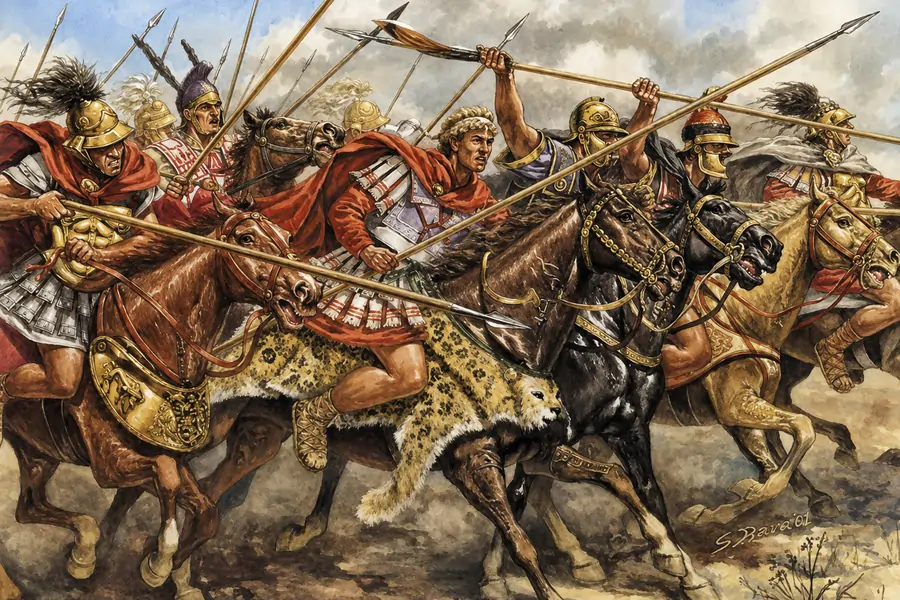
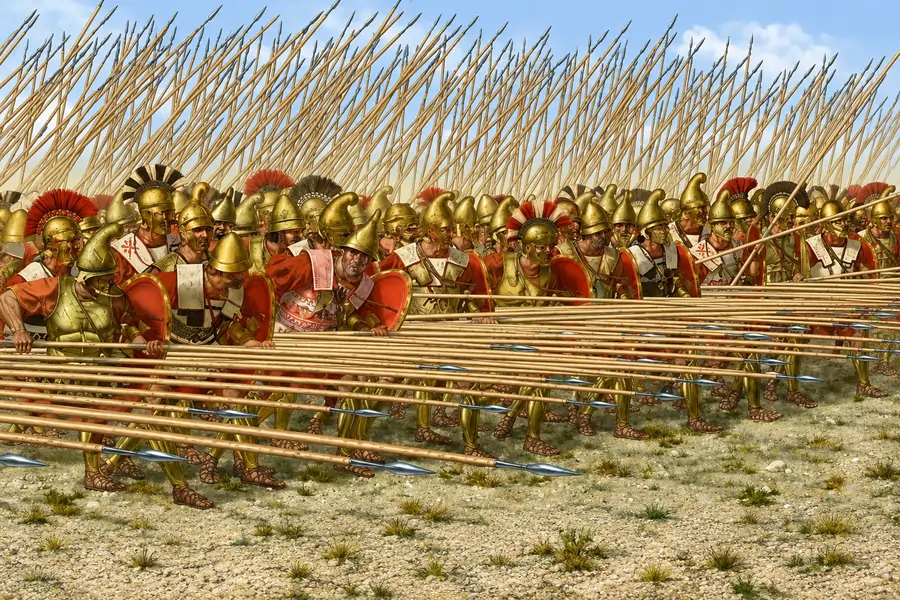
The military legacy was equally important. The successors continued to develop the Macedonian phalanx, companion-style cavalry, siege warfare, and increasingly sophisticated use of war elephants. The armies of the Hellenistic kingdoms were therefore descendants of Alexander's military system, but they were also products of the wars fought after his death. The very soldiers who had helped conquer Persia became the foundation of rival kingdoms. The later Roman confrontation with the Hellenistic kingdoms would eventually transform the balance of power again. Rome's encounters with Macedonian armies demonstrated both the strengths and limitations of the successor military system. Its confrontation with Rome is examined in Why the Roman Legion Defeated the Macedonian Phalanx.
The Wars of the Diadochi also changed the meaning of Alexander's legacy. The successors did not abandon his memory. Instead, they competed to inherit it. Coins continued to use Alexander's imagery. Royal propaganda invoked his achievements. Cities claimed connections to his conquests. Kings presented themselves as legitimate heirs to the world he had created. In that sense, Alexander's empire survived politically through fragmentation. His successors could not preserve the empire as one state, but none of them could escape the political world he had created.
References and Primary Sources
The Wars of the Diadochi are reconstructed from a difficult body of evidence. Much of the detailed contemporary history has been lost, meaning that later authors such as Diodorus Siculus and Plutarch are particularly important. Diodorus' Books XVIII-XX preserve extensive material concerning the succession wars, while Plutarch's Lives of Eumenes and Demetrius provide important narrative perspectives on two of the principal commanders.
- Diodorus Siculus, Library of History, Book XVII - Alexander's final campaigns and death in Babylon.
- Diodorus Siculus, Library of History, Book XVII.117-118 - Alexander's final illness and succession tradition.
- Diodorus Siculus, Library of History, Book XVIII.3-4 - The Babylonian settlement and initial division of the satrapies.
- Diodorus Siculus, Library of History, Book XVIII.29-32 - Eumenes, Craterus and the first succession war.
- Diodorus Siculus, Library of History, Book XVIII.33-36 - Perdiccas' Egyptian campaign and death.
- Diodorus Siculus, Library of History, Book XIX.27-43 - The campaigns of Eumenes and Antigonus and the Battle of Gabiene.
- Diodorus Siculus, Library of History, Book XIX.28 - The Silver Shields and their battlefield reputation.
- Diodorus Siculus, Library of History, Book XIX.43-44 - The surrender and execution of Eumenes.
- Diodorus Siculus, Library of History, Book XIX.48 - Antigonus' accumulation of royal treasure.
- Diodorus Siculus, Library of History, Book XIX.105 - The Peace of 311 BC.
- Diodorus Siculus, Library of History, Books XIX-XX - The campaigns leading to Ipsus.
- Plutarch, Library of History, 28-30 - The coalition against Antigonus and the Battle of Ipsus.
- Diodorus Siculus, Library of History, Book XXI - Antigonus' death and the aftermath of Ipsus.
- Plutarch, Life of Demetrius; Diodorus Siculus, Library of History, Books XX-XXI - The final struggles among Demetrius, Lysimachus and Seleucus.
- Plutarch, Life of Eumenes - An important ancient biography of Eumenes and his struggles against Antigonus.
- Arrian, Anabasis of Alexander, Book VII - A major source for Alexander's final months and death.
- R. M. Errington, studies on the chronology and political history of the early Diadochi.
- Edward M. Anson, research on the chronology and political development of the Wars of the Diadochi.
Books and Memorables
This article may contain affiliate links. If you purchase through these links, I may earn a small commission at no extra cost to you.


Related Articles
Frequently Asked Questions
What were the Wars of the Diadochi?
The Wars of the Diadochi were a series of succession wars fought among Alexander the Great's generals and other powerful commanders after his death in 323 BC. The main struggle was over control of Alexander's enormous empire. Important conflicts included the wars involving Perdiccas, Eumenes, Antigonus, Ptolemy, Seleucus, Lysimachus, and Cassander, with the Battle of Ipsus in 301 BC becoming the decisive turning point in the breakup of the empire.
Who were the Diadochi after Alexander the Great died?
The Diadochi were the leading successors who competed for Alexander the Great's empire after his death. The most important figures included Antigonus the One-Eyed, Ptolemy, Seleucus, Lysimachus, Cassander, Eumenes, Perdiccas, Antipater, and Craterus. They initially claimed to govern on behalf of Alexander's royal family, but their rivalry eventually produced independent Hellenistic kingdoms.
Why did Alexander the Great's empire collapse after his death?
Alexander's empire collapsed because he died without an uncontested adult successor, leaving a young son and a politically weak half-brother as the remaining royal heirs. His generals controlled powerful armies and wealthy provinces, while no central institution could force them to remain united. Rival claims to the regency, competing territorial ambitions, and repeated wars gradually transformed Alexander's unified empire into several independent kingdoms.
What happened at the Battle of Gabiene in 316 BC?
The Battle of Gabiene in 316 BC was fought between Eumenes and Antigonus the One-Eyed during the Wars of the Diadochi. Eumenes' elite Silver Shields performed exceptionally well and helped defeat Antigonus' infantry, but Antigonus captured Eumenes' baggage train, including the families and possessions of many soldiers. The Silver Shields eventually surrendered Eumenes to Antigonus in exchange for their property, leading to Eumenes' execution.
Why was the Battle of Ipsus in 301 BC important?
The Battle of Ipsus in 301 BC was important because it ended Antigonus the One-Eyed's attempt to reunite Alexander the Great's empire under his rule. Antigonus was killed after his forces were defeated by a coalition led by Seleucus and Lysimachus. His defeat allowed the major successor kingdoms to consolidate, making the political division of Alexander's empire much more permanent.
What kingdoms emerged from the Wars of the Diadochi?
The Wars of the Diadochi eventually produced three major Hellenistic powers: Ptolemaic Egypt under the descendants of Ptolemy I, the Seleucid kingdom in much of Asia under Seleucus I and his successors, and Antigonid Macedonia under the dynasty descended from Antigonus and Demetrius. These kingdoms became the principal political powers of the Hellenistic world after Alexander's empire fragmented.
Add Comment