Archimedes was more than just a mathematician who supposedly shouted "Eureka!" from a bath. During the Second Punic War, the Greek city of Syracuse faced one of the most formidable military powers of the ancient Mediterranean. Rome arrived with armies, warships, siege towers, artillery, and the confidence of a republic that had already survived Hannibal. Syracuse responded with something far less conventional. Machines designed around mathematics, mechanics, leverage, and an extraordinary understanding of how a fortified city could turn physical laws into weapons. Archimedes' catapults, ship-lifting cranes, grappling mechanisms, and other defensive devices transformed the Roman assault into a prolonged struggle. Some later stories about his inventions are almost certainly exaggerated, particularly the famous burning mirror. Yet the surviving ancient accounts clearly explain how Archimedes' engineering made Syracuse extraordinarily difficult to capture.
This is the story of Archimedes of Syracuse, his mathematical discoveries, the famous principle of buoyancy, and the remarkable military machines associated with the Siege of Syracuse during the Second Punic War. It also separates what ancient historians actually reported from the legends that developed around his inventions. The following table separates the principal machines described in ancient sources from later or less certain traditions.
| Military machine | How it was used | Reported effectiveness | Historical confidence |
|---|---|---|---|
| Long-range catapults / artillery | Hurled large stones and other missiles at approaching Roman ships and troops. | Extremely effective at disrupting Roman assaults and forcing ships to alter their approach. | High - described by Polybius and Plutarch. |
| Adjustable-range artillery | Different machines were apparently used at different ranges as ships came closer to the walls. | Highly effective because Roman forces could not easily move into a "safe" distance. | High - strongly supported by Polybius. |
| Claw / iron hand | A grappling mechanism seized ships by the prow, lifted them and released them, potentially capsizing or sinking them. | Reportedly devastating against ships approaching the walls. | High for the underlying lifting mechanism; exact design uncertain. |
| Overhead dropping mechanisms | Heavy weights were dropped onto ships from elevated positions. | Could crush or destabilize vessels beneath the walls. | High - described by ancient historians. |
| Ship-turning / grappling mechanisms | Ships were seized, lifted by the prow and allowed to fall or overturn. | Designed to neutralize ships at close range and cause casualties among their crews. | High in broad concept; exact mechanism uncertain. |
| Burning mirror / heat ray | Traditionally said to concentrate sunlight onto Roman ships and ignite them. | Legend claims ships were burned at a distance. | Very low for use at Syracuse; absent from the earliest detailed accounts. |
Table of Contents
- Who Was Archimedes?
- Archimedes' Contribution to Mathematics
- Eureka and the Discovery of Buoyancy
- The Second Punic War and the Road to Syracuse
- The Siege of Syracuse
- Archimedes' Military Machines
- 1. Long-Range Catapults and Artillery
- 2. Short-Range Artillery
- 3. The Claw of Archimedes
- 4. Overhead Cranes and Dropping Mechanisms
- 5. Grappling Mechanisms and Ship-Trapping Devices
- 6. The Alleged Burning Mirror
- How Effective Were Archimedes' Machines?
- The Defeat of Syracuse and Death of Archimedes
- The Legacy of Archimedes
- References and Further Reading
Who Was Archimedes?
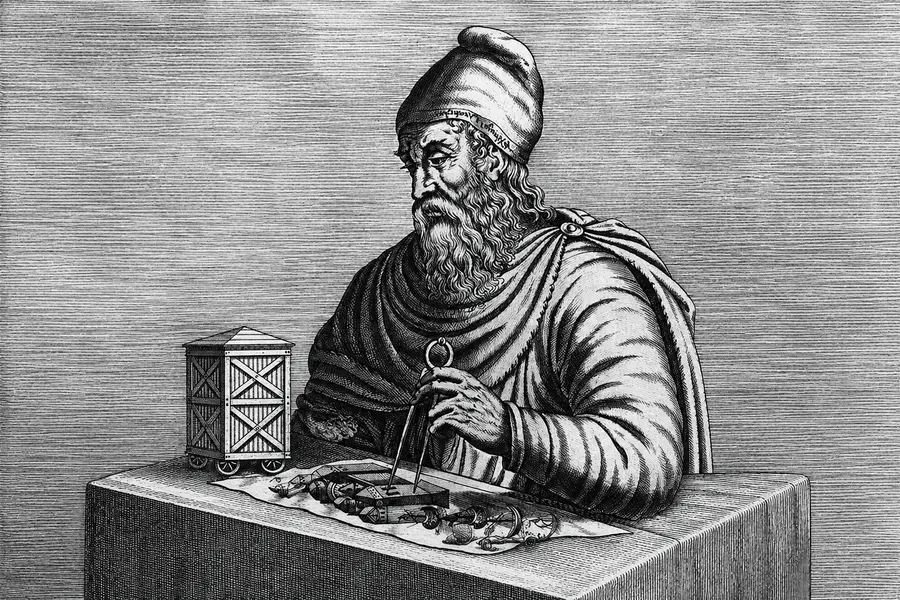
Archimedes was born around 287 BC in Syracuse, a wealthy and strategically important Greek city on Sicily. He died around 212 BC when Syracuse fell to the Romans. Relatively little is known about his private life. His father, Phidias, was an astronomer, and Archimedes appears to have had close connections with the court of King Hiero II of Syracuse. He almost certainly had contact with the intellectual world of Alexandria, then the leading centre of Hellenistic mathematics and science. The MacTutor History of Mathematics Archive notes that his surviving mathematical works demonstrate an extraordinary familiarity with the mathematical tradition associated with Alexandria.
What makes Archimedes unusual is the combination of theoretical mathematics and practical engineering. He could reason about abstract geometrical problems while also applying mechanical principles to ships, water, pulleys, artillery, and fortifications. His relationship with King Hiero is particularly important for understanding his later military role. According to Plutarch's Life of Marcellus, Hiero asked Archimedes to demonstrate how a small force could move a very large weight. Archimedes reportedly used a system of compound pulleys to move a heavily loaded ship with surprisingly little effort. The demonstration impressed the king so much that he subsequently asked Archimedes to prepare defensive and offensive machines for siege warfare.
Archimedes' Contribution to Mathematics
Archimedes' military reputation sometimes overshadows what may be his greatest achievement: his contribution to mathematics. Historians of mathematics regard him as one of antiquity's most important mathematicians, particularly because several of his methods anticipated ideas that would later become central to calculus.
The Method of Exhaustion
One of Archimedes' most powerful mathematical techniques was the method of exhaustion. By inscribing and circumscribing increasingly accurate figures around a shape, he could establish increasingly precise limits for its area or volume. This allowed him to solve problems that, in modern mathematics, would naturally be approached using integration. He applied these ideas to circles, parabolas, spheres, cylinders, spirals and other geometrical figures. His work on the area of a parabolic segment, for example, demonstrated an extraordinary ability to calculate curved areas using rigorous geometric arguments.
Archimedes and Pi
Archimedes also produced one of the most famous ancient calculations of π. By using polygons inside and outside a circle, he established bounds for the value of pi. His result placed π between approximately 3.1408 and 3.1429, remarkably close to the modern value. This was achieved without modern algebraic notation, calculators, or trigonometric tables in the modern sense. The achievement illustrates why Archimedes' mathematics remains so impressive. He developed powerful methods from comparatively simple geometrical foundations.
Geometry, Volume and the Sphere
Archimedes was especially proud of his work on the sphere and cylinder. He demonstrated that the volume of a sphere is two-thirds that of the smallest cylinder capable of enclosing it, and that the surface area of the sphere is two-thirds that of the corresponding cylinder including its bases. According to later tradition, Archimedes wanted a sphere and cylinder placed on his tomb as a reminder of this achievement. Centuries later, the Roman statesman Cicero claimed to have located Archimedes' neglected tomb in Syracuse by identifying this geometrical design.
Mechanics and Centres of Gravity
Archimedes also developed fundamental ideas concerning levers, equilibrium and centres of gravity. These were not merely theoretical curiosities. They provided the intellectual foundation for the mechanical devices that later became associated with his name. His work demonstrates a recurring theme: mathematics could describe the behaviour of physical objects, and once that behaviour was understood, it could be converted into mechanical advantage. That principle lies at the heart of the famous saying attributed to him: "Give me a place to stand, and I will move the Earth." The wording comes through later tradition, but it captures the central idea of Archimedean mechanics: leverage can transform a small applied force into a much greater mechanical effect.
Eureka and the Discovery of Buoyancy
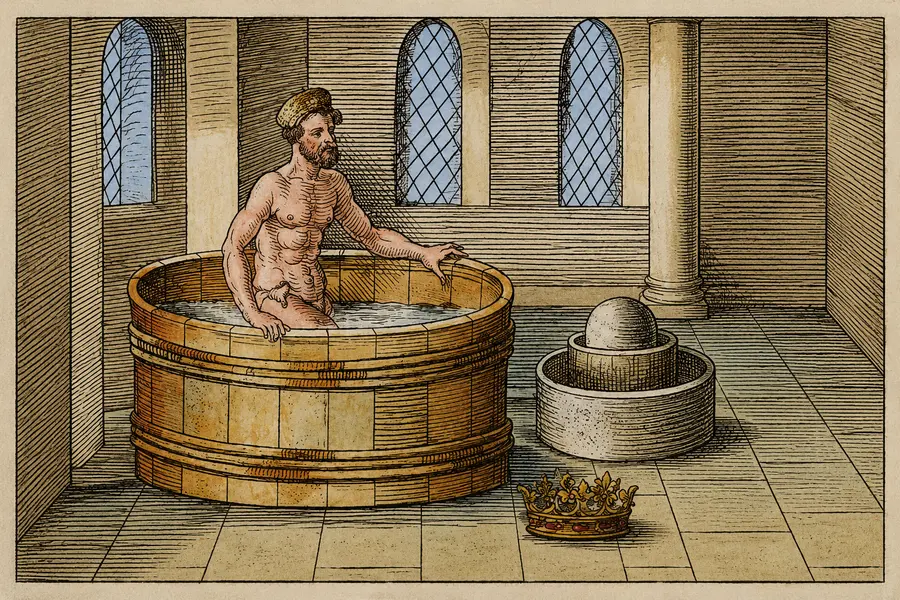
The most famous story about Archimedes concerns a bath, a crown, and a sudden realization. According to the traditional account, King Hiero suspected that a golden crown made for him contained another metal mixed with the gold. The problem was to determine whether the crown was pure without destroying it. Archimedes supposedly realized while entering a bath that an object immersed in water displaces water according to its volume. The story says that he became so excited by the discovery that he ran through the streets shouting "Eureka!"-"I have found it!". The famous story is associated with On Floating Bodies, but an important historical qualification is necessary: the surviving ancient writings do not establish that the bath incident happened exactly as later tradition describes it. The story appears in Vitruvius rather than in Archimedes' own surviving writings.
What is much more secure is the underlying scientific principle. Archimedes investigated floating bodies and hydrostatics systematically. The principle now bearing his name states that a body immersed in a fluid experiences an upward buoyant force equal to the weight of the fluid displaced. This was a profound achievement because it connected geometry, weight, density and fluid behaviour through a general mathematical principle.
The Second Punic War and the Road to Syracuse
The military story of Archimedes cannot be separated from the Second Punic War, fought between Rome and Carthage from 218 to 201 BC. Syracuse initially maintained relations with Rome. However, after the death of King Hiero II, political divisions within the city contributed to a shift toward the Carthaginian side. Rome responded by sending forces against Syracuse. In approximately 213 BC, Roman forces under Marcus Claudius Marcellus and Appius Claudius began the siege. Ancient accounts describe a city protected by substantial fortifications and defended by Archimedes' machines.
The Siege of Syracuse
The Roman plan was straightforward in principle. Attack Syracuse from both land and sea, overcome its walls, and force the city to surrender. But Syracuse was exceptionally difficult to assault. Its walls took advantage of the city's geography, while its defenders could operate from elevated positions. Polybius, one of the most important ancient historians of the Punic Wars, specifically emphasizes the strength of the city's position and the defensive preparations associated with Archimedes. Polybius describes Roman forces approaching with siege equipment and a fleet. Marcellus deployed large warships and a specialized floating assault device known as the sambuca, essentially a ship-mounted assault ladder intended to allow Roman soldiers to reach the walls. Archimedes responded by exploiting the different ranges at which Roman ships could approach the fortifications.
The result was devastating for the Roman assault. Polybius reports that Archimedes' machines could strike at long range with powerful projectiles and then use smaller machines as ships came closer. When the Roman fleet tried to approach under cover, additional devices attacked the ships at close quarters. Polybius' account is particularly valuable because he was writing much closer to the events than later authors. His description also provides a useful corrective to the more spectacular legends that developed later. The Roman assault did not succeed quickly. Instead, the siege became a prolonged blockade. Syracuse remained a major obstacle to Roman control of Sicily until the Romans eventually found a way into the city.
Archimedes' Military Machines: What Did He Actually Build?
Archimedes' miracle machines were not supernatural. The surviving accounts describe machines based on very real principles. Leverage, counterweights, ropes, pulleys, torsion, projectile mechanics, and carefully chosen firing ranges. The distinction between the first five categories and the burning mirror is important. Polybius, Livy, and Plutarch provide evidence for the artillery and ship-lifting mechanisms. The famous mirror story appears much later and is not supported by the earliest detailed accounts of the siege.
1. Long-Range Catapults and Artillery
The most credible weapons associated with Archimedes were not fantastical machines but sophisticated artillery. Ancient Greek and Hellenistic armies already possessed powerful torsion artillery. Archimedes appears to have designed, adapted, or organized artillery systems particularly suited to the geography and defensive requirements of Syracuse.
Polybius explains that the machines could fire at considerable distances and that Archimedes used progressively smaller weapons as the Roman ships came closer. This was a remarkably practical solution. Instead of relying upon one universal weapon, the defenders created overlapping zones of fire. At long range, large projectiles could threaten ships before they reached the walls. At intermediate range, smaller artillery could continue the attack. At close range, mechanical devices could directly seize or damage vessels.
This arrangement effectively created a layered defensive system. It is one of the most important reasons why Archimedes' machines should not be viewed as isolated inventions. Their effectiveness came partly from how they worked together as a defensive network.
2. Short-Range Artillery
Polybius describes Archimedes using different sizes of artillery according to the distance of the attacking ships. When Roman vessels were farther away, larger machines could be employed. As they approached, the defenders shifted to smaller weapons capable of engaging targets at shorter ranges. This may seem obvious to a modern reader, but it was a sophisticated approach to siege defence. A fixed fortification can become vulnerable if attackers discover a distance at which its weapons cannot reach them. Archimedes apparently designed the defensive artillery to minimize this problem.
The Roman assault therefore became progressively more dangerous as ships approached the walls instead of less dangerous. Polybius records that the Roman attackers were eventually forced to attempt approaches at night, demonstrating the psychological as well as physical effect of the artillery.
3. The Claw of Archimedes
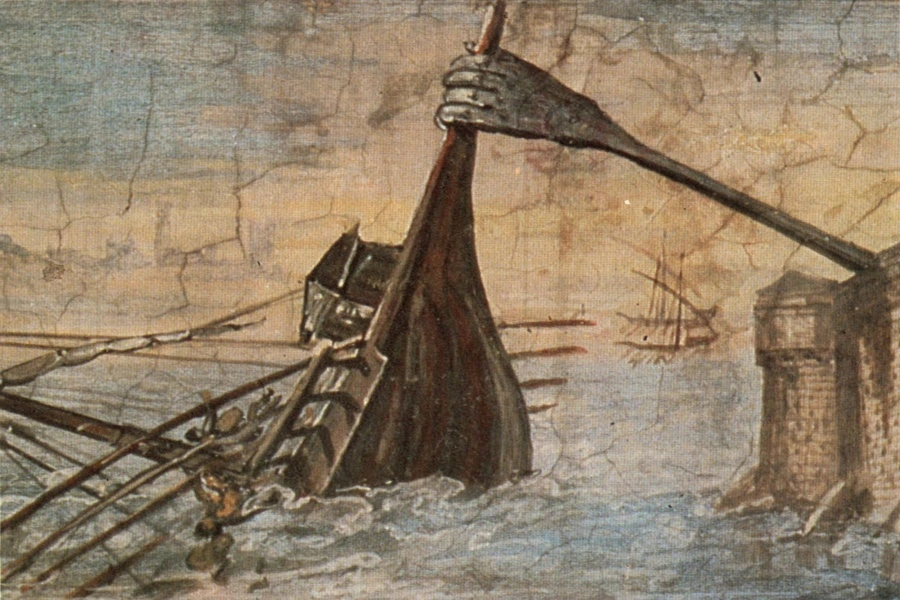
The mechanism now known as the Claw of Archimedes, sometimes called the "iron hand," is probably the most famous of the machines that can be connected to the siege with reasonable confidence. It was essentially a giant mechanical grappling device. A beam extended from the fortifications toward the sea. An iron hook or claw attached to a chain could be lowered toward an approaching ship. Once the hook caught the vessel, operators inside the walls could manipulate the mechanism to lift its prow.
Polybius describes a particularly dramatic sequence. The prow of a ship could be raised until the vessel stood at an extreme angle. The mechanism could then be released, causing the ship to fall back into the water. Some vessels could capsize; others could take on water and sink. Plutarch gives an even more dramatic description, stating that ships could be lifted into the air and then dropped or swung against the rocks.
The exact mechanical arrangement is uncertain. No surviving engineering drawing from the siege allows us to reconstruct the machine with complete confidence. However, the underlying concept is entirely compatible with known ancient technology involving beams, ropes, chains, pulleys and counterweights.
Effectiveness: If deployed as described, the claw would have been particularly useful against ships that came close to the walls. It turned the very act of approaching the fortress into a serious risk. The weapon was therefore less like a modern naval cannon and more like a giant mechanical trap.
4. Overhead Cranes and Dropping Mechanisms
Not every ship had to be lifted completely into the air to be destroyed. Some of the machines described by Plutarch involved heavy objects being dropped onto ships from above. Imagine approaching a fortified wall in a relatively fragile wooden vessel. The danger would not come only from arrows and stones fired horizontally. A machine positioned above the ship could release a heavy weight directly downward.
This exploited one of the simplest principles of mechanics: Gravity. Plutarch describes huge beams extending over ships and heavy weights being released onto them. Such devices would have been especially dangerous because a ship could be structurally damaged without requiring the defenders to expose themselves outside the walls. The combination of gravity, leverage, and elevated defensive positions gave the Syracusans an enormous advantage over ships operating immediately below the fortifications.
5. Grappling Mechanisms and Ship-Trapping Devices
Some descriptions of Archimedes' machines are variations of the same basic concept as the claw. Polybius describes devices in which an iron hand attached to a chain could grab a ship. The operator then manipulated a beam from inside the walls. By applying force at the correct point, the mechanism could raise the vessel's prow.
The genius of the idea was not necessarily the hook itself. Hooks, ropes, and cranes were not unknown in the ancient world. The innovation lay in applying mechanical principles on a large enough scale to make a defensive fortification interact directly with enemy ships. Instead of simply throwing projectiles at the Roman fleet, the Syracusans could use the city's walls as the foundation of a gigantic mechanical system. This is one reason Archimedes' military engineering deserves to be considered alongside his mathematical achievements. He understood that a machine's effectiveness depends not only on the machine itself but on the environment in which it operates.
6. The Alleged Burning Mirror
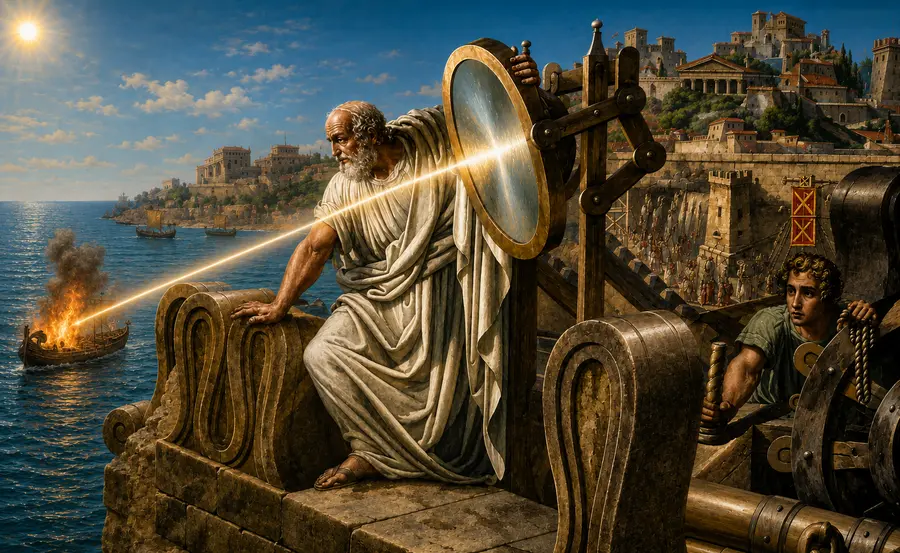
No story about Archimedes' weapons is more famous or more controversial than the burning mirror. The later tradition says that Archimedes constructed a huge arrangement of mirrors capable of concentrating sunlight onto Roman ships. The reflected sunlight supposedly generated enough heat to ignite the vessels. It is an extraordinary story. It is also the least secure part of the popular account of the Siege of Syracuse.
The principal ancient accounts that describe the siege and Archimedes' machines do not mention a burning mirror. Polybius, who provides one of the most detailed accounts, does not describe one. Plutarch's account also does not include the famous heat ray. Later writers eventually associated Archimedes with the device. That does not mean the physical principle is impossible. Mirrors can concentrate sunlight, and experiments have demonstrated that large reflective arrangements can produce significant heat. The much harder question is whether an ancient device could reliably focus enough sunlight onto a moving wooden warship at the required distance and keep the focus long enough to ignite it. For that reason, historians generally treat the burning mirror as unproven and probably legendary in the context of the siege. It should not be presented as an established fact.
How Effective Were Archimedes' Machines?
The ancient sources leave little doubt that Archimedes' engineering made the Roman assault extraordinarily difficult. Polybius describes Roman ships being badly damaged by artillery and grappling mechanisms. Plutarch likewise portrays Marcellus' elaborate preparations as being frustrated by the Syracusan defences. But it would be an exaggeration to say that Archimedes single-handedly defeated the Roman army.
Machines did not defend Syracuse by themselves. They operated from strong fortifications, were handled by trained crews, and benefited from the city's geography. The defenders also possessed ordinary weapons, soldiers, and naval forces. Archimedes provided an extraordinary technological component to a broader defensive system. The most convincing evidence of effectiveness is therefore the length and character of the siege. Rome was a military superpower with extensive experience in siege warfare, yet Syracuse resisted for a prolonged period. Archimedes' machines were particularly effective because they solved a series of specific tactical problems:
- Long-range artillery prevented Roman ships from approaching safely.
- Smaller artillery continued the attack as ships closed the distance.
- Heavy dropping devices attacked vessels immediately below the walls.
- Grappling machines turned close approaches into potentially catastrophic traps.
- The defensive machines allowed crews to attack ships while remaining protected behind the fortifications.
This was essentially an ancient version of layered coastal defence. For the Roman soldiers, the psychological effect must also have been significant. Ancient warfare depended heavily on morale. Soldiers were willing to attack when they believed their equipment and tactics gave them a reasonable chance of survival. When machines repeatedly destroyed or disabled assault equipment, confidence could collapse.
The Defeat of Syracuse and Death of Archimedes

For all the success of Archimedes' machines, Syracuse eventually fell. The Romans discovered that the city's defences could not protect every part of the enormous perimeter equally well. According to Plutarch, Marcellus learned of a poorly guarded section of the walls near a tower. The opportunity came during a festival, when many Syracusans were distracted by celebrations. The Romans seized the position and gained entry into the city. Once the walls were penetrated, the strategic situation changed dramatically. The machines that had been so effective against a fleet outside the walls could not save a city whose internal defences were collapsing.
Syracuse was taken in 212 BC. Archimedes died during the Roman capture of the city. The circumstances are surrounded by several traditions, but all share the essential point that a Roman soldier killed him despite Marcellus' reported desire that the famous mathematician be spared. The most famous version says that Archimedes was working on a mathematical diagram when a soldier approached him. Archimedes supposedly asked the soldier not to disturb his circles. The soldier then killed him.
Plutarch actually provides multiple versions of the death. In another account, Archimedes was carrying mathematical instruments and was mistaken for someone carrying valuable objects. The multiplicity of traditions is a useful reminder that even ancient writers did not possess a single certain account. What is certain is that Archimedes died when Syracuse fell. He was approximately seventy-five years old.
The Legacy of Archimedes
Archimedes' influence extends far beyond the siege of Syracuse. His surviving works helped establish mathematical methods for studying areas, volumes, equilibrium, and floating bodies, while his mechanical ideas connected mathematical reasoning with the physical world. His approach was remarkably systematic for antiquity and later became an important part of the development of mathematics, physics, and engineering. Modern scholarship continues to study his influence across these fields.
A Forerunner of Calculus
Archimedes' method of exhaustion allowed him to calculate areas and volumes of curved figures by using increasingly precise geometric approximations. Although he did not possess modern calculus, his methods anticipated important ideas that would later become central to mathematical analysis. His work on circles, parabolas, spheres, and other figures demonstrated how rigorous mathematics could be applied to problems involving curved shapes.
The Foundations of Mechanics
Archimedes also transformed the study of mechanics by developing rigorous treatments of levers, equilibrium, centres of gravity, and floating bodies. These were more than isolated discoveries: together they showed how mathematical principles could be used to describe physical forces and mechanical systems. His work became an important foundation for the later development of statics and hydrostatics.
From the Archimedean Screw to Modern Engineering
The device traditionally associated with Archimedes for raising water became one of the most enduring examples of his mechanical legacy. Similar screw-based mechanisms have continued to find applications in water movement and engineering. More broadly, Archimedes' systematic treatment of simple machines influenced later mechanical thinkers and engineers, particularly during the Renaissance and the development of modern engineering.
Archimedes and the Scientific Revolution
Archimedes' work did not disappear with the ancient world. His mathematical and mechanical writings were studied and transmitted through later intellectual traditions before becoming increasingly influential in Renaissance Europe. His methods contributed to a renewed interest in mathematical approaches to nature and mechanics, helping make his work part of the longer intellectual history that eventually produced modern mathematical physics and engineering.
A Lasting Military Legacy
The defense of Syracuse gave Archimedes a unique place in military history, but his greatest legacy was not any single weapon. It was the demonstration that mathematical understanding could be converted into practical mechanical advantage. His machines worked by applying principles of leverage, gravity, projectile motion, and mechanical force within a carefully prepared defensive environment. The siege therefore became an enduring example of how science, engineering, fortifications, and military tactics could work together.
Archimedes ultimately represents something larger than the legendary inventor who supposedly burned Roman ships or shouted "Eureka!" He was a mathematician who investigated the physical world with extraordinary rigor and an engineer who showed how abstract principles could solve practical problems. More than two thousand years after his death, that combination of mathematics, physics, and engineering remains the central reason Archimedes occupies such an important place in the history of science.
Why Archimedes' Machines Still Fascinate Us
The popular image of Archimedes sometimes reduces him to three things: a man shouting "Eureka," a giant claw lifting Roman ships, and a mirror burning them from afar. The real story is more interesting. The strongest evidence does not require a miraculous weapon. Archimedes' actual achievement was arguably more impressive: he took abstract principles of geometry and mechanics and turned them into a coordinated defensive system capable of frustrating one of the most powerful military states of the ancient world.
His machines worked because they exploited predictable physical laws. A lever could multiply force. A pulley could redistribute force. Gravity could become a weapon. A projectile could be matched to its intended range. A fortified wall could become the support structure for a giant mechanical device. The result was a defence system in which mathematics became military power.
Syracuse eventually fell, and Archimedes died with it. But the machines that once terrified Roman soldiers became part of the enduring story of ancient engineering. His mathematics survived even more decisively. More than two thousand years later, Archimedes remains a rare figure who belongs simultaneously to the histories of mathematics, physics, engineering, invention and warfare. His greatest lesson may be that the boundary between pure science and practical technology is far less rigid than it sometimes appears. And behind those walls stood Archimedes.
References and Further Reading
- Polybius, Histories, Book VIII. Polybius provides one of the most important surviving accounts of the Roman assault on Syracuse and describes Archimedes' artillery and ship-lifting mechanisms. Perseus Digital Library - Polybius, Book VIII
- Plutarch, Life of Marcellus. Plutarch gives a detailed narrative of Marcellus' assault, Archimedes' machines, and the death of the mathematician. University of Chicago - Plutarch, Life of Marcellus
- MacTutor History of Mathematics Archive - Archimedes. A detailed scholarly biography covering Archimedes' mathematics, mechanics, surviving works and historical legacy. University of St Andrews - Archimedes
- Dictionary of Scientific Biography - Archimedes. A scholarly biographical treatment of Archimedes' life, mathematics and mechanics, including discussion of the uncertainty surrounding his biography. Dictionary of Scientific Biography - Archimedes
- World History Encyclopedia - Archimedes. Useful secondary overview of Archimedes' life, engineering achievements and role in the defence of Syracuse. World History Encyclopedia - Archimedes
-
Diodorus Siculus, Book XXVI.
A later ancient account containing additional traditions concerning Archimedes' machines, including the famous mirror story. Because these details are later and less securely corroborated, they should be treated cautiously. LacusCurtius - Diodorus Siculus, Book XXVI
Books and Memorables
This article may contain affiliate links. If you purchase through these links, I may earn a small commission at no extra cost to you.


Related Articles
Frequently Asked Questions
What war machines did Archimedes use to defend Syracuse?
Archimedes is credited by ancient historians with helping Syracuse defend itself with powerful artillery, large catapults, grappling mechanisms, cranes and devices that could lift or damage Roman ships approaching the city's walls. These machines used principles of leverage, pulleys, gravity and projectile mechanics to make the fortified city extremely difficult for the Romans to assault.
What was the Claw of Archimedes and how did it work?
The Claw of Archimedes was a large grappling mechanism reportedly used during the Roman siege of Syracuse. An iron hook attached to a beam and lifting system could catch the prow of an approaching ship and raise it from the water. The mechanism could then release the vessel, potentially causing it to capsize or suffer severe structural damage. Ancient accounts describe the device, although its exact construction is uncertain.
How did Archimedes defend Syracuse against the Romans?
Archimedes helped defend Syracuse by designing or improving machines that allowed the defenders to attack Roman forces from behind the city's fortifications. Long-range artillery could strike approaching ships, smaller weapons could engage vessels at closer distances, and grappling and lifting mechanisms could attack ships near the walls. These defences helped Syracuse resist the Roman siege for a prolonged period.
Did Archimedes really burn Roman ships with mirrors?
The famous story that Archimedes used mirrors to concentrate sunlight and burn Roman ships is not firmly supported by the earliest accounts of the Siege of Syracuse. Polybius and Plutarch, the most important ancient sources for the siege, describe Archimedes' artillery and ship-lifting machines but do not mention a burning mirror. The heat-ray story appears in later traditions and is therefore best treated as historically uncertain.
What happened to Archimedes when Syracuse fell to Rome?
Archimedes was killed when Roman forces captured Syracuse in 212 BC during the Second Punic War. Ancient sources give different accounts of his final moments, but they agree that a Roman soldier killed him despite orders from the Roman commander Marcellus to spare him. One famous tradition says that Archimedes was working on a mathematical diagram when the soldier approached him.
Why were Archimedes' machines effective during the Siege of Syracuse?
Archimedes' machines were effective because they combined different weapons and ranges with the natural advantages of Syracuse's fortified position. Large artillery could attack ships at long range, smaller machines could continue the attack as vessels approached, and cranes or grappling mechanisms could threaten ships near the walls. The machines allowed defenders to use mechanical advantage while remaining relatively protected behind the fortifications.
Add Comment