
The Battle of Hattin on 4 July 1187 was the decisive military disaster [1][2] that broke the field army of the Kingdom of Jerusalem and opened the way for Saladin to reconquer most of the Crusader states, including Jerusalem. The defeat was not simply the result of superior numbers. The Crusaders marched away from their water supply, suffered in the heat and under harassment, lost cohesion, and then fought on ground that Saladin had deliberately made almost impossible to survive on. Hattin is therefore one of the clearest medieval examples of how logistics, command decisions, morale, terrain, and operational planning can matter more than battlefield courage.
Table of Contents
- The Kingdom of Jerusalem Before Hattin
- The Death of Baldwin IV and the Crisis of Succession
- Prelude to the Battle of Hattin
- The Opposing Armies and Leaders
- Why Did Guy of Lusignan March to Hattin?
- The March from Sepphoris to Hattin
- The Sequence of the Battle
- Why Did the Crusaders Lose the Battle of Hattin?
- Why Saladin Had the Advantage
- The Immediate Aftermath
- The Fall of Jerusalem
- Impact and Historical Significance
- Conclusion
- References and Further Reading
The Kingdom of Jerusalem Before Hattin
By the 1180s, the Kingdom of Jerusalem was no longer the aggressive expansionist state created by the First Crusade. It was a relatively small Christian kingdom surrounded by increasingly powerful Muslim rulers. Its survival depended on fortified cities, castles, military orders, feudal levies, alliances, and the ability to concentrate a field army quickly when Saladin threatened its territory.
This makes Hattin especially useful when studying military leadership. The episode also illustrates the relationship among exhaustion, fear, cohesion, and combat effectiveness, as explored in the study of ancient soldiers' mentality, morale, and survival. The battle was not won by one spectacular charge. It was prepared by years of political consolidation, intelligence gathering, diplomacy, raiding, and operational pressure. Saladin's victory illustrates the same broader principle discussed in the greatest military generals in history. Exceptional commanders often win by shaping the conditions of battle before the decisive clash begins.
The Death of Baldwin IV and the Crisis of Succession

The most important change before Hattin was the loss of King Baldwin IV. Known to later generations as the "Leper King," Baldwin had contracted leprosy while still young. Despite his illness, he proved to be an energetic and capable ruler. He personally led campaigns and, most importantly, provided a political centre around which competing factions could temporarily cooperate. Baldwin defeated Saladin at Montgisard in 1177 and repeatedly resisted attempts to overrun the kingdom. But his illness progressively destroyed his physical ability to govern. By the early 1180s he had become severely disabled. In 1183 he arranged for his young nephew, Baldwin V, to be crowned co-king, partly to prevent Guy of Lusignan from automatically inheriting the throne.
Baldwin IV died in 1185, aged only about twenty-four or twenty-five [3][4]. He left behind a kingdom whose succession was already politically fragile. His nephew Baldwin V was still a child and could not personally lead armies or reconcile powerful barons. Raymond of Tripoli became regent, but the arrangement did not solve the underlying succession dispute. Baldwin V died in 1186, probably from natural causes, although medieval sources circulated accusations of poisoning [4]. His death removed the last male king in Baldwin IV's immediate line. His mother, Sibylla, claimed the throne and unexpectedly crowned her husband, Guy of Lusignan, as king.
Guy was deeply unpopular with important members of the nobility. Baldwin IV himself had previously removed Guy from the regency after judging his leadership inadequate. The succession therefore left the kingdom with an adult king but not with the political unity that Baldwin IV had struggled to maintain. The result was dangerous. Saladin faced a kingdom divided between factions supporting Guy and factions associated with Raymond of Tripoli and other barons. Although these divisions did not mean that the Crusaders were incapable of fighting, they made strategic decision-making much more difficult. At Hattin, the problem would become fatal.
Prelude to the Battle of Hattin
In May 1187, a Crusader force led by Gerard de Ridefort and Roger de Moulins was defeated at the Battle of Cresson [5]. The disaster demonstrated that Saladin was no longer merely raiding the kingdom. He was preparing a major offensive. Saladin assembled a large army in the region of Damascus and prepared to cross into Galilee. His objective was not simply to destroy a castle or raid a frontier. He wanted to force the Crusaders to mobilize their entire field army, separate that army from its secure supply base, and then defeat it in conditions favourable to his forces.
By late June 1187, the Crusaders had gathered at Sepphoris, near strong springs and reliable water [1][5]. Their position was defensible precisely because it solved the logistical problem that would soon destroy them. Raymond reportedly argued against the march. From a military perspective, staying at Sepphoris had major advantages: the Crusaders controlled water, had a strong defensive position, and could force Saladin to attack them. Yet Guy eventually ordered the army to march. The decision transformed the campaign.
The Opposing Armies and Leaders
| Side | Principal leaders | Approximate strength | Important characteristics |
|---|---|---|---|
| Kingdom of Jerusalem and allies | Guy of Lusignan, Raymond III of Tripoli, Raynald of Châtillon, Gerard de Ridefort | About 18,000-20,000 | Heavy cavalry, infantry, crossbowmen, military orders, limited water and supplies once on the march |
| Ayyubid forces | Saladin, with commanders including al-Afdal and Muzaffar al-Din Gökböri | Probably around 20,000 or more; medieval figures vary greatly | Large cavalry force, mounted archers, strong logistical support, high operational mobility |
Exact troop numbers are uncertain. Medieval chroniclers often supplied enormous figures, and modern historians generally use more conservative estimates. The important point is that Saladin possessed a large and highly mobile army, while the Crusaders had assembled one of the largest field armies available to the Kingdom of Jerusalem.
Why Did Guy of Lusignan March to Hattin?
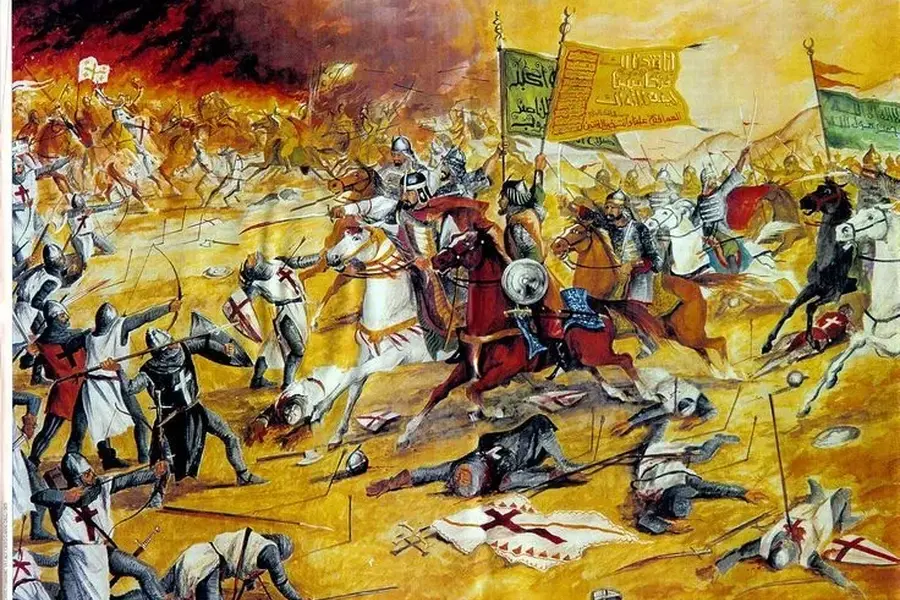
Guy of Lusignan faced a difficult strategic choice after Saladin attacked Tiberias on 2 July 1187. The city was defended by a small garrison while Raymond of Tripoli's wife, Eschiva, was inside the citadel. Raymond initially advised against moving the main army from Sepphoris because the Crusaders had a secure water supply and a strong defensive position there. Remaining in place would have forced Saladin to operate farther from his own bases while preserving the Crusaders' strength.
Guy nevertheless decided that Tiberias had to be relieved. Leaving the city to Saladin risked surrendering an important position and could have damaged Guy's authority among the Crusader nobility. The decision was therefore not simply a reckless desire to fight. Guy faced political pressure, the immediate threat to Tiberias, and the expectation that the kingdom's assembled army should respond to a direct attack on one of its major strongholds.
Once the decision was made, however, the Crusaders abandoned the logistical advantages of Sepphoris. The march toward Tiberias took them across increasingly dry and exposed terrain, while Saladin's cavalry harassed the column and made movement more difficult. What began as an attempt to relieve Tiberias gradually became the situation Saladin wanted: the Crusader army was moving away from its water supply while becoming increasingly exhausted and disorganized.
The March from Sepphoris to Hattin
The march became a test of endurance for thousands of soldiers, horses, and camp followers. Saladin did not need to destroy the army immediately. His mounted troops could harass the column from the flanks, restrict its movement, and prevent the Crusaders from easily stopping to rest or reaching reliable water. The longer the army remained on the march, the more its men and animals suffered from heat, thirst, and exhaustion.
By the time the Crusaders approached Hattin, the condition of the army had deteriorated significantly. The heavy cavalry that formed the kingdom's principal striking force depended on fresh horses and organized formations. Exhausted mounts and disordered troops could not deliver the concentrated charges that had made the Crusader knights so formidable. The decision to march toward Tiberias had therefore placed the army in precisely the conditions that Saladin sought to create.
The Crusaders eventually halted near the Horns of Hattin, two prominent volcanic hills overlooking the surrounding landscape. Although the elevated position offered some tactical advantages, it did not solve the army's most urgent problem: water. The nearest reliable sources were controlled or threatened by Saladin's forces, while the Sea of Galilee remained beyond immediate reach. By the morning of 4 July, the Crusaders were isolated from their water supply, physically weakened, and increasingly unable to fight as a single coordinated force.
The Sequence of the Battle
1. The Crusader army becomes trapped
By the morning of 4 July, the Crusaders were effectively surrounded or heavily constrained by Saladin's forces [1][5]. Their infantry had suffered during the previous day's march, and the army's ability to operate as a unified formation had deteriorated.
2. Muslim archers maintain pressure
Saladin did not immediately throw his entire cavalry force into a single charge. Mounted archers and other troops continued to harass the Crusaders. The purpose was to reduce cohesion, exhaust the troops, and make the Crusader cavalry less capable of delivering the concentrated charge on which its battlefield doctrine depended.
3. Attempts to break out fail
The Crusaders attempted to reach water and escape the encirclement. Their formations repeatedly came under attack. A heavy cavalry army could be devastating when it had space and momentum, but Hattin denied both. Thirsty horses, exhausted men, broken formations, and continuous missile fire made coordinated charges increasingly difficult.
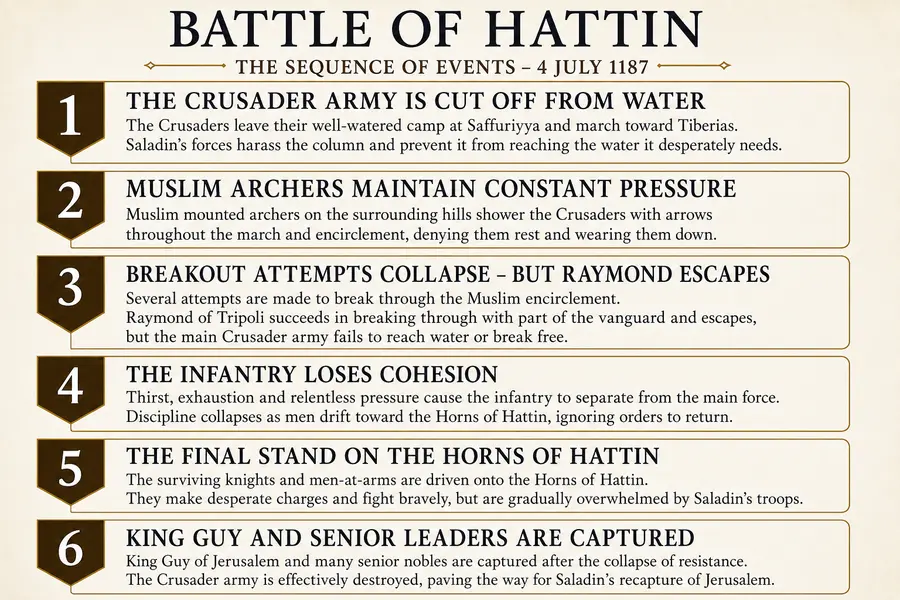
4. The infantry loses cohesion
The Crusader infantry was essential to the army's survival. Once the infantry and cavalry became separated, the knights lost much of the protection that allowed them to regroup and launch organized attacks. The army ceased functioning as a coherent combined-arms force.
5. The final stand on the Horns
The remaining Crusaders withdrew toward the Horns of Hattin. Saladin's troops surrounded the position and pressed the attack. The final resistance was fierce, but the outcome was no longer in serious doubt. The Crusader army had been reduced from a powerful field force to a trapped and exhausted remnant.
6. Capture of the king and senior leaders
Guy of Lusignan was captured along with many leading nobles [1][2]. The relic known as the True Cross, carried with the army, also fell into Saladin's hands. Its capture had enormous religious and psychological significance for Latin Christendom. Saladin treated Guy as a valuable prisoner. Raynald of Châtillon received a very different fate. Saladin had long regarded him as a particularly dangerous violator of truces and personally executed him after the battle. A number of Templar and Hospitaller prisoners were also killed, while many other captives were enslaved or ransomed.
Why Did the Crusaders Lose the Battle of Hattin?
- Loss of logistical security: The army left abundant water behind and entered a dry environment while carrying thousands of men and animals.
- Operational harassment: Saladin prevented the Crusaders from marching in comfort or maintaining perfect cohesion.
- Command division: Political distrust weakened the process by which the king and his commanders made strategic decisions.
- Exhaustion: Heat, thirst, hunger, and repeated attacks reduced the army's combat effectiveness before the main engagement.
- Loss of infantry-cavalry cohesion: Once the infantry could no longer adequately support the knights, the Crusaders lost much of the tactical system on which they depended.
- Failure to seize the initiative: The army reached Hattin without forcing Saladin into an unfavorable engagement and instead allowed him to complete the encirclement.
It is tempting to blame Guy alone, but that oversimplifies the campaign. Guy made the final decision to march, yet the choice emerged from a political and military crisis involving several commanders. Hattin was a failure of strategic coordination as much as an error by one king.
Why Saladin Had the Advantage
Saladin's advantage deserves separate treatment because it was more than simply "the Crusaders were thirsty." His campaign worked because several advantages reinforced one another.
| Saladin's advantage | How it mattered |
|---|---|
| Operational mobility | Mounted troops could move around the Crusader column, attack from different directions, and disengage before heavy cavalry could respond. |
| Control of the campaign tempo | Saladin chose when to pressure, when to withdraw, and when to commit to decisive combat. |
| Logistics | His army had access to better water and supply arrangements while the Crusaders became increasingly isolated. |
| Intelligence and reconnaissance | Saladin knew the Crusader army's movements and could adjust his position accordingly. |
| Psychological pressure | Constant harassment made the march exhausting and increased uncertainty within the Crusader ranks. |
| Terrain exploitation | He encouraged the Crusaders to fight in dry, exposed country rather than allowing them to remain at Sepphoris. |
| Strategic unity | Saladin commanded a large coalition under a single strategic objective: destroy the Crusader field army. |
The Immediate Aftermath
The destruction of the field army left the Crusader states almost defenceless. Castles and cities still possessed walls, but fortifications are far less useful when an enemy can isolate them one by one, and there is no large field army capable of lifting sieges. Tyre became the crucial exception. Conrad of Montferrat arrived and organized the city's defence, preventing Saladin from immediately completing the conquest of the remaining coastal strongholds. This delay proved extremely important because it gave the Latin states a base from which they could survive until Western reinforcements arrived.
The Fall of Jerusalem
After the Battle of Hattin, Jerusalem was effectively isolated. Saladin's victories across Galilee and the surrounding territories had removed much of the kingdom's ability to field a relief army, while many towns and fortresses surrendered rather than face prolonged sieges. In September 1187, Saladin brought his army before Jerusalem and began preparations for an assault. The city's defence was organized by Balian of Ibelin, one of the nobles who had survived Hattin. Although the defenders were determined, they lacked the large field army that had previously protected the kingdom. After several days of fighting and negotiations, the defenders agreed to surrender, and Jerusalem passed into Saladin's hands on 2 October 1187.[6]
The surrender was particularly significant because of what had happened when the Crusaders captured Jerusalem in 1099. That conquest had been accompanied by widespread killing, whereas Saladin chose a negotiated settlement that allowed many Christian inhabitants to leave in return for ransoms. The terms were still harsh for poorer residents who could not afford payment, and not everyone was able to secure their freedom immediately. Nevertheless, the comparatively controlled transfer of the city became an important part of Saladin's reputation in both contemporary and later accounts. For the Crusader states, however, the strategic consequences were devastating: the city at the heart of their religious and political project had been lost, transforming Hattin from a battlefield catastrophe into the decisive turning point of the Crusader presence in the Holy Land.
Impact and Historical Significance
Hattin ranks among the most decisive battles of the medieval period [1][2] because the result changed the strategic map of the eastern Mediterranean almost immediately. It destroyed the military core of the Kingdom of Jerusalem and allowed Saladin to capture much of the territory that the Crusaders had controlled for decades.
The battle also demonstrates the importance of logistics in medieval warfare. The Crusader knights were among the most formidable heavy cavalry in the medieval world, but armour and battlefield skill could not compensate for an army that could not obtain water. Hattin is therefore a powerful case study in the principle that an army's fighting strength begins to collapse when its ability to move, feed, water, and coordinate its soldiers disappears.
Hattin also enhanced Saladin's reputation as one of the most effective commanders of the Crusading era. His achievement was not merely battlefield bravery. He had unified a fragmented Muslim political landscape, built military resources in Egypt and Syria, isolated the Crusader states, exploited their political divisions, and finally engineered a campaign in which the enemy destroyed its own logistical security.
Conclusion
The Battle of Hattin was won as much through strategy and logistics as through combat. Saladin exploited the Crusaders' decision to leave the secure water supply at Sepphoris, subjected the army to sustained pressure, and forced it to fight while exhausted, thirsty, and increasingly disorganized. By the time the Crusaders reached the Horns of Hattin, the conditions that made their heavy cavalry so formidable had largely disappeared. Hattin destroyed the field army of the Kingdom of Jerusalem and opened the way for Saladin's capture of Jerusalem. Its enduring military lesson is straightforward: armies can be defeated by decisions made on the road to battle long before they are defeated on the battlefield itself.
References and Further Reading
- Brundage, James A. The Crusades: A Documentary Survey. University of Wisconsin Press. See the Medieval Sourcebook collection for translated accounts of Hattin.
- Lyons, M. C., and D. E. P. Jackson. Saladin: The Politics of the Holy War. Cambridge University Press, 1982.
- Runciman, Steven. A History of the Crusades, Volume II: The Kingdom of Jerusalem and the Frankish East, 1100-1187. Cambridge University Press.
- Barber, Malcolm. The Crusader States. Yale University Press, 2012.
- Nicolle, David. Hattin 1187: Saladin's Greatest Victory. Osprey Campaign series.
- Ernoul, The Battle of Hattin, 1187, translated in the Fordham University Medieval Sourcebook.
- De Expugatione Terrae Sanctae per Saladinum, translated in the Fordham University Medieval Sourcebook.
Books and Memorables
This article may contain affiliate links. If you purchase through these links, I may earn a small commission at no extra cost to you.


Related Articles
Frequently Asked Questions
Why did the Crusaders march from Sepphoris to Hattin?
The Crusader army marched from Sepphoris toward Tiberias because Saladin had attacked the city and was threatening its defenders. Although Sepphoris offered access to water and a secure position, King Guy of Lusignan decided that the army should attempt to relieve Tiberias. The march forced the Crusaders away from their water supply and into hot, exposed terrain where Saladin's cavalry could harass them.
How did thirst affect the Crusader army at the Battle of Hattin?
Thirst severely weakened the Crusader army before the main fighting began. The army had left the reliable water sources around Sepphoris and struggled to reach fresh water as Saladin's forces harassed the march. Exhausted soldiers and horses became less capable of maintaining formation or launching effective cavalry attacks, allowing Saladin to fight an increasingly disorganized enemy.
What happened to King Guy after the Battle of Hattin?
King Guy of Lusignan was captured by Saladin after the Crusader army was defeated at Hattin on 4 July 1187. He was held as a prisoner rather than executed. His capture was particularly damaging because the Kingdom of Jerusalem had lost both its main field army and its king, leaving its remaining cities and fortresses vulnerable to Saladin's advance.
How did the Battle of Hattin lead to the fall of Jerusalem?
The Battle of Hattin destroyed much of the military force capable of defending the Kingdom of Jerusalem. Saladin subsequently captured or received the surrender of numerous towns and fortresses, leaving Jerusalem increasingly isolated. When Saladin's army reached Jerusalem in September 1187, the city lacked a large field army capable of relieving it and eventually surrendered on 2 October 1187.
What was the role of water in the Battle of Hattin?
Water was one of the most important factors in the Battle of Hattin. The Crusaders abandoned the well-watered position at Sepphoris and marched through dry terrain toward Tiberias. Saladin's forces harassed the army throughout the march and prevented it from easily reaching fresh water. By the time the Crusaders fought at Hattin, thirst and exhaustion had severely reduced their ability to fight effectively.
Why is the Battle of Hattin considered a decisive medieval battle?
The Battle of Hattin is considered decisive because the Crusader army of the Kingdom of Jerusalem was effectively destroyed in a single campaign. King Guy was captured, the True Cross was lost, and many leading nobles and military commanders were taken prisoner. Saladin was then able to capture much of the Crusader kingdom, including Jerusalem, making Hattin a major turning point in the history of the Crusades.
Add Comment