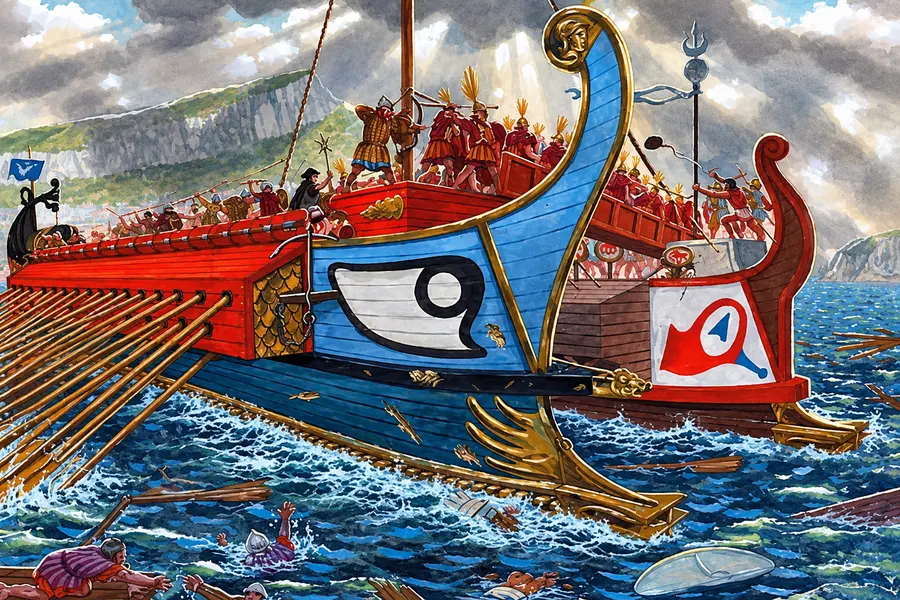
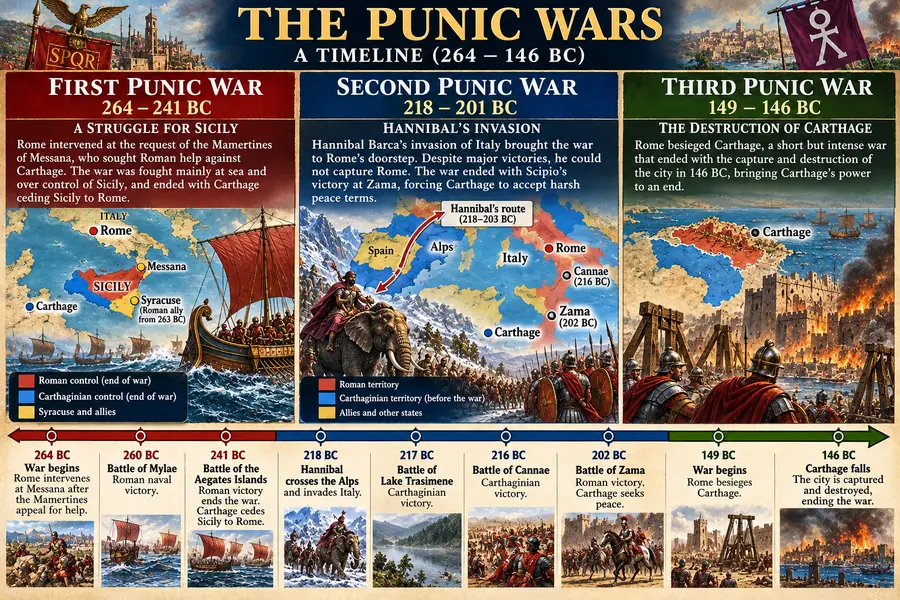
Carthage began the First Punic War as the dominant naval power in the western Mediterranean. Less than fifty years later, Hannibal was marching across the Alps while Rome controlled the seas. The change was extraordinary. Rome had entered the First Punic War as primarily a land power. Yet, it built hundreds of warships, suffered repeated naval disasters, rebuilt its fleets, and eventually defeated Carthage at sea. During the Second Punic War, Carthage still possessed a substantial navy, but it never mounted a sustained shipbuilding effort capable of challenging Rome for control of the Mediterranean. Why?
The answer is more complicated than simply saying that Carthage neglected its navy. Carthage still deployed fleets during the war, including a force of 130 warships sent toward Syracuse in 212 BC. The real question is why Carthage did not repeat the strategy that Rome had adopted during the First Punic War, replacing enormous naval losses and continuously expanding its fleet until it could force a decision at sea. The answer lies in what happened during the First Punic War, the financial consequences of Carthage's defeat, the rise of Carthaginian power in Spain, Hannibal's land-based strategy, and the remarkable naval infrastructure that Rome had created by the beginning of the Second Punic War.
The important distinction is that Carthage did not abandon naval warfare. It continued to build, deploy, and concentrate warships during the Second Punic War. What it failed to do was recreate the sustained naval mobilization of the First Punic War or develop a fleet capable of systematically challenging Roman control of the Mediterranean.
Table of Contents
- Carthage's Naval Advantage in the First Punic War
- How Rome Built a Navy Almost from Scratch
- The Corvus and Rome's Naval Learning Curve
- Rome Kept Rebuilding After Catastrophic Losses
- What the First Punic War Did to Carthage
- Carthage Rebuilt Its Power in Spain
- Why the Second Punic War Was Different
- Did Carthage Actually Have a Navy During the Second Punic War?
- The 130 Ships at Syracuse
- Why Rome Had the Naval Advantage
- Why Carthage Did Not Match Rome Ship for Ship
- Did Carthage Actually Need Naval Supremacy?
- The Real Reason Carthage Lost Its Naval Advantage
Carthage's Naval Advantage in the First Punic War
When Rome and Carthage went to war in 264 BC, the two powers were not evenly matched in every area. Rome was the rising land power of Italy. Carthage was a wealthy maritime state whose influence depended heavily on commerce, colonies, ports, and naval power. The First Punic War therefore presented Rome with a problem it had rarely encountered before. Defeating Carthaginian armies in Sicily was not enough. As long as Carthage could move troops and supplies by sea, reinforce its strongholds and threaten Roman communications, Rome could not easily force a settlement.
Modern naval historian Michael Pitassi describes the First Punic War as a conflict in which Rome, previously primarily a land power, had to expand its navy from a relatively limited force to several hundred ships in order to challenge Carthage's naval power. He also notes the striking reversal during the Second Punic War: the still-powerful Carthaginian navy failed to challenge Roman naval power effectively. (Michael Pitassi, Roman Warships, Cambridge University Press.) This makes the First Punic War essential to understanding the Second. The naval balance that existed in 218 BC was not natural. It was created by the events of the previous war.
How Rome Built a Navy Almost from Scratch
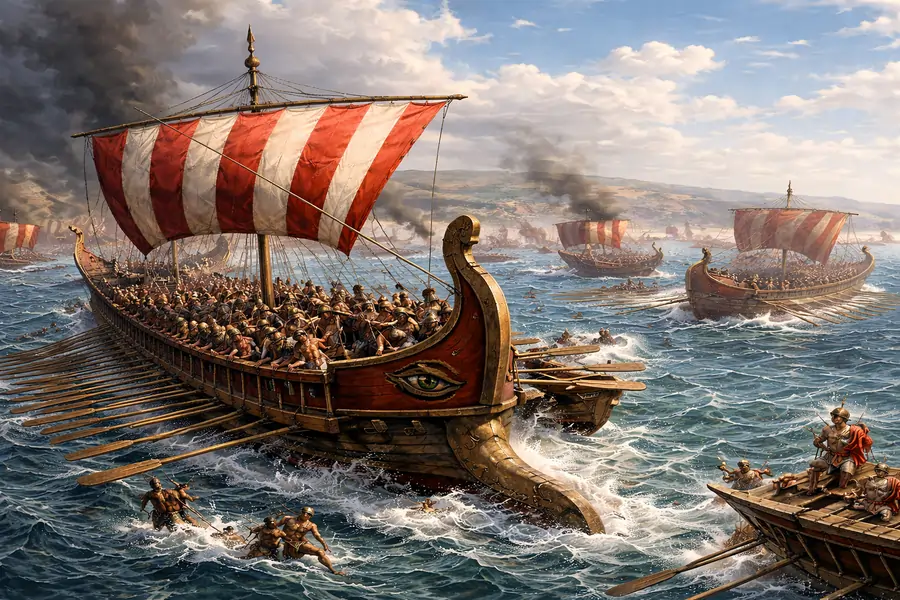
Rome's response to Carthage's maritime superiority was extraordinary. According to Polybius, the Romans obtained a Carthaginian quinquereme that had come into their possession and used it as a model for constructing their own ships. The Romans then began a huge shipbuilding program. Polybius's account places the first major Roman fleet at around 120 ships. Later sources give slightly different figures, but the important point is not the exact number. Rome had undertaken an enormous industrial project to create a fleet capable of confronting Carthage.
The scale of the undertaking is difficult to appreciate today. Building a warship was only the beginning. A fleet required timber, shipwrights, rope, sails, weapons, food, water and trained crews. Large galleys also required hundreds of rowers and other personnel. Rome was therefore not simply manufacturing ships. It was creating an entirely new military system. And the Romans had to do it while fighting a powerful naval enemy.
The Corvus and Rome's Naval Learning Curve
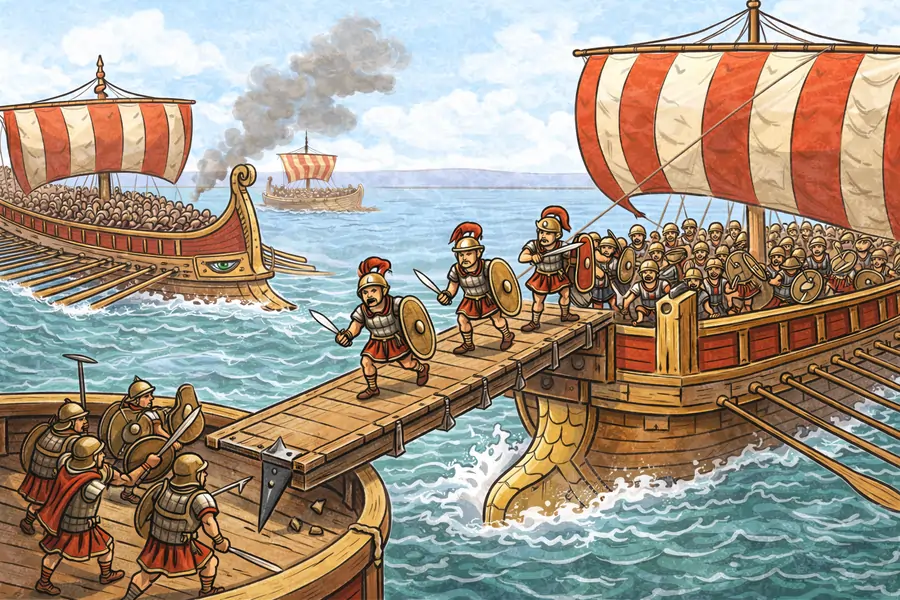
Rome initially lacked the seamanship necessary to consistently defeat experienced Carthaginian crews in conventional naval maneuvers. The Roman solution was ingenious. Instead of trying to become better sailors overnight, they developed a method of making naval battles resemble infantry battles. This was the purpose of the famous corvus. The corvus was a boarding device fitted to the front of a Roman warship. When a Roman ship came alongside an enemy vessel, the device could be dropped onto the opposing deck and used to hold the ships together. Roman soldiers could then cross over and fight the enemy as they would on land.
Polybius provides a detailed description of the device in Histories Book 1. Later descriptions identify it as a long boarding bridge equipped with a spike that could grip an enemy vessel. The corvus did not make Roman sailors superior to Carthaginian sailors. It changed the conditions under which their strengths mattered. That distinction is important. Rome did not initially beat Carthage by mastering Carthaginian naval warfare. It found a way to reduce the importance of Carthaginian seamanship. The Roman victory at Mylae in 260 BC demonstrated how effective this approach could be. The Romans captured enemy ships and turned a traditional naval engagement into a contest in which their infantry could dominate.
Rome Kept Rebuilding After Catastrophic Losses
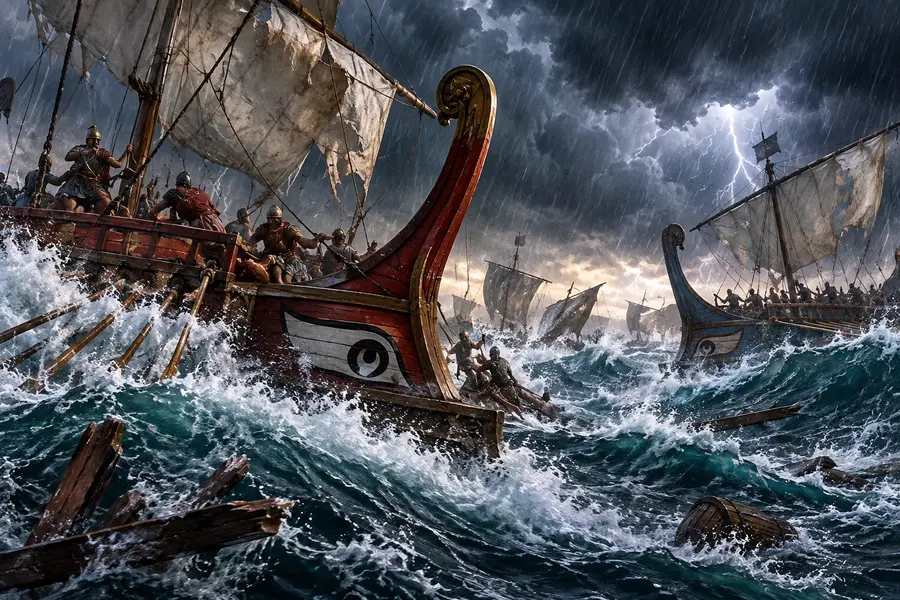
This is perhaps the most important part of the story. The Roman navy suffered enormous losses during the First Punic War. Some were caused by Carthaginian action. Others were caused by one of the most dangerous enemies of ancient navies: the weather. Several Roman fleets were destroyed by storms. Yet these disasters did not convince Rome to abandon naval warfare. Instead, Rome repeatedly built new fleets.
Polybius records some astonishing losses. By the end of the First Punic War, he calculated that the Romans had lost roughly 700 quinqueremes, including ships lost to shipwreck, while the Carthaginians had lost around 500. His figures are debated by modern historians, but they illustrate the extraordinary scale of naval attrition during the conflict. The important strategic difference was what the two sides did with their losses.
The Romans eventually understood something fundamental about naval war. A fleet could be destroyed without destroying the state's ability to make another fleet. This became one of Rome's greatest strategic advantages. The First Punic War was therefore not simply a sequence of battles between Roman and Carthaginian ships. It was also a contest between two states' abilities to absorb losses and continue the war.
What the First Punic War Did to Carthage
Carthage did not emerge from the First Punic War as a weak state. It remained wealthy, politically important, and militarily capable. But it emerged from the conflict in a dramatically altered strategic position. The peace settlement forced Carthage to surrender Sicily and pay a large indemnity. Polybius gives the initial settlement as Carthage to pay 2,200 Euboic talents over twenty years. When the Roman commissioners reviewed the treaty, they increased the indemnity by another 1,000 talents and reduced the repayment period by half. Carthage had also lost its position in Sicily, while Rome subsequently seized Sardinia and Corsica during the turbulent years that followed.
The result was a major geopolitical shift. Carthage's traditional sphere of influence in the western Mediterranean had been severely reduced, while Rome now possessed Sicily and was beginning to develop interests far beyond the Italian mainland. For Carthage, rebuilding its military power was unavoidable. But rebuilding did not necessarily mean recreating the enormous naval machine that had existed before the war. The question became where Carthage should invest its limited resources.
Carthage Rebuilt Its Power in Spain
The answer increasingly became Spain. The expansion of the Barcid family in Iberia transformed Carthage's strategic position. Hamilcar Barca, Hasdrubal, and eventually Hannibal Barca developed a territorial base capable of supplying soldiers, money, and resources. This was fundamentally different from the Carthaginian strategy of the First Punic War. The expansion in Spain gave Carthage a new source of soldiers, revenue, and strategic depth, making land power increasingly central to Carthaginian military strength.
Spain offered several advantages. It contained valuable mineral resources, agricultural land, and large populations from which troops could be recruited. It also provided Carthage with a military base far from the immediate reach of Rome. By the time Hannibal began preparing for war with Rome, Carthage had therefore recovered much of its military strength. But much of that strength was concentrated in armies rather than a gigantic Mediterranean battle fleet. This helps explain the strange strategic situation of 218 BC.
Why the Second Punic War Was Different
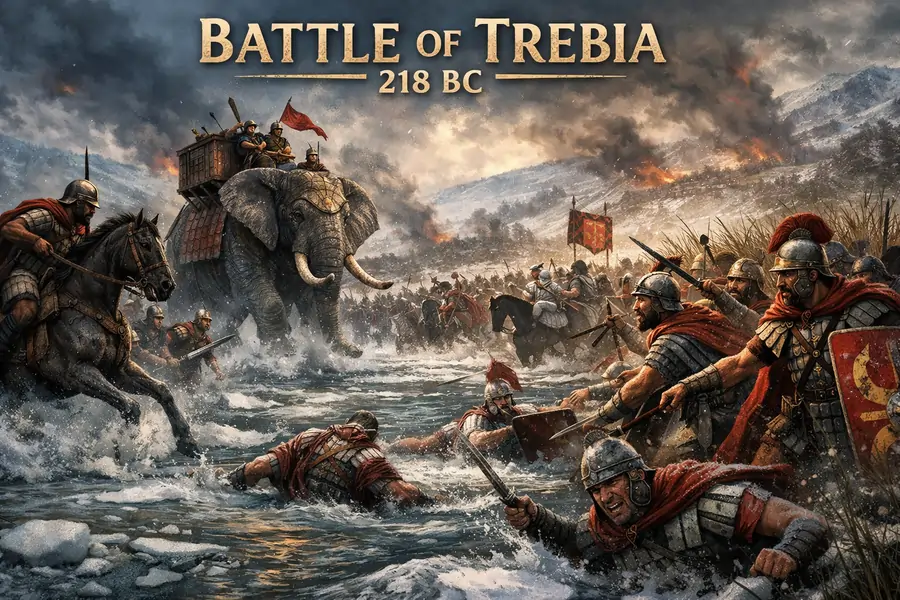
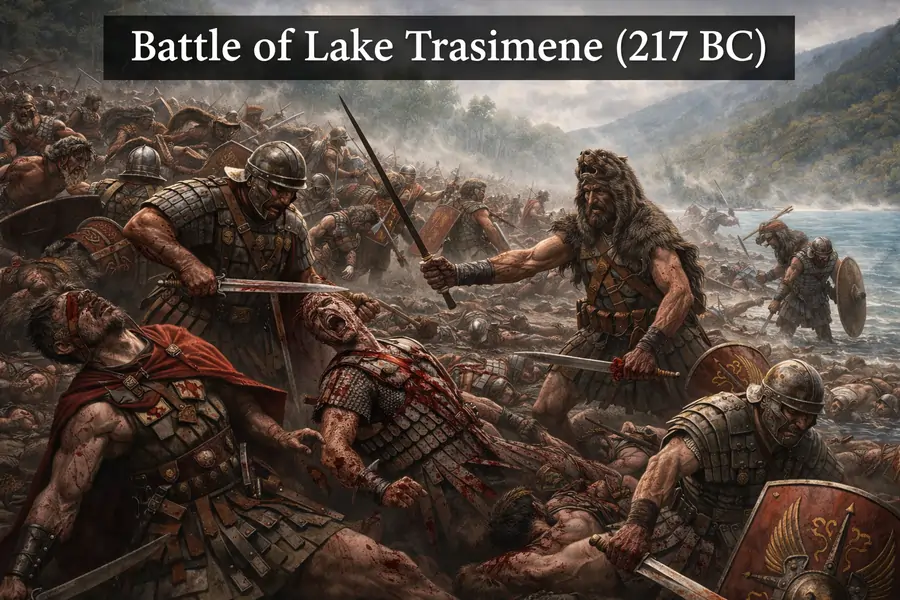
The Second Punic War required a very different military strategy from the First Punic War. Hannibal's invasion did not require Carthage to achieve naval supremacy before the campaign began. His army entered Italy by land, and his early strategy depended primarily on defeating Roman armies and destabilizing Rome's Italian alliance network. This reduced the immediate strategic incentive for Carthage to risk another First Punic War-style naval arms race. His early victories demonstrate how heavily the war depended on land warfare. The Battle of Ticinus was followed by the catastrophic Roman defeat at the Battle of Trebia. The following year Hannibal ambushed another Roman army at the Battle of Lake Trasimene.
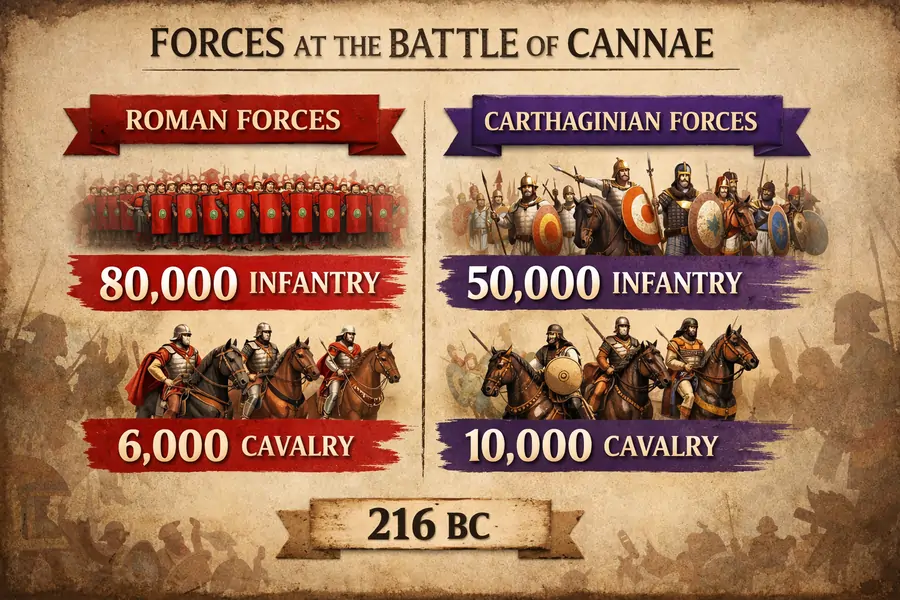
In 216 BC, the disaster became even greater at Cannae, where Hannibal surrounded and destroyed a much larger Roman army. The Battle of Cannae remains one of the most famous examples of battlefield encirclement in ancient warfare. Hannibal's victories created the possibility of breaking the Roman alliance system. His strategy depended heavily on armies, cavalry, allies, and the political fragmentation of Italy. That made a gigantic Carthaginian fleet less immediately important than it had been during the struggle for Sicily.
The Fabian strategy adopted by Rome after its early defeats also illustrates the change. Rome increasingly accepted that it could avoid giving Hannibal the decisive battle he wanted while fighting him through a long war of attrition.
Did Carthage Actually Have a Navy During the Second Punic War?

Yes. This is an important correction to the popular image of the Second Punic War. Carthage did not simply dismantle its fleet or forget how to build warships. The surviving evidence shows repeated Carthaginian naval activity. At the beginning of the war, Hannibal's brother Hasdrubal was assigned a fleet for the defense of Spain. Livy gives the force as 57 warships- 50 quinqueremes, two quadriremes, and five triremes. However, only 32 quinqueremes and the five triremes were ready for sea. (Livy, Ab Urbe Condita 21.22.)
That detail is revealing. Carthage still had the ability to assign a large fleet to an important theater. The problem was that the number of ships actually ready for operations was considerably smaller than the nominal fleet. There was also naval activity around Italy. Livy records Carthaginian quinqueremes operating around the islands near the Strait of Messina early in the war. Later, Carthage made major naval efforts to support Syracuse.
The 130 Ships at Syracuse
The siege of Syracuse provides the clearest evidence that Carthage still possessed significant naval resources. When the Romans besieged Syracuse, the city became one of the most important remaining Carthaginian strongholds in Sicily. Archimedes' defensive machines have made the siege famous, but the struggle was also a naval contest. In 214 BC, Bomilcar was unable to intervene effectively against the Roman fleet and withdrew. In 212 BC, however, Carthage assembled a much larger force, 130 warships and 700 transports, demonstrating that the problem was not an inability to put ships to sea. According to the surviving accounts, the Carthaginian fleet ultimately failed to force its way into Syracuse and withdrew.
Carthage tried again. In 212 BC, Bomilcar returned with an enormous force. Livy records 130 warships and 700 transports loaded with supplies. This is an extraordinary number and one of the most important pieces of evidence for understanding the Carthaginian navy during the Second Punic War. Carthage clearly could assemble a major fleet. The problem was that this was not the beginning of a sustained naval campaign designed to destroy Roman naval power. It was a concentrated effort to save a strategically important ally.
The operation also demonstrates the limits of Carthage's position. The fleet was carrying enormous quantities of supplies, and the weather disrupted its movement. Marcellus eventually confronted the Carthaginian force with a Roman fleet of around 100 ships. The Carthaginians ultimately withdrew. The episode is revealing because the Carthaginians possessed enough ships to challenge a major Roman fleet, but they did not turn that force into a campaign for general naval supremacy.
Why Rome Had the Naval Advantage
By 218 BC, Rome possessed something Carthage no longer enjoyed to the same degree: an established naval system capable of sustaining prolonged large-scale operations. The Roman state had shipyards, experienced naval commanders, sailors, marines, ports, and an institutional memory of large-scale naval warfare. Rome could also draw upon the resources of an enormous Italian alliance network. This mattered because the Roman navy did not have to be rebuilt from the beginning every time a fleet suffered losses. Rome had already learned the lessons of the First Punic War. The result was a striking reversal.
| First Punic War | Second Punic War |
|---|---|
| Carthage begins with major naval superiority | Rome begins with the stronger naval system |
| Rome has limited naval experience | Rome has decades of naval experience |
| Rome builds fleets during the war | Rome maintains established fleets |
| Carthage repeatedly contests Roman naval operations | Carthage does not sustain a prolonged contest for naval supremacy |
| Sicily is the central strategic objective | Italy, Spain, Africa and alliances become central theaters |
Why Carthage Did Not Match Rome Ship for Ship
Several factors probably explain why Carthage did not attempt to recreate the enormous naval mobilization of the First Punic War.
1. Carthage had different strategic priorities
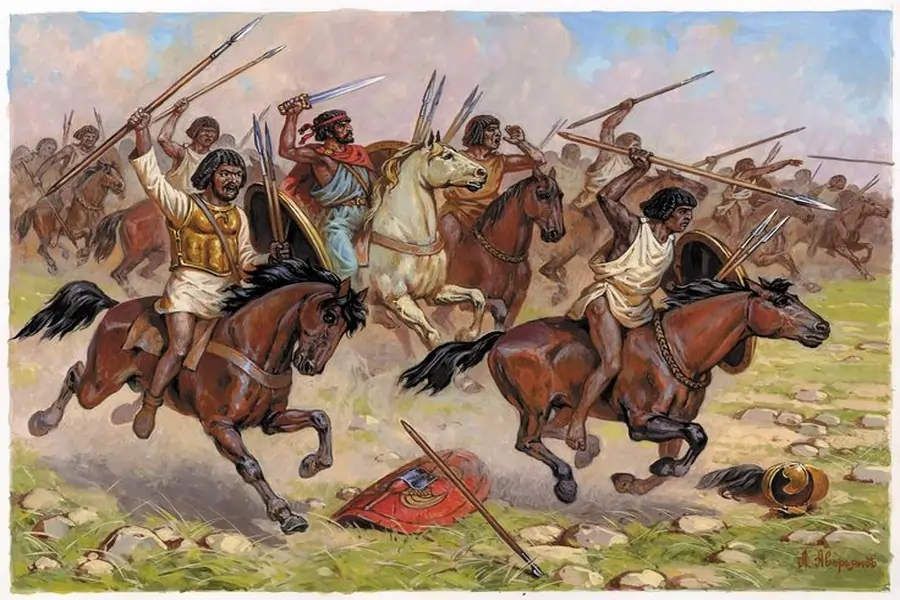
The first and most obvious reason is strategy. Hannibal's invasion of Italy was based on an army crossing the Alps. His greatest opportunities came from defeating Roman armies and attracting Rome's allies to his side. The battles of Trebia, Trasimene, and Cannae show where Carthage was initially concentrating its resources. Hannibal's famous cavalry advantage was also crucial. Numidian cavalry, Iberian troops, Gallic warriors and experienced African infantry formed the core of his military system. Carthage had to keep these forces supplied and reinforced.
2. A naval arms race was extremely expensive
Rome's First Punic War experience had demonstrated just how expensive naval warfare could become. Thousands of rowers had to be recruited and trained. Ships needed constant maintenance. Crews had to be paid, fed, and supplied. A large fleet consumed enormous quantities of timber and other materials. The indemnity and Mercenary War imposed serious costs, but Carthage subsequently recovered significant wealth and military strength, especially through expansion in Spain. Financial exhaustion therefore cannot by itself explain the absence of a new naval arms race.
Its subsequent expansion in Spain produced new wealth, but the resources generated there were also needed to maintain armies and secure Carthaginian control over Iberia. Matching Rome ship for ship would probably have required Carthage to divert enormous resources away from the armies that were already producing spectacular results in Italy.
3. Carthage no longer controlled Sicily
This factor is easy to overlook. During the First Punic War, Sicily was the central strategic prize. Carthage's naval power was essential because its armies in Sicily depended upon maritime communications and reinforcement. After 241 BC, Carthage no longer possessed Sicily. That changed the geography of the war.
Rome controlled the island that had previously been the main battlefield. Carthage's new base in Spain was connected to Italy by land routes that Hannibal could exploit. Africa remained the Carthaginian homeland, while Rome's naval superiority made large-scale maritime reinforcement and operations from Carthage more difficult and risky. Naval superiority was still valuable, but it was no longer automatically the key to winning the war.
4. Rome's navy was now much harder to destroy
There is another lesson from the First Punic War. Rome had already demonstrated that destroying one Roman fleet did not necessarily solve the problem. Even catastrophic storms failed to permanently remove Rome from the sea. This made a strategy based on destroying the Roman navy much less attractive. Carthage could win a naval battle and still face another Roman fleet months later. The Roman state had become remarkably good at absorbing losses.
5. Hannibal's army created opportunities Carthage could not ignore
After Cannae, Rome's political system was under enormous pressure, even though it ultimately proved much more resilient than Hannibal expected. Carthage therefore had a powerful reason to continue supporting the land war. Rebuilding a massive fleet would have consumed resources that might instead be used to reinforce Hannibal, support Spain, defend Sicily, or aid Rome's enemies. The Carthaginian leadership was not choosing between "navy" and "nothing." It was choosing among several competing military requirements.
Did Carthage Actually Need Naval Supremacy?
Carthage did not necessarily need to defeat Rome at sea to win the Second Punic War. Hannibal's army entered Italy by land and inflicted a succession of major defeats on Roman armies. The immediate strategic objective was not to conquer Rome through a maritime invasion, but to fracture the Roman alliance system and force a negotiated settlement. Naval supremacy would still have been valuable for moving supplies, supporting allies and protecting communications, but its marginal importance was different from the First Punic War, when Sicily itself was the central theater.
The best way to understand Carthage's naval strategy during the Second Punic War is therefore not to imagine a complete abandonment of naval power. Carthage still used ships for:
- protecting its African and Spanish coasts;
- transporting troops and supplies;
- supporting allied cities;
- attempting to relieve Syracuse;
- interfering with Roman supply operations;
- maintaining communications between different theaters.
What Carthage generally did not do was commit to the kind of prolonged naval arms race that had characterized the First Punic War. That distinction is critical. Carthage had a navy. Rome had a naval system capable of sustaining a major war across multiple theaters.
The Strategic Irony of the First Punic War
There is a remarkable irony at the heart of the Punic Wars. Carthage had entered the First Punic War with the naval advantage because generations of maritime experience had made it a major Mediterranean power. Rome responded by learning. It copied enemy technology, built fleets, experimented with tactics, trained crews, and accepted catastrophic losses.
The Romans eventually became good enough at naval warfare to defeat Carthage in its own strategic domain. The First Punic War therefore did more than decide the fate of Sicily. It changed the military capabilities of both states. Carthage lost part of its old maritime position. Rome acquired a permanent naval tradition. That transformation became decisive decades later.
Why Hannibal Could Not Repeat the First Punic War in Reverse
Hannibal is often remembered primarily for his spectacular victories. His crossing of the Alps, his victory at Cannae, and his long campaign in Italy have made him one of antiquity's most famous commanders. But Hannibal's war was never simply a replay of the First Punic War.
He could not reverse the strategic geography of the Mediterranean by marching into Italy. Rome still possessed Sicily, Sardinia and Corsica. It had a large fleet, secure bases and access to the resources of Italy. Even after enormous Roman defeats, Rome continued to field armies and fleets. This is one reason the Second Punic War eventually became a war of endurance rather than a single contest of battlefield brilliance.
Rome gradually shifted the conflict away from Hannibal's strongest theater. It fought in Spain. It attacked Syracuse. It intervened in the Adriatic. Eventually, under Scipio Africanus, Rome took the war directly to Africa. The rise of Scipio Africanus illustrates this strategic transformation. Rome was no longer merely defending Italy against Hannibal. It was using its broader resources to attack the foundations of Carthaginian power.
From Cannae to Zama: The Naval Advantage Becomes Strategic
The contrast between Cannae and Zama is particularly revealing. At Cannae, Hannibal demonstrated what his army could achieve against Rome's legions. At Zama, Rome brought the war to Africa and forced Carthage to fight under completely different conditions. The final defeat of Hannibal at the Battle of Zama in 202 BC ended the Second Punic War.
By then, Rome's naval dominance was part of a much larger strategic system. Roman fleets could move armies, secure supply routes and support operations across the Mediterranean. Carthage had never managed to reverse the naval balance created during the First Punic War. And after Zama, it would never again be an equal military power to Rome.
The Real Reason Carthage Did Not Rebuild Its Navy
So why did Carthage not rebuild its navy during the Second Punic War? The simplest answer is that the premise needs qualification. Carthage did rebuild and operate naval forces. It deployed dozens of warships in different theaters and was capable of concentrating a fleet of 130 warships and hundreds of transports during the struggle for Syracuse. What Carthage did not do was rebuild its navy to the scale required to wage another sustained contest for Mediterranean naval supremacy. Several factors explain this.
- The First Punic War had transferred naval initiative from Carthage to Rome.
- Rome had developed the institutional capacity to replace huge naval losses.
- Carthage emerged from the war with major financial and territorial losses.
- Carthage subsequently rebuilt its military power around Spain, armies, and the Barcid command structure.
- Hannibal's strategy focused on defeating Rome's armies and breaking its alliance system rather than conquering Italy through naval power.
- Carthage's navy remained useful for transportation, supply, coastal defense, and major relief operations, but it was not the centerpiece of the war.
- Rome's established fleet made a new naval arms race exceptionally expensive and difficult for Carthage to win.
The most important lesson is therefore not that Carthage became incapable of building ships. It is that Rome had learned something during the First Punic War that Carthage could not easily undo. Rome had learned how to replace losses. A Carthaginian fleet could defeat a Roman squadron. A storm could destroy Roman ships. A naval battle could kill thousands of Roman sailors. Yet Rome could continue building. That capacity turned naval power from a temporary advantage into an institution.
By the time Hannibal crossed the Alps in 218 BC, the fundamental naval balance created by the First Punic War was already heavily in Rome's favor. Carthage still had ships. What it no longer possessed was the strategic freedom to make the Mediterranean a second First Punic War. And that helps explain one of the great reversals in ancient military history: the Carthaginians, who had once forced Rome to learn naval warfare, entered the Second Punic War facing the naval power that Rome had become.
References and Sources
The following primary and secondary sources were used to develop this article. Ancient figures should be treated with appropriate caution because surviving historians sometimes provide conflicting numbers and their accounts were written centuries after some of the events they describe.
- Polybius, The Histories, Books 1-3, especially Books 1.20-23, 1.37, 1.53-63 and 3.20-22.
- Livy, Ab Urbe Condita, Books 21-26, particularly Book 21.22 and Book 25.27.
- Pitassi, Michael. Roman Warships. Cambridge University Press. Chapter 5, "Naval Ascendancy: Third and Second Centuries BC."
- Tarn, W. W. "The Fleets of the First Punic War." The Classical Quarterly.
- Hoyos, Dexter. The Carthaginians. Routledge.
- Lazenby, J. F. The First Punic War: A Military History. Stanford University Press.
- Lazenby, J. F. Hannibal's War: A Military History of the Second Punic War. University of Oklahoma Press.
- Alex Michael Elliott, "The Role of the Roman Navy in the Second Punic War: The Strategic Control of the Mediterranean."
For primary-source reading, the Histories of Polybius and Livy's Ab Urbe Condita provide the most important surviving narratives for the Punic Wars. Polybius is particularly valuable because he wrote comparatively close to the events of the Second Punic War and explicitly examined Rome's rise to Mediterranean dominance.
Books and Memorables
This article may contain affiliate links. If you purchase through these links, I may earn a small commission at no extra cost to you.


Related Articles
Frequently Asked Questions
Why did Carthage not rebuild its navy during the Second Punic War?
Carthage did not completely abandon its navy during the Second Punic War, but it did not rebuild a fleet large enough to challenge Rome for overall naval supremacy. Carthage concentrated much of its military resources on armies, Spain, Hannibal's campaign in Italy, and supporting important allies. Rome, meanwhile, already had the naval infrastructure and experience developed during the First Punic War, making a new naval arms race extremely expensive for Carthage.
Why was Carthage's navy stronger than Rome's at the start of the First Punic War?
Carthage was the established naval power in the western Mediterranean when the First Punic War began in 264 BC. It had generations of maritime experience, established shipyards, experienced sailors and a long tradition of naval warfare. Rome initially had very little experience with large warships and had to build a fleet largely from scratch before it could challenge Carthage at sea.
How did Rome build a navy during the First Punic War?
Rome built a large fleet after recognizing that it could not defeat Carthage in Sicily while Carthage controlled the sea. Polybius states that Rome initially ordered 100 quinqueremes and 20 triremes, using a captured Carthaginian quinquereme as a model. Rome then developed naval tactics such as the corvus and repeatedly constructed replacement fleets after suffering heavy losses.
How did Rome rebuild its navy after losing ships in storms?
Rome repeatedly rebuilt its fleets after catastrophic naval losses during the First Punic War. In one major disaster, a storm destroyed most of a Roman fleet, leaving only 80 of 364 ships according to Polybius. The Roman government responded by ordering another 220 ships to be built, which Polybius says were completed in only three months. This ability to absorb enormous losses and continue building fleets became an important Roman advantage.
Did Carthage still have a navy during the Second Punic War?
Yes. Carthage still possessed a substantial navy during the Second Punic War. Polybius and Livy record Carthaginian warships operating in Spain, Italy and Sicily. The largest recorded Carthaginian naval concentration of the war occurred in 212 BC, when Bomilcar brought about 130 warships and a much larger force of transports toward Syracuse. Carthage therefore had a navy, but it did not use it to sustain a prolonged contest for Mediterranean naval supremacy.
Why did Rome have naval superiority over Carthage in the Second Punic War?
Rome had naval superiority because the First Punic War had transformed its maritime capabilities. By 218 BC, Rome possessed experienced crews, established naval bases, shipbuilding capacity and decades of experience operating large fleets. Carthage still had significant naval forces, but its military strategy was centered more heavily on armies in Spain and Italy. Rome could therefore maintain large fleets across several theaters while Carthage struggled to match its overall naval strength.
Add Comment