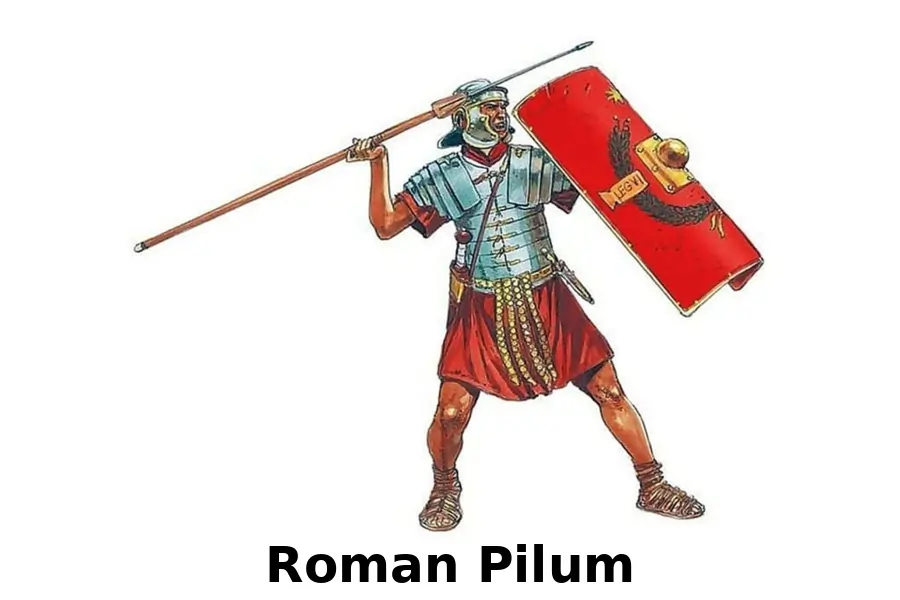
The Roman pilum was more than just a simple javelin. It was one of the most carefully engineered weapons of the ancient world, designed to break enemy formations before Roman soldiers ever crossed swords. With its long iron shank, heavy wooden shaft, and armor-piercing point, the pilum represented the Roman ability to combine battlefield experience with practical innovation. Used for centuries by legionaries from the Roman Republic through the early Empire, this weapon played a crucial role in transforming the Roman army into one of history's most effective military machines.
Table of Contents
- What Was the Roman Pilum?
- When Was the Roman Pilum Invented and How Long Was It Used?
- Which Roman Soldiers Used the Pilum?
- Roman Pilum Design, Size, and Construction
- How the Roman Pilum Worked in Battle
- The Engineering Innovation Behind the Pilum
- The Pilum During the Punic Wars
- Why the Pilum Was So Effective
- Why Rome's Enemies Struggled Against the Pilum
- Why Rome Stopped Using the Pilum
- Legacy of the Roman Pilum
What Was the Roman Pilum?
The Roman pilum was a heavy javelin used by Roman infantry, especially legionaries, during the Republic and early Imperial periods. Unlike ordinary spears, which were primarily designed for repeated throwing or hand-to-hand combat, the pilum was designed for a very specific battlefield purpose: to disrupt the enemy formation before Roman soldiers engaged in hand-to-hand combat.
A typical Roman soldier would throw the pilum at close range before drawing his gladius and advancing into melee combat. This combination of missile attack followed by disciplined sword fighting became one of the defining characteristics of the Roman legion.
The Greek historian Polybius, writing in the 2nd century BC, described Roman infantry equipment in detail and noted that Roman soldiers carried throwing weapons as part of their standard battlefield system (Polybius, Histories, Book VI).
The pilum was not the only reason for Roman military success, but it perfectly represented Roman tactical thinking: weaken the enemy formation, create confusion, then exploit the opening with disciplined infantry. The heavy legionaries would then capitalise on the advantage and rout the enemy.
When Was the Roman Pilum Invented and How Long Was It Used?
The exact origin of the pilum remains debated among historians. Some scholars believe the Romans adopted or improved similar throwing weapons used by neighboring Italic peoples such as the Samnites, whom Rome fought during the Samnite Wars between the 4th and 3rd centuries BC. By the Middle Roman Republic, especially during the Punic Wars against Carthage, the pilum had become a central weapon of Roman heavy infantry. It was widely used during conflicts such as the First Punic War, Second Punic War, and later Roman campaigns across the Mediterranean.
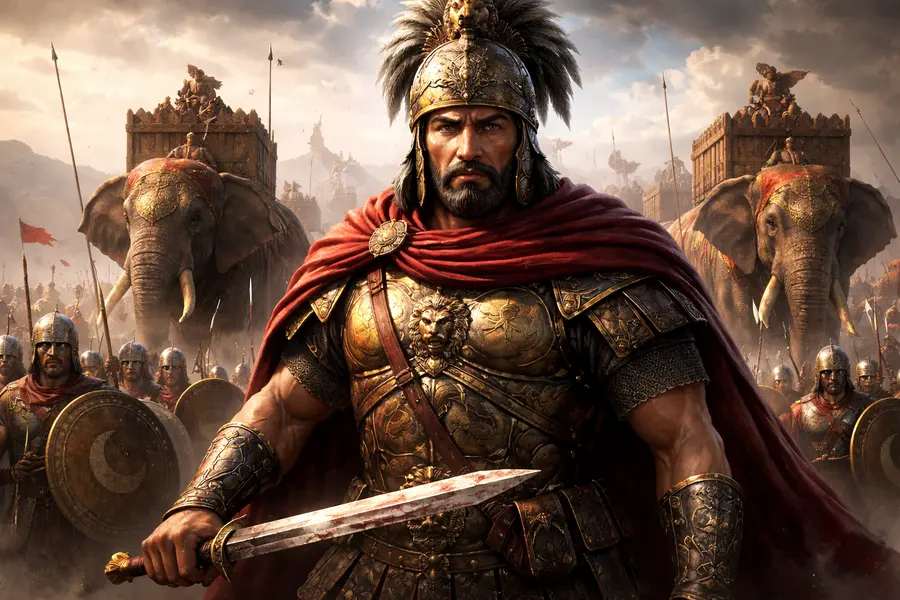
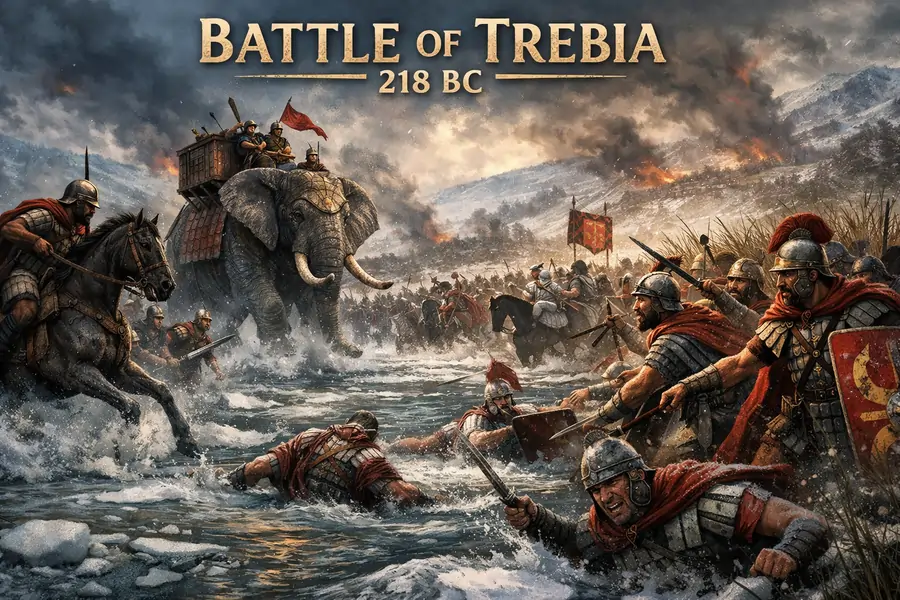
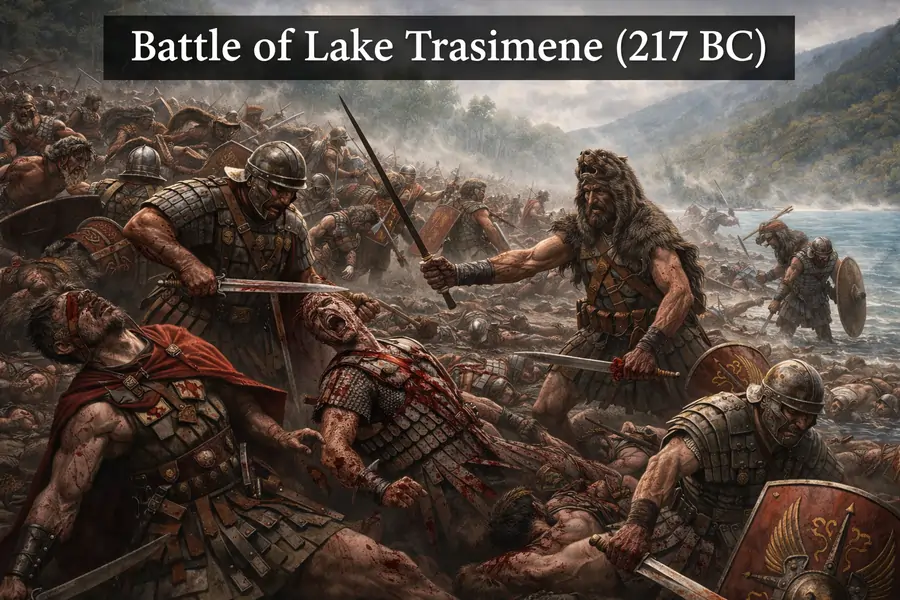
During the war against Hannibal Barca, Roman soldiers carrying pila faced one of the greatest military commanders in history. Battles such as Trebia, Lake Trasimene, and Cannae demonstrated both the strengths and weaknesses of Roman battlefield tactics. The pilum continued to evolve during the late Republic under generals such as Julius Caesar. It remained an important legionary weapon throughout much of the early Roman Empire, roughly from the 3rd century BC until the 2nd-3rd centuries AD, before gradually being replaced by other throwing weapons such as lighter javelins and darts.
Which Roman Soldiers Used the Pilum?
During the Republican period, the Roman army was organized according to the manipular system. The main soldiers associated with the pilum were the heavy infantry classes:
- Hastati: Younger frontline soldiers who opened the battle.
- Principes: More experienced soldiers who formed the second battle line.
Both hastati and principes typically carried pila before engaging with their swords. The older and wealthier triarii, however, traditionally fought with long thrusting spears rather than pila.
After the Marian military reforms of the late 2nd century BC, distinctions between hastati, principes, and triarii disappeared. The professional Roman legionary became a standardized soldier equipped with a shield, sword, armor, and pilum. This professionalization of the army helped create the famous legion system explained in detail in the article on Roman legion structure, organization, and battlefield tactics.
Roman Pilum Design, Size, and Construction
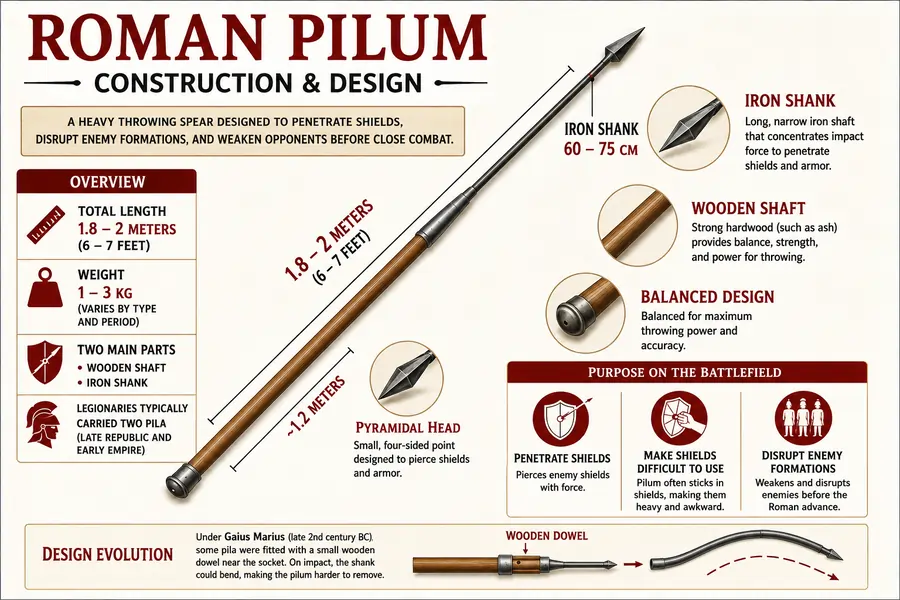
The effectiveness of the Roman pilum came from its unusual construction. While it looked simple, every part of the weapon served a practical battlefield function.
Length and Size of the Roman Pilum
A typical pilum measured approximately 1.8 to 2 meters (6-7 feet) in total length. The weapon consisted of two main sections:
- A wooden shaft roughly 1.2 meters long
- A narrow iron shank around 60-90 centimeters long
The weight varied depending on the period and design, but many examples were between approximately 2 and 5 kilograms. Roman armies also used different versions, including heavier and lighter pila.
The Wooden Shaft
The rear portion of the pilum was made from hardwood such as ash. This provided enough strength for throwing while maintaining balance. The shaft was thick enough to generate significant force but not so heavy that soldiers could not carry multiple weapons.
The Long Iron Shank
The most distinctive feature of the pilum was its extended iron neck. Unlike a normal spearhead attached directly to wood, the pilum had a long metal section ending in a small pyramidal point. This design concentrated the force of impact into a narrow area, improving its ability to penetrate shields and sometimes armor.
Archaeological discoveries from Roman military sites confirm variations in pilum construction, showing that the weapon changed over time rather than existing as a single fixed design.
How the Roman Pilum Worked in Battle
The Roman pilum was not intended to defeat an entire army through missile fire alone. Instead, it was designed as a tactical weapon that created the perfect conditions for the Roman infantry assault. A Roman legionary usually threw his pilum shortly before contact with the enemy, often at a distance of roughly 15-30 meters. The goal was to strike the enemy formation at the moment when opposing soldiers were preparing for close combat.
When hundreds or thousands of pila were thrown together, the effect could be devastating. Enemy soldiers faced a sudden storm of heavy projectiles capable of piercing shields, disrupting formations, and slowing an organized charge. After releasing their pila, Roman soldiers advanced behind their large rectangular shields (scuta) and attacked with their short swords. The impact was devastating as the pila temporarily created enough disruption and confusion in the enemy lines for the well-organized Roman soldiers to break through.
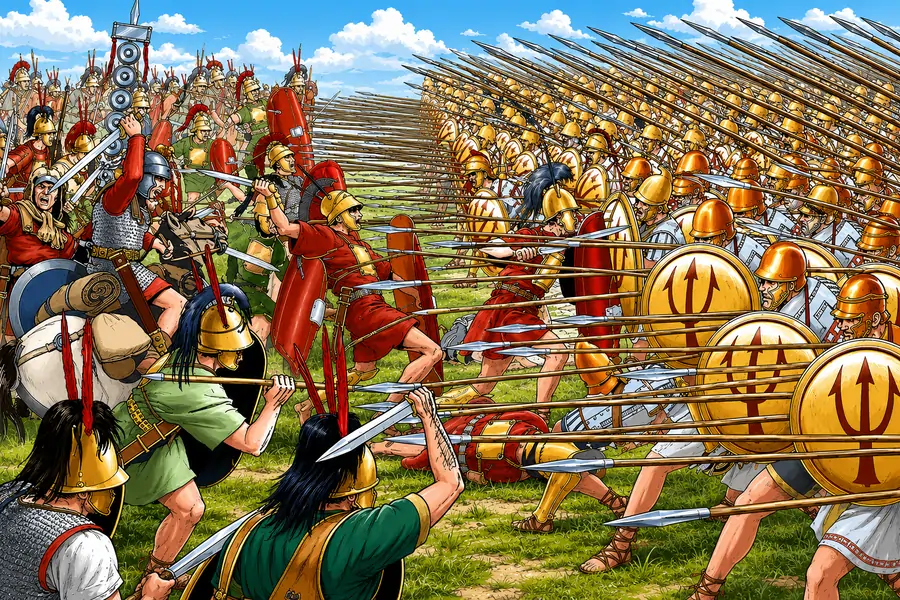
Roman adaptability was especially important when facing armies with very different fighting styles, including the armies of Carthage, Hellenistic kingdoms, and tribal warriors. This flexibility later contributed to Roman victories against formations such as the Macedonian phalanx, explored in detail in Why the Roman Legion Defeated the Macedonian phalanx.
The Engineering Innovation Behind the Roman Pilum
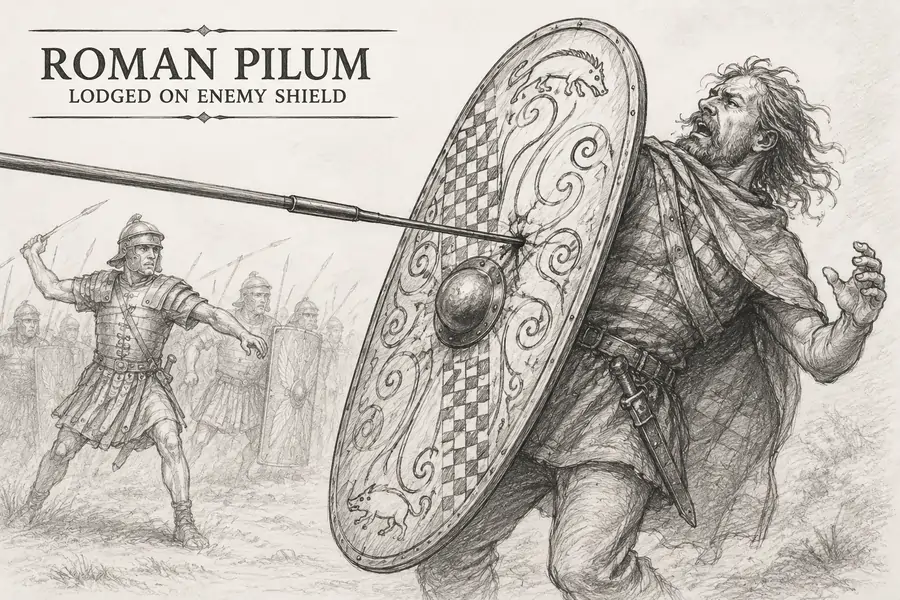
The genius of the Roman pilum was not simply that it could kill an opponent. Many ancient weapons could do that. Its true innovation was that it attacked an enemy soldier's most important defensive tool: the shield. Ancient battles depended heavily on maintaining formation. A soldier protected himself and his companions through shield positioning. If that shield became useless, the entire formation became vulnerable.
Conventional missile weapons such as arrows were often less effective against heavy shields because many failed to penetrate deeply, and those that became embedded could sometimes be removed quickly. The Roman pilum solved this problem through a unique design. Its small pyramidal iron tip concentrated the force of impact into a narrow point, allowing it to punch through wooden shields. Once embedded, the shape of the iron head and the long metal shank made the weapon extremely difficult to pull out during battle.
The weight of the wooden shaft hanging from the shield further increased the problem. A shield pierced by a pilum became heavy, awkward, and difficult to maneuver. Enemy warriors were often forced to either fight with a compromised defense or abandon their shields completely before facing Roman legionaries in close combat.
The Greek writer Plutarch described an important modification attributed to the Roman general Gaius Marius before the Battle of Vercellae in 101 BC. According to Plutarch, Marius replaced one of the iron rivets holding the pilum head with a weaker wooden peg, causing the weapon to bend after impact and making it harder for enemies to throw back (Plutarch, Life of Marius).
Modern historians debate whether all pila were deliberately designed to bend. Archaeological evidence suggests that some examples were actually very strong, while others may have deformed depending on construction and impact conditions. The important point is that the pilum was engineered to reduce the enemy's ability to continue fighting effectively.
The Roman Pilum During the Punic Wars
The Punic Wars between Rome and Carthage were among the most important conflicts in the development of Roman military tactics. During these wars, the pilum became one of the standard weapons carried by Roman heavy infantry. Against Hannibal's army in the Second Punic War, Roman legionaries faced a highly diverse military force containing African infantry, Iberian warriors, Gallic troops, elite cavalry, and specialist units such as Balearic slingers and Numidian cavalry.
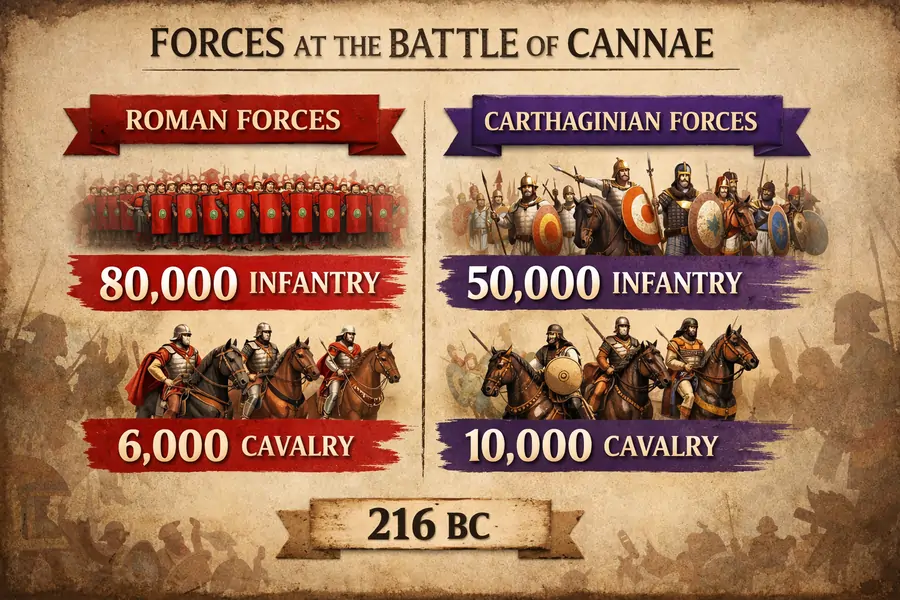
The pilum gave Roman infantry an advantage in direct combat, but Hannibal repeatedly showed that weapons alone did not decide battles. At the Battle of Cannae in 216 BC, Roman soldiers were equipped with effective weapons, but Hannibal's superior battlefield strategy surrounded and destroyed a much larger Roman army.
Rome eventually adapted. Instead of relying only on aggressive attacks, Roman commanders adopted new approaches such as the Fabian Strategy, avoiding Hannibal's strengths while rebuilding their military power. At the Battle of Zama in 202 BC, Roman discipline, improved tactics, and effective infantry organization helped Scipio Africanus defeat Hannibal and end the Second Punic War.
Why Was the Roman Pilum So Effective?
The effectiveness of the Roman pilum came from how perfectly it matched the fighting style of the legion. It was not an isolated weapon but part of a complete military system. The pilum provided several battlefield advantages:
- Formation disruption: Enemy formations could lose organization moments before contact.
- Shield neutralization: Warriors who lost their shields became much easier targets for Roman swordsmen.
- Psychological impact: Soldiers advancing toward Roman lines had to endure a concentrated missile attack immediately before melee combat.
- Tactical flexibility: Legionaries could fight effectively against many different enemy types.
Roman military success was never based on a single weapon. Training, organization, engineering, discipline, and morale were equally important. The daily routine and preparation behind this effectiveness are covered in the daily life of a Roman soldier.
Why Rome's Enemies Struggled Against the Pilum
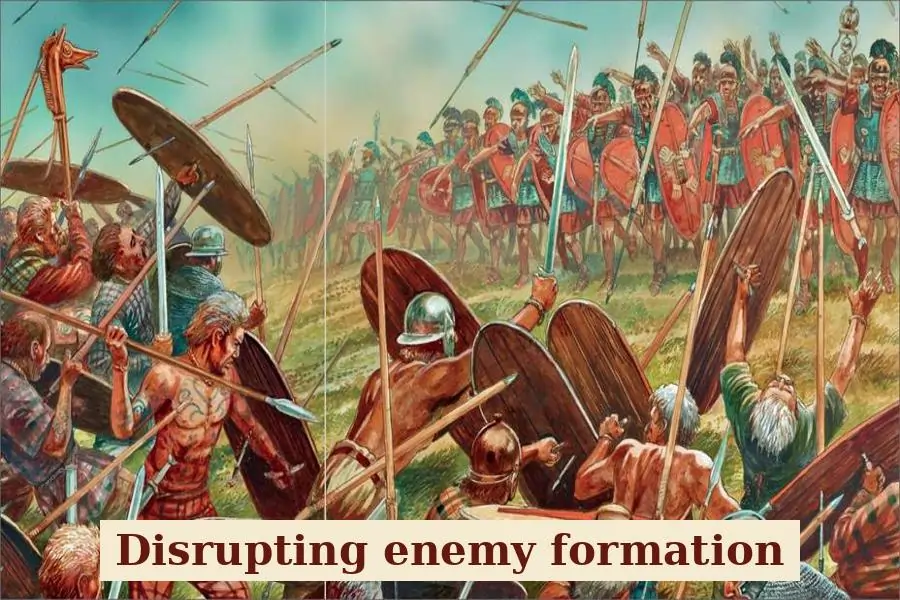
The Roman pilum was especially difficult for Rome's enemies to counter because it forced them to fight on Roman terms. Many ancient armies depended on powerful opening charges, individual warrior skill, or tightly packed formations to overwhelm their opponents. The pilum disrupted this approach by creating disorder at the exact moment when armies were preparing for decisive close combat.
Disrupting Enemy Momentum
Many of Rome's opponents, especially tribal armies such as the Gauls, relied heavily on the speed and aggression of their initial attack. A successful charge depended on maintaining confidence, cohesion, and forward momentum. A concentrated volley of pila forced attacking warriors to slow down, reorganize, or hesitate just before reaching Roman lines. This brief loss of momentum gave disciplined legionaries an important advantage when the fighting shifted to close quarters.
Forcing Enemies Into Unfamiliar Battles
The pilum helped transform chaotic battlefield encounters into the type of combat where Roman training was most effective. Instead of allowing opponents to fully exploit their preferred fighting styles, Roman soldiers used the opening missile attack to create confusion before advancing in organized formations. Enemy warriors who excelled in individual combat or aggressive assaults often found themselves facing a coordinated military system built around timing, discipline, and teamwork.
Difficult to Develop a Simple Counter
Unlike some battlefield threats that could be answered with a change in equipment or formation, the pilum was part of a larger Roman tactical system. Avoiding the weapon completely was difficult because armies still needed to close the distance and engage Roman infantry. Advancing too cautiously gave the Romans more control of the battlefield, while charging recklessly increased the chance of disorder before contact.
The success of the pilum came from how effectively it complemented Roman tactics rather than from the weapon alone. Rome's enemies were not simply facing a javelin; they were facing a carefully coordinated sequence of movement, missile attack, and disciplined close combat that made the Roman legion one of the most adaptable military forces of the ancient world.
Why Did Rome Stop Using the Pilum?
The pilum gradually declined during the later Roman Empire as warfare changed. By the 3rd and 4th centuries AD, Roman armies increasingly fought with different equipment and tactical systems. Several factors contributed to this transition:
- Greater use of cavalry warfare
- Changes in enemy tactics
- Increasing reliance on lighter missile weapons
- Evolution of Roman infantry equipment
Late Roman soldiers often used weapons such as the spiculum, verutum, and throwing darts known as plumbatae. These weapons better matched the changing battlefield conditions of Late Antiquity. However, the disappearance of the pilum did not represent a failure of the weapon. Instead, it reflected Rome's traditional strength: the ability to adapt military equipment to new challenges.
The Legacy of the Roman Pilum
The legacy of the Roman pilum extends far beyond its centuries of battlefield use. It remains one of the greatest examples of practical military engineering from the ancient world. Unlike weapons designed purely for killing power, the pilum targeted disrupting the cohesion of the enemy formation. By damaging shields and breaking formations, it changed the conditions of battle before swords were even drawn.
The weapon symbolizes why Rome became such a successful military power. Roman armies were not always the most innovative creators of completely new technology, but they excelled at improving existing ideas and turning them into reliable systems.
From the wars against Carthage to the expansion of the Empire, the pilum was one component of the larger Roman military system that helped legionaries succeed for centuries. Alongside the gladius, scutum, and disciplined legion formation, it became one of the defining weapons of ancient Rome.
Historical Sources and References
- Polybius - The Histories, Book VI - Description of Roman Republican military organization and equipment.
- Plutarch. Life of Marius - Account of Marius' military reforms and pilum modifications.
- Vegetius. De Re Militari - Late Roman discussion of military training and equipment.
- Bishop, M.C. & Coulston, J.C.N. Roman Military Equipment: From the Punic Wars to the Fall of Rome. Oxbow Books.
- Goldsworthy, Adrian. The Complete Roman Army. Thames & Hudson.
- Connolly, Peter. Greece and Rome at War.
Recommended Books
This article may contain affiliate links. If you purchase through these links, I may earn a small commission at no extra cost to you.


Related Articles
Frequently Asked Questions
Why did Roman soldiers throw the pilum before attacking?
Roman soldiers threw the pilum before charging to weaken and disrupt enemy formations before close combat. The heavy javelin could penetrate shields, making them difficult to use and forcing some enemies to abandon their protection. This gave Roman legionaries an advantage when they advanced with their swords.
How was the Roman pilum different from a normal spear?
The Roman pilum was different from a normal spear because it was mainly designed as a throwing weapon rather than a reusable thrusting spear. It had a long iron shank with a small penetrating tip that could pierce enemy shields and make them difficult to remove during battle.
Did the Roman pilum really bend after hitting a shield?
Some Roman pila could bend after impact, but not every pilum was deliberately designed this way. Ancient sources describe modifications that made the weapon harder to reuse, while archaeological evidence suggests different versions existed. The main purpose of the pilum was to disable enemy shields and disrupt formations.
How far could a Roman soldier throw a pilum?
A Roman soldier could typically throw a pilum effectively at a range of around 15 to 30 meters. Although it could sometimes travel farther, Roman legionaries usually waited until the enemy was close so the weapon would strike with maximum force before the final infantry attack.
When did Roman legionaries stop using the pilum?
The Roman pilum was widely used from the Roman Republic through the early Roman Empire, roughly from the 3rd century BC to the 2nd or 3rd century AD. It gradually declined as Roman military tactics changed and later soldiers adopted different throwing weapons such as the spiculum and plumbatae.
Why was the Roman pilum so effective against enemy shields?
The Roman pilum was effective against shields because its narrow iron tip concentrated the force of impact into a small area, allowing it to penetrate wooden defenses. Once stuck, the long iron shank and heavy shaft made the shield awkward to handle, reducing an enemy soldier's ability to fight effectively.
Add Comment