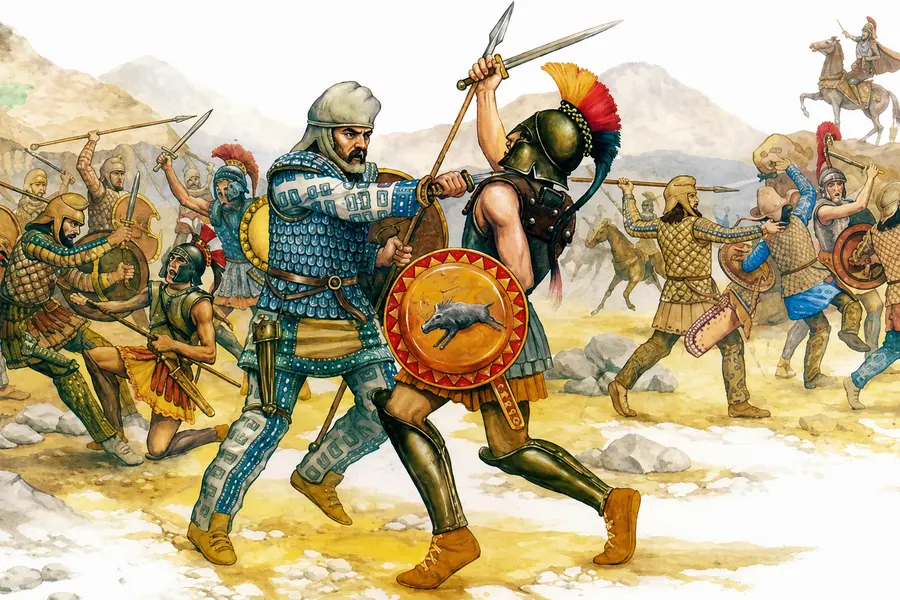
We all know Alexander the Great for his brilliant victories, excellent tactical judgement, and use of terrain. However, the Battle of the Persian Gate in 330 BC was an example of how the invincible Macedonian Phalanx struggled under unfavourable conditions. Unlike in the open-field battles at Granicus, Issus, and Gaugamela, Alexander could not simply rely on the speed of his cavalry or the flexibility of his combined-arms army to overwhelm his opponent. At the Persian Gate, a small Persian force commanded by Ariobarzanes used the terrain advantage offered by the Zagros Mountains to inflict severe casualties on the Macedonians. A carefully prepared ambush allowed the defenders to halt the Macedonian advance toward Persepolis temporarily. Alexander eventually solved the problem through reconnaissance, maneuver, and a dangerous flanking march, but the battle demonstrated just how vulnerable even his veteran army could become when terrain neutralized its greatest advantages.
The battle is particularly fascinating because it represents a rare moment when Alexander's normally relentless advance was checked by a Persian commander who understood exactly how to exploit geography. It was, in many respects, the Persian version of the Battle of Thermopylae, in which a determined defense of a narrow mountain pass delayed a numerically superior invading army.
Table of Contents
- Prelude to the Battle of the Persian Gate
- What Was the Persian Gate?
- Opposing Forces and Commanders
- Why Did Ariobarzanes Defend the Persian Gate?
- The Persian Ambush and Alexander's Initial Setback
- Why Was the Battle of the Persian Gate So Difficult for Alexander?
- How Did Alexander Defeat the Persian Gate?
- Battle of the Persian Gate vs. Thermopylae
- Consequences of the Battle
- What the Ancient Sources Tell Us
- Conclusion
- References and Further Reading
Prelude to the Battle of the Persian Gate
By the winter of 330 BC, Alexander the Great had already destroyed the military power of the Achaemenid Persian Empire in a series of extraordinary campaigns. His invasion had begun in 334 BC, and within two years he had defeated Persian armies at the Battle of the Granicus River and the Battle of Issus. Yet the Persian Empire was not conquered simply because its main armies had been beaten. Alexander still had to occupy its administrative centers, secure its roads, capture its royal treasuries, and prevent resistance from regrouping. The decisive confrontation came at Gaugamela in October 331 BC, where Alexander defeated Darius III in the battle that effectively shattered the Great King's ability to defend the western half of his empire.
The significance of Gaugamela cannot be overstated. Alexander's victory opened the road into the heart of the Achaemenid Empire. Babylon surrendered. Susa followed. The Macedonian king now turned toward Persis itself, the Persian homeland and the symbolic center of Achaemenid power. The route from Susa toward Persepolis was not simply another march across an open plain. The Zagros Mountains stood between Alexander and the Persian heartland. One route was easier and more established, while another offered a shorter but considerably more dangerous passage through the mountains.
Alexander chose the difficult route. This decision was characteristic of his campaign style. Alexander repeatedly accepted tactical risks when doing so promised operational speed. His army had crossed rivers under enemy observation, attacked fortified cities, marched through hostile territories, and fought enormous armies. But the Persian Gate presented a different kind of problem: an enemy who did not need to defeat Alexander's army in a conventional battle. All Ariobarzanes needed to do was stop it from passing.
The Persian commander understood the strategic importance of the position. If Alexander could be delayed in the mountains, Persian forces elsewhere might have time to reorganize. More importantly, the Persian Gate stood on the road leading directly toward Persepolis, one of the most important royal centers of the Achaemenid Empire. The resulting confrontation would become one of the most dramatic episodes of Alexander's invasion of Persia.
What Was the Persian Gate?
The Persian Gate was a narrow mountain pass through the Zagros Mountains that controlled one of the principal approaches into Persis. Ancient sources also refer to the position as the Susian Gate or Susian Rock, depending on the direction from which the pass was approached. The exact location of the ancient battlefield has been debated by historians and archaeologists. The traditional identification places the Persian Gate in the region of modern southwestern Iran, generally associated with the Tang-e Meyran/Tang-e Khas area and the mountainous approaches toward Persepolis. Encyclopaedia Iranica notes that the defensive position has traditionally been identified with a narrow defile surrounded by parallel ridges.
Whatever the precise reconstruction of the battlefield, its military character is clear. The pass was narrow enough to restrict the movement of a large army and surrounded by elevated terrain that allowed defenders to observe and attack troops below. That geographical feature was critical. Alexander's army was at its most dangerous when it could deploy its various components together. Macedonian phalanx infantry provided the heavy center, hypaspists and other elite infantry supported difficult assaults, while Companion Cavalry and allied horsemen provided mobility and shock power.
The Persian Gate interfered with this system. There was little room for cavalry maneuver. The Macedonian phalanx could not easily exploit its formation in a confined mountain corridor. Large numbers of troops became a liability because the terrain prevented them from deploying effectively. The Persian Gate was therefore not merely a geographical obstacle. It was a natural fortress. In modern military terminology, Ariobarzanes had selected terrain that created a powerful force multiplier. A smaller army could defend a position that would have been almost impossible to hold on an open battlefield.
Opposing Forces and Commanders
Alexander the Great
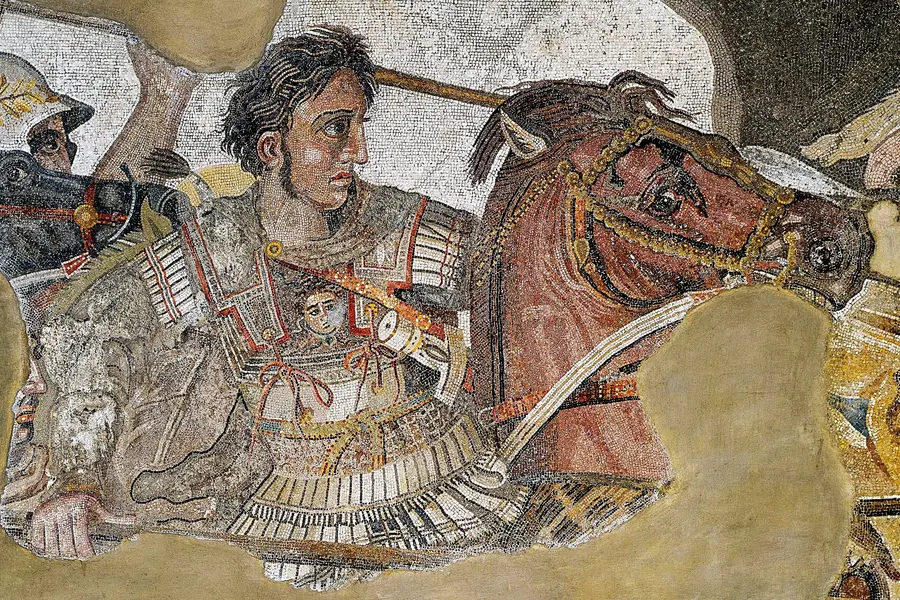
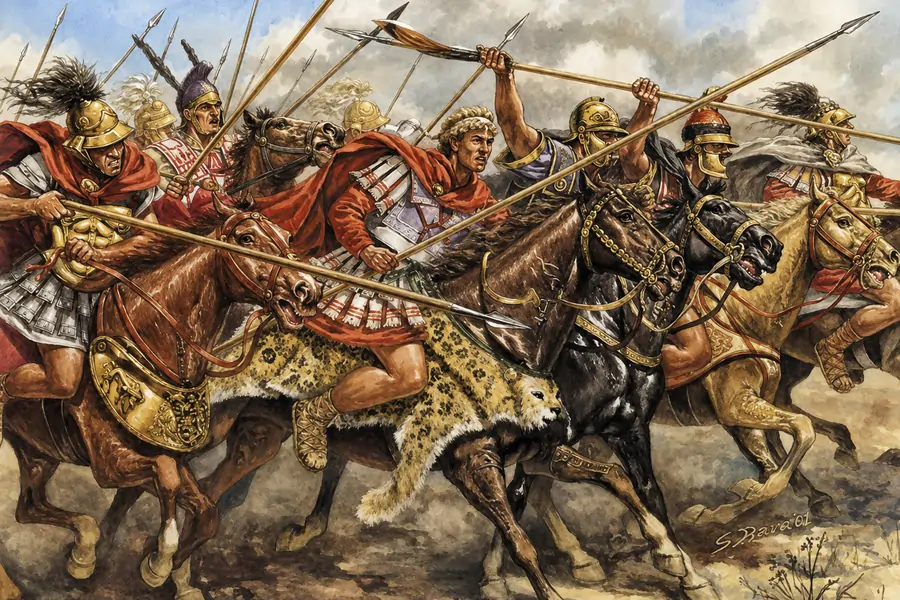
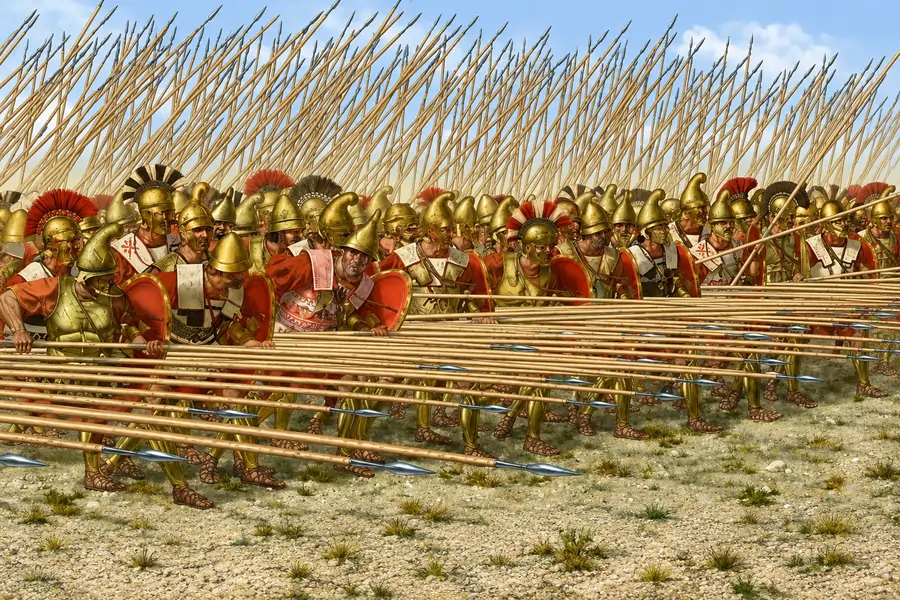
Alexander the Great commanded the invading Macedonian army personally. By 330 BC, this was an exceptionally experienced force. Many of its soldiers had fought continuously since the beginning of the Asian campaign. The army combined Macedonian, Greek, Thessalian, Thracian, and other allied troops. Its greatest strength was not simply numerical superiority but the integration of different battlefield capabilities. The Macedonian phalanx formed the backbone of the infantry. Its long sarissas gave heavily equipped infantry considerable reach, while the Companion Cavalry provided an elite mounted striking force.
The effectiveness of the Macedonian system depended on cooperation between these elements. The Macedonian phalanx's effectiveness came from discipline, cohesion, and its ability to operate as part of a larger combined-arms army rather than acting independently. Alexander's most trusted commanders also played important roles in the campaign. Craterus was an experienced infantry commander, while Perdiccas and Ptolemy were among the officers who would later become major figures in the wars following Alexander's death.
Ariobarzanes
The Persian defense was commanded by Ariobarzanes, the satrap or military governor of Persis. He was one of the Persian commanders who continued resistance after the catastrophic defeat at Gaugamela. Unlike Darius III, Ariobarzanes did not need to defeat Alexander's army in a traditional battle. His objective could be much simpler. Use the terrain to delay or damage the Macedonian army and prevent its immediate advance toward Persepolis.
The sources disagree about the precise size of his force. Arrian gives an enormous figure of approximately 40,000 infantry and 700 cavalry, while Curtius Rufus gives a smaller figure of about 25,000 infantry, with Diodorus mentioning approximately 300 cavalry. Modern historians generally treat the ancient troop totals with caution because numerical exaggeration is common in ancient military narratives. The important point is not the exact number of Persian soldiers. It is that Ariobarzanes had enough men to occupy the defensive position effectively while Alexander's army was severely constrained by the terrain.
Why Did Ariobarzanes Defend the Persian Gate?
Ariobarzanes's decision to defend the Persian Gate becomes easier to understand when the wider strategic situation is considered. Persia had already suffered catastrophic defeats. Darius III was retreating eastward, Alexander had taken Babylon and Susa, and the Macedonian army was approaching Persepolis. For Ariobarzanes, the Persian Gate was therefore one of the last opportunities to impose a meaningful delay on the invasion.
The objective was probably not simply to destroy Alexander's army. A commander defending a narrow pass could achieve considerable strategic value even without winning a conventional victory. Every day Alexander spent fighting in the mountains was a day in which the Persian administration could reorganize, information could travel, and surviving Persian forces could withdraw or regroup. The pass also protected the road to Persepolis.
Persepolis was more than another city. It was one of the ceremonial capitals of the Achaemenid Empire and a powerful symbol of Persian kingship. Alexander's capture of the city would demonstrate that the Macedonian invasion had reached the empire's heart. Ariobarzanes therefore had compelling reasons to make the mountains his battlefield. He had something Alexander did not, a defensive position that could be prepared in advance.
The Persian Ambush and Alexander's Initial Setback
The most dramatic version of the Battle of the Persian Gate comes from the accounts of Diodorus Siculus and Quintus Curtius Rufus. According to these traditions, Alexander's army entered the narrow valley without realizing the full extent of the Persian preparations. The Macedonians believed that the road ahead was relatively secure. Then the Persians attacked.
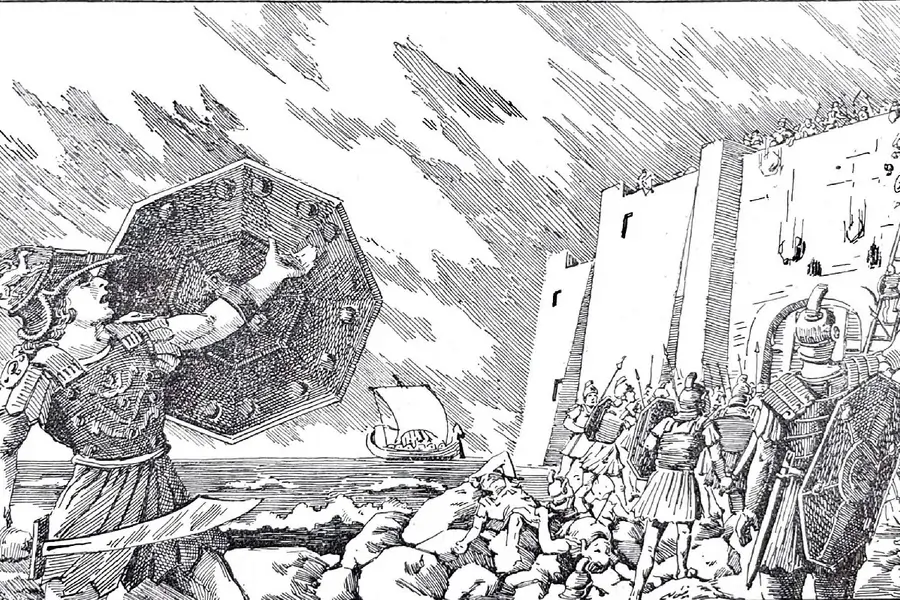
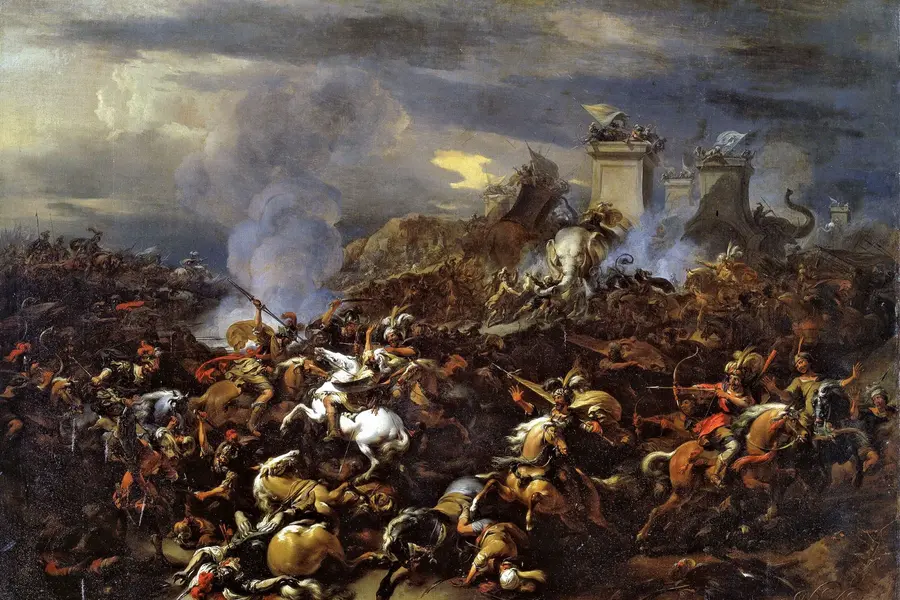
From the surrounding heights, Persian soldiers launched missiles and hurled rocks down onto the Macedonian column. The geography transformed the attack into something closer to a controlled killing zone than a conventional battle. The Macedonians could not easily strike back. Their enemy was above them. The narrow road prevented the army from deploying properly. The soldiers at the front were exposed, while those behind had difficulty moving forward to support them.
Alexander's army had encountered an enemy that had essentially removed the advantages of numbers and formation. According to the account preserved by Curtius, Alexander eventually ordered his troops to withdraw after suffering significant casualties. Diodorus similarly describes a devastating Persian attack in which the Macedonians were unable to respond effectively. This is important because it represents an unusually serious setback in Alexander's Persian campaign.
However, the ancient sources are not unanimous. Arrian, whose Anabasis of Alexander is generally regarded as one of the most important surviving accounts of Alexander's campaigns, presents the engagement somewhat differently. In his version, Alexander approaches the fortified position, suffers losses from missile fire, withdraws, and then develops a plan to outflank the defenders.
The discrepancy matters. It means that the popular description of the Persian Gate as a straightforward "defeat" of Alexander should be treated with some caution. Alexander clearly encountered serious resistance and could not force the position frontally, but the precise scale of the initial disaster depends on which ancient account is followed. Encyclopaedia Iranica likewise emphasizes that the ancient sources provide differing accounts of the battle and Persian troop strength. What is beyond dispute is that the direct approach failed. Alexander needed another solution.
Why Was the Battle of the Persian Gate So Difficult for Alexander?
The Battle of the Persian Gate was difficult because it attacked the fundamental assumptions behind Alexander's normal method of warfare.
1. The terrain neutralized Macedonian cavalry
Alexander's Companion Cavalry was among the most powerful striking forces of the ancient world. On open ground, Alexander could use cavalry to threaten a flank, create breakthroughs, or pursue a defeated enemy. At the Persian Gate, there was almost nowhere for cavalry to operate. The mountains reduced the value of Alexander's most mobile arm. The same problem would have confronted any commander attempting to fight a conventional battle in a narrow defile. The cavalry could not transform the battlefield into an open space.
2. The Macedonian phalanx could not deploy normally
The phalanx was equally constrained. Its long sarissas were devastating when large bodies of infantry maintained formation and advanced together. In a narrow mountain corridor, however, formation depth and frontage became difficult to exploit. Individual units could not simply spread out and envelop the enemy. The battle therefore illustrates an important principle of ancient warfare: a highly sophisticated military system can become less effective when the battlefield prevents it from using its strengths.
3. The Persians controlled the high ground
Ariobarzanes did not merely occupy the road. His soldiers could attack from elevated positions. Gravity itself became an ally for the Persians. Rocks and missiles thrown downward could inflict damage without requiring the defenders to expose themselves to a full Macedonian assault.
4. Alexander was operating deep inside enemy territory
Alexander was not fighting near Macedonia or a secure supply base. His army was thousands of kilometers from home and had already spent years campaigning in Asia. Logistics mattered enormously. Maintaining food supplies, replacement animals, equipment, and communications over such distances was a major military achievement in itself. Alexander's ability to keep his army moving was one of the less visible foundations of his success. His logistical system is examined in greater detail in how Alexander the Great managed the logistics of his army.
5. The defenders had prepared the battlefield
Perhaps the greatest advantage belonged to Ariobarzanes before the fighting even started. He had chosen the battlefield. Alexander had to react to it. That reversed the normal relationship between the Macedonian king and his opponents. Alexander usually sought to impose his tempo on the enemy. At the Persian Gate, the Persians initially dictated the terms.
How Did Alexander Defeat the Persian Gate?
Alexander's answer was not to attack the Persian defenses repeatedly. He outmaneuvered them. After realizing that a direct assault against the fortified position was too costly, Alexander sought another route through the mountains. According to Arrian and other ancient accounts, he divided his force and personally led selected troops along a difficult path around the Persian position. This was a classic Alexander solution. When tactical force failed, change the geometry of the battlefield.
Alexander's objective was to get behind the Persian defenders. The plan required an extremely difficult march through mountainous terrain. The Macedonians had to undertake a difficult march through mountainous terrain, apparently using a route that allowed them to approach the Persian position from behind. It was a dangerous operation. But it transformed the battle.
Suddenly Ariobarzanes was no longer defending a single narrow front. His army was threatened from two directions. Alexander's maneuver also demonstrated the importance of reconnaissance and local intelligence. The ancient sources contain different versions of how Alexander learned about the alternative route, including the involvement of guides or captured individuals. Plutarch's account is particularly concise, emphasizing that Alexander found a guide who could lead his troops through a route around the Persian position.
The maneuver was more important than the identity of the guide. Alexander had discovered that the Persian Gate was a fortress only if approached from the direction Ariobarzanes expected. Once the Macedonians appeared behind the defenders, the Persian position became untenable. According to Arrian, the Macedonians attacked the Persians from both directions. The defenders fought desperately, but their carefully constructed defensive advantage had disappeared.
Craterus and other Macedonian commanders played important roles in the assault while Alexander's flanking force struck the Persian rear. The Persian defense collapsed. Ancient accounts describe extraordinarily fierce fighting during the final phase. Curtius Rufus presents the defenders as fighting with desperate determination even after losing their weapons, grappling with Macedonian soldiers and using the enemy's own weapons against them.
The battle had therefore changed from a Persian tactical success into a Macedonian operational victory. Alexander had not defeated the Persian Gate by smashing through it. He had defeated it by making the defensive position irrelevant. This is one of the most revealing aspects of Alexander's generalship. His greatest victories were not always based on superior numbers or brute force. He frequently searched for a point where the enemy's defensive arrangement could be disrupted.
Battle of the Persian Gate vs. Thermopylae
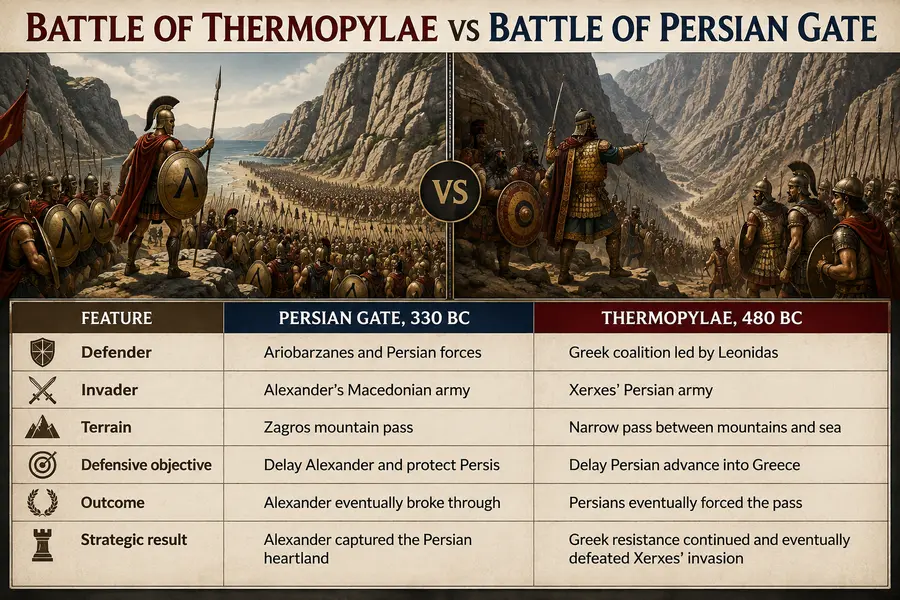
The Persian Gate is frequently compared with the Battle of Thermopylae, and the comparison is justified, but only to a point. Both battles involved a numerically inferior defensive force attempting to exploit a narrow mountain passage against a larger invading army. Both defenders understood that geography could compensate for numerical inferiority. Both battles became symbols of determined resistance.
| Feature | Persian Gate, 330 BC | Thermopylae, 480 BC |
|---|---|---|
| Defender | Ariobarzanes and Persian forces | Greek coalition led by Leonidas |
| Invader | Alexander's Macedonian army | Xerxes' Persian army |
| Terrain | Zagros mountain pass | Narrow pass between mountains and sea |
| Defensive objective | Delay Alexander and protect Persis | Delay Persian advance into Greece |
| Outcome | Alexander eventually broke through | Persians eventually forced the pass |
| Strategic result | Alexander captured the Persian heartland | Greek resistance continued and eventually defeated Xerxes' invasion |
There is also an intriguing reversal. At Thermopylae, Greeks attempted to stop a Persian invasion at a mountain bottleneck. At the Persian Gate, Persians attempted to stop a Greek-Macedonian invasion at another mountain bottleneck. The symbolism is almost perfect. But the military circumstances were very different.
Leonidas's objective was primarily to delay the Persian army while Greek forces prepared elsewhere. Ariobarzanes likewise appears to have understood the value of delay, but Alexander's army was already operating deep inside Persia after the destruction of Darius's main field army. Thermopylae also involved a much broader strategic coalition and naval dimension, while the Persian Gate was part of Alexander's rapidly moving conquest of the Achaemenid heartland.
Perhaps the most important difference is what happened afterward. At Thermopylae, the Persian victory did not end Greek resistance. At the Persian Gate, the Persian defeat opened the road to Persepolis. The Persian Gate was therefore a tactical and operational victory for Alexander with enormous symbolic consequences.
Consequences of the Battle of the Persian Gate
Alexander reached Persepolis
The immediate consequence was the opening of the road into Persis. Alexander could now advance toward Persepolis, the great ceremonial capital of the Achaemenid kings. The importance of this achievement is difficult to exaggerate. Babylon and Susa had already fallen, but Persepolis represented the symbolic heart of Persian royal power. Alexander entered Persepolis in early 330 BC.
The Persian resistance lost one of its last major defensive positions
Ariobarzanes's defense demonstrated that Persian resistance had not completely disappeared after Gaugamela. But the defeat at the Persian Gate removed one of the final organized obstacles between Alexander and the Persian heartland. Encyclopaedia Iranica describes the Persian Gate as the point where Ariobarzanes blocked Alexander's advance before the Macedonian king fought his way through to Persepolis.
The battle exposed the limits of Alexander's army
There is an important lesson here for understanding Alexander's military career. Alexander was not invincible because his soldiers were magically superior to every opponent. His army could be badly positioned. Cavalry could become irrelevant. Infantry formations could be trapped. Intelligence could be incomplete. What made Alexander exceptional was his ability to respond when circumstances changed.
The Persian Gate demonstrates this particularly well. At the Granicus, Alexander's aggressive river crossing produced victory. At Issus, he exploited the narrow battlefield against Darius. At Gaugamela, he created an opening and drove directly at the Persian command structure. At the Persian Gate, however, he initially found that direct pressure was insufficient. His response was adaptation. This is one reason the Persian Gate deserves to be studied alongside his better-known battles. It shows Alexander not simply as an aggressive battlefield commander but as a problem solver.
The fall of Persepolis changed the symbolic character of the war
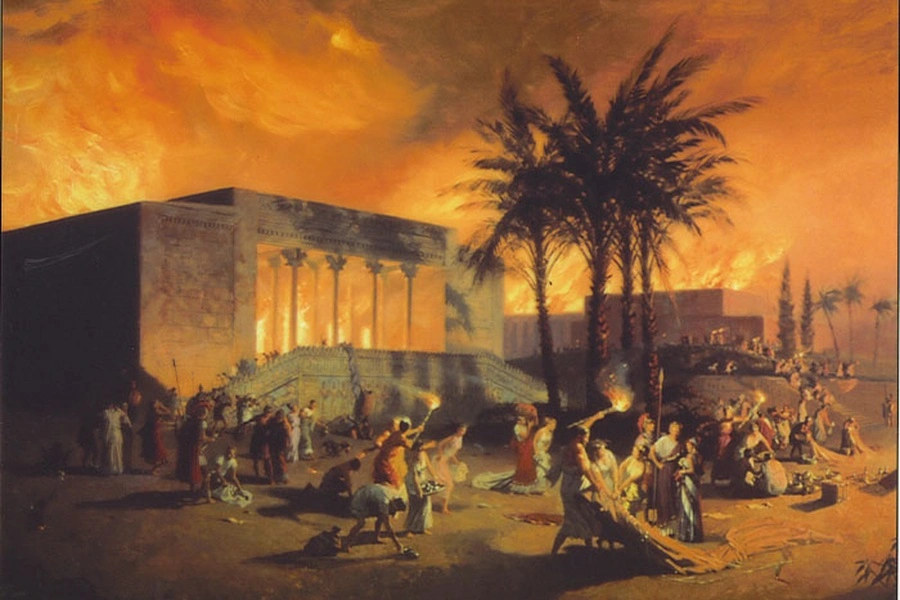
Once Alexander reached Persepolis, the campaign entered a new phase. The Macedonians had effectively captured the central royal territories of the Achaemenid Empire. The Persian king remained alive for a short time, but the political and military structure supporting his western empire had been severely damaged. The subsequent destruction of parts of Persepolis has generated considerable historical debate. Ancient sources connect the burning with Alexander's decision to retaliate for Persian destruction during the Greco-Persian Wars, although the exact circumstances and extent of the destruction remain debated by modern historians. The Persian Gate therefore sits at a crucial transition point. Before it, Alexander was still breaking through Persian defenses. After it, he was increasingly pursuing the remnants of the Persian monarchy.
What the Ancient Sources Tell Us About the Persian Gate
Reconstructing the Battle of the Persian Gate requires caution because no contemporary Persian narrative of the battle survives. Modern historians therefore depend heavily on later Greco-Roman authors. The most important surviving narratives include:
- Arrian, Anabasis of Alexander, especially Book 3, Chapter 18.
- Quintus Curtius Rufus, Historiae Alexandri Magni, especially Books 5.3-5.4.
- Diodorus Siculus, Bibliotheca historica, Book 17.
- Plutarch, Life of Alexander, especially the account surrounding Alexander's approach to Persepolis.
These accounts do not always agree. Arrian gives Ariobarzanes a very large force and describes a direct approach followed by Alexander's decision to outflank the Persian position. Curtius and Diodorus provide more dramatic accounts of an initial Persian ambush and heavy Macedonian losses. Modern historians therefore have to distinguish between what is reasonably secure and what remains uncertain. The uncertainty surrounding troop numbers is particularly important. Ancient authors routinely supplied enormous figures for armies, and Persian troop totals at Alexander's battles often differ substantially between sources.
It is therefore better to describe Ariobarzanes as commanding a substantial defensive force rather than repeating a single ancient figure as fact. The fate of Ariobarzanes is also disputed. Arrian's account allows for the possibility that he escaped into the mountains, while Curtius provides a tradition in which Ariobarzanes fought his way toward Persepolis and ultimately died after continuing the struggle. Encyclopaedia Iranica notes this divergence explicitly. This is precisely the kind of distinction that matters when writing responsible ancient history. A compelling story should not require pretending that every detail is certain.
Conclusion: Why the Battle of the Persian Gate Matters
The Battle of the Persian Gate was one of the clearest reminders that Alexander's army was not invincible. Ariobarzanes used the Zagros Mountains to neutralize the Macedonian advantages of mobility, formation, and combined-arms coordination, forcing Alexander to abandon a direct assault and find another way forward.
Alexander's eventual victory demonstrated the quality that distinguished him as a commander: adaptability. Rather than repeatedly attacking a position that favored the defenders, he changed his approach and turned the Persian defenses against them. The battle therefore stands as an important example of how reconnaissance, maneuver, and tactical flexibility could overcome even a formidable defensive position.
Although Ariobarzanes failed to prevent Alexander from reaching Persepolis, his resistance showed that Persian military power had not simply disappeared after Gaugamela. The Persian Gate remains significant because it was not an easy Macedonian victory, but a hard-fought contest in which geography temporarily gave the defenders the advantage.
References and Further Reading
Primary Sources
- Arrian, Anabasis of Alexander, Book 3, especially Chapter 18
- Quintus Curtius Rufus (History of Alexander), Books 5.3-5.4
- Diodorus Siculus, Bibliotheca Historica, Book 17, especially Chapters 68-69
- Plutarch, Life of Alexander, especially the chapters dealing with Alexander's advance toward Persepolis
Modern Reference Works
- Encyclopaedia Iranica - Alexander the Great, useful for the broader historical context of Alexander's conquest of the Achaemenid Empire.
- Encyclopaedia Iranica - Ariobarzanes, particularly valuable for the Persian Gate's geography, ancient source discrepancies, troop numbers, and the fate of Ariobarzanes.
- Encyclopaedia Iranica - Darius III, for the political and military circumstances surrounding the final phase of Darius's reign and Alexander's advance into Persia.
- Livius - Persian Gate (330 BCE), which provides a useful reconstruction of Alexander's route and the geographical problems surrounding the battle.
Books and Memorables
This article may contain affiliate links. If you purchase through these links, I may earn a small commission at no extra cost to you.


Related Articles
Frequently Asked Questions
Where was the Persian Gate located in ancient Persia?
The Persian Gate was a narrow mountain pass through the Zagros Mountains that controlled an important approach into Persis. Its exact ancient location remains debated, but it is traditionally associated with the Tang-e Meyran or Tang-e Khas area in southwestern Iran on the route toward Persepolis.
Why did Ariobarzanes choose the Persian Gate to stop Alexander?
Ariobarzanes chose the Persian Gate because its narrow mountain terrain gave the Persian defenders a major advantage. The restricted passage prevented Alexander from deploying his cavalry and Macedonian phalanx effectively, while Persian soldiers could attack from elevated positions. The pass also protected the road toward Persepolis.
How did the Persian army ambush Alexander at the Persian Gate?
According to accounts by Diodorus Siculus and Quintus Curtius Rufus, Persian soldiers attacked the Macedonian army from the surrounding heights after Alexander entered the narrow valley. They used missiles and rocks against troops who had little room to deploy or respond effectively, causing significant Macedonian casualties.
How did Alexander get around the Persian Gate defenses?
After realizing that a direct assault was too costly, Alexander searched for an alternative route through the mountains. He led selected troops on a difficult flanking march that brought them around the Persian position and threatened the defenders from the rear. This maneuver turned the Persian defensive position into a trap.
Why was the Battle of the Persian Gate difficult for Alexander the Great?
The battle was difficult because the mountainous terrain neutralized several of Alexander's greatest military advantages. His Companion Cavalry had little room to maneuver, the Macedonian phalanx could not deploy normally, and Persian soldiers controlled elevated defensive positions. Ariobarzanes had also prepared the battlefield before Alexander arrived.
How was the Battle of the Persian Gate different from the Battle of Thermopylae?
Both battles involved a smaller defending force using a narrow mountain passage to delay a larger invading army, but their strategic circumstances were different. At Thermopylae, Greek forces attempted to delay Xerxes' Persian invasion of Greece. At the Persian Gate, Ariobarzanes used a mountain pass to delay Alexander's invasion of the Persian heartland and protect the route to Persepolis.
Add Comment