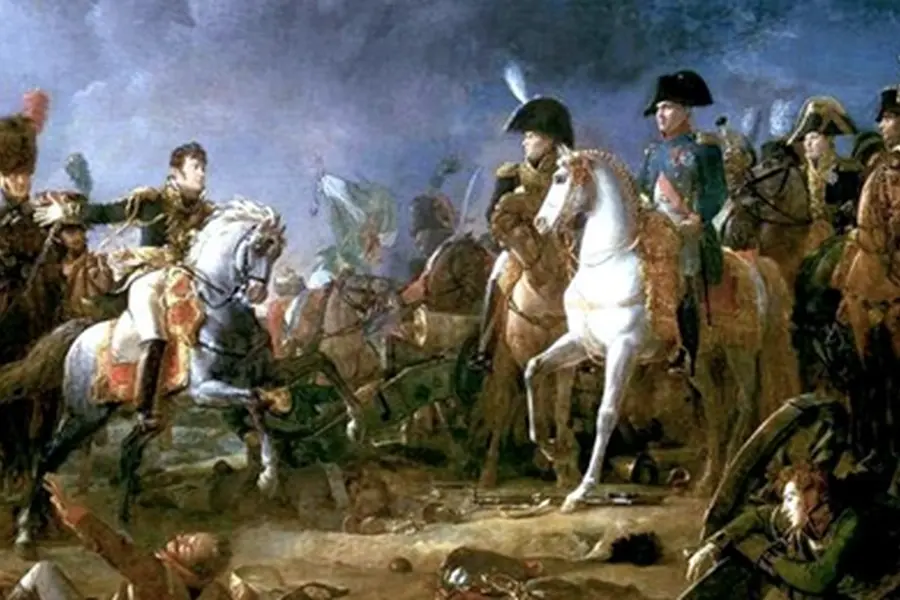
The Battle of Austerlitz, fought on 2 December 1805, was Napoleon Bonaparte's greatest battlefield victory and one of the most decisive battles in military history. Facing a larger Austro-Russian army commanded in the presence of two emperors, Napoleon deliberately appeared weak, allowed the Allies to occupy the crucial Pratzen Heights, and then tore apart their army with a devastating attack against its exposed centre. The victory destroyed the military power of the Third Coalition on the European continent and established Napoleon as the dominant military and political power in Europe. It echoed the dramatic reversal he had achieved at the Battle of Marengo five years earlier, when a seemingly lost campaign was transformed by timing, morale, and a decisive counterattack.
Table of Contents
- The War of the Third Coalition
- The Road to Austerlitz
- The Battlefield and Strategic Situation
- Armies and Commanders at Austerlitz
- Napoleon's Plan at Austerlitz
- The Battle of Austerlitz: 2 December 1805
- How Napoleon Won the Battle
- Casualties and Losses
- Aftermath of Austerlitz
- Why Was Austerlitz So Significant?
- The Legacy of Austerlitz
- Conclusion
- References and Further Reading
The War of the Third Coalition
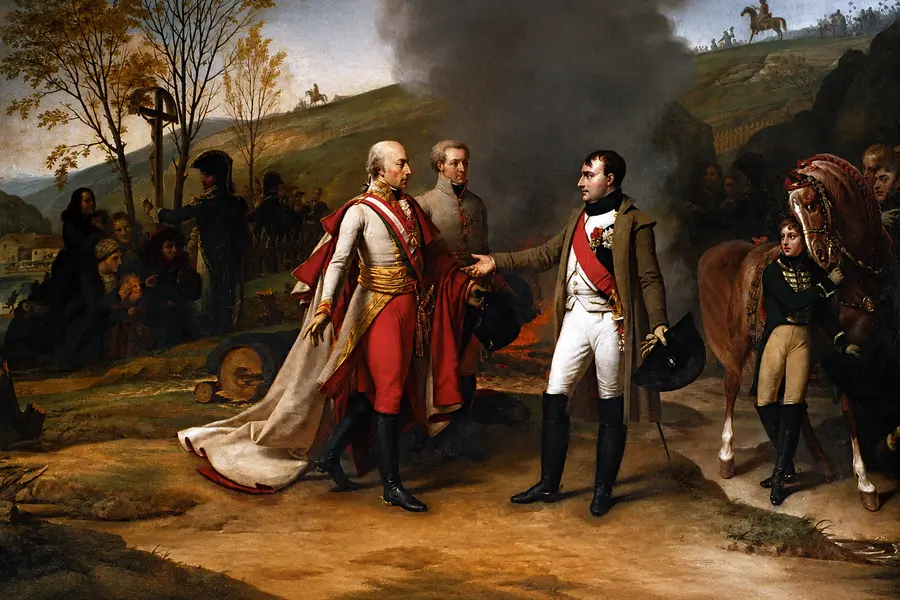
The Battle of Austerlitz cannot be understood in isolation. It was the climactic land battle of the War of the Third Coalition, a European conflict created by growing opposition to Napoleon's expansion of French power. Britain had been at war with France since the collapse of the Peace of Amiens in 1803. Napoleon was preparing an enormous army at Boulogne for a possible invasion of Britain when European diplomacy began moving rapidly against him. Britain worked to construct a new coalition involving Austria and Russia, while Sweden and several German states also became involved in the wider struggle. Austria feared the expansion of French influence in Italy and Germany, while Russia regarded Napoleon's growing dominance of Europe as a direct threat to the continental balance of power.
In August 1805, Austria secretly committed itself to the coalition. Napoleon responded by abandoning the immediate invasion plan and turning the enormous army assembled in northern France toward Central Europe. The army that became known as the Grande Armée was organized into independent corps capable of marching and fighting separately while concentrating rapidly for decisive operations. Napoleon's organizational system would prove crucial during the campaign. The coalition possessed substantial numerical resources, although they were not concentrated in a single army. They expected to overwhelm France from several directions, but coordination was its weakness. Austria moved into Bavaria before the Russian army had fully arrived, allowing Napoleon to exploit the gap between the coalition armies.
Napoleon's response produced the Ulm Campaign. Instead of marching directly toward the Austrian army, the French Grande Armée executed a huge wheeling movement through southern Germany. The maneuver surrounded General Karl Mack's Austrian army, forcing its capitulation at Ulm in October 1805. Thousands of Austrian soldiers became prisoners, and the principal Austrian field army in Germany ceased to exist. The road toward Vienna was effectively opened.
Napoleon entered Vienna in November. Yet the war was not over. A Russian army under General Mikhail Kutuzov was still operating in the field, while Emperor Alexander I of Russia was determined to continue the struggle. Napoleon therefore moved eastward in search of a decisive battle. At sea, the French position was far less successful. On 21 October 1805, Admiral Horatio Nelson destroyed the combined Franco-Spanish fleet at the Battle of Trafalgar. Trafalgar ended any realistic French prospect of invading Britain, but Napoleon's continental campaign continued with extraordinary speed. The land war would ultimately be decided in Moravia.
The Road to Austerlitz
After the fall of Vienna, Napoleon pursued the retreating Russian army. Kutuzov successfully avoided being trapped and eventually joined forces with additional Russian formations. The French emperor was now operating far from France, with his army stretched across Central Europe. This created a dangerous situation. Napoleon needed a major victory before the Russians could combine with other coalition forces or before Prussia decided to enter the war against France. He therefore began looking for an opportunity to force the Allies into battle under conditions favorable to him. The opportunity appeared around Austerlitz, in Moravia, in the modern Czech Republic.
The Battlefield and Strategic Situation
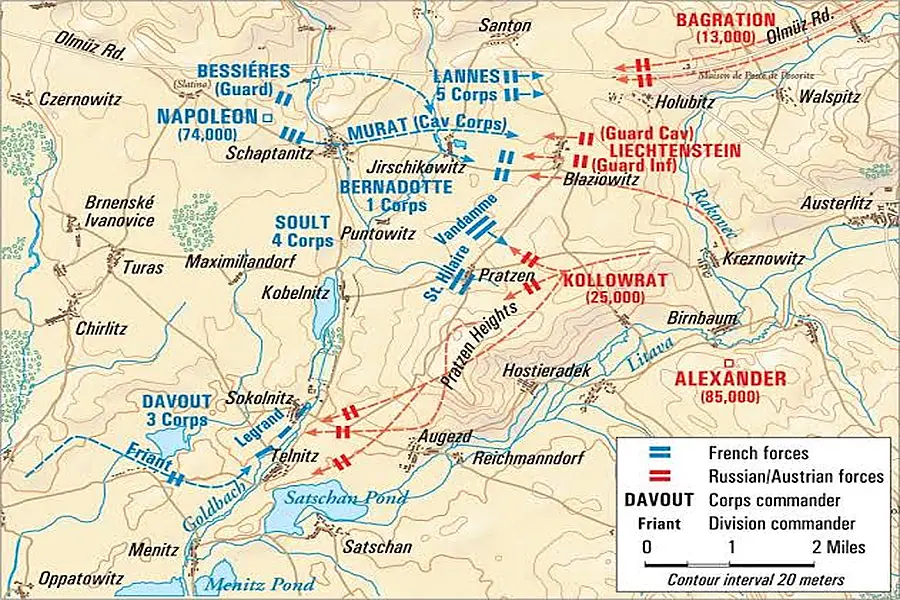
Austerlitz was fought across a rolling landscape of villages, streams, ponds and elevated ground. The most important feature was the Pratzen Plateau, a series of heights running through the centre of the battlefield. Whoever controlled the Pratzen Heights possessed a commanding position from which forces could operate against either wing. Napoleon understood that the heights were more valuable than their apparent importance suggested. The French army occupied positions west of the plateau. The Allied army stretched roughly from the area around the Pratzen Heights toward the French right, with a powerful concentration on its left wing.
The Allied plan required precision. Four major infantry columns were intended to move southward against the French right, while Bagration's forces operated against the French left. Cavalry and reserves were positioned around the centre. The plan was not inherently foolish. Its weakness was that it depended upon coordinated movement by a large multinational army whose commanders were not operating from a single, unified command structure. Alexander I was the Russian emperor and nominal supreme authority, while Kutuzov was the experienced Russian commander. Austrian officers, including General Franz von Weyrother, played an important role in planning. The result was a command system in which political authority and military experience did not always coincide. Given their numerical superiority and the apparent weakness of the French right, the Allied plan offered a plausible opportunity to envelop Napoleon's army.
Armies and Commanders at Austerlitz
The exact number of troops present at Austerlitz varies between sources because historians use different definitions of "present," "engaged," and "available." A reasonable modern estimate places the French army at roughly 70,000-75,000 men, while the Austro-Russian army numbered approximately 85,000-90,000. The figures should therefore be treated as estimates rather than exact headcounts.
| Army | Approximate Strength | Principal Commanders | Role |
|---|---|---|---|
| French Grande Armée | About 70,000-75,000 | Napoleon, Berthier, Soult, Lannes, Davout, Bernadotte, Murat | Defend the flanks while striking the Allied centre |
| Austro-Russian Army | About 85,000-90,000 | Alexander I, Kutuzov, Buxhöwden, Bagration, Dokhturov, Langeron, Przybyszewski | Attack the French right and pressure both wings |
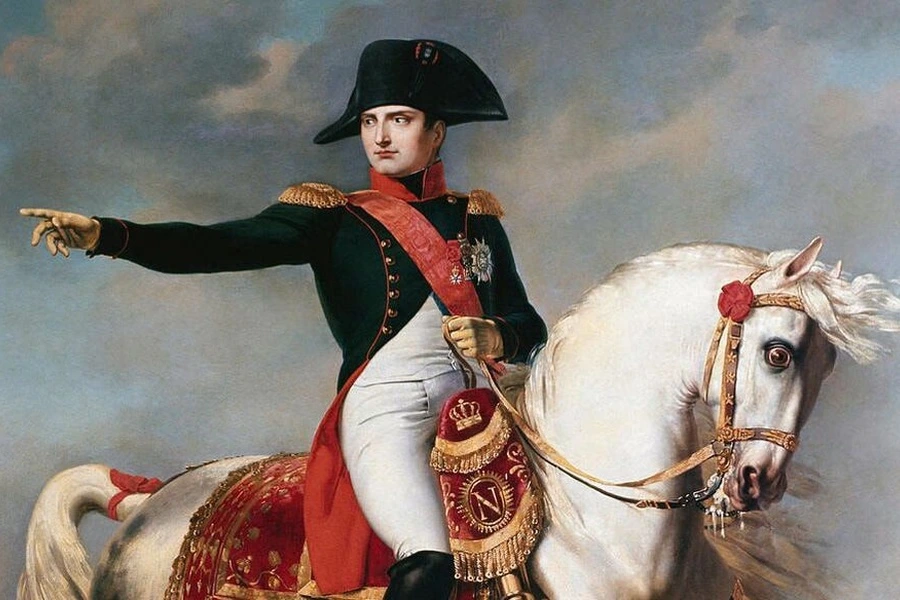
Napoleon Bonaparte
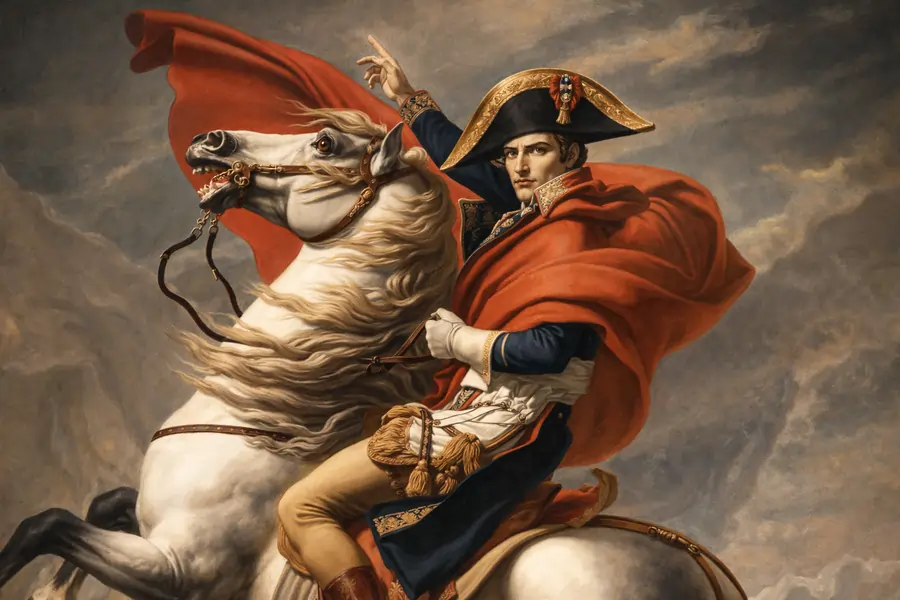
Napoleon was 36 years old and already one of Europe's most successful commanders. His campaigns in Italy and Egypt had established his reputation, while his victories during the 1805 campaign had demonstrated the effectiveness of the Grande Armée's corps system. His greatest strength was not simply tactical brilliance. Napoleon was exceptionally good at combining movement, deception, concentration of force and timing. At Austerlitz, these qualities worked together. Napoleon's command style can be compared with other great commanders discussed in our guide to the greatest military generals in history, but Austerlitz is particularly valuable because it shows how a commander can win by shaping the enemy's decisions before the decisive fighting begins.
Louis-Nicolas Davout
Marshal Davout commanded the French III Corps. His role at Austerlitz was extraordinarily demanding. His troops had to march rapidly to reinforce Napoleon's apparently weak right flank. Elements of Davout's corps arrived after an exhausting forced march from the direction of Vienna. Their arrival prevented the Allied attack against Telnitz and Sokolnitz from overwhelming the French right. The ability of the French corps system to move independently and reinforce threatened sectors was one of the most important operational advantages Napoleon possessed.
Marshal Nicolas Soult
Soult commanded the French IV Corps and was entrusted with the decisive assault on the Pratzen Heights. His divisions under Generals Saint-Hilaire and Vandamme formed the spearhead of Napoleon's central attack. Soult was therefore at the centre of the battle's decisive moment. Napoleon famously emphasized the importance of taking the Pratzen Heights when the opportunity appeared.
Jean Lannes and Joachim Murat
On the French left, Marshal Jean Lannes commanded the infantry while Marshal Joachim Murat controlled much of the cavalry. Their task was to hold Bagration and prevent the Allied right from interfering with Napoleon's central attack.
Mikhail Kutuzov
Kutuzov was the most experienced senior Russian commander on the field. He understood the danger of committing too much of the Allied army against the French right, but he had to operate within a command structure heavily influenced by Tsar Alexander I and other senior officers.
Tsar Alexander I and Emperor Francis II
The battle is sometimes called the Battle of the Three Emperors because Napoleon, Alexander I and Francis II were all present. Francis II was Holy Roman Emperor and ruler of Austria, while Alexander was the Russian emperor. The presence of two allied monarchs made the battle politically important, but it also complicated command. Napoleon, by contrast, exercised centralized authority over the French army.
Pyotr Bagration
Bagration commanded the Allied right wing. His troops faced Lannes and Murat and fought a hard defensive battle as the French left pressed forward.
Napoleon's Plan at Austerlitz
The brilliance of Napoleon's plan can be reduced to a deceptively simple idea. Make the Allies believe the French right was vulnerable, encourage them to move their main strength away from the centre, then seize the Pratzen Heights and destroy the Allied army's cohesion. The plan depended on four interconnected actions.
- Weakening the French right. Napoleon deliberately accepted risk around Telnitz and Sokolnitz.
- Encouraging an Allied attack. The French posture suggested that Napoleon feared being outflanked.
- Holding the Allied left in place. Davout's III Corps would arrive and prevent the Allied assault from breaking through.
- Destroying the centre. Once the Pratzen Heights were weakened, Soult would attack with overwhelming force.
The critical point was timing. If the French attacked too early, the Allied centre would still be strong. If they waited too long, the French right might collapse. Napoleon therefore waited until the Allied left had committed itself southward. Then he struck. The French were deliberately trading space for opportunity. Rather than trying to protect every part of the battlefield equally, Napoleon accepted temporary weakness in one area to create overwhelming strength somewhere else. This principle is one reason Austerlitz remains so important in the study of military history. Napoleon was not simply responding to the Allied army. He was controlling the choices available to it.
The Battle of Austerlitz: 2 December 1805
The Morning Mist
The morning of 2 December was cold and misty. The weather initially concealed movements across the battlefield, helping create the atmosphere of uncertainty on which Napoleon's plan depended. The French positions appeared relatively passive while Allied columns began moving toward the French right. The first major fighting developed around Telnitz and Sokolnitz.
The Allied Attack on the French Right
The Allied left began moving southward in accordance with the plan. Austrian and Russian troops attacked the French positions around Telnitz. The French defenders were heavily outnumbered. Napoleon had intentionally left this sector thinly held, and for a moment the danger was very real. But the French right did not collapse.
At the critical moment, Davout's III Corps arrived after a forced march of extraordinary speed. The appearance of fresh French troops stabilized the sector and forced the Allies to continue committing men to the struggle. This was crucial. Every Allied unit moving toward Telnitz and Sokolnitz was another unit moving away from the Pratzen Heights. The battle was therefore developing exactly as Napoleon had hoped.
The Pratzen Heights Become Exposed
As the Allied columns descended from the plateau toward the French right, the centre became increasingly vulnerable. Napoleon observed the movement from his command position and recognized that the moment had arrived. The Allied centre had been weakened. At approximately 8:30 a.m., Napoleon ordered Soult to attack the Pratzen Heights. The assault was made by the divisions of Saint-Hilaire and Vandamme. According to a detailed study of the battle, Napoleon had specifically been watching for the moment when the Allies weakened their centre to support their attack on the French right.
The French Attack the Centre
Soult's troops advanced through the mist. The French attack struck the plateau before the Allied commanders could fully restore their defensive deployment. Saint-Hilaire's division fought its way onto the heights, while Vandamme's division supported the operation. The fighting became extremely intense because the Allies quickly understood what had happened. The French had not merely captured high ground. They had driven a wedge into the middle of the Allied army.
The Allied Counterattack
Once the Allies recognized the danger, they attempted to retake the Pratzen Heights. Russian formations were thrown into the battle. Kutuzov and his commanders tried to restore the centre and prevent the French from splitting the army. The fighting on the plateau became one of the most intense phases of Austerlitz. For a time, the outcome was genuinely uncertain. Russian troops counterattacked repeatedly, and the French divisions on the heights faced heavy pressure. Napoleon responded by reinforcing the critical sector and maintaining pressure rather than allowing the battle to become a prolonged defensive struggle.
The Imperial Guards Clash
What came next was the battle's most dramatic confrontation between the elite cavalry of the Russian Imperial Guard and French forces. The Russian Guard was among the finest formations in the Allied army. Its intervention demonstrated how seriously the Allied command regarded the loss of the Pratzen Heights. French Imperial Guard cavalry entered the struggle and helped restore the situation. The clash became symbolic of the battle. The Allies had committed some of their best troops to recover a position they had allowed themselves to lose in the first place.
Lannes and Bagration on the Northern Flank
While the main drama unfolded around the Pratzen Heights, the fighting in the north continued. Lannes confronted Bagration's forces while Murat's cavalry fought to prevent the Allied right from breaking through. The French did not need to destroy Bagration's entire force. They needed to prevent it from interfering with Napoleon's central operation. Lannes and Murat succeeded in doing so.
The Allied Left Is Trapped
By late morning, the consequences of the French breakthrough were becoming catastrophic for the Allied left. The troops attacking Telnitz and Sokolnitz had advanced far away from the centre. Now French troops held the Pratzen Heights behind them, while Davout continued to resist them from the west. The Allied left was effectively caught between French forces operating from two directions. Napoleon could now turn his victorious centre southward. The operation that had begun as a controlled risk on the French right had become a trap.
The French Destroy the Allied Left
Once the Pratzen Heights were securely held, French troops descended against the Allied left and rear. The Allies attempted to retreat, but their formations had become increasingly disorganized. Some units were forced toward the frozen ponds and marshy ground around Sokolnitz and Telnitz. The French artillery added to the chaos.
Napoleon's famous post-battle bulletin claimed that approximately 20,000 Allied soldiers were driven toward the lakes and drowned. Modern historians treat such figures with caution, and the extent of the drowning has been debated. The episode nevertheless became one of the most famous stories associated with Austerlitz. Napoleon's official account also substantially emphasized the scale of the victory and his army's achievements.
The Allied Army Retreats
By around 11 a.m., the Allied position was becoming untenable. Bagration's troops withdrew from the northern sector. The centre had been penetrated, and the left wing was in serious danger of being enveloped. By early afternoon, the Allied army was retreating across the battlefield. The battle that had begun with the Allies believing they were about to turn Napoleon's right had ended with their own army split apart. Napoleon had won one of the most complete battlefield victories of the Napoleonic Wars.
How Napoleon Won the Battle of Austerlitz
The French victory was not the result of a single clever maneuver. It came from several decisions that reinforced one another.
1. Napoleon understood the battlefield
Napoleon recognized that the Pratzen Heights were the key to the entire position. He was willing to abandon them temporarily because he understood that the Allies would weaken their own centre by occupying the heights and then moving away from them.
2. He deliberately appeared weaker than he was
The French right was genuinely vulnerable, but Napoleon wanted the Allies to notice that vulnerability. Napoleon's deception worked because it was built around a real weakness. His battlefield deception transformed a weakness into bait. This is one of the most important lessons of Austerlitz. Napoleon simply made a real weakness look even more exploitable.
3. He waited for the right moment
Napoleon did not attack the Pratzen Heights immediately. He waited until the Allied left had committed itself to the southern offensive. The timing transformed a difficult assault into a decisive breakthrough.
4. The French corps system provided operational flexibility
Davout's rapid arrival on the French right demonstrated why Napoleon's corps system was so effective. Individual corps could march and conduct operations semi-independently before concentrating when required. The French army was therefore able to operate across a wide area and fight independently.
5. Napoleon concentrated force at the decisive point
Instead of spreading his army evenly across the battlefield, Napoleon accepted risk in secondary areas so that he could achieve superiority at the critical point. When Soult attacked the Pratzen Heights, the French were able to commit substantial strength against a centre that had been weakened by the Allied plan.
6. The Allied command structure was less coherent
The Austro-Russian army contained many experienced soldiers and capable commanders, but the coalition's command arrangements were complicated. Alexander I exercised considerable influence, while Kutuzov had to work within a broader political and military hierarchy. The Allied plan required several columns to move according to a complicated timetable. Once the French penetrated the centre, coordinating those forces became extraordinarily difficult.
In contrast, Napoleon could make rapid decisions and communicate them through a well-developed staff system. This combination of deception, timing, concentration and command unity explains why Austerlitz is frequently regarded as Napoleon's perfect battle. The battle has also become a standard case study in the principles of war, particularly concentration, surprise, economy of force and offensive action.
Casualties and Losses at Austerlitz
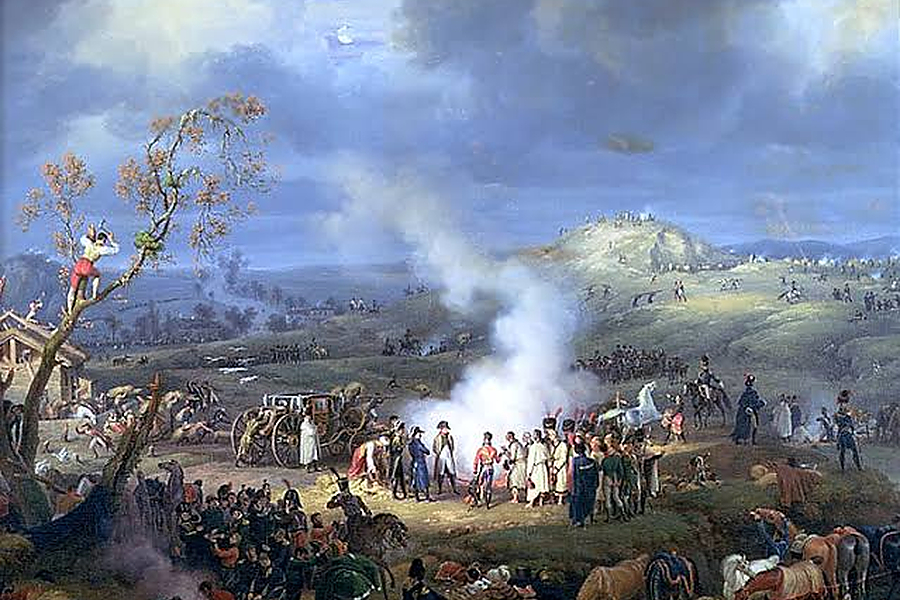
Casualty estimates vary considerably between sources. The French probably suffered around 8,000-9,000 killed, wounded or missing, while Allied losses were substantially higher and included thousands of prisoners.
| Category | French | Austro-Russian Allies |
|---|---|---|
| Approximate troops engaged | 70,000-75,000 | 85,000-90,000 |
| Estimated casualties | About 8,000-9,000 | Roughly 25,000-30,000+ depending on methodology |
| Prisoners | Limited | Thousands captured |
| Artillery losses | Relatively limited | Large numbers of guns captured |
The disparity was strategically more important than the precise numbers. The French army remained operationally effective, while the Austro-Russian force had been badly disrupted and Austria was no longer in a position to continue the campaign effectively. Modern estimates should be preferred over Napoleon's official post-battle bulletin, which was designed partly as political and morale-building propaganda. Napoleon claimed more than 30,000 prisoners, 120 guns and 40 standards in his proclamation after the battle.
Aftermath of the Battle of Austerlitz
The political consequences of Austerlitz were immediate. Emperor Francis II recognized that Austria could not continue the war. An armistice was agreed shortly after the battle, and negotiations followed. On 26 December 1805, France and Austria signed the Treaty of Pressburg. Austria withdrew from the Third Coalition and accepted substantial territorial and financial losses. French influence expanded dramatically across southern Germany and Italy.
Russia withdrew its forces from the immediate campaign, although it remained hostile to Napoleon. Britain also remained at war with France despite the continental coalition's collapse. The result was therefore not a permanent peace. It was a decisive French victory that temporarily removed Austria from the war and left Napoleon dominant on the European continent.
The Confederation of the Rhine
Austerlitz accelerated Napoleon's transformation of the political map of Germany. French influence over Bavaria, Württemberg and other German states increased substantially. In 1806, Napoleon created the Confederation of the Rhine, a group of German states aligned with France.
This development weakened the old Holy Roman Empire beyond repair. In August 1806, Francis II formally abdicated as Holy Roman Emperor, bringing the centuries-old institution to an end. It is therefore more accurate to say that Austerlitz helped create the political conditions that led to the dissolution of the Holy Roman Empire rather than claiming that the battle itself immediately abolished it.
Why Was Austerlitz So Significant?
Austerlitz was much more than another French battlefield victory. It changed the political balance of Europe.
It destroyed the Third Coalition on land
The Third Coalition had been created to contain Napoleon. After Ulm and Austerlitz, Austria was forced out of the war and Russia retreated. The coalition's immediate strategic objective had failed.
It established Napoleon's continental dominance
By the end of 1805, Napoleon controlled or dominated much of Western and Central Europe. His armies had demonstrated that even a larger coalition force could be defeated when its movements could be manipulated and its forces divided. Austerlitz therefore became the foundation of Napoleon's reputation as the greatest battlefield commander of his generation.
It demonstrated the power of operational warfare
The battle is particularly important because Napoleon's victory did not begin on 2 December. The decisive process began months earlier with the organization of the Grande Armée, its rapid movement from the English Channel toward Germany, the destruction of Mack's army at Ulm, the capture of Vienna and the pursuit of the Russian army. Austerlitz was the culmination of a campaign rather than an isolated tactical achievement.
It became a model of military deception
Few battles demonstrate deception more clearly. Napoleon made the Allied commanders believe they had identified his weakness when they were actually moving into the trap he had prepared. The commander who can influence what the enemy believes may be able to influence what the enemy does. This is one reason Austerlitz belongs on any list of the most decisive battles in history.
It demonstrated the importance of morale and cohesion
Military effectiveness depends on more than the number of soldiers on the battlefield. Units must understand their mission, maintain formation, and continue to function when neighboring units are retreating. Once the Allied centre was penetrated and the left wing threatened with encirclement, the army's cohesion deteriorated rapidly. This connects with the broader question of soldier morale, battlefield psychology and survival. Armies do not necessarily collapse because every soldier is physically defeated. They can collapse because soldiers and commanders lose confidence that their formation can still win.
The Legacy of Austerlitz
Austerlitz became one of the defining events of Napoleon's career. It was followed by further French victories, including Jena and Auerstedt in 1806 and Friedland in 1807. Napoleon's empire reached its greatest territorial extent several years later. Yet Austerlitz stands apart because of the completeness of the victory. Napoleon faced a numerically superior army and persuaded its commanders to execute a movement that created the conditions for their own defeat.
The battle also demonstrates why military history cannot be reduced to lists of weapons or troop numbers. The French did not win simply because their soldiers were better trained or because Napoleon possessed more artillery. The victory resulted from a chain of decisions:
- the strategic concentration of the Grande Armée;
- the destruction of the Austrian army at Ulm;
- the pursuit of the Russians;
- the deliberate appearance of French weakness;
- the Allied decision to attack the French right;
- the French seizure of the Pratzen Heights;
- Davout's determined defence of the right flank;
- and the destruction of Allied cohesion once the centre was broken.
That combination makes Austerlitz one of the clearest examples of how strategy, operational movement, battlefield deception and tactical execution can combine to produce a decisive victory. Napoleon's achievement is also easier to appreciate when compared with commanders from other periods. His ability to coordinate widely separated forces and concentrate them at a decisive point has useful parallels with the campaigning methods of commanders such as Alexander the Great and Julius Caesar, although the armies, technology and political environments were radically different.
Conclusion
The Battle of Austerlitz was Napoleon Bonaparte's masterpiece because he defeated a larger Austro-Russian army by controlling the battle before the decisive fighting had even begun. He understood that the Allied commanders wanted to attack his apparently vulnerable right flank. Instead of preventing that attack, he encouraged it. As the Allied left moved south toward Telnitz and Sokolnitz, the Pratzen Heights became exposed. Napoleon waited until the moment was right and then unleashed Soult's divisions against the centre.
The French seizure of the heights split the Allied army's battlefield position. Davout prevented the Allied left from breaking through, Lannes and Murat contained Bagration in the north, and Napoleon's victorious centre eventually turned against the Allied left. By the afternoon of 2 December 1805, the army of the two emperors was in retreat. The victory forced Austria out of the Third Coalition, produced the Treaty of Pressburg, accelerated French dominance in Germany and Italy, and helped prepare the political transformation that would destroy the old Holy Roman Empire the following year.
References and Further Reading
- Fondation Napoléon. "The Battle of Austerlitz and the Principles of War." A detailed study of Napoleon's plan, command structure, battlefield decisions, and operational principles.
- Fondation Napoléon. "Austerlitz, 2 December, 1805: A Timeline." Useful chronology covering the Third Coalition, French campaign, and events surrounding the battle.
- Fondation Napoléon. "Proclamation after Austerlitz, 12 Frimaire, An XIV." Contemporary French account showing how Napoleon presented the victory to his army and the French public.
- Fondation Napoléon. "Austerlitz, 2 December 1805." Bibliography of official accounts, eyewitness material and scholarly works concerning the battle.
- U.S. Army Combined Arms Research Library. George Nafziger, French Order of Battle at Austerlitz, 2 December 1805. A detailed archival order of battle for the French army.
- Napoleon Series. Stephen Millar, Russian-Austrian Order-of-Battle at Austerlitz: 2 December 1805. Detailed information on the Allied formations and commanders.
- Fondation Napoléon. "Napoleon's Perfect Battle," interview with historian Jacques Garnier discussing Napoleon's command decisions and the conduct of the battle.
Primary-source caution: Napoleon's official bulletins are valuable historical documents, but they were also intended to celebrate the victory and strengthen the emperor's political image. Casualty figures and dramatic descriptions should therefore be compared with modern military histories and archival evidence rather than accepted uncritically.
Books and Memorables
This article may contain affiliate links. If you purchase through these links, I may earn a small commission at no extra cost to you.


Related Articles
Frequently Asked Questions
How did Napoleon trick the Allies at Austerlitz?
Napoleon deliberately made the French army appear weaker than it was, particularly on its right flank. He allowed the Allies to believe that they could defeat the French right and cut Napoleon's communications. This encouraged the Allied army to move a large part of its strength away from the centre, allowing Napoleon to attack the weakened Pratzen Heights at the decisive moment.
Why were the Pratzen Heights important at Austerlitz?
The Pratzen Heights were the key elevated position in the centre of the Austerlitz battlefield. Napoleon temporarily allowed the Allies to occupy and then weaken the position by moving troops toward the French right. Once the Allied centre was exposed, French troops under Marshal Soult attacked and captured the heights, splitting the Allied army and creating the decisive breakthrough.
What was Napoleon's plan for the Battle of Austerlitz?
Napoleon planned to tempt the Allied army into attacking his apparently weak right flank while keeping his main striking force ready to attack the centre. As the Allied left moved toward Telnitz and Sokolnitz, the French would seize the weakened Pratzen Heights. The attack was intended to divide the Allied army and allow Napoleon to defeat its wings separately.
How did the French right survive the Allied attack at Austerlitz?
The French right was deliberately left relatively weak, but Napoleon expected it to hold long enough for his central attack to develop. Marshal Louis-Nicolas Davout's III Corps made a rapid forced march to reinforce the threatened sector. Davout's troops helped hold Telnitz and Sokolnitz, preventing the Allied left from breaking through while Napoleon attacked the Pratzen Heights.
Why did the Allied army lose the Battle of Austerlitz despite having more soldiers?
The Allies had a numerical advantage but their army became divided by its own plan. A large part of the Allied force moved south to attack the French right, weakening the centre at the Pratzen Heights. Napoleon then concentrated superior forces against that weakened centre, broke through it, and threatened the Allied left from the rear. The loss of cohesion was more important than the Allies' initial numerical advantage.
What made the Battle of Austerlitz Napoleon's greatest victory?
Austerlitz combined strategic deception, careful timing, rapid troop movements and concentration of force at the decisive point. Napoleon persuaded the Allies to attack where he wanted them to attack, waited until their centre was exposed, and then launched a powerful assault on the Pratzen Heights. The resulting destruction of the Allied position forced Austria out of the Third Coalition and established Napoleon's dominance in continental Europe.
Add Comment