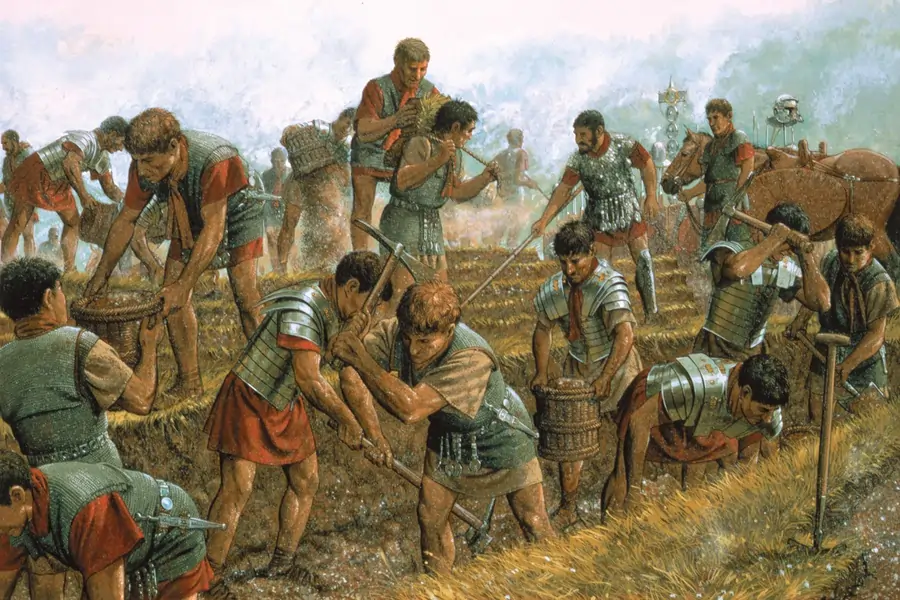
The Romans referred to their military camps as castra (singular: castrum).The Romans were very skilled and experienced in building their military camps, and it was one of their greatest hidden weapons. Many ancient armies relied on victory through battlefield courage, perfecting their weapons or overwhelming their enemy through sheer numbers. The Romans, however, designed a powerful military system built on engineering, discipline, and organization. Roman legions were not just warriors but also frequently constructed fortified camps at the end of almost every marching day, even while campaigning deep inside hostile territory. These camps served a very important purpose. It protected soldiers from surprise attacks, secured supplies, maintained morale, and allowed Roman armies to survive in enemy lands for years at a time.
The Roman marching camp became so effective that ancient historians repeatedly identified it as one of the foundations of Roman military dominance. Greek historian Polybius observed that Roman discipline and camp organization helped Roman armies outperform enemies who often fought with equal bravery but far less structure (Polybius, Histories, VI.27-42). From the forests of Germania to the deserts of North Africa, Roman camps transformed armies into highly organized military forces capable of operating across enormous distances. The success of Roman campaigns can be attributed to these fortified encampments, which helped Rome conquer much of the ancient Mediterranean world.
Table of Contents
- Why Roman Camps Were Revolutionary
- Why Romans Built Camps Every Day
- How Romans Chose Camp Locations
- How Roman Soldiers Built Camps
- Layout of a Roman Military Camp
- Defenses of Roman Camps
- Daily Life Inside the Camp
- Role of Camps in Roman Victories
- Temporary Camps vs Permanent Forts
- Roman Engineering and the Use of Early Concrete
- Why Roman Camps Were So Effective
- References and Further Reading
Why Roman Camps Were Revolutionary
Roman military camps were dramatically different from the encampments used by other ancient armies of the time. Tribal armies and temporary mercenary forces often camped wherever they halted for the night, relying on natural terrain or minimal defenses for protection. Roman armies, however, took great effort into preparing their camp and treated it as a military necessity rather than an optional precaution.
Every small camp set up by the Roman soldiers functioned as a temporary fortress. Even after exhausting marches, legionaries were expected to dig trenches, construct defensive walls, and organize proper defense before resting. According to the Roman military writer Vegetius, this constant discipline reduced vulnerability to ambushes and reinforced the army's cohesion during campaigns (De Re Militari, I.21).
The Roman camp system was created to improve the quality of life and protection for the soldiers. The Roman soldiers slept behind fortified defenses rather than exposed in open terrain. Supplies remained organized and protected. Most importantly, Roman camps provided security for the armies and helped them recover even after long marches or devastating battles.
Modern historian Adrian Goldsworthy describes Roman camps as "mobile fortresses" that allowed Roman armies to safely operate deep inside enemy territory while securing logistical stability (Goldsworthy, The Complete Roman Army). This organizational superiority often mattered more than battlefield heroics alone. Even after catastrophic defeats during the Punic Wars, Rome repeatedly rebuilt its armies because its military system remained intact. Following the disaster at the Battle of Cannae, where Hannibal annihilated a massive Roman force, Roman discipline and logistical organization prevented the republic from collapsing entirely.
Why Romans Built Camps Every Day
Roman military doctrine enforced the practice of constructing camps almost every day during military campaigns. In a modern-day context, it may seem inefficient and unnecessary for exhausted soldiers to spend hours building defenses after marching long distances. Especially since these camps were temporary and would not be reused again. For the Romans, however, camp construction was essential to survival.
The first reason was protection from surprise attacks. Ancient warfare was unpredictable, and enemy forces often launched raids during the night or early morning. This would usually take the defenders off guard, causing significant losses. By surrounding themselves with ditches and wooden palisades, Roman soldiers dramatically reduced the likelihood of such sneak attacks.
Polybius noted that Roman camps were designed with such consistency that every soldier knew exactly where his assigned place was located, regardless of where the army marched (Polybius, Histories, VI.31). This improved their efficiency as the troops could establish camps quickly because every legionary already understood the layout. Roman encampments also improved the logistical organization of the army. Food supplies, weapons, pack animals, and engineering tools all needed protection during campaigns. A secure camp created a safe place for the soldiers to repair equipment, prepare meals, and recover physically before the next march.
Roman soldiers campaigning in hostile territory often faced constant stress and exhaustion. Sleeping behind defensive walls provided reassurance that enemy warriors could not easily launch surprise attacks while they sleep. The Roman emphasis on discipline can also be seen in the daily routines of ordinary legionaries. If you want to understand how Roman soldiers lived during campaigns, see Daily Life of a Roman Soldier.
How Romans Chose Camp Locations
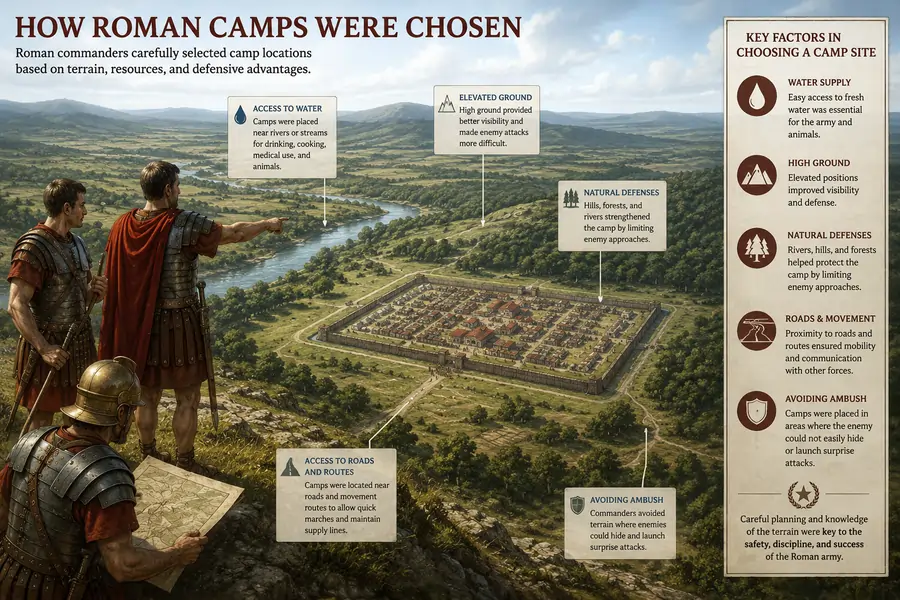
The placement of these fortified camps was also crucial for survival. Roman commanders carefully selected camp locations based on the surrounding terrain, access to fresh water, and the defensive advantages of the location. Easy access to fresh water was one of the highest priorities. Armies required enormous quantities of water for drinking, cooking, medical treatment, and animals. Roman camps were frequently positioned near rivers or streams. The Roman commanders also avoided locations where enemies could easily control or poison the water supply.
Whenever possible, Roman armies preferred elevated ground. High positions improved visibility and made enemy assaults more difficult for the attackers. Ancient military writers repeatedly emphasized the importance of terrain in warfare, and Roman commanders understood that armies fighting uphill faced severe disadvantages. Placing the camps on defensible terrain was very important. Hills, forests, and rivers could all strengthen a camp's natural defenses by blocking the routes of attack. At the same time, Roman generals avoided areas where enemies could conceal ambushes. This caution became especially important after disasters such as the Battle of Teutoburg Forest, where Roman forces were trapped in difficult terrain by Germanic tribes under Arminius.
The success of the army was based on how quickly they could march long distances. Roman camps were constructed with access to roads and movement routes. This ensured that the army could quickly reposition itself or march to support other troops. A poorly positioned camp could isolate an army from reinforcements or food supplies. Archaeological discoveries across Europe have confirmed the remarkable consistency of Roman camp placement. Excavated marching camps in Britain, Germany, and Gaul reveal carefully planned positions chosen for both logistical and defensive advantages.
How Roman Soldiers Built Camps
The construction of Roman military camps was one of the most fascinating engineering achievements of the ancient world. Roman legionaries were not just fighters but were also trained laborers capable of building fortified positions with extraordinary speed. Each soldier carried tools alongside his weapons, including shovels, picks, and wooden stakes. Each soldier had a specific task, and this enabled them to set up their camps like clockwork. Roman armies treated engineering work as a normal part of military life rather than a separate, specialized task.
The process usually began with officers and surveyors marking the camp boundaries. The location was carefully selected to ensure maximum safety. Roman camps typically followed rectangular layouts because straight lines simplified organization and defense. The dimensions depended on the size of the army, terrain conditions, and the expected threat level. Once the perimeter was established, soldiers were instructed to dig defensive trenches known as fossae. These ditches created obstacles for attackers and slowed them down significantly. The excavated soil was then piled inward to create a raised embankment called the agger.
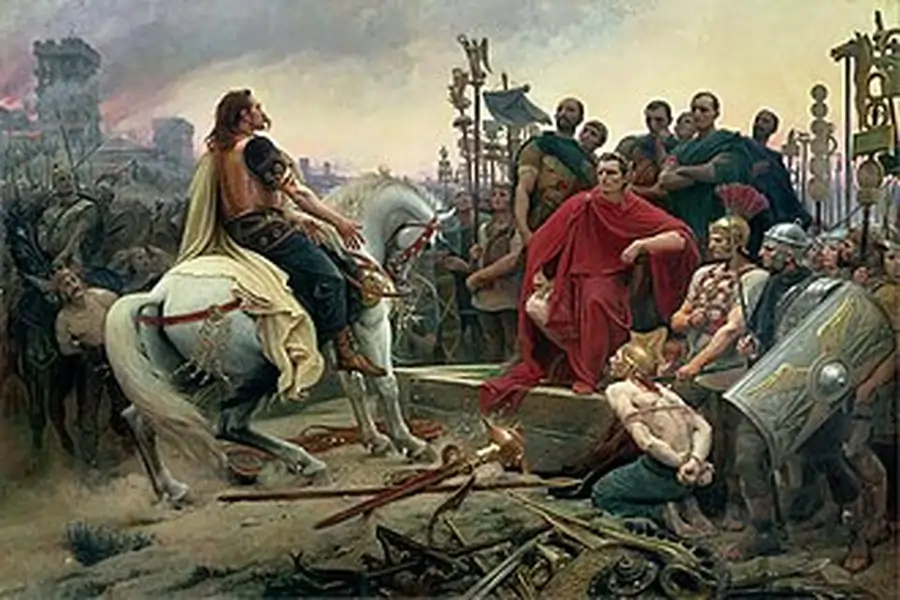
Sharpened wooden stakes, known as valli, were then inserted into the rampart to create a defensive palisade wall called the vallum. This combination of ditch, earth wall, and wooden stakes transformed the camp into a formidable temporary fortress. Julius Caesar frequently referenced Roman camp construction during the Gallic Wars, especially when describing siege operations and defensive preparations (Gallic Wars, VII.72). During the campaign at Alesia, Roman engineering reached its peak level of effectiveness and ingenuity as Caesar's forces constructed a massive double-walled fortification designed both to trap the defenders and repel external relief armies.
You can explore Caesar's siege engineering in greater detail in Battle of Alesia: Caesar's Double Wall Strategy.
Modern historian Peter Connolly argued that Roman camp construction reflected a military culture obsessed with preparation and routine rather than reckless battlefield aggression (Connolly, Greece and Rome at War).
Layout of a Roman Military Camp
The internal layout of a Roman military camp reflected Rome's military philosophy of order, predictability, and control. Roman encampments followed highly organized grid systems. Two main roads formed the camp's central structure. The Via Praetoria ran from the main gate toward the commander's headquarters, while the Via Principalis crossed the camp horizontally. These roads allowed excellent mobility for the soldiers to navigate within the camp during emergencies.
At the center stood the praetorium, the commander's headquarters. From here, generals coordinated troop movements, logistics, and military planning. Adjacent to the praetorium were administrative areas, supply zones, and meeting spaces. Soldiers slept in carefully organized rows of leather tents grouped according to unit structure. Every legionary knew exactly where his tent was located and where to go to mobilize quickly if attacked.
There were storage areas for protecting grain, tools, weapons, and medical supplies. Pack animals and cavalry horses occupied separate sections to maintain order. Polybius admired the efficiency of Roman camp organization and noted that even large armies could function smoothly because every soldier understood the camp's layout in advance (Polybius, Histories, VI.31-32). The structured organization of Roman camps closely mirrored the structure of the legion itself. For a deeper understanding of how Roman units operated, see Roman Legion Structure Explained.
Defenses of Roman Camps
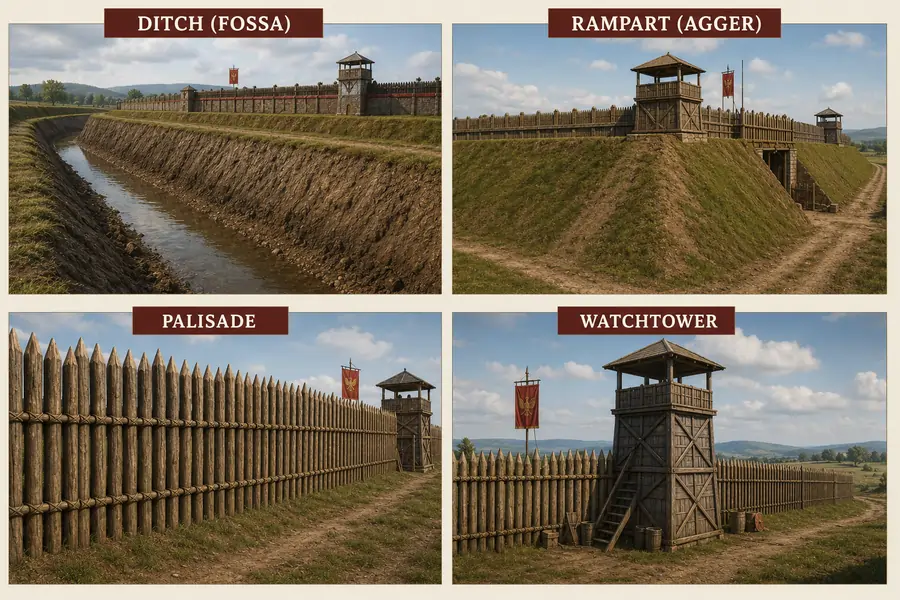
Roman camps were designed to withstand sudden attacks and provide soldiers with enough time to prepare and set up defenses even in hostile territory. The defensive ditch was usually the first obstacle that the attackers had to overcome. Enemy warriors attempting to cross the trench were slowed significantly and were exposed to Roman missiles and counterattacks from above.
Behind the ditch stood the rampart and wooden palisade. Although the Roman camps were only temporary structures, they could become surprisingly difficult to assault. Archaeological evidence from Roman frontier regions suggests that some marching camps were built with astonishing speed while still maintaining effective defensive structures.
The Romans had guards stationed to look out for enemy activity throughout the night. Roman soldiers rotated watches, and failures during guard assignments could result in severe punishment. Vegetius emphasized that military discipline depended on constant vigilance and strict enforcement of camp security (De Re Militari, III.8). Gates were the most vulnerable part of any defensive structure. The Roman engineers carefully controlled entry points to ensure that they were secure and well guarded. Guards inspected movement in and out of the encampment while patrols monitored nearby terrain for enemy activity. These defensive systems allowed Roman armies to remain organized even when surrounded by hostile populations far from Roman territory.
Daily Life Inside the Camp
Life inside a Roman military camp was physically exhausting and followed a strict routine for the Roman soldiers. The Legionnaires spent much of their time performing manual labor rather than fighting battles. Meals were usually simple and based heavily on grain, bread, and salted meat. Soldiers prepared food themselves, often using portable cooking equipment carried during campaigns.
Weapon maintenance formed another major part of camp life. Swords needed sharpening, shields required repairs, and armor had to be cleaned regularly to prevent rust and damage. Training continued even during campaigns. Legionaries practiced marching, weapons drills, and formation maneuvers constantly. This relentless training culture can be compared with systems such as the Spartan Agoge. The primary difference between the Spartans and Romans, though, was that the Romans focused more heavily on engineering, logistics, and coordinated unit discipline.
Despite the structural organisation and skill of the Romans, sleeping conditions inside camps were often uncomfortable. Soldiers shared leather tents in small groups, and poor weather could make camp life miserable. Despite these hardships, Roman encampments provided a significantly better quality of life than other army camps of the era. This psychological boost helped the Roman soldiers endure these conditions and continue fighting. For additional context, see Ancient Soldiers' Mentality, Survival Rates and Morale.
Role of Camps in Roman Victories
The role of the humble Roman military camp is portrayed in various campaigns in ancient history. These organized camps allowed Roman armies to rest and recuperate even while campaigning deep inside enemy territory. Julius Caesar's conquest of Gaul depended heavily on fortified camps and engineering works. Roman forces frequently operated in hostile regions surrounded by tribal enemies, yet their ability to rapidly establish fortified positions ensured their safety.
The siege of Alesia remains one of the greatest examples of Roman military engineering. While trapping Vercingetorix inside Alesia, Julius Caesar's army was surrounded by a large Gallic relief army. To combat this, he constructed enormous fortification lines around the city while simultaneously preparing defenses against external reinforcements. According to Caesar, the Roman fortifications included trenches, walls, towers, and hidden traps designed to exhaust attacking forces (Gallic Wars, VII.72-74).
Roman camps also proved essential during the Punic Wars against Carthage. Hannibal Barca repeatedly defeated Roman armies in open battle, but Rome's logistical system and disciplined military structure allowed the republic to continue fighting despite devastating losses. Modern historians often argue that Roman military success depended less on tactical brilliance alone and more on Rome's ability to sustain prolonged warfare through discipline, manpower, and logistics.
Temporary Camps vs Permanent Forts
Romans built temporary camps to provide short-term support during marching and campaigning. Some camps evolved into permanent frontier forts. These would be occupied for decades and helped consolidate Roman frontier territories. Temporary camps were usually constructed quickly using earthworks and wooden palisades. Many existed for only a single night before the army would abandon them and continue marching. Despite their temporary nature, these camps were still built with care and precision following standardized layouts and defensive principles.
Permanent forts became increasingly important during the imperial period when Rome needed to secure its long frontiers. The wooden palisades were replaced by stronger stone walls. Many forts developed extensive infrastructure, including barracks, granaries, workshops, and even bathhouses. Along borders such as the Rhine, Danube, and Hadrian's Wall, Roman forts became long-term military centers that projected Roman authority and influence. Some permanent camps eventually evolved into civilian settlements and later major European cities.
Roman Engineering and the Use of Early Concrete
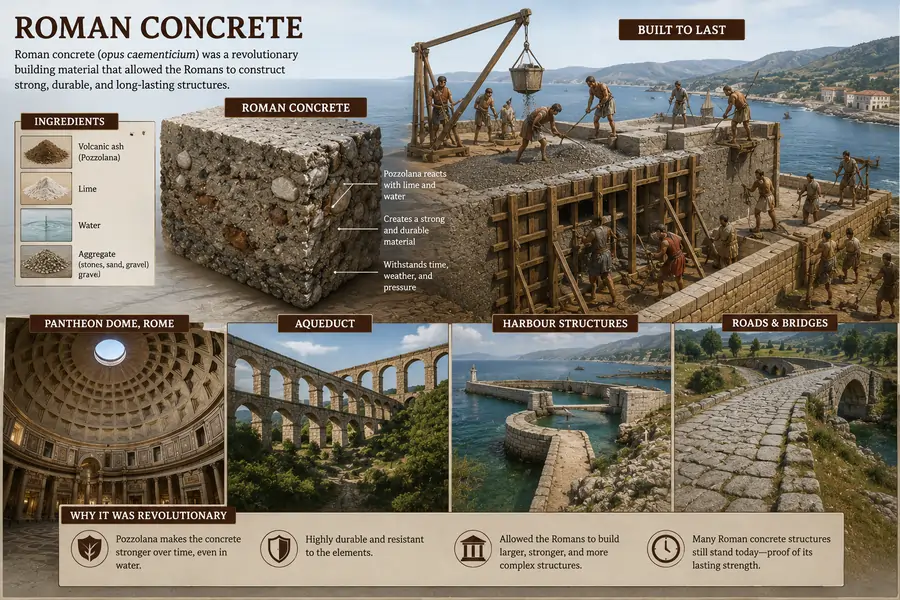
Roman military engineering became even more impressive during the later republic and imperial periods because of Rome's growing mastery of concrete construction. The Romans developed a durable material known as opus caementicium, often referred to today as Roman concrete. This mixture combined lime mortar, volcanic ash, and small stones, creating structures that could survive for centuries.
Permanent frontier forts increasingly incorporated stone and concrete construction. Roman engineers used these materials for walls, watchtowers, gates, granaries, and defensive foundations. The durability of Roman military forts along the Rhine and Hadrian's Wall demonstrates the effectiveness of these construction methods even in harsh climates. Roman architect Vitruvius described the importance of volcanic ash in strengthening Roman concrete, particularly when mixed near coastal regions (De Architectura, II.6). Modern archaeological studies have shown that some Roman concrete structures remain remarkably resilient even after nearly two thousand years.
Why Roman Camps Were So Effective
The Roman military camps represented the core strengths of the Roman army itself. Its reliance on blueprints to build standardised structures ensured easy construction by recruits with little experience. The daily routine of constructing fortified camps forced soldiers to work together constantly and reinforced obedience under difficult conditions. Roman armies became extraordinarily resilient, with each soldier having a clear understanding of his role within a larger system.
Engineering expertise allowed Roman forces to create defensive positions almost anywhere. This capability gave Roman commanders far greater operational flexibility. Standardized camp layouts simplified communication, logistics, and military command structure. Roman armies could also fall back to these defensive encampments if the battle did not go well. Historian Yann Le Bohec argues that Roman military superiority depended heavily on discipline and organization rather than individual heroism alone (Le Bohec, The Imperial Roman Army). These military camps were therefore one of the major reasons for Rome's military successes in expanding and consolidating huge territories.
References and Further Reading
Ancient Sources
- Polybius - The Histories
- Vegetius - De Re Militari
- Julius Caesar - Commentarii de Bello Gallico
- Livy - History of Rome
- Josephus - The Jewish War
Modern Historians and Scholarship
- Adrian Goldsworthy - The Complete Roman Army
- Peter Connolly - Greece and Rome at War
- Lawrence Keppie - The Making of the Roman Army
- Yann Le Bohec - The Imperial Roman Army
- Bishop and Coulston - Roman Military Equipment
Recommended Books
This article may contain affiliate links. If you purchase through these links, I may earn a small commission at no extra cost to you.
Related Articles
Frequently Asked Questions
How long did Roman soldiers take to build a military camp?
Roman soldiers could often construct a temporary marching camp within a few hours after completing a full day's march. Because Roman camps followed standardized layouts, legionaries already knew where to dig trenches, build ramparts and position tents. This efficiency became one of the major advantages of the Roman army during long campaigns.
Did Roman armies really build camps every night?
Roman armies frequently built fortified camps at the end of daily marches, especially while campaigning in hostile territory. Ancient historians such as Polybius and Vegetius described camp construction as a normal part of Roman military discipline. In safer regions or emergencies, commanders sometimes skipped full camp construction, but fortified camps were considered standard Roman practice.
What tools did Roman soldiers carry to build camps?
Roman legionaries carried engineering tools alongside their weapons, including shovels, picks, axes and sharpened wooden stakes called valli. These tools allowed Roman armies to quickly dig defensive trenches and construct wooden palisades wherever they camped.
Why were Roman military camps rectangular?
Roman military camps were usually rectangular because straight lines improved organization, troop movement and defense. A standardized rectangular layout also helped soldiers quickly locate roads, gates, supply areas and commanders' tents during emergencies.
What happened if Roman soldiers failed guard duty in camp?
Guard duty was taken extremely seriously in the Roman army. Soldiers caught sleeping or abandoning their posts could face severe punishments, including flogging or even execution in extreme cases. Roman commanders believed strict camp security was essential for preventing surprise attacks.
Are any Roman military camps still visible today?
Archaeologists have discovered the remains of many Roman camps across Europe, North Africa and the Middle East. Some temporary camps are still visible as earthworks, while larger permanent forts along frontiers such as Hadrian's Wall preserve stone walls, gates and barracks from the Roman period.
Add Comment