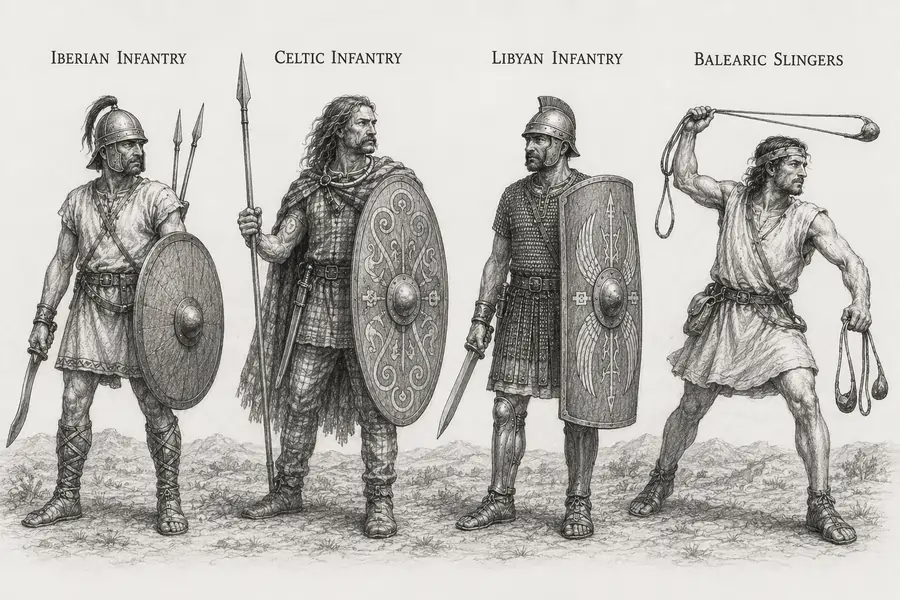
Hannibal Barca almost won the Second Punic War (218-201 BC) using his multi-ethnic army and terrorized the Romans on their own soil. Rather than relying on a single national force, Hannibal combined experienced Libyan spearmen, fearless Iberian swordsmen, aggressive Gallic warriors, deadly Balearic slingers, agile Numidian javelinmen, and numerous allied contingents into one highly coordinated fighting force. Each unit possessed distinct weapons, strengths, and battlefield roles, allowing Hannibal to exploit terrain, deceive Roman commanders, and defeat armies that often outnumbered him. While Roman victories eventually decided the war, Hannibal's multinational infantry remains one of history's greatest examples of combined-arms warfare and military leadership. Understanding how these infantry units worked together explains why Hannibal won spectacular victories at the Battle of Trebia, the Battle of Lake Trasimene, and the Battle of Cannae, battles still studied in military academies around the world.
Table of Contents
- Overview of Hannibal's Infantry Army
- Composition and Estimated Numbers
- Libyan Infantry
- Iberian Infantry
- Gallic Infantry
- Balearic Slingers
- Numidian Javelinmen
- How Hannibal Unified a Multi-Ethnic Army
- Battlefield Performance
- Why Rome Struggled Against Hannibal's Infantry
- Why Hannibal's Infantry Was So Effective
- Legacy
Overview of Hannibal's Infantry Army
When Hannibal Barca crossed the Alps in 218 BC to invade Italy, he did not command an army of Carthaginian citizens. Instead, he led one of the most culturally diverse military forces ever assembled in the ancient world. Soldiers spoke different languages, worshipped different gods, fought with different weapons, and followed different military traditions. Yet under Hannibal's leadership, these varied infantry units operated with remarkable coordination.
Unlike the Roman Republic, whose armies were organized around standardized legions, Carthage relied heavily on troops recruited from across its Mediterranean territories and allied kingdoms. Carthaginian citizens themselves rarely served as heavy infantry in overseas campaigns. Instead, Carthage drew manpower from North Africa, Iberia, the Balearic Islands, Gaul, Numidia, Liguria, and later from Italian allies who defected after Rome's defeats.
Rather than viewing this diversity as a weakness, Hannibal transformed it into one of his greatest military advantages. Every ethnic group filled a specialized battlefield role. Heavy Libyan infantry provided discipline and staying power; Iberians excelled in close combat; Gallic warriors delivered powerful shock attacks; Balearic slingers disrupted enemy formations from long range, while Numidian light infantry screened the army and harassed advancing Romans.
This flexibility contrasted sharply with the more standardized Roman legion explained in our guide to the Roman legion structure. Hannibal rarely fought the same battle twice, adapting his infantry deployment to terrain, enemy strength, and strategic objectives. His multinational force became one of the defining features of the Second Punic War, allowing him to inflict some of the worst defeats in Roman military history.
Composition and Estimated Numbers
The exact size of Hannibal's infantry varied throughout the campaign as casualties, reinforcements, disease, and allied defections continually changed its composition. Ancient historians Polybius and Livy provide differing figures, but modern historians generally agree on approximate numbers. Infantry numbers constantly changed because Hannibal rarely fought with the same army twice.
| Infantry Unit | Estimated Strength (218 BC) | Primary Role |
|---|---|---|
| Libyan Heavy Infantry | 12,000-15,000 | Heavy spear infantry |
| Iberian Infantry | 8,000-12,000 | Elite assault infantry |
| Gallic Infantry | 15,000-20,000+ | Shock troops |
| Balearic Slingers | 1,000-2,000 | Missile infantry |
| Numidian Javelinmen | 500-1,500 | Light skirmishers |
| Ligurian & Italian Infantry | Several thousand (later years) | Auxiliary infantry |
These figures changed dramatically after Hannibal crossed the Alps. Nearly half of his army was lost to harsh weather, starvation, tribal attacks, and desertion during the crossing. Despite these devastating losses, the surviving infantry remained experienced veterans who would defeat multiple Roman consular armies in the years that followed.
As Hannibal gained victories in Italy, thousands of Gallic tribesmen and later several Italian communities joined his army, partially replacing earlier losses. Consequently, the ethnic balance of the army shifted over time, with Gallic infantry becoming increasingly numerous after 218 BC.
Libyan Heavy Infantry
Origin
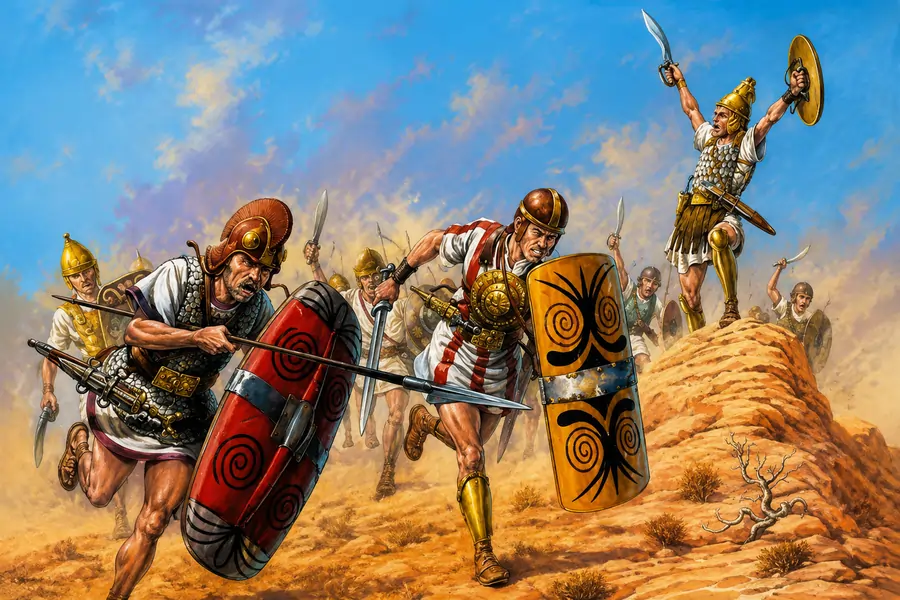
The Libyan infantry formed the professional core of Hannibal's army. Most recruits came from Carthage's North African territories in modern Tunisia and western Libya, regions that had supplied disciplined soldiers to Carthaginian armies for generations. Unlike many mercenary contingents, these troops were subjects of Carthage and often possessed considerable military experience before campaigning in Italy (Polybius, Histories, Book III).
Equipment
- Long thrusting spear
- Large round or oval shield
- Helmet of bronze or iron
- Mail or linen cuirass (many later adopted Roman equipment)
- Short sword for close combat
Following victories against Rome, many Libyan infantrymen re-equipped themselves with captured Roman armor, shields, helmets, and weapons. Polybius specifically notes that Hannibal encouraged this practice because Roman equipment offered excellent protection while allowing his veterans to fight more flexibly than traditional Greek-style formations. Unlike Greek hoplites, Libyan infantry fought as part of a highly flexible combined-arms system rather than in isolation.
Tactical Role
The Libyans served as Hannibal's heavy infantry. Their primary mission was to hold critical sectors of the battlefield, protect vulnerable troops, and deliver decisive attacks once enemy formations became disorganized. Unlike the Romans, who depended upon rigid manipular rotations, Hannibal used his Libyans selectively. Rather than exhausting them in prolonged frontal assaults, he frequently held them in reserve until the decisive moment.
The finest example occurred at the Battle of Cannae. Hannibal deliberately positioned his Libyan veterans on both wings while placing weaker Gallic and Iberian troops in the center. As the Roman legions pushed the center backward, the Libyans wheeled inward and attacked the Roman flanks, helping complete one of history's most famous double envelopments.
Strengths
The Libyan heavy infantry possessed several important strengths that made them the backbone of Hannibal's army. They were exceptionally disciplined and consisted largely of experienced veterans who had campaigned in both North Africa and Iberia before invading Italy. Their strong defensive capabilities allowed them to hold formation under intense pressure, while their willingness to adopt captured Roman armor and weapons after early victories improved both their protection and battlefield effectiveness. Perhaps most importantly, they excelled in coordinated maneuvers, enabling Hannibal to execute sophisticated tactical plans such as the famous double envelopment at Cannae. Modern historians frequently compare the Libyans to elite professional infantry because they consistently maintained formation even during chaotic battles, providing the dependable core around which Hannibal built his most successful battlefield strategies.
Weaknesses
Despite their many strengths, the Libyan heavy infantry also had several limitations. Their numbers were relatively small compared to the Roman legions, making every casualty difficult to replace. Unlike Rome, which could continually raise new citizen armies, Carthage had only a limited pool of experienced Libyan veterans available for service in Italy. As the war progressed, losses steadily reduced the quality of Hannibal's veteran core. The Libyans were also most effective when operating as part of Hannibal's combined-arms strategy alongside cavalry and missile troops. If isolated from supporting units or forced to fight unsupported against overwhelming numbers, even these elite infantrymen became increasingly vulnerable.
Best Battlefield Performances
At the Battle of Trebia, Libyan infantry helped exploit the disorder created after the Roman army crossed the freezing river before battle. While Hannibal's cavalry dominated the flanks, the disciplined Libyans steadily pressed the exhausted Roman infantry, contributing to another decisive Carthaginian victory. At the Battle of Cannae, they were held in reserve and swung the tide of battle with their flanking attack.
Iberian Infantry
Origin
The Iberian infantry came primarily from southeastern and eastern Spain, regions conquered by the Barcid family following the First Punic War. Hannibal had spent years campaigning in Iberia before invading Italy, giving him firsthand knowledge of the fighting abilities of local tribes such as the Contestani, Edetani, and Celtiberians. Many Iberians were not simple mercenaries. Some fought because of long-standing alliances with the Barcid family, while others sought wealth, prestige, or revenge against rival tribes supported by Rome.
Equipment
- Falcata or straight-cutting sword
- Several throwing javelins
- Oval shield (caetra or scutum type)
- Bronze helmet (among wealthier warriors)
- Linen or leather armor, though many fought lightly protected
The famous Iberian falcata remains one of antiquity's most recognizable swords. Its forward-curving blade generated tremendous cutting power while still delivering effective thrusts, making it particularly dangerous in close combat.
Tactical Role
Iberians acted as Hannibal's aggressive assault infantry. They excelled in fast attacks, broken terrain, and prolonged melee fighting where individual skill mattered more than rigid formation. Hannibal frequently deployed them alongside Gallic warriors in the center of his battle line, where their offensive spirit helped absorb Roman pressure before his heavier troops delivered the decisive blow.
Unlike the Libyans, whose strength lay in discipline and cohesion, Iberians relied on speed, initiative, and fierce hand-to-hand combat. Their ability to transition quickly from missile attacks with javelins to sword fighting made them highly adaptable against Roman maniples.
Strengths
The Iberian infantry were renowned for their exceptional close-combat ability and highly aggressive fighting style. Skilled in the use of both javelins and swords, they could harass enemy formations with missile fire before rapidly closing for hand-to-hand combat. Many of these warriors had gained years of battlefield experience during Hannibal's campaigns in Iberia, making them seasoned veterans by the time they invaded Italy. Their confidence in their commander, combined with a tradition of fierce warrior culture, helped maintain high morale throughout the campaign. These qualities made the Iberians among the most versatile and dependable assault troops in Hannibal's multinational army.
Weaknesses
Despite their impressive fighting ability, the Iberian infantry had several disadvantages. They generally wore lighter armor than Roman legionaries, making them more vulnerable during prolonged engagements. While they excelled in aggressive assaults and close-quarters combat, they were less effective when forced into extended defensive fighting. Their success often depended on coordinated support from Hannibal's heavier Libyan infantry and cavalry, which protected their flanks and exploited openings they created. When committed to sustained frontal engagements against well-organized Roman formations without adequate support, the Iberians could suffer significant casualties despite their courage and skill.
Best Battlefield Performances
Iberian infantry distinguished themselves during the opening years of the Italian campaign, particularly at the Battles of Trebia, Lake Trasimene, and Cannae. At Cannae, they formed part of Hannibal's deliberately advanced center, where they fought stubbornly while slowly yielding ground in a controlled withdrawal. Their disciplined resistance drew the Roman legions deeper into the trap before the Libyan infantry struck from both flanks.
This controlled fighting withdrawal demonstrates that Iberian infantry were far more disciplined than the stereotype of reckless tribal warriors suggests. Polybius praised the coordination of Hannibal's center, indicating careful planning rather than spontaneous resistance (Polybius, Histories, Book III). The effectiveness of these Spanish veterans reflected Hannibal's years of campaigning in Iberia before the war, during which he forged experienced soldiers into one of the Mediterranean's finest fighting forces.
Gallic Infantry
Origin
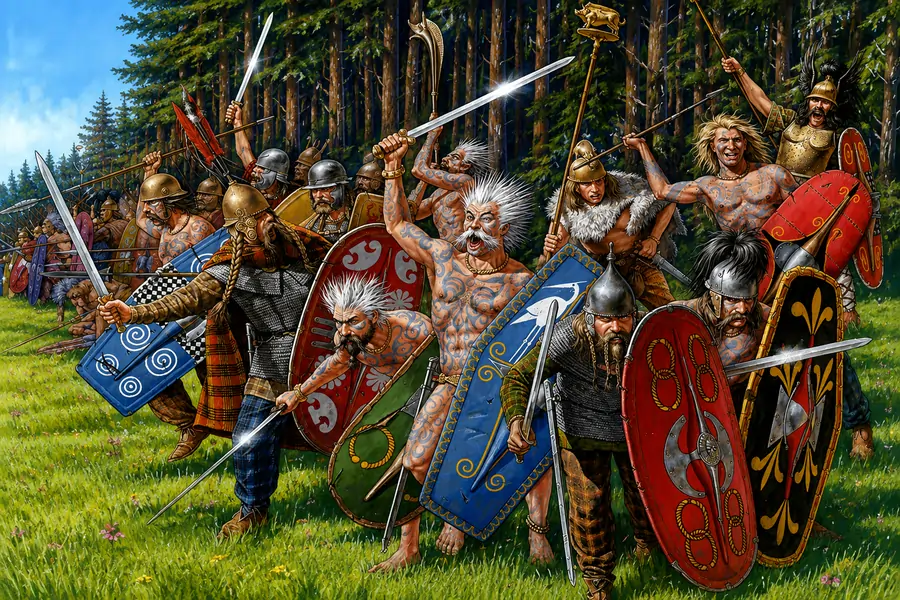
The Gallic infantry were the largest ethnic group in Hannibal's army after he arrived in northern Italy. Many came from the Boii and Insubres tribes of Cisalpine Gaul (modern northern Italy), while others had joined Hannibal before he crossed the Alps from southern Gaul. These tribes had long resisted Roman expansion and viewed Hannibal as an opportunity to regain their independence.
Unlike the Libyans and Iberians, many Gallic warriors initially fought for political reasons rather than pay. Hannibal skillfully presented himself as a liberator rather than a conqueror, promising freedom from Roman domination. His diplomatic efforts won the support of thousands of Gallic warriors after his victories at the Battle of Trebia and the Battle of Lake Trasimene. The influx of Gallic recruits significantly increased Hannibal's manpower, allowing him to replace many of the losses suffered during the Alpine crossing.
Equipment
- Long slashing sword
- Large oval shield
- Long spear or heavy thrusting spear
- Several javelins (some tribes)
- Bronze helmet (wealthier warriors)
- Minimal body armor, although nobles often wore chainmail
Contrary to popular belief, not all Gallic warriors fought half-naked. Ancient sources describe many noble warriors wearing high-quality chainmail, a Celtic invention later adopted by both Carthaginians and Romans. However, poorer warriors often relied only on shields and courage for protection.
Tactical Role
The Gallic infantry served primarily as Hannibal's shock troops. Their role was to attack aggressively, disrupt enemy formations, absorb the initial clash, and create opportunities for Hannibal's more disciplined infantry to exploit.
Rather than expecting the Gauls to fight prolonged defensive battles, Hannibal used their natural aggression where it offered the greatest advantage. They frequently occupied the center of his battle line alongside the Iberians, drawing Roman attention while Libyan heavy infantry waited on the wings. This deployment reflected Hannibal's deep understanding of his soldiers. Instead of forcing every unit to fight identically, he adapted tactics to match each group's strengths.
Strengths
The Gallic infantry was valued for its outstanding offensive spirit and willingness to launch aggressive attacks. Their large numbers provided Hannibal with an important source of manpower, while their powerful charges could overwhelm enemy formations and disrupt carefully organized battle lines. Accustomed to the hardships of tribal warfare, Gallic warriors also possessed impressive physical endurance and excelled in close-quarter combat, where their strength and ferocity could be fully exploited.
Beyond their physical capabilities, the Gauls also exerted a significant psychological impact on the battlefield. The sight of thousands of warriors advancing with loud battle cries, blaring war horns, and brightly decorated shields could intimidate opposing armies before the fighting even began. This aggressive display often unsettled less experienced Roman soldiers, reducing their confidence and cohesion before the first swords were crossed. Hannibal understood the value of this intimidation and frequently employed Gallic infantry where their fearsome reputation could have the greatest effect.
Weaknesses
Despite their formidable offensive capabilities, the Gallic infantry had several weaknesses. They were generally less disciplined than Hannibal's Libyan veterans and varied considerably in training and equipment, with wealthier warriors often possessing superior armor and weapons to their poorer counterparts. Their aggressive fighting style also meant they frequently suffered higher casualties during prolonged engagements, particularly against well-organized Roman legionaries.
Without strong leadership, some Gallic contingents tended to break formation while pursuing fleeing enemies or become difficult to control after a victory. Hannibal recognized these limitations and rarely relied on them to fight independently. Instead, he integrated Gallic warriors with his more disciplined Libyan and Iberian infantry. He placed experienced officers in key positions, ensuring that their ferocity was directed effectively without compromising the overall battle plan.
Best Battlefield Performances
At Cannae, Gallic infantry occupied the exposed center of Hannibal's formation together with Iberian troops. They endured enormous pressure from the advancing Roman legions while gradually giving ground in a carefully controlled withdrawal. This maneuver compressed the Roman formation and created the conditions for Hannibal's famous double envelopment.
Although the Gauls suffered heavy casualties during the battle, their sacrifice was essential to one of history's greatest tactical victories. Modern military historians often note that without the Gallic infantry's stubborn resistance, Hannibal's encirclement could never have succeeded.
Balearic Slingers
Origin
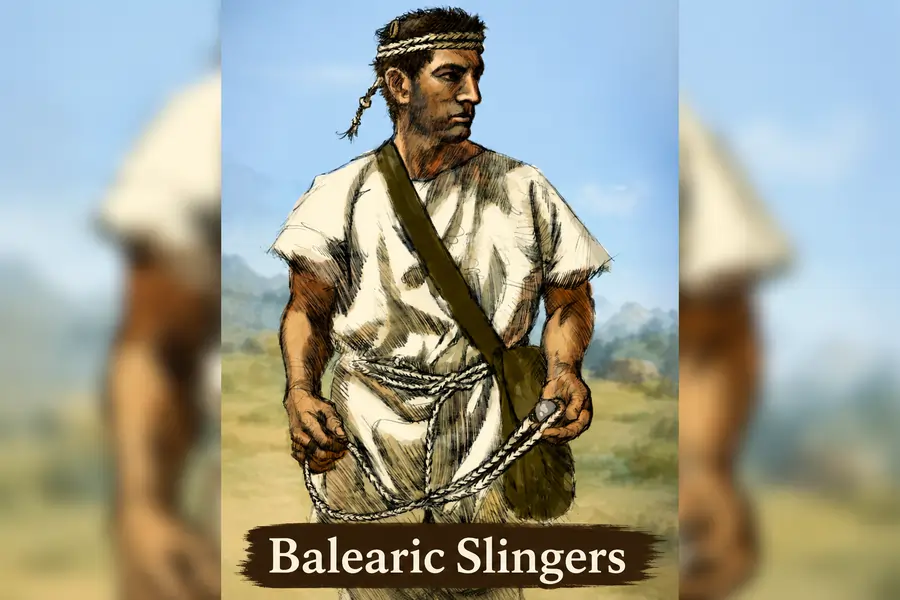
The Balearic Slingers came from the Balearic Islands off the eastern coast of Spain, particularly Majorca and Minorca. These islanders had earned an international reputation centuries before Hannibal invaded Italy and were widely regarded as the finest slingers in the ancient Mediterranean.
According to ancient tradition, Balearic children learned to use the sling from an early age. Classical writers claimed that mothers placed food on poles and required children to knock it down with stones before they could eat, though modern historians debate whether this account is literal or symbolic (Strabo, Geography, Book III). The result was generations of exceptionally skilled missile troops capable of remarkable accuracy.
Equipment
- Three slings of different lengths
- Leather pouch filled with stone or lead projectiles
- Small shield
- Short knife or sword for self-defense
- Minimal armor to maximize mobility
Each slinger typically carried three separate slings. Short slings delivered greater accuracy at close range, while longer slings generated tremendous velocity over longer distances. Skilled slingers could adapt quickly to changing battlefield conditions.
Tactical Role
The Balearic Slingers operated as elite missile infantry. Their primary missions included:
- Harassing enemy formations before contact
- Targeting officers and standard bearers
- Breaking Roman shield formations
- Supporting cavalry operations
- Covering infantry advances
Unlike Roman velites, whose javelins had limited range, Balearic slingers could attack from much greater distances. Their projectiles often struck with enough force to fracture bones, dent helmets, or incapacitate soldiers even without penetrating armor.
Strengths
The Balearic Slingers were among the most effective missile troops of the ancient world, renowned for their outstanding range, exceptional accuracy, and remarkably high rate of fire. Their light equipment allowed them to move quickly across the battlefield, making them difficult targets while enabling them to reposition as the fighting evolved. By showering advancing Roman formations with a constant barrage of stones or lead projectiles, they disrupted enemy cohesion, inflicted casualties before the main engagement, and created both physical and psychological pressure. This sustained bombardment often forced Roman commanders to attack under unfavorable conditions, giving Hannibal's infantry a significant advantage before close combat even began.
Weaknesses
Despite their exceptional effectiveness as missile troops, the Balearic Slingers were not designed for prolonged close combat. Lightly equipped and carrying only basic weapons for self-defense, they depended on Hannibal's heavy infantry and cavalry to protect them from enemy charges. Their battlefield success relied on maintaining distance from opposing forces and retreating behind the main battle line before the armies clashed. If caught in melee or prevented from withdrawing in time, the slingers were highly vulnerable due to their lack of armor and limited hand-to-hand fighting capability.
Best Battlefield Performances
During the opening campaigns in Italy, the Balearic Slingers repeatedly disrupted Roman formations before the decisive infantry engagement. At Lake Trasimene, where visibility was limited by morning fog and broken terrain, their missile fire added confusion to an already devastating ambush. Their effectiveness demonstrates Hannibal's appreciation for combined-arms warfare. Rather than relying solely on heavy infantry, he ensured every battle began with carefully coordinated missile support.
Numidian Javelinmen
Origin
Although the Numidians are best remembered for their exceptional cavalry, Hannibal also employed Numidian light infantry armed with javelins. These soldiers came from the kingdoms of Numidia in present-day Algeria and western Tunisia, where warfare emphasized mobility, endurance, and skirmishing rather than heavy armor.
The Numidians lived in harsh environments that demanded self-reliance and physical endurance. Their ability to move rapidly over difficult terrain made them valuable reconnaissance troops and battlefield skirmishers.
Equipment
- Several light throwing javelins
- Small round shield
- Short sword or dagger
- Little or no body armor
Unlike Roman infantry burdened with heavy equipment, Numidian javelinmen prioritized speed. Their lightweight gear allowed them to advance, throw missiles, and withdraw before enemy infantry could respond effectively.
Tactical Role
The Numidian javelinmen performed several important battlefield functions:
- Screening Hannibal's main army
- Scouting enemy movements
- Harassing advancing infantry
- Protecting vulnerable missile troops
- Pursuing retreating enemies
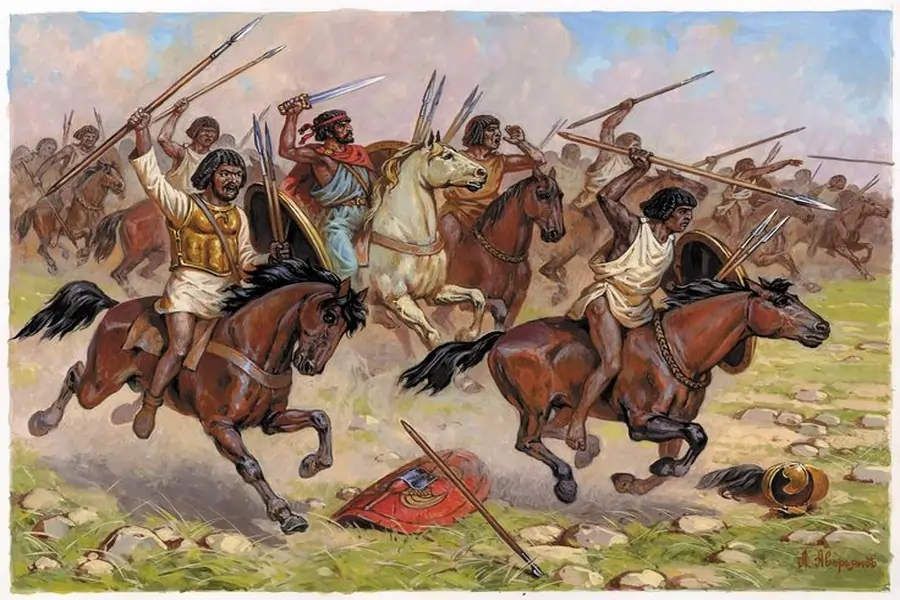
They frequently operated alongside the famous Numidian cavalry, creating highly mobile skirmishing forces capable of attacking from multiple directions.
Strengths
The Numidian javelinmen were prized for their exceptional mobility and ability to deploy rapidly across the battlefield. Their lightweight equipment allowed them to move quickly over long distances, making them excellent scouts who could gather intelligence and monitor enemy movements. They excelled at harassing opposing forces with hit-and-run attacks, repeatedly throwing javelins before withdrawing beyond the enemy's reach. Their agility and familiarity with difficult landscapes also enabled them to operate effectively in rough or mountainous terrain, where heavier infantry often struggled to maneuver. These qualities made them invaluable as skirmishers and reconnaissance troops within Hannibal's army.
Weaknesses
While the Numidian javelinmen were highly effective as light skirmishers, they were poorly suited for direct engagements with heavily armed infantry. Their minimal armor and light equipment left them vulnerable in close combat, making prolonged melee engagements against Roman legionaries particularly dangerous. Their effectiveness depended on maintaining constant mobility, using speed and maneuverability to avoid being pinned down. If forced into a static fight or prevented from withdrawing after launching their javelins, they quickly lost the advantages that made them such valuable troops on the battlefield.
Best Battlefield Performances
Numidian skirmishers contributed significantly during Hannibal's campaigns in southern Italy, where mountainous terrain favored light infantry. They also supported cavalry actions by preventing Roman light troops from interfering with mounted operations. Although ancient historians devote more attention to the famous Numidian horsemen, modern military historians increasingly recognize that their accompanying light infantry enhanced Hannibal's battlefield flexibility.
Ligurian and Italian Allied Infantry
Origin
As the war progressed, Hannibal's victories encouraged several Italian communities to abandon Rome and join the Carthaginian cause. Among these recruits were Ligurians from northwestern Italy, Bruttians from southern Italy, Lucanians, Samnites, and soldiers from Capua after its defection in 216 BC. These troops varied considerably in equipment and fighting style, reflecting the military traditions of their home regions.
Tactical Role
Rather than forming elite assault units, these allied infantry generally served as supporting troops. They guarded camps, reinforced garrisons, conducted raids, and supplemented Hannibal's veteran core during extended operations. Their local knowledge proved especially valuable during campaigns in southern Italy, where familiarity with roads, mountain passes, and supply routes improved Hannibal's operational mobility.
Strengths
The Ligurian and Italian allied infantry provided Hannibal with several important advantages beyond simply increasing the size of his army. Their familiarity with the local geography, including mountain passes, roads, and supply routes, proved invaluable during campaigns across Italy. They also supplied much-needed additional manpower, allowing Hannibal to replace some of his earlier losses and maintain his operational strength. These troops were particularly useful for garrisoning captured towns, protecting supply lines, and conducting secondary operations, which reduced the burden on Hannibal's experienced Libyan, Iberian, and Gallic veterans and allowed his elite infantry to remain available for major field battles.
Weaknesses
The Ligurian and Italian allied infantry also had several limitations that reduced their overall battlefield effectiveness. Their level of training varied considerably between different communities, resulting in inconsistent combat performance. Loyalty could also fluctuate depending on the political situation, as some allied cities changed sides during the war when Roman fortunes improved. Furthermore, these troops generally lacked the extensive combat experience of Hannibal's original Libyan, Iberian, and Gallic veterans, making them less reliable in major pitched battles. Consequently, Hannibal often employed them in supporting roles while reserving his seasoned infantry for the most critical engagements.
Comparison of Hannibal's Infantry Units
| Infantry Type | Primary Weapon | Battlefield Role | Main Strength | Main Weakness |
|---|---|---|---|---|
| Libyan Heavy Infantry | Spear, sword | Heavy line infantry | Discipline | Limited numbers |
| Iberian Infantry | Falcata, javelins | Assault infantry | Close combat | Lighter armor |
| Gallic Infantry | Long sword, spear | Shock troops | Aggressive attack | Less disciplined |
| Balearic Slingers | Sling | Missile infantry | Range and accuracy | Weak in melee |
| Numidian Javelinmen | Javelins | Light skirmishers | Mobility | Minimal protection |
| Ligurian & Italian Allies | Mixed weapons | Support infantry | Local knowledge | Inconsistent quality |
Taken individually, none of these infantry formations was superior to the Roman legion in every aspect of warfare. Hannibal's genius lay in recognizing that each unit excelled under different conditions. Instead of forcing uniformity, he built an army in which every contingent compensated for another's weaknesses. This complementary approach transformed a collection of diverse peoples into one of the most formidable fighting forces of the ancient world.
How Hannibal Successfully United a Multi-Ethnic Army
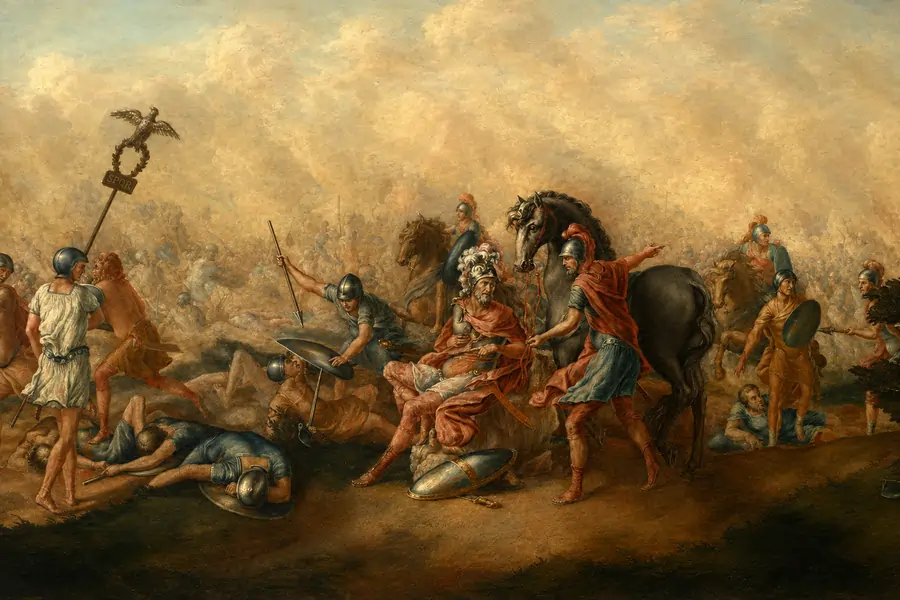
Leading an army composed of soldiers from half a dozen different cultures was one of Hannibal's greatest achievements. His infantry spoke different languages, followed different military traditions, and often had little in common beyond a shared enemy. Yet throughout nearly fifteen years of campaigning in Italy, Hannibal rarely experienced the large-scale mutinies or breakdowns in discipline that plagued many other ancient armies. Several factors explain this remarkable cohesion.
1. Hannibal Used Every Unit According to Its Strengths
Unlike commanders who attempted to standardize their forces, Hannibal embraced diversity. He never expected Gallic warriors to fight like Libyan spearmen or asked Balearic Slingers to perform the role of heavy infantry. Instead, every contingent received tasks that matched its traditional style of warfare.
- Libyans anchored the battle line and delivered decisive flank attacks.
- Iberians excelled in aggressive close combat.
- Gallic warriors absorbed the enemy's initial attack.
- Balearic Slingers weakened enemy formations before contact.
- Numidian light troops screened the army and disrupted Roman deployments.
Because each unit fought in a familiar way, Hannibal minimized the disadvantages normally associated with multinational armies.
2. Experienced Officers Maintained Discipline
Hannibal inherited many veteran officers from his father, Hamilcar Barca, and his brother-in-law Hasdrubal the Fair. These commanders understood the customs and languages of the various allied peoples under Carthaginian rule. Rather than issuing orders directly to thousands of soldiers from different cultures, Hannibal relied upon trusted subordinate commanders who coordinated individual contingents while following an overall battle plan.
3. Success Created Loyalty
Victories produced confidence. Between 218 BC and 216 BC, Hannibal repeatedly defeated Roman armies at the Battle of Trebia, the Battle of Lake Trasimene, and the Battle of Cannae. Successful campaigns generated prestige, wealth through captured equipment, and confidence in Hannibal's leadership. Ancient armies often remained loyal to victorious commanders even when political support from their governments weakened. Hannibal benefited greatly from this phenomenon.
4. Mutual Dependence
Each ethnic contingent depended upon the others. Gallic infantry needed Libyan discipline to stabilize the battle line. Libyans benefited from Balearic missile support before engaging. Numidian skirmishers protected vulnerable missile troops, while cavalry shielded exposed infantry flanks. This interdependence encouraged cooperation rather than rivalry.
How Hannibal's Infantry Performed in Major Battles
Battle of Trebia (218 BC)
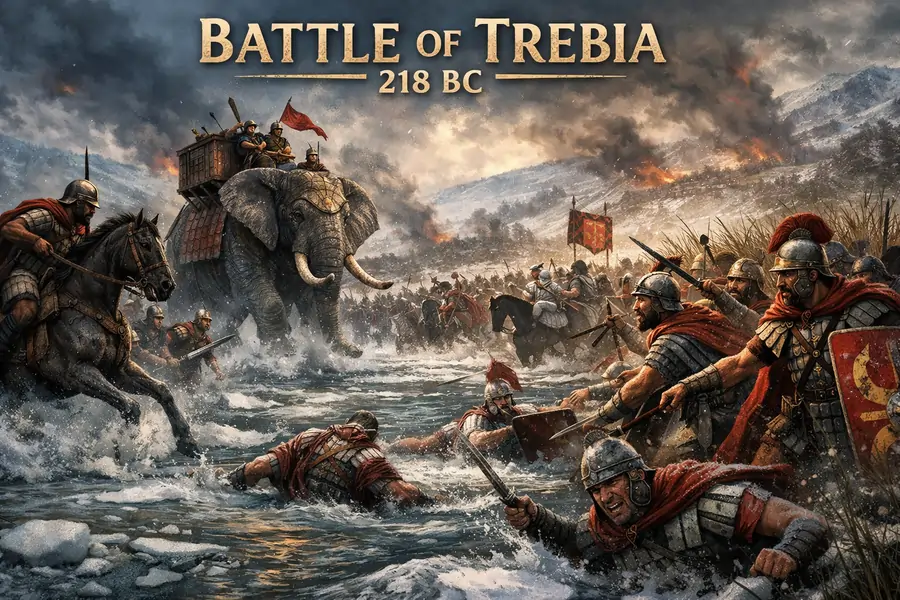
Trebia demonstrated Hannibal's ability to combine different infantry types into a single coordinated battle plan. Balearic Slingers and Numidian skirmishers harassed the Romans as they crossed the freezing Trebia River. Exhausted Roman soldiers then encountered Hannibal's main infantry line, where Iberians, Libyans, and Gauls fought together while Mago Barca's concealed force attacked from the rear. The battle highlighted how Hannibal integrated missile troops, heavy infantry, and ambush tactics into one carefully planned operation.
Battle of Lake Trasimene (217 BC)
At Lake Trasimene, Hannibal used terrain rather than formation to maximize the effectiveness of his infantry. Gallic and Iberian infantry occupied concealed positions on surrounding hills while Libyan veterans blocked the Roman escape route. As the Roman column entered the narrow lakeside road under heavy morning fog, Hannibal launched one of history's largest successful ambushes. Instead of fighting a conventional battle, each infantry contingent attacked simultaneously from different directions, preventing the Romans from forming an organized battle line.
Battle of Cannae (216 BC)
Cannae remains the finest demonstration of Hannibal's multinational infantry working together. Each unit fulfilled a carefully planned role.
- Gallic and Iberian infantry formed the deliberately advanced center.
- The center slowly withdrew without collapsing.
- Libyan heavy infantry held back on both wings.
- Balearic Slingers softened Roman formations before the main engagement.
- Numidian skirmishers supported cavalry operations.
As the Romans crowded into the center, the Libyan infantry pivoted inward, striking both Roman flanks. Simultaneously, Hannibal's cavalry completed the encirclement from behind, producing the famous double envelopment still studied in modern military academies.
Battle of Zama (202 BC)
The Battle of Zama demonstrated both the strengths and limitations of Hannibal's infantry. After years of campaigning in Italy, many of his experienced veterans had been lost. Hannibal was forced to combine newly recruited African levies, mercenaries, and surviving Italian veterans into three separate infantry lines.
Although his veteran third line fought exceptionally well, the earlier lines lacked the experience and cohesion that had characterized the army during the Italian campaign. Scipio Africanus exploited these weaknesses while benefiting from superior Numidian cavalry support. Zama therefore illustrates that Hannibal's earlier successes depended not simply on tactical brilliance but also on the extraordinary quality of the veteran infantry he had forged over many years.
Why Rome Struggled Against Hannibal's Infantry
Rome's repeated defeats during the early years of the Second Punic War were not simply the result of Hannibal's brilliance as a commander. They also reflected the unique strengths of his multinational infantry. Roman armies were highly disciplined and well organized, but they were designed to fight other conventional armies. Hannibal presented them with a far more complex challenge. Instead of relying on a single style of warfare, he combined heavy infantry, aggressive assault troops, missile specialists, and light skirmishers into a flexible fighting force in which every contingent complemented the others.
The Roman legions excelled in straightforward battles where disciplined formations and superior manpower could decide the outcome. Hannibal rarely allowed them to fight on those terms. His Libyan veterans held key positions with remarkable discipline, Iberian infantry adapted quickly to close combat, Gallic warriors absorbed the initial shock of battle, while Balearic Slingers and Numidian skirmishers disrupted Roman formations before the main engagement even began. Hannibal then coordinated these different infantry types with his cavalry, ensuring that each unit supported the others at the decisive moment. This combined-arms approach repeatedly forced Roman commanders into unfamiliar situations, contributing to catastrophic defeats at Trebia, Lake Trasimene, and Cannae. Although Rome eventually adapted through strategic patience, superior resources, and commanders such as Scipio Africanus, Hannibal's infantry demonstrated that a well-led, multi-ethnic army could repeatedly outfight one of the ancient world's most disciplined military systems.
Why Hannibal's Infantry Performed Better Than Other Carthaginian Armies
Many Carthaginian armies struggled against Rome before and after Hannibal's campaigns. Yet Hannibal repeatedly defeated larger Roman forces despite commanding soldiers from many different cultures. Several reasons explain this contrast.
Superior Leadership
Ancient historians consistently praised Hannibal's battlefield command. Polybius described him as one of history's greatest generals because of his ability to inspire confidence, adapt tactics, and remain calm under pressure (Polybius, Histories, Book IX).
Rather than relying on numerical superiority, Hannibal carefully selected battlefields that neutralized Roman advantages. His military leadership earned him a place among the greatest military generals in history.
Veteran Soldiers
Most of Hannibal's original infantry had already fought extensive campaigns in Iberia before invading Italy. These veterans were accustomed to difficult terrain, long marches, and coordinated operations. By contrast, many Roman armies relied heavily on newly raised citizen legions that required time to gain battlefield experience.
Operational Flexibility
Roman commanders generally preferred direct engagements in open terrain where disciplined legions could exploit their organizational advantages. Hannibal rarely accepted such conditions. He chose rivers, forests, valleys, hills, and narrow approaches that amplified the strengths of his multinational infantry while restricting Roman maneuverability. His escape during the Ager Falernus campaign further demonstrates how he consistently used terrain and deception to offset Roman numerical superiority.
Combined-Arms Warfare
Perhaps Hannibal's greatest innovation was his integration of infantry, cavalry, missile troops, and light skirmishers into a unified battlefield system. Unlike armies that relied upon a single decisive arm, Hannibal ensured every unit supported the others.
- Balearic Slingers disrupted enemy formations.
- Numidian skirmishers created confusion.
- Heavy infantry fixed Roman forces in place.
- Cavalry delivered the decisive blow.
This coordinated approach made the entire army significantly more effective than the sum of its individual parts.
Legacy of Hannibal's Infantry
Although Carthage ultimately lost the Second Punic War, Hannibal's infantry profoundly influenced military history. His campaigns demonstrated that disciplined leadership could unite soldiers from different cultures into a remarkably effective fighting force. Later commanders, including Julius Caesar, Napoleon Bonaparte, Helmuth von Moltke, and Norman Schwarzkopf, studied Hannibal's campaigns for lessons in operational maneuver, battlefield deception, and combined-arms tactics.
Modern historians continue to view Hannibal's multinational infantry as one of antiquity's greatest military achievements. Rather than depending upon standardized equipment or overwhelming numbers, Hannibal built success through adaptability, trust, and an exceptional understanding of each contingent's capabilities. His victories remain central to any study of the Punic Wars and continue to influence military thinking more than two thousand years later.
References
- Polybius - The Histories. Books III, IX, XV.
- Livy. Ab Urbe Condita, Books XXI-XXX.
- Adrian Goldsworthy. The Fall of Carthage. Cassell, 2000.
- Dexter Hoyos. Mastering the West: Rome and Carthage at War. Oxford University Press, 2015.
- John Lazenby. Hannibal's War. University of Oklahoma Press, 1998.
- Nigel Bagnall. The Punic Wars. Pimlico, 1999.
- Theodore Ayrault Dodge. Hannibal. Da Capo Press.
- Richard A. Gabriel. Scipio Africanus: Rome's Greatest General. Potomac Books, 2008.
Recommended Books
This article may contain affiliate links. If you purchase through these links, I may earn a small commission at no extra cost to you.
Related Articles
Frequently Asked Questions
How many different infantry units served in Hannibal's army?
Hannibal's army consisted of several specialized infantry units, including Libyan heavy infantry, Iberian swordsmen, Gallic warriors, Balearic Slingers, Numidian javelinmen, and later Ligurian and Italian allied troops. Each unit had distinct weapons, fighting styles, and battlefield roles that complemented one another, allowing Hannibal to build one of the most effective multi-ethnic armies of the ancient world.
Why were Hannibal's Libyan infantry considered his best soldiers?
The Libyan heavy infantry formed the disciplined core of Hannibal's army. They were experienced veterans who excelled at maintaining formation, executing complex maneuvers, and fighting in coordinated attacks. Many later equipped themselves with captured Roman armor and weapons, making them even more effective during battles such as Cannae.
What role did the Iberian infantry play in Hannibal's battles?
The Iberian infantry served as Hannibal's elite assault troops. Armed with javelins and swords such as the famous falcata, they specialized in aggressive close combat and often fought in the center of Hannibal's battle line. Their disciplined fighting helped absorb Roman pressure while creating opportunities for Hannibal's flanking attacks.
How did Hannibal coordinate soldiers from different cultures and fighting styles?
Rather than forcing every unit to fight the same way, Hannibal assigned each ethnic group a role that matched its traditional strengths. Libyans acted as heavy infantry, Iberians and Gauls provided offensive power, Balearic Slingers delivered missile support, and Numidian troops performed reconnaissance and skirmishing. This flexible command system allowed the army to fight as a unified force despite its diverse origins.
Which infantry units were most important at the Battle of Cannae?
Several infantry units played critical roles at Cannae. Gallic and Iberian infantry formed the deliberately advanced center that gradually withdrew under Roman pressure, while the Libyan heavy infantry attacked the Roman flanks at the decisive moment. Balearic Slingers and Numidian light troops supported the battle by disrupting enemy formations before the main engagement.
Why did Hannibal's multinational infantry perform better than other Carthaginian armies?
Hannibal's infantry succeeded because of experienced leadership, extensive battlefield training, and excellent coordination between different troop types. Instead of relying on a single style of warfare, Hannibal integrated heavy infantry, light infantry, missile troops, and cavalry into a combined-arms force. His ability to use each contingent according to its strengths gave his army a significant tactical advantage over many Roman commanders.
Add Comment