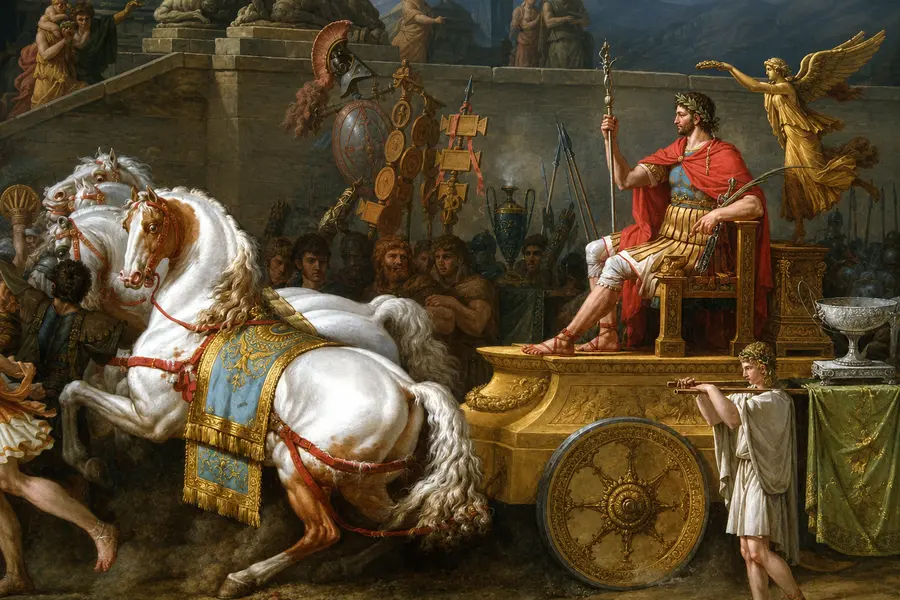
The Battle of Pydna, fought on 22 June 168 BC during the Third Macedonian War, was one of the most decisive battles in military history. On the plains near Pydna in northern Greece, the disciplined legions of the Roman Republic defeated King Perseus of Macedon and the formidable Macedonian phalanx. More than a victory over a rival kingdom, Pydna marked the end of Macedonian dominance that had begun under Philip II and Alexander the Great nearly two centuries earlier. It also demonstrated that battlefield flexibility, leadership, and adaptability could overcome even the most intimidating infantry formation ever created. The battle reshaped the balance of power in the Mediterranean, established Rome as the dominant force in Greece, and influenced military thinking for centuries.
Table of Contents
- Battle Overview
- Background to the Third Macedonian War
- Prelude to the Battle of Pydna
- Opposing Armies
- Why the Macedonian Phalanx Was So Strong
- Why the Roman Legion Was Superior in Flexibility
- How the Battle of Pydna Unfolded
- Why Rome Won the Battle of Pydna
- Could the Macedonian Phalanx Have Won?
- Roman Legion vs Macedonian Phalanx
- Significance of the Roman Victory
- Legacy of the Battle
- References
Battle Overview
| Aspect | Details |
|---|---|
| Date | 22 June 168 BC |
| War | Third Macedonian War |
| Location | Near Pydna, Macedon (modern northern Greece) |
| Roman Commander | Lucius Aemilius Paullus Macedonicus |
| Macedonian Commander | King Perseus of Macedon |
| Estimated Roman Strength | Approximately 38,000 men |
| Estimated Macedonian Strength | Approximately 40,000-44,000 men |
| Result | Decisive Roman victory |
| Historical Importance | Ended Macedonian military supremacy and confirmed Rome as the dominant Mediterranean power. |
The Battle of Pydna is frequently regarded as the clearest demonstration of why the Roman legion eventually replaced the Macedonian phalanx as the dominant infantry system of the ancient world. While the phalanx remained devastating on level ground, the battle revealed its dependence on maintaining perfect formation. Once that cohesion was lost, Roman legionaries exploited every weakness with remarkable efficiency.
Background to the Third Macedonian War
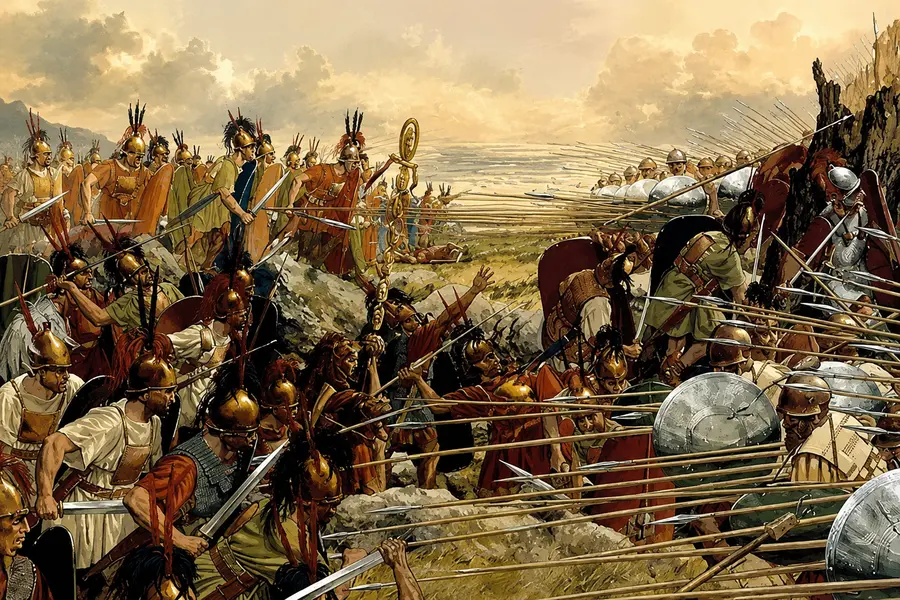
Following the death of Alexander the Great in 323 BC, his empire fragmented into several successor kingdoms. Although the empire itself dissolved, the Kingdom of Macedon remained one of the strongest military powers in Greece. Under Philip II and Alexander, the Macedonian army had conquered much of the known world using innovative combined-arms tactics centered around the famous sarissa phalanx. Over the following century, however, a new power steadily emerged in the west. The Roman Republic defeated Carthage during the Punic Wars, expanded across Italy, and increasingly intervened in Greek affairs. Rome's victories over Hellenistic kingdoms gradually shifted the balance of power toward the Republic.
King Perseus, who ascended the Macedonian throne in 179 BC, inherited a kingdom determined to restore its prestige after earlier defeats by Rome. An able administrator and capable commander, Perseus rebuilt Macedon's finances, strengthened its defenses, and cultivated alliances across Greece and the Balkans. His growing influence alarmed the Roman Senate, which viewed any resurgence of Macedonian power as a threat to its expanding sphere of influence. Diplomatic tensions eventually escalated into the Third Macedonian War (171-168 BC)-initially, the campaign frustrated Roman commanders. Perseus avoided decisive engagements, relied on favorable terrain, and won several limited successes that prolonged the conflict. Yet despite these tactical achievements, he failed to capitalize on Roman setbacks or build a broad anti-Roman coalition.
Recognizing the need for stronger leadership, Rome appointed the experienced general Lucius Aemilius Paullus in 168 BC. Unlike several of his predecessors, Paullus combined patience with battlefield discipline. Rather than rushing into battle, he reorganized his army, improved supply lines, and maneuvered carefully until he could engage Perseus under favorable conditions. The appointment of Paullus reflected Rome's growing military professionalism. The Republic increasingly relied on commanders capable of adapting to complex operational challenges rather than seeking quick victories. This flexibility became one of Rome's defining strengths and is explored further in our guide to the organization and evolution of the Roman legion.
Prelude to the Battle of Pydna
During the spring of 168 BC, both armies maneuvered through the rugged terrain of northern Greece. Perseus occupied a strong defensive position near the Elpeus River, where mountains protected one flank while natural obstacles restricted Roman movement. A frontal assault would have been extremely costly. Paullus instead employed a strategy of maneuver rather than direct confrontation. A Roman detachment secretly crossed difficult mountain passes and threatened the Macedonian rear. Ancient historian Livy records that this movement forced Perseus to abandon his carefully prepared defensive line and withdraw toward the plains near Pydna.
The withdrawal deprived Perseus of one of his greatest advantages. The new battlefield offered broad, relatively open terrain that initially favored the Macedonian phalanx but also provided sufficient space for Roman tactical maneuver if the formation became disrupted. According to Plutarch, the battle itself began after what may have been a minor skirmish involving a runaway pack animal or cavalry patrol near a stream separating the two armies. Although ancient accounts differ on the precise trigger, both armies soon committed their full strength.
Before the main engagement, soldiers on both sides spent days preparing equipment, constructing fortified camps, and maintaining discipline. Roman military success depended not only on battlefield tactics but also on meticulous organization, a characteristic discussed in our article on Roman military camps. Daily training, logistical planning, and high morale gave Roman armies remarkable resilience during prolonged campaigns. For the Macedonians, confidence remained high. Their army still possessed one of history's most feared infantry formations. Many believed the enormous hedge of spear points would once again prove unstoppable.
Opposing Armies
| Roman Republic | Kingdom of Macedon |
|---|---|
| Flexible manipular legion | Sarissa phalanx |
| Heavy legionary infantry | Pezhetairoi (phalangites) |
| Italian allied infantry | Thracian infantry |
| Cavalry contingents | Companion-style cavalry |
| Light infantry and velites | Peltasts and mercenaries |
| Experienced command under Paullus | King Perseus commanding personally |
Numerically, the armies were relatively evenly matched. The decisive difference lay not in their size but in how each army fought. Macedon relied on disciplined cohesion and overwhelming frontal power, whereas Rome emphasized flexibility, initiative, and cooperation between different combat arms. The Roman soldiers themselves were seasoned veterans accustomed to long campaigns. Combined with strong morale and unit cohesion, these factors allowed legionaries to remain effective even when battles became chaotic.
Why the Macedonian Phalanx Was So Strong
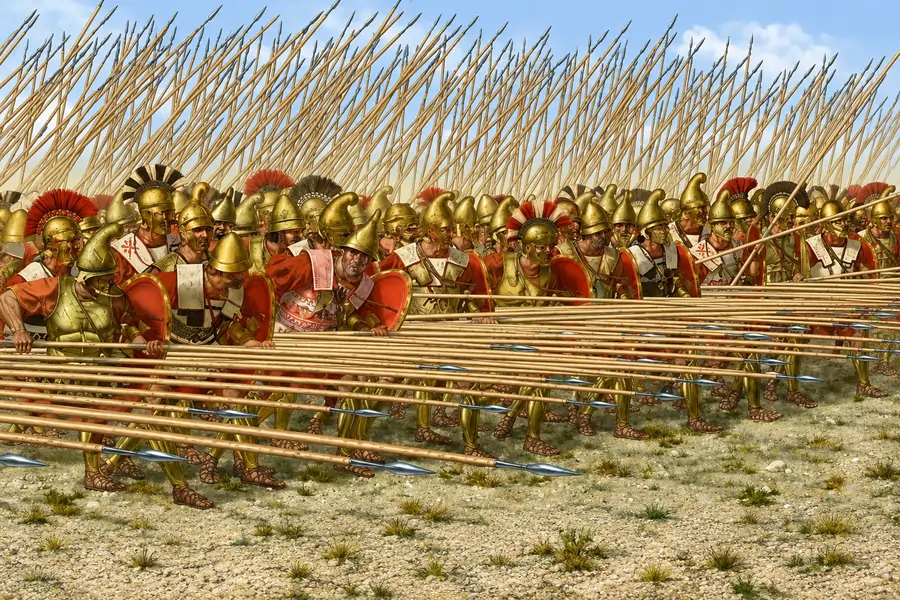
The Macedonian phalanx was arguably the most formidable infantry formation of the Hellenistic Age. Developed by Philip II and perfected during Alexander the Great's campaigns, it dominated battlefields for nearly two centuries. Against opponents who met it head-on across level ground, few formations could withstand its relentless advance.
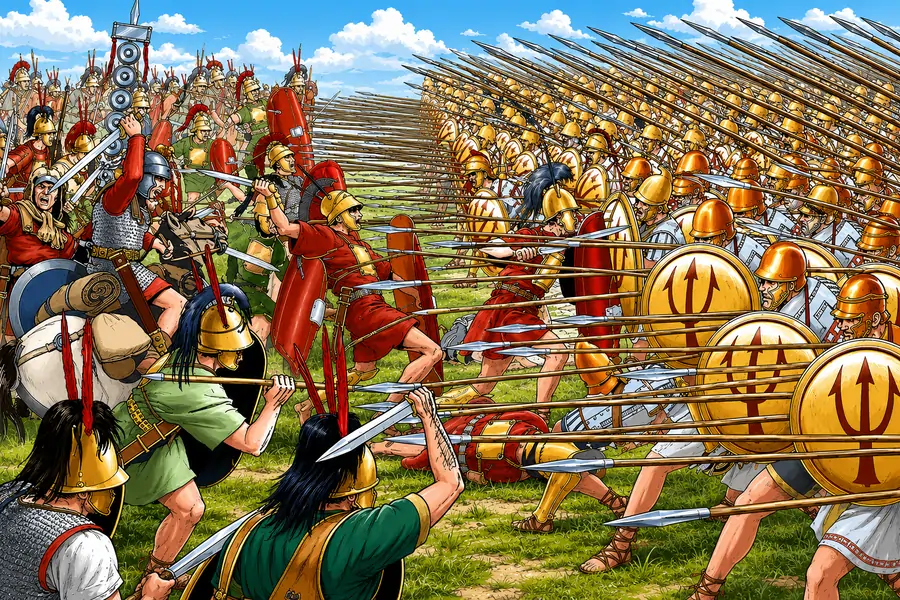
The defining feature of the phalanx was the sarissa, a pike measuring roughly 5 to 6 meters (16-20 feet). Each soldier held the weapon with both hands, allowing several ranks of spear points to project ahead of the front line. An enemy attempting a frontal attack had to penetrate multiple layers of spearheads before reaching the soldiers themselves. Several characteristics made the formation exceptionally powerful:
- Extraordinary reach. The sarissa allowed Macedonian infantry to strike opponents long before shorter swords or spears could be used.
- Mutual protection. Closely packed ranks created overlapping spear coverage that shielded neighboring soldiers.
- Psychological impact. Advancing toward a forest of spear points intimidated many enemy formations before physical contact even occurred.
- Immense pushing power. Thousands of heavily drilled soldiers advancing together generated enormous momentum capable of breaking less organized infantry.
When operating on open, level terrain with secure flanks, the phalanx could appear almost unstoppable. Ancient historians repeatedly describe opposing soldiers struggling to approach its bristling wall of pikes. Its success, however, depended on maintaining perfect alignment. Every soldier had to move in step while preserving precise spacing. Even relatively small gaps could reduce the effectiveness of the entire formation.
Why the Roman Legion Was Superior in Flexibility
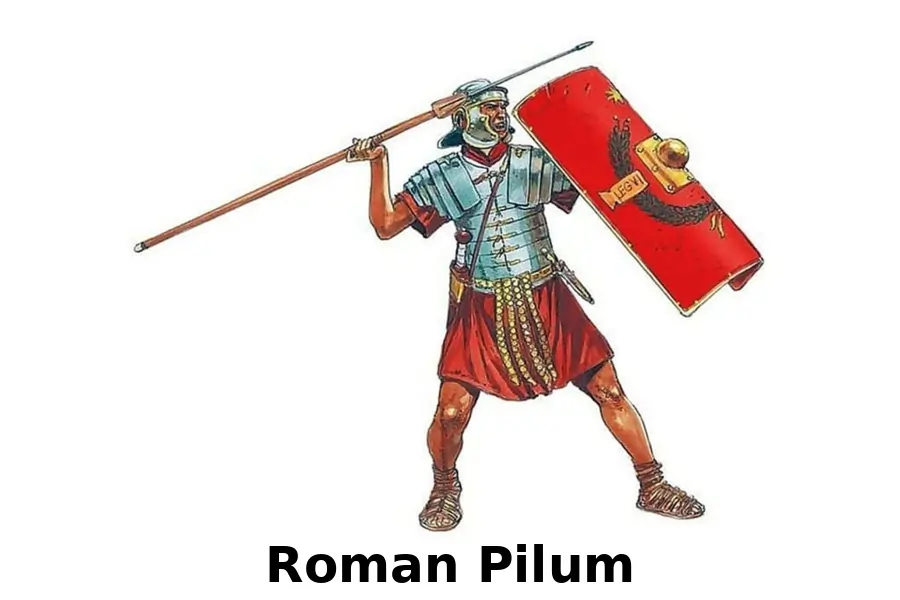
Although the Macedonian phalanx possessed unmatched frontal power, the Roman legion represented a fundamentally different military philosophy. Rather than relying on one massive formation, Roman commanders employed smaller tactical units capable of adapting to changing battlefield conditions. By the second century BC, the Roman manipular legion had evolved into a highly flexible fighting force. Soldiers were organized into independent maniples that could advance, withdraw, reinforce neighboring units, or exploit openings without requiring the entire army to maintain rigid alignment. Each legionary carried equipment designed for close combat. Protected by the large scutum shield, armed with the gladius, and supported by heavy javelins (pila), Roman infantry excelled once fighting became fragmented.
Unlike the phalanx, Roman soldiers were trained to make individual decisions while remaining disciplined within their units. This adaptability reflected a broader military culture that valued initiative, engineering, and battlefield experience. Roman commanders also understood the importance of morale and resilience, themes explored in our article on the mindset and morale of ancient soldiers. Ironically, the strengths of both armies would soon collide at Pydna. The phalanx would initially demonstrate exactly why it had dominated ancient battlefields for generations. Yet the same qualities that made it nearly invincible under ideal conditions would ultimately contribute to its downfall.
How the Battle of Pydna Unfolded
The armies met on the afternoon of 22 June 168 BC on a broad plain near Pydna, bordered by low hills and crossed by uneven ground and shallow streambeds. The terrain appeared favorable for the Macedonian phalanx, and King Perseus believed this was the ideal place to bring the Romans to battle.
Lucius Aemilius Paullus, however, understood the strengths of his opponent. Rather than rushing into an attack, he carefully observed the Macedonian deployment and waited for the right opportunity. Ancient historian Plutarch records that Paullus recognized the immense danger of confronting the phalanx head-on while it remained perfectly ordered.
The Macedonian Advance
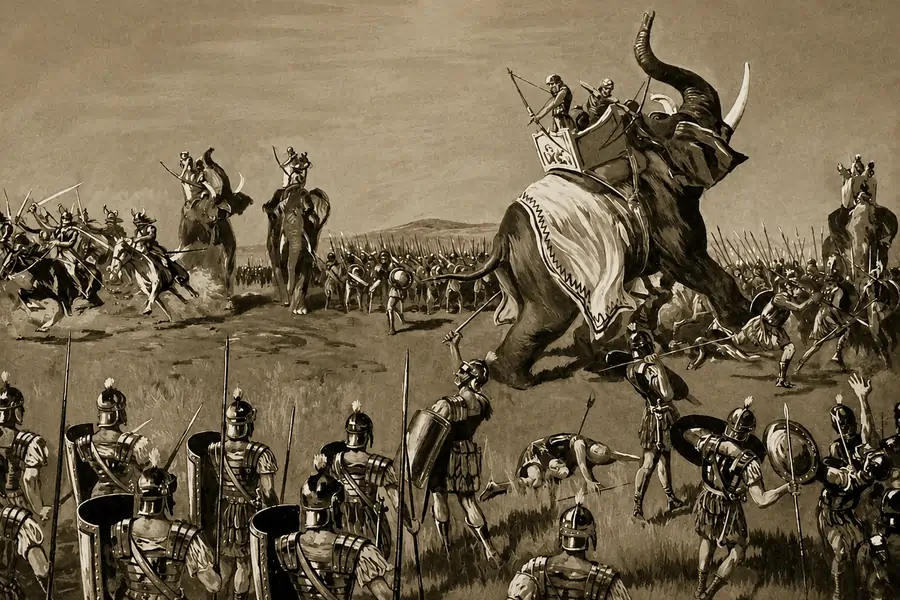
The battle opened with skirmishing between light infantry before the Macedonian main line began its advance. Thousands of phalangites lowered their enormous sarissas simultaneously, creating a seemingly impenetrable wall of spear points stretching across the battlefield. As the formation gathered momentum, it became one of the most intimidating sights in ancient warfare. The tightly packed soldiers advanced shoulder to shoulder, with the first five ranks projecting their pikes forward. Roman soldiers faced dozens of spearheads before they could even reach the enemy line.
Livy describes the Roman front ranks struggling to penetrate the forest of pikes, while Plutarch notes that even experienced legionaries hesitated before such a disciplined advance. Initially, the Macedonian attack achieved exactly what Philip II had intended when he created the phalanx nearly two centuries earlier. The Roman infantry was steadily pushed back, unable to close the distance at which their swords could be used effectively.
The Roman Line Gives Ground
Rather than ordering a reckless counterattack, Paullus instructed his soldiers to yield ground while maintaining discipline. This controlled withdrawal prevented panic and bought valuable time. The Roman commander realized that forcing the legionaries into a frontal contest against intact sarissas would almost certainly end in disaster. Instead, he trusted that the battlefield itself would eventually undermine the cohesion of the Macedonian formation.
As the phalanx continued advancing, its rigid ranks began moving away from the smooth plain and onto increasingly broken ground. Small ridges, rocky patches, and shallow depressions forced individual files to adjust their pace independently. These seemingly insignificant obstacles would prove decisive.
The Terrain Breaks the Phalanx
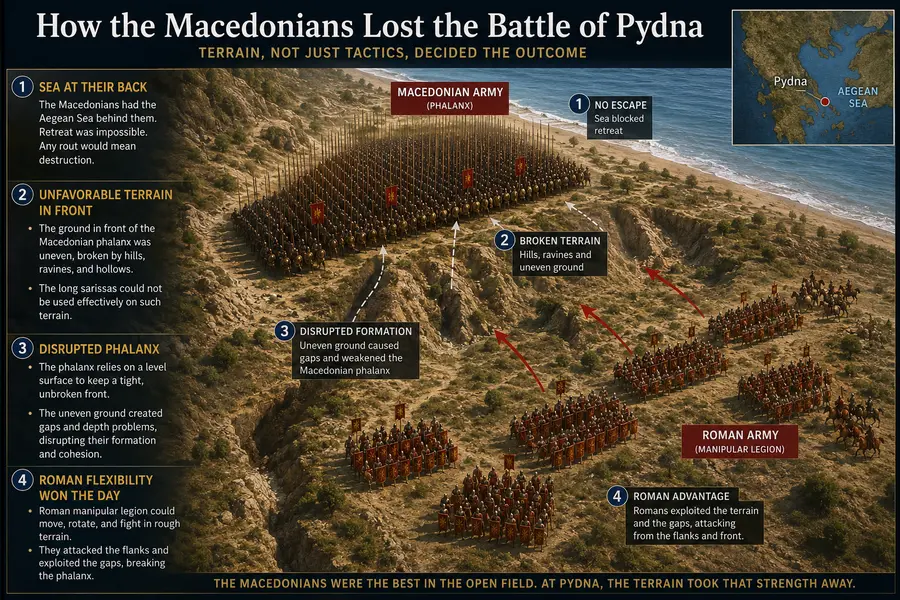
The effectiveness of the Macedonian phalanx depended entirely on maintaining perfect alignment. Every soldier needed to remain shoulder to shoulder with his neighbors while keeping the sarissa pointed in exactly the right direction. Uneven ground made this impossible.
As some sections slowed while others continued advancing, gaps gradually appeared between individual units. Files became uneven, intervals widened, and portions of the once-solid wall of pikes lost contact with neighboring formations.
Polybius, writing only decades after the battle, observed that a phalanx remained virtually invincible while maintaining cohesion but became highly vulnerable once its formation was disrupted. What had begun as tiny separations rapidly expanded into exploitable openings. Soldiers carrying six-meter pikes suddenly found themselves unable to support neighboring units effectively. The greatest strength of the phalanx had become its greatest weakness.
Paullus Seizes the Opportunity
Aemilius Paullus immediately recognized the developing situation. Instead of ordering a general assault, he instructed nearby maniples to attack wherever openings appeared. Roman commanders did not attempt to break the phalanx by brute force. Instead, they divided it into smaller engagements where its advantages disappeared.
The manipular legion was perfectly suited for this kind of fighting. Individual units could maneuver independently without disrupting the rest of the army. As gaps widened, legionaries surged through them and attacked the exposed flanks of isolated phalanx blocks. This decentralized initiative demonstrated one of the defining strengths of the Roman military system. Junior officers could react quickly to local opportunities without waiting for orders affecting the entire battle line.
Close Combat Favors the Romans
Once Roman soldiers penetrated the formation, the character of the battle changed completely. The sarissa was an extraordinary weapon in frontal combat, but it became almost useless at close quarters. Measuring over five meters in length and held with both hands, it could not easily be shortened, turned, or wielded inside tightly compressed fighting. Roman legionaries, by contrast, excelled in exactly these conditions. Protected by the large scutum shield, they closed rapidly with individual phalangites before drawing their short gladius. Designed specifically for stabbing in confined spaces, the sword allowed Roman infantry to strike around shields and into lightly protected areas.
Many Macedonian soldiers, still holding their enormous pikes, struggled even to draw secondary weapons before Roman legionaries reached them. Instead of confronting an organized wall of spear points, the Romans now fought hundreds of isolated skirmishes against infantry unable to support one another. This dramatic reversal illustrates why tactical flexibility increasingly became more valuable than sheer frontal power during the Hellenistic period.
The Collapse of the Macedonian Center
As more Roman maniples poured into the widening gaps, the cohesion of the Macedonian center rapidly deteriorated. Individual phalanx formations attempted to realign, but the confusion of battle made coordinated movement nearly impossible. Soldiers in the rear often could not see what was happening at the front, while those on the flanks found themselves attacked from unexpected directions. The dense formation that had initially advanced with remarkable discipline now prevented effective maneuver.
Roman infantry exploited every weakness. Instead of attacking where the phalanx remained strongest, they continued targeting isolated sections until the Macedonian line fragmented into disconnected pockets of resistance. The transformation was astonishingly rapid. Within a relatively short period, one of history's most feared military formations had lost the very cohesion upon which its effectiveness depended.
The Limited Role of the Macedonian Cavalry
King Perseus possessed a capable cavalry force, including elite mounted nobles. Many historians have questioned why these troops played such a limited role during the decisive stages of the battle. Ancient sources suggest that Perseus either hesitated or found no suitable opportunity to launch a coordinated cavalry attack while his infantry struggled.
Some later writers even accused the king of abandoning the battlefield too early, although modern historians debate whether these accounts reflect political bias after the Roman victory. Whatever the precise circumstances, the Macedonian cavalry failed to relieve the collapsing infantry. Without effective support, isolated phalanx units faced overwhelming pressure from increasingly confident Roman legionaries.
The Macedonian Army Breaks
As the center collapsed, panic spread across the Macedonian ranks. Some formations attempted an orderly withdrawal, while others disintegrated entirely. Roman infantry maintained relentless pressure, preventing the surviving phalangites from reforming into a coherent defensive line. The pursuit continued until organized resistance effectively ceased.
According to ancient estimates, approximately 20,000 Macedonian soldiers were killed and around 11,000 captured, while Roman losses were remarkably light by comparison, generally estimated at fewer than one thousand men. Although ancient casualty figures should always be treated cautiously, there is little doubt that the battle ended in a catastrophic defeat for Macedon.
Why Rome Won the Battle of Pydna
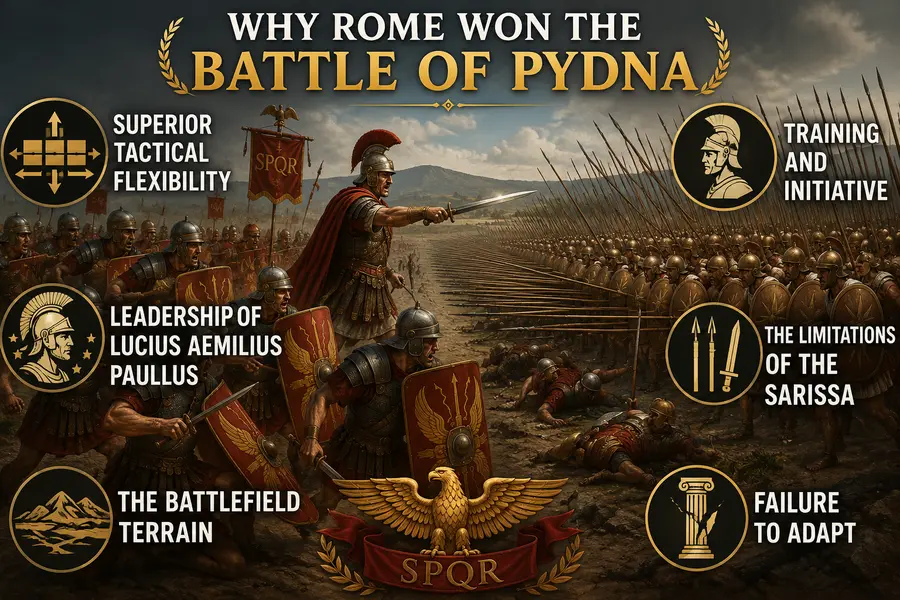
The Roman victory cannot be explained by a single moment or tactical decision. Instead, several interconnected factors combined to transform an initially dangerous situation into one of the Republic's greatest battlefield successes.
Superior Tactical Flexibility
The most important advantage possessed by the Roman army was its flexibility. The manipular legion was specifically designed to adapt to changing battlefield conditions. Independent units could maneuver around obstacles, reinforce threatened sectors, or exploit unexpected opportunities without disrupting the entire battle line. The Macedonian phalanx, by contrast, functioned as a single integrated system. When one section lost alignment, neighboring units also became vulnerable. This dependence on cohesion meant that local disruptions quickly affected the effectiveness of the entire formation.
Leadership of Lucius Aemilius Paullus
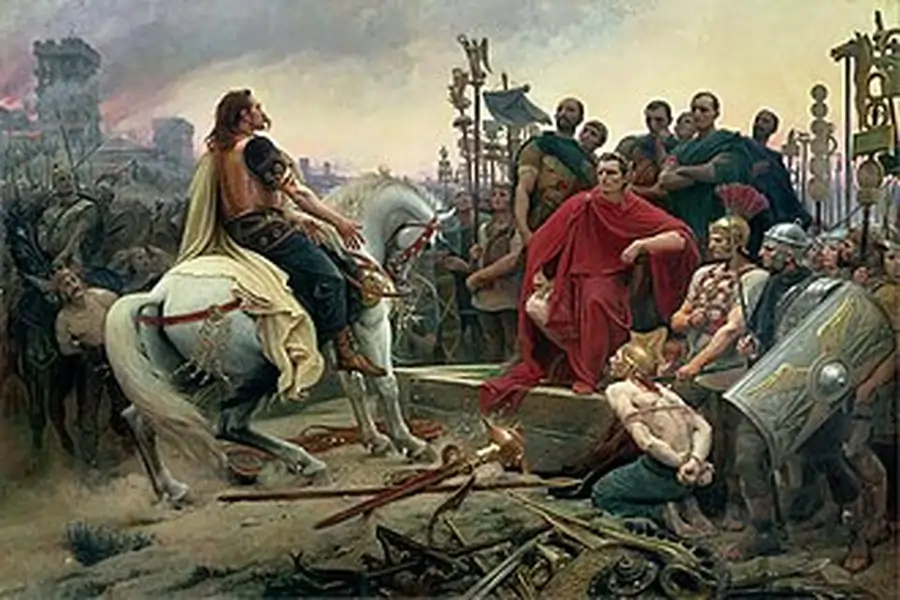
Paullus displayed exceptional battlefield judgment. Rather than challenging the phalanx under ideal conditions, he exercised patience until terrain created opportunities. Once gaps appeared, he reacted immediately, allowing subordinate commanders sufficient freedom to exploit them. His willingness to adapt contrasted sharply with commanders who relied on rigid battle plans. Throughout Roman history, successful generals repeatedly demonstrated the importance of flexibility, a quality later seen in leaders such as Julius Caesar during campaigns like the Battle of Alesia.
The Battlefield Terrain
Terrain played a far greater role than numerical strength. Although the battlefield initially appeared suitable for the phalanx, even modest irregularities proved sufficient to disrupt its precise alignment. Once cohesion was lost, the advantages of long pikes disappeared almost immediately. The Romans did not defeat the phalanx by overpowering it directly. Instead, they used the battlefield itself as a force multiplier.
Training and Initiative
Roman soldiers operated within a military system that encouraged discipline alongside individual initiative. Legionaries were accustomed to adapting quickly during battle, while experienced centurions maintained local control even amid confusion. Their confidence came from rigorous training, extensive campaigning, and strong unit cohesion. This professionalism allowed Roman forces to react faster than the more rigid Macedonian formations once the battle became fragmented.
The Limitations of the Sarissa
The sarissa remained one of antiquity's most effective battlefield weapons, but only under specific conditions. Its extraordinary length made frontal assaults extremely dangerous. However, once enemies reached close quarters or attacked from the sides, its size became a liability. Phalangites often lacked sufficient space to reposition their pikes or transition quickly to secondary weapons. The Roman combination of the scutum, pilum, and gladius proved far more versatile during chaotic fighting.
Failure to Adapt
Perhaps the greatest strategic lesson of Pydna is that military systems must evolve. The Macedonian army continued relying upon a tactical doctrine developed under Philip II nearly two centuries earlier. Although still formidable, it had changed relatively little while Roman military organization steadily evolved through continuous campaigning against a wide variety of opponents. Pydna demonstrated that adaptability could outweigh even the most celebrated battlefield tradition.
Could the Macedonian Phalanx Have Won?
Although the Battle of Pydna is often portrayed as proof that the Roman legion was inherently superior, the outcome was not inevitable. Under different circumstances, the Macedonian phalanx could have posed a far greater challenge and may even have won the battle.
The phalanx was at its strongest on broad, level ground where it could maintain perfect alignment and present an unbroken wall of sarissas. Had King Perseus remained in his original defensive position near the Elpeus River or fought on terrain that preserved the formation's cohesion, the Romans would have faced a much more difficult task. More aggressive use of the Macedonian cavalry to protect the flanks or exploit Roman disorder might also have changed the course of the battle.
Ultimately, Pydna was not simply a contest between two infantry systems but a demonstration of how terrain, leadership, and adaptability influence battlefield success. Once uneven ground disrupted the phalanx, its greatest strengths became liabilities, allowing the flexible Roman maniples to penetrate the gaps and fight on terms that favored them.
Roman Legion vs Macedonian Phalanx
| Category | Roman Legion | Macedonian Phalanx |
|---|---|---|
| Primary Weapon | Gladius, pilum, scutum | Sarissa (5-6 meter pike) |
| Formation | Flexible maniples | Densely packed pike blocks |
| Mobility | Excellent | Limited |
| Performance on Uneven Ground | Highly effective | Formation easily disrupted |
| Close Combat | Exceptional | Relatively weak |
| Command Structure | Decentralized initiative | Dependent on maintaining cohesion |
| Primary Strength | Adaptability and versatility | Overwhelming frontal power |
| Primary Weakness | Can struggle against intact pike walls frontally | Vulnerable once gaps appear |
Significance of the Battle of Pydna
The Battle of Pydna fundamentally changed the balance of power in the ancient Mediterranean. The decisive Roman victory ended the Third Macedonian War and destroyed Macedon's ability to challenge Roman influence in Greece. King Perseus was captured after the battle, bringing the Antigonid dynasty to an end. Following the victory, the Roman Senate divided Macedon into four separate republics to prevent it from becoming a military threat again. In 148 BC, after suppressing a final uprising, Rome annexed Macedon as a province, cementing its control over the region.
Pydna also marked the end of the Macedonian phalanx as the dominant infantry formation of the Hellenistic world. Although pike formations continued to be used by some successor states, they never again played the decisive role they had under Philip II and Alexander the Great. By removing its strongest rival in Greece, Rome was free to expand its influence throughout the eastern Mediterranean. The victory paved the way for later Roman interventions against the Seleucid Empire, Pontus, and eventually Ptolemaic Egypt.
Legacy of the Battle of Pydna
The Battle of Pydna is remembered as one of history's clearest demonstrations of the importance of tactical flexibility. While the Macedonian phalanx remained exceptionally powerful in ideal conditions, the battle showed that it was vulnerable on uneven terrain and against an adaptable opponent. For military historians, Pydna represents the transition from the dominance of the Hellenistic pike phalanx to the rise of the Roman legion. The battle validated Rome's emphasis on flexible formations, disciplined infantry, and decentralized command, principles that contributed to centuries of Roman military success.
Today, Pydna remains a landmark battle in the study of ancient warfare. It is frequently cited as the engagement that confirmed Rome as the leading military power of the Mediterranean and demonstrated that adaptability could overcome even the most formidable battlefield formation.
References
Ancient Sources
- Livy. Ab Urbe Condita, Books XXI-XXIII.
- Plutarch. Life of Aemilius Paulus
- Polybius - Histories
Modern Scholarship
- Goldsworthy, Adrian. The Complete Roman Army. Thames & Hudson, 2003.
- Goldsworthy, Adrian. The Fall of Carthage. Yale University Press, 2006.
- Lazenby, J. F. The Spartan Army. Aris & Phillips, 1985.
- Sabin, Philip, van Wees, Hans & Whitby, Michael (Editors). The Cambridge History of Greek and Roman Warfare, Volume I. Cambridge University Press, 2007.
- Worthington, Ian. By the Spear: Philip II, Alexander the Great, and the Rise and Fall of the Macedonian Empire. Oxford University Press, 2014.
- Sekunda, Nicholas. The Macedonian Army 359-323 BC. Osprey Publishing.
Recommended Books
This article may contain affiliate links. If you purchase through these links, I may earn a small commission at no extra cost to you.


Related Articles
Frequently Asked Questions
Why did the Macedonian phalanx fail at the Battle of Pydna?
The Macedonian phalanx failed at the Battle of Pydna because uneven terrain disrupted its tightly packed formation. As gaps appeared between units, Roman legionaries exploited these openings and attacked the phalangites at close range, where the long sarissa pikes became difficult to use effectively.
How did the terrain affect the Battle of Pydna?
The terrain played a decisive role in the Battle of Pydna. Although the battlefield initially favored the Macedonian phalanx, rough and uneven ground caused parts of the formation to lose alignment during the advance. This allowed the more flexible Roman maniples to move into the gaps and break the phalanx apart.
Why was the Roman legion more flexible than the Macedonian phalanx?
The Roman legion was organized into smaller tactical units called maniples that could maneuver independently during battle. Unlike the Macedonian phalanx, which depended on maintaining a continuous line, Roman legionaries could adapt to changing terrain, reinforce weak points, and exploit enemy mistakes without disrupting the rest of the army.
What happened to King Perseus after the Battle of Pydna?
After his defeat at the Battle of Pydna, King Perseus surrendered to the Romans. He was taken prisoner by Lucius Aemilius Paullus and later displayed during the general's triumph in Rome. His capture marked the end of the Antigonid dynasty's rule over Macedon.
How did the Battle of Pydna change Roman expansion?
The Battle of Pydna removed Macedon as Rome's strongest rival in Greece and gave the Roman Republic greater influence over the eastern Mediterranean. Within two decades, Macedon became a Roman province, allowing Rome to expand further into the Hellenistic world.
Is the Battle of Pydna still studied in military history?
Yes. The Battle of Pydna is widely studied because it demonstrates how battlefield flexibility, leadership, and terrain can determine the outcome of a battle. Military historians often cite it as a classic example of an adaptable army defeating a stronger but more rigid battlefield formation.
Add Comment