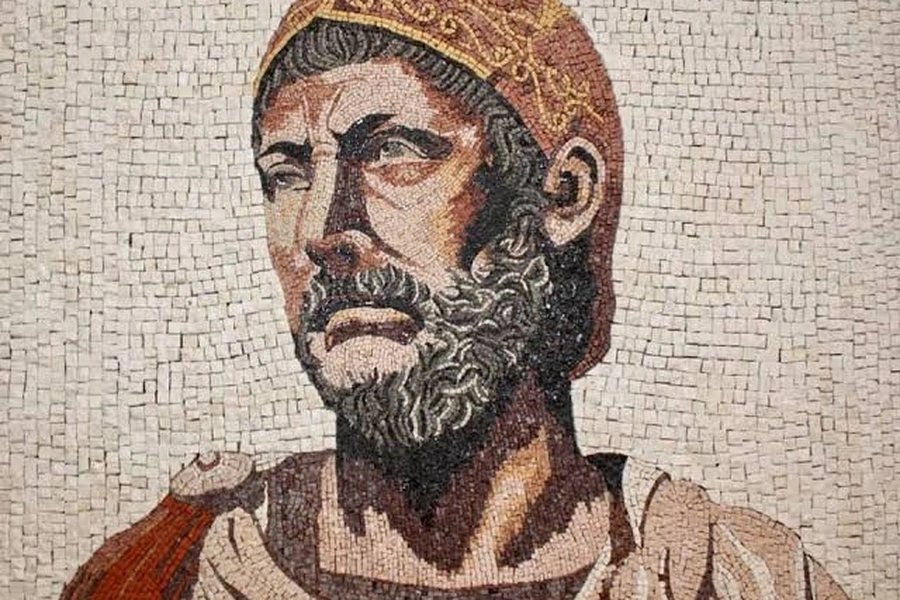
Hannibal Barca did not need to defeat every Roman soldier to win a war against Rome. He needed to make Roman commanders hesitate, make Rome's allies question their loyalty, make soldiers fear the consequences of defeat, and make political opponents suspicious of one another. From releasing Italian prisoners with a message of liberation, to sparing Fabius's property, deceiving Roman troops with fire-bearing oxen, and, according to later ancient accounts, using venomous snakes at sea decades later, Hannibal repeatedly treated belief itself as a weapon. His psychological warfare was not a modern system of propaganda, but a remarkably sophisticated collection of deception, intimidation, persuasion, spectacle and manipulation.
Hannibal's reputation as one of history's greatest military commanders usually rests on his victories over Rome. Yet the more revealing question is not simply how Hannibal defeated Roman armies, but how Hannibal tried to influence what Romans, Italians and his own soldiers believed. His greatest psychological weapon was often uncertainty. Making an enemy unsure of what he was seeing, whom he could trust, what Hannibal intended, or even whether Rome was worth fighting for.
Table of Contents
- What Was Hannibal's Psychological Warfare?
- Hannibal and the "Freedom of Italy"
- Turning Gallic Resentment Into a Weapon
- The Prisoners Hannibal Turned Into a Psychological Spectacle
- How Hannibal Tried to Make Fabius Look Like a Traitor
- Exploiting the Roman Commander's Personality
- Fear, Uncertainty and the Trap at Lake Trasimene
- The Oxen Trick at Ager Falernus
- Tarentum: When Invasion Was Presented as Liberation
- Hannibal's Psychological Control Over His Own Army
- Zama and the Psychology of Hannibal's Veterans
- Hannibal's Final Psychological Trick: Venomous Snakes
- Why Hannibal's Psychological Warfare Ultimately Failed
- What Made Hannibal's Psychological Warfare So Effective?
- References and Sources
What Was Hannibal's Psychological Warfare?
There was no ancient military manual called "psychological warfare" in the modern sense. Hannibal was not working with concepts such as cognitive bias, information operations, or behavioral science. Nevertheless, many of his actions fit what we would now recognize as psychological warfare by deliberately influencing an opponent's perceptions, emotions, confidence, decisions, and relationships. This distinction matters because Hannibal's deception was rarely an isolated trick. Releasing prisoners communicated that Rome's Italian allies had little reason to fear him. Sparing Fabius's property created suspicion around the Roman commander. The oxen deception exploited uncertainty at exactly the moment when Roman troops needed to know where Hannibal was. At Tarentum, local conspirators used the language of liberty to make a Carthaginian takeover appear to be an act of liberation.
| Psychological method | Hannibal's example | Intended effect |
|---|---|---|
| Propaganda | "Freedom of Italy" | Separate Rome from its Italian allies |
| Political messaging | Treatment of Italian prisoners | Present Hannibal as an opponent of Rome rather than an enemy of Italy |
| Deception | Burning oxen at Ager Falernus | Create hesitation and confusion |
| Political manipulation | Sparing Fabius's estate | Make Romans suspect their own commander |
| Morale manipulation | Gladiatorial spectacle | Show soldiers the consequences of defeat |
| Fear and surprise | Venomous snakes at sea | Disrupt an enemy's ability and willingness to fight |
Hannibal and the "Freedom of Italy"
Perhaps Hannibal's most ambitious psychological campaign was political rather than military. He understood a fundamental weakness in Rome's position. Rome's armies were Roman, but Rome's power depended heavily on an extensive network of Italian allies. Hannibal therefore tried to redefine the Second Punic War. Instead of presenting it simply as Carthage versus Rome, he wanted Italian communities to see it as a struggle between Rome and the peoples it had subjected. Polybius gives unusually clear evidence for this strategy. After taking Roman prisoners, Hannibal treated Rome's Italian allies differently. He told them that he had not come to fight the Italians but to fight Rome on their behalf. He claimed that he had come to restore the freedom of Italy and help communities recover territory they had lost to Roman power. The allied prisoners were then released without ransom.
This was political messaging with a practical military purpose. Every released prisoner could return home carrying Hannibal's message. Hannibal did not need to convince every Italian that Carthage was benevolent. He only needed enough communities to conclude that Rome might no longer be able to protect them and that supporting Hannibal might be advantageous. This helps explain why the political consequences of Hannibal's early victories mattered so much. His success was supposed to create a psychological chain reaction. Defeat Roman armies, undermine confidence in Roman protection, encourage defections, and then use those defections to make Rome appear weaker still.
It was a dangerous strategy for Rome because military defeat and political defection could reinforce each other. The more allies Rome lost, the more vulnerable it appeared. The more vulnerable it appeared, the more attractive Hannibal's offer could become. Yet this strategy also demonstrates the limits of Hannibal's psychological warfare. Rome's alliance network did not collapse. Some communities defected, especially in southern Italy, but many of Rome's allies remained loyal. Hannibal could create doubt, but he could not manufacture a universal Italian rebellion.
Turning Gallic Resentment Into a Weapon
The Celts of Cisalpine Gaul already had serious grievances against Rome. Rome had expanded into northern Italy and fought repeated wars against Gallic communities. Hannibal did not create this resentment. He recognized it and converted it into strategic leverage. Polybius explicitly emphasizes that Hannibal had studied the peoples and geography of northern Italy before embarking on his invasion. Gallic hostility toward Rome was therefore not an unexpected bonus. It formed part of the political environment Hannibal hoped to exploit.
One particularly revealing incident occurred when Celtic soldiers serving alongside the Romans abandoned them and joined Hannibal. Hannibal rewarded them and sent them back toward their communities to describe what they had done and encourage others to ally with him. Polybius says Hannibal understood that their actions would make their fellow tribesmen more likely to join his cause. That is an early example of using people as psychological messengers. Hannibal was not merely gaining soldiers. He was creating witnesses who could carry a political narrative back into hostile territory.
Hannibal's approach to the Gallic tribes was not based on persuasion alone. Shortly after crossing the Alps into Italy in 218 BC, he approached the Taurini, a Celtic people hostile to his Gallic allies, and offered them an alliance. When they refused, Hannibal besieged their chief city and captured it after only three days. According to Polybius, he then massacred those who had resisted him, an act that struck terror into the neighboring tribes and prompted them to submit to his authority. The message was unmistakable. Hannibal could be a powerful ally to those who joined him, but resistance carried a terrifying price. By making an example of the Taurini, he transformed a single act of violence into a warning for every other tribe watching from the sidelines. The result was a brutal form of psychological warfare. Cooperation could now appear safer than defiance to neighboring tribes.
The Prisoners Hannibal Turned Into a Psychological Spectacle
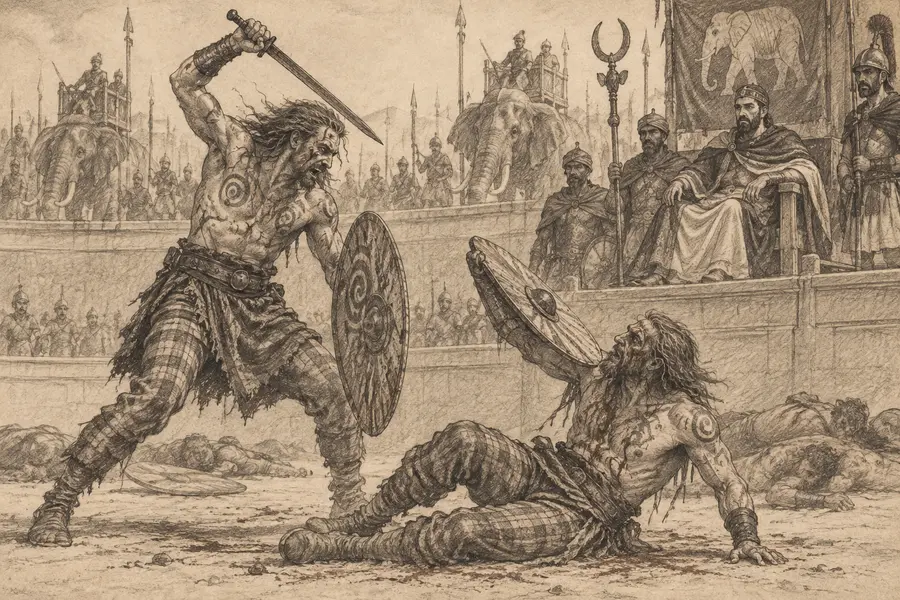
One of Hannibal's strangest acts of psychological warfare occurred before the Battle of Ticinus. It tells us a great deal about how he understood morale. Hannibal brought forward young Celtic prisoners whom he had captured during the difficult Alpine crossing. Polybius describes them as being in terrible physical condition, heavily chained and marked by previous mistreatment. Hannibal then displayed valuable armour, horses and military cloaks and offered the prisoners the opportunity to fight one another for these prizes, with death providing an escape from captivity for the loser.
All volunteered. Hannibal was not staging this spectacle simply for entertainment. He used the event to communicate a message to his own soldiers. Polybius says Hannibal explicitly told his army that the prisoners represented their own situation. They too faced a contest in which victory meant everything and defeat could mean death or captivity. The Carthaginians too had to fight Rome or face defeat.
Every soldier knew that defeat could mean death. But watching prisoners physically confront that choice turned the idea into something immediate and emotional. The soldiers were not hearing a lecture about courage. They were watching men who looked like them make a life-or-death decision. Hannibal then reframed their situation. His army was trapped in a similar struggle, but its possible reward was enormous. Victory over Rome and access to the wealth and power of the Roman world. This was motivational psychology through spectacle. Hannibal understood that soldiers could be moved by fear, ambition, pride, pity and identification simultaneously.
How Hannibal Tried to Make Fabius Look Like a Traitor
Hannibal's attempt to undermine Quintus Fabius Maximus is arguably his most sophisticated example of psychological warfare because the target was not a battlefield formation. It was trust. Fabius had adopted the strategy of avoiding a decisive engagement and instead wearing Hannibal down through delay, harassment, and the denial of easy opportunities. This approach became known as the Fabian Strategy. Hannibal recognized that defeating the strategy required more than defeating soldiers. He needed to make Romans question the commander who was implementing it.
While ravaging the countryside, Hannibal deliberately spared Fabius's property. Livy's summary preserves the striking point that Hannibal spared Fabius's farm while destroying the surrounding countryside specifically so that Fabius might be suspected of treason. Think about the psychological trap. If Fabius's land was destroyed like everyone else's, Hannibal gained nothing. But if Fabius's property remained untouched, people could begin asking questions:
- Why did Hannibal spare Fabius's land?
- Was Fabius secretly negotiating with him?
- Was the dictator deliberately allowing Hannibal to ravage Italy?
- Was the Fabian strategy actually a cover for betrayal?
Hannibal was trying to make Fabius's greatest strength, his patience, look like evidence of disloyalty. This is a remarkable example of psychological warfare because Hannibal did not need the accusation to be true. He only needed people to consider it plausible. Fabius understood the danger. The Roman commander eventually took steps to neutralize the political suspicion surrounding his property.
When the Senate refused to ransom the Roman prisoners held by Hannibal, Fabius sent his son to Rome to sell part of his estate and used the proceeds to redeem the men himself. After their release, several of the prisoners offered to repay him, but Fabius refused, effectively making the rescue a personal sacrifice for his countrymen rather than a political bargain. He also endured the growing accusations against him without abandoning his strategy, and before temporarily leaving command, repeatedly warned Minucius not to fight Hannibal recklessly.
Exploiting the Roman Commander's Personality
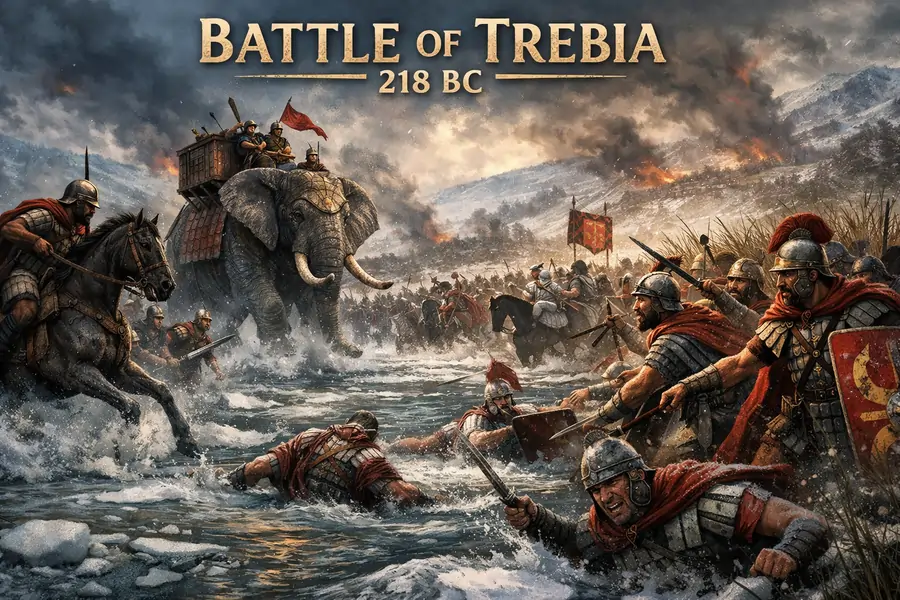
Hannibal's psychological warfare often depended on understanding the personality of the man commanding the opposing army. The Battle of Trebia provides a useful example. The important psychological point is not the tactical details of the battle but Hannibal's ability to exploit the Roman desire for an aggressive victory. Hannibal understood that a Roman commander eager to prove himself could be encouraged to act before conditions were ideal. Instead of simply forcing the Romans to attack, Hannibal created circumstances in which an attack could appear attractive.
This is one of the recurring features of his command style. Hannibal often preferred to let his opponent make the psychologically tempting decision himself. That distinction matters. A commander who orders an enemy to do something has limited control over the enemy. A commander who makes the enemy want to do something has much greater control. Hannibal's victories over Roman armies were therefore connected to his ability to read Roman commanders as individuals rather than treating the Roman army as a faceless machine. A similar dynamic can be seen at the Battle of Cannae, where Hannibal was prepared to exploit the aggressive Roman command approach when Varro assumed command.
Fear, Uncertainty and the Trap at Lake Trasimene
The Battle of Lake Trasimene is often remembered for its devastating ambush, but its psychological dimension deserves separate attention. Hannibal created a situation in which the Romans lacked a reliable understanding of where the danger actually lay. The landscape concealed the scale and position of his forces, while the Roman advance created a sense that Hannibal was retreating or moving away. The psychological effect of the trap was therefore uncertainty.
An army can tolerate danger when it understands the danger. Soldiers can prepare for an attack when they know where the enemy is coming from. But uncertainty is different. It forces individuals to make decisions with incomplete information. Hannibal repeatedly exploited this condition. His soldiers did not necessarily need the Romans to believe a completely false story. They only needed the Romans to misunderstand the situation for long enough.
The Oxen Trick at Ager Falernus
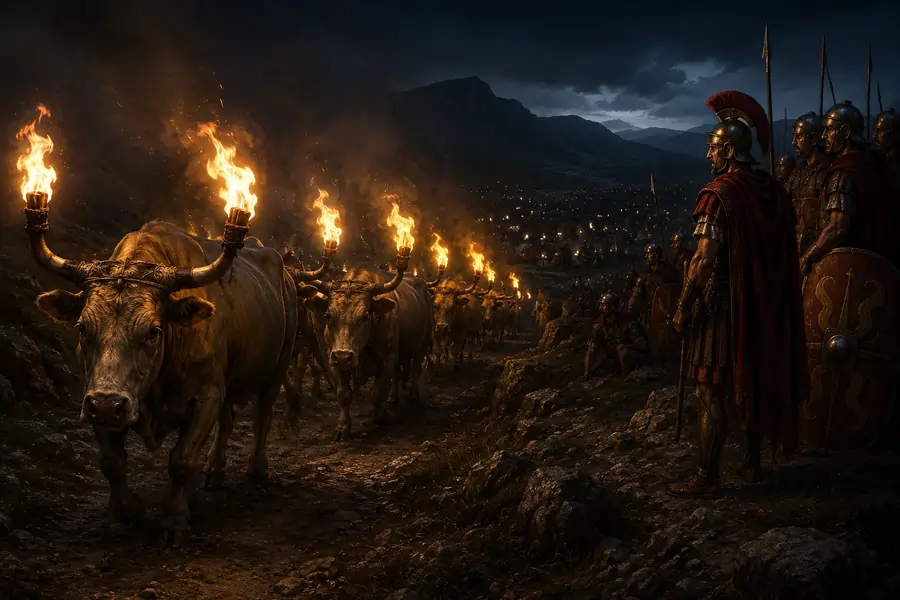
Hannibal's escape from Ager Falernus is one of the clearest examples of deception being used to create psychological paralysis. Fabius had effectively restricted Hannibal's movements. Hannibal needed to escape without fighting his way through the Roman position. According to Livy, he ordered burning material to be bound to the horns of oxen and drove the frightened animals toward the Roman positions at night. The frightened animals were then driven toward the Roman positions at night. The strange moving lights created confusion and helped Hannibal slip away through another route.
The trick is memorable because it sounds almost theatrical. But its psychological logic is extremely practical. Roman soldiers observing hundreds of moving lights in darkness could not immediately determine what they were seeing. Were these troops? Torches? An attack? A diversion? Hannibal exploited the natural human tendency to treat ambiguous information as threatening when the stakes are high.
He did not have to convince the Romans that an enormous army was approaching. He merely had to make them uncertain enough that they could not react effectively. The incident is also a reminder that ancient psychological warfare did not always require elaborate speeches or political propaganda. Sometimes a commander could manipulate the enemy simply by controlling what the enemy could see. A detailed account of the episode can be found in How Hannibal Escaped Ager Falernus.
Tarentum: When Invasion Was Presented as Liberation
Hannibal's political messaging became particularly sophisticated at Tarentum. When Carthaginian forces entered the city, local conspirators moved among the population telling people not to be afraid and speaking loudly about liberty. Polybius says they presented the Carthaginians as having come to save the Tarentines. An invading army normally creates fear because people ask:
"What are these soldiers going to do to us?"
Hannibal's supporters wanted the question to become:
"What can these soldiers free us from?"
The physical presence of the Carthaginian army had not changed. The narrative surrounding it had. This is precisely why Hannibal's language of Italian freedom deserves to be treated as more than propaganda. It was an attempt to reshape the psychological identity of the war. Rome wanted its subjects and allies to see Carthage as an external invader. Hannibal wanted them to see Rome as the oppressor and Carthage as the opportunity. That battle over interpretation was just as important as the fighting itself.
Hannibal's Psychological Control Over His Own Army
Psychological warfare was not directed only at Rome. Hannibal commanded one of the most ethnically diverse armies of the ancient Mediterranean. His soldiers included Libyans, Iberians, Gauls, Numidians and other contingents, each with different languages, traditions and political interests. Keeping such an army together for years in hostile territory was itself a psychological achievement. He had to maintain cohesion within the army despite its ethnic and linguistic diversity. Soldiers needed reasons to remain loyal, disciplined and willing to continue campaigning far from home.
This helps explain the importance of Hannibal's personal example. Ancient accounts emphasize his endurance, willingness to share hardships, and ability to maintain discipline. These qualities mattered because authority in a pre-modern army was intensely personal. Soldiers could not rely on a modern bureaucratic military institution to reassure them. They needed to believe in their commander, their comrades, and their chances of survival.
His treatment of prisoners also served this purpose. A Roman soldier who heard that Italian allies were being released might begin to think differently about surrender. A soldier who saw the spectacular treatment of prisoners might understand the consequences of defeat. Hannibal was constantly sending messages, even when he was not deliberately making a speech.
Zama and the Psychology of Hannibal's Veterans
By the time of Zama, Hannibal was operating under very different circumstances from those that had produced his great Italian victories. One of the psychologically interesting aspects of his deployment was the position of his experienced veterans. Hannibal placed his most reliable Italian veterans in the rear of his infantry formation rather than simply mixing them into the front ranks.
It is tempting to reduce this to a simple explanation. The veterans were there to stop inexperienced troops from fleeing. But the evidence allows a more nuanced interpretation. The veteran third line functioned as a reserve and as a source of stability behind less experienced troops. Modern reconstructions also emphasize that the precise intention behind the formation is not completely recoverable from the ancient evidence. Psychologically, however, the arrangement makes sense as part of Hannibal's wider approach to morale. His experienced soldiers represented the army's memory of previous victories. They were men who had survived years of campaigning in Italy.
Their presence communicated something powerful to the newer troops. Their presence could have communicated a reassuring message to less experienced troops: the army's most experienced soldiers were still available as a reserve. At the same time, placing veterans behind inexperienced troops created a physical and psychological barrier against uncontrolled retreat. The significance of Zama is that Hannibal's psychological methods could no longer compensate for the strategic circumstances he faced. His veterans were formidable, but the political and military situation had changed dramatically.
Hannibal's Final Psychological Trick: Venomous Snakes
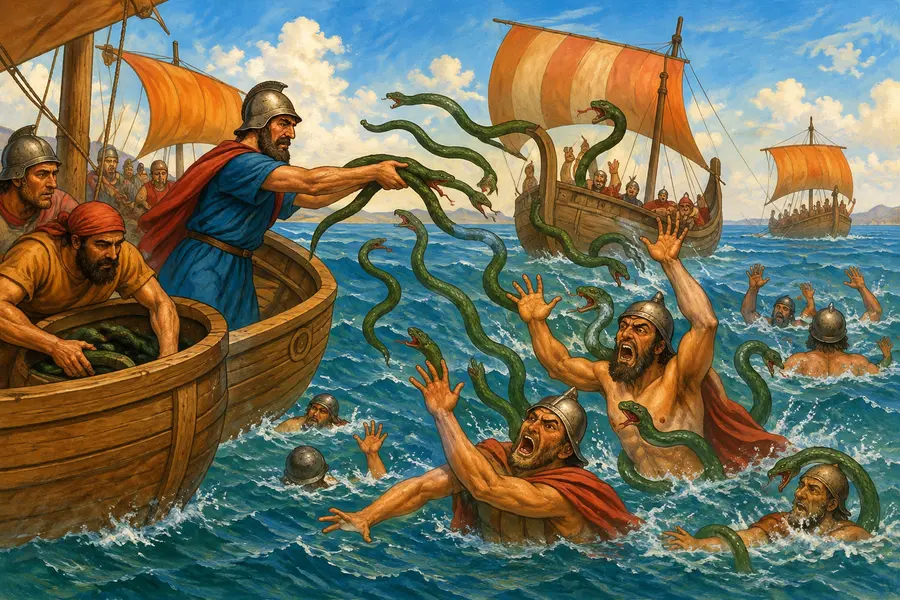
Hannibal's career in psychological warfare did not end with his defeat by Scipio. Years after the Second Punic War, Hannibal was living in exile at the court of Prusias of Bithynia. He became involved in the conflict between Prusias and Eumenes II of Pergamum. Ancient authors preserve a remarkable story about a naval engagement in which Hannibal, faced with an inferior fleet, ordered venomous snakes to be collected and placed inside earthenware jars. Cornelius Nepos describes Hannibal instructing his sailors to concentrate their attack on Eumenes's ship while using the snakes to disrupt the remaining enemy vessels. Frontinus likewise preserves the story, explaining that jars containing vipers were hurled among enemy ships so that fear of the snakes would interfere with the crews' ability to fight and perform their duties.
The story should be treated carefully because it comes from later ancient authors rather than the contemporary Polybius. Even an ancient biographical tradition was already capable of embellishment, and a modern historian should distinguish between what is securely documented and what belongs to the literary tradition. Nevertheless, the psychological logic of the story is unmistakably Hannibalic. The enemy expected arrows, spears, and boarding parties. Instead, men suddenly faced venomous snakes crawling across the decks.
The point was not simply to kill sailors. Snakes could produce hesitation, panic, and disgust. A sailor who might calmly face an armed opponent could react very differently when the immediate danger was an unpredictable poisonous animal. It is the perfect late example of Hannibal's broader philosophy. Attack the enemy's expectations, and you may weaken his ability to fight before you have physically defeated him. There is also an intriguing historical twist. One ancient tradition connects the snake stratagem with Hannibal himself, while Frontinus preserves it as an example of his advice to Antiochus and then separately attributes a similar action to Prusias.
Why Hannibal's Psychological Warfare Ultimately Failed
It would be easy to turn Hannibal into an almost superhuman master of psychological warfare. The historical reality is more interesting. Hannibal repeatedly succeeded at manipulating individuals, local communities, and battlefield situations. But he failed to produce the political collapse he needed. Rome absorbed catastrophic military defeats. It rebuilt its armies. It refused to abandon its allies. It adapted its strategy. Even after the disaster of Cannae, Rome continued fighting rather than accepting Hannibal's preferred political settlement.
The Battle of Cannae is therefore important to the psychological story precisely because its enormous military impact did not produce the final psychological collapse Hannibal needed. Rome's response demonstrates the limits of psychological warfare against a society with strong political institutions, deep manpower reserves and a culture that could reinterpret disaster as a reason for greater resistance.
Hannibal could inflict extraordinary military and psychological shocks, but he could not convert those shocks into Rome's political collapse. Rome's institutions, manpower reserves, alliance network, and willingness to continue the war allowed it to absorb defeats that would have destroyed a less resilient state. The Romans also adapted: after early disasters, they increasingly avoided the kind of decisive battle that Hannibal sought and relied on strategies that denied him the opportunity for another Cannae. His psychological warfare could influence decisions and create fear, but it could not by itself overcome Rome's capacity to absorb losses and continue fighting.
What Made Hannibal's Psychological Warfare So Effective?
Hannibal's psychological warfare was powerful because it was rarely psychological warfare in isolation. He connected emotion to circumstances. He did not simply tell Italians that Rome was oppressive. He released Italian prisoners and sent them home to tell the story. He did not merely accuse Fabius of betrayal. He created a visible circumstance that could make Romans suspect him. He did not simply tell his soldiers that defeat would be terrible. He showed them prisoners fighting for their lives.
He did not merely claim that he could escape Fabius. He created a confusing spectacle in the darkness that made Roman reaction difficult. He did not merely tell Tarentines that Carthage was their liberator. His supporters repeated the message inside the city at the precise moment when people were struggling to understand what was happening. And, if the ancient account of the snakes is accepted, he later exploited the instinctive fear of venomous animals when conventional naval strength was insufficient. Across these episodes, four principles appear again and again:
| Hannibal's psychological principle | Historical example |
|---|---|
| Control the narrative | Presenting the war as the liberation of Italy |
| Exploit existing fears and grievances | Recruiting support among Rome's hostile Celtic neighbors and Italian allies |
| Create uncertainty | The burning oxen at Ager Falernus |
| Undermine trust | Sparing Fabius's property |
| Turn fear into motivation | The prisoner spectacle before Ticinus |
| Attack expectations | The ancient account of the venomous snakes |
A Roman commander who believed an opportunity for victory had appeared could make a different decision from one who knew he was being manipulated. An Italian ally who believed Hannibal was fighting Rome on Italy's behalf could behave differently from one who saw Carthage as another foreign conqueror. A Roman politician who suspected his commander of collusion could undermine the very strategy that was protecting Rome. Hannibal repeatedly tried to control that space between reality and perception.
That is why his psychological warfare remains so fascinating more than two thousand years later. His greatest talent was not simply defeating armies. It was making people act on the reality he wanted them to believe in. Hannibal's psychological warfare ultimately could not break Rome. But it demonstrated something that would become fundamental to military history. An army's strength exists not only in its weapons and numbers, but also in what its soldiers believe, what its commanders fear, and what its enemies think they know.
References and Sources
- Polybius, The Histories, Book 3. Particularly important for Hannibal's treatment of Roman and Italian prisoners, the "freedom of Italy" message, the Celtic alliances, and the prisoner spectacle. Read Polybius, Book 3.
- Polybius, The Histories, Book 8. Important evidence for the political and psychological circumstances surrounding Hannibal's involvement with Tarentum. Read Polybius, Book 8.
- Livy, History of Rome, Book 22. A major source for Hannibal's campaign in Italy, including the Ager Falernus deception and the story of Fabius's spared property. Read Livy, Book 22.
- Cornelius Nepos, Life of Hannibal. Useful for Hannibal's later career and the ancient account of the venomous snakes used in the war with Eumenes. Read Cornelius Nepos's Hannibal.
- Frontinus, Strategemata, Book IV. Preserves the ancient tradition concerning the use of venomous snakes against enemy ships and is useful for examining Hannibal's reputation as a master of stratagems. Read Frontinus, Book IV.
- Polybius, Book 15. Important for the context of Zama and Hannibal's final campaign against Scipio. Read Polybius, Book 15.
- Oxford Classical Resources on Hannibal and the Second Punic War. Modern scholarship is particularly useful when distinguishing ancient literary traditions from historically secure conclusions about Hannibal's intentions.
Books and Memorables
This article may contain affiliate links. If you purchase through these links, I may earn a small commission at no extra cost to you.


Related Articles
Frequently Asked Questions
What was Hannibal's psychological warfare strategy?
Hannibal's psychological warfare strategy relied on manipulating what his enemies believed rather than relying only on battlefield strength. He used deception, fear, propaganda, intimidation, surprise and political manipulation to influence Roman commanders, soldiers and Rome's Italian allies. His aim was often to make an opponent hesitate, distrust his own leadership, or believe that supporting Hannibal was safer than resisting him.
How did Hannibal use propaganda to turn Italy against Rome?
Hannibal presented his invasion of Italy as a struggle to free Italy from Roman domination. According to Polybius, he released Italian allied prisoners without ransom and told them that he was fighting Rome on their behalf. By treating Rome's allies differently from Roman citizens, Hannibal hoped to weaken their loyalty to Rome and encourage defections.
How did Hannibal psychologically manipulate Fabius Maximus?
Hannibal attempted to undermine Fabius Maximus by deliberately sparing Fabius's property while ravaging the surrounding countryside. The unusual treatment could make Romans suspect that Fabius had reached an agreement with Hannibal. The tactic targeted Fabius's reputation and political credibility rather than his army, demonstrating how Hannibal used suspicion as a weapon.
How did Hannibal escape the Romans at Ager Falernus?
At Ager Falernus, Hannibal used a deception involving oxen carrying burning material attached to their horns. The moving lights created confusion among the Roman forces watching his movements at night. While attention was drawn toward the apparent disturbance, Hannibal's army escaped through another route. The episode is a classic example of Hannibal exploiting uncertainty and Roman expectations.
How did Hannibal use fear to control his own soldiers?
Hannibal used dramatic displays, rewards and examples of courage to influence the morale of his multinational army. Before the Battle of Ticinus, he reportedly staged a fight between Celtic prisoners and used the spectacle to demonstrate the stakes of war to his soldiers. He also cultivated loyalty through personal leadership, shared hardship and the promise of rewards for victory.
Did Hannibal really use venomous snakes in naval warfare?
Ancient writers including Cornelius Nepos and Frontinus describe Hannibal using containers filled with venomous snakes during a naval conflict involving Eumenes II of Pergamum. The story should be treated cautiously because it comes from later ancient sources rather than a contemporary eyewitness account. Whether every detail is historical or partly literary, the episode illustrates Hannibal's reputation for using unexpected forms of fear and deception against an enemy.
Add Comment