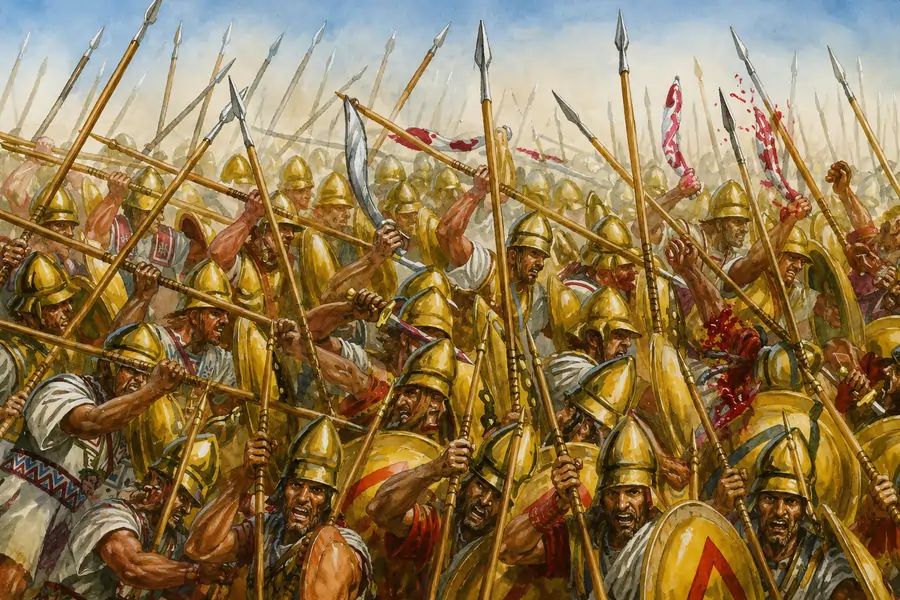
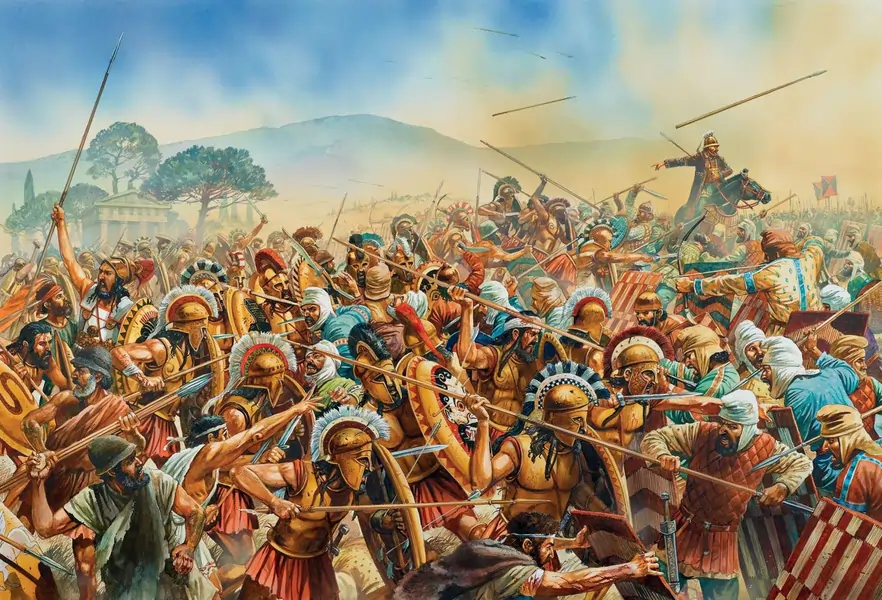
The Battle of Leuctra in 371 BC was the battle that broke Sparta's military supremacy. For generations, Spartan hoplites had been regarded as the most formidable heavy infantry in the Greek world. At Leuctra, however, the Theban general Epaminondas refused to fight the battle on Spartan terms. By concentrating his strongest troops against the Spartan elite, using cavalry unusually aggressively, advancing his army in an echelon, and deliberately holding back part of his line, he transformed a smaller Theban army into a force capable of destroying Sparta's battlefield dominance. The result was not merely a Theban victory. It was a turning point in ancient Greek military history that ended centuries of Spartan prestige and opened the way for a new political order in Greece.
The Battle of Leuctra is therefore important for more than the question of who won. It demonstrates how an innovative commander could exploit the conventions of hoplite warfare against an opponent who was accustomed to winning through those same conventions. The battle also shows why military reputation, morale, battlefield formation, and political power could be just as important as numbers.
Table of Contents
- Spartan Dominance in Greece
- The Rise of Thebes and the Road to War
- What Caused the Battle of Leuctra?
- The Lead-Up to Leuctra
- The Opposing Armies
- Epaminondas' Battle Plan
- The Battle of Leuctra: Step by Step
- Why Did the Thebans Win at Leuctra?
- Casualties and the Cost to Sparta
- The Aftermath of Leuctra
- Why Was the Battle of Leuctra Significant?
- Military Legacy of Epaminondas
- Conclusion
- References and Further Reading
Spartan Dominance in Greece
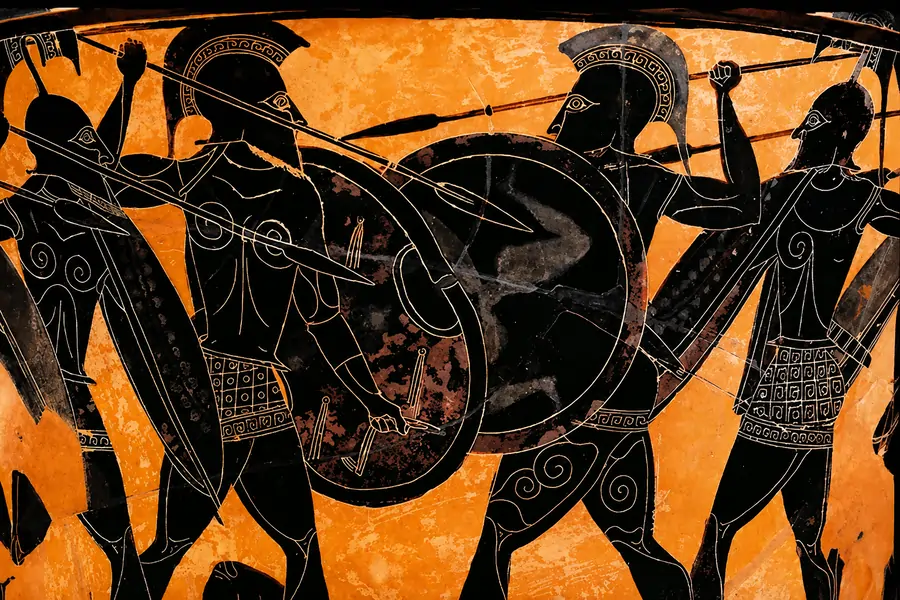
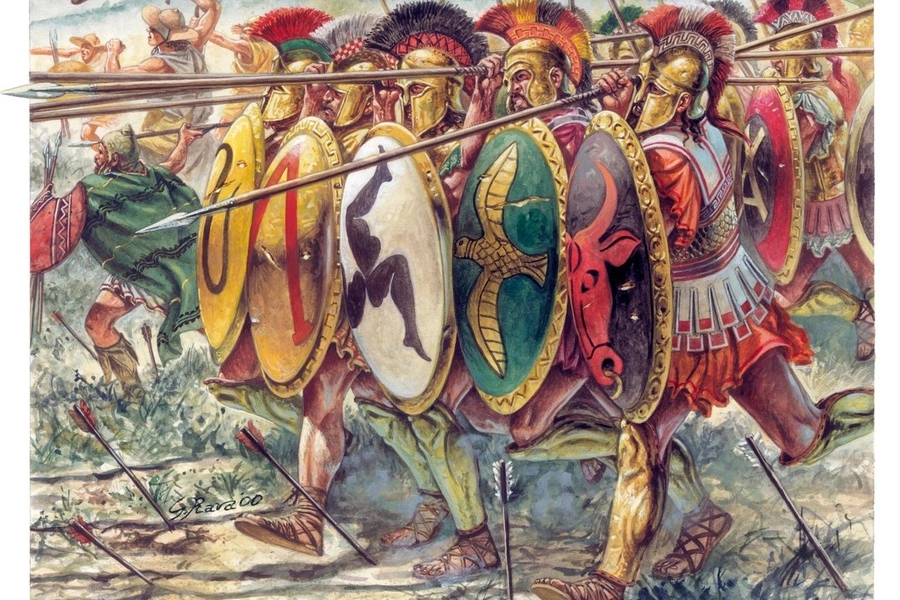
To understand why Leuctra was so shocking, it is necessary to understand what Sparta represented in fourth-century BC Greece. Sparta had not always been the undisputed leader of the Greek world, but its victory over Athens in the Peloponnesian War transformed the balance of power. When Athens surrendered in 404 BC, Sparta emerged as the dominant land power in Greece. Spartan influence extended far beyond Laconia. The Peloponnesian League provided Sparta with a network of allied states, while Spartan armies repeatedly intervened in the affairs of other Greek poleis. The Spartan state could use its reputation for military discipline and battlefield effectiveness to intimidate opponents before a battle was even fought.
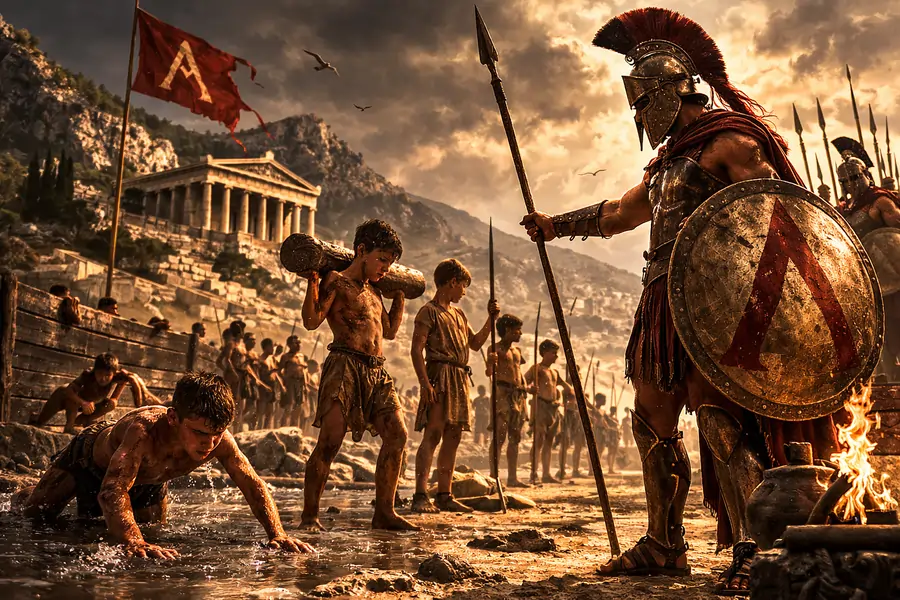
That reputation had been built over generations. Spartan society placed extraordinary emphasis on military preparation, discipline, communal identity, and obedience. The Agoge, the famous Spartan educational and training system, helped produce citizens who were expected to fight as part of a disciplined collective rather than as individual warriors. Yet the image of Spartan invincibility should not be taken literally. Sparta had suffered defeats before Leuctra, including at Sphacteria during the Peloponnesian War and, more significantly, in the immediate pre-Leuctra period, at Tegyra in 375 BC. The Thebans had already demonstrated that Spartan troops could be defeated under the right circumstances. Leuctra was different because the defeat occurred in a major set-piece battle and involved the destruction of a substantial portion of the Spartan citizen hoplite force.
By the time of Leuctra, Sparta also faced a serious demographic problem. The number of full Spartan citizens had declined substantially over the preceding centuries. Xenophon records that approximately 700 Spartans were present on the battlefield at Leuctra and that around 400 of them were killed. The loss was therefore disproportionately severe for a state whose military system depended heavily on its citizen warrior class. This is one reason Leuctra became more than another Greek battle. A defeat could be recovered from. The destruction of a significant proportion of Sparta's remaining citizen warriors was much harder to replace.
The Rise of Thebes and the Road to War
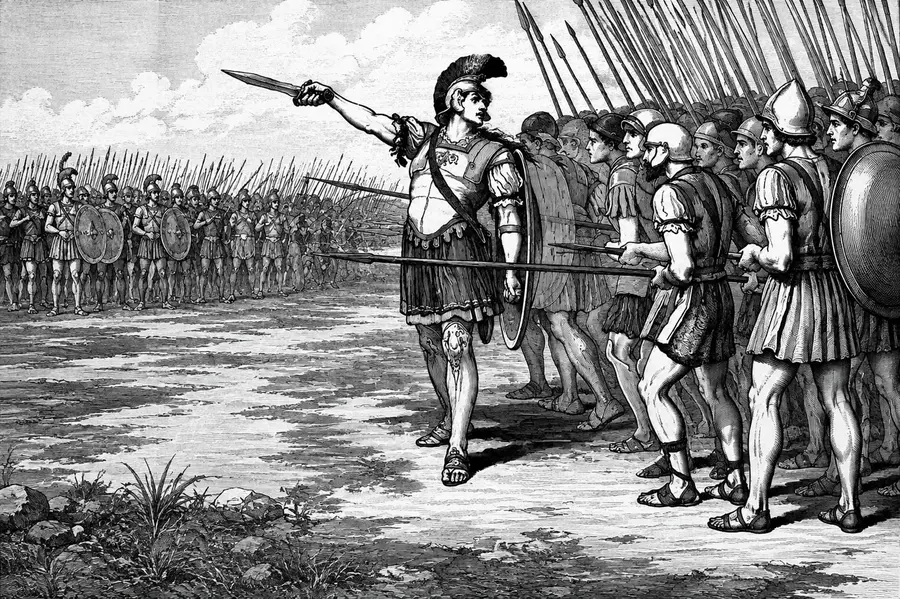
Thebes had long been an important city in Boeotia, but during the early fourth century BC it began to emerge as a serious challenger to Spartan influence. The political organization of the Boeotian League gave Thebes considerable influence over neighboring communities, and Theban leaders increasingly resisted Spartan attempts to dismantle that power. The relationship between Sparta and Thebes had become especially bitter after Sparta occupied the Theban acropolis, the Cadmea, in 382 BC. The occupation was eventually overthrown in 379 BC, when a group of Theban political leaders, including Pelopidas, helped liberate the city.
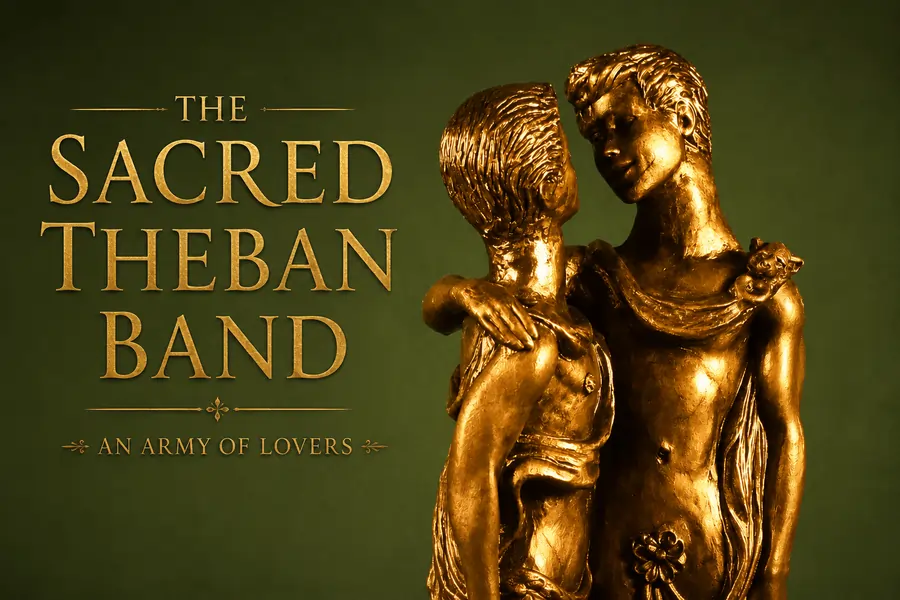
The recovery of Theban independence changed the strategic situation in central Greece. Thebes was no longer prepared to accept Spartan intervention in Boeotian affairs. Instead, Theban leaders sought to rebuild the Boeotian Confederacy and strengthen their position against Sparta. Two figures became particularly important: Epaminondas and Pelopidas. They were political allies and military commanders, but their importance extended beyond their individual victories. Pelopidas became closely associated with the Sacred Band of Thebes, while Epaminondas developed a reputation for intellectual depth and unconventional military thinking.
The Sacred Band would become particularly important at Leuctra. The unit consisted of 300 elite soldiers and had already demonstrated its effectiveness at Tegyra. Its presence gave Epaminondas a highly disciplined body of troops that could be trusted at the decisive point of the battlefield. The Theban military revival was therefore already underway before Leuctra. The battle did not create Theban military power from nothing. It was the culmination of a decade of political resistance, military experimentation, and growing confidence.
What Caused the Battle of Leuctra?
The immediate cause of the Battle of Leuctra was a dispute over the political status of the Boeotian League and the authority of Thebes over the other Boeotian cities. In 371 BC, representatives from several Greek states met at Sparta in an attempt to establish peace. Sparta wanted the individual Boeotian cities to be treated as autonomous states. This would effectively undermine Theban control over the Boeotian Confederacy.
The Theban representative, Epaminondas, refused to accept the Spartan demand. He insisted that Thebes had the right to represent the Boeotian communities collectively, just as Sparta represented the communities of Laconia. The dispute was not simply about wording. It concerned who possessed political authority in Boeotia. The disagreement made a general peace impossible. Sparta decided to enforce its position militarily.
King Cleombrotus I was already operating with a Spartan army in the region. Rather than returning home immediately, he moved into Boeotia. According to Xenophon's account, Cleombrotus took an unexpected route through Thisbae, seized the fortress at Creusis, and captured a number of Theban ships. He then moved toward Leuctra. For Sparta, the campaign appeared to be another opportunity to force a rebellious Greek state back into submission. For Thebes, it became a fight for political independence and the survival of its regional alliance.
The Lead-Up to the Battle of Leuctra
The two armies eventually faced one another near Leuctra, a settlement in Boeotia in the territory of Thespiae. The battlefield was relatively open and suitable for a traditional hoplite engagement. Some Theban commanders initially preferred a more cautious approach. The Spartans were still feared, and fighting them in an open field carried enormous risks. A retreat toward Thebes and a defensive strategy could have forced Sparta into a difficult siege. Epaminondas disagreed.
He understood that refusing battle might preserve the army temporarily but could also surrender the political initiative to Sparta. The Thebans needed a victory that would destroy the psychological advantage enjoyed by their opponent. The decision to fight was therefore as much psychological as military. The Spartans expected their traditional battle formation to work. Epaminondas intended to make the battlefield itself work against them. Ancient accounts also preserve stories about Epaminondas invoking the memory of local victims associated with Spartan wrongdoing at Leuctra.
The Opposing Armies
Exact troop numbers are difficult to establish because the surviving ancient sources differ and do not provide a modern-style order of battle. Xenophon, Diodorus Siculus, Plutarch, and later writers emphasize different aspects of the campaign. A reasonable summary is that the Spartan-led force was larger than the Theban army. Estimates commonly place the Spartan and allied army at roughly 10,000 to 11,000 men, while the Theban army probably numbered around 6,000 to 7,000 heavy infantry, supported by several hundred cavalry and light troops.
| Feature | Theban Army | Spartan-led Army |
|---|---|---|
| Commander | Epaminondas | King Cleombrotus I |
| Main force | Boeotian hoplites | Spartan and allied hoplites |
| Elite troops | 300 Sacred Band soldiers | Spartan citizen hoplites and royal guard |
| Cavalry | Several hundred, used aggressively | Several hundred, defeated early in the battle |
| Approximate strength | 6,000-7,000 hoplites plus cavalry and light troops | About 10,000-11,000 total troops |
| Major tactical feature | Deep left wing and echelon formation | Traditional phalanx with Spartans on the right |
The crucial point is that Epaminondas did not attempt to defeat the entire Spartan army simultaneously. He identified the Spartan right wing, where the best Spartan troops and the king were positioned, as the decisive target. This was a radical departure from the usual expectation that a Greek army should deploy its strongest troops on its own right wing. The Greek phalanx had traditionally produced a complicated battlefield dynamic in which formations tended to drift toward the right. Epaminondas exploited this convention instead of accepting it.
Epaminondas' Battle Plan
The central question in understanding Leuctra is simple: how did Epaminondas defeat a larger Spartan army? The answer lies in concentration. Instead of spreading his troops evenly across the battlefield, Epaminondas created a massive concentration on his left wing. This formation was reportedly extraordinarily deep, perhaps around 50 ranks, compared with a much shallower formation elsewhere. The idea was brutally simple. If the Thebans could destroy the Spartan elite before the rest of the Spartan army could properly intervene, the battle could be won even if most of the enemy line remained intact. The plan contained several interconnected elements.
- Concentrate the strongest infantry. Epaminondas placed an unusually deep column of Theban infantry opposite the Spartan right.
- Put cavalry in front of the infantry. Rather than allowing the cavalry to act as a distant auxiliary, he used it to disrupt the Spartan formation before the main infantry collision.
- Use the Sacred Band at the decisive point. The elite Theban unit formed part of the attack against the Spartan leadership.
- Advance in echelon. The Theban left moved forward while other sections of the army remained behind, creating an angled battlefield formation.
- Refuse a simultaneous general engagement. The weaker Theban right was deliberately delayed so that it would not become trapped before the decisive left-wing attack succeeded.
This is often described as the oblique order or oblique formation. The concept was not entirely unprecedented, and historians caution against portraying Epaminondas as the inventor of every element of the maneuver. The importance of Leuctra lies in how he combined several existing practices into a deliberate operational system. Modern scholarship also cautions that the exact reconstruction of the battlefield remains debated. John F. Lazenby's discussion in the Oxford Classical Dictionary emphasizes the unusually deep Theban formation, the positioning of cavalry ahead of the phalanx, the disorder created when Spartan cavalry retreated into their infantry, and the concentration against the Spartan right.
The Battle of Leuctra: Step by Step
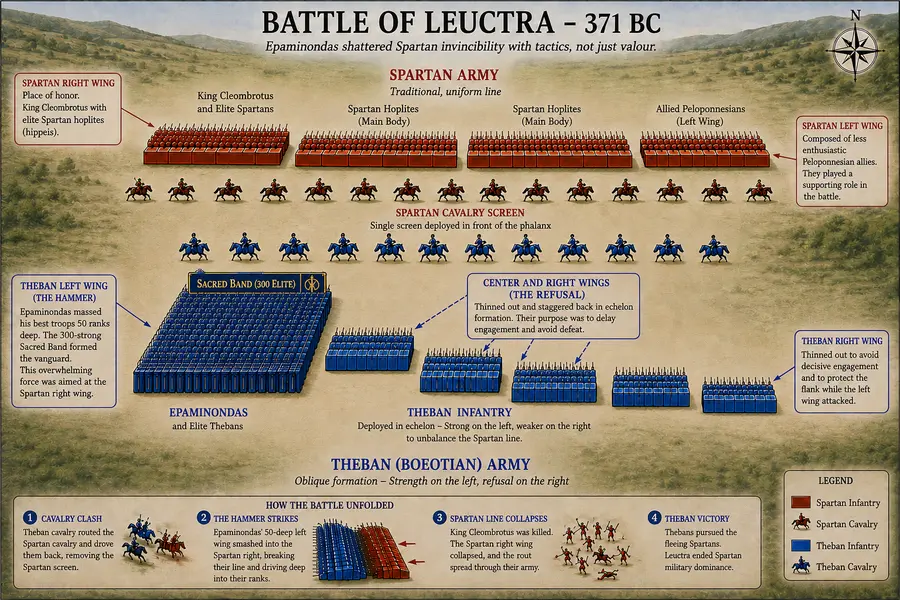
1. The Armies Deploy
Cleombrotus arranged his forces according to familiar Greek practice. The Spartan citizen troops occupied the right wing, the position traditionally associated with the strongest troops. Allied contingents occupied much of the remaining line.
Epaminondas presented something very different. His left wing was enormously deep and contained his best troops. The Sacred Band was positioned with this powerful formation. The remainder of the Theban army was drawn up progressively farther back toward the right, creating an echelon rather than a straight battle line. From a distance, the formation would have looked strange to soldiers accustomed to seeing opposing hoplite armies deploy in roughly parallel lines.
2. The Cavalry Clash
The battle began with the cavalry rather than immediately with the main hoplite formations. The Theban cavalry proved superior and drove the Spartan cavalry from the field. The retreat was particularly damaging because the fleeing horsemen disrupted the Spartan infantry formation behind them. This was precisely the kind of disruption Epaminondas needed. His deep infantry formation was now approaching an enemy whose organization had already been compromised.
3. The Theban Left Advances
Epaminondas then committed his enormous left wing against the Spartan right. The depth of the formation gave the Thebans extraordinary striking power at the point of contact. Instead of distributing their strength across the entire battlefield, they concentrated a large share of their combat power against a relatively narrow section of the Spartan army. The result was a local numerical advantage even though the Thebans were outnumbered overall. This distinction is crucial. Epaminondas did not need to have more soldiers than Sparta. He needed to have more soldiers at the decisive point.
4. The Spartan Right Is Overwhelmed
The Spartan troops did not simply collapse at first contact. Spartan hoplites remained disciplined and fought hard, and Cleombrotus' troops attempted to respond to the unexpected attack. But the Theban concentration placed extraordinary pressure on the Spartan right. The Sacred Band and the deep Theban column pushed toward the Spartan command group. Cleombrotus was eventually mortally wounded. His death was a devastating blow because the Spartan army had lost its king at the very point where its strongest troops were engaged in a desperate struggle. The battle now became increasingly difficult for the Spartan right to control.
5. The Rest of the Theban Army Holds Back
One of the most interesting elements of Epaminondas' plan was what he did not do. He did not immediately throw his entire army into the fight. The Theban right remained behind the advancing left. This protected it from the larger Spartan and allied formations while giving the decisive attack time to destroy the Spartan elite.
This was a remarkable departure from the instinct to commit everything at once. Epaminondas effectively divided the battle into different phases and different levels of urgency. His left wing had one job: destroy the Spartan right. The rest of his army had another: avoid being destroyed before that happened.
6. The Spartan Army Breaks
Once the Spartan right had been defeated and Cleombrotus was dead, the psychological balance of the battle changed dramatically. The Spartan allies on the other parts of the battlefield had little reason to continue a fight that had already produced a catastrophic defeat among the Spartan citizen troops. The rest of the Peloponnesian army withdrew.
The Thebans had achieved something that had seemed almost impossible: they had defeated the Spartan army in a major pitched battle. Xenophon reports that nearly 1,000 Lacedaemonians were killed, including approximately 400 of the 700 Spartans present. The scale of these losses was devastating for the Spartan state.
Why Did the Thebans Win at Leuctra?
The Theban victory was not the result of one clever maneuver alone. It came from several decisions working together.
Concentration at the decisive point
The most important principle was concentration. Epaminondas accepted weakness in one part of the battlefield in order to create overwhelming strength in another. This allowed the smaller army to create local superiority against the Spartan elite.
Targeting the Spartan leadership
The Thebans did not merely attack anonymous enemy soldiers. They attacked the part of the Spartan formation where the king and elite troops were located. Once Cleombrotus was killed, the Spartan command structure faced an enormous psychological shock.
Effective use of cavalry
Greek hoplite warfare is often imagined as a contest exclusively between blocks of heavily armed infantry. Leuctra demonstrates why that picture is incomplete. The cavalry action mattered because the Theban horsemen disrupted the Spartan formation before the decisive infantry engagement. The retreating Spartan cavalry appears to have contributed to the disorder of the Spartan infantry exactly at the moment when the infantry needed cohesion.
The echelon formation
The delayed advance of the Theban right prevented the entire army from becoming committed to the battle simultaneously. It also created an angled advance in which the decisive wing reached the enemy before the weaker sections. The Oxford Handbook of Warfare in the Classical World describes Epaminondas' arrangement as a combination of traditional and innovative elements rather than a completely new system invented from nothing. That distinction is important because it prevents the battle from becoming a simplistic story of a single "genius invention."
Spartan expectations became a weakness
Sparta's reputation was itself part of the problem. The Spartans were accustomed to the confidence that came from generations of military success. Epaminondas understood that the psychological effect of defeating them could be enormous. At Leuctra, the Thebans did not simply defeat Spartan soldiers. They demonstrated that Spartan soldiers could be defeated in the very kind of battlefield where Sparta believed it was strongest. This helps explain why the battle became such a powerful historical dividing line.
Casualties and the Cost to Sparta
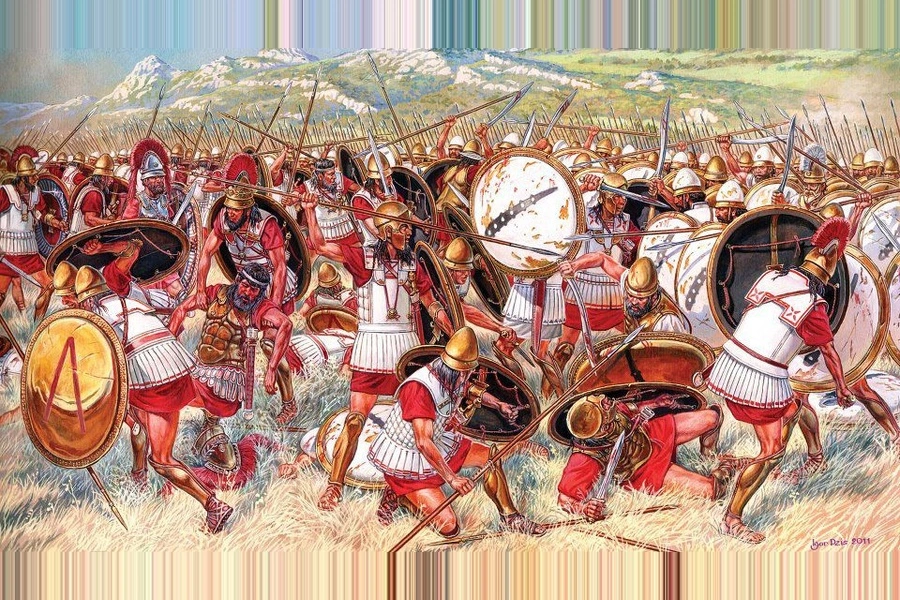
The precise casualty figures remain difficult to establish because ancient sources do not agree on every detail. The most frequently cited figures indicate approximately 1,000 Lacedaemonians were killed, including around 400 full Spartan citizens. For modern armies, such numbers might appear modest compared with later battles involving tens of thousands of soldiers. For Sparta, however, the losses were potentially catastrophic.
The Spartan military system depended he avily on a relatively small citizen body. Every full Spartan citizen lost in battle represented not merely one dead soldier but the loss of a member of the political and military elite. The defeat therefore attacked the foundation of Spartan power.
| Impact | Effect on Sparta |
|---|---|
| Military losses | Hundreds of Spartan citizens were killed. |
| Leadership | King Cleombrotus was killed. |
| Prestige | The reputation of Spartan battlefield invincibility was badly damaged. |
| Political influence | Spartan control over allies became increasingly difficult to maintain. |
| Strategic position | The Peloponnesian League began to weaken. |
The Aftermath of Leuctra
The consequences of Leuctra were enormous. Sparta's enemies quickly recognized that the old political order had been broken. The Peloponnesian League could no longer operate with the same authority, while states that had previously lived under Spartan pressure began looking for opportunities to escape it. Epaminondas eventually carried the war into the Peloponnese. The Theban campaigns were designed not simply to defeat Spartan armies but to dismantle the territorial and economic foundations of Spartan power.
One of the most important consequences was the liberation of Messenia. For centuries, Sparta had controlled Messenia and relied heavily on the labor of its helot population. The establishment of an independent Messenian state represented a profound strategic and economic blow to Sparta. The Thebans also encouraged the development of Megalopolis in Arcadia, creating another political counterweight to Sparta.
The victory therefore changed the map of Greece. Sparta remained a significant state, but it was no longer the unquestioned military power that other Greek states had to accommodate. Thebes, meanwhile, entered what historians generally call the period of Theban hegemony. The period was relatively short-lived, but it was significant. Theban power reached its height under Epaminondas before the balance of power shifted again.
Why Was the Battle of Leuctra Significant?
1. It ended Spartan military supremacy
The most obvious significance of Leuctra was the collapse of Spartan dominance on the Greek mainland. Oxford's Oxford Classical Dictionary describes Leuctra as ending roughly two centuries of Spartan domination on the battlefield. This does not mean Sparta disappeared after 371 BC. It remained an important Greek state for generations. What disappeared was the assumption that Sparta possessed an almost unquestionable military superiority.
2. It established Thebes as the leading Greek land power
Leuctra elevated Thebes to the position of the most powerful Greek land power of the moment. The victory also demonstrated the military potential of the Boeotian League. Thebes had moved from resisting Spartan intervention to defeating Sparta's main army in open battle.
3. It changed Greek military thinking
Leuctra is frequently discussed as a landmark in the development of battlefield tactics because Epaminondas deliberately concentrated combat power at a decisive point rather than distributing his troops evenly. The battle showed that a phalanx was not simply a rigid block of infantry. Its depth, speed, positioning, supporting cavalry, and relationship with neighboring formations could be manipulated.
This broader evolution in Greek warfare eventually contributed to the increasingly sophisticated combined-arms systems of the later fourth century BC. The Macedonian military reforms associated with Philip II and the campaigns of Alexander the Great belong to this wider history of experimentation in heavy infantry, cavalry, and battlefield coordination.
4. It demonstrated the importance of morale
Leuctra also provides an important lesson about military psychology. The Spartans had not suddenly become poor soldiers. They fought with the discipline expected of Spartan hoplites. But their reputation could not protect them once their formation was penetrated, their king was mortally wounded, and their elite troops suffered heavy casualties. The battle is therefore a useful case study alongside the broader question of how morale, cohesion, fear, and group identity influenced survival on ancient battlefields. The psychology of ancient soldiers was every bit as important as their weapons and armor.
5. It demonstrated that military reputation could be broken
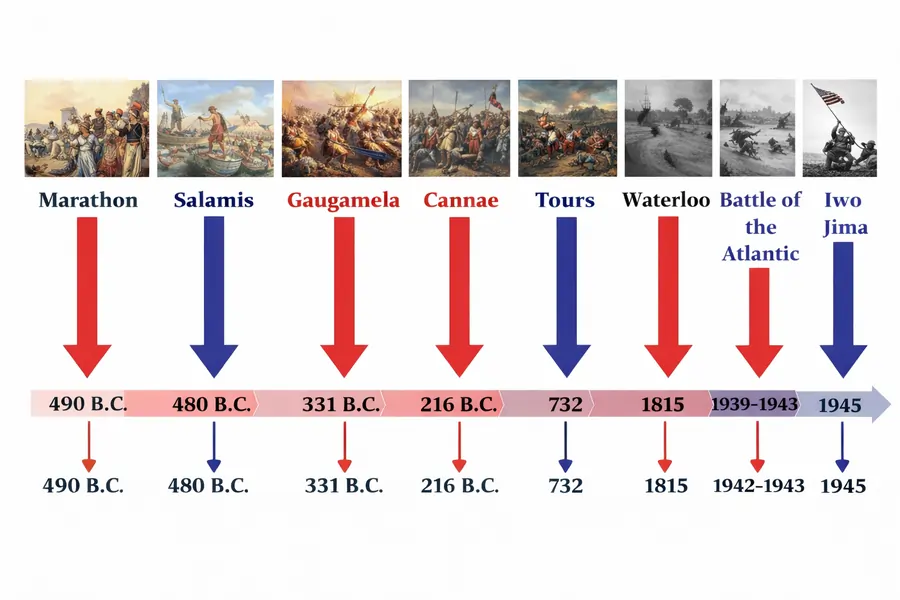
Few events illustrate the fragility of military prestige better than Leuctra. For generations, Greek states had learned to treat Spartan armies with caution. After Leuctra, that psychological calculation changed. The Spartan army could still fight, but it could no longer rely on the expectation that an enemy would fear it into submission. That makes Leuctra comparable in historical importance to other battles in which a seemingly dominant military power suddenly lost its aura of superiority. The most decisive battles in history include several examples of victories whose consequences extended far beyond the battlefield itself.
The Military Legacy of Epaminondas
Epaminondas' achievement at Leuctra made him one of the most influential commanders of classical Greece. Yet it is important not to reduce his success to the phrase "oblique formation." His real achievement was the integration of several battlefield ideas into one coherent plan. He understood the enemy's habits. He identified the decisive target. He concentrated his best troops against it. He used cavalry to disrupt the enemy before the infantry engagement. He protected his weaker wing by delaying it. And he understood that killing or routing the enemy leadership could have consequences far beyond the number of soldiers physically removed from the battlefield.
His approach is especially interesting when placed within the longer development of Greek and Macedonian warfare. The fourth century BC was a period of experimentation in military organization. Commanders were increasingly willing to combine different troop types and manipulate traditional formations. The later success of Macedonian armies under Philip II and Alexander the Great demonstrated the power of coordinating infantry and cavalry rather than treating them as separate battlefield arms. Readers interested in how this development culminated in Macedonian warfare can explore the Alexander the Great biography, battles and strategy guide.
Centuries later, Roman armies would develop still more flexible formations. The evolution from the Greek hoplite system to the Macedonian phalanx and eventually to the Roman legion illustrates a recurring pattern in military history: successful armies eventually become vulnerable when opponents learn how to attack the assumptions on which their success depends.
Conclusion
The Battle of Leuctra was fought on a relatively small plain in Boeotia, but its consequences reached across the Greek world. Sparta entered the battle with an enormous advantage in reputation. Its soldiers were experienced, disciplined, and feared. The Spartan state had dominated Greek land warfare for generations, and its political influence extended throughout the Peloponnese. Epaminondas understood that defeating such an opponent required more than courage.
He refused to fight a conventional battle. Instead, he concentrated his strongest troops against the Spartan elite, used cavalry to disrupt the opposing formation, advanced his army in echelon, and deliberately delayed his weaker wing. His army was smaller, but at the decisive point it was stronger. When the Theban attack crushed the Spartan right, and King Cleombrotus fell, the psychological foundation of the Spartan army collapsed with it. The significance of Leuctra therefore lies in two connected victories. Thebes won the physical battle, while Epaminondas defeated the idea that Spartan military superiority was inevitable.
Leuctra ended Sparta's long-standing dominance, weakened the political structure that supported its hegemony, opened the way for the liberation of Messenia, and established Thebes as the leading Greek land power. Its tactical legacy was equally important. Epaminondas demonstrated that battlefield formations could be manipulated deliberately to create local superiority even when an army was outnumbered overall. Yet the Theban hegemony would not last forever. Epaminondas himself would die at Mantinea in 362 BC, and Thebes would eventually be overtaken by a new power from the north: Macedon. The rise of Philip II and Alexander would introduce another stage in the evolution of Greek warfare.
That is perhaps the most enduring lesson of Leuctra. Military dominance is rarely permanent. The army that seems unbeatable often becomes predictable, and predictability gives an innovative opponent something to exploit. Sparta had built its reputation on disciplined hoplite warfare. At Leuctra, Epaminondas turned that confidence against it. The Battle of Leuctra was therefore not simply the battle in which Thebes defeated Sparta. It was the battle in which an old model of Greek military dominance was decisively challenged by a commander willing to rethink how a hoplite army could fight.
References and Further Reading
- Xenophon, Hellenica, Book VI. Xenophon's account is the earliest surviving major narrative source for the battle and is particularly important for the campaign leading to Leuctra and the reported Spartan losses. An accessible translation is available through the Fordham University Ancient History Sourcebook.
- Diodorus Siculus. Library of History, Book 15. Diodorus provides a longer narrative of the Boeotian War, the Battle of Leuctra, and the subsequent Theban campaigns. The University of Chicago's LacusCurtius collection provides an accessible English translation.
- Plutarch, Life of Pelopidas. Plutarch's biography provides additional material concerning Pelopidas, the Sacred Band, and the Theban victory.
- John F. Lazenby, "Leuctra," Oxford Classical Dictionary. This modern scholarly reference discusses the battlefield, the unusually deep Theban formation, cavalry action, and the defeat of the Spartan right.
- John Buckler, "Epaminondas at Leuctra, 371 B.C.," in The Oxford Handbook of Warfare in the Classical World. Buckler examines the tactical arrangements at Leuctra and emphasizes the combination of traditional and innovative battlefield methods used by Epaminondas.
- Mark Cartwright, "Battle of Leuctra," World History Encyclopedia. Useful for an accessible overview of the campaign, opposing forces, battle sequence, and aftermath. The source also notes that some details of the battle remain debated among historians.
Books and Memorables
This article may contain affiliate links. If you purchase through these links, I may earn a small commission at no extra cost to you.


Related Articles
Frequently Asked Questions
What was the Battle of Leuctra?
The Battle of Leuctra was fought in 371 BC between the Theban-led Boeotian army and a Spartan-led army in Boeotia. The Thebans, commanded by Epaminondas, defeated the Spartans in a major pitched battle, ending Sparta's long-standing dominance of Greek land warfare. The battle is especially famous for Epaminondas' unconventional use of a deeply reinforced left wing and echelon formation.
How did Epaminondas defeat Sparta at Leuctra?
Epaminondas defeated Sparta at Leuctra by concentrating his strongest troops against the Spartan right wing instead of spreading his army evenly across the battlefield. He placed his main infantry force unusually deep, used cavalry to disrupt the Spartan formation, advanced his powerful left wing ahead of the rest of his army, and delayed his weaker right wing. This created overwhelming local superiority against the Spartan elite before the larger Spartan-led army could bring its full strength to bear.
Why did Sparta lose the Battle of Leuctra in 371 BC?
Sparta lost the Battle of Leuctra because the Theban army used a more flexible battlefield plan that exploited the traditional Spartan formation. The Thebans defeated the Spartan cavalry, disrupted the Spartan line, concentrated a very deep infantry formation against the Spartan right, and attacked the area where King Cleombrotus and the elite Spartan troops were positioned. Cleombrotus was mortally wounded and the Spartan right wing was eventually defeated, causing the rest of the army to withdraw.
What tactics did Epaminondas use at the Battle of Leuctra?
Epaminondas used several coordinated tactics at Leuctra, including an unusually deep infantry formation, concentration of forces against the Spartan right wing, cavalry positioned ahead of the hoplite line, an echelon or oblique advance, and a delayed attack by the weaker parts of his army. Rather than seeking to defeat the entire Spartan army simultaneously, he focused his greatest strength on the most important part of the enemy formation.
How did the Battle of Leuctra end Spartan military dominance?
The Battle of Leuctra ended Spartan military dominance by destroying a large part of the Spartan citizen warrior force and severely damaging Sparta's reputation for battlefield superiority. Ancient sources report that about 400 of the approximately 700 Spartan citizens present were killed. The defeat weakened Sparta's ability to dominate its allies and allowed Thebes to become the leading Greek land power for a period.
Why was the Battle of Leuctra important in ancient Greek history?
The Battle of Leuctra was important because it ended Sparta's long-standing military supremacy and began a period of Theban dominance in Greece. It also demonstrated how an outnumbered army could win by concentrating superior forces at a decisive point rather than fighting along the entire battlefield at once. Epaminondas' combination of deep infantry formations, cavalry support and echelon tactics became an important example in the development of Greek military strategy.
Add Comment