The Battle of Cannae, fought in 216 BC, stands as one of the most decisive and devastating defeats for the Romans. On a scorching summer day in southern Italy, the Roman Republic assembled the largest army it had ever fielded, determined to crush the Carthaginian invader Hannibal Barca once and for all. What followed instead was a catastrophe so complete that it nearly ended Rome's dominance before it had fully begun.
Significance of the Battle of Cannae
Cannae is remembered not merely for the scale of Roman losses, but also because of the tactical brilliance of the Carthaginian general Hannibal Barca. With an army significantly smaller and composed of a mixed bag of mercenaries and conscripts, Hannibal achieved the impossible. This was the perfect battlefield maneuver: the double envelopment, a tactic that annihilated a numerically superior enemy by surrounding it on all sides. To this day, the Battle of Cannae is studied in military academies worldwide as a tactical masterpiece that brought Rome to its knees.
The battle of Cannae occurred during the Second Punic War, a back-and-forth struggle between Rome and Carthage for control of the western Mediterranean. For Rome, Cannae was a moment of existential terror. For Hannibal, it was the height of his career. However, this stunning victory did not force Rome to surrender. Instead, it reshaped Roman strategy, hardened Roman resolve, and altered the course of ancient history.
Rome and Carthage Before Cannae
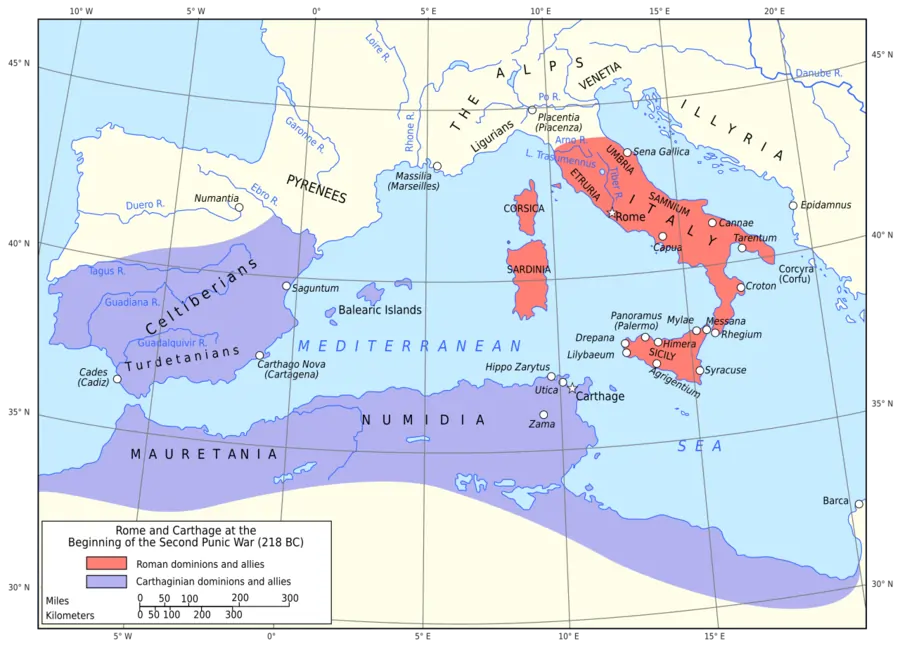
The Rise of the Roman Republic
By the early third century BC, the Roman Republic had emerged as the dominant power in Italy. Through a combination of military discipline, political flexibility, and relentless expansion, Rome had subdued rival Latin, Etruscan, and Samnite states. Its strength lay in its professionally trained citizen army—disciplined legions composed of land-owning Romans who fought not for pay, but for survival, honor, and civic duty.
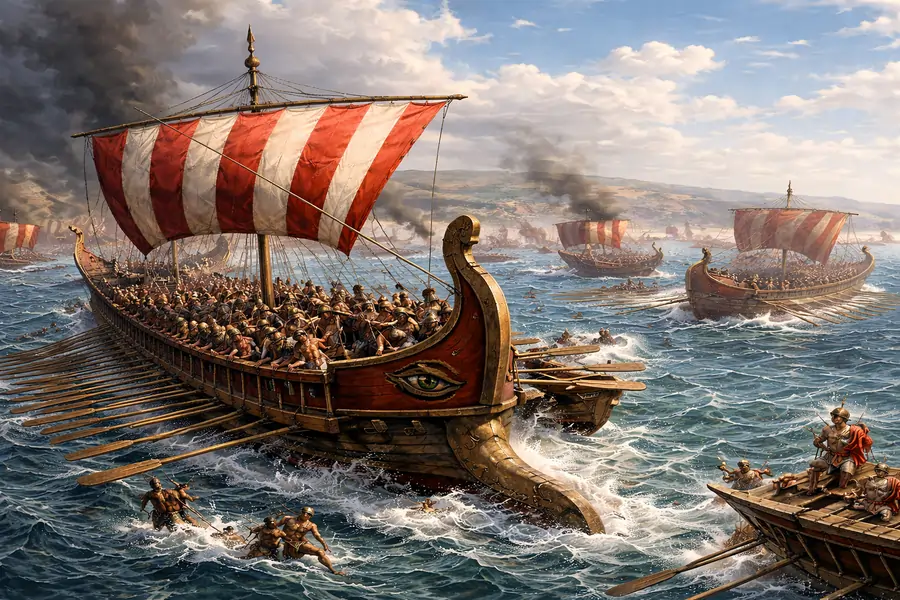
Rome's victory in the First Punic War (264–241 BC) against Carthage had given it control of Sicily. Before the First Punic War, Rome was only a regional power. However, the conflict with Carthage had forced Rome to build a navy from scratch, and this helped it expand its influence all over the Mediterranean. This victory did not bring everlasting peace, however. Carthage resented its defeat and the heavy indemnities imposed by Rome, while Roman leaders increasingly viewed Carthaginian influence as a threat to their growing empire. Another war between Rome and Carthage was inevitable.
Carthage and Hannibal's Oath
Carthage, centered in modern-day Tunisia, was a wealthy maritime empire built on trade, colonies, and naval supremacy. Unlike Rome, which had citizen soldiers, Carthage relied heavily on professional mercenaries and allied soldiers rather than citizen conscripts. After its defeat in the First Punic War, Carthage turned its attention to expansion in Iberia (modern Spain), where it rebuilt its strength under the leadership of the Barcid family.
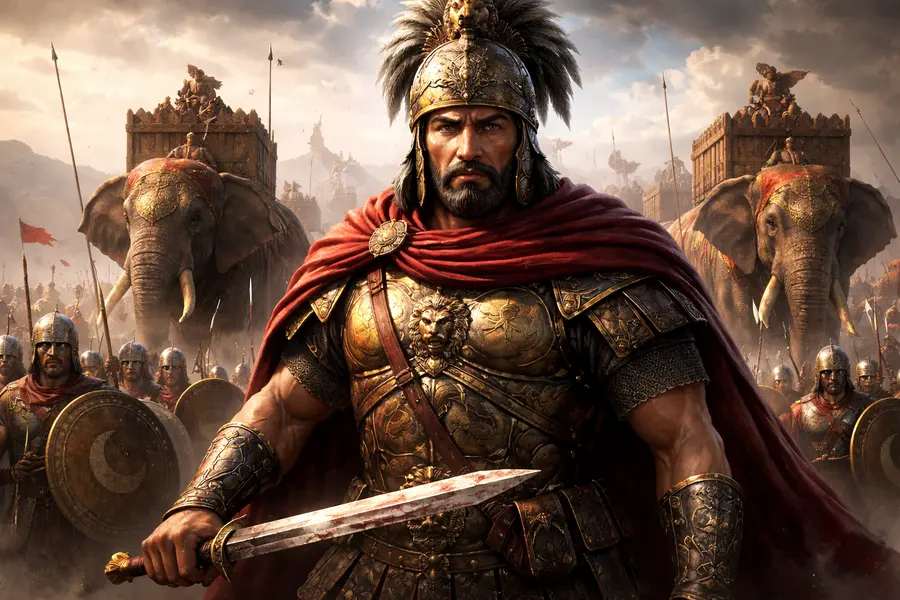
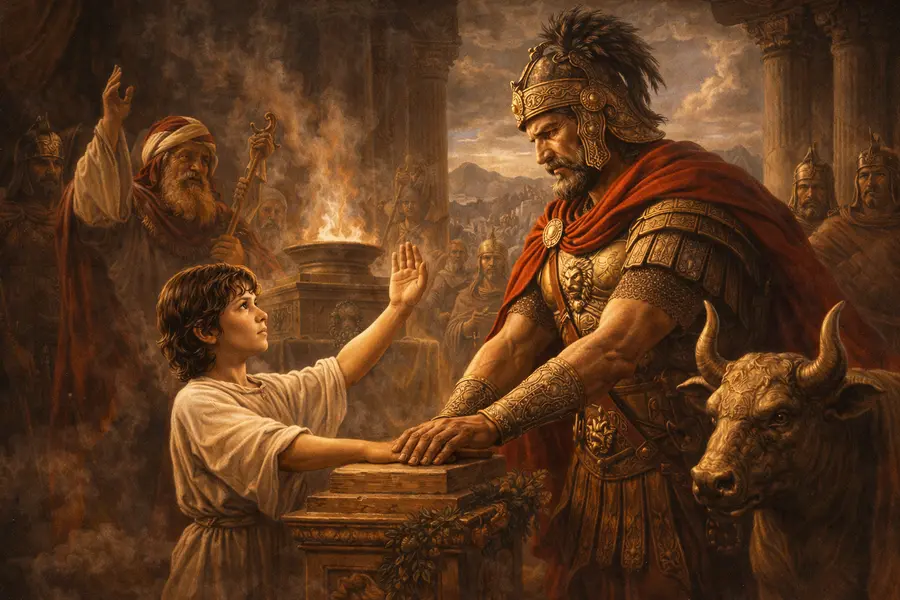
At the heart of this revival stood Hannibal Barca, one of history's greatest military commanders. According to ancient sources, Hannibal swore an oath as a child to remain an eternal enemy of Rome at a Carthaginian temple. Whether literal or symbolic, this hatred shaped his life forever. When Rome interfered with Carthaginian interests in Iberia, Hannibal seized the opportunity to strike, launching one of the boldest invasions in military history.
Hannibal's Road to Cannae
Hannibal's campaign against Rome began with audacity that had never been seen before in history. In 218 BC, he led his army from Iberia across southern Gaul and then over the Alps—an undertaking that stunned the ancient world. Despite losing men, animals, and supplies, Hannibal descended into northern Italy with a hardened core of veterans.
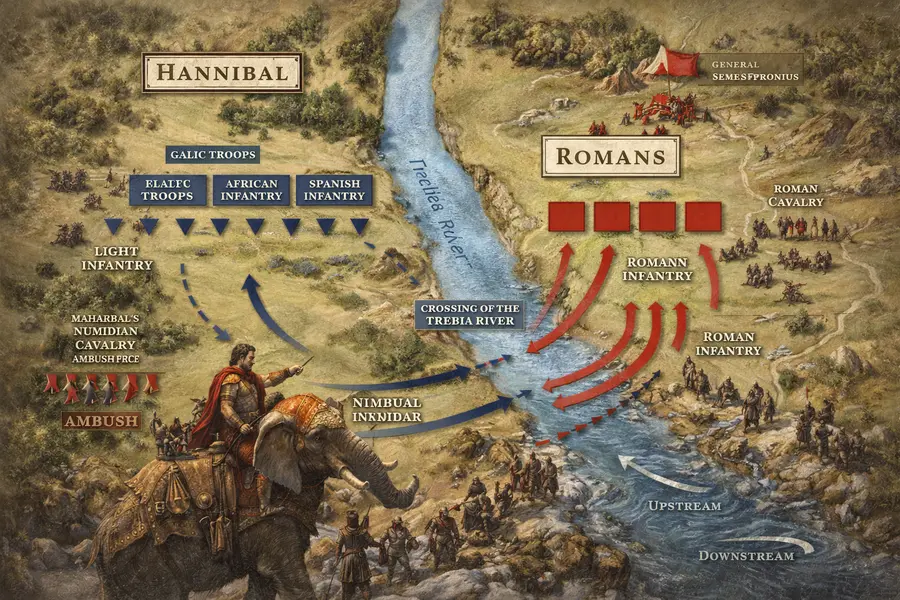
He quickly demonstrated his tactical genius. Roman armies sent to intercept him were defeated at the Battle of Trebia, where Hannibal used terrain, timing, and hidden troops to devastating effect. The following year, he annihilated another Roman force at the Battle of Lake Trasimene, ambushing it along the lakeshore with fog as cover. Thousands died in a matter of hours.
These defeats plunged Rome into panic. In desperate times, Rome would appoint a dictator to handle any crisis. They now appointed Quintus Fabius Maximus as dictator to handle Hannibal. Fabius adopted a cautious strategy of avoiding open battle and wearing Hannibal down through attrition. Though militarily sound, this "Fabian strategy" was deeply unpopular with the Romans. The Romans wanted decisive action and results. They wanted Hannibal dead, now!
By 216 BC, political pressure forced Rome to abandon the cowardly Fabian strategy. Rome was a proud republic, and defeat was never an option for its citizens. Following a Fabian strategy of refusing to offer battle and keeping Hannibal in check was disgraceful to them. When Fabius Maximus' term was over, the Romans elected Gaius Terentius Varro and Lucius Aemilius Paullus as their new consuls.
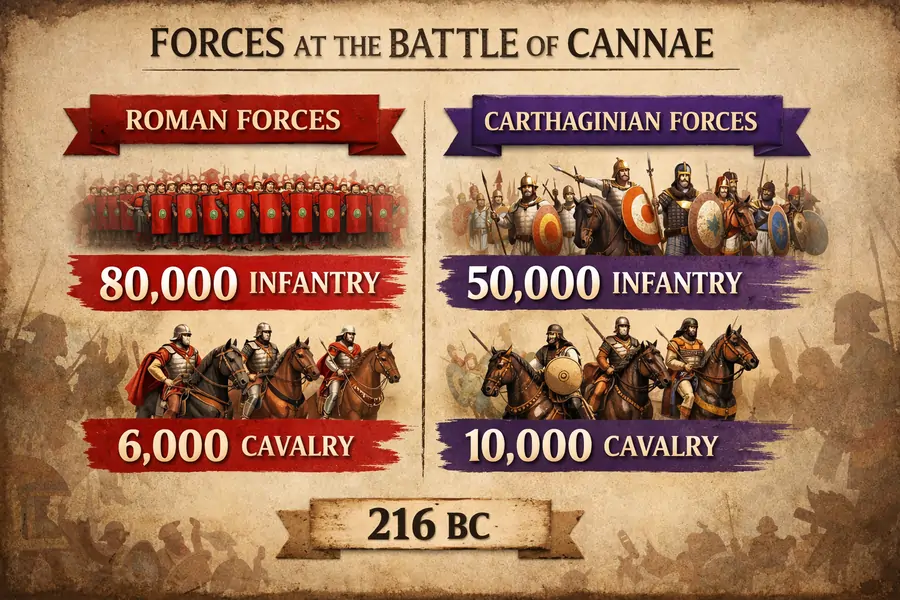
The new consuls vowed to act more decisively on the Hannibal problem. The Fabian strategy had done its job. Instead of bleeding the army with losses, Rome had now conserved its strength for the decisive showdown. They had by now raised an unprecedented army, 8 legions with a total of 80,000 men and 6,000 cavalry. This was the biggest army that Rome had ever raised. To give more context, Rome usually raises 4 legions every year, 2 for each consul. They had now doubled this number and marched south, determined to bring Hannibal to battle near the small village of Cannae in Apulia.
The Battlefield of Cannae
Cannae lay on a broad, open plain near the Aufidus River (modern Ofanto), a region ideal for large-scale infantry engagement. The Romans believed this terrain favored their strengths: massed heavy infantry capable of overwhelming the enemy through sheer force. They had lost previous battles to trickery and deceit. The open plains made sure that there will be no such surprises. Rome wanted a fair fight, and they were sure of winning given their numbers. After all, the Roman infantry had till now never lost a direct battle with Hannibal. Even in the Battle of Trebia and Battle of Lake Trasimene, the Roman center had managed to maintain formation and broke out from their encirclement.
However, the plain environment also concealed dangers. The plain was exposed to fierce summer winds that carried dust into the faces of advancing troops. Hannibal deliberately positioned his army so that the wind and sun disadvantaged the Romans. What appeared to be a neutral battlefield was, in reality, carefully chosen by Hannibal. A plain open field also meant that the Carthaginian cavalry could be deployed to its full potential. The Carthaginian cavalry outmatched the Romans in both size and quality.
The Armies at Cannae
The Roman Army
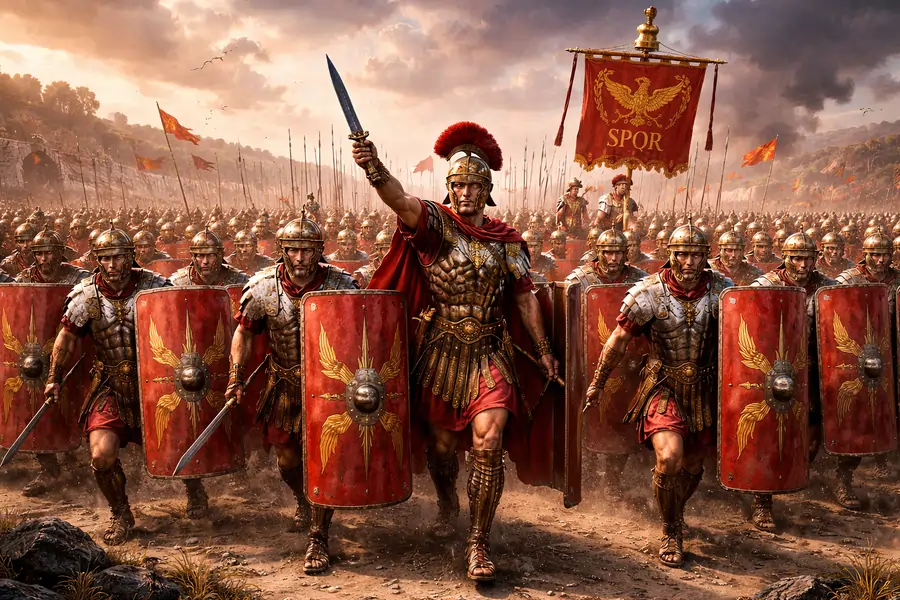
The Roman force at Cannae was enormous by ancient standards. Ancient sources estimate approximately 80,000 infantry and 6,000 cavalry—nearly double Hannibal's numbers. Command of the army alternated between the two consuls:
- Lucius Aemilius Paullus, cautious and experienced
- Gaius Terentius Varro, aggressive and politically ambitious
The Carthaginian Army
Hannibal commanded roughly 50,000 infantry and 10,000 cavalry, a diverse force of Iberians, Gauls, Libyan heavy infantry, and Numidian cavalry. Though smaller, his army was more flexible, motivated, and better led. Crucially, Hannibal possessed superior cavalry, especially on his flanks—an advantage that would prove decisive in the coming battle.
Hannibal's Cunning Strategy to Provoke the Romans
When the Carthaginians saw the Roman army, they were shocked by its huge size. The mood was grim as the Carthaginians contemplated what to do. Trapped in a foreign land, they could not afford to lose a single battle. Gisco, a Carthaginian general, is said to have commented on how much larger the Roman army was than the Carthaginians. Hannibal is said to have responded:
"Another thing that has escaped your notice, Gisgo, is even more amazing—that although there are so many of them, there is not one among them called Gisgo"
This broke the silence and lifted the grim mood. Hannibal had chosen to fight, and his army believed in him!
When there are two Roman consuls commanding the army, they alternate command of the army each day. Hannibal knew that Paullus was more cautious and level-headed. He also knew that Varro was known to be rash, and so he challenged the Roman army when he was in command. He taunted the huge Roman army by arraying his troops in front of their camp, and Varro took the bait.
The Battle Begins
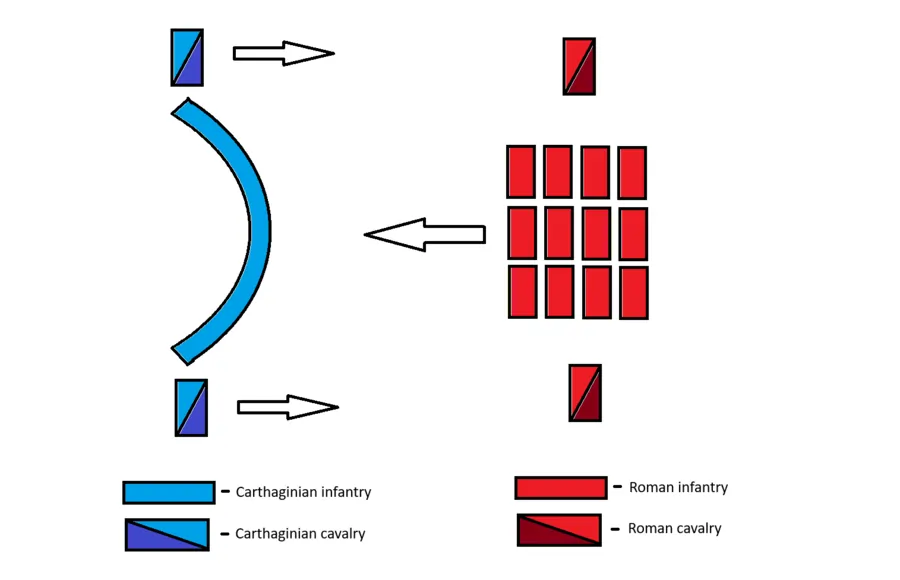
The Roman soldiers were hungry for battle. They had waited long enough with the Fabian strategy, and now they wanted blood. When the Paullus hesitated to give battle, they saw it as a sign of weakness. The largest army Rome had ever assembled, numbering almost twice that of the enemy, was afraid of engaging. At this point, the Romans had to fight anyhow or risk taking a huge blow to morale.
The Battle of Cannae unfolded as one of the most brilliant tactical maneuvers ever executed. The Romans concentrated their infantry into an unusually deep formation, abandoning flexibility in favor of raw pushing power. The plan was simple: smash through Hannibal's center and destroy his army in a single blow. They knew that they had the superiority in numbers and planned to use it to punch through the Carthaginian center. Cavalry units were placed on both flanks as usual.
Hannibal, on the other hand, placed his weakest infantry—the Gauls and Iberians—at the center in a deliberately convex formation, while his elite African infantry held the flanks. He had predicted that the Romans would use their numerical superiority to attack his weak center. The Carthaginian general was gambling on their overconfidence, and this was going to pay off.
The battle began as the troops marched slowly towards each other in unison. Hasdrubal, in the Punic left wing, charged the Roman right wing with his heavy cavalry. His heavy cavalry was composed of seasoned Celts and Spaniards. Paullus, who was commanding the cavalry in the Roman right wing, was expecting a vicious struggle. As the two clashed, some soldiers dismounted from their horses and started fighting on foot. However, the Carthaginians outnumbered and outclassed the Roman cavalry, who were routed and fled the battlefield. Paullus managed to escape the rout and joined the Roman center.
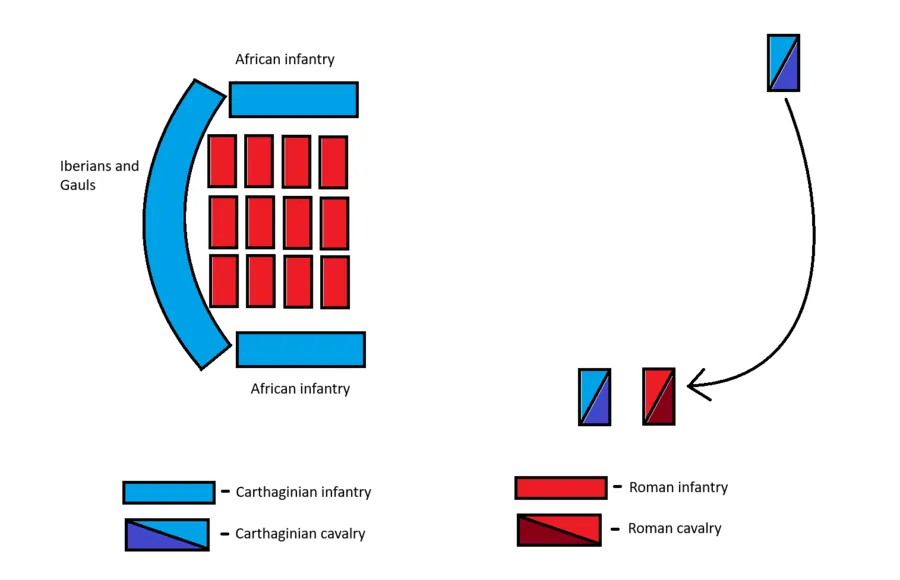
On the Punic right wing, however, the cavalry battle was evenly matched. The Numidians on the Carthaginian side were fewer in number than their Gallic and Spanish counterparts and were incapable of securing a decisive victory. Varro, who was commanding the Roman left wing, was also struggling to match the nimble Numidians as they kept throwing volley after volley of javelins. A stalemate had been achieved.
The Carthaginian Center Crumbles
As the cavalry battle took place in the wings, the Roman legions had finally reached their destination. The Gauls and Iberians in the Carthaginian center fought ferociously. However, the weight of the Roman heavy legions was pushing the Carthaginians back. Hannibal had strategically placed himself in the center to help rally his troops to fight on. This was the place where the battle would be won or lost.
The Carthaginian center slowly began to fall back. The crescent-shaped formation now began collapsing like a bubble. The pure skill and numbers of the Roman legions were showing as the Carthaginan center began to crumble. Hannibal kept pushing his troops to fight while falling back slowly. However, the Carthaginians did not have any more room to fall back. The Carthaginian center now resembled an inverse crescent as more and more Roman troops were funneled into the center.
The Trap
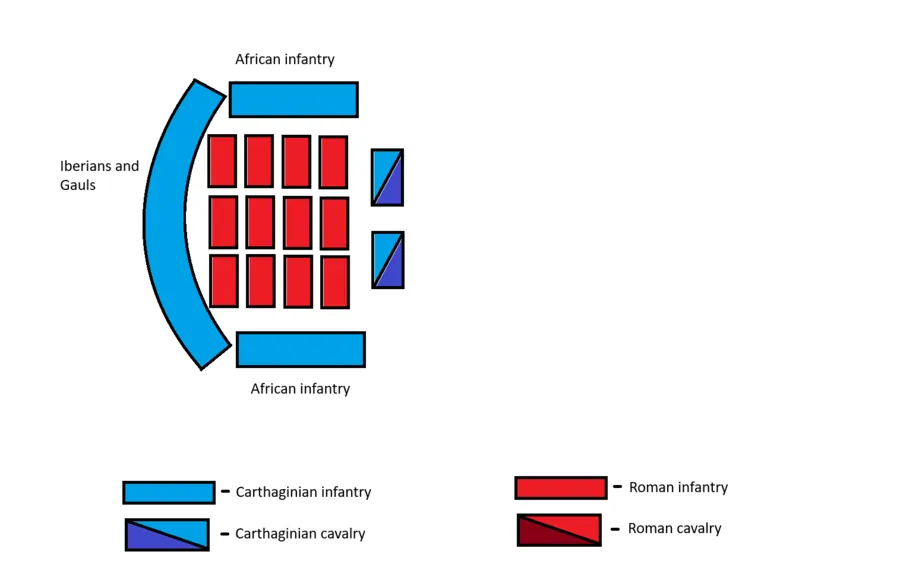
Sensing that victory was within reach and aiming for glory, the Romans broke all cohesion and charged into the center. At this point in time, Hannibal ordered his fresh Libyan troops, who were concealed by the smoke, to engage the Romans on the flanks. The Libyan troops were wearing captured Roman equipment, which added to the confusion for the Romans. Hannibal then rallied the troops in his center to hold the line and fight. The Romans were now surrounded on three sides. The situation looked dire as the Romans were corralled like cattle. It was about to get a whole lot worse.
Hasdrubal, who had routed the Roman right wing, had swung around with his troops and attacked the Roman cavalry in the left wing. Attacked on both sides, Varro and the Roman cavalry fled the battle. The Carthaginian cavalry then exercised enormous restraint not to chase the fleeing enemy cavalry and now turned its attention to the Roman center.
After rallying his cavalry, Hasdrubal then charged at the Roman rear, who had no idea what had happened. 80,000 Roman soldiers were now trapped on all sides. Hannibal had accomplished the world's first recorded double envelopment that was perfectly executed. The Romans, who were already tightly packed in formation, were now funneled into an even tighter space.
"Throw your soldiers into positions whence there is no escape, and they will prefer death to flight. If they will face death, there is nothing they may not achieve. Officers and men alike will put forth their utmost strength. Soldiers in desperate straits lose the sense of fear. If there is no place of refuge, they will stand firm."
The Slaughter Begins
Sun Tzu was wrong in this scenario. The Romans were not in a spot they would ever want to be in. They were lured into a deadly trap and caught with no escape. They were so tightly packed that many could not even raise their weapons to fight. The Romans, however, were not in the habit of surrendering without a fight. What followed was a slow, drawn-out slaughter.
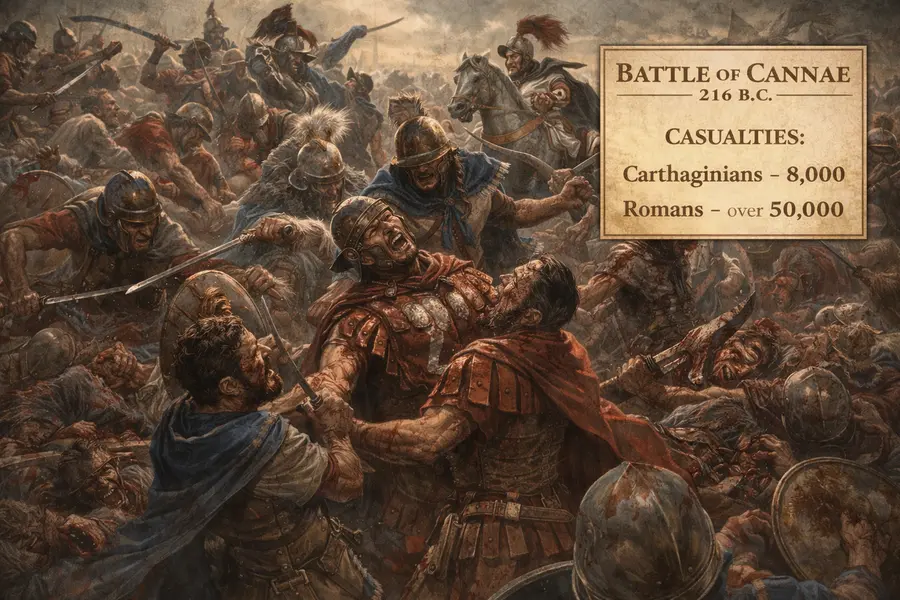
Hannibal was known to take prisoners and treat them well. However, in Cannae, no such restraint was shown. By the end of the day, dead and dying Romans were littered across the battlefield. In desperation, some Roman soldiers had dug small holes, thrust their faces into them to suffocate themselves to death. Paullus, who was trapped in the Roman center, was one of the casualties. Varro had fled the battlefield with what remained of his cavalry.
Total Roman losses in the Battle of Cannae were staggering. Rome lost about 50,000-70,000 men. In contrast, Carthage had lost only about 6,000 to 8,000 men. Rome also lost a significant portion of its leadership. One of the consuls, Paullus, was killed in the battle. 28 out of the 40 tribunes (senior ranking officers), 80 members of the senate or magistrates, and 200 Roman knights (equites) were among the casualties. 20 percent of all Roman fighting men between the ages of 18 and 50 were killed that day in Cannae. Only 14,000 Romans managed to escape that day for the Romans.
Rome never surrenders
The scale of the defeat was so huge that any empire on Earth would have given up and sued for peace. However, Rome would not give up. The Romans were in shock. They announced a national day of mourning as there was not a single family not impacted by the massacre at Cannae. They returned to their Fabian strategy of not giving battle and keeping Hannibal in check in the Italian peninsula. They will bide their time, build their strength, and strike back at the Carthaginian heartland soon.
"Assuredly, no one man has been blessed with all God's gifts. You, Hannibal, know how to gain a victory; you do not know how to use it."
Hannibal, however, didn't march on Rome immediately. The Romans began making preparations for a siege, but it never came. Hannibal had hoped that Rome would sue for peace and more of its Italian allies would join him. The Romans, however, did not discuss peace terms, and their staunch allies remained loyal to them. Hannibal's struggle would continue alone for years before he was finally recalled to defend Carthage from a Roman invasion under Publius Cornelius Scipio Africanus, culminating in the Battle of Zama.
Frequently Asked Questions
When was the Battle of Cannae and where did it take place?
The Battle of Cannae was fought on August 2, 216 BC on the plains near the village of Cannae (modern Canne) in Apulia, southern Italy. It took place during the Second Punic War between Rome and Carthage.Who won the Battle of Cannae?
The Carthaginian army commanded by Hannibal Barca decisively defeated the Roman Republic. Despite being outnumbered, Hannibal's tactics led to one of the worst defeats in Roman history.How many soldiers were killed at Cannae?
Ancient sources estimate Roman losses between 50,000 and 70,000 men, including nearly all of the consular army. Carthaginian casualties were much lower, around 6,000 to 8,000 soldiers.What tactics did Hannibal use to defeat the Romans at Cannae?
Hannibal executed a double envelopment by deliberately weakening his center and allowing the Romans to push forward. His superior cavalry crushed the Roman wings, then swung around to encircle the infantry, trapping them in a tightening pocket that led to their destruction.Why is the Battle of Cannae still studied today?
Cannae is considered a tactical masterpiece and one of the greatest battles in military history. The perfect double envelopment and the extreme disparity in casualties make it a case study in strategy at military academies worldwide.What was the longer-term impact of Cannae on Rome?
Although Rome suffered a catastrophic defeat, it refused to surrender. The loss led to a reorganization of Roman strategy, reliance on the Fabian tactics, and eventually Rome's ultimate victory in the Second Punic War. Cannae also hardened Roman resolve and motivated the creation of new legions and alliances.Related Articles