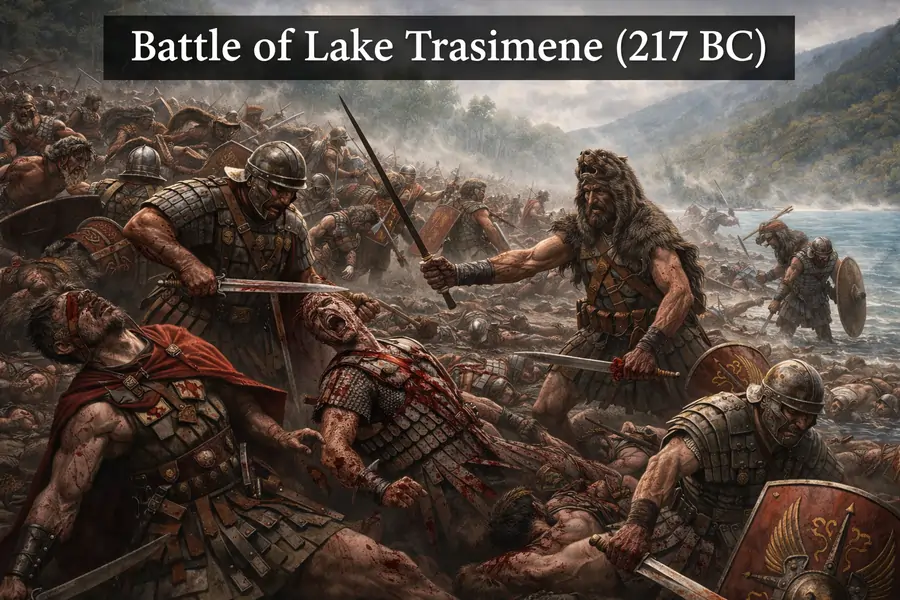
The Battle of Lake Trasimene in 217 BC stands as one of the most devastating ambushes in military history. During the early years of the Second Punic War, the Carthaginian general Hannibal Barca lured the Roman army into a carefully prepared trap beside the mist-covered shores of Lake Trasimene in central Italy. Within a few hours, thousands of Roman soldiers were slaughtered or forced into the lake as Hannibal's hidden forces attacked from every direction. The battle not only destroyed an entire Roman army but also demonstrated Hannibal's tactical brilliance, sending shockwaves through the Roman Republic and reshaping the course of the war.
Table of Contents
- Background: The Second Punic War and Hannibal's Invasion of Italy
- The Strategic Situation in Early 217 BC
- Geography of the Battlefield
- The Armies at Lake Trasimene
- Hannibal's Masterful Ambush Plan
- The Battle Unfolds
- Casualties and Immediate Outcome
- Roman Reaction: Panic and the Fabian Strategy
- Why the Battle Was So Devastating
- The Legacy of the Battle
Background: The Second Punic War and Hannibal's Invasion of Italy
The Battle of Lake Trasimene was part of a wider conflict, which was the Punic Wars. The clash was one of the major battles of the Second Punic War (218-201 BC), the epic struggle between Rome and Carthage for control of the western Mediterranean. This war followed decades after the earlier confrontation between the two powers in the First Punic War, where Rome became a naval power with tactical innovation and perseverance.
Hannibal Barca, the brilliant Carthaginian commander, had sworn to be an enemy of Rome. Determined to challenge Roman dominance, Hannibal launched a bold campaign in 218 BC that would earn him a legendary status in military history. Instead of attacking Rome directly by sea, he led his army from Iberia across southern Gaul and over the Alps into northern Italy. The crossing of the Alps with 50,000 soldiers was a legendary achievement.
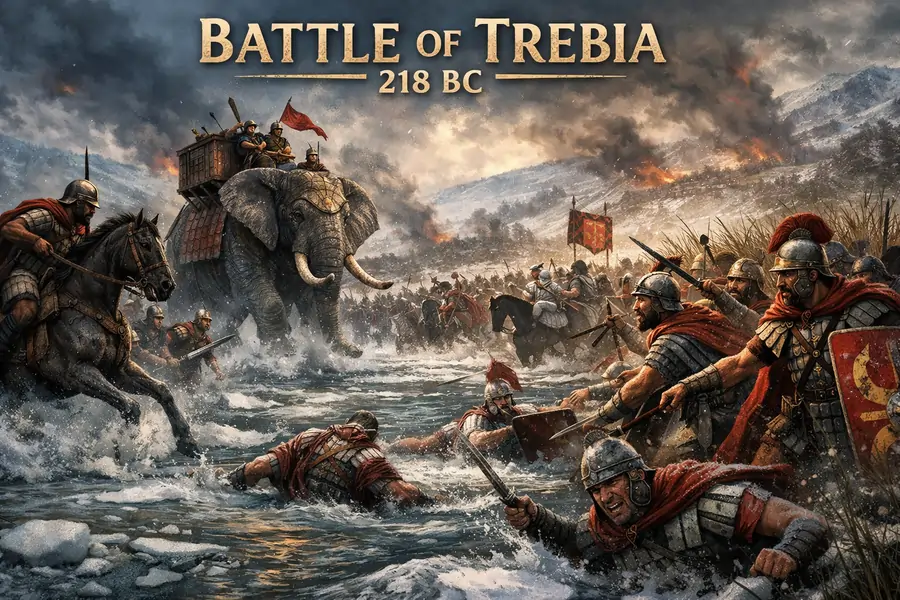
Once in Italy, Hannibal quickly replenished his troops and demonstrated his tactical genius. He defeated the Roman forces at the Battle of Ticinus and then inflicted a crushing defeat at the Battle of Trebia (218 BC). These victories boosted the morale of his troops and encouraged Gallic tribes in northern Italy to join his cause, increasing the size and strength of his army.
Despite these setbacks, Rome still possessed enormous manpower and resources. Roman leaders believed that with determination, they could eventually crush the invading Carthaginian army. In 217 BC, the Roman consul Gaius Flaminius was tasked with confronting Hannibal and preventing him from advancing deeper into Italy. What followed next was one of the most catastrophic Roman defeats ever recorded.
The Strategic Situation in Early 217 BC

After his victory at Trebia, Hannibal spent the winter reorganizing his forces and strengthening alliances among the Gallic tribes of northern Italy. Since he could not be supplied from Carthage, local alliances were crucial for continuing the war in Italy. By the spring of 217 BC, he commanded a formidable army of more than 50,000 men composed of Iberians, Gauls, Africans, and Numidian cavalry. These were troops of different origins but united under a brilliant military commander.
The Romans were still shocked by their defeat in Trebia, but they were not going to give up so easily. They prepared for another campaign and raised two consular armies to counter Hannibal's advance. One army under Gaius Flaminius moved into Etruria (modern Tuscany), hoping to intercept Hannibal before he could threaten central Italy. Another Roman force under the consul Gnaeus Servilius Geminus marched to support him.
Hannibal understood that the Romans would aggressively try to engage him in battle if he began raiding their territory. The Romans could not afford to have Hannibal threatening their allies. He therefore marched through the Apennine Mountains into Etruria, devastating the countryside as he advanced. Villages were burned, crops destroyed, and Roman allies terrorized.
This strategy of provoking the Romans worked like a charm. Flaminius, angered by the devastation and eager to prove himself in battle, rushed to pursue the Carthaginian army. He did not wait to link up with the army marching under Geminus. This mistake would prove to be extremely costly for the Romans.
Geography of the Battlefield
Lake Trasimene lies in central Italy, surrounded by continuous hills and narrow valleys. The northern shoreline forms a natural corridor between the lake itself and the rising hills to the north. In ancient times, this corridor was even narrower due to higher water levels and marshy terrain. The terrain was ideal for setting up an ambush.
Hannibal recognized the strategic potential of this landscape immediately. The road along the northern shore forced any army traveling through the area into a confined space between the lake and the hills. Once an army entered this bottleneck, it would have very limited room to deploy or maneuver. Hannibal would exploit this vulnerability to the fullest in the coming battle.
Hannibal positioned his troops along the hills overlooking the road. Heavy infantry were concealed behind ridges, while cavalry and lighter troops waited to block escape routes. The Carthaginian commander carefully arranged his army so that once the Romans entered the valley, they would be attacked simultaneously from the front, flanks, and rear. The narrow terrain ensured that once trapped, there was no possibility of escape.
The Armies at Lake Trasimene
Both sides brought significant forces to the battlefield, although the Roman army was poorly positioned and unprepared for what awaited them.
Carthaginian Army
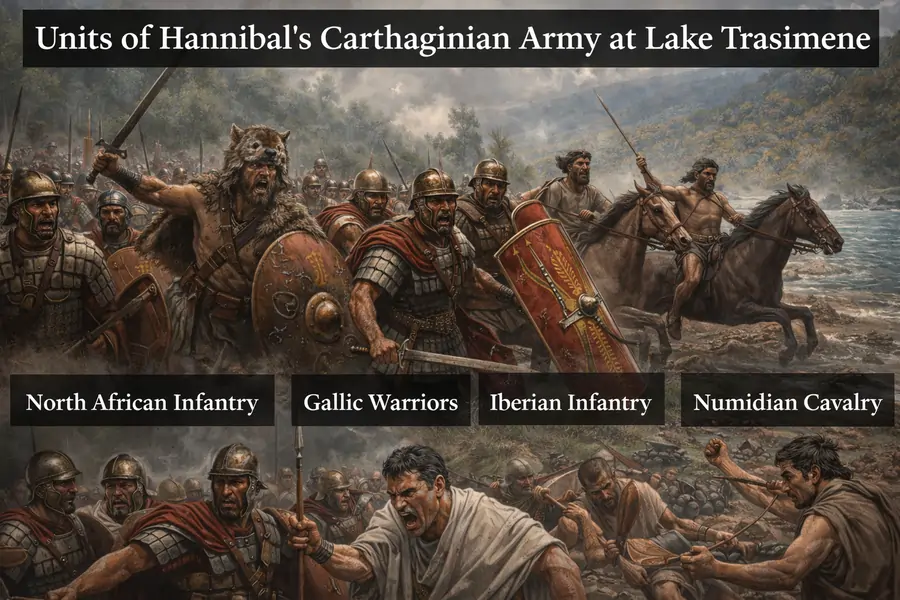
Hannibal's army was a diverse group of mercenaries and conscripts. His army included North African heavy infantry, Iberian swordsmen, Gallic warriors, Numidian light cavalry, and Balearic slingers. Unfortunately, there were no elephants available for Hannibal to deploy for the battle, as all of them had already perished. Despite being an army of multiple cultures, they were organised and efficient on the battlefield. The army's flexibility and experience allowed Hannibal to execute complex battlefield maneuvers. In total, the Carthaginians had over 50,000 troops at their disposal.
Roman Army
The Roman army under Flaminius consisted of roughly four legions and allied infantry, totaling around 25,000 soldiers. The Roman legions were disciplined and formidable in open battle. However, their strength depended on organized formations and coordinated movements. Unfortunately for the Romans, the terrain at Lake Trasimene made it impossible to form a proper battle line. The Roman infantry was therefore not able to perform to its full potential.
Hannibal's Masterful Ambush Plan
The Battle of Lake Trasimene remains one of the largest ambushes ever executed in military history. During the night before the battle, Carthaginian troops quietly moved into concealed positions along the hills overlooking the road. Hannibal asked his troops to light fires in the distant hills to mislead Roman scouts into believing that the enemy army was still several miles away.
At dawn, Flaminius' army marched along the lakeshore road in a long column. There was a thick morning fog that further reduced visibility. The Roman troops were not expecting a fight as they thought that the enemy was still miles away. When most of the Roman troops had entered the narrow valley, Hannibal sprung his trap.
There was a small Carthaginian force blocking the end of the narrow valley. As soon as the Roman column engaged these troops, they could hear trumpets from the hills to the side and their rear. This confused the Roman troops as they could hear the trumpets, but the fog meant they could not see any enemy troops yet. Carthaginian troops suddenly surged down from the hills. Hidden infantry attacked the Roman flanks while cavalry cut off the rear. The Roman army was surrounded before it even realized a battle had begun.
The Battle Unfolds
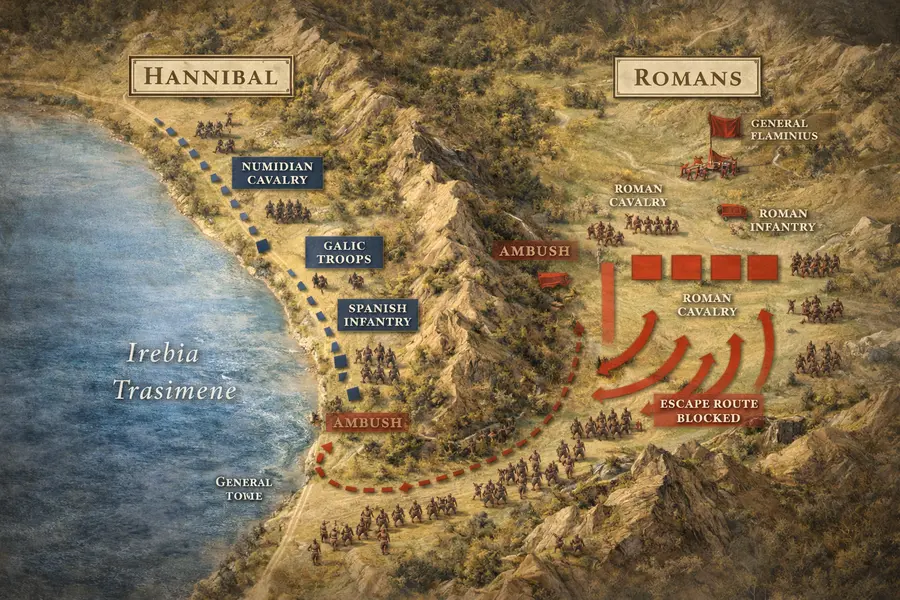
The fighting at Lake Trasimene was chaotic and brutal. This was the most successful military ambush involving such a large army. Roman soldiers found themselves attacked from all sides and were unable to fall into a proper formation. Units became separated and disorganized as they were unaware of what was unfolding before their eyes.
For nearly three hours, desperate fighting erupted across the valley. Roman soldiers attempted to form defensive lines, but the narrow terrain and constant attacks made coordination impossible. Many Romans were pushed into the lake itself. Some attempted to swim to safety, but heavy armor dragged them under the water, and they drowned. Many others were slaughtered where they stood by the Carthaginians.
The Gallic warriors and Iberian infantry struck the Roman formations with ferocity, while Numidian cavalry hunted down any groups attempting to escape. In the chaos of the battle, a Gallic warrior named Ducarius saw the Roman consul Gaius Flaminius fighting for his life. Ducarius saw the opportunity to avenge his fellow Gauls who were killed by the Romans and charged. He bravely fought through the Romans and struck down the Roman commander. With their commander dead and their army surrounded, Roman resistance gradually collapsed.
Casualties and Immediate Outcome
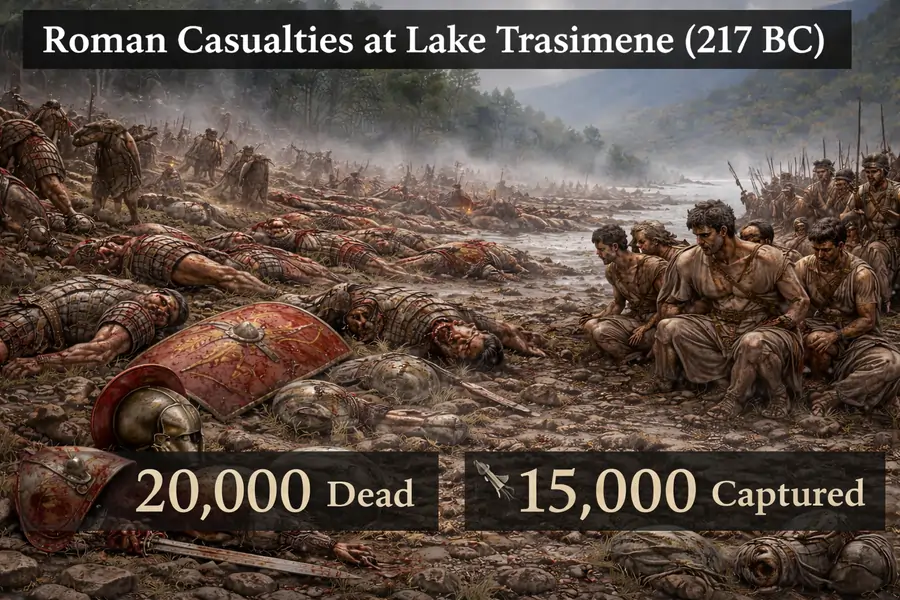
The Battle of Lake Trasimene was one of the most one-sided battles of ancient history. The Roman army was lured into a trap and annihilated. Approximately 15,000 Roman soldiers were killed during the fighting, while another 6,000-10,000 were captured after attempting to escape. Carthaginian losses were comparatively light, likely numbering around 1,500 to 2,500 men killed. There were also a few thousand wounded.
The destruction of Flaminius' army shocked the Roman world. Entire Roman legions had been wiped out in a matter of hours. News of the disaster spread rapidly, causing panic throughout the Roman Republic. Hannibal's army roamed freely through central Italy, devastating Roman territory and encouraging Rome's allies to revolt. Rome was on the verge of collapse.
Roman Reaction: Panic and the Fabian Strategy
The defeat at Lake Trasimene caused widespread panic among the population of Rome. The Senate feared that Hannibal might march directly on the city itself. Rome was now facing an existential crisis. In times of desperate need, Rome would appoint a dictator to stabilize the situation by any means necessary. The Roman Senate appointed Quintus Fabius Maximus as dictator of Rome to handle the crisis with Hannibal. Unlike earlier commanders, Fabius recognized that confronting Hannibal directly in battle was extremely dangerous.
The Roman army was depleted, and Roman morale was in tatters. Any large engagement with Hannibal was sure to end up in disaster. To combat this, Fabius adopted a cautious strategy that later became known as the Fabian strategy. Fabius avoided direct engagement with the Carthaginian general and focused on harassing Hannibal's supply lines while shadowing his movements. This helped to keep Hannibal in check while avoiding the risk of a pitched battle.
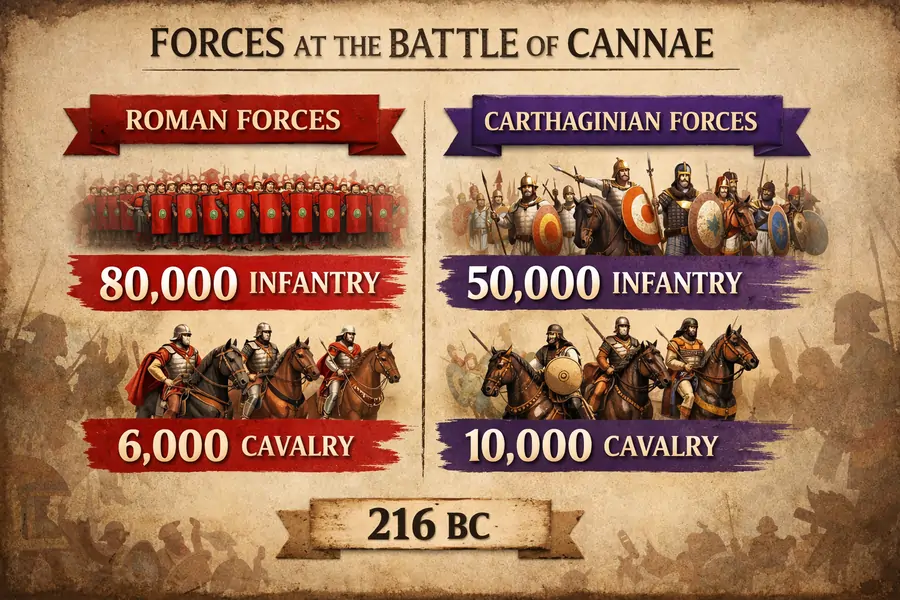
This strategy was effective as Hannibal was desperate to fight decisive battles due to his poor supply situation. It also gave time for Rome to raise a larger army. However, this frustrated many Romans who desired immediate revenge. The Romans were too proud to admit their dire situation and wanted to settle scores for their defeats in Trebia and Lake Trasimene. Roman impatience eventually led to another massive confrontation with Hannibal the following year at the Battle of Cannae (216 BC), where Rome suffered an even greater defeat.
Why the Battle Was So Devastating
Several factors combined to make Lake Trasimene one of Rome's worst military disasters. The narrow corridor between the hills and the lake prevented the Romans from deploying their legions properly. The fog from the lake impacted visibility, and the Romans were unaware of the Carthaginian troops surrounding them until it was very late. Once trapped inside the valley, maneuvering became impossible.
The battle was the largest ambush in history, and hostilities began suddenly with no warning. Roman troops were not in formation and were disorganized and vulnerable. They were also outnumbered and surrounded. Most of the troops were struggling to escape the massacre rather than fight in an organised manner.
Hannibal used clear tactics and provocation to lure the Romans to fight. His careful planning and coordination allowed the Roman troops to be funneled into a narrow corridor with no hope of escape. The Roman army was destroyed, with very few troops escaping the battlefield alive. The Roman consul Flaminus was also among the casualties.
The Legacy of the Battle
The Battle of Lake Trasimene has fascinated historians and military strategists for centuries. It remains one of the largest successful ambushes in recorded military history. Hannibal's victory demonstrated that even Rome's powerful legions could be destroyed if caught in unfavorable conditions. The battle completely broke the Roman morale and bolstered the confidence of the Carthaginian troops.
Today, many historians include Hannibal among the greatest military generals in history, alongside figures such as Alexander the Great and Napoleon. The battle is also frequently listed among the most decisive battles in world history due to its enormous psychological and strategic impact on Rome.
Although Rome would ultimately recover and win the long war against Carthage, the shock created by the decisive loss at Trasimene forced Roman leaders to rethink their military strategy. They were also forced to appoint a dictator, which showed how dire the situation was for Rome. More than two thousand years later, the battle still stands as a powerful reminder that tactical brilliance and careful planning can overcome even the most formidable military forces.
Frequently Asked Questions
What was the Battle of Lake Trasimene?
The Battle of Lake Trasimene was fought in 217 BC during the Second Punic War between Rome and Carthage. Carthaginian general Hannibal Barca ambushed a Roman army led by the consul Gaius Flaminius near Lake Trasimene in central Italy. Using the surrounding hills and morning fog to conceal his forces, Hannibal trapped the Roman army and destroyed it in one of the largest ambushes in military history.
Who won the Battle of Lake Trasimene?
The Battle of Lake Trasimene was a decisive victory for Hannibal and the Carthaginian army. The Roman force led by Consul Gaius Flaminius was surrounded and almost completely destroyed during the ambush.
Why was the Battle of Lake Trasimene important?
The Battle of Lake Trasimene was important because it was one of Rome's worst defeats and demonstrated Hannibal's tactical brilliance. The destruction of an entire Roman army shocked the Roman Republic and forced Rome to adopt the cautious Fabian strategy during the Second Punic War.
Where was the Battle of Lake Trasimene fought?
The Battle of Lake Trasimene was fought along the northern shore of Lake Trasimene in central Italy, in the region known in antiquity as Etruria (modern Tuscany). The narrow valley between the lake and surrounding hills allowed Hannibal to launch his famous ambush.
How many Romans died at the Battle of Lake Trasimene?
Ancient historians estimate that around 15,000 Roman soldiers were killed during the Battle of Lake Trasimene, while several thousand more were captured. The battle resulted in the near destruction of the Roman army under Consul Gaius Flaminius.
How did Hannibal defeat the Romans at Lake Trasimene?
Hannibal defeated the Romans by setting up a carefully planned ambush. His troops hid in the hills surrounding the narrow road along Lake Trasimene and attacked once the Roman army marched into the valley. The Romans were trapped between the lake and the hills and were unable to form proper battle lines, allowing the Carthaginian army to surround and overwhelm them.