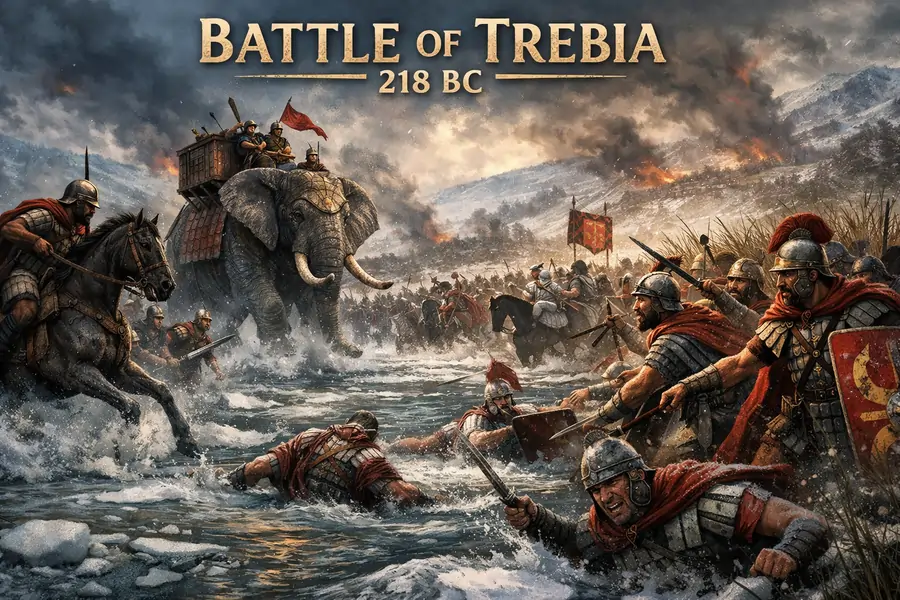
The Battle of Trebia (218 BC) was one of the first major battles of the Second Punic War between the Roman Republic and Carthage. Fought near the Trebia River in northern Italy, the battle ended in a decisive victory for Hannibal Barca, who used superior cavalry, an ambush, and harsh winter conditions to destroy a larger Roman army. The defeat marked the first major Roman battlefield disaster against Hannibal and demonstrated the Carthaginian general's exceptional tactical skill.
The battle occurred in December 218 BC after Hannibal executed his daring plan to invade the Italian peninsula across the Alps. Roman forces under the consul Tiberius Sempronius Longus were sent to intercept Hannibal. However, they were lured into crossing the freezing Trebia River before the fight, leaving them cold, hungry, and exhausted. Hannibal then launched a carefully planned attack that caught the Romans between his army and a hidden ambush force led by his brother Mago Barca.
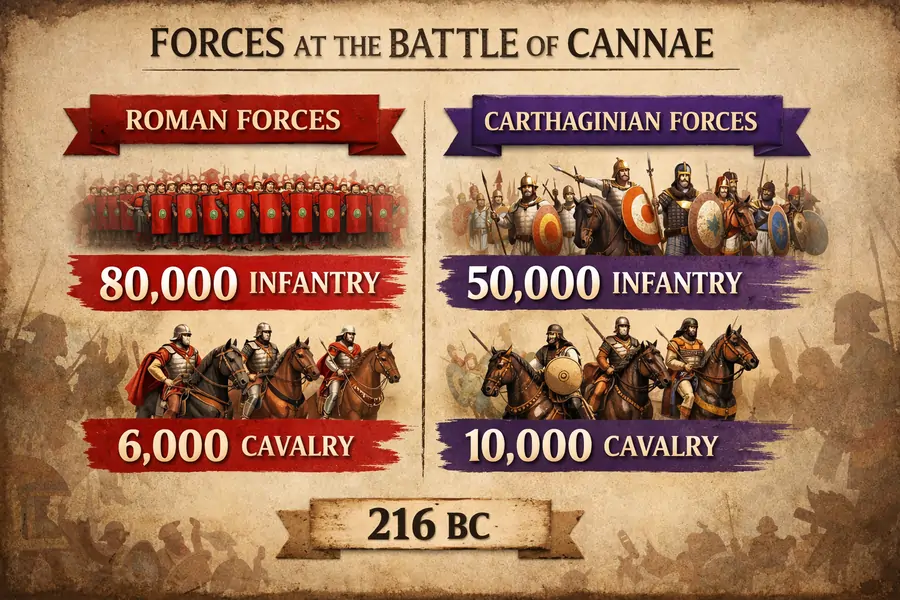
The result was an unexpected, catastrophic defeat for Rome. Thousands of Roman soldiers were killed on the battlefield. Many more were drowned in the freezing Trebia River while trying to retreat. The Carthaginian army had gotten its first major victory on Italian soil. The Battle of Trebia was the beginning of a series of devastating defeats for the proud Roman army. It would soonbe followed by the Battle of Lake Trasimene (217 BC) and the legendary Battle of Cannae (216 BC).
The Battle of Trebia was a crucial victory for Hannibal during the early stages of the Second Punic War. The battle proved Hannibal's military brilliance and motivated his men. Carthage was now capable of challenging the Romans on land in their own backyard. This victory would help Hannibal recruit more allies to join his depleted army.
Table of Contents
- Background: The Road to the Battle of Trebia
- Hannibal's Daring Invasion of Italy
- Early Fighting Before the Battle of Trebia
- Commanders at the Battle of Trebia
- Armies at the Battle of Trebia
- Hannibal's Strategy Before the Battle
- The Morning of the Battle
- Crossing the Trebia River
- Deployment of the Armies
- The Battle Begins
- Cavalry Dominance
- The Ambush of Mago
- Roman Collapse
- Roman Escape
- Casualties
- Why Hannibal Won the Battle
- Significance of the Battle of Trebia
- Roman Response
- Conclusion
Background: The Road to the Battle of Trebia
The Rivalry Between Rome and Carthage
The Second Punic War (218–201 BC) was the continuation of a series of wars between Rome and Carthage, two of the most powerful states in the ancient Mediterranean world. The conflict had its roots in the First Punic War (264–241 BC), during which Rome built its navy and defeated Carthage to gain control of Sicily. The loss severely weakened Carthage's economy, military, and political standing.
However, Carthage soon rebuilt its strength in the silver mine-rich Spain (Iberia). Under the leadership of the powerful Barcid family, particularly Hamilcar Barca, the father of Hannibal Barca. Carthage established a strong military and economic base in the region. After Hamilcar's death, leadership eventually passed to his son Hannibal Barca, who had grown up with deep hatred toward Rome. According to Roman historians, Hannibal swore an oath as a child that he would never be a friend of Rome.
The Spark That Started the War
Tensions escalated over the city of Saguntum, located in eastern Spain. According to the agreement signed after the First Punic War, any territory south of the Ebro River was under Carthage's sphere of influence. Although Saguntum was south of the Ebro River, which was meant to divide Roman and Carthaginian influence, it appealed to Rome for help.
In 219 BC, Hannibal besieged and captured Saguntum. The entire adult population of the city was put to death. Rome demanded that Carthage hand Hannibal over for punishment or face war. When Carthage refused, Rome declared war in 218 BC, beginning the Second Punic War.
Hannibal's Daring Invasion of Italy
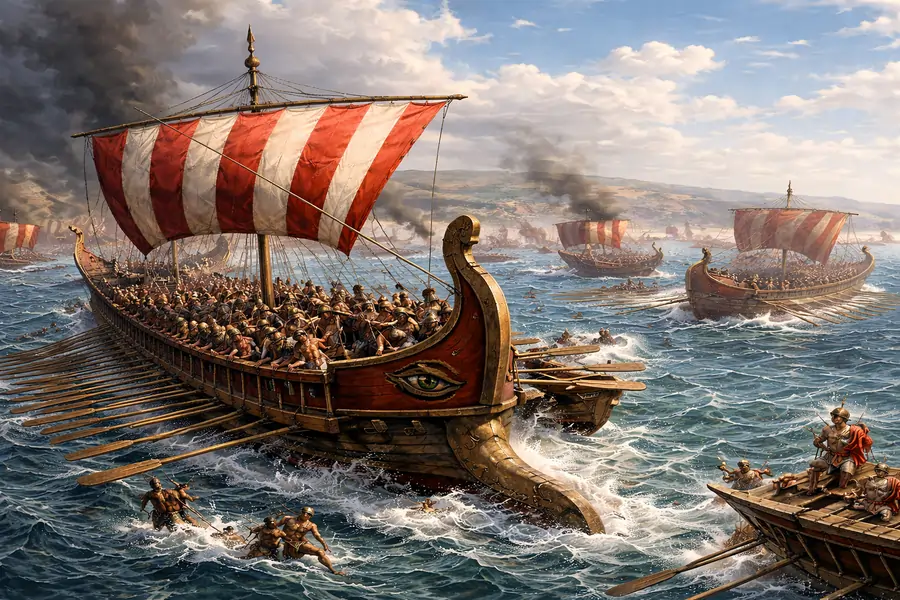
Carthage had lost its naval superiority by the end of the First Punic War. Hannibal was therefore unable to engage them at sea or land any forces in Italy by transport ships. Rather than waiting for the Romans to attack Spain or Carthage, Hannibal launched one of the boldest campaigns in military history. He took the initiative by invading the Italian mainland by land, over the Alps!
The Crossing of the Alps
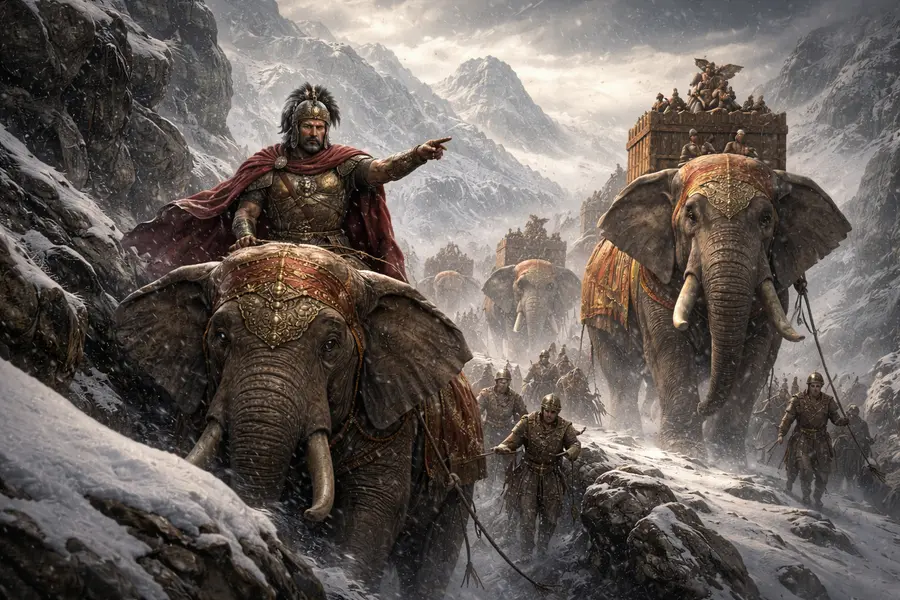
Hannibal marched his army of 38,000-50,000 infantry, 8,000-9000 cavalry, and 37 war elephants from Spain across southern Gaul and into the Alps. This was an incredible journey that remains one of the most famous military operations in history.
The Alpine crossing was an extremely dangerous endeavour. The harsh weather and treacherous terrain made each step a nightmare. There were also hostile mountain tribes that constantly harassed Hannibal's forces and inflicted severe casualties. Despite these hardships, Hannibal successfully entered northern Italy with a battle-ready army.
Allies in Northern Italy
When Hannibal reached Northern Italy, his army was severely depleted. Only about 20,000 to 25,000 of his infantry and 6,000 of his cavalry survived the trek. However, Northern Italy was inhabited by several Gallic tribes who resented Roman rule. The Romans were constantly at war with the Gauls and suppressing rebellions. Hannibal hoped that the common enmity toward Rome would help him recruit the Gauls to his army. His arrival sparked uprisings among these tribes, and many warriors joined the Carthaginian army. This provided Hannibal with additional manpower and valuable knowledge of the region.
Early Fighting Before the Battle of Trebia
Before the Battle of Trebia, there were a few small skirmishes. Hannibal had already defeated Roman forces in a smaller engagement known as the Battle of the Ticinus River (218 BC). In this battle, Hannibal used his superior Numidian cavalry to defeat the Roman forces. The Roman commander Publius Cornelius Scipio was wounded during the fight and was saved by the bravery of his son Scipio Africanus. Following this defeat, Roman forces retreated toward the Trebia River and waited for reinforcements led by the consul Tiberius Sempronius Longus.
Commanders at the Battle of Trebia
Hannibal Barca
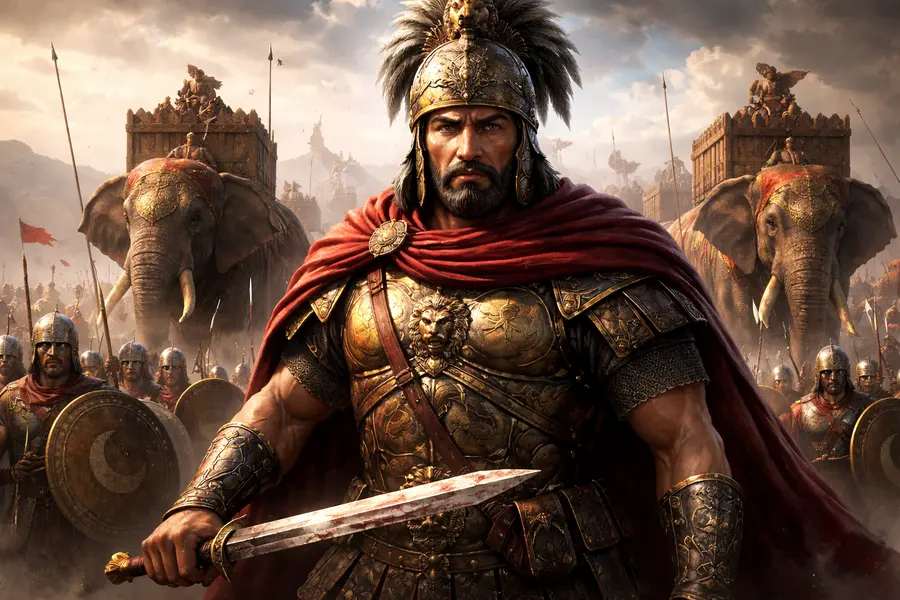
Hannibal Barca is widely regarded as one of the greatest military commanders in history. He predicted the actions of his enemy and decisively countered them. He also exploited the superiority of the Carthaginian cavalry to its full potential. At Trebia, Hannibal carefully designed a battle plan that would exploit Roman aggression and impatience.
Tiberius Sempronius Longus
The Romans considered Hannibal as just a minor annoyance. The Roman consul Tiberius Sempronius Longus was eager to win a decisive victory to gain glory. Unlike his colleague Scipio, who preferred caution, Sempronius wanted immediate battle. Hannibal would use this eagerness and impatience to bring the Roman army to its knees.
Armies at the Battle of Trebia
Roman Army
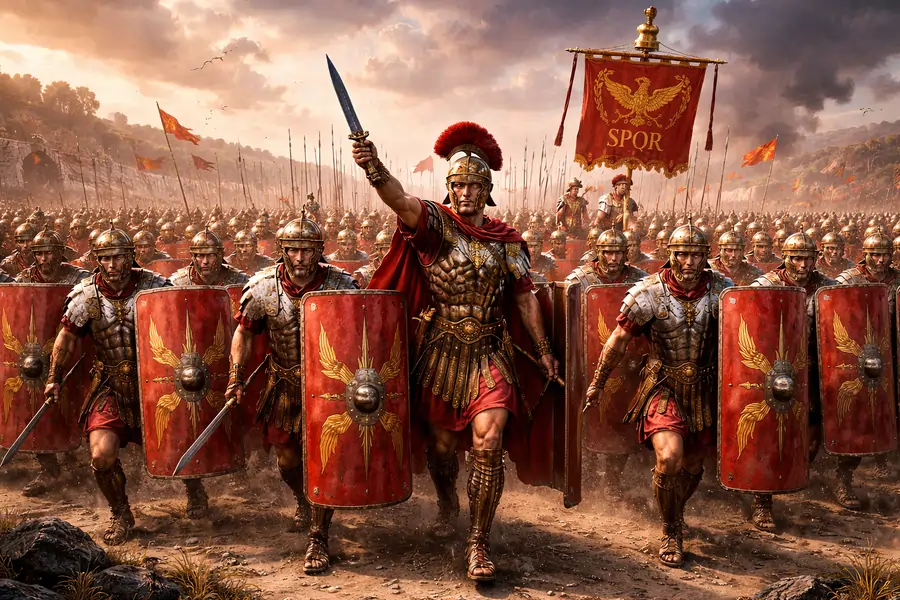
The Roman army likely numbered around 40,000 soldiers with about 4,000 cavalry. It consisted of Roman legions supported by allied Italian troops. Roman military doctrine relied heavily on disciplined infantry formations supported by cavalry on the flanks. The Roman heavy infantry was skilled and undefeated in battle.
Carthaginian Army
Hannibal commanded an army of roughly 40,000 troops with about 11,000 cavalry and about 30 war elephants. His army was composed of a diverse mixture of forces:
- African heavy infantry
- Iberian infantry
- Celtic warriors
- Numidian light cavalry
- Heavy cavalry
- War elephants
The Numidian cavalry was especially effective due to its mobility and skill in skirmishing.
Hannibal's Strategy Before the Battle
The Romans did not consider the Carthaginians as a major threat in a pitched battle. Hannibal anticipated that Roman commanders would rush into battle if provoked. He hatched a cunning plan to catch the Romans off guard. Hannibal secretly sent his brother Mago Barca with around 2,000 soldiers to hide near the battlefield. These troops would later launch a surprise attack from the rear that would take the Romans completely by surprise.
The Morning of the Battle
The Battle of Trebia took place on a cold winter morning of December 218 BC. Hannibal had instructed his troops to eat well and rest the day before the battle properly. The Romans, however, were asked to be in a constant state of alertness and did not have proper rest.
Hannibal then sent his Numidian cavalry to provoke the Roman camp. They attacked the Roman camp briefly before retreating across the Trebia River. Sempronius was furious with the attack and ordered the entire Roman army to pursue them. The Roman soldiers were rushed from their sleep and had to march out without having breakfast.
Crossing the Trebia River
The hungry Roman army had to cross the freezing waters of the Trebia River early in the morning, chasing the nimble Numidians. This left the Roman soldiers:
- Cold, freezing and exhausted
- Hungry
- Disorganized
Meanwhile, Hannibal's army was warm, rested, and ready. The stage was now set for the final clash.
Deployment of the Armies
Roman Formation
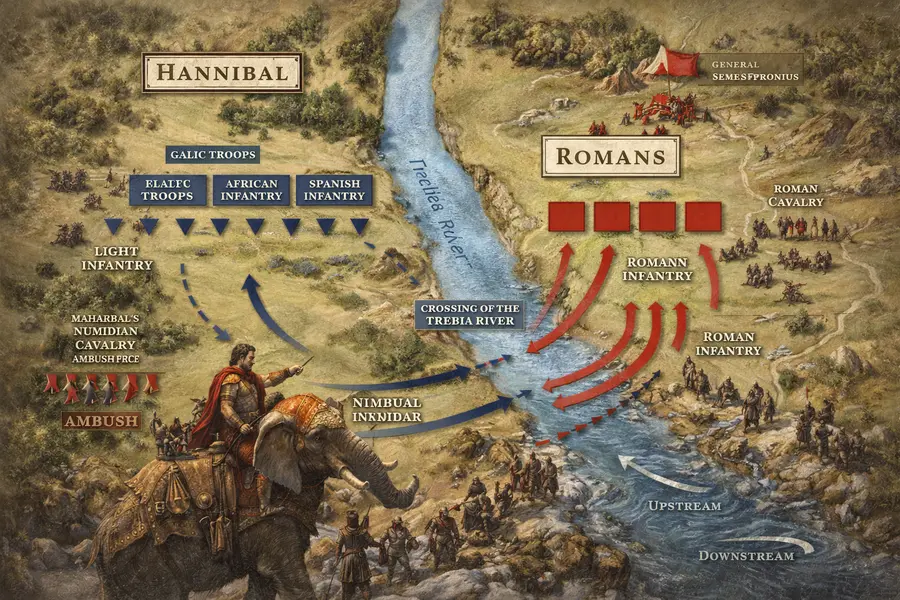
The Roman army deployed its heavy infantry in the center with cavalry on both wings and light troops positioned at the front. This was the standard Roman formation, and the Romans favored a direct frontal attack to punch through the enemy's center.
Carthaginian Formation
Hannibal, who had planned for all this, had arranged his forces carefully:
- Iberian and Celtic infantry in the center
- African infantry on the flanks
- Strong cavalry units on both wings
- War elephants at the front
Mago's hidden force of 2,000 troops waited nearby for the right moment to strike.
The Battle Begins
The battle opened with skirmishing between light troops without any clear victor. Soon, the main infantry forces clashed. Immediately, the difference in class of the heavy infantry troops began to show. The Roman infantry pushed the Carthaginian center backward. However, Hannibal's plan was unfolding exactly as intended.
Cavalry Dominance
The Roman cavalry was hopelessly outmatched in terms of skill and numbers on the flanks. The Carthaginian cavalry soon overwhelmed the Roman cavalry on both flanks. The Roman cavalry was driven off the battlefield, and the Carthaginian horsemen swung around to attack the Roman infantry from the sides. The Roman infantry was in disarray as they were being attacked from three sides.
The Ambush of Mago
At the decisive moment, Mago Barca launched his hidden ambush force against the Roman rear. The Roman army suddenly found itself surrounded:
- Carthaginian infantry in front
- Cavalry on both flanks
- Ambush troops attacking from behind
Roman Collapse
The Roman army was already hard pressed from three sides and crumbling under the onslaught. When Mago's troops hit them from the rear, they collapsed entirely. Morale plummeted, and the troops began to abandon their weapons and retreat. Some tried to cross the freezing Trebia River and drowned; most were killed where they stood. The freezing conditions and exhaustion made the situation even worse for the Romans.
Roman Escape
Unlike the Battle of Cannae, which would be fought years later, the disaster in Trebia was not complete. Around 10,000 Roman soldiers managed to break through the Carthaginian center and escape to safety. This proved that even when surrounded, the elite Roman heavy infantry were capable of punching through the Carthaginian infantry.
Casualties
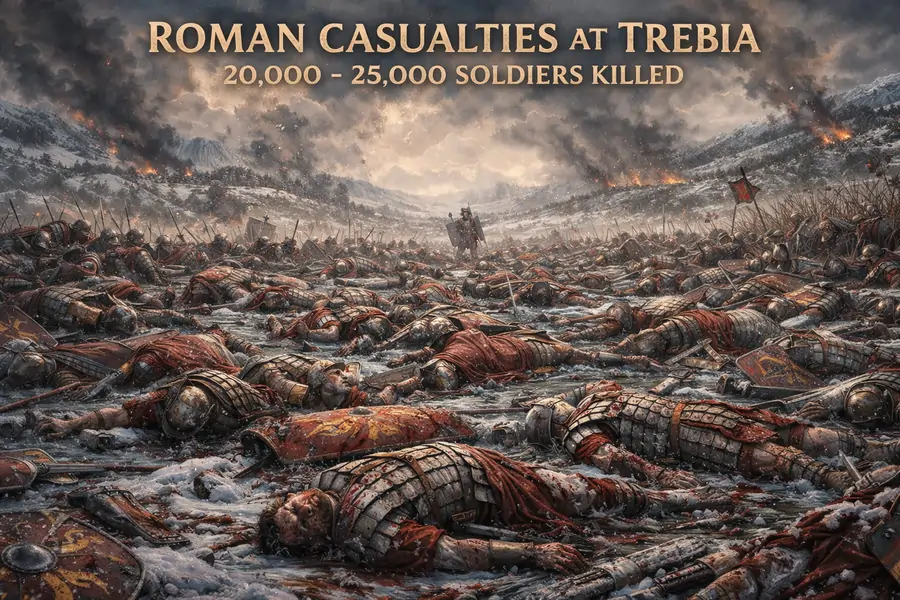
Historians estimate that the Romans lost about 20,000 soldiers killed and thousands captured. Most of their cavalry, however, escaped. Carthaginian casualties were significantly lower, with only a few thousand killed. The Romans had lost half of their army.
Why Hannibal Won the Battle
- The Numidian cavalry was vastly superior to their Roman counterparts and played a significant role in dictating the terms of the battle.
- Hannibal had carefully planned an ambush attack that took the Romans completely by surprise.
- Effective use of terrain and harsh winter conditions severely weakened the Roman troops and reduced their morale.
- The overconfidence of the Romans was thoroughly exploited by Hannibal.
Significance of the Battle of Trebia
The Battle of Trebia was one of the most significant battles of the Second Punic War.
- It was Hannibal's first major victory in Italy. This helped bolster the morale of his troops after their perilous trip across the Alps.
- It helped Hannibal gain the trust of the Gallic tribes. This was essential in recruiting more troops.
- It shattered Roman confidence. Before this battle, the Romans did not believe that they could lose a significant land battle against the Carthaginians.
- It paved the way for later victories at Lake Trasimene and Cannae.
Roman Response
Despite the crushing defeat, Rome refused to surrender. The Roman Republic raised new armies and continued to fight Hannibal. They challenged Hannibal again in the Battle of Lake Trasimene, suffering another crushing defeat. This forced the Roman leaders to adopt the cautious Fabian Strategy, avoiding confrontation with Hannibal while gradually weakening his forces.
Conclusion
The Battle of Trebia (218 BC) marked the beginning of Hannibal's devastating campaign against Rome in Italy. Exploiting Roman overconfidence and the strength in his cavalry, he outwitted and destroyed the proud Roman army. Hannibal's military brilliance established him as one of history's greatest military commanders. Although Rome would eventually win the Second Punic War, the defeat at Trebia remains a powerful reminder of Hannibal's extraordinary leadership. Hannibal would forever be remembered as Rome's greatest enemy in ancient military history.
Frequently Asked Questions
When was the Battle of Trebia fought?
The Battle of Trebia was fought in December 218 BC during the early stages of the Second Punic War between the Roman Republic and Carthage. It was one of the first major battles of Hannibal's campaign in Italy.
Who fought in the Battle of Trebia?
The Battle of Trebia was fought between the Roman Republic and Carthage. The Roman army was commanded by the consul Tiberius Sempronius Longus, while the Carthaginian forces were led by the famous general Hannibal Barca.
Where did the Battle of Trebia take place?
The battle took place near the Trebia River in northern Italy, close to the Roman colony of Placentia. The freezing winter conditions and the river crossing played a crucial role in weakening the Roman army before the battle began.
Why did Hannibal win the Battle of Trebia?
Hannibal won the Battle of Trebia by using superior cavalry, a carefully planned ambush, and the harsh winter conditions to his advantage. He lured the Roman army into crossing the freezing Trebia River, leaving them cold and exhausted before launching a coordinated attack with infantry, cavalry, and a hidden ambush force.
Why was the Battle of Trebia important?
The Battle of Trebia was important because it was Hannibal's first major victory over Rome during the Second Punic War. The defeat shocked the Romans, encouraged Gallic tribes to join Hannibal, and set the stage for further Carthaginian victories such as the Battle of Lake Trasimene and the Battle of Cannae.