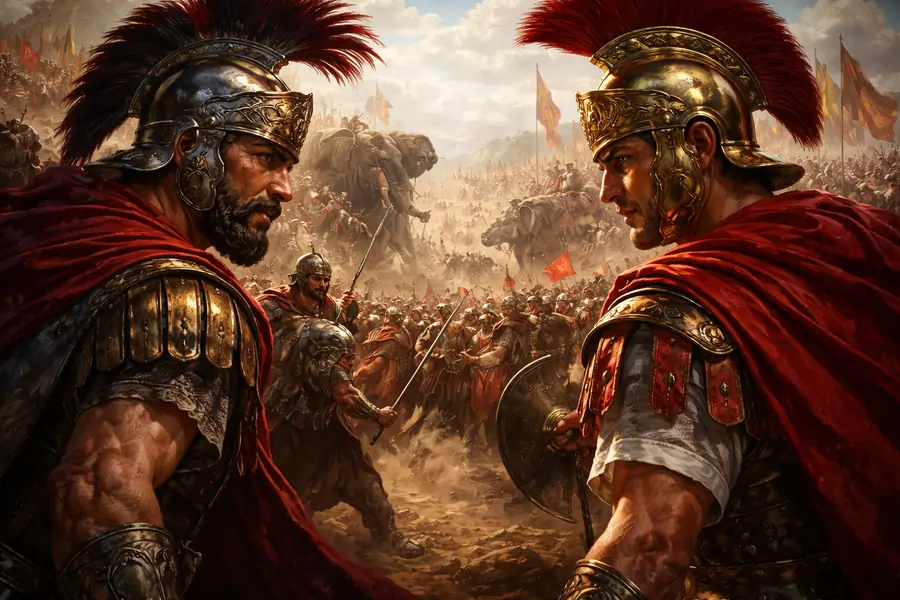
The Battle of Zama in 202 BC stands as one of the most decisive engagements in ancient military history, marking the final confrontation between Hannibal Barca and Publius Cornelius Scipio Africanus. This climactic battle not only ended the Second Punic War but also reshaped the balance of power in the Mediterranean world. Carthage was never able to recover militarily from this defeat, establishing Rome as the dominant force for centuries to come. In this detailed analysis, we will explore the events leading up to Zama, examine the legendary commanders who led the armies, and provide a detailed breakdown of the battle itself.
Table of Contents
Timeline Leading to the Battle of Zama
The Battle of Zama cannot be understood without understanding the events of the Second Punic War. This long and brutal conflict between Rome and Carthage spanned nearly two decades and saw some of the most innovative military tactics in history. Hannibal Barca of Carthage was the most prominent figure in this conflict.
Tensions between Rome and Carthage had been simmered since the First Punic War. The war began in 218 BC, following the conflict with the city of Saguntum. Hannibal Barca, determined to challenge Roman dominance, launched a bold invasion of Italy by crossing the Alps, an unprecedented military maneuver.
Over the next several years, Hannibal won a string of brilliant victories on Roman soil:
- 218 BC: Victory at the Battle of Trebia
- 217 BC: Crushing ambush at the Battle of Lake Trasimene
- 216 BC: Catastrophic Roman loss at the Battle of Cannae
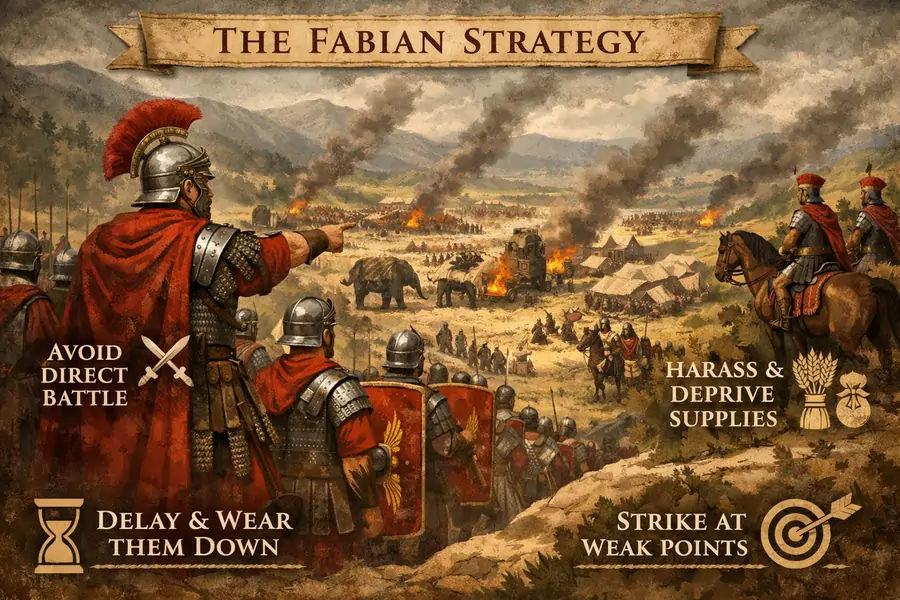
After these defeats, Rome was struggling to recover and was forced to adopt the Fabian Strategy, avoiding direct confrontation with Hannibal and focusing on attrition. This denied Hannibal the much-needed victories he needed to bring Rome to the negotiating table. It also put his supply lines under huge stress.
Meanwhile, Rome began to fight back on other fronts. Carthage's overseas territories in Spain and Africa were now threatened directly. A young general named Scipio emerged as a key figure, eventually taking the war into North Africa. By 204 BC, Scipio had invaded Carthaginian territory, forcing Hannibal to return from Italy to defend Carthage. The stage was now set for the final showdown at Zama.
Hannibal Barca: Rome's Greatest Enemy
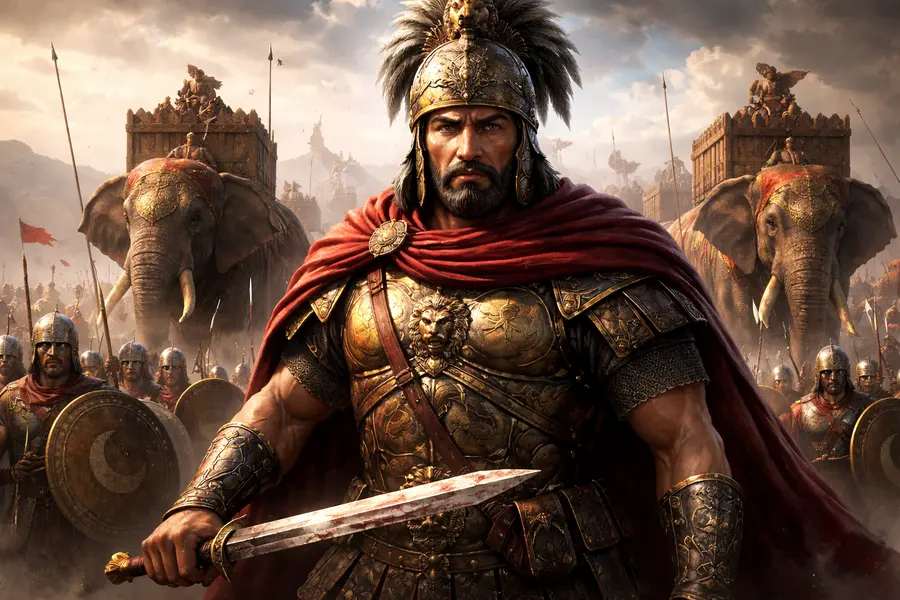
Hannibal Barca is widely regarded as one of the greatest military commanders in history due to his military genius. Born into a Carthaginian noble family that deeply hated Rome, Hannibal swore an oath of eternal enmity against the Roman Republic. He would soon show his leadership skills and knack for tactical abilities in the coming battles. His military genius was evident early, particularly in his use of terrain, deception, and combined arms tactics.
His greatest achievement came at Cannae, where he executed a double envelopment that annihilated a much larger Roman army. This battle would be studied for decades by military scholars. Despite these victories, Hannibal faced strategic limitations; he lacked consistent reinforcements and supplies, and could not break Rome's alliances in Italy. By the time of Zama, Hannibal was still formidable but no longer at the height of his power. His army in Africa was a mix of veterans and newly recruited troops, lacking the cohesion of his earlier forces.
Scipio Africanus: Rome's Strategic Mastermind
Publius Cornelius Scipio, later known as Scipio Africanus, was the architect of Rome's ultimate victory. Unlike many Roman generals, Scipio studied Hannibal's tactics carefully and adapted his own strategies accordingly. He respected Hannibal's genius and was wary of any traps that he might set for him.
Scipio's campaigns in Spain weakened Carthage's resources and demonstrated his own tactical brilliance. His alliance with Numidian cavalry leader Masinissa proved crucial, giving Rome a significant advantage in mobility. For the first time since the start of the war, Rome would be at an advantage in terms of cavalry troops. Scipio's decision to invade Africa was bold and strategically sound; it forced Carthage to recall Hannibal and shifted the war to enemy territory.
Prelude to the Battle of Zama
When Hannibal returned to Africa in 203 BC, he attempted to negotiate peace. However, negotiations failed, and both sides prepared for a decisive battle. The armies met near Zama, likely located in modern-day Tunisia. Both commanders understood the stakes—this would be the final confrontation that would determine the fate of their civilizations.
The Carthaginians had numerical superiority at Zama and also 80 war elephants. However, most of these troops were new recruits who were not trained in battle. Most of Hannibal's veteran troops were dispersed when he returned to Carthage due to a lack of ships. The Roman army, on the other hand, was trained and effective. Due to the alliance with Masinissa, the Numidian leader, the Romans had superior cavalry.
Forces and Deployment
Roman Forces:
- Approximately 29,000 infantry
- Around 6,000 cavalry (including Numidian allies)
Carthaginian Forces:
- Roughly 36,000 infantry
- 4,000 cavalry
- 80 war elephants
Hannibal arranged his army in three lines, with elephants at the front. The remnants of Mago's army that had returned from Northern Italy were the first line. The second line were mostly raw recruits who had poor morale and discipline. The third line was what was left of Hannibal's army from his Italian campaign. Scipio placed his heavy infantry in the center as usual and his cavalry on the flanks. Massinssa's Numidian cavalry was placed to the right of the infantry.
The Battle of Zama: Step-by-Step Analysis
Phase 1: The Elephant Charge
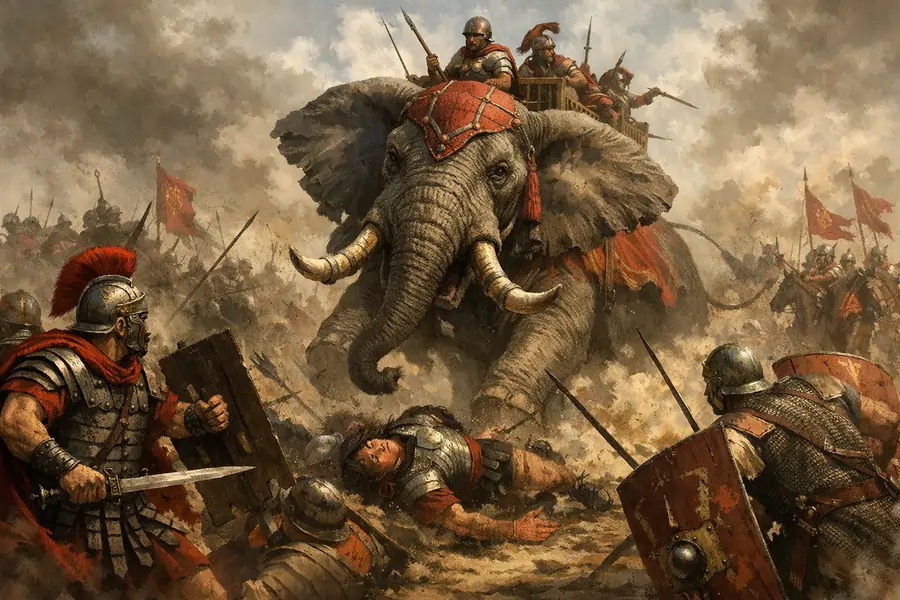
Hannibal's army was a combination of the remnants of three different armies. They were poorly coordinated, low on morale, and lacked training and discipline. Hannibal knew that a head-on engagement with the elite Roman infantry would result in certain disaster. To break up the Roman formation and cause confusion, he started the battle by launching his war elephants against the Roman lines. The plan was to disorganize the Roman troops with the elephant charge and use this moment to take them by surprise.
However, Scipio was prepared for this. When the elephants charged, the Roman troops used trumpets and horns to frighten the elephants. The heavy infantry also banged their weapons and shields rhythmically, which startled the elephants. This seemed to suggest that the war elephants were not fully trained as they were too easily spooked by the Romans, proving to be more of a liability than an asset. Some of the elephants veered off course and crashed back into the Carthaginian cavalry.
Scipio also carefully constructed gaps in the Roman formation that allowed the remaining elephants to pass through with minimal damage. The Romans then pelted the elephants with javelins and took them out one by one. Hannibal's trump card of using the elephants was thus neutralised with minimal damage.
Phase 2: Cavalry Engagement
On the flanks, Roman and Numidian cavalry engaged Carthaginian horsemen. The Roman cavalry, under the command of Laelius and Masinissa, was superior in skill and numbers. When Masinissa saw that the elephants had disorganized the Carthaginian cavalry, he charged at them and drove them away from the battlefield. This would prove to be a critical development later in the battle.
Phase 3: Infantry Clash
The main infantry engagement began with Hannibal's first line of mercenaries advancing. After intense fighting, they were eventually pushed back into the second line, causing disorder. The second line, composed of Carthaginian citizens, was no match for the disciplined Roman legions and began to falter. This forced Hannibal to commit his third line of veterans from Italy prematurely in the fight.
Hannibal had hoped that the Roman infantry would press forward into the Carthaginian center, similar to Cannae, and held his veteran troops ready to sweep around the flanks. However, Scipio sensed the trap and commanded his troops to hold off the pursuit. The Roman troops were also disciplined enough to fall back when instructed. This phase of the battle was brutal and evenly matched, showcasing the tactical brilliance of both commanders.
The Carthaginians used this moment to regroup the first and second lines of troops to hold the line. The Romans and Carthaginians were evenly matched, and the fighting was brutal. The fighting raged on for some time with neither side gaining the advantage.
Phase 4: The Decisive Moment
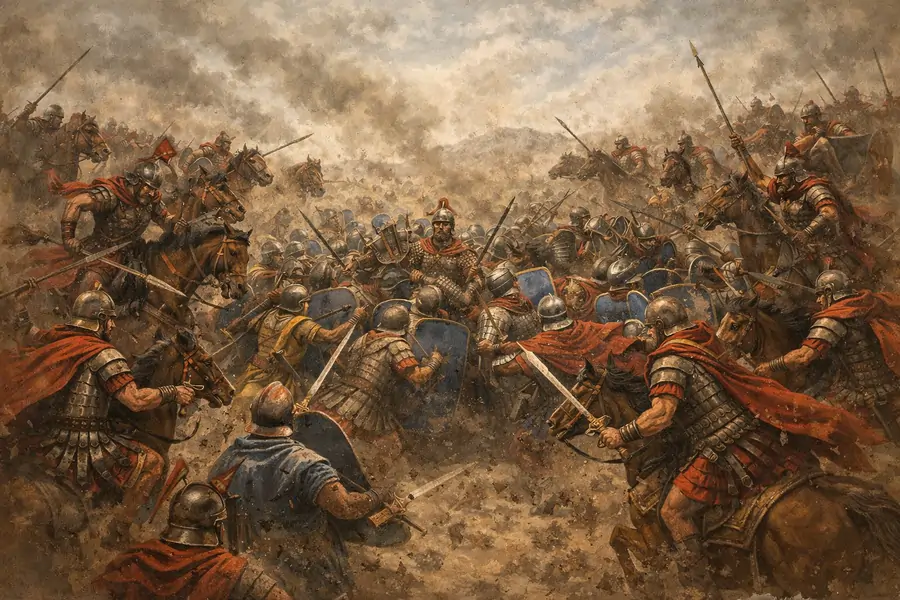
As the infantry battle reached its peak, the Roman and Numidian cavalry returned from their pursuit. They had completely driven off the Carthaginian cavalry and returned to the battle in the nick of time. They then attacked Hannibal's hard-pressed forces from the rear.
Surrounded and outnumbered, the Carthaginian army collapsed. What followed was a massacre from which only a few Carthaginians, including Hannibal, escaped.
Turning Points of the Battle
- Neutralization of Carthaginian war elephants: Scipio's tactical innovation prevented early disruption and used Hannibal's elephants against him.
- Cavalry superiority: The Numidian alliance gave Rome a decisive edge. Without cavalry support, Hannibal could not perform quick maneuvers.
- Roman discipline: When Hannibal tried to perform another double envelopment, Scipio sensed it and recalled his troops. The legions maintained cohesion and withdrew in unison, averting a disaster.
- Return of cavalry: The Roman and Numidian cavalry returned to the battle and attacked the Carthaginian rear, which sealed Hannibal's fate.
Aftermath and Consequences
The Battle of Zama effectively ended the Second Punic War. Carthage was forced to sue for peace under harsh terms:
- Carthage lost all of its overseas territories
- It was forced to pay heavy war indemnities
- Restrictions on military power
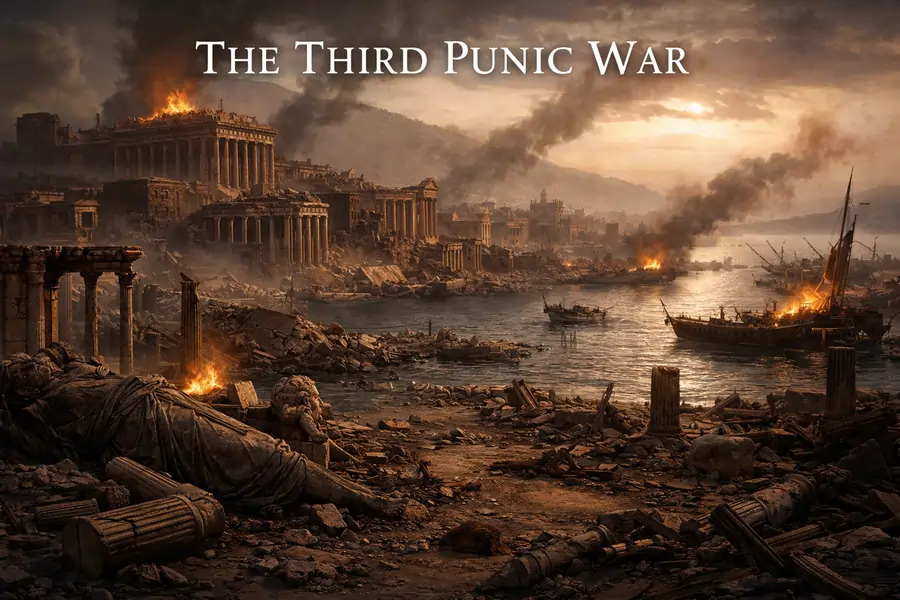
Rome emerged as the dominant power in the western Mediterranean. Carthage would never fully recover and would eventually be destroyed in the Third Punic War.
Legacy of the Battle of Zama
The Battle of Zama is often listed among the most decisive battles in history due to its far-reaching consequences. It proved Scipio's military brilliance and sealed Rome's victory in the Second Punic War. It marked the end of Carthaginian ambitions and the beginning of Roman supremacy. The battle also highlighted the importance of adaptability in warfare; Scipio's ability to learn from Hannibal ultimately secured victory.
For Hannibal, Zama was his only major defeat, yet it demonstrated his resilience and enduring legacy as one of history's greatest commanders. After the defeat in Zama, Hannibal retired from his military career and became a successful Carthaginian political leader as a suffete. Due to Roman pressure, he was forced into exile in 195 BC. For Rome, it was the moment that enabled it to become a global superpower.
Frequently Asked Questions
What was the Battle of Zama?
The Battle of Zama was fought in 202 BC near Carthage between Roman forces led by Scipio Africanus and Carthaginian forces commanded by Hannibal Barca. It was the decisive battle of the Second Punic War and resulted in a Roman victory that ended the conflict.
Why was the Battle of Zama important?
The Battle of Zama was important because it ended the Second Punic War and marked the rise of Rome as the dominant power in the western Mediterranean. The defeat forced Carthage to accept harsh peace terms, effectively ending its status as a major military power.
How did Scipio defeat Hannibal at Zama?
Scipio defeated Hannibal by adapting his tactics to counter Carthaginian strengths. He neutralized Hannibal's war elephants by creating gaps in his lines, used superior Numidian cavalry to dominate the flanks, and launched a decisive rear attack that encircled Hannibal's army.
What role did cavalry play in the Battle of Zama?
Cavalry played a crucial role in the Battle of Zama. Roman and Numidian cavalry forces defeated the Carthaginian horsemen early in the battle and later returned to attack Hannibal's army from the rear, which ultimately decided the outcome of the battle.
Who won the Battle of Zama?
The Romans, led by Scipio Africanus, won the Battle of Zama. Their victory ended the Second Punic War and secured Rome's dominance over Carthage.
What happened after the Battle of Zama?
After the Battle of Zama, Carthage was forced to surrender and accept strict peace terms, including paying heavy indemnities, giving up its territories, and limiting its military capabilities. This marked the end of Carthage as a major power and set the stage for Roman expansion.